
A Marginal CO 2 Abatement Cost Curve for
A Marginal CO 2 Abatement Cost Curve for the Maritime Transport Sector From 2009 IMO GHG study
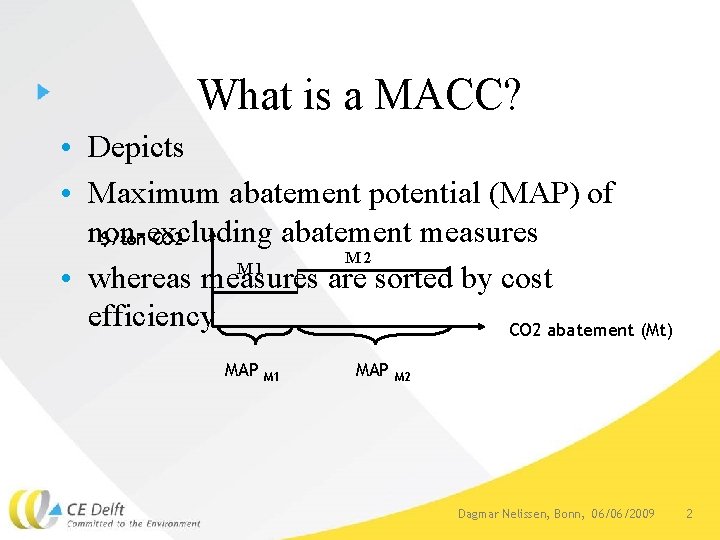
What is a MACC? • Depicts • Maximum abatement potential (MAP) of non-excluding abatement measures $/ton CO 2 M 1 • whereas measures are sorted by cost efficiency CO 2 abatement (Mt) MAP M 1 MAP M 2 Dagmar Nelissen, Bonn, 06/06/2009 2

Why a MACC? • Indication of costs of alternative emission/abatement targets • Indication of environmental effects of environmental regulation • Compare various policy instruments on costs and environmental effects Dagmar Nelissen, Bonn, 06/06/2009 3

Emission data underlying MACC for Maritime Transport Sector • IMO fleet/emission forecast for 2020: international shipping, global fleet • 14 ship types considered • Ship types not considered: yachts, offshore, service, and miscellaneous vessels CO 2 emissions of total fleet CO 2 emission of fleet considered for MACC IMO fleet inventory for 2007 ~1, 020 Mt ~870 Mt IMO forecast for 2020 (A 1 B scenario) ~1, 420 Mt ~1, 250 Mt Dagmar Nelissen, Bonn, 06/06/2009 4
Abatement Measures Taken into Account • Only subset of measures available for inclusion • Most measures retrofit measures • 25 individual measures allocated to 10 measure groups • Measure groups: 1. Propeller maintenance 2. Propeller/propulsion system upgrades 3. Hull coating and maintenance Dagmar Nelissen, Bonn, 06/06/2009 5

Marginal CO 2 Abatement Cost Curve for 2020 Dagmar Nelissen, Bonn, 06/06/2009 6
MACC summary (1) • Max. abatemet potential of all measures taken into account: – 210 – 440 Mt CO 2 – 15 – 30% of total emissions of fleet considered • Max. abatement potential of measures with negative cost effectiveness (benefits exceed costs): – 135 – 365 Mt CO 2 – 10 – 25% of total emissions of fleet considered Dagmar Nelissen, Bonn, 06/06/2009 7

Summary MACC (2) • Emissions of fleet considered forecasted to grow by ~380 Mt. • Only if highest estimate of MAP is true, sector will achieve carbon neutral growth • Thus, reduction of total maritime emissions only possible – if there are more effective measures and/or – if demand is reduced. Dagmar Nelissen, Bonn, 06/06/2009 8
Caveats (1) • Emission reduction potential probably underestimated because • there are more abatement measures than the ones included in this MACC • First comprehensive MACC for shipping ever published • Little data to build upon • Measures included based on cost data availability • Emission reduction potential probably Dagmar Nelissen, Bonn, 06/06/2009 9
Caveats (2) • Cost efficiency data is fleet average: • Measures that are not profitable when applied to world fleet • could well be profitable for some ship categories. • Example: Measure “Speed reduction” – Fleet average: 100 $/ton CO 2 (central estimate) Dagmar Nelissen, Bonn, 06/06/2009 10
Further analysis (1) • Depicted perspective = social perspective: • costs of world economy not costs of ship operators depicted • Main difference between social and company perspective: capital costs – Social perspective: 4% – Company perspective: 16% Dagmar Nelissen, Bonn, 06/06/2009 11
Further Analysis (2) • Impact of fuel price – Higher fuel price makes measures more efficient: fuel expenditure savings rise (downward shift of curves) – Current fuel price: ~ 400 $/ton – Fuel price 2008: > 700 $/ton Dagmar Nelissen, Bonn, 06/06/2009 12
Conclusions • Shipping has a large potential to reduce emissions cost-effectively. • Nevertheless, emissions will continue to increase. • There is a considerable degree of uncertainty in these conclusions, based on the uncertainty in the MACC. Dagmar Nelissen, Bonn, 06/06/2009 13

Thanks for your attention! Dagmar Nelissen, Bonn, 06/06/2009 14
- Slides: 14