
A Machine Learning Approach for Evaluating Creative Artifacts
- Slides: 1
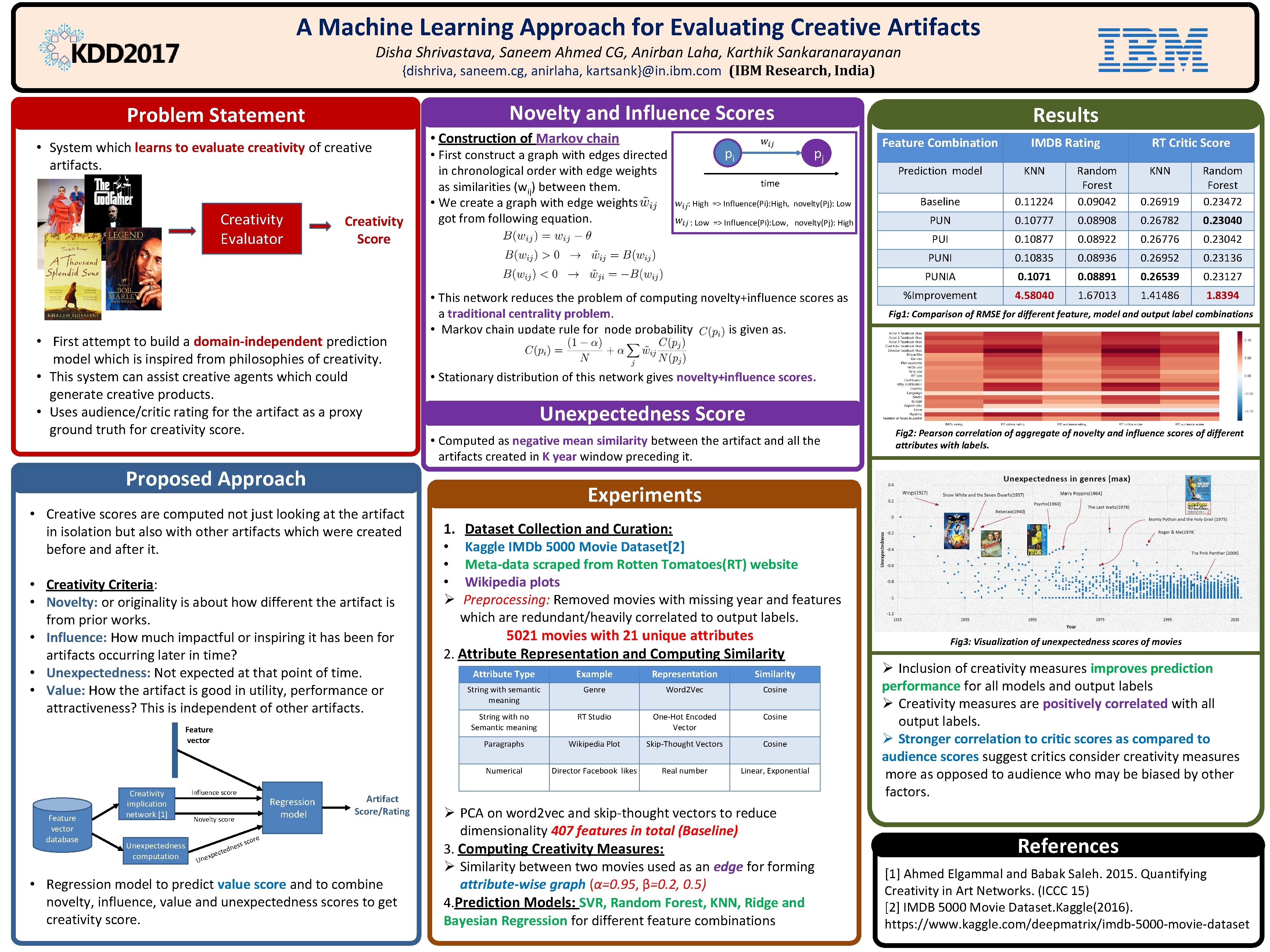
A Machine Learning Approach for Evaluating Creative Artifacts Disha Shrivastava, Saneem Ahmed CG, Anirban Laha, Karthik Sankaranarayanan {dishriva, saneem. cg, anirlaha, kartsank}@in. ibm. com (IBM Research, India) Novelty and Influence Scores Problem Statement • System which learns to evaluate creativity of creative artifacts. Creativity Evaluator Creativity Score • Construction of Markov chain • First construct a graph with edges directed in chronological order with edge weights as similarities (wij) between them. • We create a graph with edge weights got from following equation. pi Results pj KNN : High => Influence(Pi): High, novelty(Pj): Low Baseline : Low => Influence(Pi): Low, novelty(Pj): High Edge reversal (reverse chronological) • First attempt to build a domain-independent prediction model which is inspired from philosophies of creativity. • This system can assist creative agents which could generate creative products. • Uses audience/critic rating for the artifact as a proxy ground truth for creativity score. • This network reduces the problem of computing novelty+influence scores as a traditional centrality problem. • Markov chain update rule for node probability is given as. • Creativity Criteria: • Novelty: or originality is about how different the artifact is from prior works. • Influence: How much impactful or inspiring it has been for artifacts occurring later in time? • Unexpectedness: Not expected at that point of time. • Value: How the artifact is good in utility, performance or attractiveness? This is independent of other artifacts. Feature vector database Creativity implication network [1] Unexpectedness computation Influence score Novelty score Regression model Artifact Score/Rating ore c s ess dn e t c pe x e n U • Regression model to predict value score and to combine novelty, influence, value and unexpectedness scores to get creativity score. RT Critic Score 0. 11224 Random Forest 0. 09042 KNN 0. 26919 Random Forest 0. 23472 PUN 0. 10777 0. 08908 0. 26782 0. 23040 PUI 0. 10877 0. 08922 0. 26776 0. 23042 PUNI 0. 10835 0. 08936 0. 26952 0. 23136 PUNIA 0. 1071 0. 08891 0. 26539 0. 23127 %Improvement 4. 58040 1. 67013 1. 41486 1. 8394 Fig 1: Comparison of RMSE for different feature, model and output label combinations • Stationary distribution of this network gives novelty+influence scores. Unexpectedness Score • Computed as negative mean similarity between the artifact and all the artifacts created in K year window preceding it. Proposed Approach • Creative scores are computed not just looking at the artifact in isolation but also with other artifacts which were created before and after it. IMDB Rating Prediction model time Feature Combination Fig 2: Pearson correlation of aggregate of novelty and influence scores of different attributes with labels. Experiments 1. Dataset Collection and Curation: • Kaggle IMDb 5000 Movie Dataset[2] • Meta-data scraped from Rotten Tomatoes(RT) website • Wikipedia plots Ø Preprocessing: Removed movies with missing year and features which are redundant/heavily correlated to output labels. 5021 movies with 21 unique attributes 2. Attribute Representation and Computing Similarity Attribute Type Example Representation Similarity String with semantic meaning Genre Word 2 Vec Cosine String with no Semantic meaning RT Studio One-Hot Encoded Vector Cosine Paragraphs Wikipedia Plot Skip-Thought Vectors Cosine Numerical Director Facebook likes Real number Linear, Exponential Ø PCA on word 2 vec and skip-thought vectors to reduce dimensionality 407 features in total (Baseline) 3. Computing Creativity Measures: Ø Similarity between two movies used as an edge forming attribute-wise graph (α=0. 95, β=0. 2, 0. 5) 4. Prediction Models: SVR, Random Forest, KNN, Ridge and Bayesian Regression for different feature combinations Fig 3: Visualization of unexpectedness scores of movies Ø Inclusion of creativity measures improves prediction performance for all models and output labels Ø Creativity measures are positively correlated with all output labels. Ø Stronger correlation to critic scores as compared to audience scores suggest critics consider creativity measures more as opposed to audience who may be biased by other factors. References [1] Ahmed Elgammal and Babak Saleh. 2015. Quantifying Creativity in Art Networks. (ICCC 15) [2] IMDB 5000 Movie Dataset. Kaggle(2016). https: //www. kaggle. com/deepmatrix/imdb-5000 -movie-dataset