
A low cost attack on Microsoft CAPTCHA Authors
![Locating Connected Characters We have 4 chunks and 7 objects [1, 3, 2, 2]](https://slidetodoc.com/presentation_image_h/0192294172643956f264eb5d9159f2ef/image-18.jpg "Locating Connected Characters We have 4 chunks and 7 objects [1, 3, 2, 2]")

- Slides: 26
A low cost attack on Microsoft CAPTCHA Authors: Jeff Yan, Ahmad El Ahmad Presented By: Abirami Poonkundran
Overview Introduction to CAPTCHA Segmentation Attack ◦ Pre-Processing ◦ Vertical Segmentation ◦ Color filling segmentation ◦ Thick arc removal ◦ Locating connected characters ◦ Segmenting connected characters Results Conclusion Latest Implementation
Introduction This paper presents a simple methodical way to break CAPTCHA systems, using Character Segmentation techniques
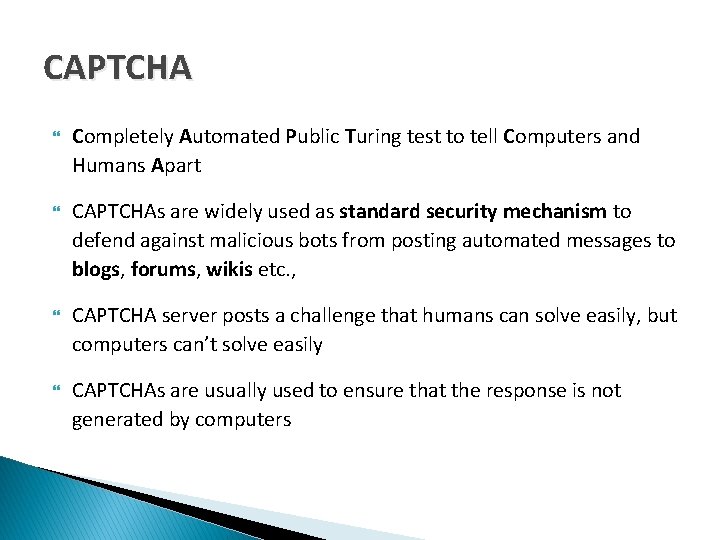
CAPTCHA Completely Automated Public Turing test to tell Computers and Humans Apart CAPTCHAs are widely used as standard security mechanism to defend against malicious bots from posting automated messages to blogs, forums, wikis etc. , CAPTCHA server posts a challenge that humans can solve easily, but computers can’t solve easily CAPTCHAs are usually used to ensure that the response is not generated by computers
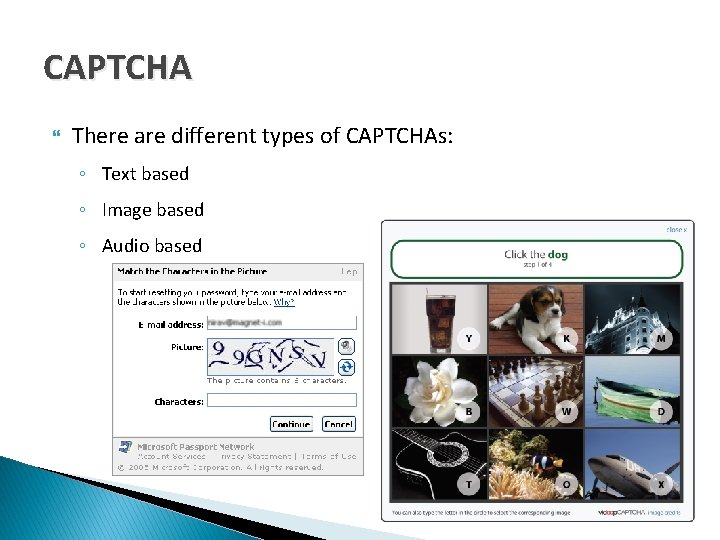
CAPTCHA There are different types of CAPTCHAs: ◦ Text based ◦ Image based ◦ Audio based
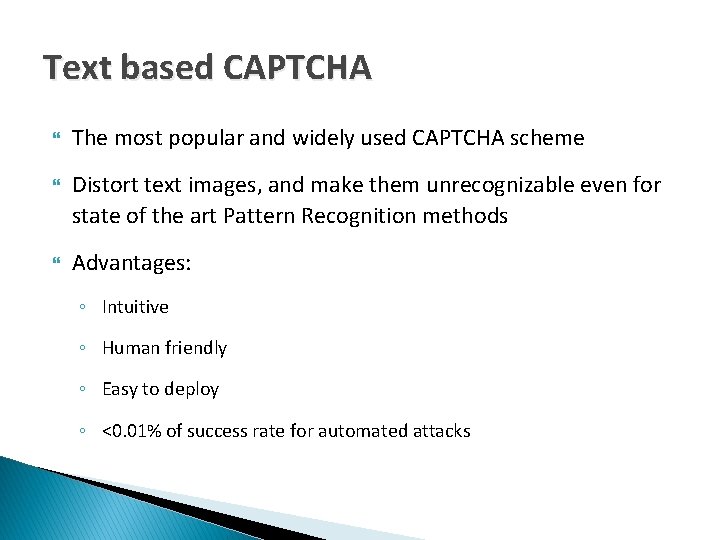
Text based CAPTCHA The most popular and widely used CAPTCHA scheme Distort text images, and make them unrecognizable even for state of the art Pattern Recognition methods Advantages: ◦ Intuitive ◦ Human friendly ◦ Easy to deploy ◦ <0. 01% of success rate for automated attacks
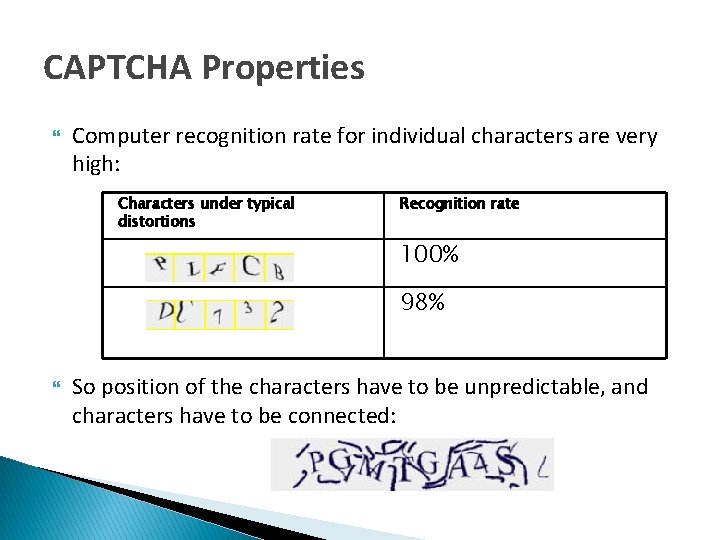
CAPTCHA Properties Computer recognition rate for individual characters are very high: Characters under typical distortions Recognition rate 100% 98% So position of the characters have to be unpredictable, and characters have to be connected:
Challenge Identifying the position of the characters in the right order (segmentation) is: ◦ Computationally expensive and ◦ Combinatorialy hard Most of the current CAPTCHA implementations including MSN, Yahoo and Google, are Segmentation-Resistant If a CAPTCHA can be segmented it can be easily broken This paper presents a novel segmentation attack
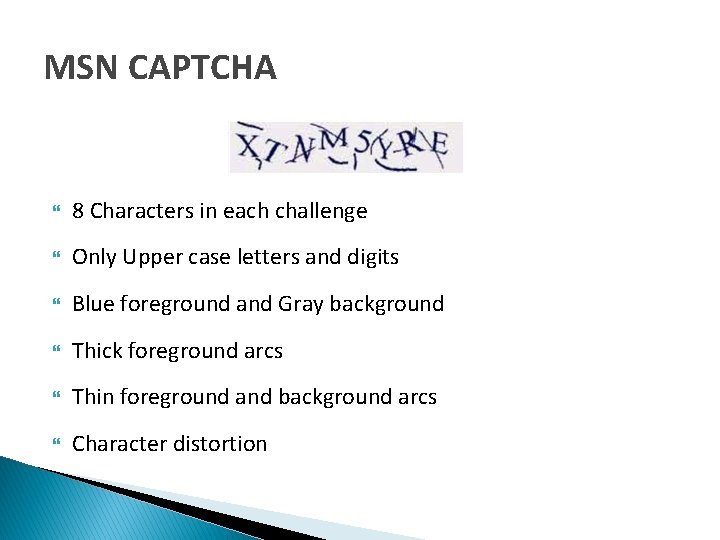
MSN CAPTCHA 8 Characters in each challenge Only Upper case letters and digits Blue foreground and Gray background Thick foreground arcs Thin foreground and background arcs Character distortion
Segmentation Attack Identify and remove random arcs Identify all character locations and divide it in to 8 segments, each containing one character Steps: ◦ Pre-Processing ◦ Vertical Segmentation ◦ Color filling segmentation ◦ Thick arc removal ◦ Locating connected characters ◦ Segmenting connected characters
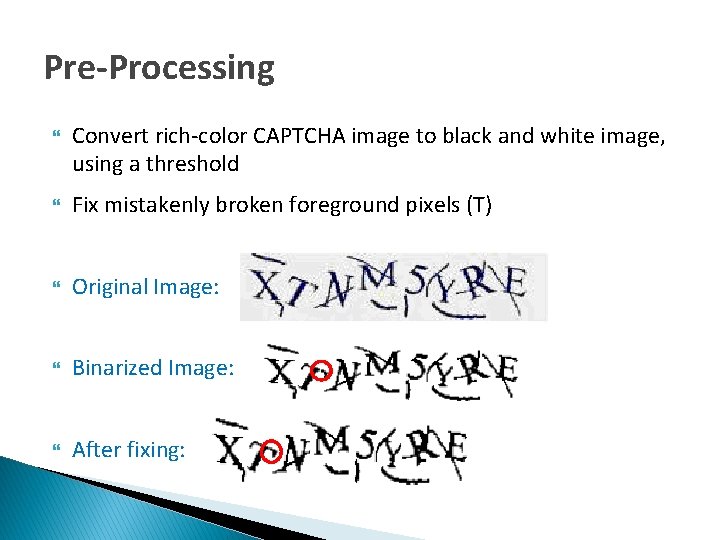
Pre-Processing Convert rich-color CAPTCHA image to black and white image, using a threshold Fix mistakenly broken foreground pixels (T) Original Image: Binarized Image: After fixing:
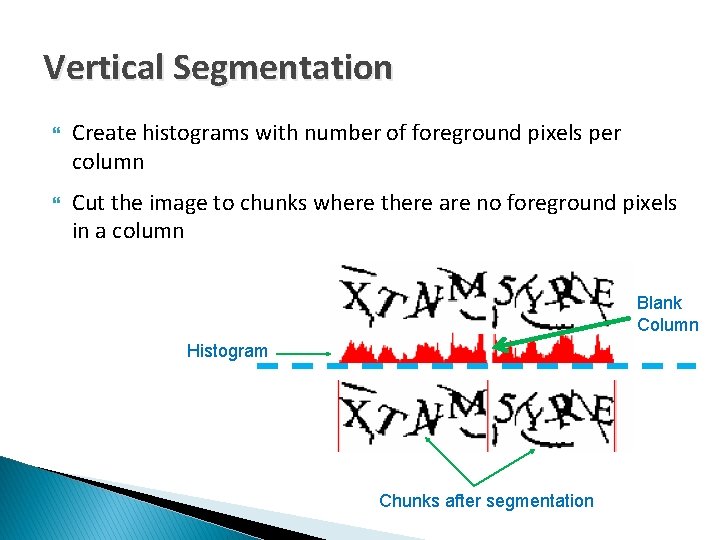
Vertical Segmentation Create histograms with number of foreground pixels per column Cut the image to chunks where there are no foreground pixels in a column Blank Column Histogram Chunks after segmentation
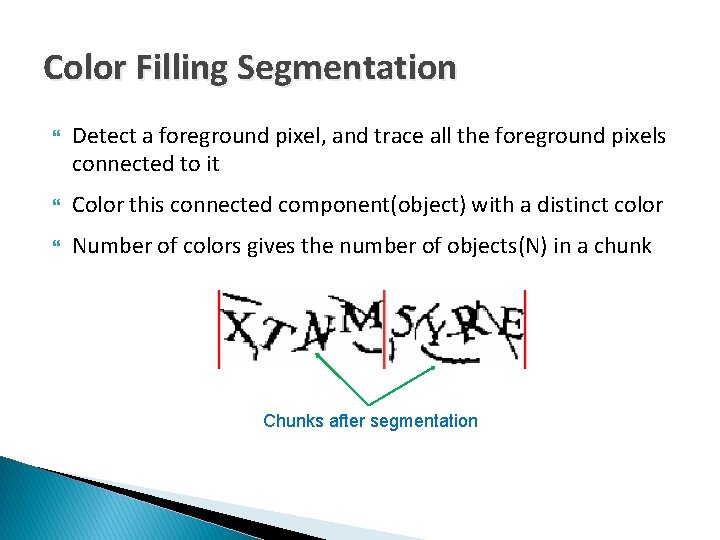
Color Filling Segmentation Detect a foreground pixel, and trace all the foreground pixels connected to it Color this connected component(object) with a distinct color Number of colors gives the number of objects(N) in a chunk Chunks after segmentation
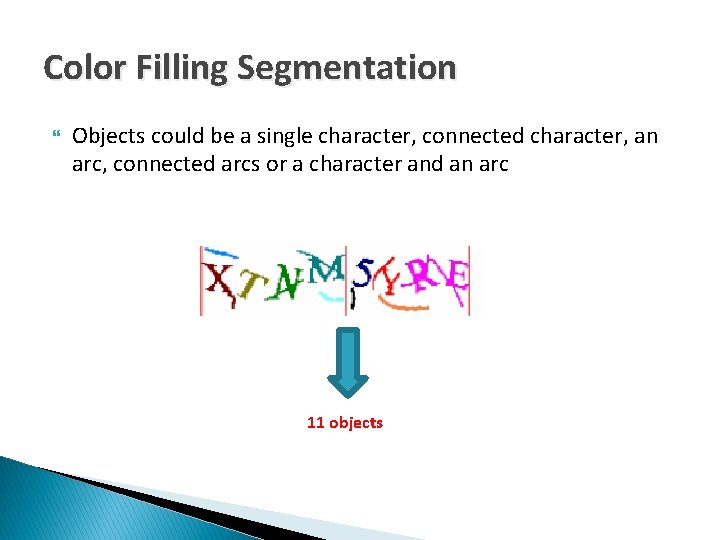
Color Filling Segmentation Objects could be a single character, connected character, an arc, connected arcs or a character and an arc 11 objects
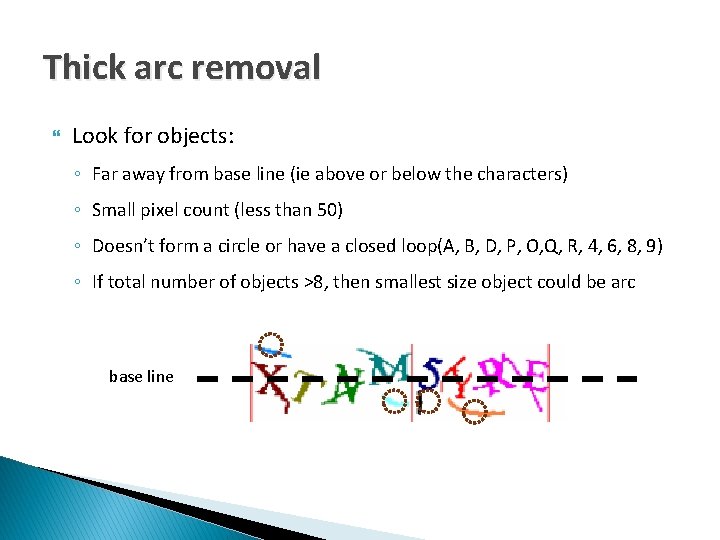
Thick arc removal Look for objects: ◦ Far away from base line (ie above or below the characters) ◦ Small pixel count (less than 50) ◦ Doesn’t form a circle or have a closed loop(A, B, D, P, O, Q, R, 4, 6, 8, 9) ◦ If total number of objects >8, then smallest size object could be arc base line
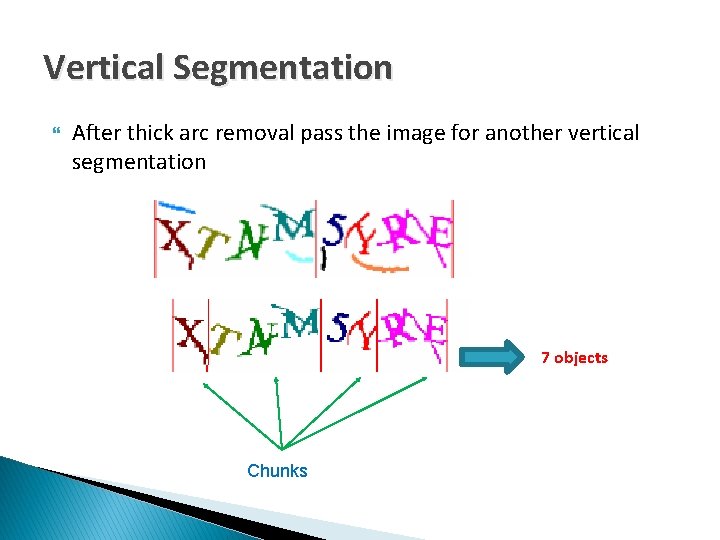
Vertical Segmentation After thick arc removal pass the image for another vertical segmentation 7 objects Chunks
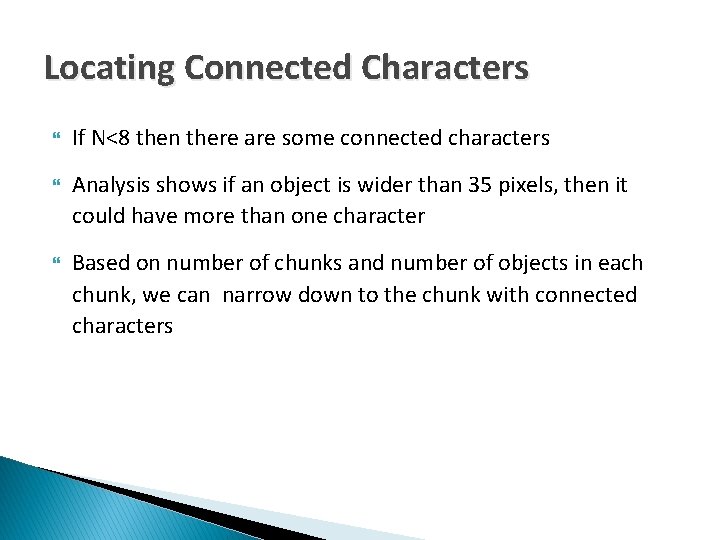
Locating Connected Characters If N<8 then there are some connected characters Analysis shows if an object is wider than 35 pixels, then it could have more than one character Based on number of chunks and number of objects in each chunk, we can narrow down to the chunk with connected characters
Locating Connected Characters We have 4 chunks and 7 objects [1, 3, 2, 2] And we know there have to be 8 characters Possibilities: a) Four chunks, each having two characters [2, 2, 2, 2] b) One chunk has three characters and two additional chunks each having two characters [3, 2, 2, 1] c) One chunk has four characters and another two characters [4, 2, 1, 1] d) There are two chunks each having three characters [3, 3, 1, 1] e) One chunk has five characters [5, 1, 1, 1]
Locating Connected Characters Chunks 2, 3, and 4 are wider than 35 pixels And we know chunk 1 has only one character (it has only 1 object, which is < 35 pixels) [1, >1, >1] a) b) c) d) e) [2, 2, 2, 2] [3, 2, 2, 1] [4, 2, 1, 1] [3, 3, 1, 1] [5, 1, 1, 1] This possibility matches our profile
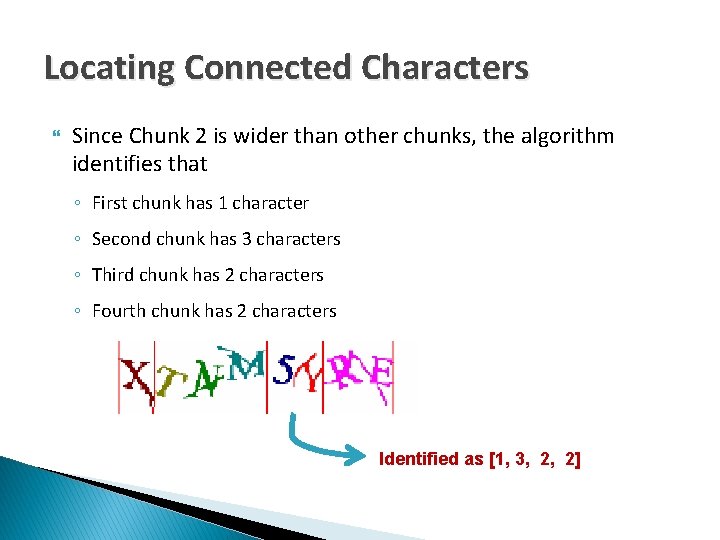
Locating Connected Characters Since Chunk 2 is wider than other chunks, the algorithm identifies that ◦ First chunk has 1 character ◦ Second chunk has 3 characters ◦ Third chunk has 2 characters ◦ Fourth chunk has 2 characters Identified as [1, 3, 2, 2]
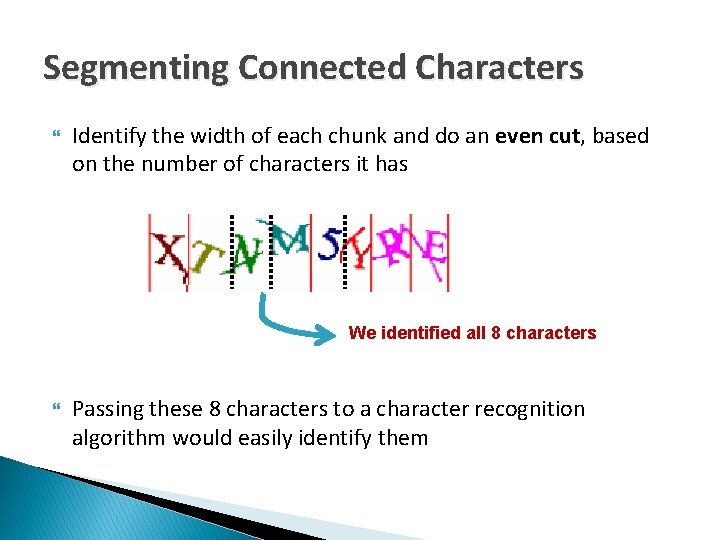
Segmenting Connected Characters Identify the width of each chunk and do an even cut, based on the number of characters it has We identified all 8 characters Passing these 8 characters to a character recognition algorithm would easily identify them
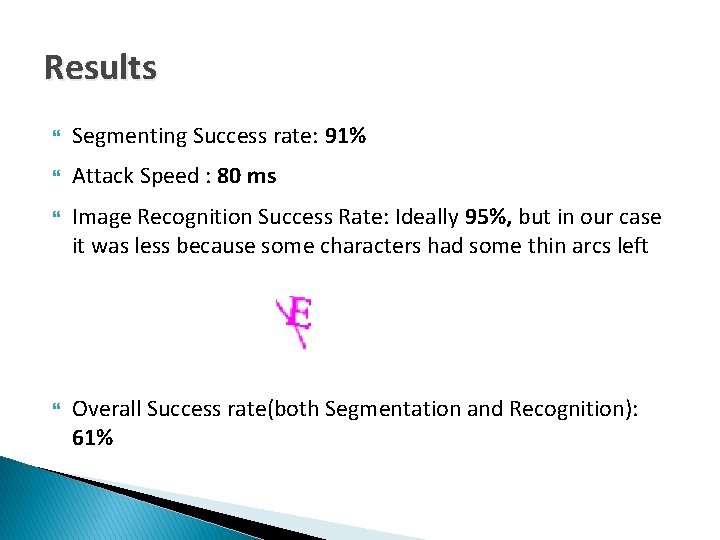
Results Segmenting Success rate: 91% Attack Speed : 80 ms Image Recognition Success Rate: Ideally 95%, but in our case it was less because some characters had some thin arcs left Overall Success rate(both Segmentation and Recognition): 61%
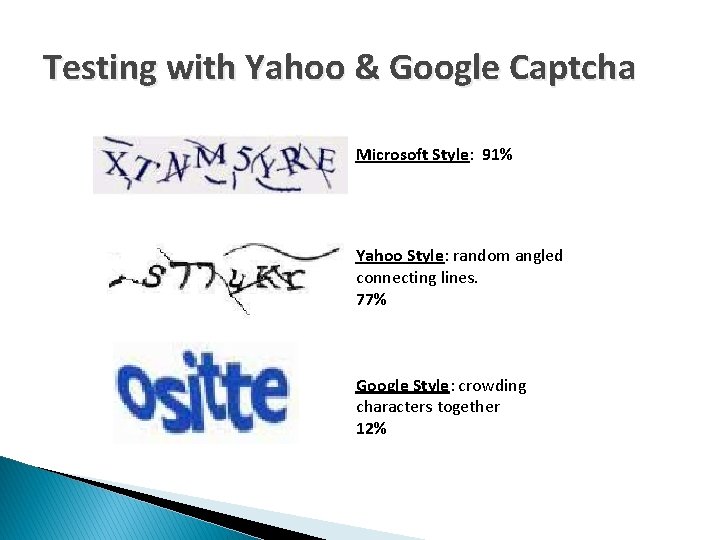
Testing with Yahoo & Google Captcha Microsoft Style: 91% Yahoo Style: random angled connecting lines. 77% Google Style: crowding characters together 12%
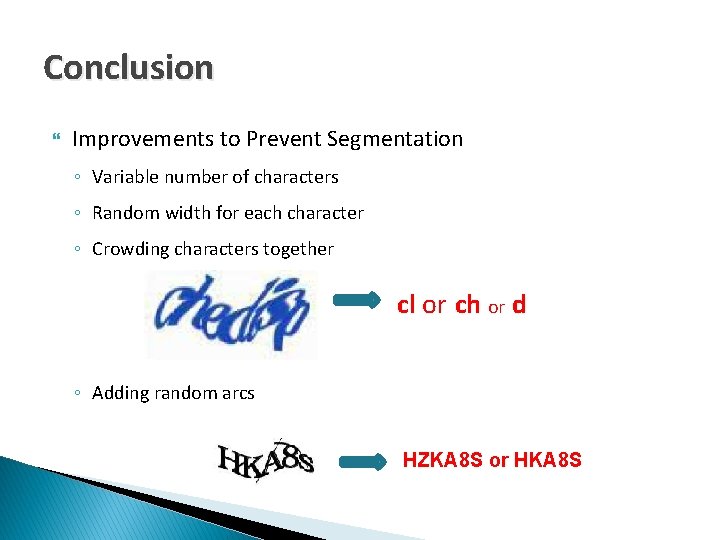
Conclusion Improvements to Prevent Segmentation ◦ Variable number of characters ◦ Random width for each character ◦ Crowding characters together cl or ch or d ◦ Adding random arcs HZKA 8 S or HKA 8 S
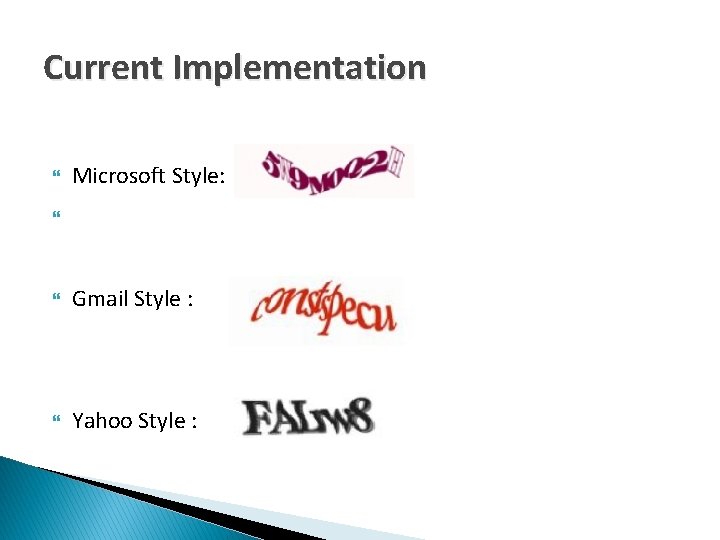
Current Implementation Microsoft Style: Gmail Style : Yahoo Style :