
A Look at Water and Its Contaminants Water

- Slides: 27
A Look at Water and Its Contaminants Water Part B
Physical Properties of Water • Matter – anything that occupies space and has mass
Physical Properties of Water • Physical Properties: can be observed or measured without changing the identity of a sample of matter • Examples: – Boiling point, melting point, density, color
Physical Properties of Water • Density: mass volume • the density of liquid water is 1. 00 g/m. L
Physical Properties of Water • Physical state affects density: – gases are much less dense than liquids – solid form of a substance is usually denser than its liquid form – EXCEPT WATER: As water freezes it occupies a larger volume (d = 0. 92 g/m. L) • the density of liquid water is 1. 00 g/m. L
Physical Properties of Water • clear, odorless, colorless, and tasteless • easily changes to each of the three phases of matter • “universal solvent”- so many substances easily dissolve in water to make aqueous solutions.
Physical Properties of Water • high boiling point 100 C • high surface tension
Mixtures and Solutions • Mixture: two or more substances are mixed together and they keep their individual properties – Heterogeneous mixture: a mixture that is not uniform throughout • Example: Chocolate chip cookie – Homogeneous mixture (Solution): a mixture that is uniform throughout • Example: Peanut Butter Cookie
Mixtures and Solutions • Mixtures are classified by size of the particles in the mixture.
Mixtures and Solutions Solution- smallest particle size, • salt water • Solute- substance that is dissolved • Solvent- substance that does the dissolving • Kool-Aid
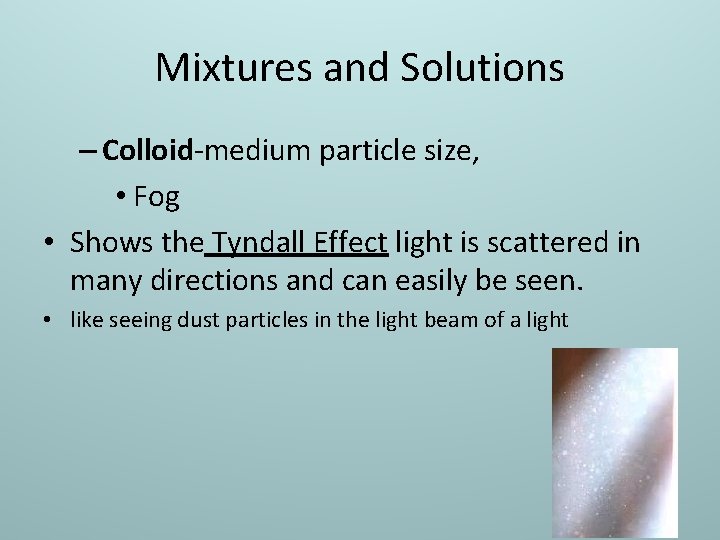
Mixtures and Solutions – Colloid-medium particle size, • Fog • Shows the Tyndall Effect light is scattered in many directions and can easily be seen. • like seeing dust particles in the light beam of a light
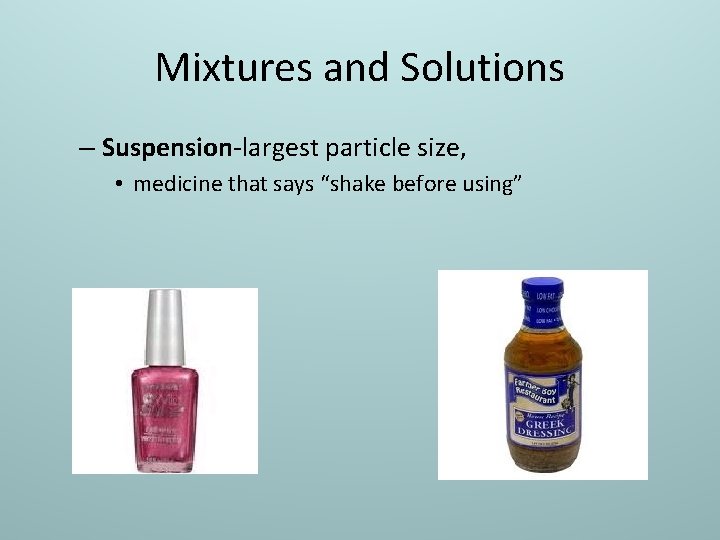
Mixtures and Solutions – Suspension-largest particle size, • medicine that says “shake before using”
Particulate View of Water • Atoms: All matter is composed of atoms; smallest particles possessing the properties of an element • Element: matter that is made up of only one kind of atom • oxygen is an element because it is composed of only oxygen atoms • 90 elements are found in nature!
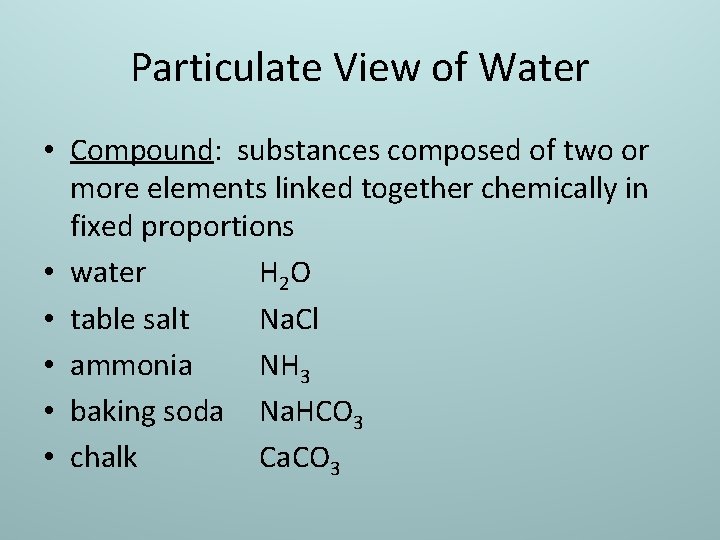
Particulate View of Water • Compound: substances composed of two or more elements linked together chemically in fixed proportions • water H 2 O • table salt Na. Cl • ammonia NH 3 • baking soda Na. HCO 3 • chalk Ca. CO 3
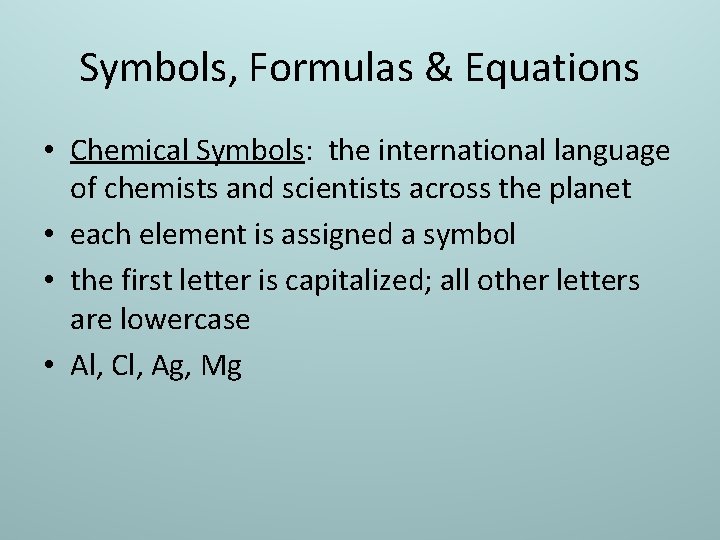
Symbols, Formulas & Equations • Chemical Symbols: the international language of chemists and scientists across the planet • each element is assigned a symbol • the first letter is capitalized; all other letters are lowercase • Al, Cl, Ag, Mg
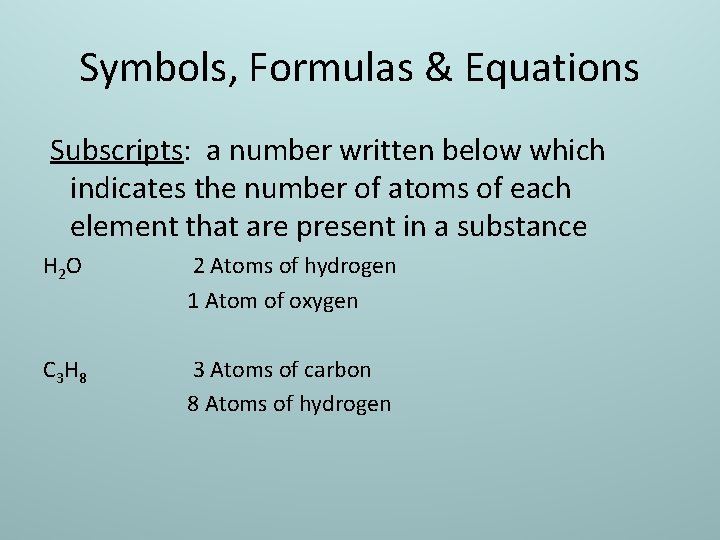
Symbols, Formulas & Equations Subscripts: a number written below which indicates the number of atoms of each element that are present in a substance H 2 O 2 Atoms of hydrogen 1 Atom of oxygen C 3 H 8 3 Atoms of carbon 8 Atoms of hydrogen
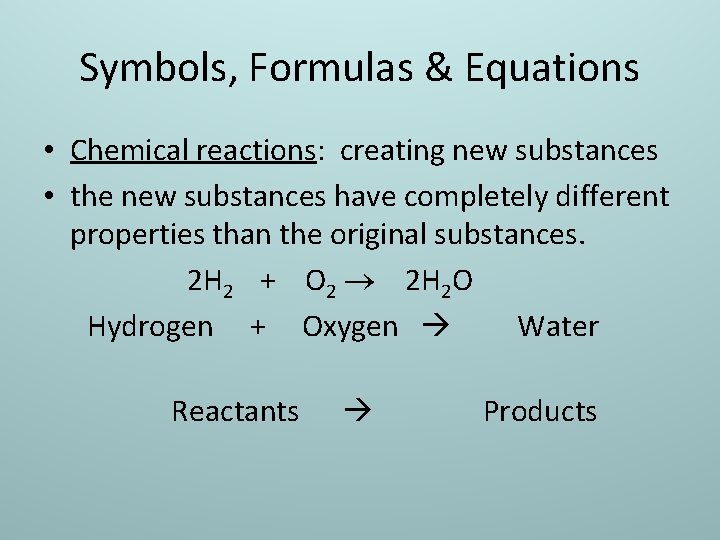
Symbols, Formulas & Equations • Chemical reactions: creating new substances • the new substances have completely different properties than the original substances. 2 H 2 + O 2 2 H 2 O Hydrogen + Oxygen Water Reactants Products
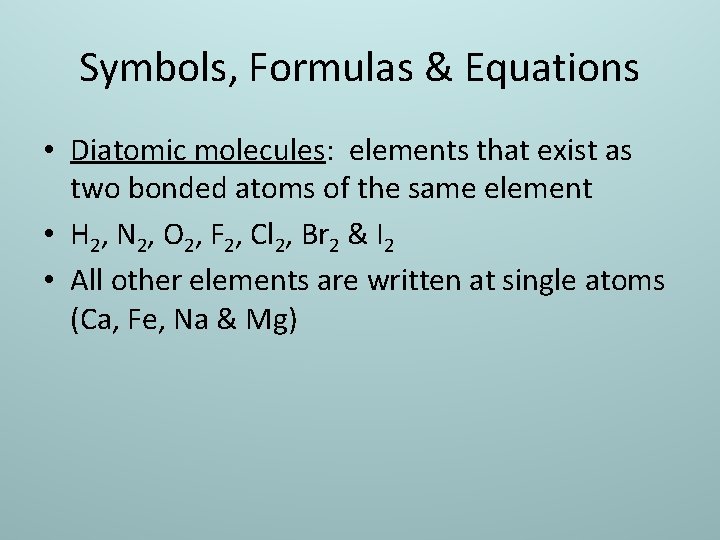
Symbols, Formulas & Equations • Diatomic molecules: elements that exist as two bonded atoms of the same element • H 2, N 2, O 2, F 2, Cl 2, Br 2 & I 2 • All other elements are written at single atoms (Ca, Fe, Na & Mg)
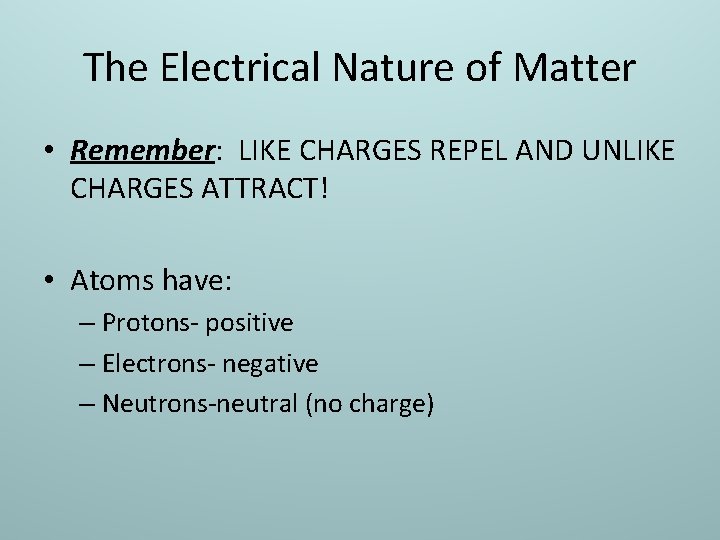
The Electrical Nature of Matter • Remember: LIKE CHARGES REPEL AND UNLIKE CHARGES ATTRACT! • Atoms have: – Protons- positive – Electrons- negative – Neutrons-neutral (no charge)
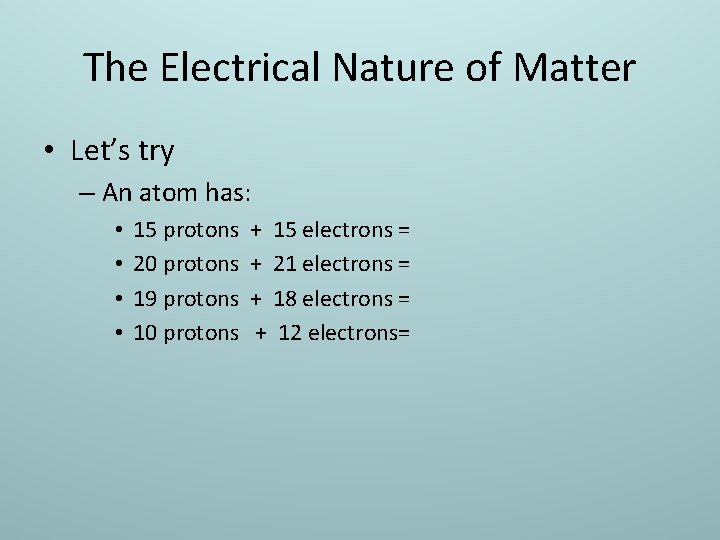
The Electrical Nature of Matter • Let’s try – An atom has: • • 15 protons + 15 electrons = 20 protons + 21 electrons = 19 protons + 18 electrons = 10 protons + 12 electrons=
The Electrical Nature of Matter • Opposites attract- – this is the glue to hold atoms together – These are chemical bonds.
Ions and Ionic Compounds • Ions: – charged atoms; – atoms that have gained or lost electrons to form negative or positive ions • Ionic Compounds: compounds composed of positive and negative ions
Ions and Ionic Compounds • Cation: a positively charged ion (Na+) • Anion: a negatively charged ion (Cl-) • Polyatomic ion: (many-atoms) an ions made of two or more bonded atoms (NH 4+ or NO 3 -)
Ions and Ionic Compounds • Step 1: Write the symbols for the ions side by side, with the positive ion (or most metallic element) first • Step 2: Cross over the charge values to give subscripts • Step 3: Check the subscripts by making sure the total charge of ions in the compound is zero, simplify • Step 4: Write the formula
Ions and Ionic Compounds • Let’s try: Need to use ion chart • zinc oxide • aluminum sulfide • calcium carbonate
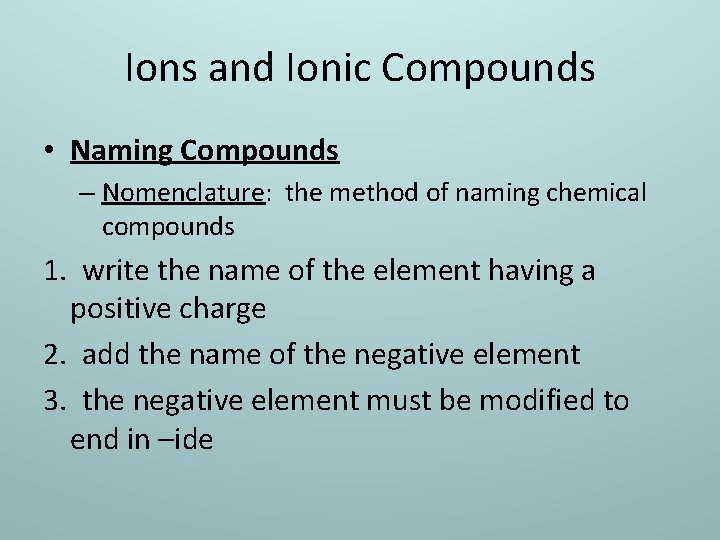
Ions and Ionic Compounds • Naming Compounds – Nomenclature: the method of naming chemical compounds 1. write the name of the element having a positive charge 2. add the name of the negative element 3. the negative element must be modified to end in –ide
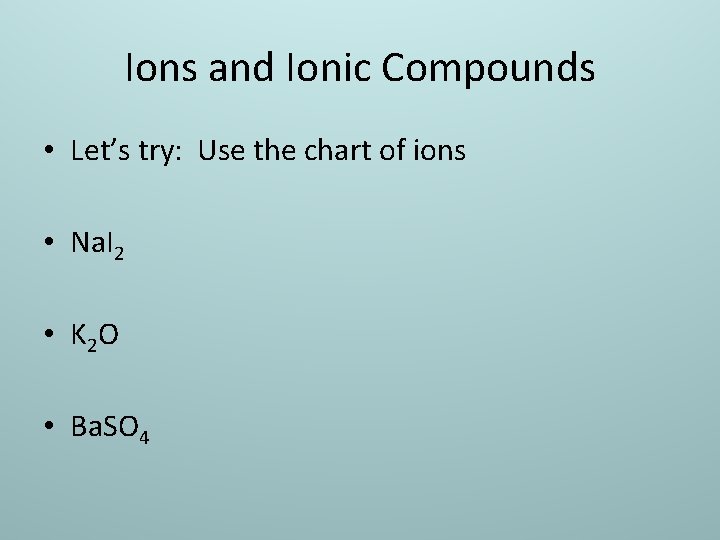
Ions and Ionic Compounds • Let’s try: Use the chart of ions • Na. I 2 • K 2 O • Ba. SO 4