
A Logic Model for Evaluating Impact of an
- Slides: 1
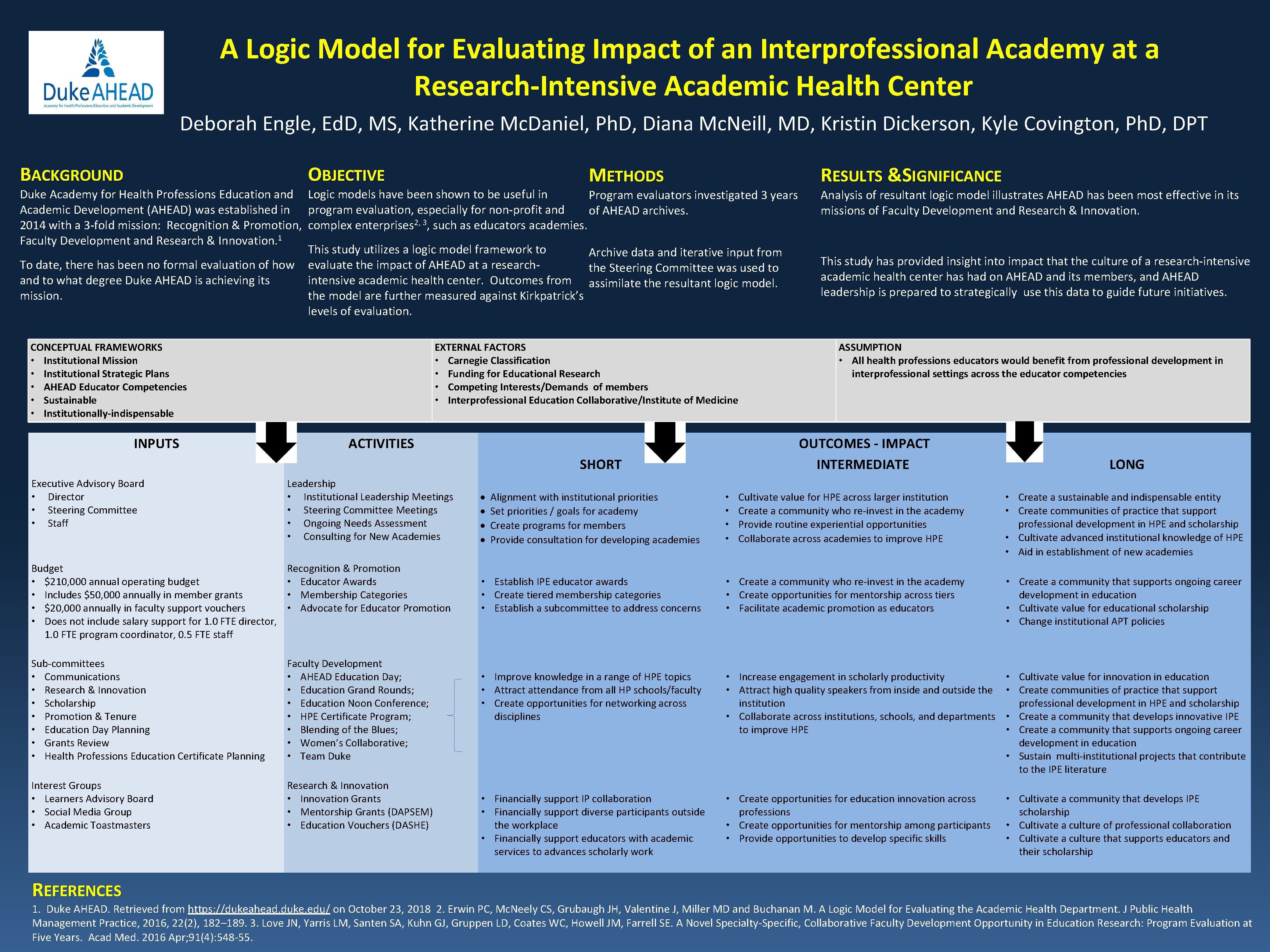
A Logic Model for Evaluating Impact of an Interprofessional Academy at a Research-Intensive Academic Health Center Deborah Engle, Ed. D, MS, Katherine Mc. Daniel, Ph. D, Diana Mc. Neill, MD, Kristin Dickerson, Kyle Covington, Ph. D, DPT BACKGROUND OBJECTIVE METHODS Duke Academy for Health Professions Education and Logic models have been shown to be useful in Program evaluators investigated 3 years Academic Development (AHEAD) was established in program evaluation, especially for non-profit and of AHEAD archives. 2014 with a 3 -fold mission: Recognition & Promotion, complex enterprises 2, 3, such as educators academies. Faculty Development and Research & Innovation. 1 This study utilizes a logic model framework to Archive data and iterative input from To date, there has been no formal evaluation of how evaluate the impact of AHEAD at a researchthe Steering Committee was used to and to what degree Duke AHEAD is achieving its intensive academic health center. Outcomes from assimilate the resultant logic model. mission. the model are further measured against Kirkpatrick’s levels of evaluation. CONCEPTUAL FRAMEWORKS • Institutional Mission • Institutional Strategic Plans • AHEAD Educator Competencies • Sustainable • Institutionally-indispensable INPUTS EXTERNAL FACTORS • Carnegie Classification • Funding for Educational Research • Competing Interests/Demands of members • Interprofessional Education Collaborative/Institute of Medicine ACTIVITIES Leadership • Institutional Leadership Meetings • Steering Committee Meetings • Ongoing Needs Assessment • Consulting for New Academies Budget • $210, 000 annual operating budget • Includes $50, 000 annually in member grants • $20, 000 annually in faculty support vouchers • Does not include salary support for 1. 0 FTE director, 1. 0 FTE program coordinator, 0. 5 FTE staff Recognition & Promotion • Educator Awards • Membership Categories • Advocate for Educator Promotion Sub-committees • Communications • Research & Innovation • Scholarship • Promotion & Tenure • Education Day Planning • Grants Review • Health Professions Education Certificate Planning Faculty Development • AHEAD Education Day; • Education Grand Rounds; • Education Noon Conference; • HPE Certificate Program; • Blending of the Blues; • Women’s Collaborative; • Team Duke Interest Groups • Learners Advisory Board • Social Media Group • Academic Toastmasters Research & Innovation • Innovation Grants • Mentorship Grants (DAPSEM) • Education Vouchers (DASHE) REFERENCES Alignment with institutional priorities Set priorities / goals for academy Create programs for members Provide consultation for developing academies Analysis of resultant logic model illustrates AHEAD has been most effective in its missions of Faculty Development and Research & Innovation. This study has provided insight into impact that the culture of a research-intensive academic health center has had on AHEAD and its members, and AHEAD leadership is prepared to strategically use this data to guide future initiatives. ASSUMPTION • All health professions educators would benefit from professional development in interprofessional settings across the educator competencies OUTCOMES - IMPACT INTERMEDIATE SHORT Executive Advisory Board • Director • Steering Committee • Staff RESULTS &SIGNIFICANCE LONG Cultivate value for HPE across larger institution Create a community who re-invest in the academy Provide routine experiential opportunities Collaborate across academies to improve HPE • Create a sustainable and indispensable entity • Create communities of practice that support professional development in HPE and scholarship • Cultivate advanced institutional knowledge of HPE • Aid in establishment of new academies • Establish IPE educator awards • Create tiered membership categories • Establish a subcommittee to address concerns • Create a community who re-invest in the academy • Create opportunities for mentorship across tiers • Facilitate academic promotion as educators • Create a community that supports ongoing career development in education • Cultivate value for educational scholarship • Change institutional APT policies • Improve knowledge in a range of HPE topics • Attract attendance from all HP schools/faculty • Create opportunities for networking across disciplines • Increase engagement in scholarly productivity • Attract high quality speakers from inside and outside the institution • Collaborate across institutions, schools, and departments to improve HPE • Cultivate value for innovation in education • Create communities of practice that support professional development in HPE and scholarship • Create a community that develops innovative IPE • Create a community that supports ongoing career development in education • Sustain multi-institutional projects that contribute to the IPE literature • Financially support IP collaboration • Financially support diverse participants outside the workplace • Financially support educators with academic services to advances scholarly work • Create opportunities for education innovation across professions • Create opportunities for mentorship among participants • Provide opportunities to develop specific skills • Cultivate a community that develops IPE scholarship • Cultivate a culture of professional collaboration • Cultivate a culture that supports educators and their scholarship • • 1. Duke AHEAD. Retrieved from https: //dukeahead. duke. edu/ on October 23, 2018 2. Erwin PC, Mc. Neely CS, Grubaugh JH, Valentine J, Miller MD and Buchanan M. A Logic Model for Evaluating the Academic Health Department. J Public Health Management Practice, 2016, 22(2), 182– 189. 3. Love JN, Yarris LM, Santen SA, Kuhn GJ, Gruppen LD, Coates WC, Howell JM, Farrell SE. A Novel Specialty-Specific, Collaborative Faculty Development Opportunity in Education Research: Program Evaluation at Five Years. Acad Med. 2016 Apr; 91(4): 548 -55.