
A Little History Keplers Laws From 1570 to
- Slides: 45
A Little History: Kepler’s Laws § From 1570 to 1600, Tycho Brahe compiled observations of stars and planets, and noted how the planets Mercury, Venus, Mars, Jupiter, and Saturn move through the sky. § His mathematical assistant, Johannes Kepler, analyzed Brahe’s data and discovered three laws that the planets obey as they orbit the sun. © 2017 Pearson Education, Inc. Slide 13 -1
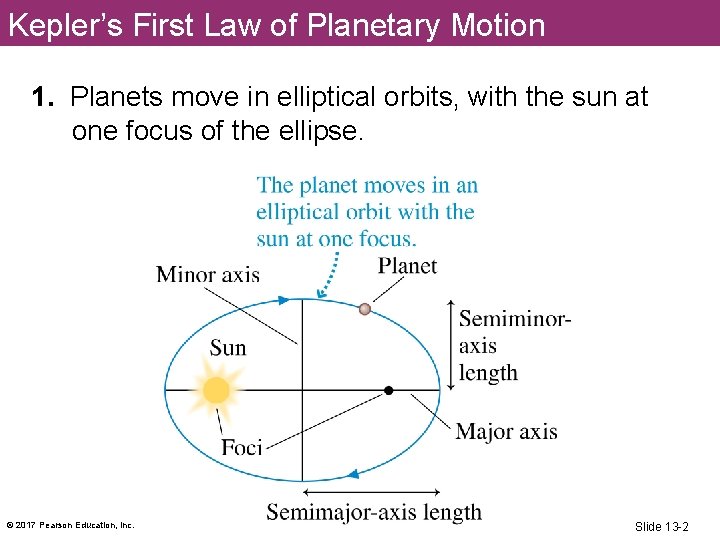
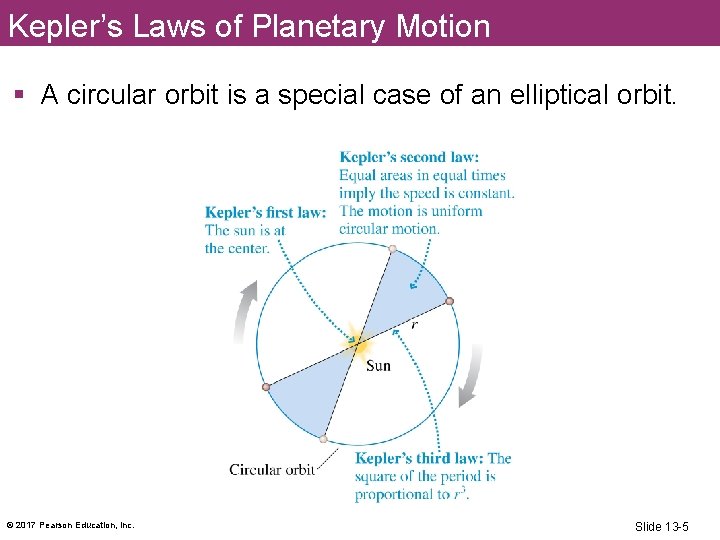
Kepler’s First Law of Planetary Motion 1. Planets move in elliptical orbits, with the sun at one focus of the ellipse. © 2017 Pearson Education, Inc. Slide 13 -2
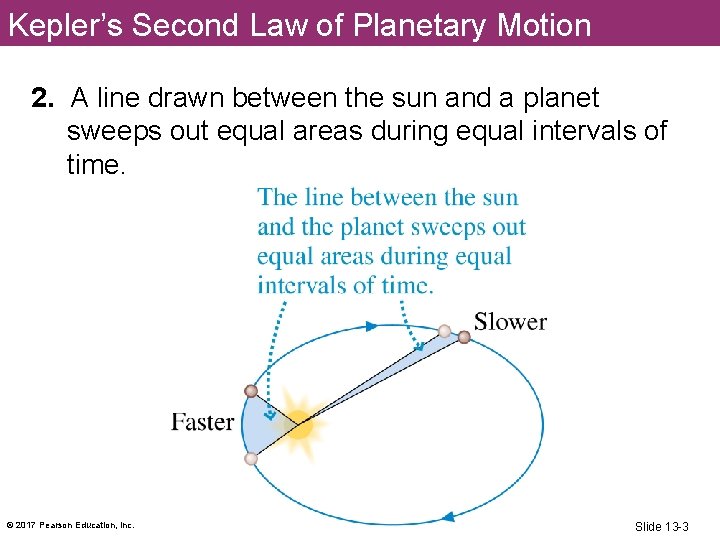
Kepler’s Second Law of Planetary Motion 2. A line drawn between the sun and a planet sweeps out equal areas during equal intervals of time. © 2017 Pearson Education, Inc. Slide 13 -3
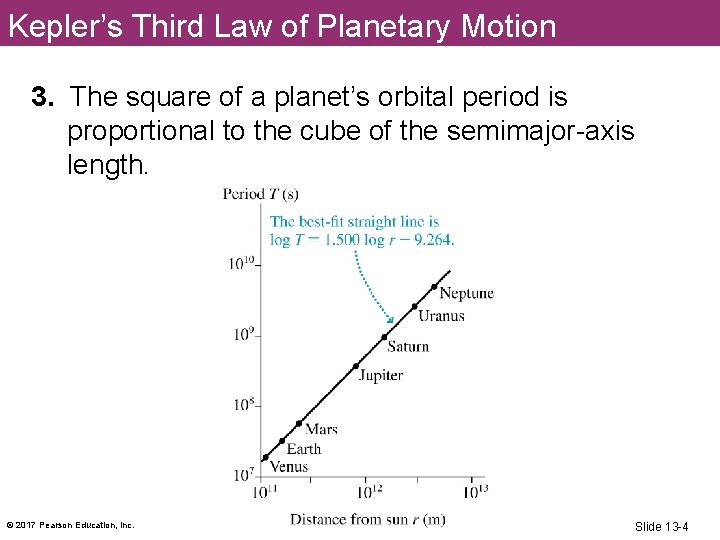
Kepler’s Third Law of Planetary Motion 3. The square of a planet’s orbital period is proportional to the cube of the semimajor-axis length. © 2017 Pearson Education, Inc. Slide 13 -4
Kepler’s Laws of Planetary Motion § A circular orbit is a special case of an elliptical orbit. © 2017 Pearson Education, Inc. Slide 13 -5
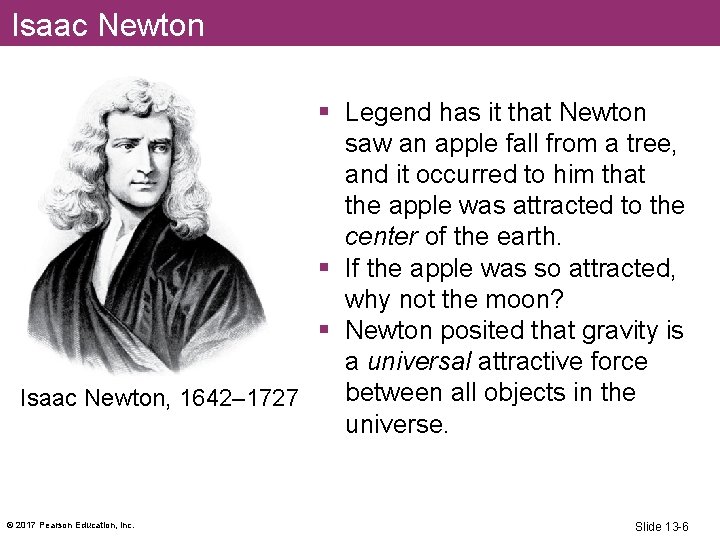
Isaac Newton § Legend has it that Newton saw an apple fall from a tree, and it occurred to him that the apple was attracted to the center of the earth. § If the apple was so attracted, why not the moon? § Newton posited that gravity is a universal attractive force between all objects in the Isaac Newton, 1642– 1727 universe. © 2017 Pearson Education, Inc. Slide 13 -6
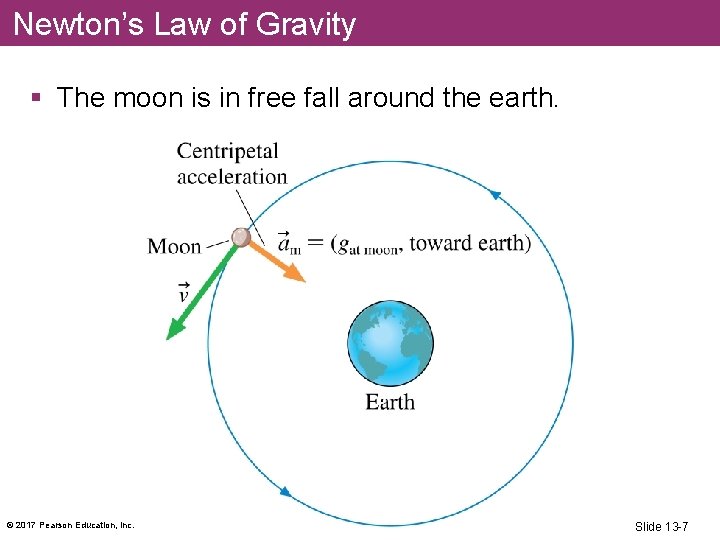
Newton’s Law of Gravity § The moon is in free fall around the earth. © 2017 Pearson Education, Inc. Slide 13 -7
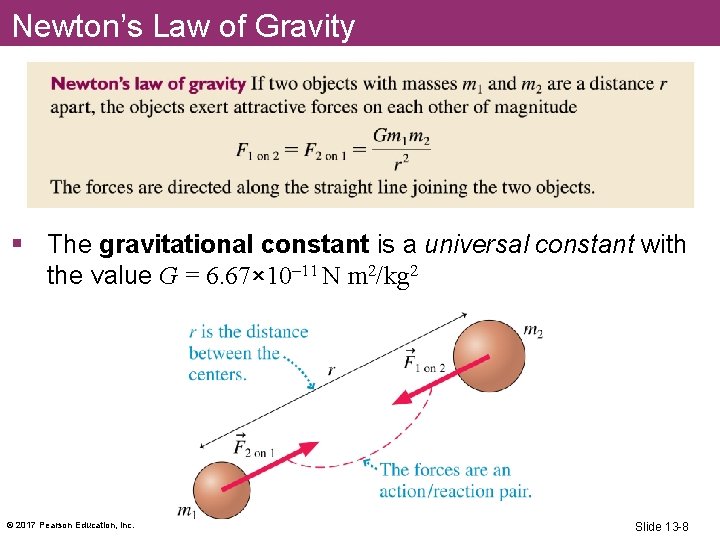
Newton’s Law of Gravity § The gravitational constant is a universal constant with the value G = 6. 67× 10– 11 N m 2/kg 2 © 2017 Pearson Education, Inc. Slide 13 -8
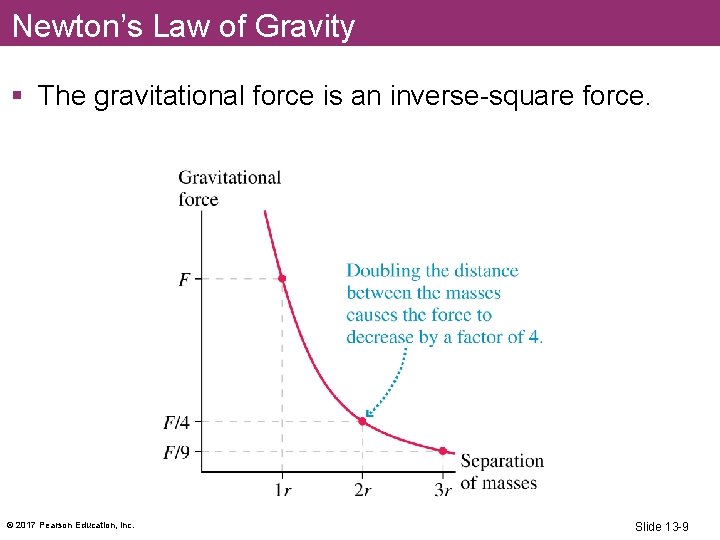
Newton’s Law of Gravity § The gravitational force is an inverse-square force. © 2017 Pearson Education, Inc. Slide 13 -9
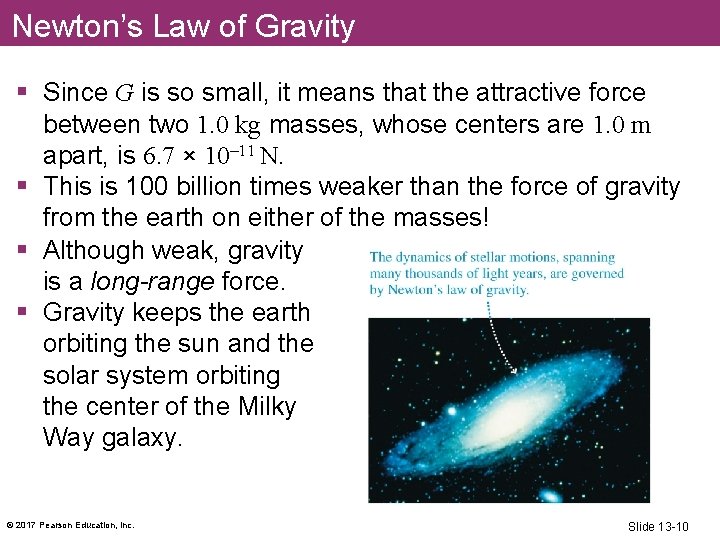
Newton’s Law of Gravity § Since G is so small, it means that the attractive force between two 1. 0 kg masses, whose centers are 1. 0 m apart, is 6. 7 × 10– 11 N. § This is 100 billion times weaker than the force of gravity from the earth on either of the masses! § Although weak, gravity is a long-range force. § Gravity keeps the earth orbiting the sun and the solar system orbiting the center of the Milky Way galaxy. © 2017 Pearson Education, Inc. Slide 13 -10
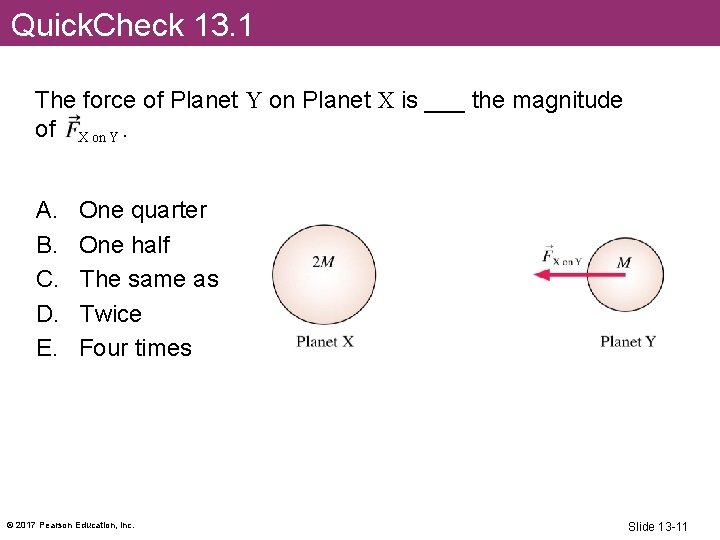
Quick. Check 13. 1 The force of Planet Y on Planet X is ___ the magnitude of X on Y. A. B. C. D. E. One quarter One half The same as Twice Four times © 2017 Pearson Education, Inc. Slide 13 -11
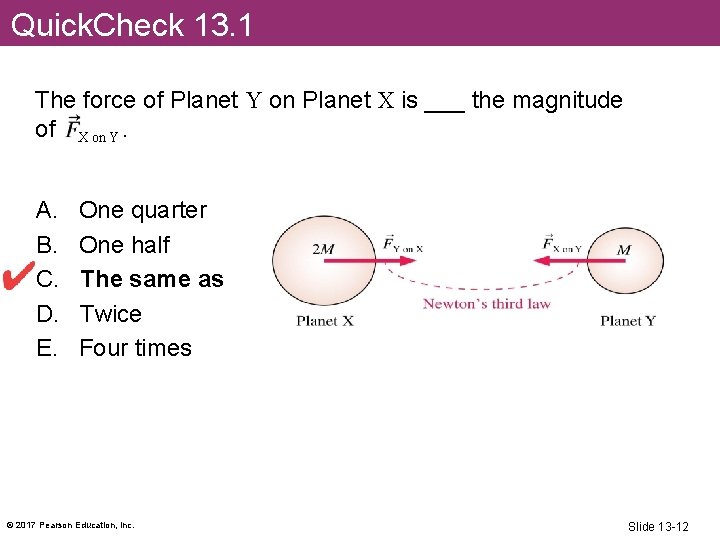
Quick. Check 13. 1 The force of Planet Y on Planet X is ___ the magnitude of X on Y. A. B. C. D. E. One quarter One half The same as Twice Four times © 2017 Pearson Education, Inc. Slide 13 -12
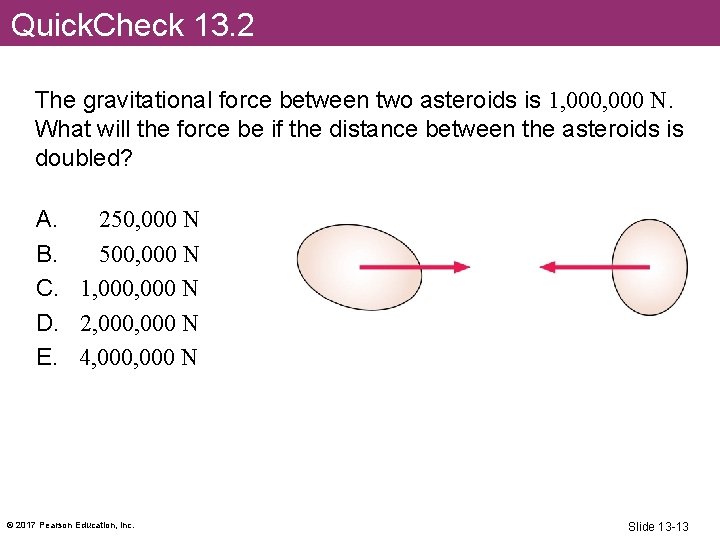
Quick. Check 13. 2 The gravitational force between two asteroids is 1, 000 N. What will the force be if the distance between the asteroids is doubled? A. 250, 000 N B. 500, 000 N C. 1, 000 N D. 2, 000 N E. 4, 000 N © 2017 Pearson Education, Inc. Slide 13 -13
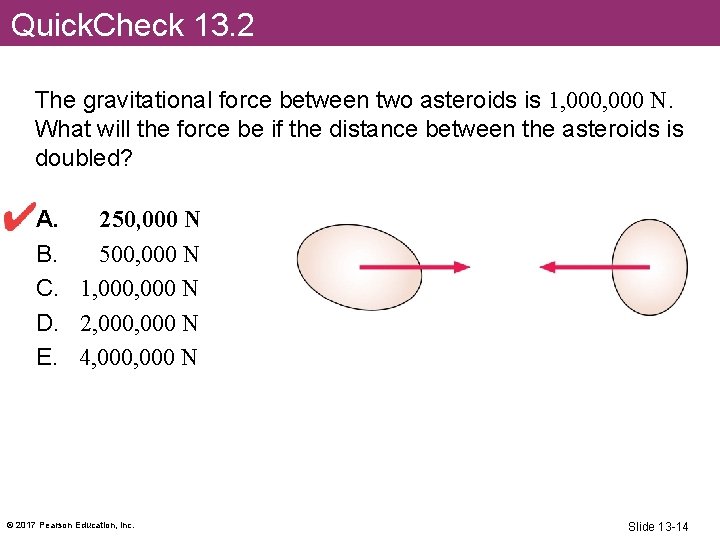
Quick. Check 13. 2 The gravitational force between two asteroids is 1, 000 N. What will the force be if the distance between the asteroids is doubled? A. 250, 000 N B. 500, 000 N C. 1, 000 N D. 2, 000 N E. 4, 000 N © 2017 Pearson Education, Inc. Slide 13 -14
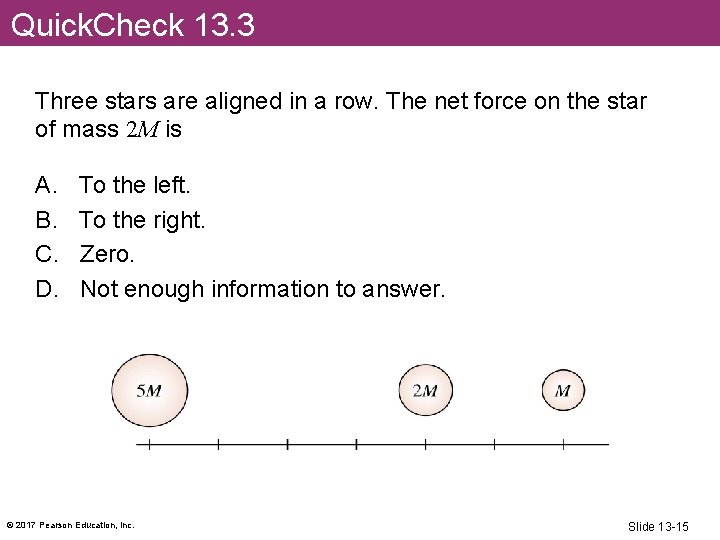
Quick. Check 13. 3 Three stars are aligned in a row. The net force on the star of mass 2 M is A. B. C. D. To the left. To the right. Zero. Not enough information to answer. © 2017 Pearson Education, Inc. Slide 13 -15
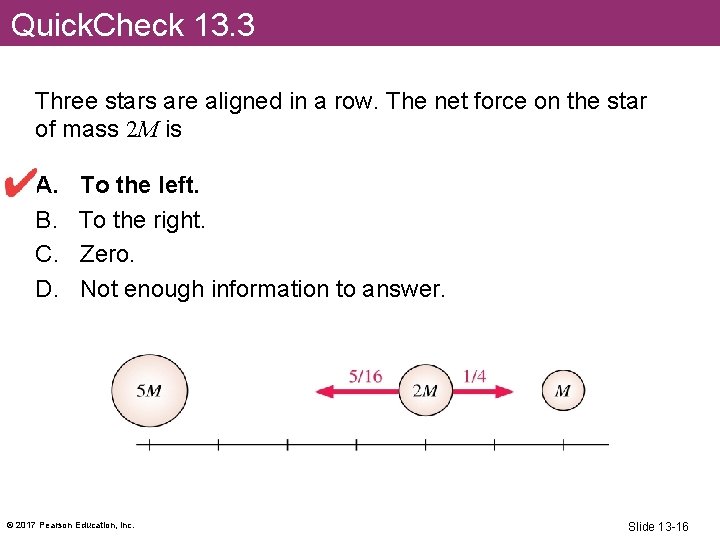
Quick. Check 13. 3 Three stars are aligned in a row. The net force on the star of mass 2 M is A. B. C. D. To the left. To the right. Zero. Not enough information to answer. © 2017 Pearson Education, Inc. Slide 13 -16
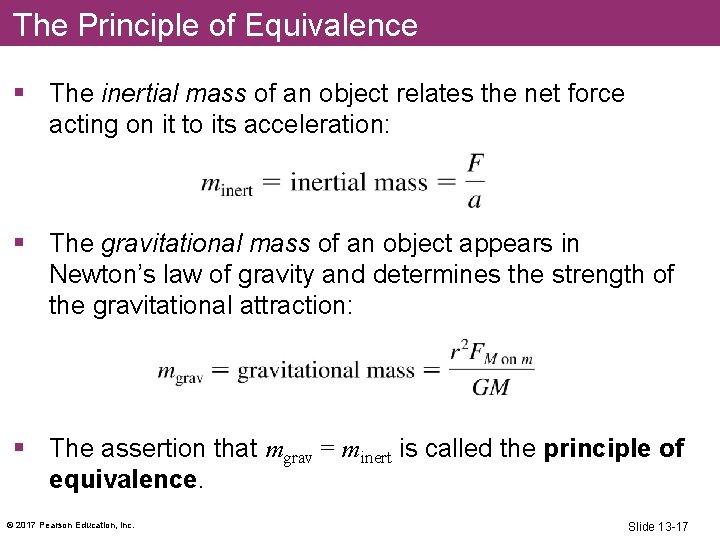
The Principle of Equivalence § The inertial mass of an object relates the net force acting on it to its acceleration: § The gravitational mass of an object appears in Newton’s law of gravity and determines the strength of the gravitational attraction: § The assertion that mgrav = minert is called the principle of equivalence. © 2017 Pearson Education, Inc. Slide 13 -17
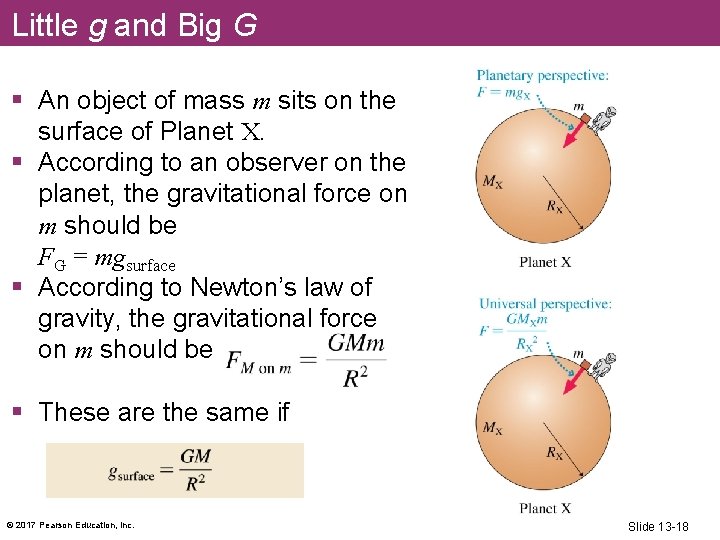
Little g and Big G § An object of mass m sits on the surface of Planet X. § According to an observer on the planet, the gravitational force on m should be FG = mgsurface § According to Newton’s law of gravity, the gravitational force on m should be § These are the same if © 2017 Pearson Education, Inc. Slide 13 -18
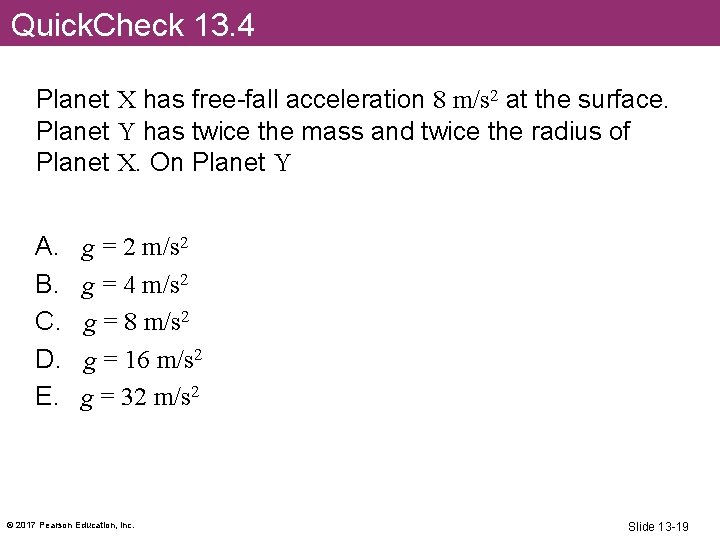
Quick. Check 13. 4 Planet X has free-fall acceleration 8 m/s 2 at the surface. Planet Y has twice the mass and twice the radius of Planet X. On Planet Y A. B. C. D. E. g = 2 m/s 2 g = 4 m/s 2 g = 8 m/s 2 g = 16 m/s 2 g = 32 m/s 2 © 2017 Pearson Education, Inc. Slide 13 -19
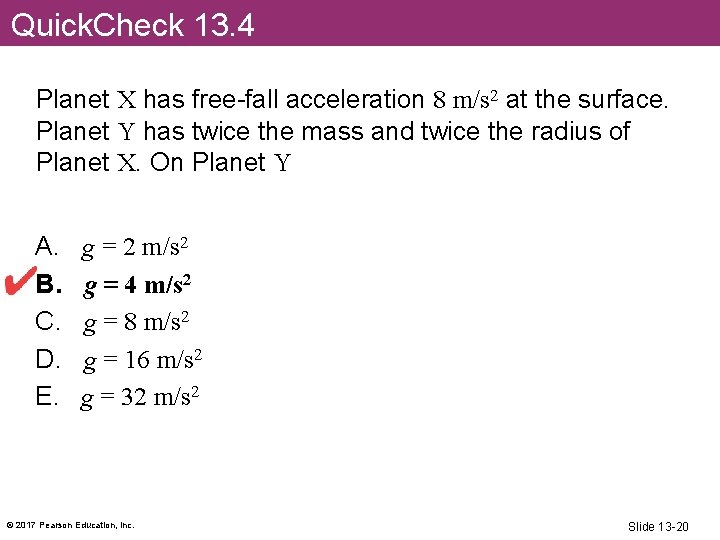
Quick. Check 13. 4 Planet X has free-fall acceleration 8 m/s 2 at the surface. Planet Y has twice the mass and twice the radius of Planet X. On Planet Y A. B. C. D. E. g = 2 m/s 2 g = 4 m/s 2 g = 8 m/s 2 g = 16 m/s 2 g = 32 m/s 2 © 2017 Pearson Education, Inc. Slide 13 -20
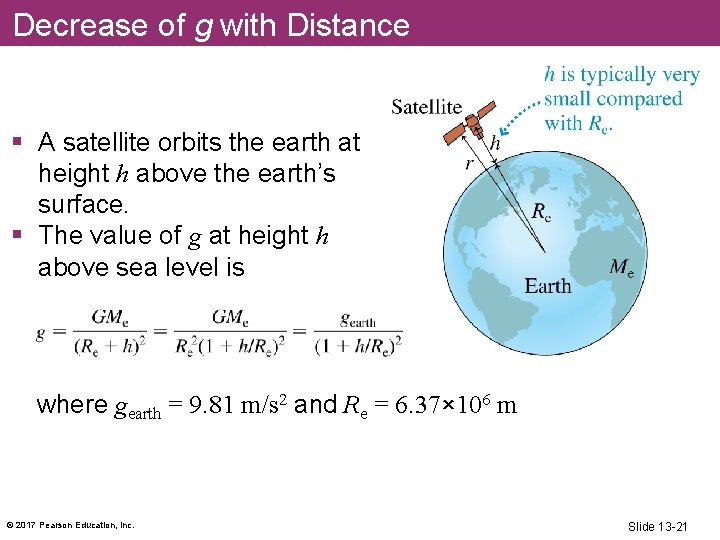
Decrease of g with Distance § A satellite orbits the earth at height h above the earth’s surface. § The value of g at height h above sea level is where gearth = 9. 81 m/s 2 and Re = 6. 37× 106 m © 2017 Pearson Education, Inc. Slide 13 -21
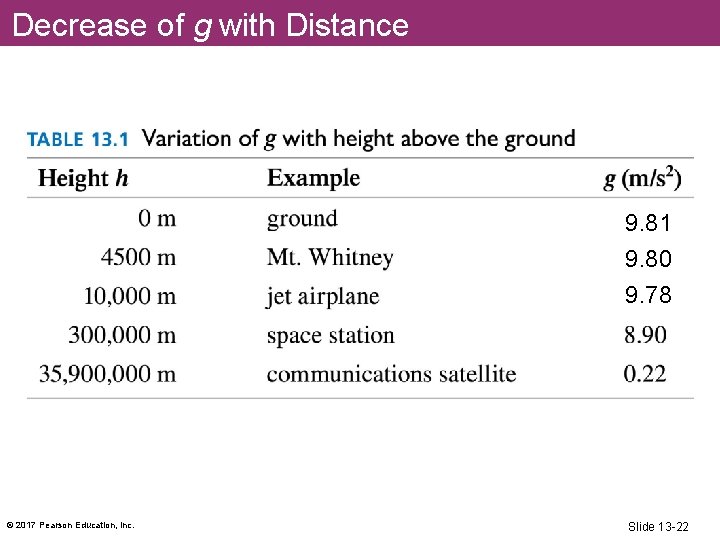
Decrease of g with Distance 9. 81 9. 80 9. 78 © 2017 Pearson Education, Inc. Slide 13 -22
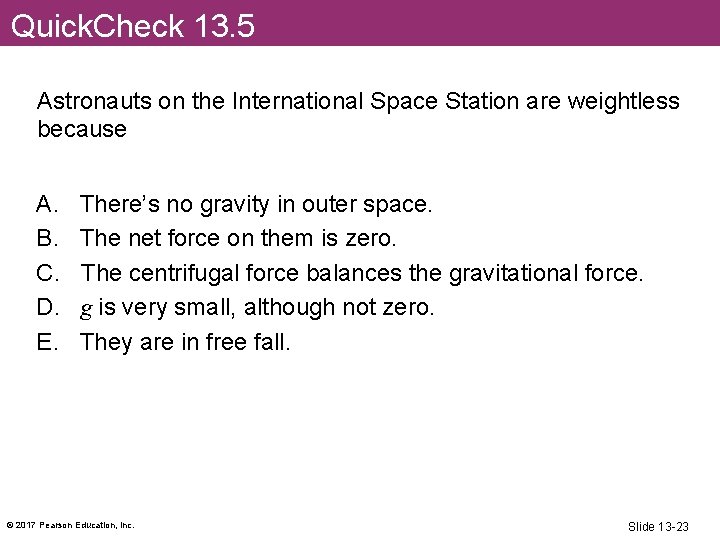
Quick. Check 13. 5 Astronauts on the International Space Station are weightless because A. B. C. D. E. There’s no gravity in outer space. The net force on them is zero. The centrifugal force balances the gravitational force. g is very small, although not zero. They are in free fall. © 2017 Pearson Education, Inc. Slide 13 -23
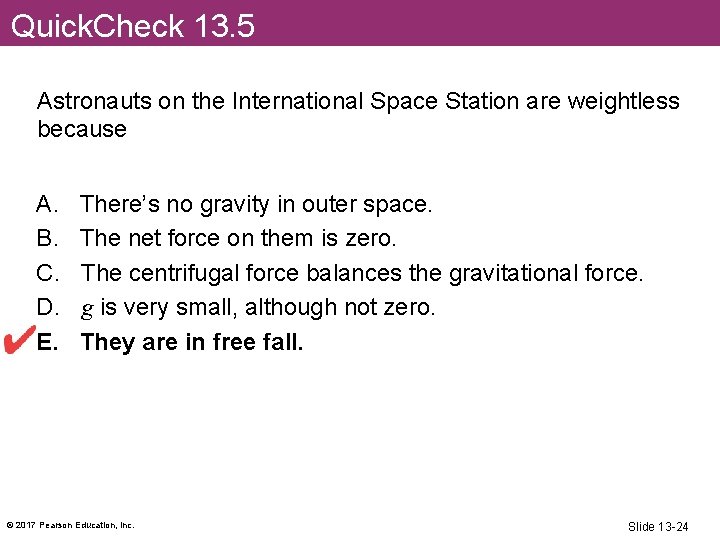
Quick. Check 13. 5 Astronauts on the International Space Station are weightless because A. B. C. D. E. There’s no gravity in outer space. The net force on them is zero. The centrifugal force balances the gravitational force. g is very small, although not zero. They are in free fall. © 2017 Pearson Education, Inc. Slide 13 -24
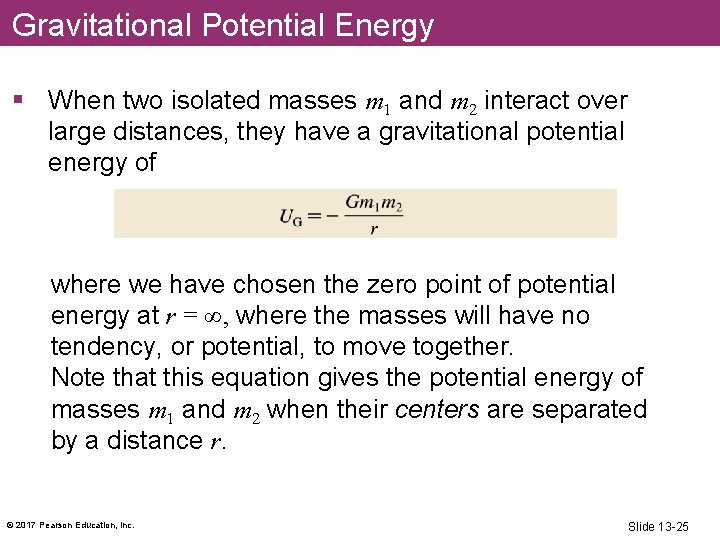
Gravitational Potential Energy § When two isolated masses m 1 and m 2 interact over large distances, they have a gravitational potential energy of where we have chosen the zero point of potential energy at r = ∞, where the masses will have no tendency, or potential, to move together. Note that this equation gives the potential energy of masses m 1 and m 2 when their centers are separated by a distance r. © 2017 Pearson Education, Inc. Slide 13 -25
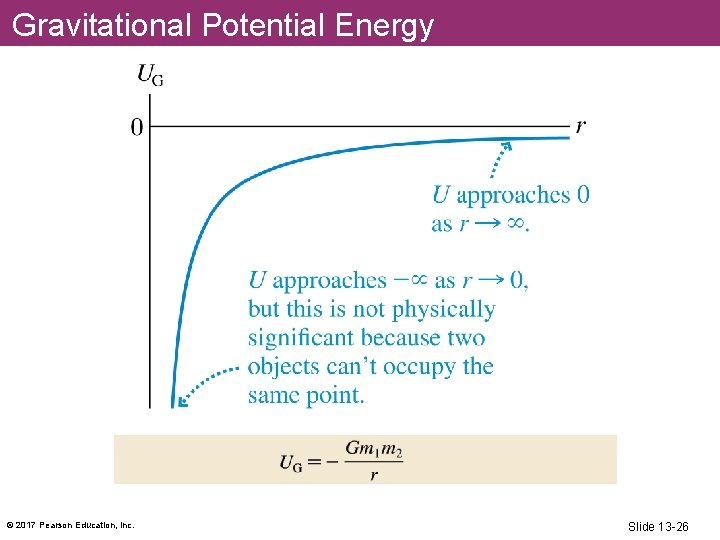
Gravitational Potential Energy © 2017 Pearson Education, Inc. Slide 13 -26
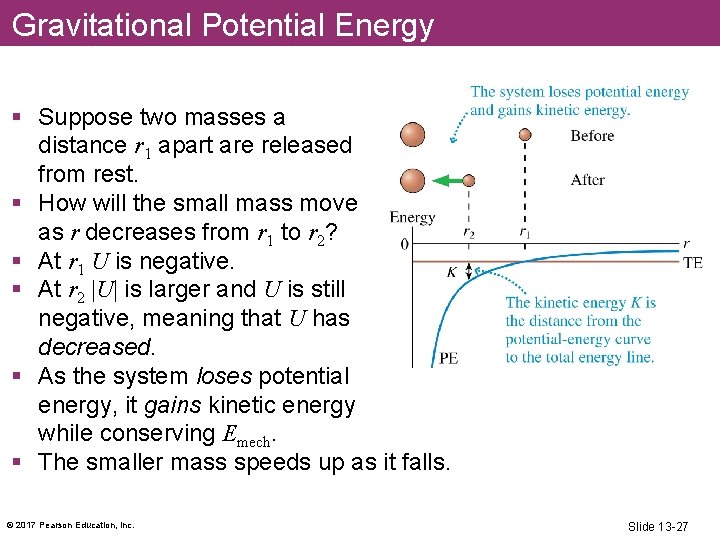
Gravitational Potential Energy § Suppose two masses a distance r 1 apart are released from rest. § How will the small mass move as r decreases from r 1 to r 2? § At r 1 U is negative. § At r 2 |U| is larger and U is still negative, meaning that U has decreased. § As the system loses potential energy, it gains kinetic energy while conserving Emech. § The smaller mass speeds up as it falls. © 2017 Pearson Education, Inc. Slide 13 -27
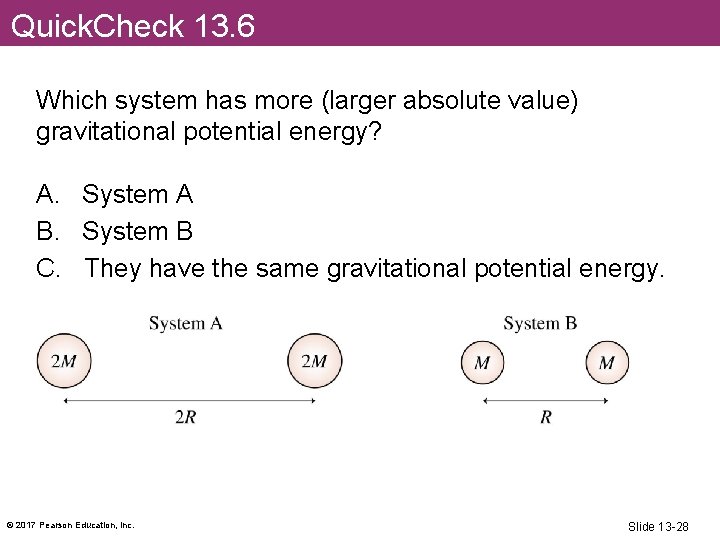
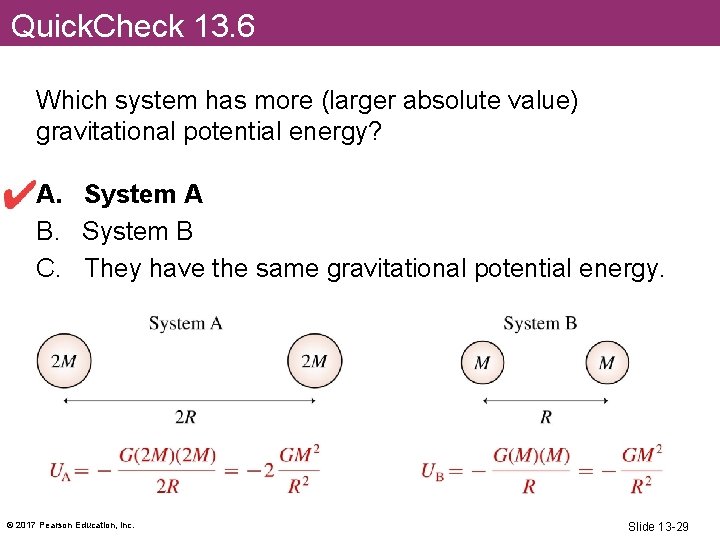
Quick. Check 13. 6 Which system has more (larger absolute value) gravitational potential energy? A. System A B. System B C. They have the same gravitational potential energy. © 2017 Pearson Education, Inc. Slide 13 -28
Quick. Check 13. 6 Which system has more (larger absolute value) gravitational potential energy? A. System A B. System B C. They have the same gravitational potential energy. © 2017 Pearson Education, Inc. Slide 13 -29
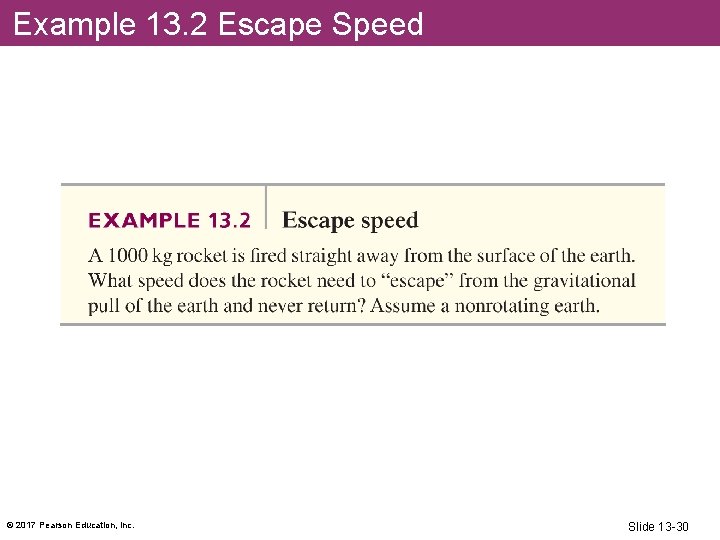
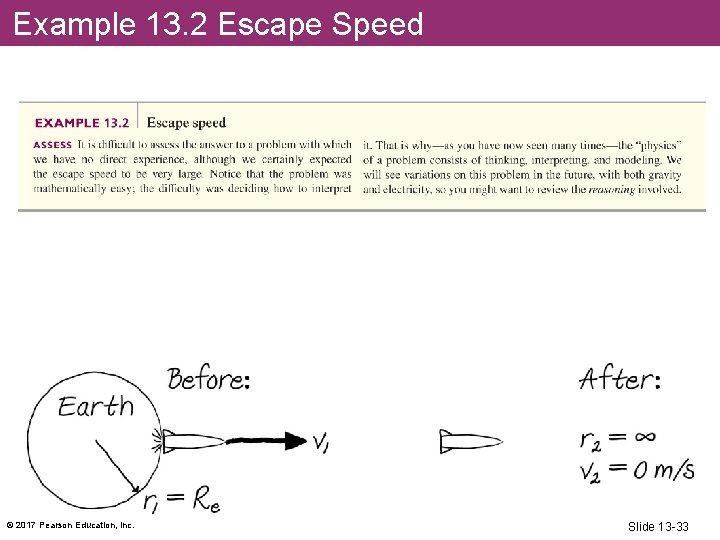
Example 13. 2 Escape Speed © 2017 Pearson Education, Inc. Slide 13 -30
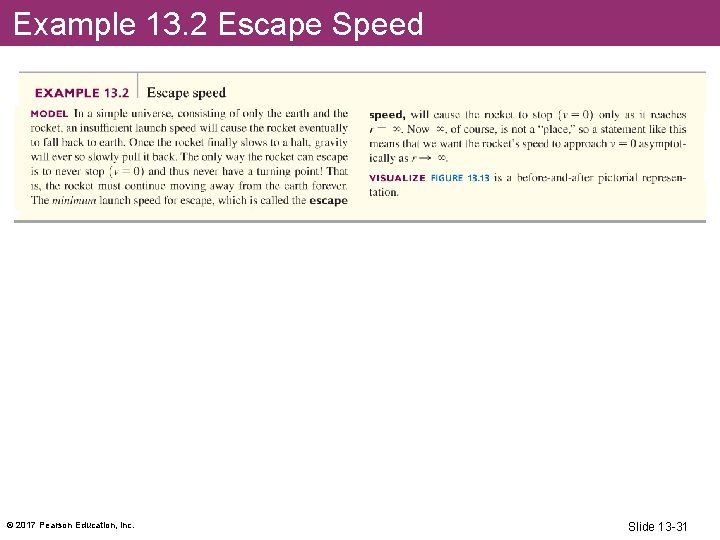
Example 13. 2 Escape Speed © 2017 Pearson Education, Inc. Slide 13 -31
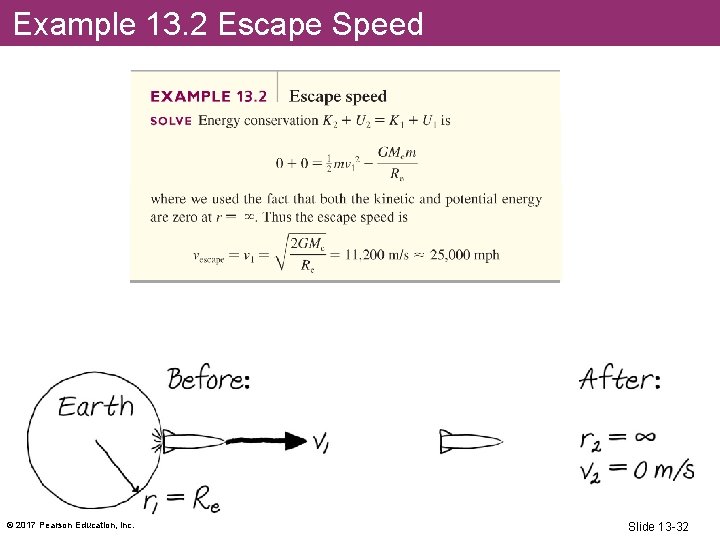
Example 13. 2 Escape Speed © 2017 Pearson Education, Inc. Slide 13 -32
Example 13. 2 Escape Speed © 2017 Pearson Education, Inc. Slide 13 -33
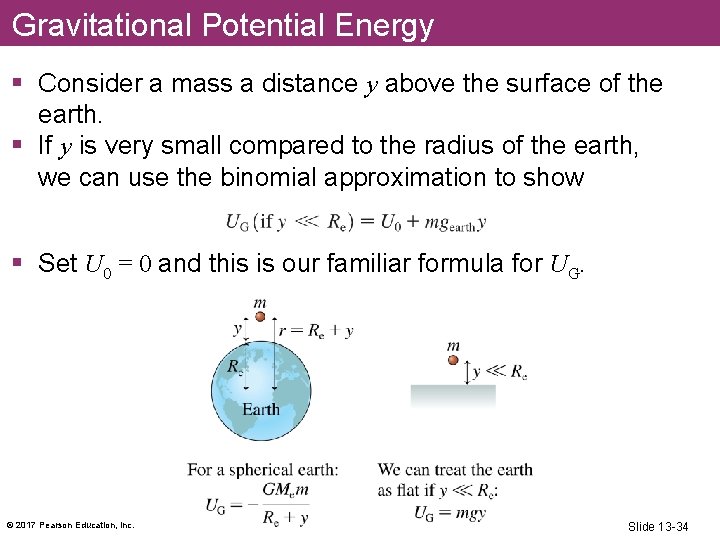
Gravitational Potential Energy § Consider a mass a distance y above the surface of the earth. § If y is very small compared to the radius of the earth, we can use the binomial approximation to show § Set U 0 = 0 and this is our familiar formula for UG. © 2017 Pearson Education, Inc. Slide 13 -34
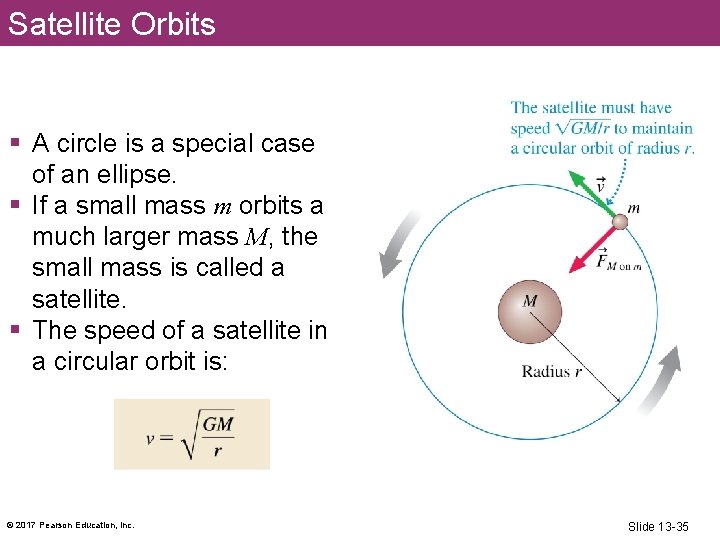
Satellite Orbits § A circle is a special case of an ellipse. § If a small mass m orbits a much larger mass M, the small mass is called a satellite. § The speed of a satellite in a circular orbit is: © 2017 Pearson Education, Inc. Slide 13 -35
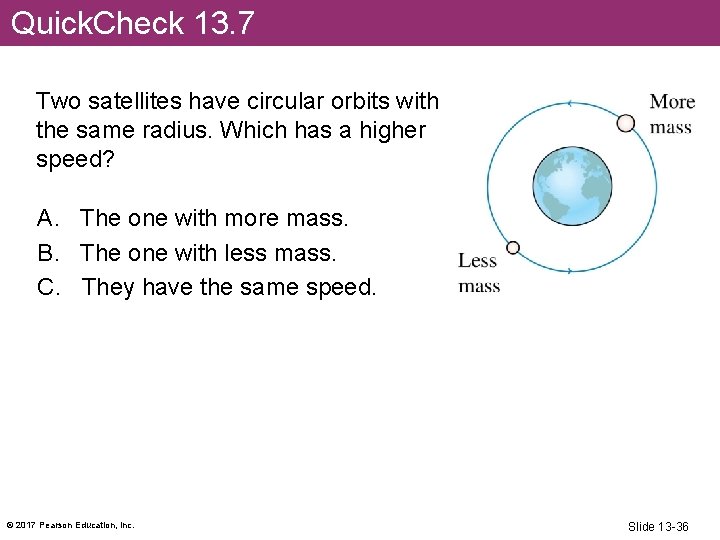
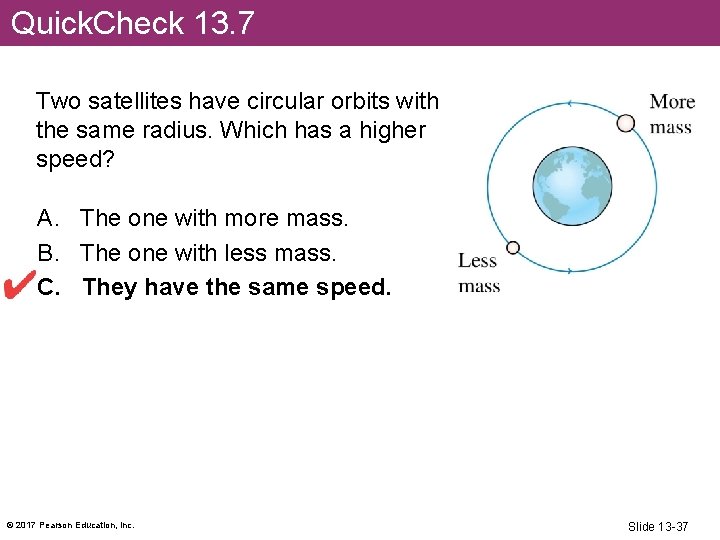
Quick. Check 13. 7 Two satellites have circular orbits with the same radius. Which has a higher speed? A. The one with more mass. B. The one with less mass. C. They have the same speed. © 2017 Pearson Education, Inc. Slide 13 -36
Quick. Check 13. 7 Two satellites have circular orbits with the same radius. Which has a higher speed? A. The one with more mass. B. The one with less mass. C. They have the same speed. © 2017 Pearson Education, Inc. Slide 13 -37
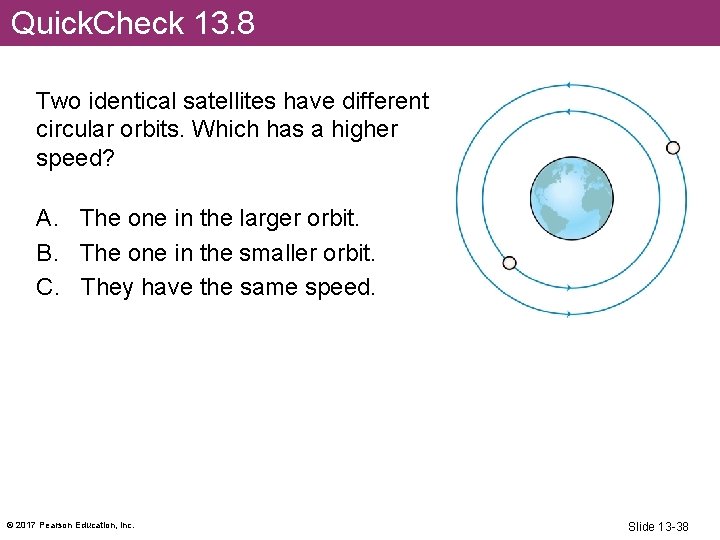
Quick. Check 13. 8 Two identical satellites have different circular orbits. Which has a higher speed? A. The one in the larger orbit. B. The one in the smaller orbit. C. They have the same speed. © 2017 Pearson Education, Inc. Slide 13 -38
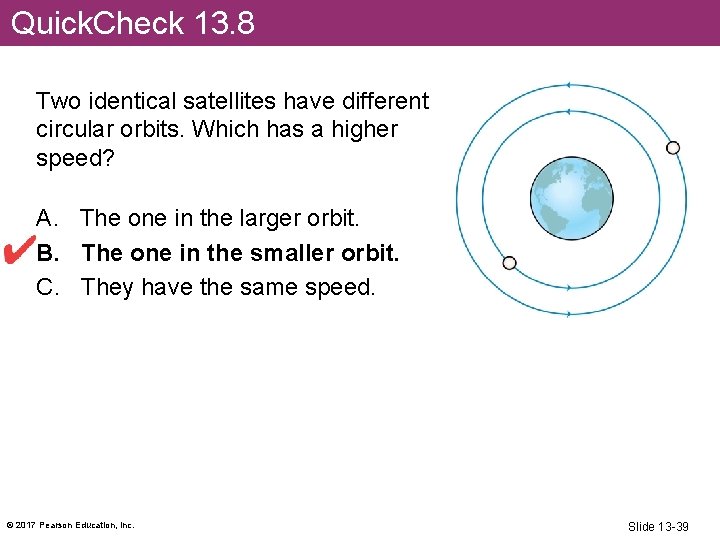
Quick. Check 13. 8 Two identical satellites have different circular orbits. Which has a higher speed? A. The one in the larger orbit. B. The one in the smaller orbit. C. They have the same speed. © 2017 Pearson Education, Inc. Slide 13 -39
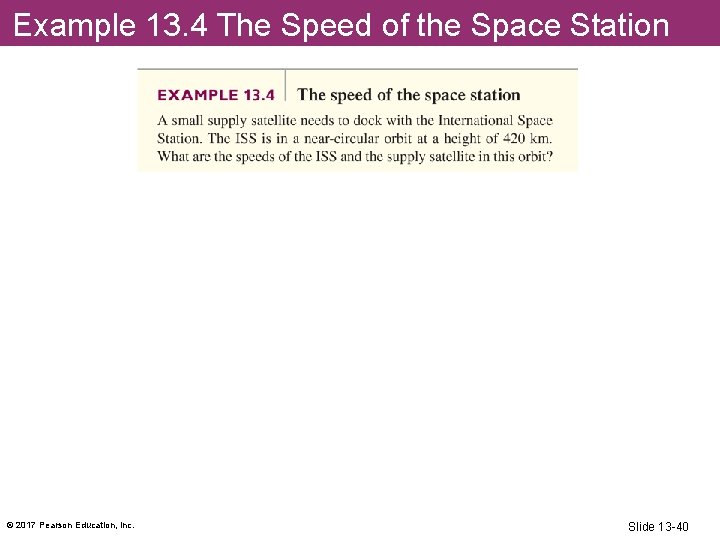
Example 13. 4 The Speed of the Space Station © 2017 Pearson Education, Inc. Slide 13 -40
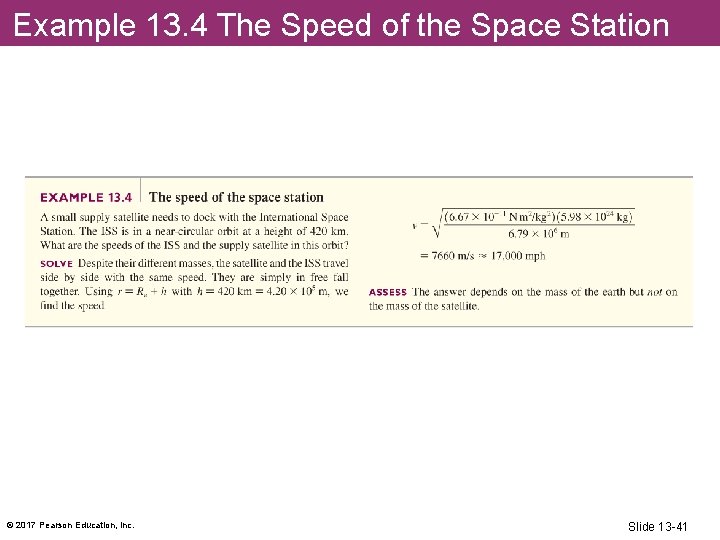
Example 13. 4 The Speed of the Space Station © 2017 Pearson Education, Inc. Slide 13 -41
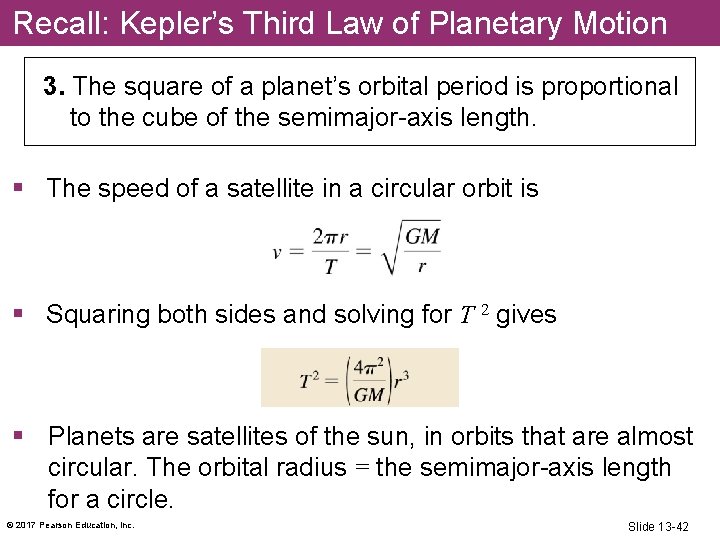
Recall: Kepler’s Third Law of Planetary Motion 3. The square of a planet’s orbital period is proportional to the cube of the semimajor-axis length. § The speed of a satellite in a circular orbit is § Squaring both sides and solving for T 2 gives § Planets are satellites of the sun, in orbits that are almost circular. The orbital radius = the semimajor-axis length for a circle. © 2017 Pearson Education, Inc. Slide 13 -42
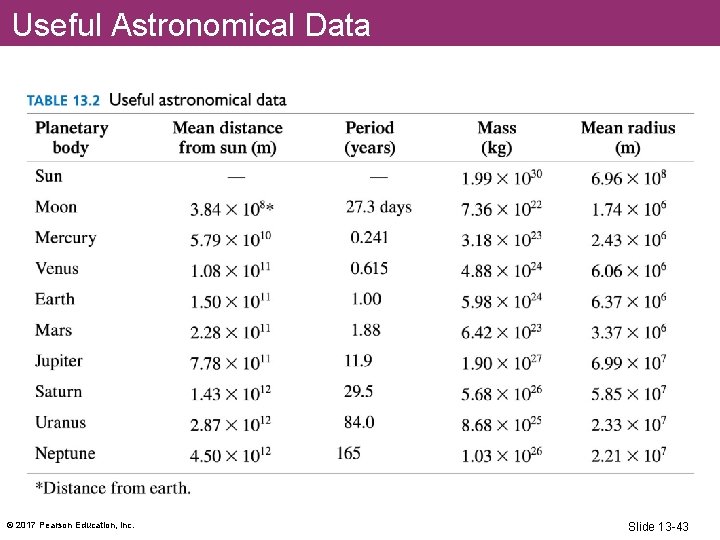
Useful Astronomical Data © 2017 Pearson Education, Inc. Slide 13 -43
Example 13. 5 Extrasolar Planets © 2017 Pearson Education, Inc. Slide 13 -44
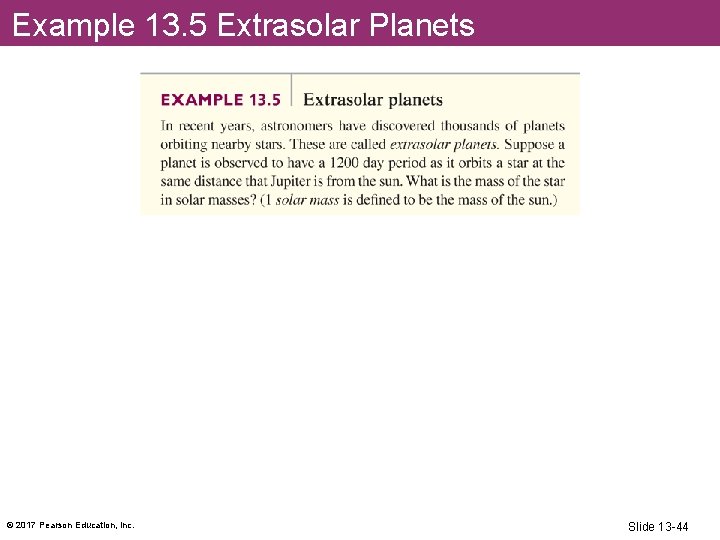
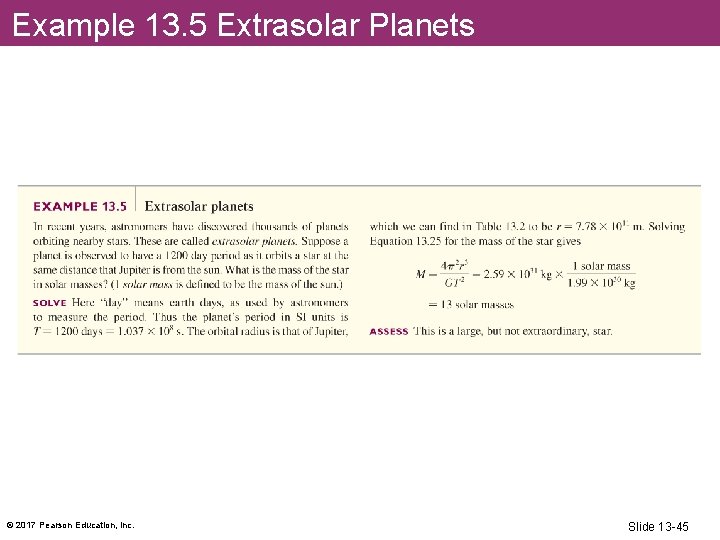
Example 13. 5 Extrasolar Planets © 2017 Pearson Education, Inc. Slide 13 -45