
A Little Bit of Probability 3 Conditional Probability
A Little Bit of Probability 3 Conditional Probability and Bayes’ Theorem
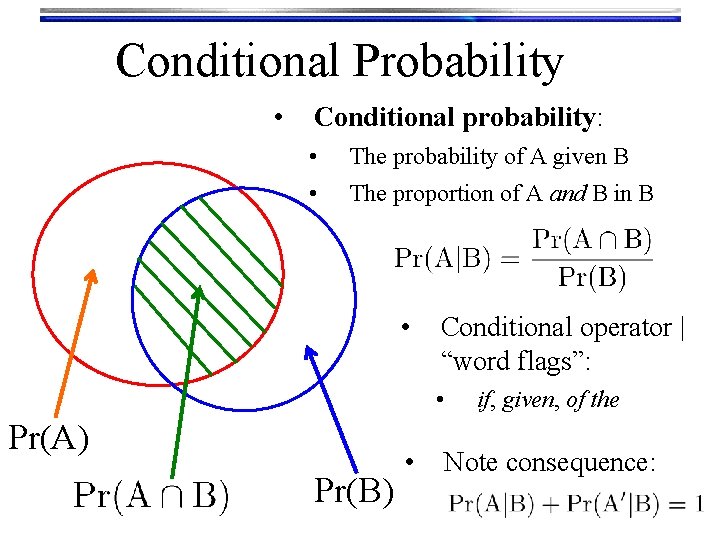
Conditional Probability • Conditional probability: • The probability of A given B • The proportion of A and B in B • Conditional operator | “word flags”: • Pr(A) Pr(B) • if, given, of the Note consequence:
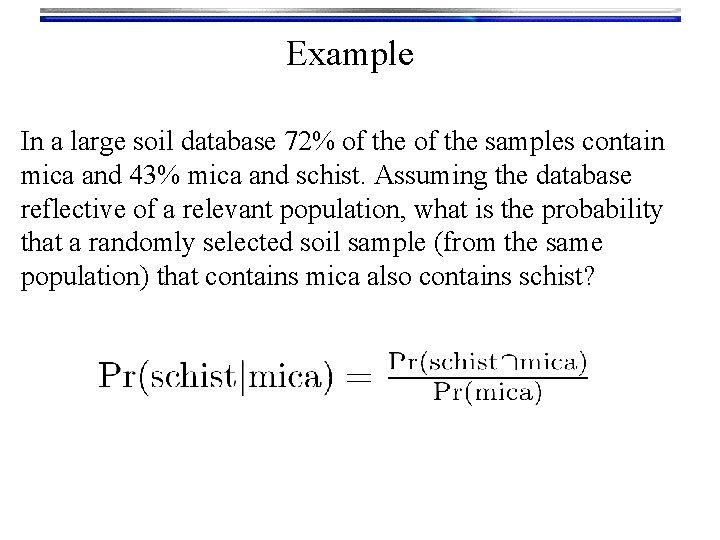
Example In a large soil database 72% of the samples contain mica and 43% mica and schist. Assuming the database reflective of a relevant population, what is the probability that a randomly selected soil sample (from the same population) that contains mica also contains schist?
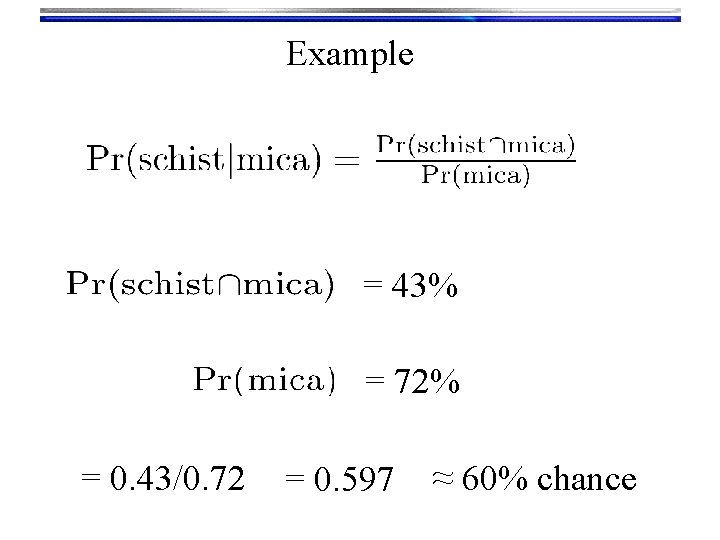
Example = 43% = 72% = 0. 43/0. 72 = 0. 597 ≈ 60% chance
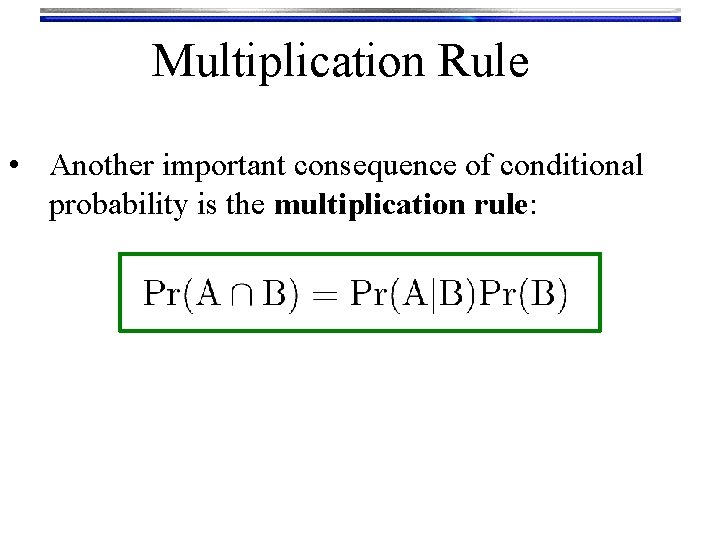
Multiplication Rule • Another important consequence of conditional probability is the multiplication rule:
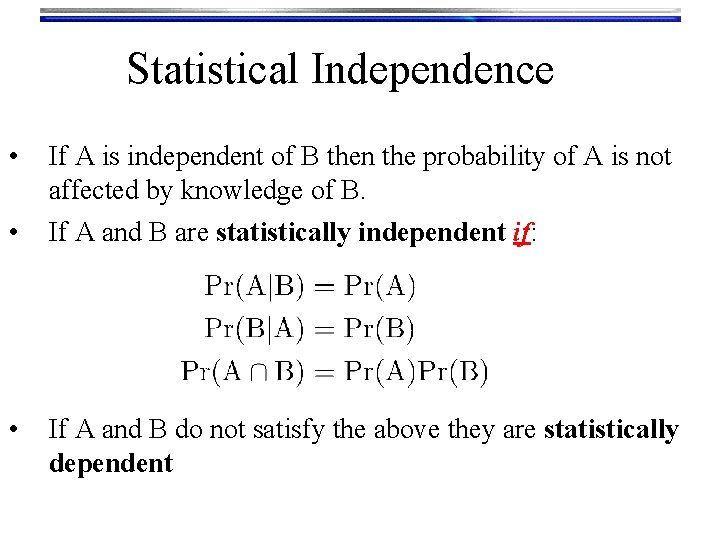
Statistical Independence • • • If A is independent of B then the probability of A is not affected by knowledge of B. If A and B are statistically independent if: If A and B do not satisfy the above they are statistically dependent
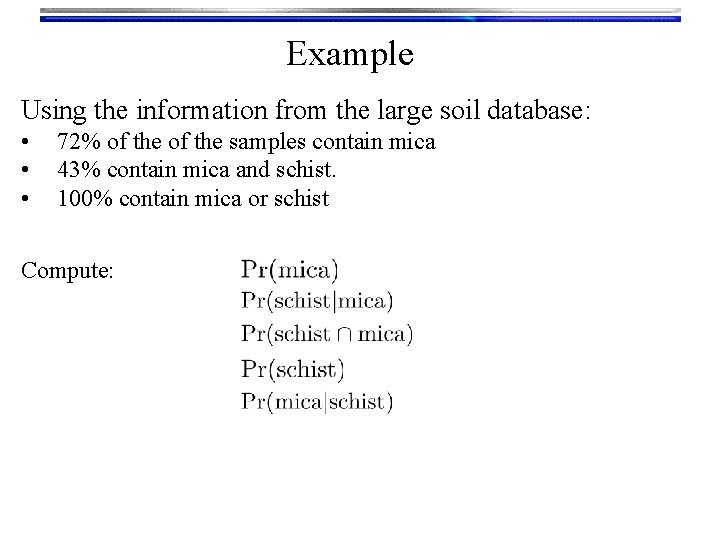
Example Using the information from the large soil database: • • • 72% of the samples contain mica 43% contain mica and schist. 100% contain mica or schist Compute:
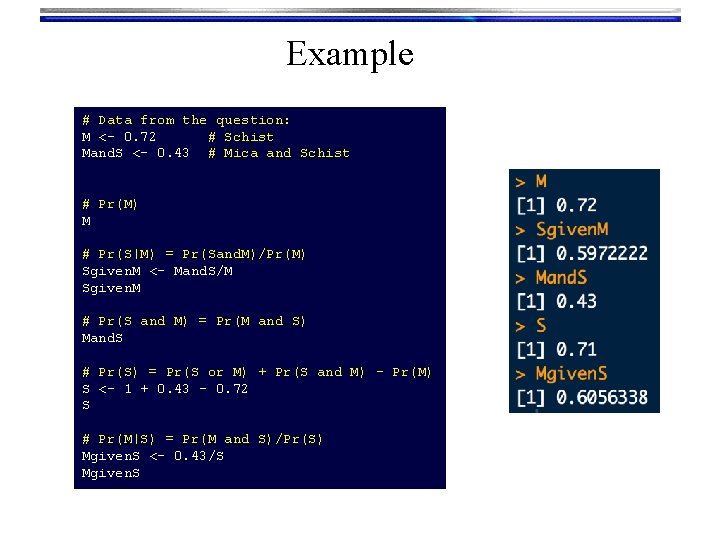
Example # Data from the question: M <- 0. 72 # Schist Mand. S <- 0. 43 # Mica and Schist # Pr(M) M # Pr(S|M) = Pr(Sand. M)/Pr(M) Sgiven. M <- Mand. S/M Sgiven. M # Pr(S and M) = Pr(M and S) Mand. S # Pr(S) = Pr(S or M) + Pr(S and M) - Pr(M) S <- 1 + 0. 43 - 0. 72 S # Pr(M|S) = Pr(M and S)/Pr(S) Mgiven. S <- 0. 43/S Mgiven. S
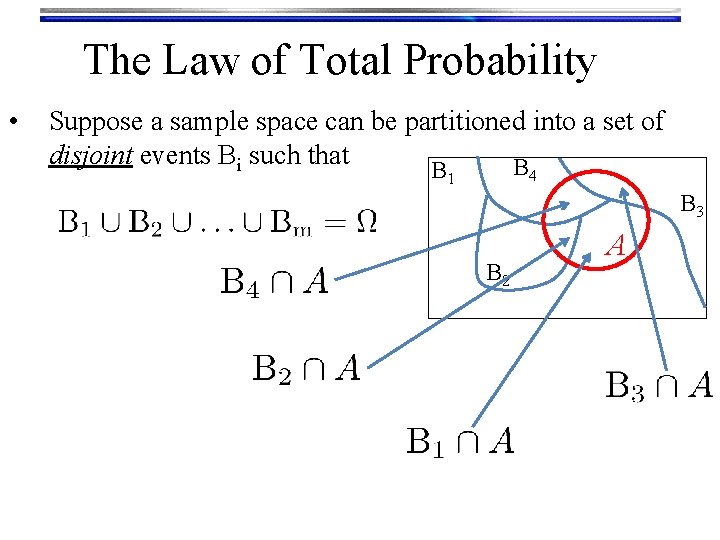
The Law of Total Probability • Suppose a sample space can be partitioned into a set of disjoint events Bi such that B B 1 4 B 3 B 2 A
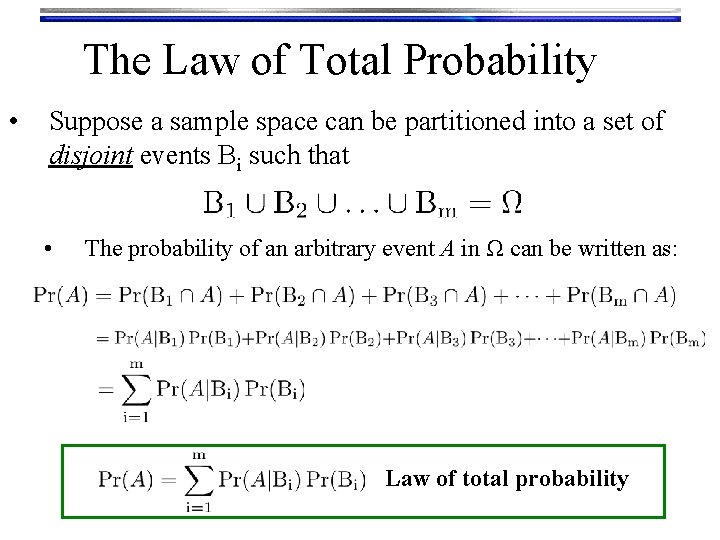
The Law of Total Probability • Suppose a sample space can be partitioned into a set of disjoint events Bi such that • The probability of an arbitrary event A in Ω can be written as: Law of total probability
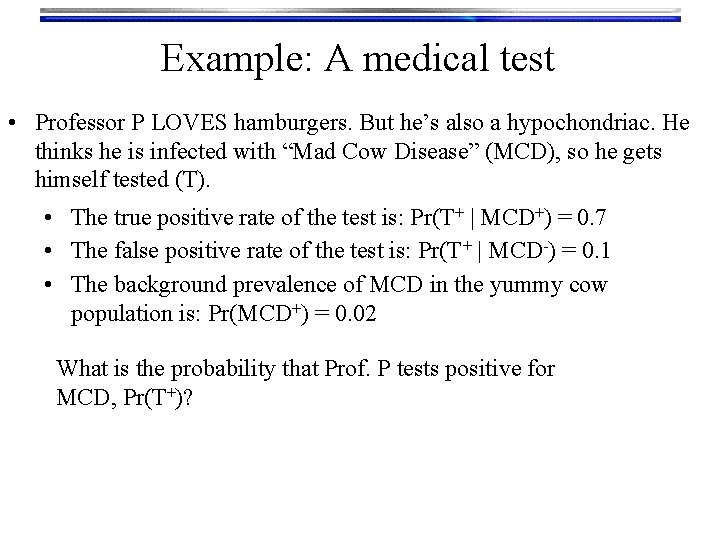
Example: A medical test • Professor P LOVES hamburgers. But he’s also a hypochondriac. He thinks he is infected with “Mad Cow Disease” (MCD), so he gets himself tested (T). • The true positive rate of the test is: Pr(T+ | MCD+) = 0. 7 • The false positive rate of the test is: Pr(T+ | MCD-) = 0. 1 • The background prevalence of MCD in the yummy cow population is: Pr(MCD+) = 0. 02 What is the probability that Prof. P tests positive for MCD, Pr(T+)?
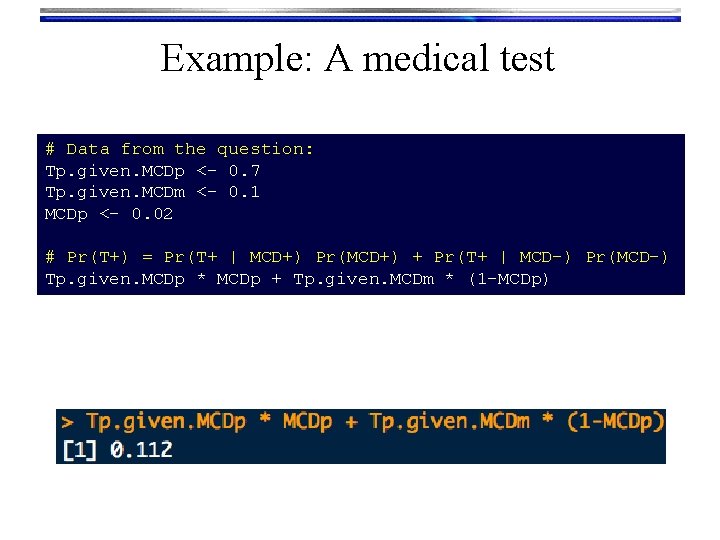
Example: A medical test # Data from the question: Tp. given. MCDp <- 0. 7 Tp. given. MCDm <- 0. 1 MCDp <- 0. 02 # Pr(T+) = Pr(T+ | MCD+) Pr(MCD+) + Pr(T+ | MCD-) Pr(MCD-) Tp. given. MCDp * MCDp + Tp. given. MCDm * (1 -MCDp)
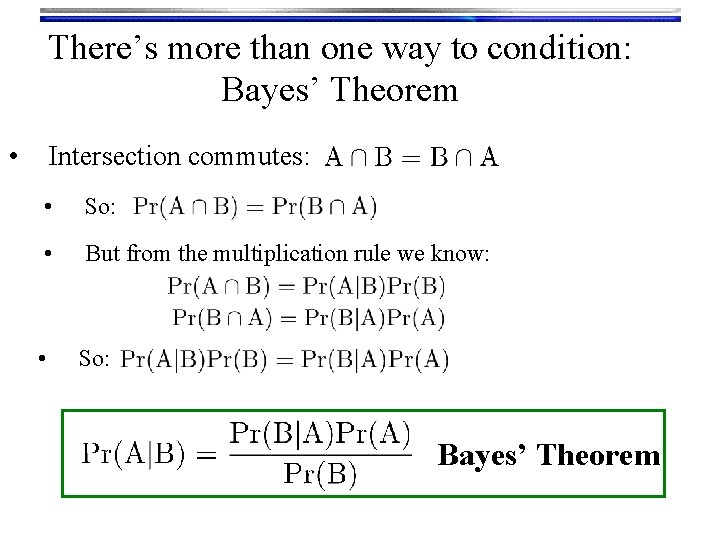
There’s more than one way to condition: Bayes’ Theorem • Intersection commutes: • So: • But from the multiplication rule we know: • So: Bayes’ Theorem
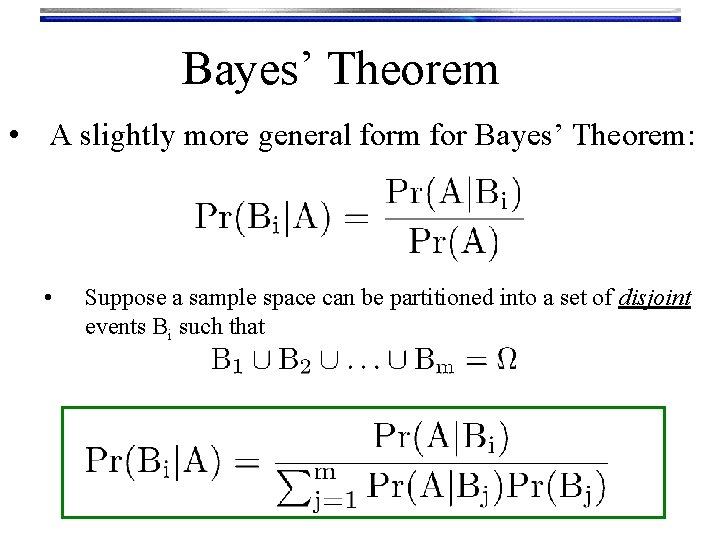
Bayes’ Theorem • A slightly more general form for Bayes’ Theorem: • Suppose a sample space can be partitioned into a set of disjoint events Bi such that
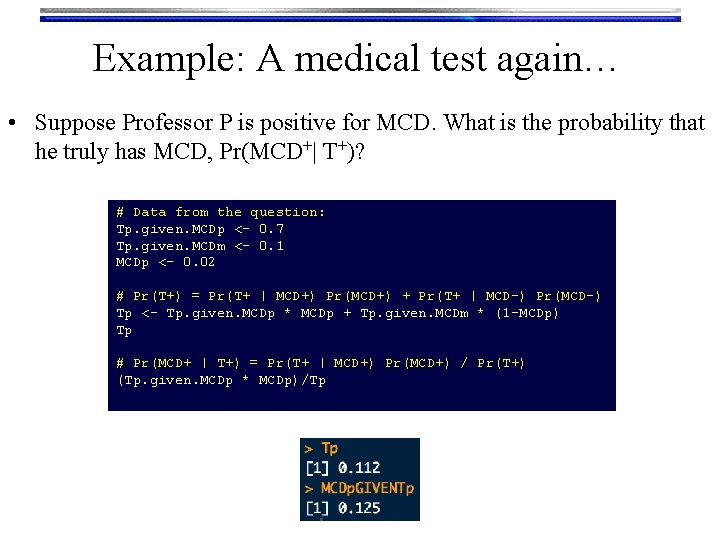
Example: A medical test again… • Suppose Professor P is positive for MCD. What is the probability that he truly has MCD, Pr(MCD+| T+)? # Data from the question: Tp. given. MCDp <- 0. 7 Tp. given. MCDm <- 0. 1 MCDp <- 0. 02 # Pr(T+) = Pr(T+ | MCD+) Pr(MCD+) + Pr(T+ | MCD-) Pr(MCD-) Tp <- Tp. given. MCDp * MCDp + Tp. given. MCDm * (1 -MCDp) Tp # Pr(MCD+ | T+) = Pr(T+ | MCD+) Pr(MCD+) / Pr(T+) (Tp. given. MCDp * MCDp)/Tp
- Slides: 15