
A Literacy Reality Check Assessing Gaps between What
A Literacy “Reality Check”: Assessing Gaps between What Is Taught and What is Needed Kate Perkins – English Instructor and Coordinator of Transitional Communication Carolyn Petsche – Director of Learning and Transitional Education Services Highland Community College, Freeport, IL
National Context Calls for new reforms ● Criticism of remedial courses in higher education led to a defense of remediation with calls for better course designs and clear knowledge of students’ needs and abilities (Boylan, 1999; Boylan, 2001). ○ Moving away from discrete-skills-based instruction (Boylan, 1999; Koski & Levin, 1998) ● Called for more thorough and timely program review (Koski & Levin, 1998).
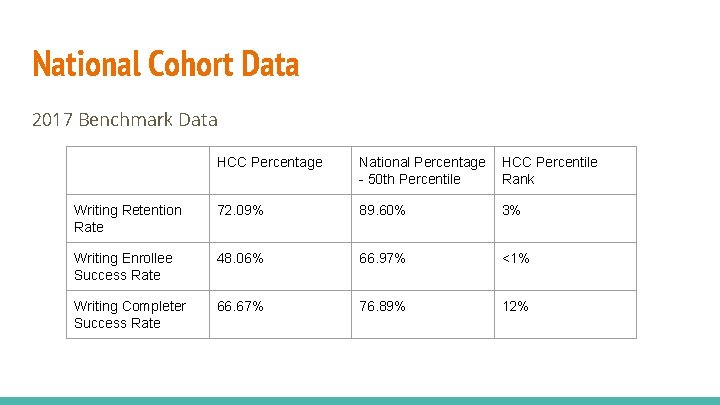
National Cohort Data 2017 Benchmark Data HCC Percentage National Percentage - 50 th Percentile HCC Percentile Rank Writing Retention Rate 72. 09% 89. 60% 3% Writing Enrollee Success Rate 48. 06% 66. 97% <1% Writing Completer Success Rate 66. 67% 76. 89% 12%
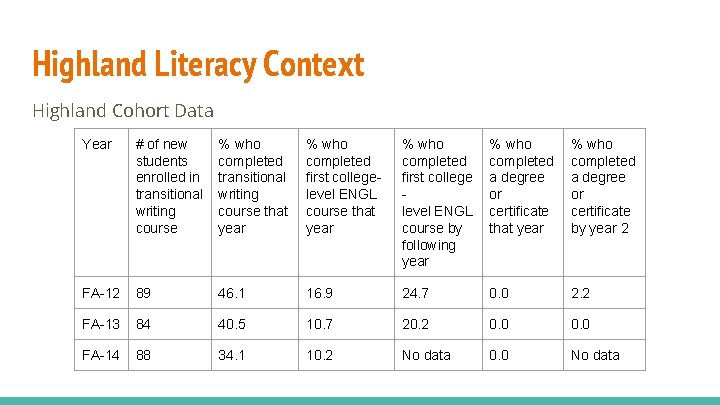
Highland Literacy Context Highland Cohort Data Year # of new students enrolled in transitional writing course % who completed transitional writing course that year % who completed first collegelevel ENGL course that year % who completed first college level ENGL course by following year % who completed a degree or certificate that year % who completed a degree or certificate by year 2 FA-12 89 46. 1 16. 9 24. 7 0. 0 2. 2 FA-13 84 40. 5 10. 7 20. 2 0. 0 FA-14 88 34. 1 10. 2 No data 0. 0 No data
Literature Review: Call for Redesigning Developmental Writing and Reading Courses ● Redesigns to developmental courses should include examination and revision of structure, curriculum, and pedagogy (Edgecombe, Jaggars, Xu & Barragan, 2014) ● Developmental coursework should “adopt a cognitive-based philosophy” by providing authentic tasks and promoting transfer (Stahl, Simpson & Hayes, 1992, p. 3) ● Understanding students’ beliefs and their impacts on student learning is essential (Simpson, Stahl & Francis, 2004)
Project’s Purpose ● Decided to replicate Burrell, Tao, Simpson & Mendez-Beruetta’s (1997) Reality Check to see what was happening in HCC’s intro classes to inform structural, curricular, and pedagogical changes in transitional reading and writing
Guiding Questions Expectations/Requirements ● What are the reading, writing, and critical thinking expectations for students to allow them to succeed in introductory courses of all disciplines at Highland? Perceptions ● What are introductory course faculty’s perceptions of student preparedness in reading, writing, and critical thinking?
Methods ● Adapted Burrell, Tao, Simpson & Mendez-Beruetta’s (1997) Reality Check Questions to own institution ○ Survey. Monkey survey distributed to faculty ● 42 survey items ○ Included demographic, basic course descriptors, and open-ended responses ● 39/50 respondents ○ ○ Representatives of all introductory courses requiring reading and/or writing placements or pre-requisites (Excluded CTE and nursing) Full- and part-time instructors
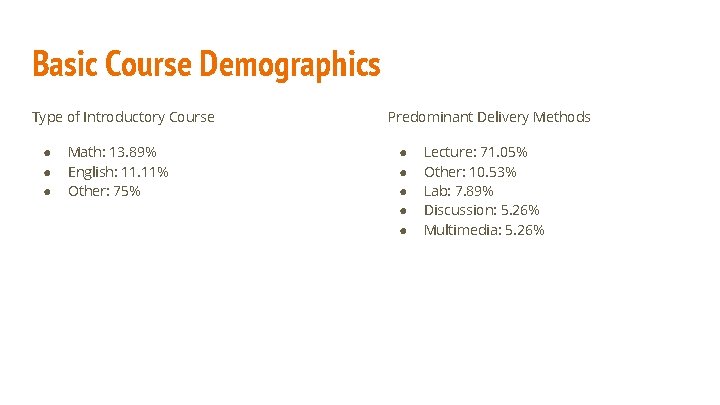
Basic Course Demographics Type of Introductory Course ● ● ● Math: 13. 89% English: 11. 11% Other: 75% Predominant Delivery Methods ● ● ● Lecture: 71. 05% Other: 10. 53% Lab: 7. 89% Discussion: 5. 26% Multimedia: 5. 26%
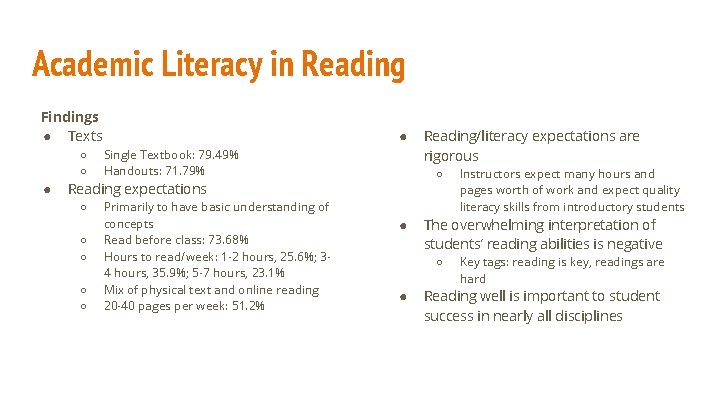
Academic Literacy in Reading Findings ● Texts ○ ○ ● ● Single Textbook: 79. 49% Handouts: 71. 79% ○ Reading expectations ○ ○ ○ Primarily to have basic understanding of concepts Read before class: 73. 68% Hours to read/week: 1 -2 hours, 25. 6%; 34 hours, 35. 9%; 5 -7 hours, 23. 1% Mix of physical text and online reading 20 -40 pages per week: 51. 2% Reading/literacy expectations are rigorous ● The overwhelming interpretation of students’ reading abilities is negative ○ ● Instructors expect many hours and pages worth of work and expect quality literacy skills from introductory students Key tags: reading is key, readings are hard Reading well is important to student success in nearly all disciplines
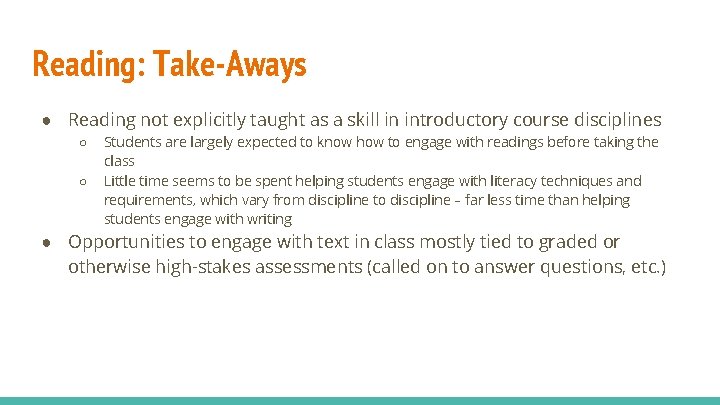
Reading: Take-Aways ● Reading not explicitly taught as a skill in introductory course disciplines ○ ○ Students are largely expected to know how to engage with readings before taking the class Little time seems to be spent helping students engage with literacy techniques and requirements, which vary from discipline to discipline – far less time than helping students engage with writing ● Opportunities to engage with text in class mostly tied to graded or otherwise high-stakes assessments (called on to answer questions, etc. )
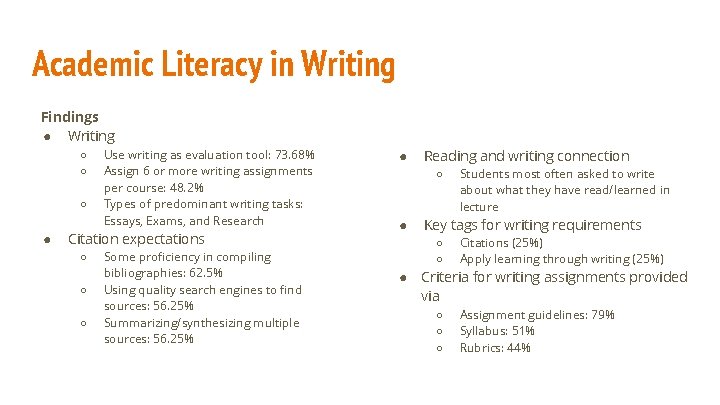
Academic Literacy in Writing Findings ● Writing ○ ○ ○ ● Use writing as evaluation tool: 73. 68% Assign 6 or more writing assignments per course: 48. 2% Types of predominant writing tasks: Essays, Exams, and Research Citation expectations ○ ○ ○ Some proficiency in compiling bibliographies: 62. 5% Using quality search engines to find sources: 56. 25% Summarizing/synthesizing multiple sources: 56. 25% ● Reading and writing connection ○ ● Key tags for writing requirements ○ ○ ● Students most often asked to write about what they have read/learned in lecture Citations (25%) Apply learning through writing (25%) Criteria for writing assignments provided via ○ ○ ○ Assignment guidelines: 79% Syllabus: 51% Rubrics: 44%
Writing: Take-Aways ● Primarily, writing is used to assess knowledge of content that has been read or learned in class; however, most instructors also expect good writing practices - strong paragraphs, essay structure, mechanics ○ Many instructors provide feedback on writing practices instead of disciplinary content, which may skew students’ understanding of the importance of writing as a way to communicate learned knowledge and/or analyze and synthesize information ● Most writing opportunities tied to grades or high-stakes assessments
Academic Literacy in Critical Thinking Findings ● Learning Criteria ○ ○ Conceptual understanding demonstrated in writing: 86. 21% Develops introduction, paragraphs, topic sentences, citations: 28 -51. 42% ● Studying ○ ○ Test types: Long essay, 100%; Problem solving, 95. 65%; Multiple Choice, 92. 86% Tests assess: Application, 30. 85%; Knowledge, 28. 43%; Comprehension, 20. 8 % Tests performance: Explanation, 35. 5%; Analyze, 24. 23%; Summarize, 19. 14% Test info comes from: Lectures, 50%; Textbook, 44. 12%
Critical Thinking and Readiness: Take-Aways ● Lots of readings, written assignments, and essay tests, but it is not clear that learning tasks target desired outcomes ○ ○ Primary goals are higher order thinking: analysis, evaluation Assignments assess lower order thinking: knowledge, application ● Most critical thinking opportunities tied to grades or high-stakes assessments ● Overall negative conception of student readiness and willingness to seek help to succeed
Implications for Teaching ● Literacy expectations should be more in line with assignment and assessment types ○ ○ ○ Campus definition of literacy expectations and core outcomes/competencies Transitional course alignment with this definition and core outcomes Expand basic skills course outcomes to align with definition and core outcomes Establish disciplinary practices in each department to hone broader campus literacy expectations Center courses around critical thinking instead of template/procedural writing, reading, and test taking to ensure tasks align with higher order conceptual understanding ● More cross-campus collaboration needs to be done to help students be more academically literate ○ ○ ○ Faculty collaboration Administrative collaboration Student services collaboration
Implications for Teaching ● Provide low-stakes opportunities for students to develop academic literacy skills ● Students need instruction and practice in disciplinary literacy skills and techniques in each ● course Students benefit from opportunities to learn and demonstrate skills before being graded on them ● Expand students’ knowledge of techniques for success ● Explicit classroom instruction on affective/non-cognitive skills can be of benefit ● Consider ways to realign perceptions of student abilities ● Negative perceptions can leak into tone, affect, etc. during interactions with students
Project Limitations ● Questions too pointed in places, not pointed enough in others ● Tried to do too much with one survey ● Took too long to hone and pilot survey
Future Plans ● Revise survey to gather more specific data ● Survey students to determine their expectations and beliefs about academic literacy requirements ● Follow-up the faculty and student surveys with focus-group meetings
Acknowledgements ● Literacy Survey group members ○ Carolyn Petsche, Misty Thruman, Sue Sauer, Chris Kuberski, and Kate Perkins ■ This group developed and piloted the survey and analyzed the data ● Special thanks ○ Dr. Jodi Lampi, NIU ■ Dr. Lampi collaborated on interpreting and preparing the data for presentation
References ● ● ● Armstrong, S. L, Stahl, N. A. & Kantner M. J. (2015). Investigating academic literacy expectations: A curriculum audit model. Journal of Developmental Education, 38, pp. 2 -23. Retrieved from https: //eric. ed. gov/? id=EJ 1083368 Azimi, H. (2018). ALP Faculty Workshop. Power. Point, Freeport, IL. Boylan, H. R. (1999). Developmental and remedial education in postsecondary education. New Directions for Higher Education , 108, pp. 87 -101. DOI: 10. 1002/he. 10806 Boylan, H. R. (2001). Developmental students: Why are they here and who are they? . In Farmer, V. L. , et. al. (authors), Selected Models of Developmental Education Programs (pp. 5 -22). Lanham, MD: University Press of America. Burrell, K. L. , Tao, L. , Simpson, M. L. , & Mendez-Beruetta, H. (1997). How do we know what we are preparing our students for? A reality check of one university’s academic literacy demands. Research in Teaching Developmental Education , 13, pp. 55 -70.
References ● ● ● Edgecombe, N. , Jaggars, S. S. , Xu, D. & Barragan, M. (2014). Accelerating the integrated instruction of developmental reading and writing at Chabot College. (CCRC Working Paper No. 71). New York, NY: Community College Research Center. Koski, W. S. & Levin, H. M. (1998). Replacing remediation with acceleration in higher education: Preliminary report on literature review and initial interviews. Washington, D. C. : National Center for Postsecondary Improvement National Higher Education Benchmarking Institute. (2017). National Community College Benchmark Project. Overland Park, KS: National Benchmarking Institute. Simpson, M. L. , Stahl, N. A. & Francis, M. A. (2004). Reading and learning strategies: Recommendations for the twenty-first century. Journal of Developmental Education, 28, pp. 214 Retrieved from https: //eric. ed. gov/? id=EJ 718571 Stahl, N. A. , Simpson, M. L. & Hayes, C. G. (1992). Ten recommendations from research for teaching high-risk college students. Journal of Developmental Education, 16, pp. 2 -11.
- Slides: 22