
a LIGO BSFM Level 2 Damping Loop Design
a. LIGO BSFM “Level 2” Damping Loop Design (Supplemental to LHO a. LOG 6392) J. Kissel G 1300561 -v 1 1

a. LIGO BSFM "Level 2" Damping Loop Design Mission Statement The damping loops installed during the SUS testing phase • merely to prove that the suspensions could be damped • damped quickly and robustly • little-to-no regard to re-injection of sensor noise • very aggressive, but poorly placed elliptic filters to rolloff noise The mission here was to design a set of loops, that Level 1 Level 2 • doesn’t take you years to design and tweak • isn’t on the hairy edge of instability • doesn’t require any “Brett Shapiro” trickery (damping in Modal, Global bases) • doesn’t require and new infrastructure (which Modal and Global damping would), but still • designed with what modeling experience we’ve gained • gets us close to what we’ll need for a. LIGO, primarily focusing on Longitudinal • will be sufficient for the first several stages of integrated testing G 1300537 -v 2 2
Damping Loop Design Model Figures of Merit • Stability: Bode plots of Open and Closed Loop Gain Transfer Functions • Cross-Coupling: The above, Modeled both as SISO and MIMO systems, the below as MIMO • Modeled Performance: Compute all DOF’s of Top Mass sensor noise contribution to Optic degree of freedom of interest • Compare: with other noise sources, requirements, coupling to DARM, etc. • Measured Performance: With what we can: Closed Loop TOP 2 TOP Open and Closed Loop TFs, TOP Sensor ASDs, TOP Control Signal ASDs (Check out G 1300537 and LLO a. LOG 6949 for a more thorough description; I assume from here on that you’ve seen and understand what they mean, so I can get right to the points. ) G 1300537 -v 2 3
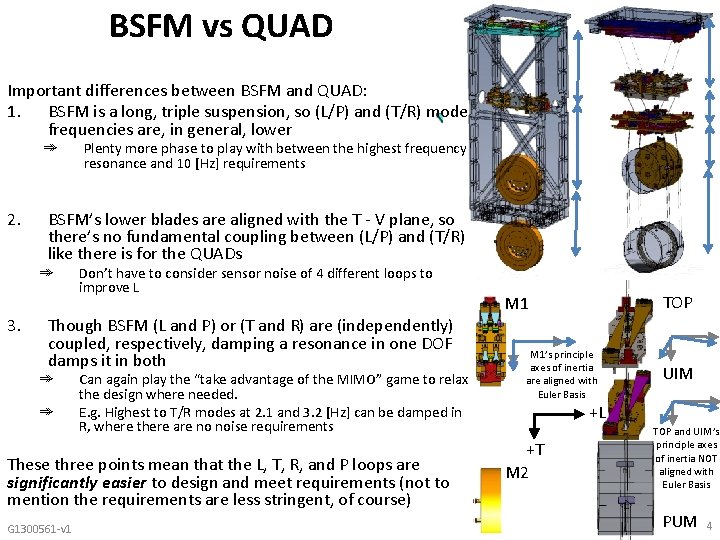
BSFM vs QUAD Important differences between BSFM and QUAD: 1. BSFM is a long, triple suspension, so (L/P) and (T/R) mode frequencies are, in general, lower ➾ 2. BSFM’s lower blades are aligned with the T - V plane, so there’s no fundamental coupling between (L/P) and (T/R) like there is for the QUADs ➾ 3. Plenty more phase to play with between the highest frequency resonance and 10 [Hz] requirements Don’t have to consider sensor noise of 4 different loops to improve L Though BSFM (L and P) or (T and R) are (independently) coupled, respectively, damping a resonance in one DOF damps it in both ➾ ➾ Can again play the “take advantage of the MIMO” game to relax the design where needed. E. g. Highest to T/R modes at 2. 1 and 3. 2 [Hz] can be damped in R, where there are no noise requirements These three points mean that the L, T, R, and P loops are significantly easier to design and meet requirements (not to mention the requirements are less stringent, of course) G 1300561 -v 1 TOP M 1’s principle axes of inertia are aligned with Euler Basis UIM +L +T M 2 TOP and UIM’s principle axes of inertia NOT aligned with Euler Basis PUM 4
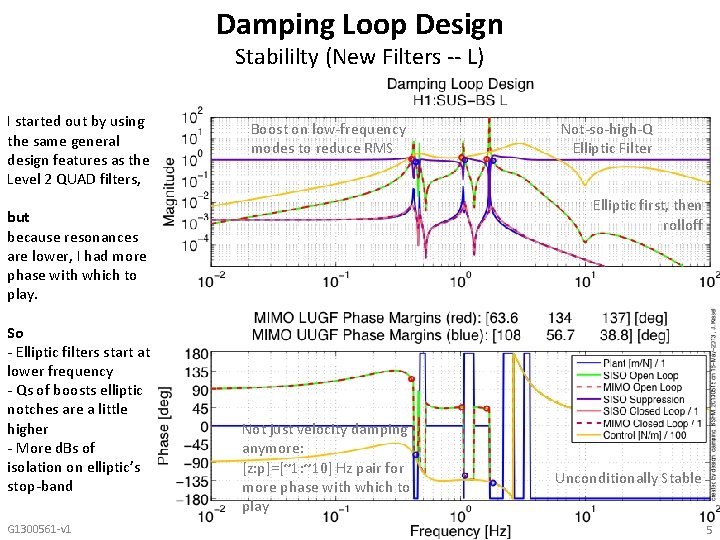
Damping Loop Design Stabililty (New Filters -- L) I started out by using the same general design features as the Level 2 QUAD filters, Boost on low-frequency modes to reduce RMS Elliptic first, then rolloff but because resonances are lower, I had more phase with which to play. So - Elliptic filters start at lower frequency - Qs of boosts elliptic notches are a little higher - More d. Bs of isolation on elliptic’s stop-band G 1300561 -v 1 Not-so-high-Q Elliptic Filter Not just velocity damping anymore: [z: p]=[~1: ~10] Hz pair for more phase with which to play Unconditionally Stable 5
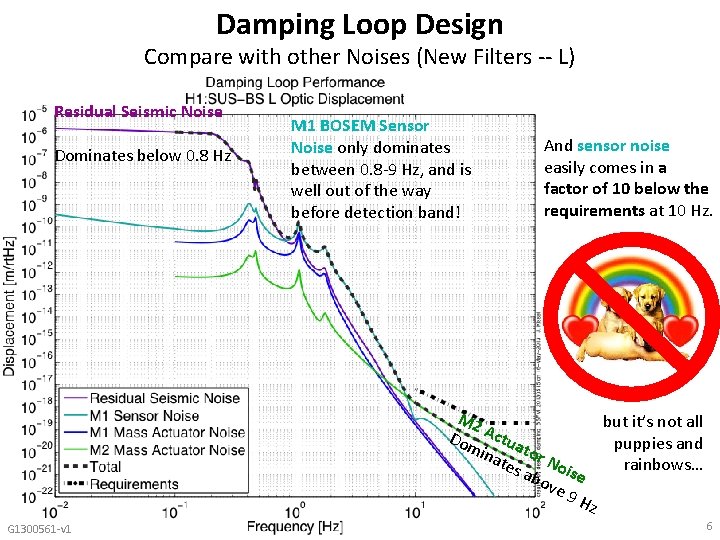
Damping Loop Design Compare with other Noises (New Filters -- L) Residual Seismic Noise Dominates below 0. 8 Hz M 1 BOSEM Sensor Noise only dominates between 0. 8 -9 Hz, and is well out of the way before detection band! And sensor noise easily comes in a factor of 10 below the requirements at 10 Hz. M 2 but it’s not all A Do ctua puppies and min t ate or No rainbows… s ab ise ove 9 H z G 1300561 -v 1 6
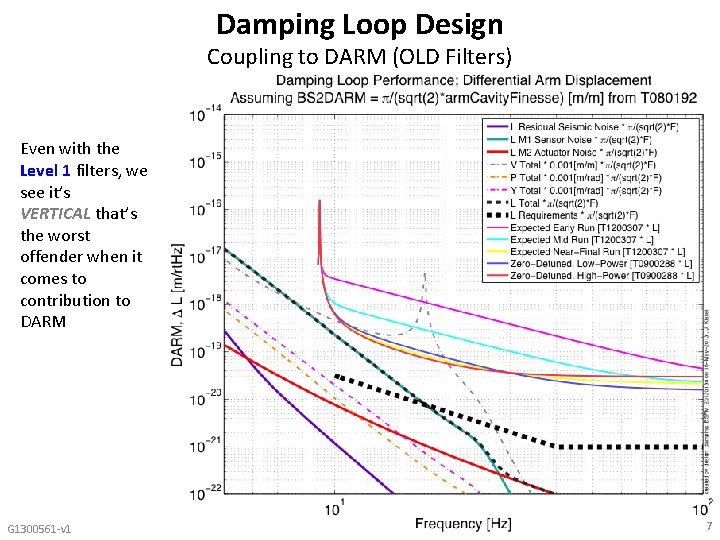
Damping Loop Design Coupling to DARM (OLD Filters) Even with the Level 1 filters, we see it’s VERTICAL that’s the worst offender when it comes to contribution to DARM G 1300561 -v 1 7
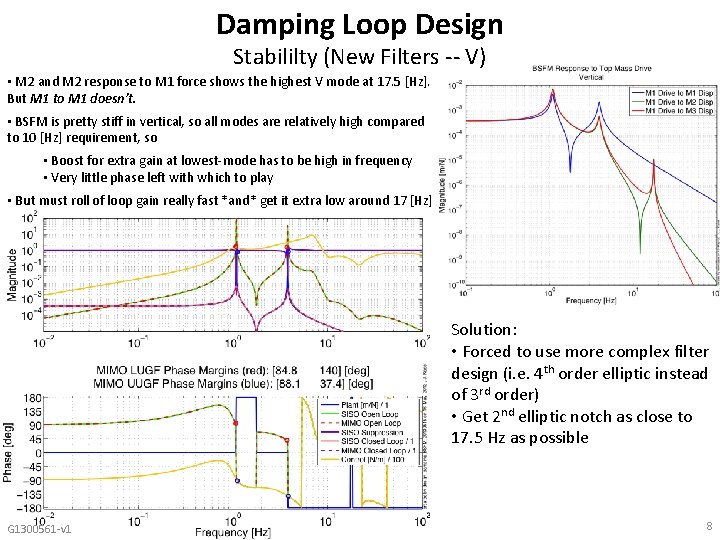
Damping Loop Design Stabililty (New Filters -- V) • M 2 and M 2 response to M 1 force shows the highest V mode at 17. 5 [Hz]. But M 1 to M 1 doesn’t. • BSFM is pretty stiff in vertical, so all modes are relatively high compared to 10 [Hz] requirement, so • Boost for extra gain at lowest-mode has to be high in frequency • Very little phase left with which to play • But must roll of loop gain really fast *and* get it extra low around 17 [Hz] Solution: • Forced to use more complex filter design (i. e. 4 th order elliptic instead of 3 rd order) • Get 2 nd elliptic notch as close to 17. 5 Hz as possible G 1300561 -v 1 8
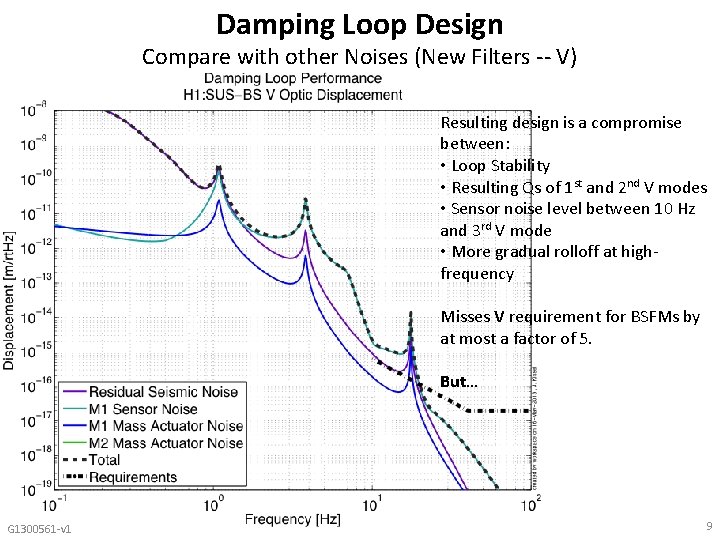
Damping Loop Design Compare with other Noises (New Filters -- V) Resulting design is a compromise between: • Loop Stability • Resulting Qs of 1 st and 2 nd V modes • Sensor noise level between 10 Hz and 3 rd V mode • More gradual rolloff at highfrequency Misses V requirement for BSFMs by at most a factor of 5. But… G 1300561 -v 1 9
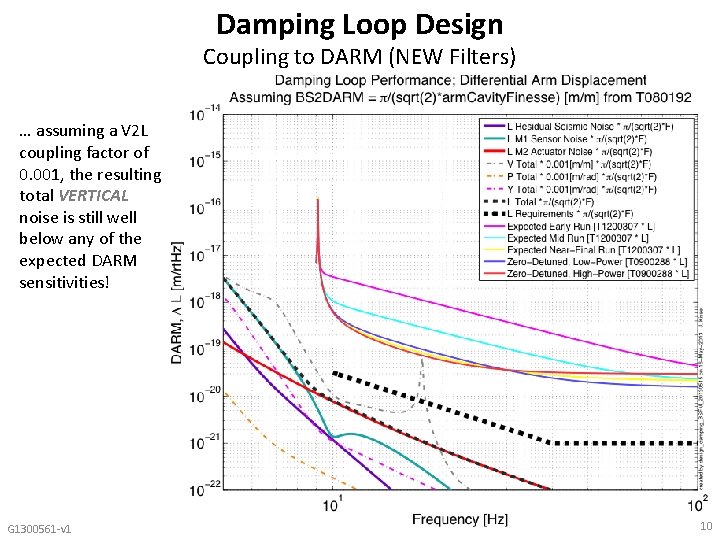
Damping Loop Design Coupling to DARM (NEW Filters) … assuming a V 2 L coupling factor of 0. 001, the resulting total VERTICAL noise is still well below any of the expected DARM sensitivities! G 1300561 -v 1 10
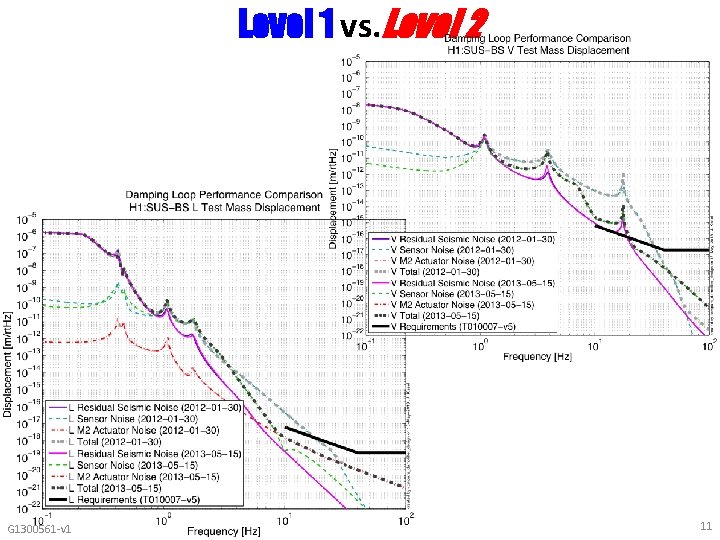
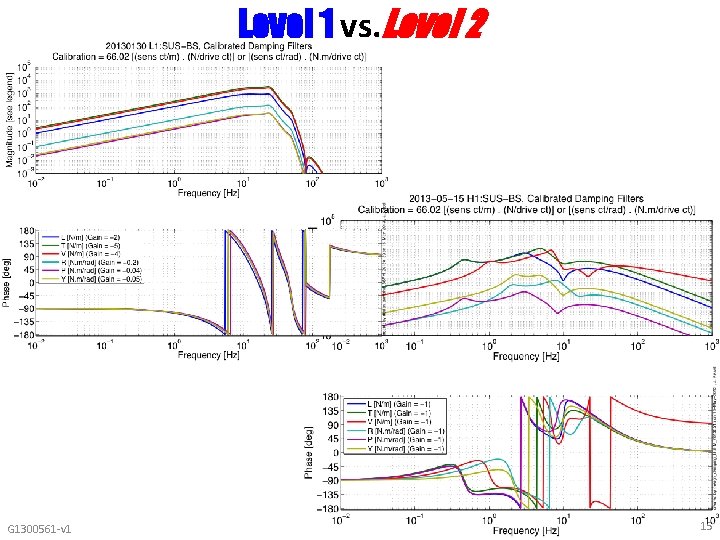
Level 1 vs. Level 2 G 1300561 -v 1 11
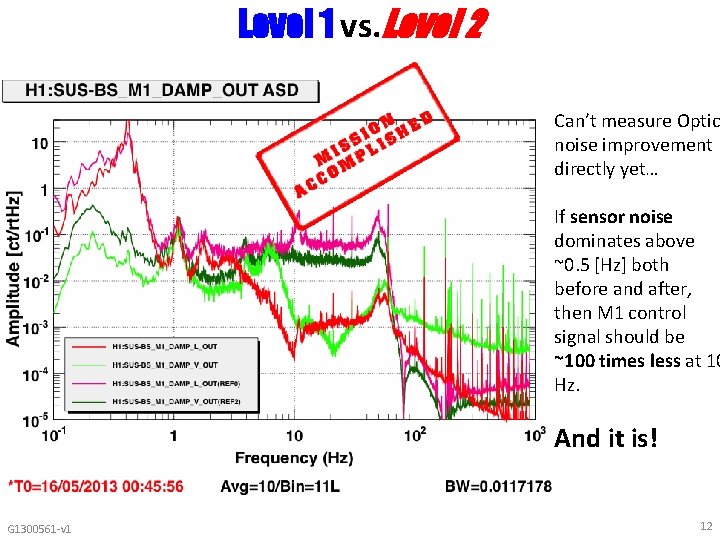
Level 1 vs. Level 2 Can’t measure Optic noise improvement directly yet… If sensor noise dominates above ~0. 5 [Hz] both before and after, then M 1 control signal should be ~100 times less at 10 Hz. And it is! G 1300561 -v 1 12
Concluding Remarks • BSFM Level 2 damping filters beat almost all a. LIGO requirements • BSFM design, in general was easier than the QUAD; Vertical is the toughest • Design choices – Chose to absorb over all gain into boost filter – Chose to move boost filters up in frequency on some DOFs • Proof of design measurements – I didn’t measure the open loop gain transfer functions • the experience with the QUAD has shown – the measurements to be more confusing than they’re worth – the measurements confirm the cross-coupled MIMO model works • So in the interest of time, I’ve nixed them – Will get closed loop transfer functions and spectra over the course of phase 3 a testing G 1300561 -v 1 13

Bonus Material For the Curious Remember, for even more text, plots, details see LHO a. LOG 6392 G 1300537 -v 2 14
Level 1 vs. Level 2 G 1300561 -v 1 15
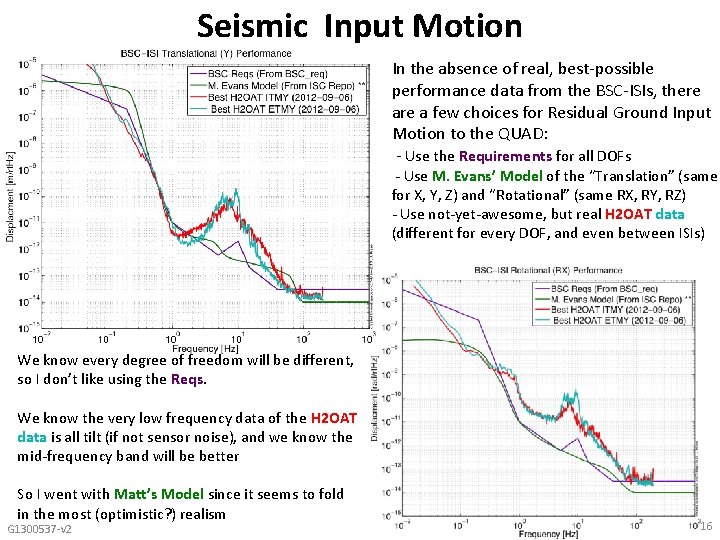
Seismic Input Motion In the absence of real, best-possible performance data from the BSC-ISIs, there a few choices for Residual Ground Input Motion to the QUAD: - Use the Requirements for all DOFs - Use M. Evans’ Model of the “Translation” (same for X, Y, Z) and “Rotational” (same RX, RY, RZ) - Use not-yet-awesome, but real H 2 OAT data (different for every DOF, and even between ISIs) We know every degree of freedom will be different, so I don’t like using the Reqs. We know the very low frequency data of the H 2 OAT data is all tilt (if not sensor noise), and we know the mid-frequency band will be better So I went with Matt’s Model since it seems to fold in the most (optimistic? ) realism G 1300537 -v 2 16
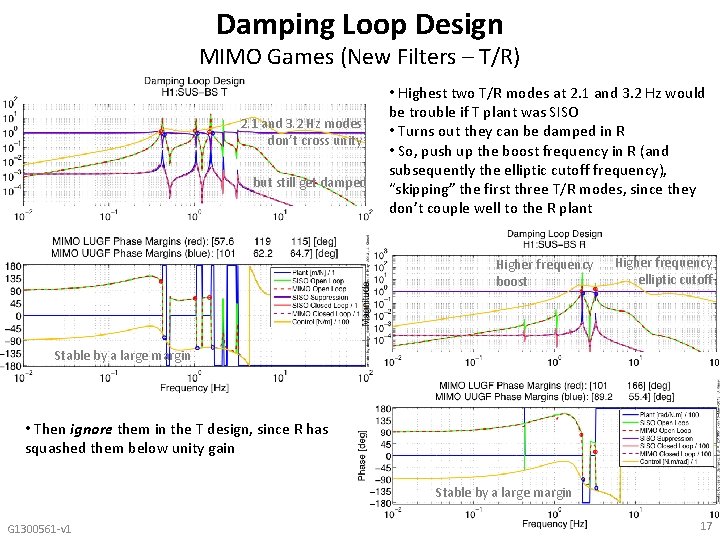
Damping Loop Design MIMO Games (New Filters – T/R) 2. 1 and 3. 2 Hz modes don’t cross unity but still get damped • Highest two T/R modes at 2. 1 and 3. 2 Hz would be trouble if T plant was SISO • Turns out they can be damped in R • So, push up the boost frequency in R (and subsequently the elliptic cutoff frequency), “skipping” the first three T/R modes, since they don’t couple well to the R plant Higher frequency boost Higher frequency elliptic cutoff Stable by a large margin • Then ignore them in the T design, since R has squashed them below unity gain Stable by a large margin G 1300561 -v 1 17
- Slides: 17