
A Lightweight Visualization of Interprocedural DataFlow Paths for

![Graph Traversal with Fractal Value • Fractal value [Koike, 1995] to focus on a](https://slidetodoc.com/presentation_image_h2/89d09d8f54aa82763b4cd9acd0ccccda/image-13.jpg "Graph Traversal with Fractal Value • Fractal value [Koike, 1995] to focus on a")
![Related Work • Program Slicing using SDG [Horwitz, 1990] – Our data-flow graph is](https://slidetodoc.com/presentation_image_h2/89d09d8f54aa82763b4cd9acd0ccccda/image-20.jpg "Related Work • Program Slicing using SDG [Horwitz, 1990] – Our data-flow graph is")
- Slides: 27
A Lightweight Visualization of Interprocedural Data-Flow Paths for Source Code Reading Takashi Ishio Shogo Etsuda Katsuro Inoue Osaka University 1 Software Engineering Laboratory, Department of Computer Science, Graduate School of Information Science and Technology, Osaka University
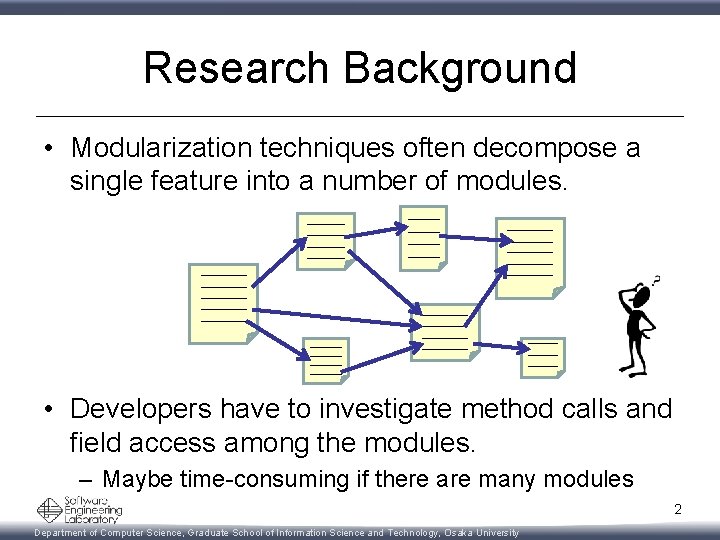
Research Background • Modularization techniques often decompose a single feature into a number of modules. • Developers have to investigate method calls and field access among the modules. – Maybe time-consuming if there are many modules 2 Department of Computer Science, Graduate School of Information Science and Technology, Osaka University
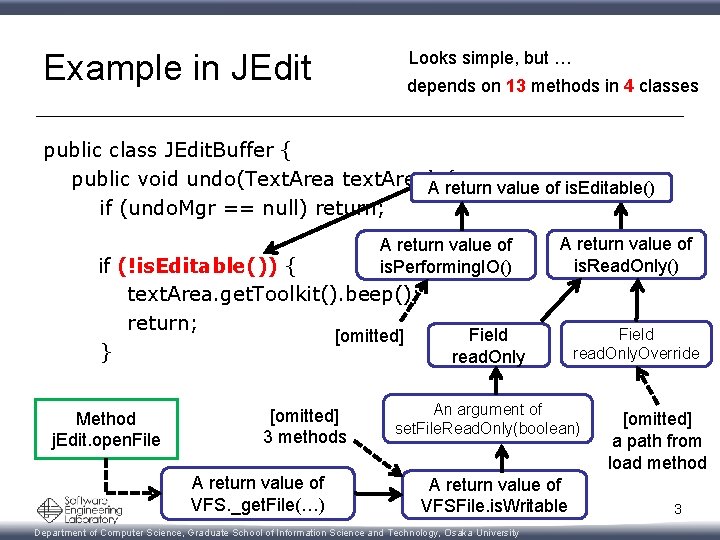
Example in JEdit Looks simple, but … depends on 13 methods in 4 classes public class JEdit. Buffer { public void undo(Text. Area text. Area)A { return value of is. Editable() if (undo. Mgr == null) return; A return value of is. Performing. IO() if (!is. Editable()) { text. Area. get. Toolkit(). beep(); return; [omitted] } try { [omitted] Method write. Lock(); 3 methods j. Edit. open. File. . . A return value of VFS. _get. File(…) A return value of is. Read. Only() Field read. Only. Override An argument of set. File. Read. Only(boolean) A return value of VFSFile. is. Writable Department of Computer Science, Graduate School of Information Science and Technology, Osaka University [omitted] a path from load method 3
Visualizing data-flow graph for source code reading • Call graph is popular but too coarse-grained. – Developers have to read each method to identify the data-flow paths related to the current tasks. • System dependence graph [Horwitz, 1990] is also applicable but too complex to visualize. – SDG includes all statements of a program. 4 Department of Computer Science, Graduate School of Information Science and Technology, Osaka University
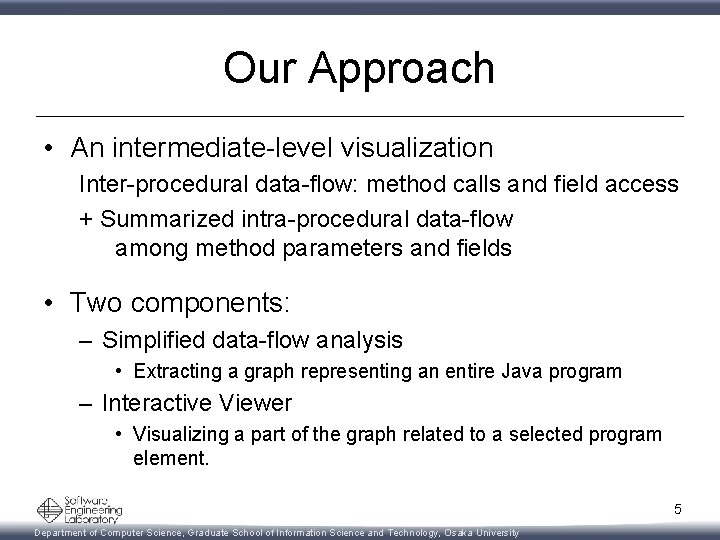
Our Approach • An intermediate-level visualization Inter-procedural data-flow: method calls and field access + Summarized intra-procedural data-flow among method parameters and fields • Two components: – Simplified data-flow analysis • Extracting a graph representing an entire Java program – Interactive Viewer • Visualizing a part of the graph related to a selected program element. 5 Department of Computer Science, Graduate School of Information Science and Technology, Osaka University
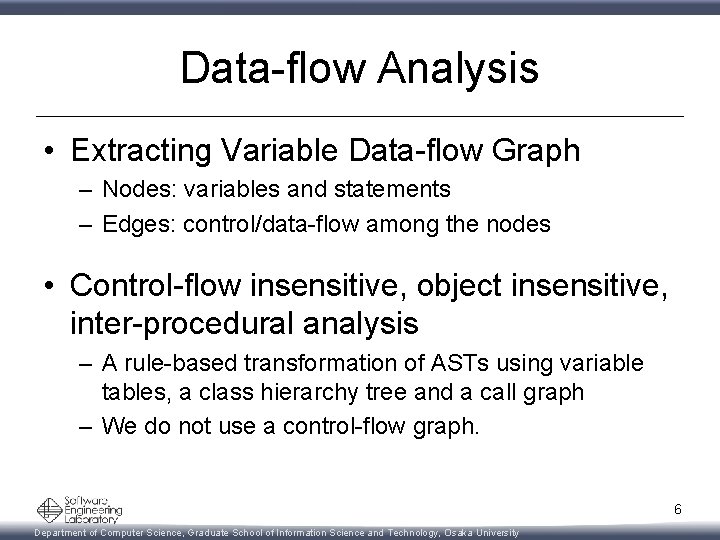
Data-flow Analysis • Extracting Variable Data-flow Graph – Nodes: variables and statements – Edges: control/data-flow among the nodes • Control-flow insensitive, object insensitive, inter-procedural analysis – A rule-based transformation of ASTs using variable tables, a class hierarchy tree and a call graph – We do not use a control-flow graph. 6 Department of Computer Science, Graduate School of Information Science and Technology, Osaka University
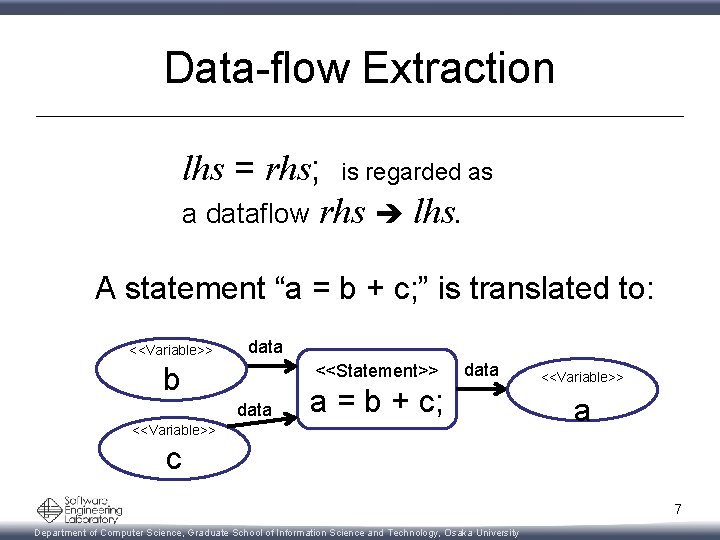
Data-flow Extraction lhs = rhs; is regarded as a dataflow rhs lhs. A statement “a = b + c; ” is translated to: <<Variable>> data <<Statement>> b data a = b + c; <<Variable>> a c 7 Department of Computer Science, Graduate School of Information Science and Technology, Osaka University
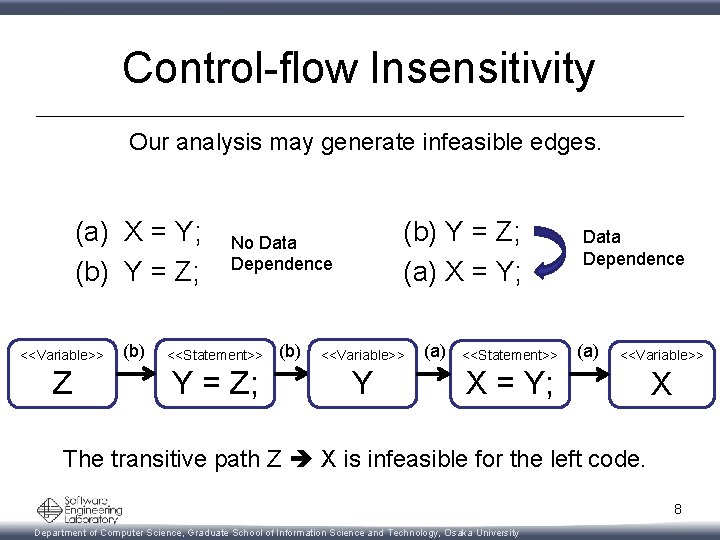
Control-flow Insensitivity Our analysis may generate infeasible edges. (a) X = Y; (b) Y = Z; <<Variable>> Z (b) Y = Z; (a) X = Y; No Data Dependence <<Statement>> Y = Z; (b) <<Variable>> Y (a) <<Statement>> Data Dependence (a) <<Variable>> X = Y; X The transitive path Z X is infeasible for the left code. 8 Department of Computer Science, Graduate School of Information Science and Technology, Osaka University
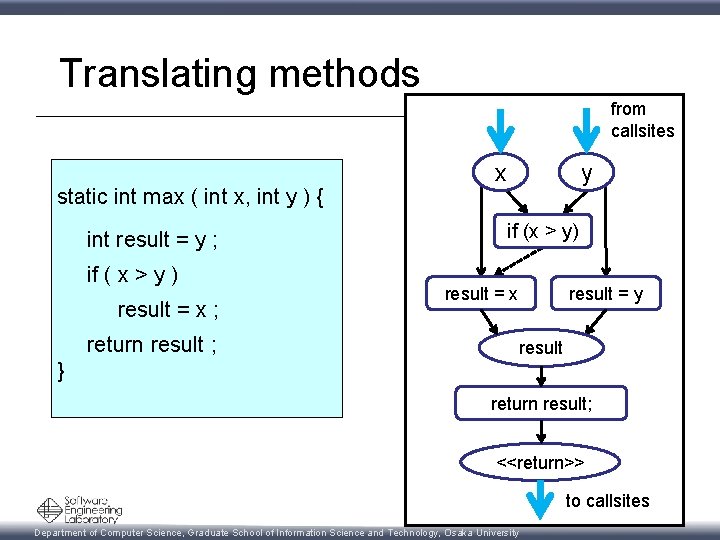
Translating methods from callsites static int max ( int x, int y ) { int result = y ; if ( x > y ) result = x ; return result ; x y if (x > y) result = x result = y result } return result; <<return>> to callsites Department of Computer Science, Graduate School of Information Science and Technology, Osaka University
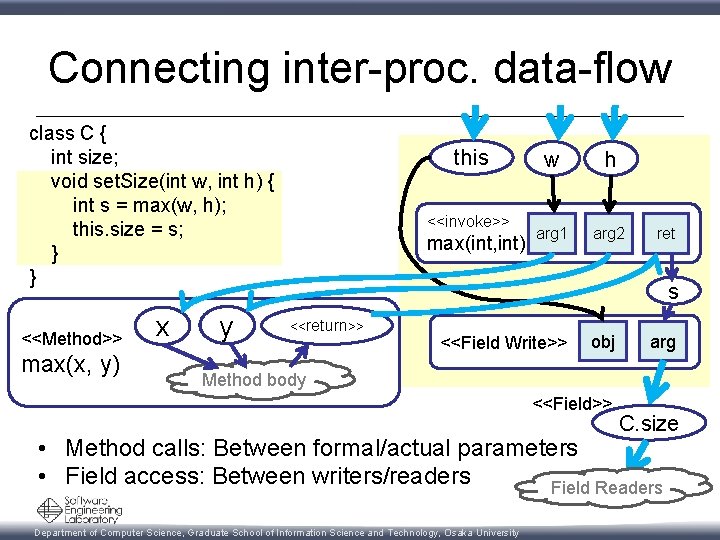
Connecting inter-proc. data-flow class C { int size; void set. Size(int w, int h) { int s = max(w, h); this. size = s; } } <<Method>> max(x, y) obj x y this <<invoke>> max(int, int) w h arg 1 arg 2 ret s <<return>> <<Field Write>> arg. Method body obj <<Field>> arg C. size 10 • Method calls: Between formal/actual parameters • Field access: Between writers/readers Field Readers Department of Computer Science, Graduate School of Information Science and Technology, Osaka University
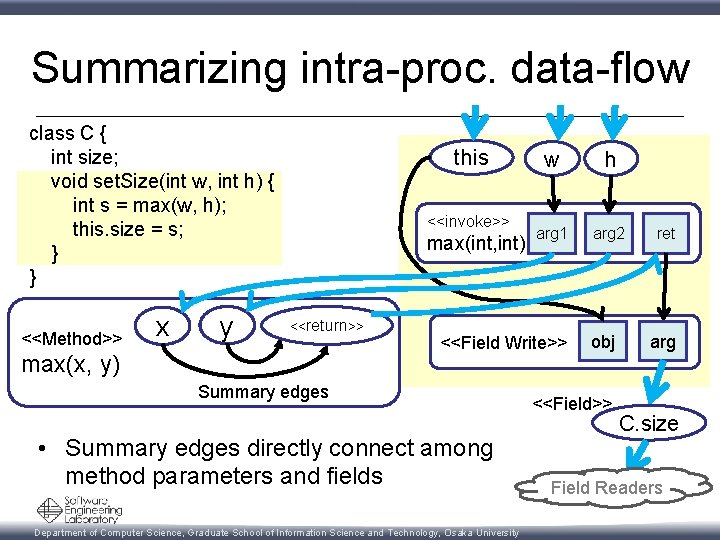
Summarizing intra-proc. data-flow class C { int size; void set. Size(int w, int h) { int s = max(w, h); this. size = s; } } <<Method>> max(x, y) obj x y this <<invoke>> max(int, int) <<return>> w h arg 1 arg 2 <<Field Write>> arg Summary edges • Summary edges directly connect among method parameters and fields Department of Computer Science, Graduate School of Information Science and Technology, Osaka University obj <<Field>> ret arg C. size 11 Field Readers
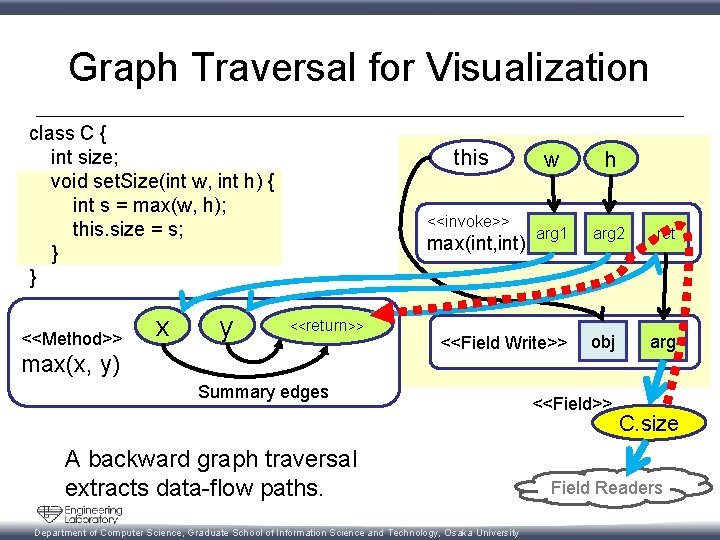
Graph Traversal for Visualization class C { int size; void set. Size(int w, int h) { int s = max(w, h); this. size = s; } } <<Method>> max(x, y) obj x y this <<invoke>> max(int, int) <<return>> w h arg 1 arg 2 <<Field Write>> arg Summary edges A backward graph traversal extracts data-flow paths. Department of Computer Science, Graduate School of Information Science and Technology, Osaka University obj <<Field>> ret arg C. size 12 Field Readers
Graph Traversal with Fractal Value • Fractal value [Koike, 1995] to focus on a small subgraph. Fractal Value = 1. 0 A return value of is. Editable() – A graph traversal starts with the 0. 5 initial value: 1. 0. A return value of – A fractal value of a node is is. Performing. IO() divided to the next nodes. 0. 25 – If the value is less than threshold, Field the traversal is terminated. read. Only – A backward traversal is likely terminated at a large fan-in node • Global Variables • Utility Methods [omitted] 3 methods 0. 5 A return value of is. Read. Only() 0. 25 Field read. Only. Override 0. 0625 A return value of VFS. _get. File(…) 13 Department of Computer Science, Graduate School of Information Science and Technology, Osaka University
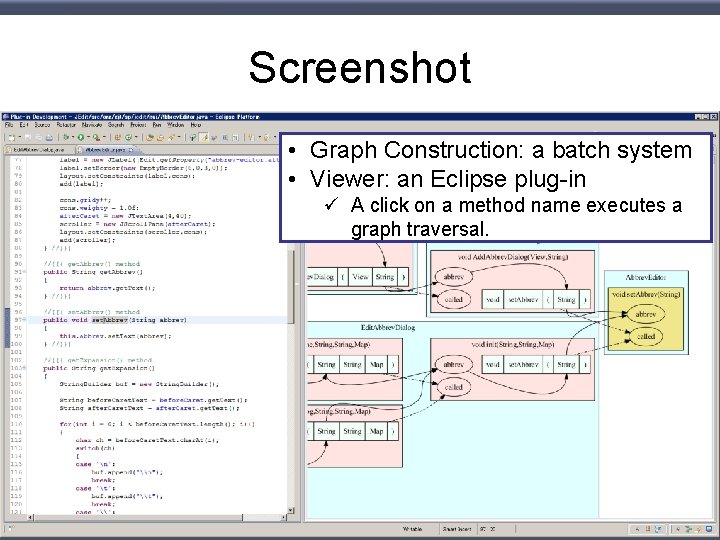
Screenshot • Graph Construction: a batch system • Viewer: an Eclipse plug-in ü A click on a method name executes a graph traversal. 14 Department of Computer Science, Graduate School of Information Science and Technology, Osaka University
Experiment Is it effective for program understanding? 15 Department of Computer Science, Graduate School of Information Science and Technology, Osaka University
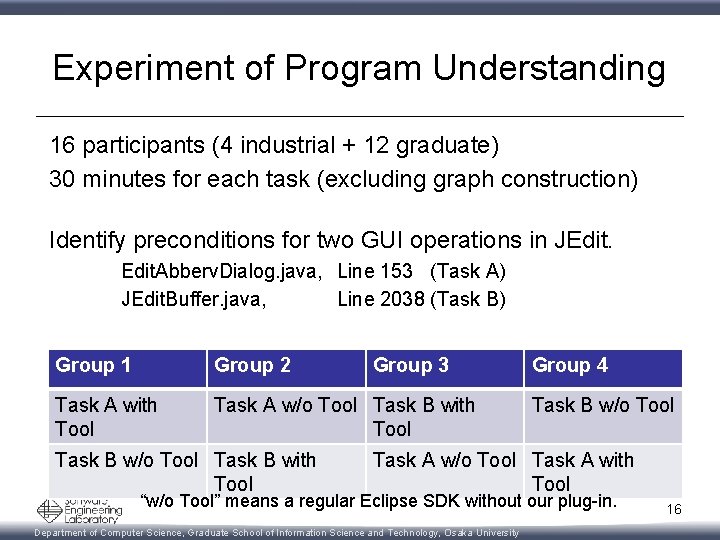
Experiment of Program Understanding 16 participants (4 industrial + 12 graduate) 30 minutes for each task (excluding graph construction) Identify preconditions for two GUI operations in JEdit. Abberv. Dialog. java, Line 153 (Task A) JEdit. Buffer. java, Line 2038 (Task B) Group 1 Group 2 Task A with Tool Task A w/o Tool Task B with Tool Task B w/o Tool Task B with Tool Group 3 Group 4 Task B w/o Tool Task A with Tool “w/o Tool” means a regular Eclipse SDK without our plug-in. Department of Computer Science, Graduate School of Information Science and Technology, Osaka University 16
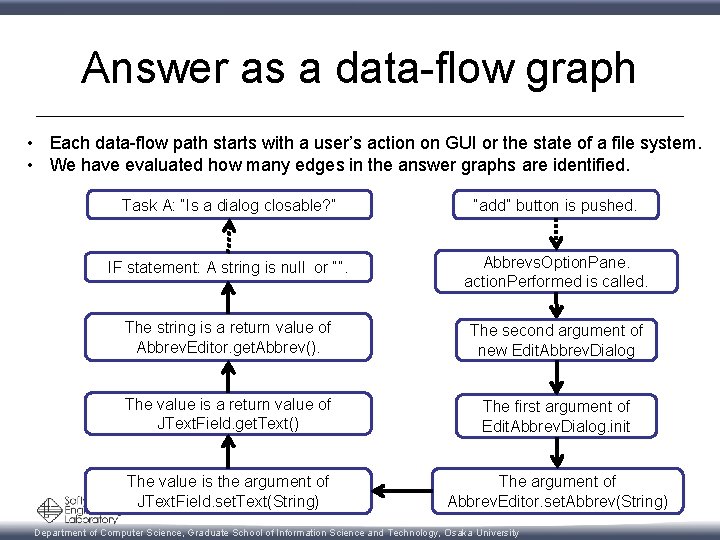
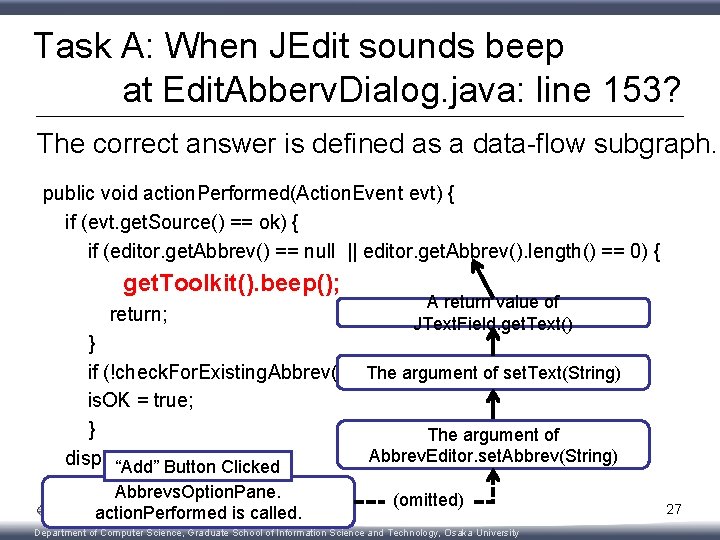
Answer as a data-flow graph • Each data-flow path starts with a user’s action on GUI or the state of a file system. • We have evaluated how many edges in the answer graphs are identified. Task A: “Is a dialog closable? ” “add” button is pushed. IF statement: A string is null or “”. Abbrevs. Option. Pane. action. Performed is called. The string is a return value of Abbrev. Editor. get. Abbrev(). The second argument of new Edit. Abbrev. Dialog The value is a return value of JText. Field. get. Text() The first argument of Edit. Abbrev. Dialog. init The value is the argument of JText. Field. set. Text(String) The argument of Abbrev. Editor. set. Abbrev(String)17 Department of Computer Science, Graduate School of Information Science and Technology, Osaka University
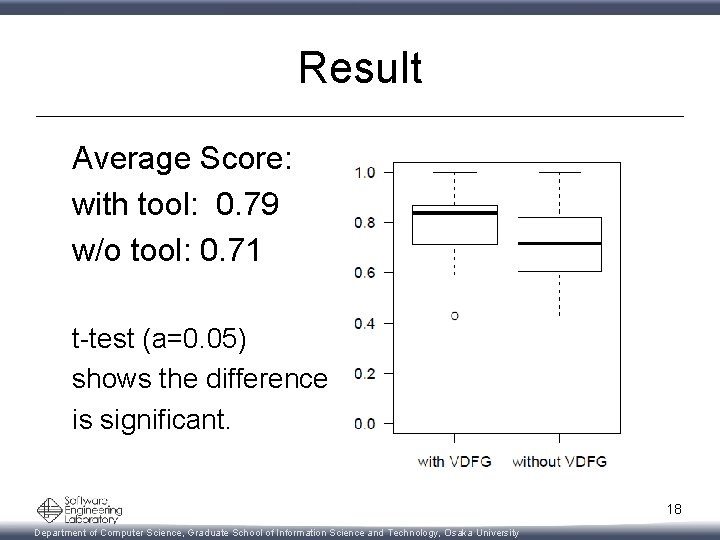
Result Average Score: with tool: 0. 79 w/o tool: 0. 71 t-test (a=0. 05) shows the difference is significant. 18 Department of Computer Science, Graduate School of Information Science and Technology, Osaka University
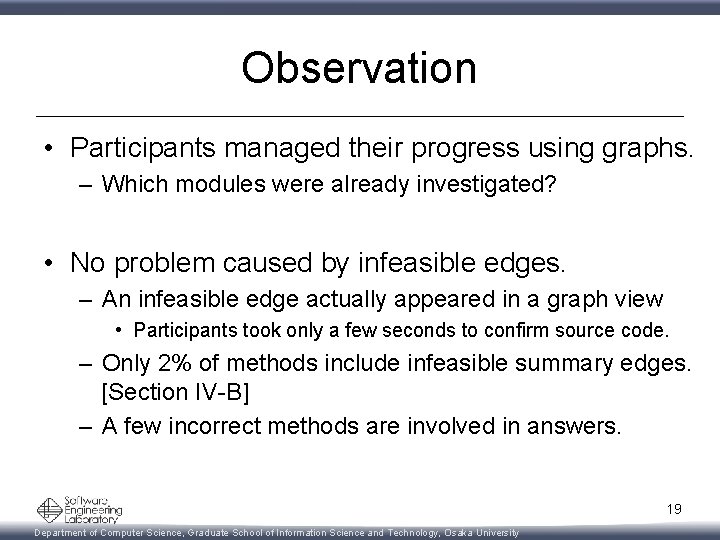
Observation • Participants managed their progress using graphs. – Which modules were already investigated? • No problem caused by infeasible edges. – An infeasible edge actually appeared in a graph view • Participants took only a few seconds to confirm source code. – Only 2% of methods include infeasible summary edges. [Section IV-B] – A few incorrect methods are involved in answers. 19 Department of Computer Science, Graduate School of Information Science and Technology, Osaka University
Related Work • Program Slicing using SDG [Horwitz, 1990] – Our data-flow graph is a control-flow insensitive approximation of SDG. – Our approach is applicable to a system/component whose control-flow information is not fully available. • Execution-After Relation [Beszédes, 2007] – Control-flow-based approximation of SDG 20 Department of Computer Science, Graduate School of Information Science and Technology, Osaka University
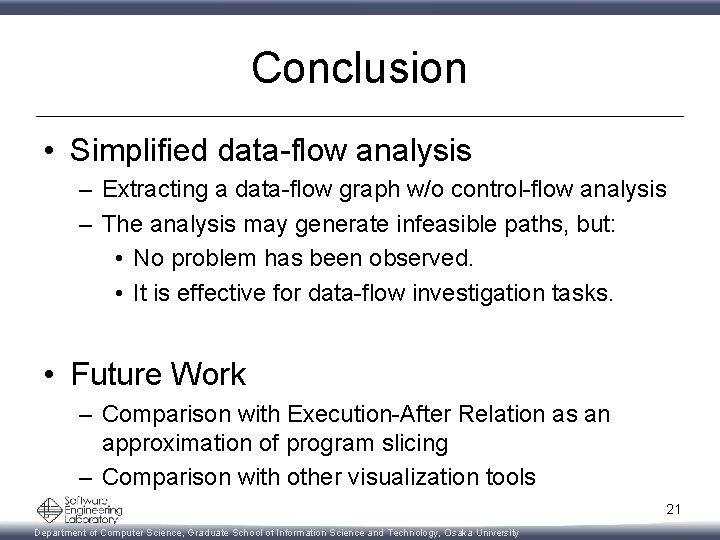
Conclusion • Simplified data-flow analysis – Extracting a data-flow graph w/o control-flow analysis – The analysis may generate infeasible paths, but: • No problem has been observed. • It is effective for data-flow investigation tasks. • Future Work – Comparison with Execution-After Relation as an approximation of program slicing – Comparison with other visualization tools 21 Department of Computer Science, Graduate School of Information Science and Technology, Osaka University
22 Department of Computer Science, Graduate School of Information Science and Technology, Osaka University
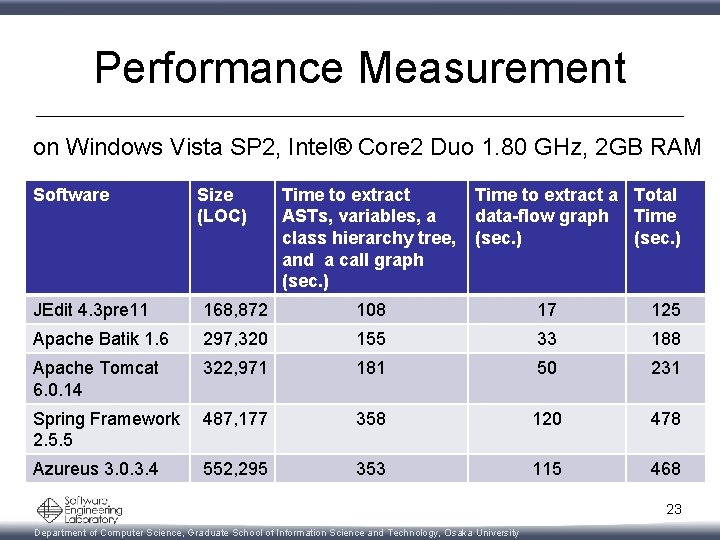
Performance Measurement on Windows Vista SP 2, Intel® Core 2 Duo 1. 80 GHz, 2 GB RAM Software Size (LOC) Time to extract ASTs, variables, a class hierarchy tree, and a call graph (sec. ) Time to extract a Total data-flow graph Time (sec. ) JEdit 4. 3 pre 11 168, 872 108 17 125 Apache Batik 1. 6 297, 320 155 33 188 Apache Tomcat 6. 0. 14 322, 971 181 50 231 Spring Framework 2. 5. 5 487, 177 358 120 478 Azureus 3. 0. 3. 4 552, 295 353 115 468 23 Department of Computer Science, Graduate School of Information Science and Technology, Osaka University
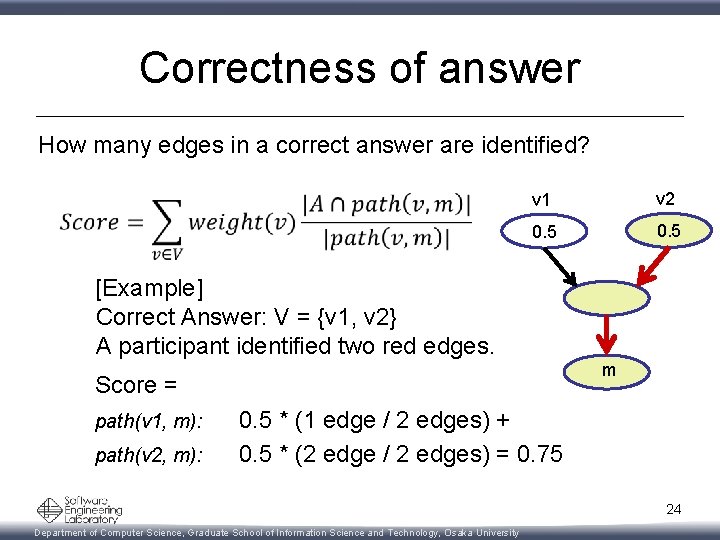
Correctness of answer How many edges in a correct answer are identified? v 1 v 2 0. 5 [Example] Correct Answer: V = {v 1, v 2} A participant identified two red edges. m Score = path(v 1, m): path(v 2, m): 0. 5 * (1 edge / 2 edges) + 0. 5 * (2 edge / 2 edges) = 0. 75 24 Department of Computer Science, Graduate School of Information Science and Technology, Osaka University
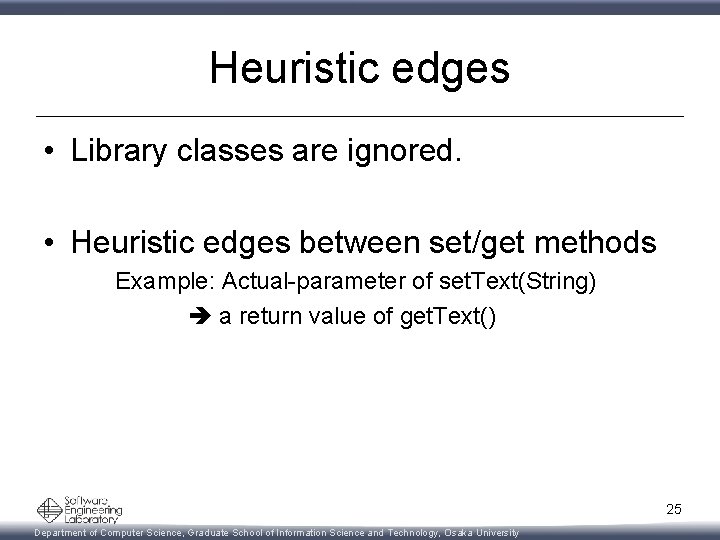
Heuristic edges • Library classes are ignored. • Heuristic edges between set/get methods Example: Actual-parameter of set. Text(String) a return value of get. Text() 25 Department of Computer Science, Graduate School of Information Science and Technology, Osaka University
Threats to Validity • Just a single case study. • The effectiveness of an interactive view is included in the study. • t-test assumes normal distribution of score. 26 Department of Computer Science, Graduate School of Information Science and Technology, Osaka University
Task A: When JEdit sounds beep at Edit. Abberv. Dialog. java: line 153? The correct answer is defined as a data-flow subgraph. public void action. Performed(Action. Event evt) { if (evt. get. Source() == ok) { if (editor. get. Abbrev() == null || editor. get. Abbrev(). length() == 0) { get. Toolkit(). beep(); return; } A return value of JText. Field. get. Text() } if (!check. For. Existing. Abbrev()) return; The argument of set. Text(String) is. OK = true; } The argument of Abbrev. Editor. set. Abbrev(String) dispose(); “Add” Button Clicked Abbrevs. Option. Pane. action. Performed is called. (omitted) Department of Computer Science, Graduate School of Information Science and Technology, Osaka University 27