
A LightWeight Distributed Scheme for Detecting IP Prefix

A Light-Weight Distributed Scheme for Detecting IP Prefix Hijacks in Real-Time Lusheng Ji†, Joint work with Changxi Zheng‡, Dan Pei†, Jia Wang†, Paul Francis‡ † AT&T Labs - Research ‡ Cornell University
Outline • Background • Algorithms and Justifications • Evaluation • Conclusion 2 /26
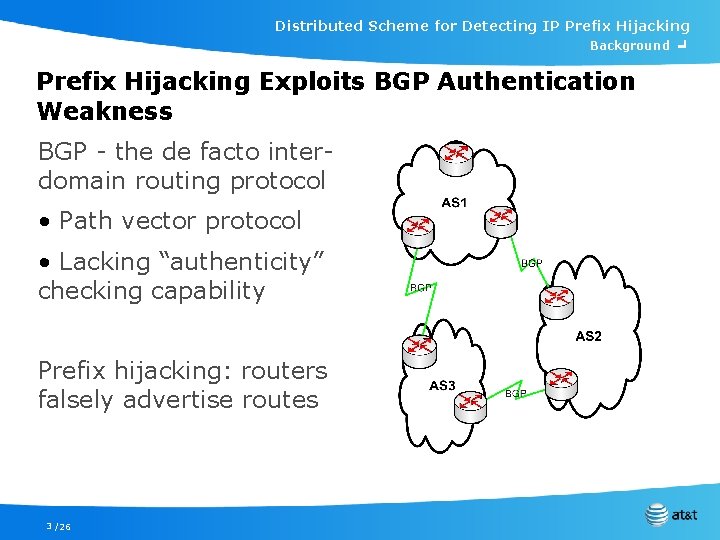
Distributed Scheme for Detecting IP Prefix Hijacking Background ╛ Prefix Hijacking Exploits BGP Authentication Weakness BGP - the de facto interdomain routing protocol • Path vector protocol • Lacking “authenticity” checking capability Prefix hijacking: routers falsely advertise routes 3 /26
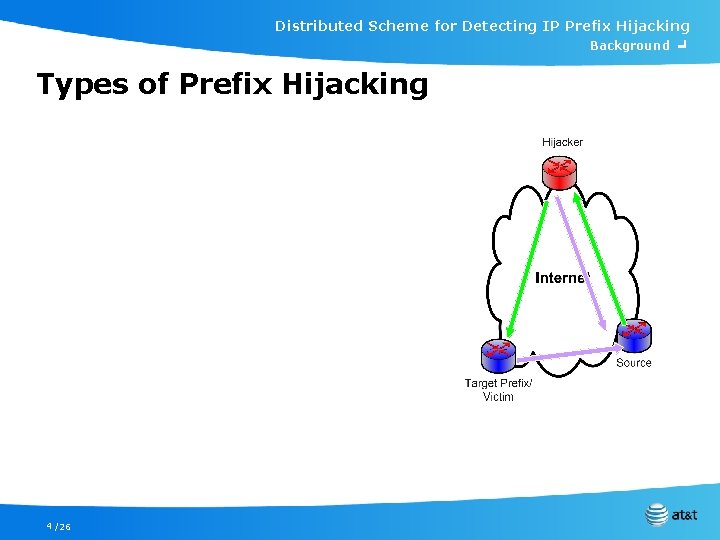
Distributed Scheme for Detecting IP Prefix Hijacking Background ╛ Types of Prefix Hijacking • Blackholing – Hijacker drops packets • Imposture – Hijacker pretends to be the victim • Interception – Hijacker forwards packets to victim 4 /26
Distributed Scheme for Detecting IP Prefix Hijacking Background ╛ Current Approaches to Prefix Hijacking Prevention and Detection • Prevention – – – Software/configuration changes Public Key Infrastructure or other authentication mechanisms Deployment hurdles • Detection – BGP update message and routing table inspection and anomaly/signature detection • • 5 /26 Limited vantage point locations Difficult to be “real-time” Often requiring privileged access High false positive rates
Distributed Scheme for Detecting IP Prefix Hijacking Algorithms and Justifications ╛ New Approach: Data Plane Monitoring Benefits • Can have multiple strategically placed vantage points – – Gotta have multiple At good locations Distributed work load Distributed traffic load • Potential of extending to overlay detection architecture – – Robustness Scalability • Easily deployable, and anybody can do it. 6 /26
Distributed Scheme for Detecting IP Prefix Hijacking Algorithms and Justifications ╛ Monitoring Prefix Network Location The First observation If a prefix is hijacked, the paths observed from certain vantage points to the prefix would likely exhibit significant changes. Let’s start from monitoring the vantage point-totarget prefix paths • What to measure 7 /26
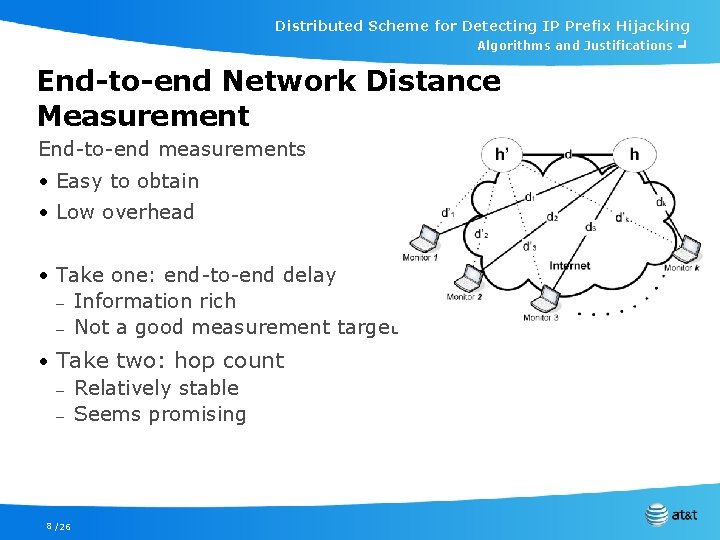
Distributed Scheme for Detecting IP Prefix Hijacking Algorithms and Justifications ╛ End-to-end Network Distance Measurement End-to-end measurements • Easy to obtain • Low overhead • Take one: end-to-end delay – Information rich – Not a good measurement target • Take two: hop count – Relatively stable – Seems promising 8 /26
Distributed Scheme for Detecting IP Prefix Hijacking Algorithms and Justifications ╛ Measurement Setup Monitors (measurement sources) • 43 Planetlab nodes (25 ASes) Target prefixes (measurement destinations) • Identified from Route. View and RIPE BGP tables • 242 MOASes • 125 SOASes 1 full month of data • One hop count measurement for each path every 12 minutes 9 /26
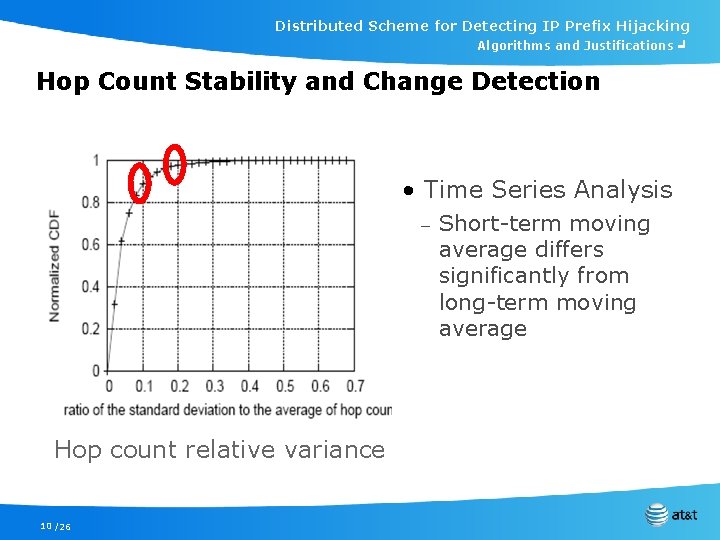
Distributed Scheme for Detecting IP Prefix Hijacking Algorithms and Justifications ╛ Hop Count Stability and Change Detection • Time Series Analysis – Hop count relative variance 10 /26 Short-term moving average differs significantly from long-term moving average
Distributed Scheme for Detecting IP Prefix Hijacking Algorithms and Justifications ╛ … But … Detection only based on hop count change may result in large false-positive ratios • Hop count is not that stable • How to quantify “significant” • Other reasons for “significant” hop count changes – – 11 /26 MOAS changing entry/exit point Traffic engineering Natural/human disasters causing large Internet topology changes Mis-configurations
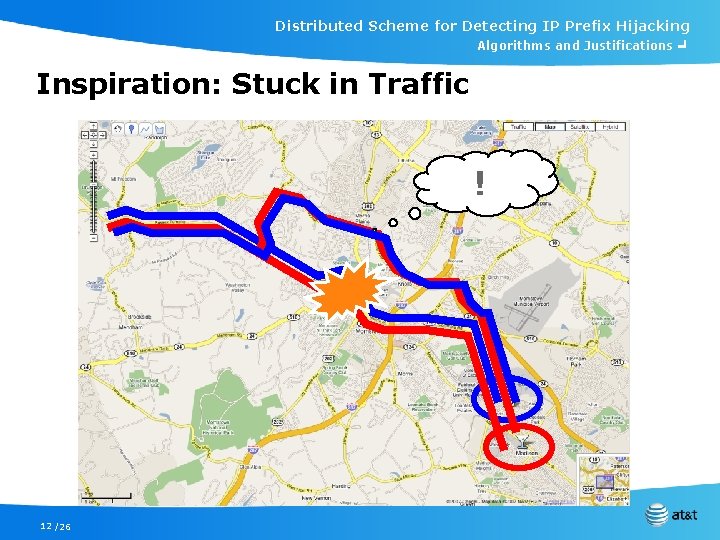
Distributed Scheme for Detecting IP Prefix Hijacking Algorithms and Justifications ╛ Inspiration: Stuck in Traffic ! 12 /26
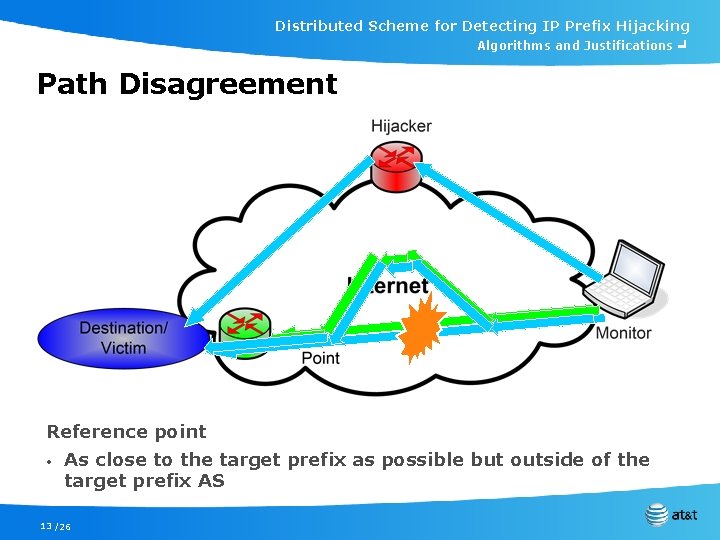
Distributed Scheme for Detecting IP Prefix Hijacking Algorithms and Justifications ╛ Path Disagreement Reference point • As close to the target prefix as possible but outside of the target prefix AS 13 /26
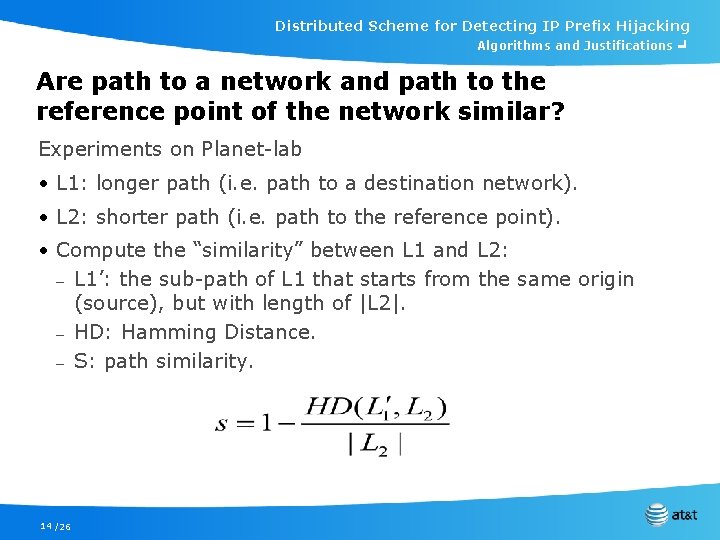
Distributed Scheme for Detecting IP Prefix Hijacking Algorithms and Justifications ╛ Are path to a network and path to the reference point of the network similar? Experiments on Planet-lab • L 1: longer path (i. e. path to a destination network). • L 2: shorter path (i. e. path to the reference point). • Compute the “similarity” between L 1 and L 2: – L 1’: the sub-path of L 1 that starts from the same origin (source), but with length of |L 2|. – HD: Hamming Distance. – S: path similarity. 14 /26
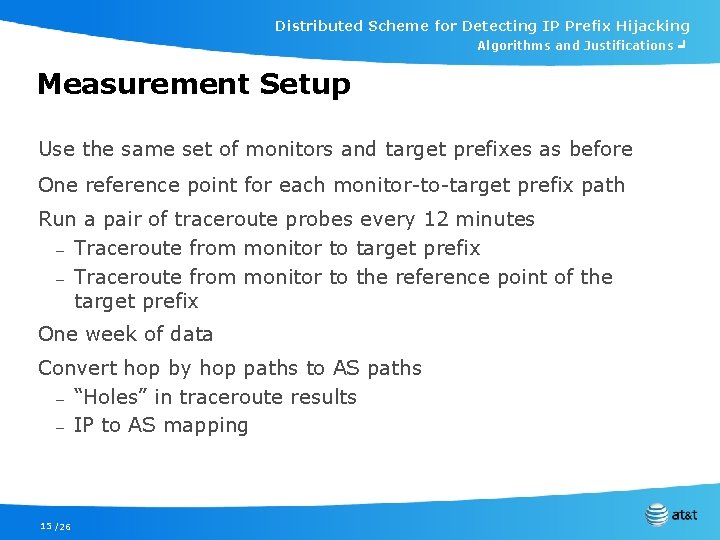
Distributed Scheme for Detecting IP Prefix Hijacking Algorithms and Justifications ╛ Measurement Setup Use the same set of monitors and target prefixes as before One reference point for each monitor-to-target prefix path Run a pair of traceroute probes every 12 minutes – Traceroute from monitor to target prefix – Traceroute from monitor to the reference point of the target prefix One week of data Convert hop by hop paths to AS paths – “Holes” in traceroute results – IP to AS mapping 15 /26
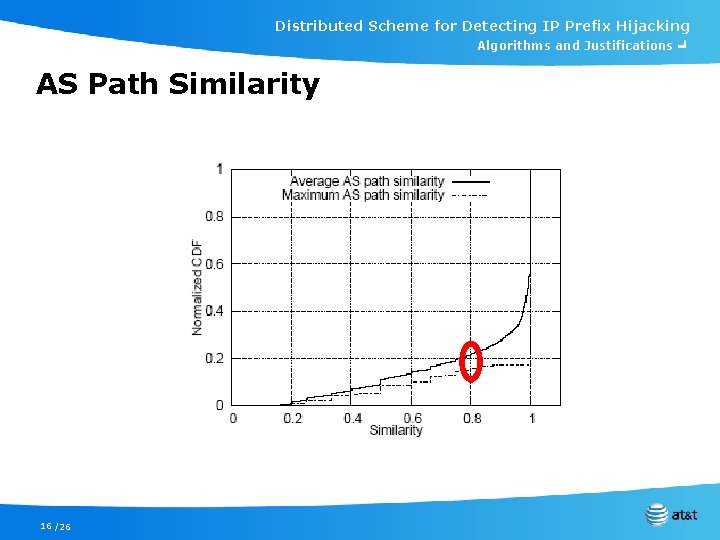
Distributed Scheme for Detecting IP Prefix Hijacking Algorithms and Justifications ╛ AS Path Similarity 16 /26
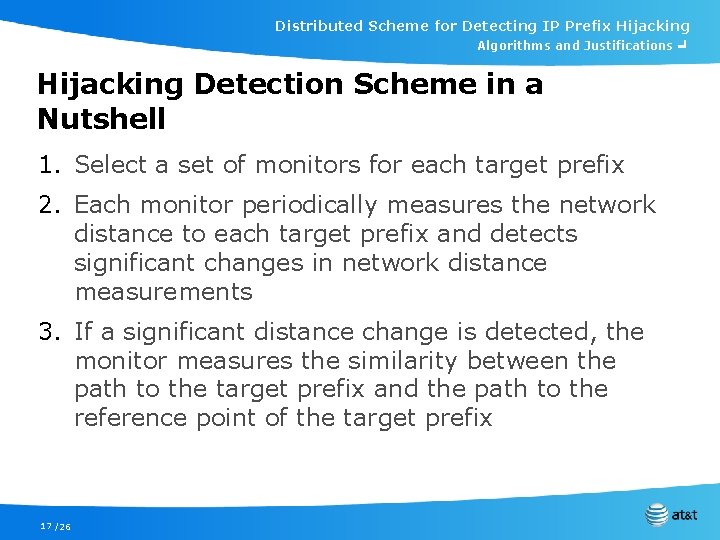
Distributed Scheme for Detecting IP Prefix Hijacking Algorithms and Justifications ╛ Hijacking Detection Scheme in a Nutshell 1. Select a set of monitors for each target prefix 2. Each monitor periodically measures the network distance to each target prefix and detects significant changes in network distance measurements 3. If a significant distance change is detected, the monitor measures the similarity between the path to the target prefix and the path to the reference point of the target prefix 17 /26
Distributed Scheme for Detecting IP Prefix Hijacking Evaluation ╛ Evaluation Methods • We are about data plane and “real-time” – Difficult to evaluate using historical data • Catching real hijacking attacks red handedly – But…… • Build simulation – 18 /26 Construct simulation scenarios based on real Internet topology
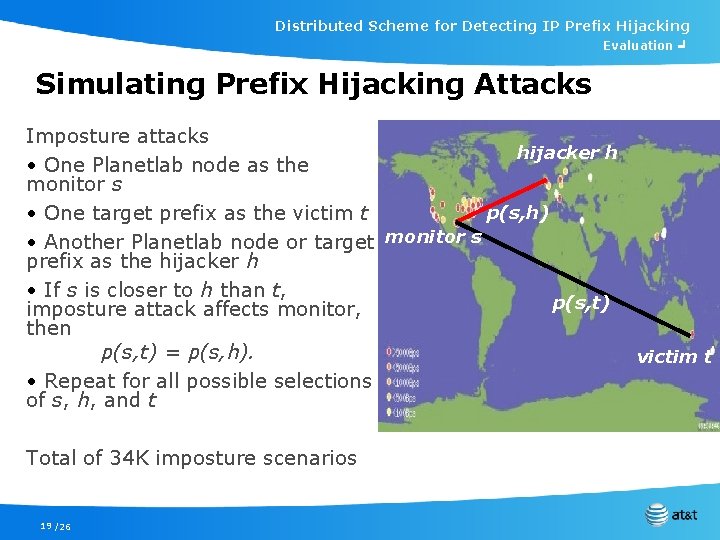
Distributed Scheme for Detecting IP Prefix Hijacking Evaluation ╛ Simulating Prefix Hijacking Attacks Imposture attacks hijacker h • One Planetlab node as the monitor s p(s, h) • One target prefix as the victim t • Another Planetlab node or target monitor s prefix as the hijacker h • If s is closer to h than t, p(s, t) imposture attack affects monitor, then p(s, t) = p(s, h). victim t • Repeat for all possible selections of s, h, and t Total of 34 K imposture scenarios 19 /26
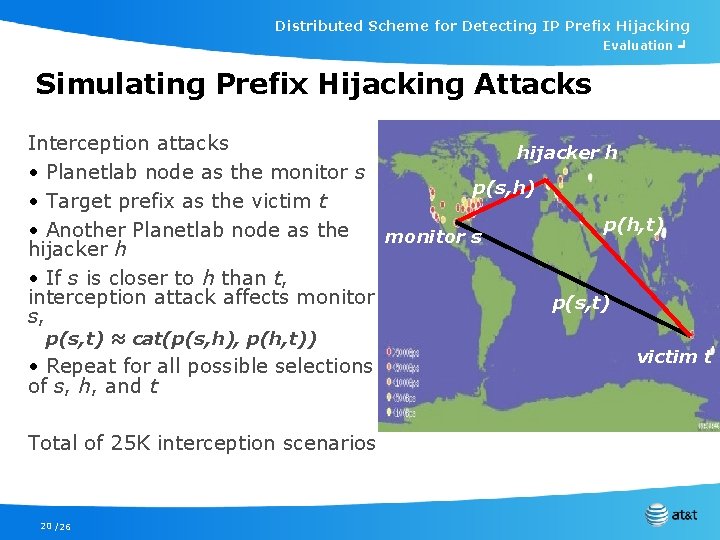
Distributed Scheme for Detecting IP Prefix Hijacking Evaluation ╛ Simulating Prefix Hijacking Attacks Interception attacks hijacker h • Planetlab node as the monitor s p(s, h) • Target prefix as the victim t p(h, t) • Another Planetlab node as the monitor s hijacker h • If s is closer to h than t, interception attack affects monitor p(s, t) s, p(s, t) ≈ cat(p(s, h), p(h, t)) • Repeat for all possible selections of s, h, and t Total of 25 K interception scenarios 20 /26 victim t
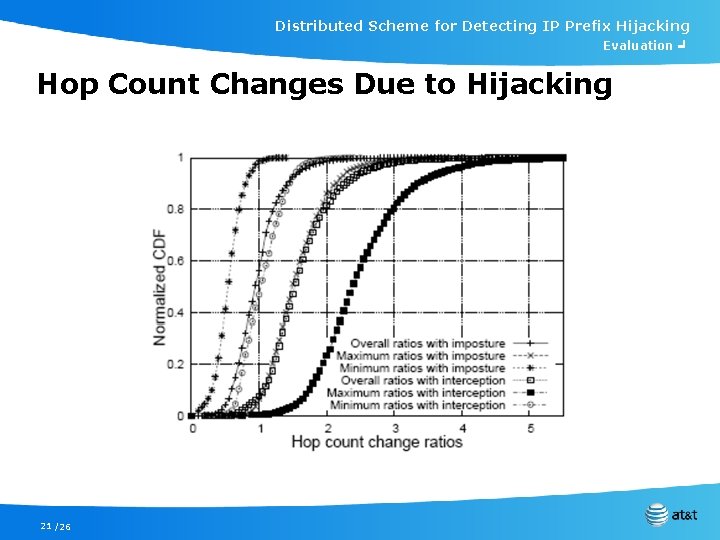
Distributed Scheme for Detecting IP Prefix Hijacking Evaluation ╛ Hop Count Changes Due to Hijacking 21 /26
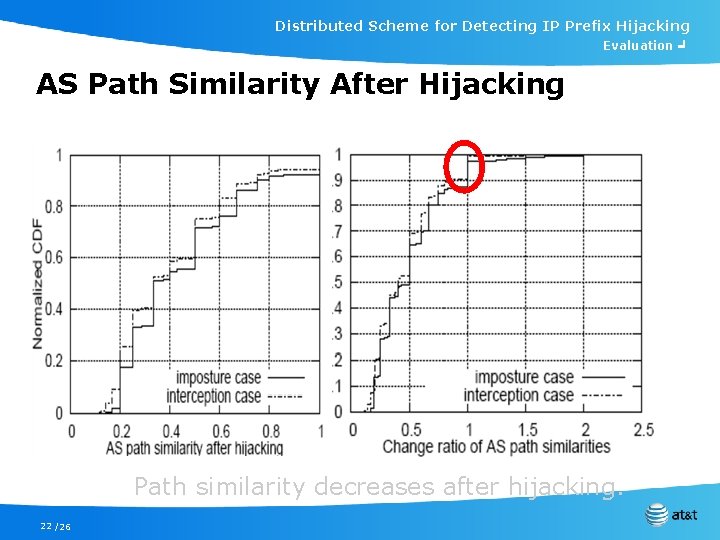
Distributed Scheme for Detecting IP Prefix Hijacking Evaluation ╛ AS Path Similarity After Hijacking Path similarity decreases after hijacking. 22 /26
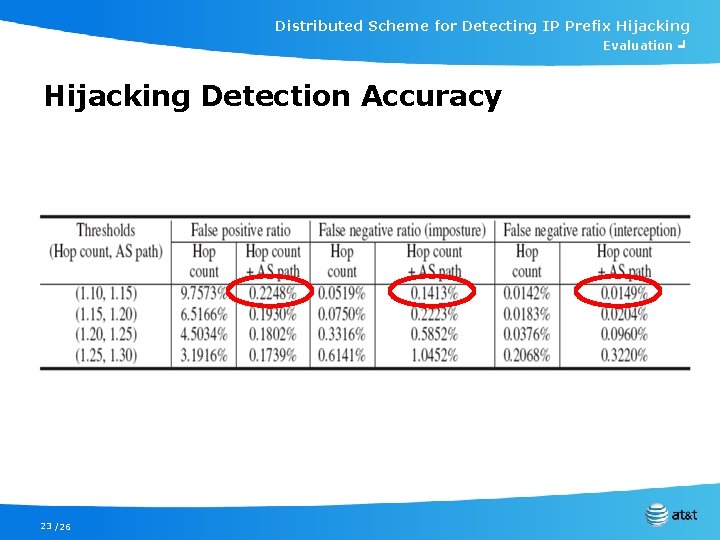
Distributed Scheme for Detecting IP Prefix Hijacking Evaluation ╛ Hijacking Detection Accuracy 23 /26
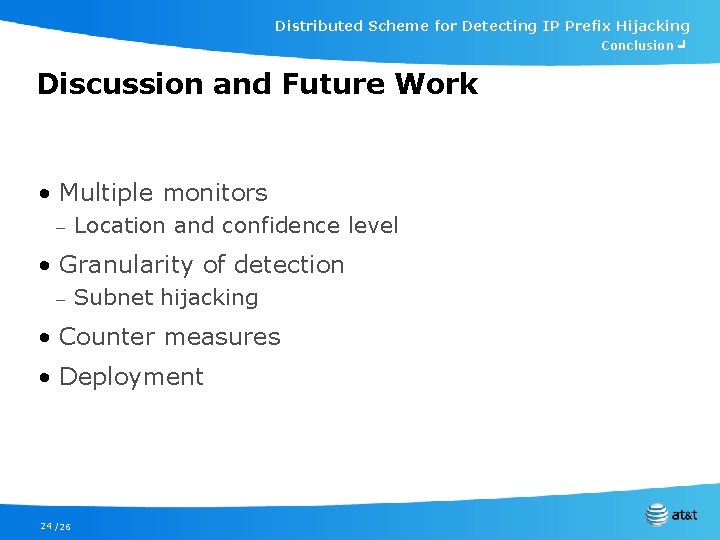
Distributed Scheme for Detecting IP Prefix Hijacking Conclusion ╛ Discussion and Future Work • Multiple monitors – Location and confidence level • Granularity of detection – Subnet hijacking • Counter measures • Deployment 24 /26
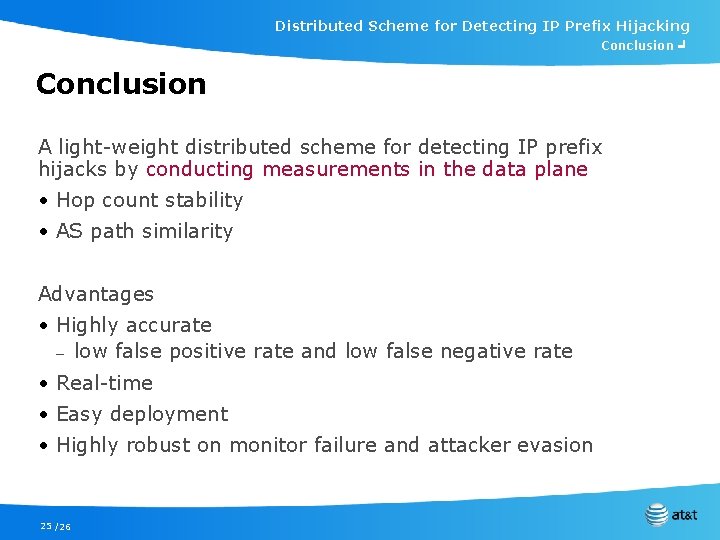
Distributed Scheme for Detecting IP Prefix Hijacking Conclusion ╛ Conclusion A light-weight distributed scheme for detecting IP prefix hijacks by conducting measurements in the data plane • Hop count stability • AS path similarity Advantages • Highly accurate – low false positive rate and low false negative rate • Real-time • Easy deployment • Highly robust on monitor failure and attacker evasion 25 /26

Distributed Scheme for Detecting IP Prefix Hijacking Conclusion ╛ Thank You 26 /26
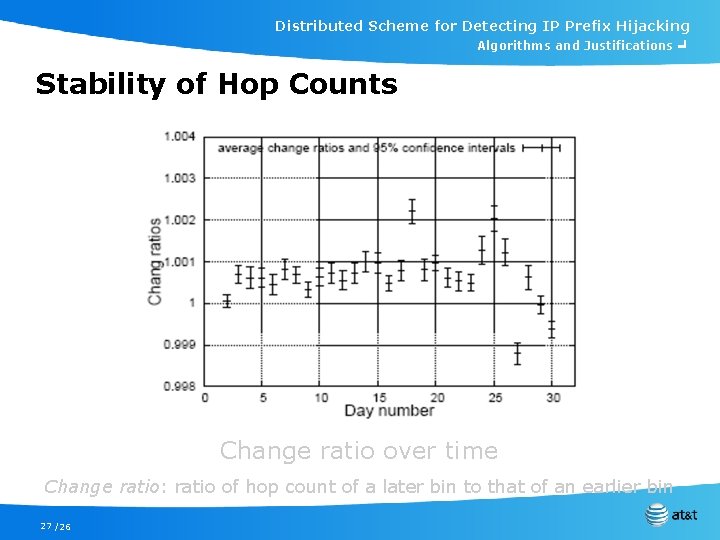
Distributed Scheme for Detecting IP Prefix Hijacking Algorithms and Justifications ╛ Stability of Hop Counts Change ratio over time Change ratio: ratio of hop count of a later bin to that of an earlier bin 27 /26
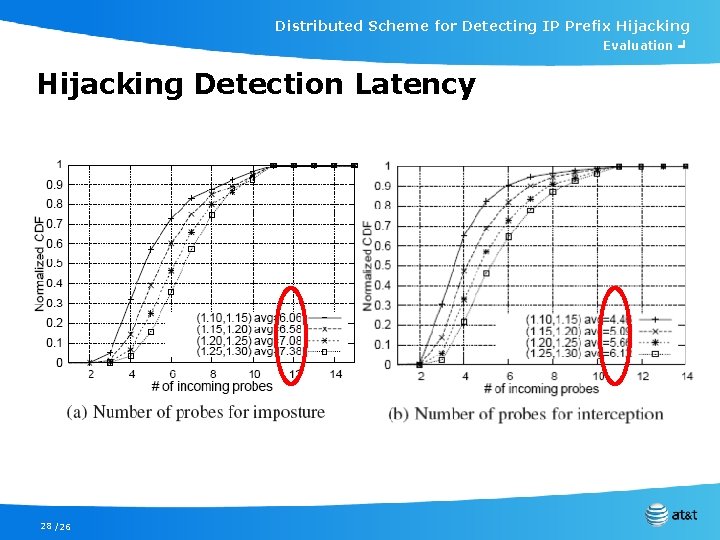
Distributed Scheme for Detecting IP Prefix Hijacking Evaluation ╛ Hijacking Detection Latency 28 /26
- Slides: 28