
A Life Course Framework for Improving the Lives



- Slides: 40
A Life Course Framework for Improving the Lives of Disadvantaged Populations Arnold Chandler | Forward Change
Overview 1. Understanding How Structural Changes Have Produced Intergenerational Cycles of Disadvantage 2. A Life Course Framework for Improving the Lives of Disadvantaged Populations: Interrupting the Cycle 2
First Major Structural Shift: Declining Male Employment and Earnings
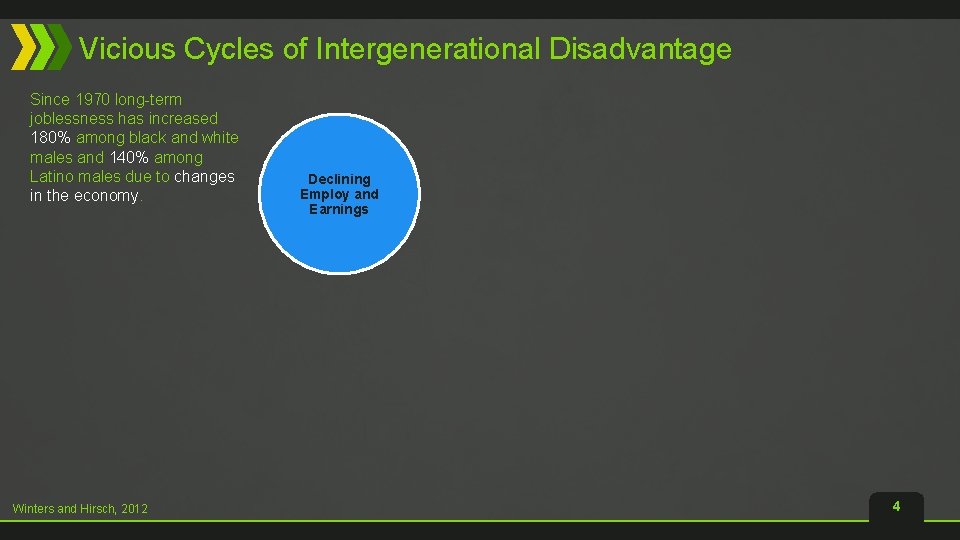
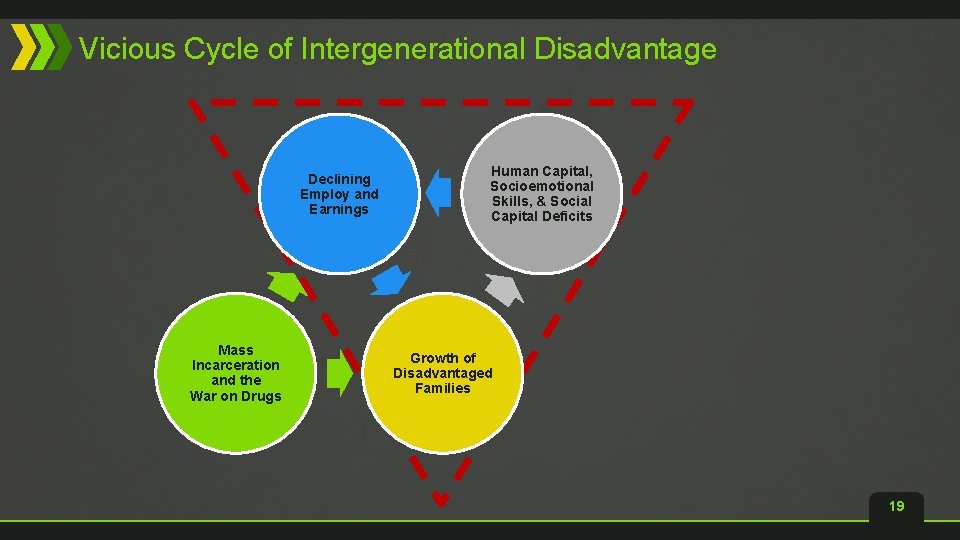
Vicious Cycles of Intergenerational Disadvantage Since 1970 long-term joblessness has increased 180% among black and white males and 140% among Latino males due to changes in the economy. Winters and Hirsch, 2012 Declining Employ and Earnings 4
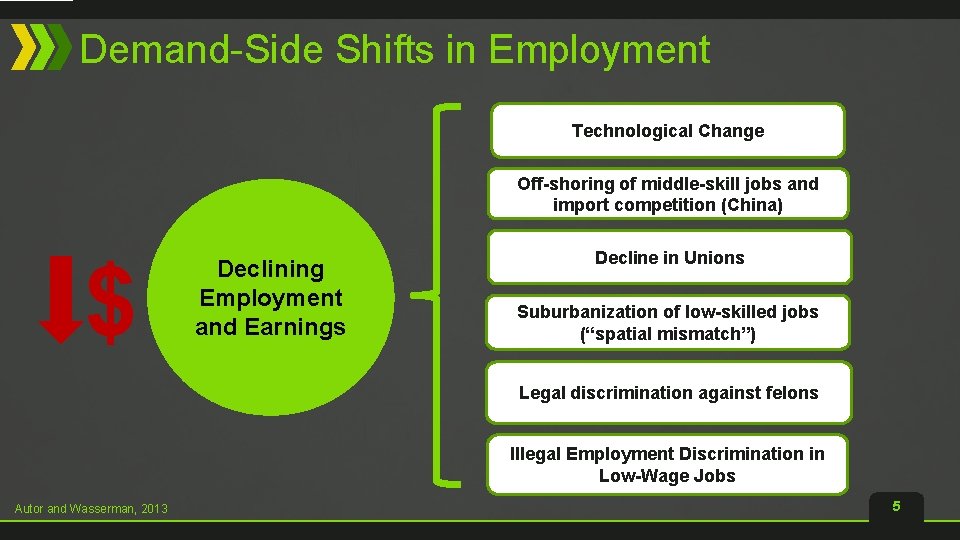
Demand-Side Shifts in Employment Technological Change Off-shoring of middle-skill jobs and import competition (China) $ Declining Employment and Earnings Decline in Unions Suburbanization of low-skilled jobs (“spatial mismatch”) Legal discrimination against felons Illegal Employment Discrimination in Low-Wage Jobs Autor and Wasserman, 2013 5
Second Major Structural Shift: Mass Incarceration
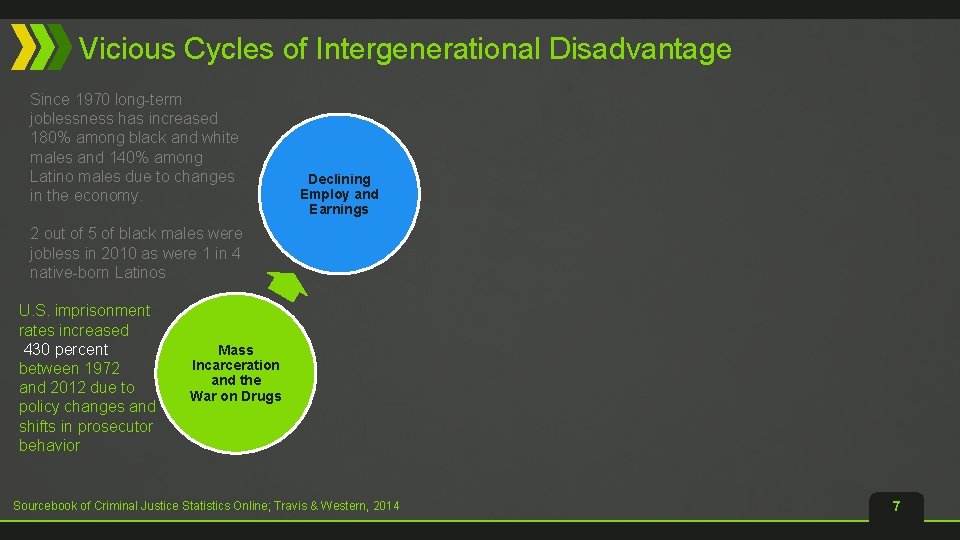
Vicious Cycles of Intergenerational Disadvantage Since 1970 long-term joblessness has increased 180% among black and white males and 140% among Latino males due to changes in the economy. Declining Employ and Earnings 2 out of 5 of black males were jobless in 2010 as were 1 in 4 native-born Latinos U. S. imprisonment rates increased 430 percent between 1972 and 2012 due to policy changes and shifts in prosecutor behavior Mass Incarceration and the War on Drugs Sourcebook of Criminal Justice Statistics Online; Travis & Western, 2014 7
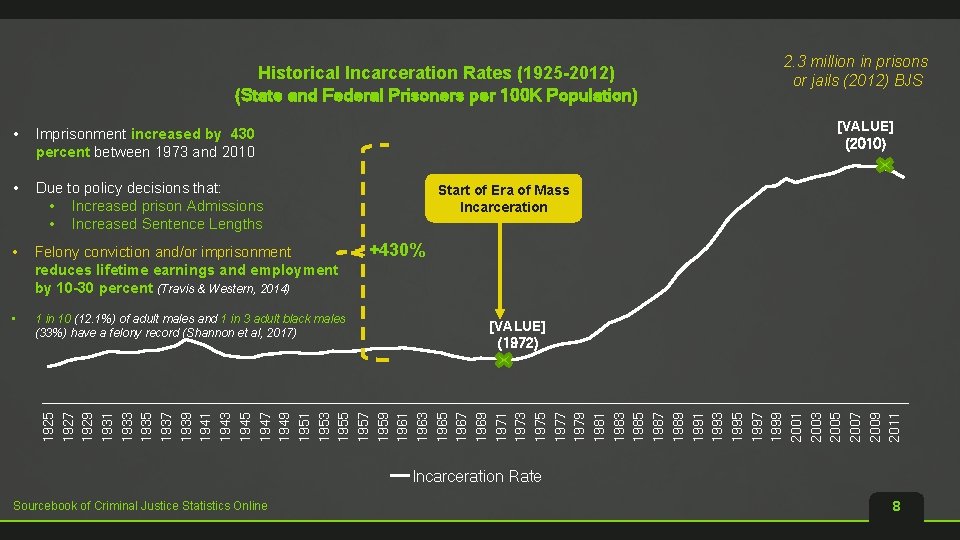
Historical Incarceration Rates (1925 -2012) (State and Federal Prisoners per 100 K Population) Imprisonment increased by 430 percent between 1973 and 2010 • Due to policy decisions that: • Increased prison Admissions • Increased Sentence Lengths • Felony conviction and/or imprisonment reduces lifetime earnings and employment by 10 -30 percent (Travis & Western, 2014) • 1 in 10 (12. 1%) of adult males and 1 in 3 adult black males (33%) have a felony record (Shannon et al, 2017) [VALUE] (2010) Start of Era of Mass Incarceration +430% [VALUE] (1972) 1925 1927 1929 1931 1933 1935 1937 1939 1941 1943 1945 1947 1949 1951 1953 1955 1957 1959 1961 1963 1965 1967 1969 1971 1973 1975 1977 1979 1981 1983 1985 1987 1989 1991 1993 1995 1997 1999 2001 2003 2005 2007 2009 2011 • 2. 3 million in prisons or jails (2012) BJS Incarceration Rate Sourcebook of Criminal Justice Statistics Online 8
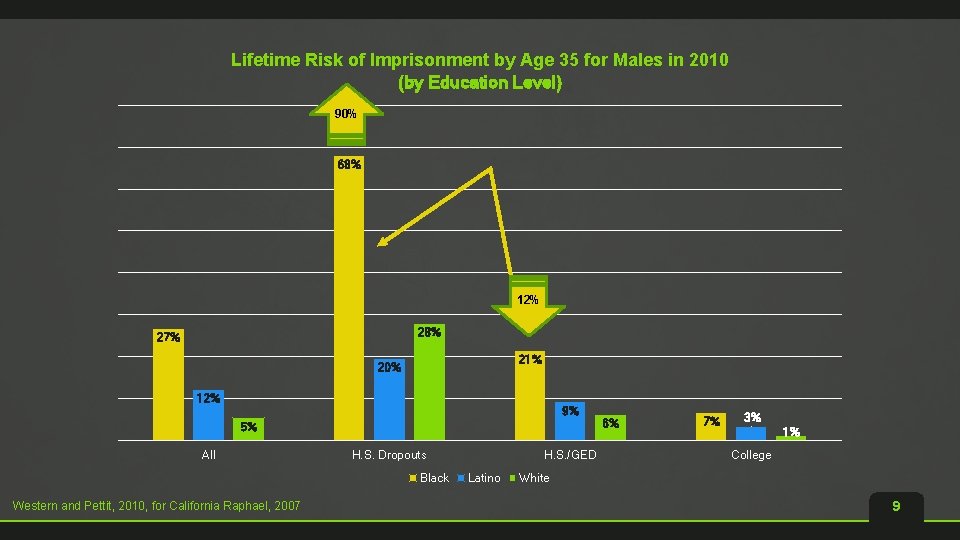
Lifetime Risk of Imprisonment by Age 35 for Males in 2010 (by Education Level) 90% 68% 12% 28% 27% 21% 20% 12% 9% 5% All H. S. Dropouts Black Western and Pettit, 2010, for California Raphael, 2007 H. S. /GED Latino 6% 7% 3% 1% College White 9
Third Major Structural Shift: The Rise of Disadvantaged Families
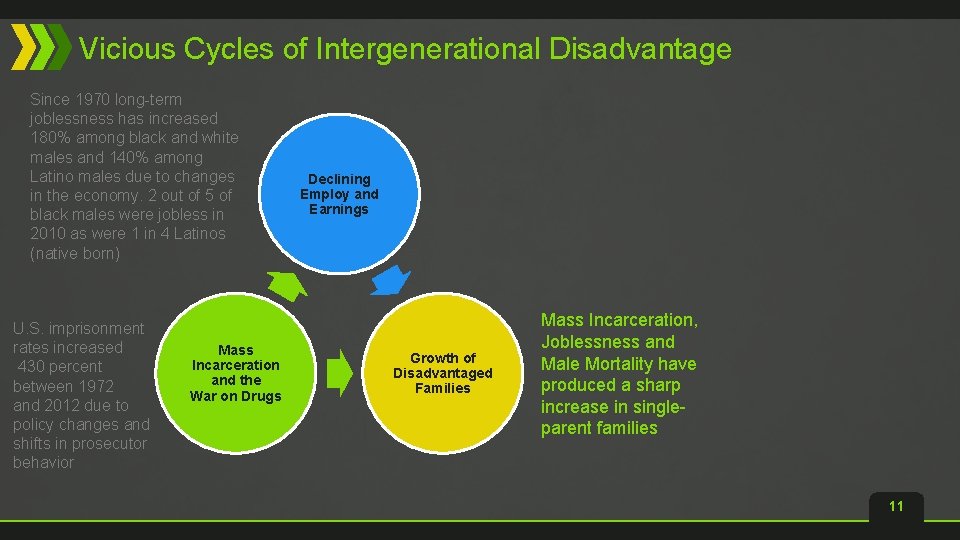
Vicious Cycles of Intergenerational Disadvantage Since 1970 long-term joblessness has increased 180% among black and white males and 140% among Latino males due to changes in the economy. 2 out of 5 of black males were jobless in 2010 as were 1 in 4 Latinos (native born) U. S. imprisonment rates increased 430 percent between 1972 and 2012 due to policy changes and shifts in prosecutor behavior Mass Incarceration and the War on Drugs Declining Employ and Earnings Growth of Disadvantaged Families Mass Incarceration, Joblessness and Male Mortality have produced a sharp increase in singleparent families 11
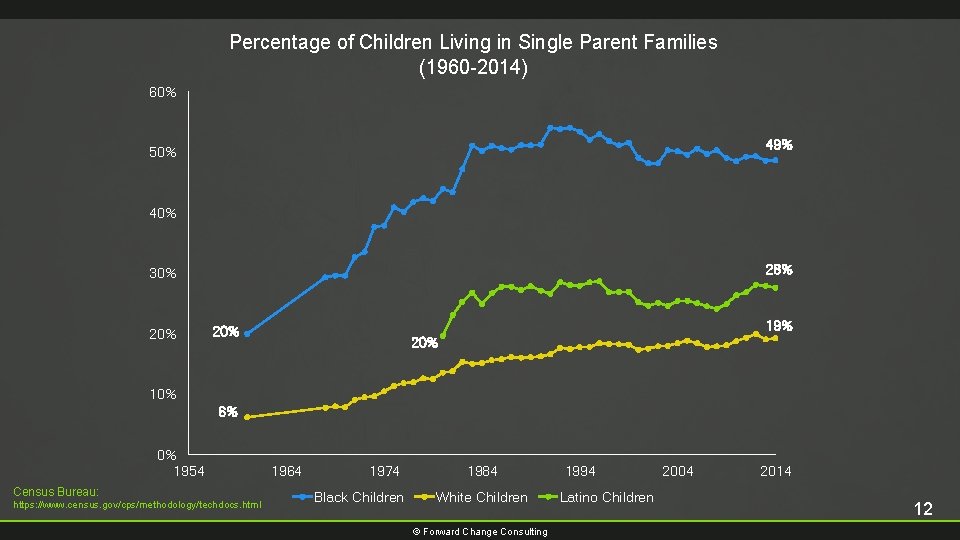
Percentage of Children Living in Single Parent Families (1960 -2014) 60% 49% 50% 40% 28% 30% 20% 19% 20% 10% 6% 0% 1954 Census Bureau: https: //www. census. gov/cps/methodology/techdocs. html 1964 1974 Black Children 1984 White Children © Forward Change Consulting 1994 Latino Children 2004 2014 12
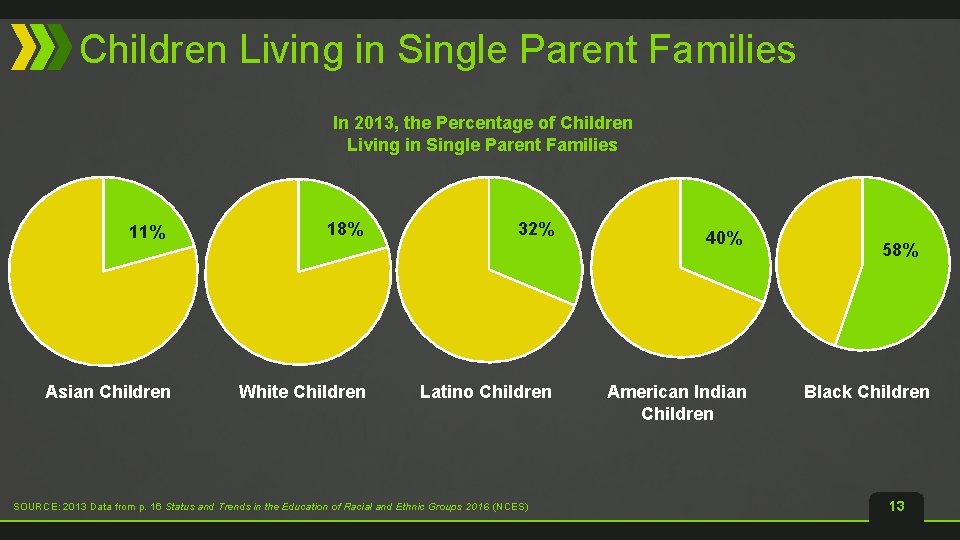
Children Living in Single Parent Families In 2013, the Percentage of Children Living in Single Parent Families 11% Asian Children 18% White Children 32% Latino Children SOURCE: 2013 Data from p. 16 Status and Trends in the Education of Racial and Ethnic Groups 2016 (NCES) 40% American Indian Children 58% Black Children 13
Vicious Cycle of Intergenerational Disadvantage Since 1970 long-term joblessness has increased 180% among black and white males and 140% among Latino males due to changes in the economy. 2 out of 5 of black males were jobless in 2010 as were 1 in 4 Latinos (native born) U. S. imprisonment rates increased 430 percent between 1972 and 2012 due to policy changes and shifts in prosecutor behavior Mass Incarceration and the War on Drugs Declining Employ and Earnings Human Capital & Socioemotional Skill Deficits Growing up in a poor or single-parent family, especially with an incarcerated father, significantly worsens behavioral, educational and employment outcomes, among males Growth of Disadvantaged Families 14
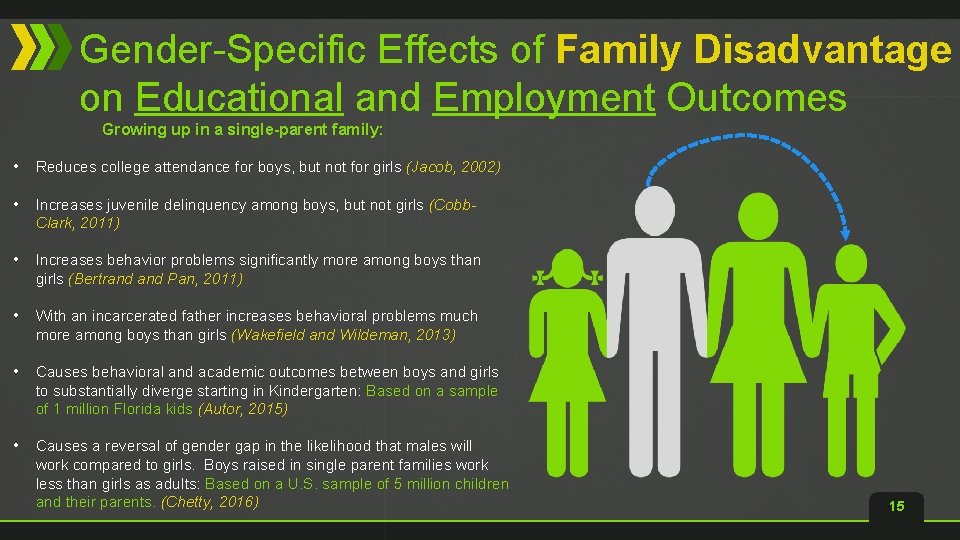
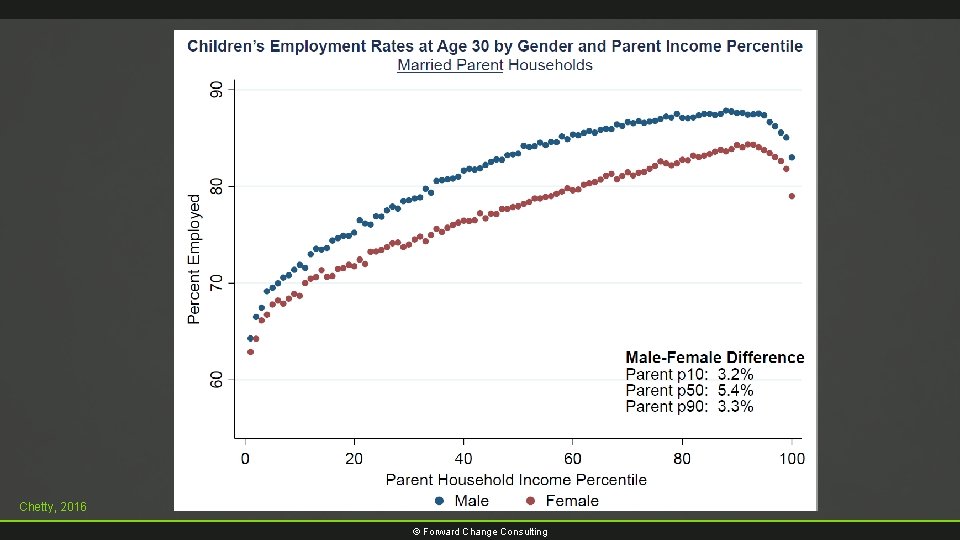
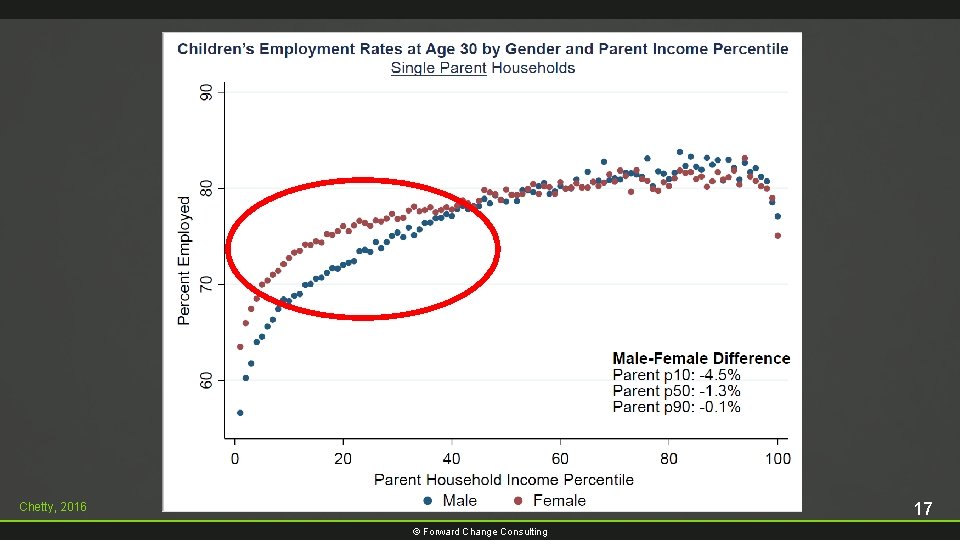
Gender-Specific Effects of Family Disadvantage on Educational and Employment Outcomes Growing up in a single-parent family: • Reduces college attendance for boys, but not for girls (Jacob, 2002) • Increases juvenile delinquency among boys, but not girls (Cobb. Clark, 2011) • Increases behavior problems significantly more among boys than girls (Bertrand Pan, 2011) • With an incarcerated father increases behavioral problems much more among boys than girls (Wakefield and Wildeman, 2013) • Causes behavioral and academic outcomes between boys and girls to substantially diverge starting in Kindergarten: Based on a sample of 1 million Florida kids (Autor, 2015) • Causes a reversal of gender gap in the likelihood that males will work compared to girls. Boys raised in single parent families work less than girls as adults: Based on a U. S. sample of 5 million children and their parents. (Chetty, 2016) 15
Chetty, 2016 © Forward Change Consulting
17 Chetty, 2016 © Forward Change Consulting
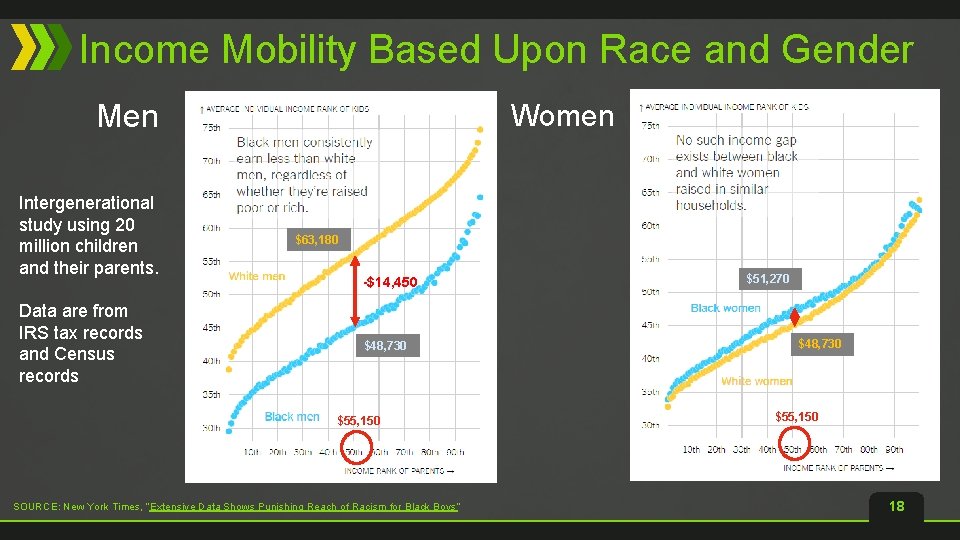
Income Mobility Based Upon Race and Gender Men Intergenerational study using 20 million children and their parents. Data are from IRS tax records and Census records Women $63, 180 -$14, 450 $48, 730 $55, 150 SOURCE: New York Times, “Extensive Data Shows Punishing Reach of Racism for Black Boys” $51, 270 $48, 730 $55, 150 18
Vicious Cycle of Intergenerational Disadvantage Declining Employ and Earnings Mass Incarceration and the War on Drugs Human Capital, Socioemotional Skills, & Social Capital Deficits Growth of Disadvantaged Families 19
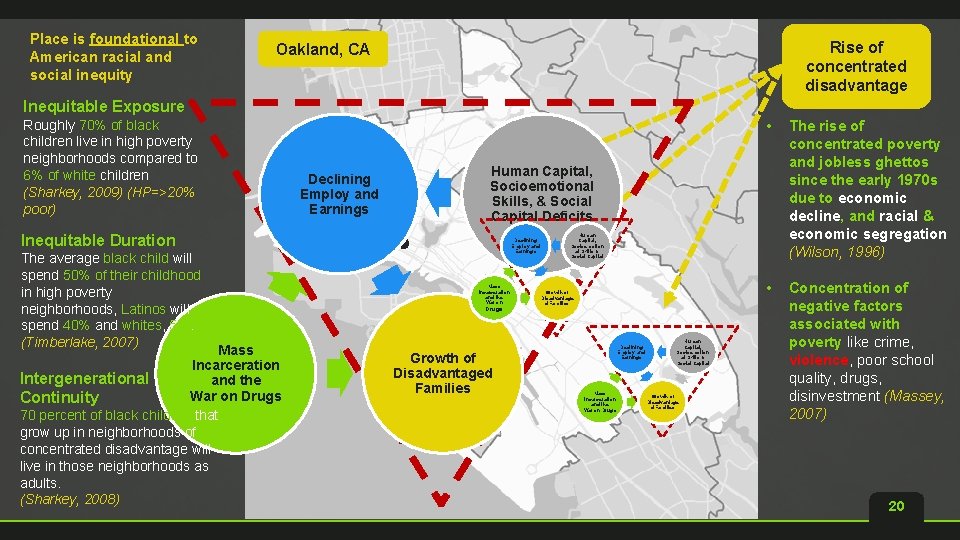
Place is foundational to American racial and social inequity Rise of concentrated disadvantage Oakland, CA Inequitable Exposure Roughly 70% of black children live in high poverty neighborhoods compared to 6% of white children (Sharkey, 2009) (HP=>20% poor) Declining Employ and Earnings Mass Incarceration Intergenerational and the War on Drugs Continuity 70 percent of black children that grow up in neighborhoods of concentrated disadvantage will live in those neighborhoods as adults. (Sharkey, 2008) The rise of concentrated poverty and jobless ghettos since the early 1970 s due to economic decline, and racial & economic segregation (Wilson, 1996) • Concentration of negative factors associated with poverty like crime, violence, poor school quality, drugs, disinvestment (Massey, 2007) Human Capital, Socioemotional Skills, & Social Capital Deficits Inequitable Duration The average black child will spend 50% of their childhood in high poverty neighborhoods, Latinos will spend 40% and whites, 5%. (Timberlake, 2007) • Declining Employ and Earnings Mass Incarceration and the War on Drugs Growth of Disadvantaged Families Human Capital, Socioemotion al Skills & Social Capital Growth of Disadvantage d Families Declining Employ and Earnings Mass Incarceration and the War on Drugs Human Capital, Socioemotion al Skills & Social Capital Growth of Disadvantage d Families 20
A Life Course Framework for Improving the Lives of Disadvantaged Populations: Interrupting the Cycle
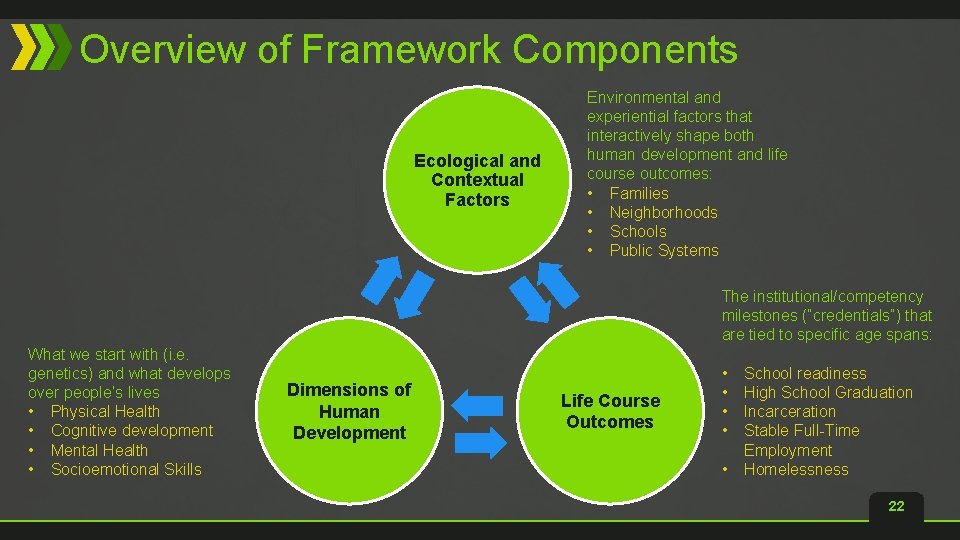
Overview of Framework Components Ecological and Contextual Factors Environmental and experiential factors that interactively shape both human development and life course outcomes: • Families • Neighborhoods • Schools • Public Systems The institutional/competency milestones (“credentials”) that are tied to specific age spans: What we start with (i. e. genetics) and what develops over people’s lives • Physical Health • Cognitive development • Mental Health • Socioemotional Skills Dimensions of Human Development Life Course Outcomes • • • School readiness High School Graduation Incarceration Stable Full-Time Employment Homelessness 22
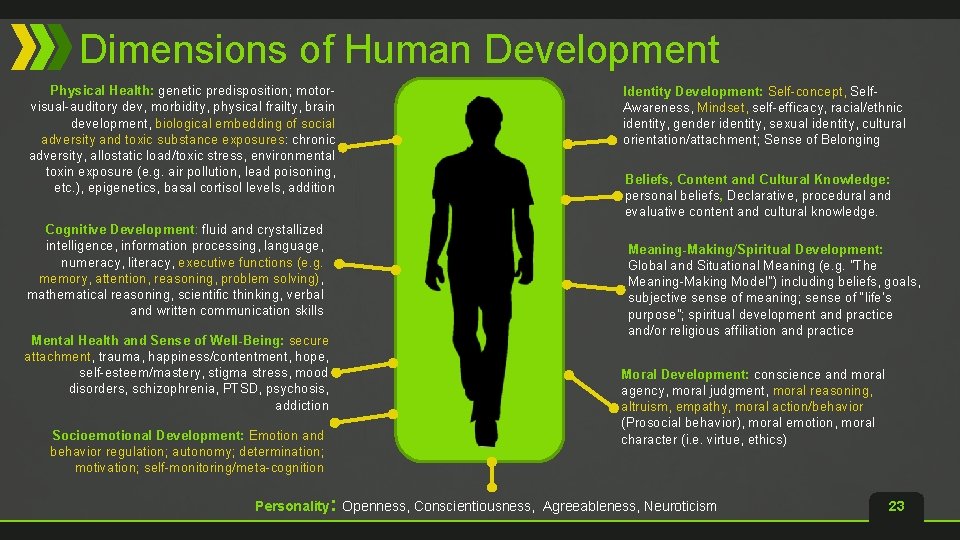
Dimensions of Human Development Physical Health: genetic predisposition; motorvisual-auditory dev, morbidity, physical frailty, brain development, biological embedding of social adversity and toxic substance exposures: chronic adversity, allostatic load/toxic stress, environmental toxin exposure (e. g. air pollution, lead poisoning, etc. ), epigenetics, basal cortisol levels, addition Cognitive Development: fluid and crystallized intelligence, information processing, language, numeracy, literacy, executive functions (e. g. memory, attention, reasoning, problem solving), mathematical reasoning, scientific thinking, verbal and written communication skills Mental Health and Sense of Well-Being: secure attachment, trauma, happiness/contentment, hope, self-esteem/mastery, stigma stress, mood disorders, schizophrenia, PTSD, psychosis, addiction Socioemotional Development: Emotion and behavior regulation; autonomy; determination; motivation; self-monitoring/meta-cognition Identity Development: Self-concept, Self. Awareness, Mindset, self-efficacy, racial/ethnic identity, gender identity, sexual identity, cultural orientation/attachment; Sense of Belonging Beliefs, Content and Cultural Knowledge: personal beliefs, Declarative, procedural and evaluative content and cultural knowledge. Meaning-Making/Spiritual Development: Global and Situational Meaning (e. g. "The Meaning-Making Model") including beliefs, goals, subjective sense of meaning; sense of “life’s purpose”; spiritual development and practice and/or religious affiliation and practice Moral Development: conscience and moral agency, moral judgment, moral reasoning, altruism, empathy, moral action/behavior (Prosocial behavior), moral emotion, moral character (i. e. virtue, ethics) Personality: Openness, Conscientiousness, Agreeableness, Neuroticism 23
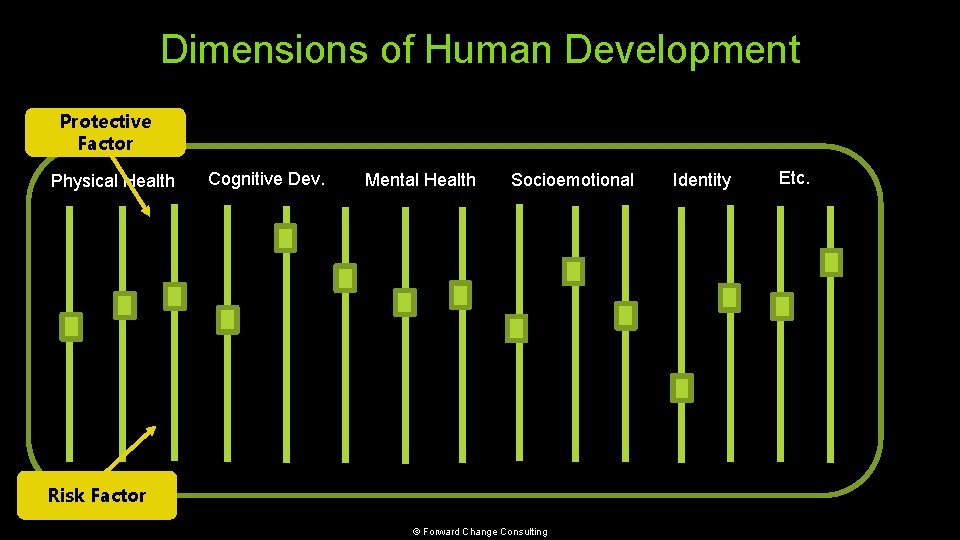
Dimensions of Human Development Protective Factor Physical Health Cognitive Dev. Mental Health Socioemotional Risk Factor © Forward Change Consulting Identity Etc.
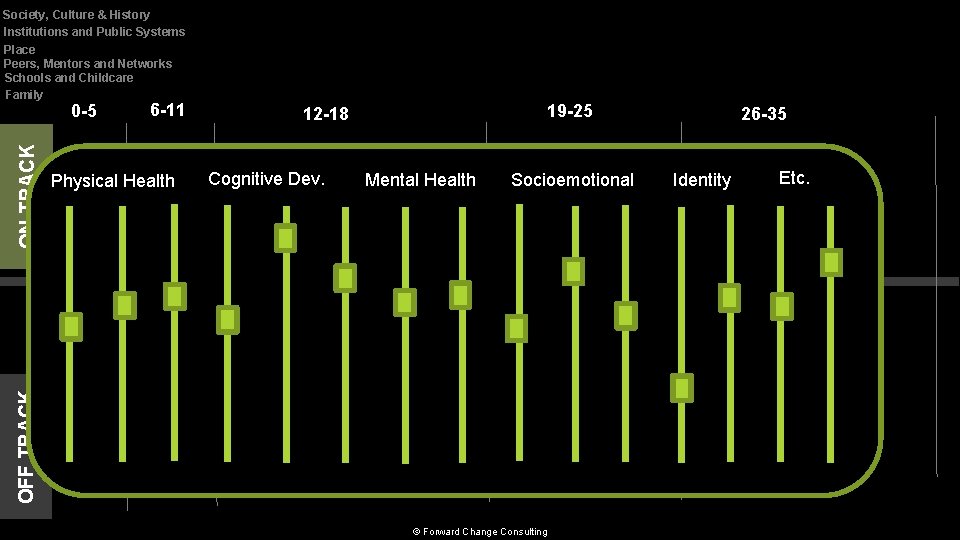
Society, Culture & History Institutions and Public Systems Place Peers, Mentors and Networks Schools and Childcare Family 6 -11 Physical Health 19 -25 12 -18 Cognitive Dev. Mental Health Socioemotional OFF TRACK ON TRACK 0 -5 © Forward Change Consulting 26 -35 Identity Etc.
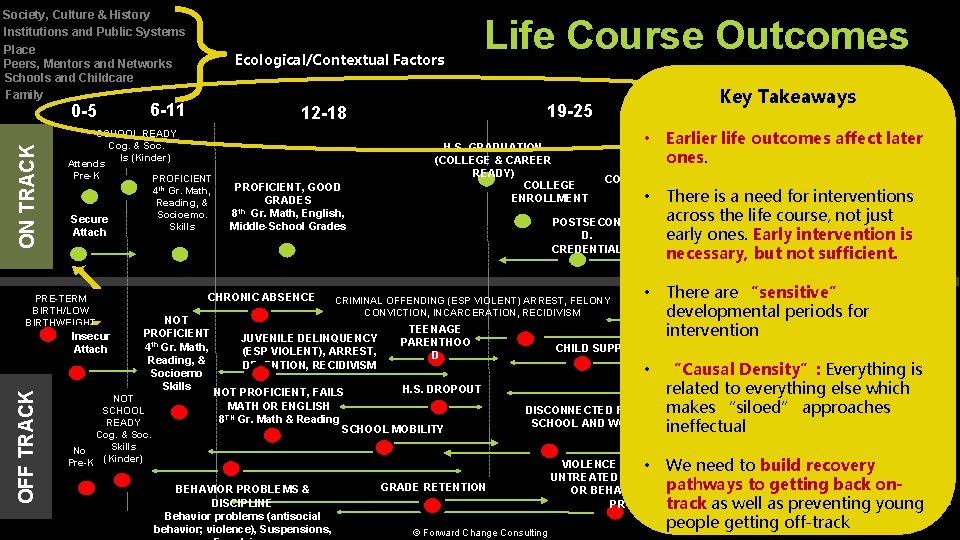
Society, Culture & History Institutions and Public Systems Place Peers, Mentors and Networks Schools and Childcare Family ON TRACK 0 -5 6 -11 Attach Insecur Attach PROFICIENT, GOOD GRADES th 8 Gr. Math, English, Middle-School Grades CHRONIC ABSENCE NOT PROFICIENT 4 th Gr. Math, Reading, & Socioemo Skills NOT SCHOOL READY Cog. & Soc. Skills No (Kinder) Pre-K Key Takeaways 26 -35 19 -25 12 -18 SCHOOL READY Cog. & Soc. Skills (Kinder) Attends Pre-K PROFICIENT 4 th Gr. Math, Reading, & Socioemo. Secure Skills PRE-TERM BIRTH/LOW BIRTHWEIGHT OFF TRACK Ecological/Contextual Factors Life Course Outcomes H. S. GRADUATION (COLLEGE & CAREER READY) COLLEGE ENROLLMENT • COLLEGE COMPLETION (4 -year college) • POSTSECON D. CREDENTIAL CRIMINAL OFFENDING (ESP VIOLENT) ARREST, FELONY CONVICTION, INCARCERATION, RECIDIVISM JUVENILE DELINQUENCY (ESP VIOLENT), ARREST, DETENTION, RECIDIVISM TEENAGE PARENTHOO D H. S. DROPOUT NOT PROFICIENT, FAILS MATH OR ENGLISH 8 TH Gr. Math & Reading SCHOOL MOBILITY STABLE HOUSING Earlier life outcomes affect later ones. STABLE FULL-TIME • EMPLOYMENT @ 300% FPL There is a need for interventions FULL-TIME across. STABLE the life course, not just EMPLOYMENT early ones. Early intervention is necessary, but not sufficient. There are “sensitive” periods for intervention COLLEGE developmental DROPOUT CHILD SUPPORT ARREARS • “Causal Density”: Everything HOUSING INSTABIITY OR HOMELESSNESS DISCONNECTED FROM SCHOOL AND WORK related to everything else which LONG-TERM makes “siloed” approaches UNEMPLOYMENT OR ineffectual UNDEREMPLOYMENT is (>6 Months) BEHAVIOR PROBLEMS & DISCIPLINE Behavior problems (antisocial behavior; violence), Suspensions, GRADE RETENTION © Forward Change Consulting VIOLENCE VICTIMIZATION OR • We need to build recovery UNTREATED SUBSTANCE ABUSE BELOW 300% FPL to. EARNING getting back on. OR BEHAVIORAL pathways HEALTH PROBLEMS track as well as preventing young people getting off-track
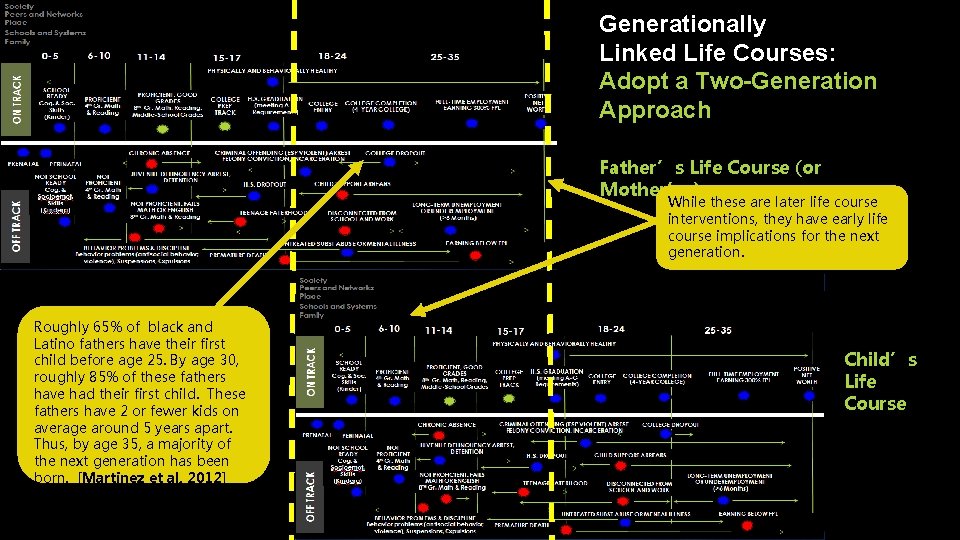
Generationally Linked Life Courses: Adopt a Two-Generation Approach Father’s Life Course (or Mother’s) While these are later life course interventions, they have early life course implications for the next generation. Roughly 65% of black and Latino fathers have their first child before age 25. By age 30, roughly 85% of these fathers have had their first child. These fathers have 2 or fewer kids on average around 5 years apart. Thus, by age 35, a majority of the next generation has been born. [Martinez et al, 2012] Child’s Life Course
Early Childhood Intervention
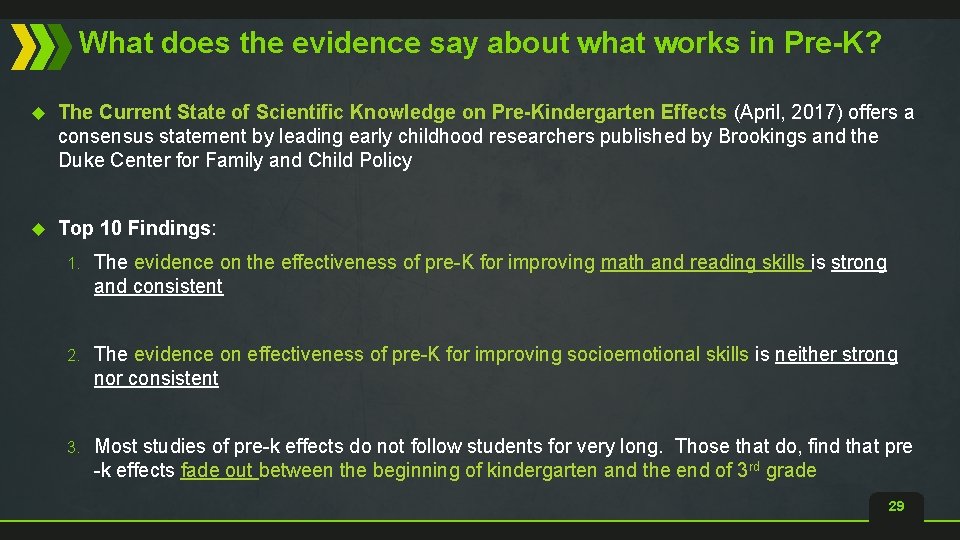
What does the evidence say about what works in Pre-K? The Current State of Scientific Knowledge on Pre-Kindergarten Effects (April, 2017) offers a consensus statement by leading early childhood researchers published by Brookings and the Duke Center for Family and Child Policy Top 10 Findings: 1. The evidence on the effectiveness of pre-K for improving math and reading skills is strong and consistent 2. The evidence on effectiveness of pre-K for improving socioemotional skills is neither strong nor consistent 3. Most studies of pre-k effects do not follow students for very long. Those that do, find that pre -k effects fade out between the beginning of kindergarten and the end of 3 rd grade 29
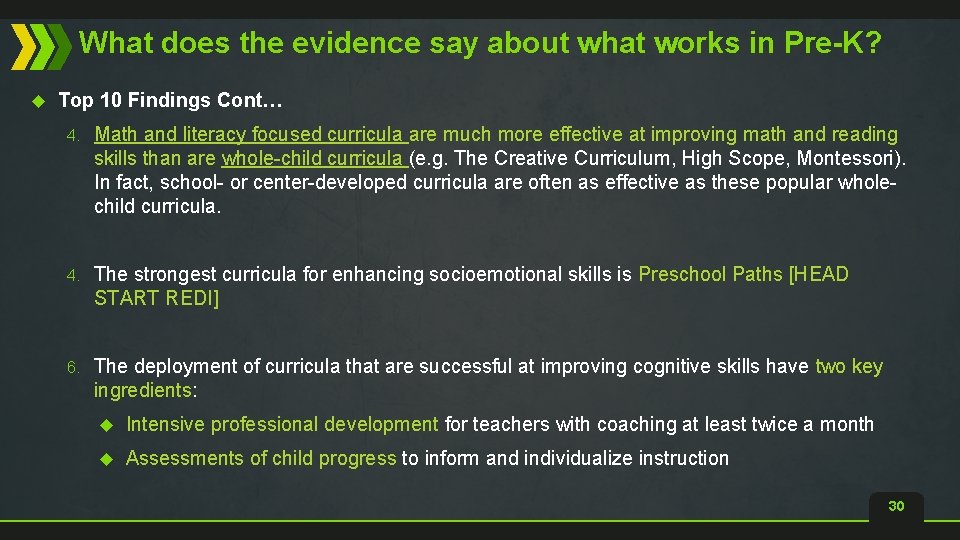
What does the evidence say about what works in Pre-K? Top 10 Findings Cont… 4. Math and literacy focused curricula are much more effective at improving math and reading skills than are whole-child curricula (e. g. The Creative Curriculum, High Scope, Montessori). In fact, school- or center-developed curricula are often as effective as these popular wholechild curricula. 4. The strongest curricula for enhancing socioemotional skills is Preschool Paths [HEAD START REDI] 6. The deployment of curricula that are successful at improving cognitive skills have two key ingredients: Intensive professional development for teachers with coaching at least twice a month Assessments of child progress to inform and individualize instruction 30
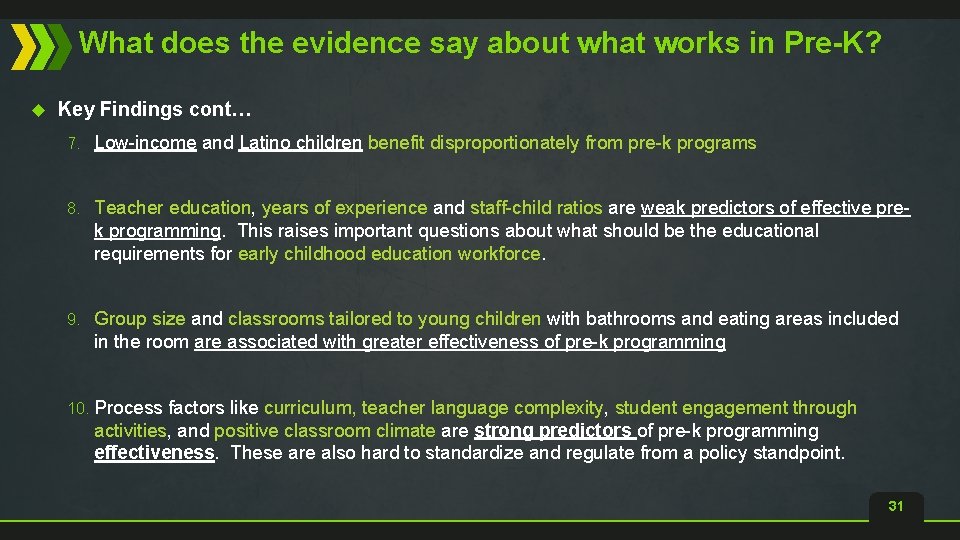
What does the evidence say about what works in Pre-K? Key Findings cont… 7. Low-income and Latino children benefit disproportionately from pre-k programs 8. Teacher education, years of experience and staff-child ratios are weak predictors of effective prek programming. This raises important questions about what should be the educational requirements for early childhood education workforce. 9. Group size and classrooms tailored to young children with bathrooms and eating areas included in the room are associated with greater effectiveness of pre-k programming 10. Process factors like curriculum, teacher language complexity, student engagement through activities, and positive classroom climate are strong predictors of pre-k programming effectiveness. These are also hard to standardize and regulate from a policy standpoint. 31
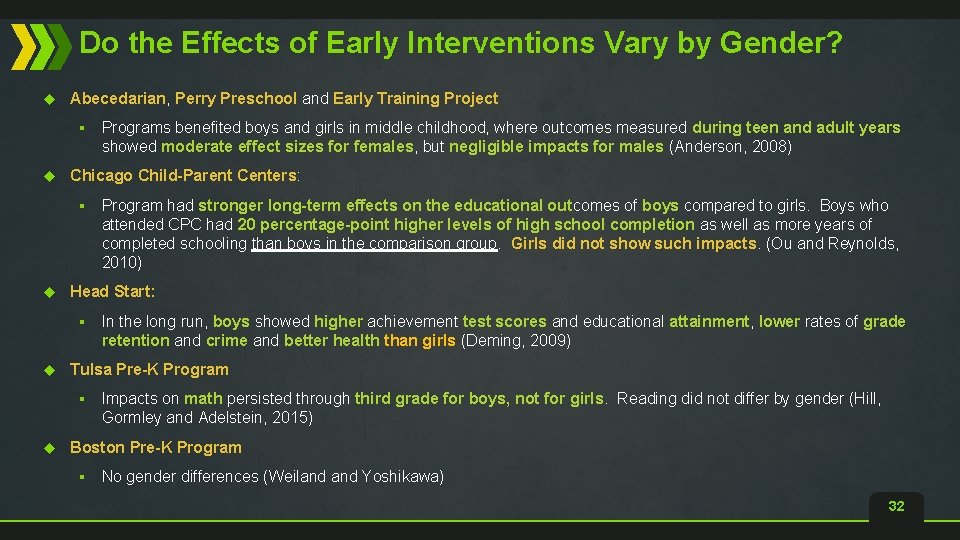
Do the Effects of Early Interventions Vary by Gender? Abecedarian, Perry Preschool and Early Training Project § Chicago Child-Parent Centers: § In the long run, boys showed higher achievement test scores and educational attainment, lower rates of grade retention and crime and better health than girls (Deming, 2009) Tulsa Pre-K Program § Program had stronger long-term effects on the educational outcomes of boys compared to girls. Boys who attended CPC had 20 percentage-point higher levels of high school completion as well as more years of completed schooling than boys in the comparison group. Girls did not show such impacts. (Ou and Reynolds, 2010) Head Start: § Programs benefited boys and girls in middle childhood, where outcomes measured during teen and adult years showed moderate effect sizes for females, but negligible impacts for males (Anderson, 2008) Impacts on math persisted through third grade for boys, not for girls. Reading did not differ by gender (Hill, Gormley and Adelstein, 2015) Boston Pre-K Program § No gender differences (Weiland Yoshikawa) 32
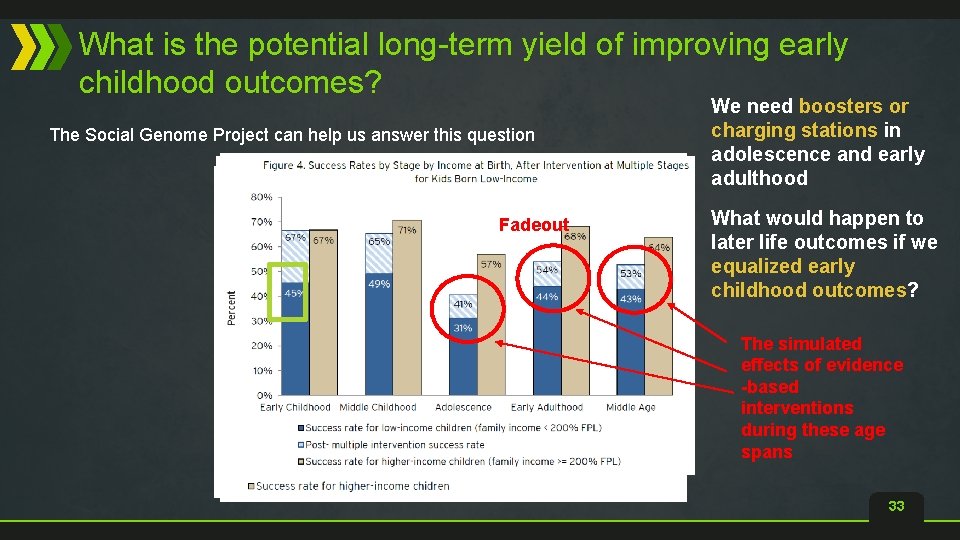
What is the potential long-term yield of improving early childhood outcomes? The Social Genome Project can help us answer this question Fadeout We need boosters or charging stations in adolescence and early adulthood What would happen to later life outcomes if we equalized early childhood outcomes? The simulated effects of evidence -based interventions during these age spans 33
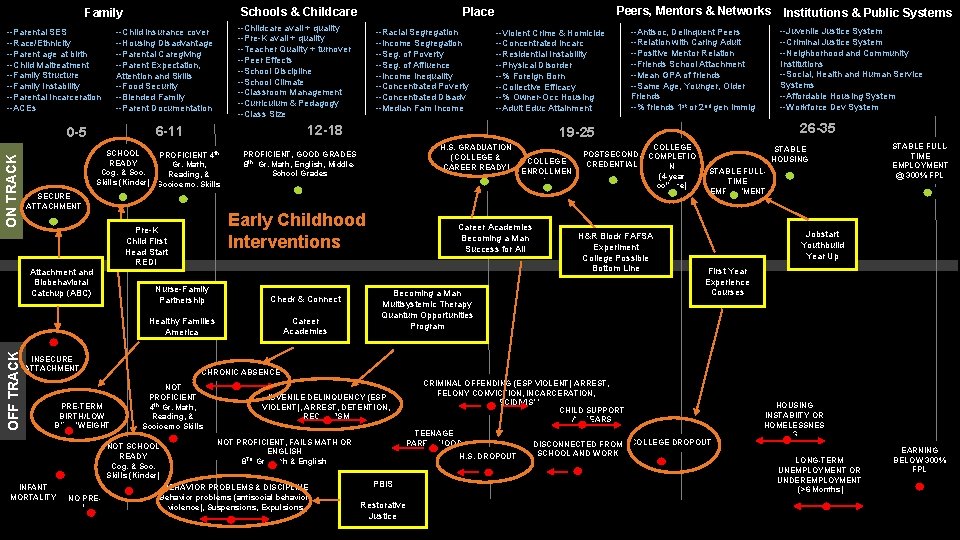
Schools & Childcare Family --Parental SES --Race/Ethnicity --Parent age at birth --Child Maltreatment --Family Structure --Family Instability --Parental Incarceration --ACEs ON TRACK SCHOOL PROFICIENT 4 th READY Gr. Math, Cog. & Soc. Reading, & Skills (Kinder) Socioemo. Skills SECURE ATTACHMENT Check & Connect Healthy Families America Career Academies NOT PROFICIENT 4 th Gr. Math, Reading, & Socioemo Skills NOT SCHOOL READY Cog. & Soc. Skills (Kinder) NO PREK --Juvenile Justice System --Criminal Justice System --Neighborhood and Community Institutions --Social, Health and Human Service Systems --Affordable Housing System --Workforce Dev System --Antisoc, Delinquent Peers --Relation with Caring Adult --Positive Mentor Relation --Friends School Attachment --Mean GPA of friends --Same Age, Younger, Older Friends --% friends 1 st or 2 nd gen immig 26 -35 COLLEGE ENROLLMEN T Career Academies Becoming a Man Success for All COLLEGE POSTSECOND. COMPLETIO CREDENTIAL N (4 -year college) H&R Block FAFSA Experiment College Possible Bottom Line Becoming a Man Multisystemic Therapy Quantum Opportunities Program STABLE HOUSING STABLE FULLTIME EMPLOYMENT @ 300% FPL Jobstart Youthbuild Year Up First Year Experience Courses CHRONIC ABSENCE PRE-TERM BIRTH/LOW BIRTHWEIGHT INFANT MORTALITY H. S. GRADUATION (COLLEGE & CAREER READY) PROFICIENT, GOOD GRADES 8 th Gr. Math, English, Middle. School Grades Nurse-Family Partnership INSECURE ATTACHMENT --Violent Crime & Homicide --Concentrated Incarc --Residential Instability --Physical Disorder --% Foreign Born --Collective Efficacy --% Owner-Occ Housing --Adult Educ Attainment 19 -25 Early Childhood Interventions Pre-K Child First Head Start REDI Attachment and Biobehavioral Catchup (ABC) --Racial Segregation --Income Segregation --Seg. of Poverty --Seg. of Affluence --Income Inequality --Concentrated Poverty --Concentrated Disadv --Median Fam Income 12 -18 6 -11 0 -5 OFF TRACK --Childcare avail + quality --Pre-K avail + quality --Teacher Quality + turnover --Peer Effects --School Discipline --School Climate --Classroom Management --Curriculum & Pedagogy --Class Size --Child insurance cover --Housing Disadvantage --Parental Caregiving --Parent Expectation, Attention and Skills --Food Security --Blended Family --Parent Documentation Peers, Mentors & Networks Institutions & Public Systems Place JUVENILE DELINQUENCY (ESP VIOLENT), ARREST, DETENTION, RECIDIVISM TEENAGE PARENTHOOD NOT PROFICIENT, FAILS MATH OR ENGLISH 8 TH Gr. Math & English BEHAVIOR PROBLEMS & DISCIPLINE Behavior problems (antisocial behavior; violence), Suspensions, Expulsions CRIMINAL OFFENDING (ESP VIOLENT) ARREST, FELONY CONVICTION, INCARCERATION, RECIDIVISM CHILD SUPPORT ARREARS H. S. DROPOUT PBIS Restorative Justice DISCONNECTED FROM SCHOOL AND WORK COLLEGE DROPOUT HOUSING INSTABIITY OR HOMELESSNES S LONG-TERM UNEMPLOYMENT OR UNDEREMPLOYMENT (>6 Months) EARNING BELOW 300% FPL
Contact Arnold Chandler | Arnold@arnoldchandler. com www. forwardchangeconsulting. com
Citations Anna Aizer and Joseph J. Doyle Jr. (2013) “Juvenile Incarceration, Human Capital and Future Crime: Evidence from Randomly. Assigned Judges. ” Working Paper 19102, National Bureau of Economic Research. Available online at http: //www. nber. org/papers/w 19102. M. Anderson (2008) “Multiple Inference and Gender Differences in Effects of Early Intervention: A Reevaluation of the Abecedarian, Perry Preschool and Early Training Projects. ” Journal of the American Statistical Association, 103(484), 1481 -1495 Margery Austin-Turner et al (2014) Tackling Persistent Poverty in Distressed Urban Neighborhoods History, Principles, and Strategies for Philanthropic Investment. Urban Institute David Autor, David Figlio, Krzysztof Karbownik, Jeffrey Roth, Melanie Wasserman (2015) Family Disadvantage and the Gender Gap in Behavioral and Educational Outcomes, Working Paper 15 -16 , Institute for Policy Research, Northwestern University David Autor and Melanie Wasserman (2012) Wayward Sons: The Emerging Gender Gap in Labor Markets and Education, The Third Way. Available at http: //www. thirdway. org/publications/662 Sandy Baum, Jennifer Ma and Kathleen Payea (2013) Education Pays 2013: The Benefits of Higher Education for Individuals and Society. The College Board Marianne Bertrand Jessica Pan (2011), The Trouble with Boys: Social Influences and the Gender Gap in Disruptive Behavior, NBER Working Paper No. 17541, National Bureau of Economic Research. Available at: http: //www. nber. org/papers/w 17541 Claudia Buchman and Thomas A. Di. Prete (2006) “The Growing Female Advantage in College Completion: The Role of Family Background and Academic Achievement, ” American Sociological Review, 71 (4), pp. 515– 541. 36
Citations Centers for Disease Control (2010) "Homicide Rates Among Persons Ages 10– 24 Years, by Race/Ethnicity and Sex, United States". Available at http: //www. cdc. gov/violenceprevention/youthviolence/stats_at-a_glance/hr_age-race. html Andrew J. Cherlin (2014) Labor’s Love Lost: The Rise and Fall of the Working Class Family in America. Russell Sage Foundation Susan Clampet-Lundquist et al (2011) “Moving Teenagers out of High Risk Neighborhoods: How Girls Fare Better than Boys” American Journal of Sociology, Volume 116 Number 4 (January 2011): 1154– 89 Todd Clear (2007) Imprisoning Communities: How Mass Incarceration Makes Disadvantaged Neighborhoods Worse. NY: Oxford University Press. Deborah A. Cobb-Clark (2011) “Fathers and Youth’s Delinquent Behavior, ” Working Paper 17507, National Bureau of Economic Research. Available at: http: //www. nber. org/papers/w 17507. David J. Deming (2009) “Early childhood intervention and life-cycle skill development: evidence from Head Start. ” American Journal: Applied Economics, 1(3), 111 -134. David J. Deming (2014) “School Choice, School Quality, and Postsecondary Attainment”. American Economic Review. 104(3): 991– 1013 Michael Greenstone and Adam Looney (2012) “The Impact of Economic and Technological Change on Marriage Rates”, The Hamilton Project. Candace Hamilton Hester, Chris Meyer, and Steven Raphael (2012) “The Evolution of Gender Employment Rate Differentials within Racial Groups in the United States”, The Journal of Legal Studies, Vol. 41, No. 2 (June 2012), pp. 385 -418 37 http: //www. jstor. org/stable/10. 1086/667578.
Citations Carolyn J. Hill, William T. Gormley, Jr, . Shirley Adelstein (2015) “Do the short-term effects of a high-quality preschool program persist? ” Early Childhood Research Quarterly, 32, 60 -79 Brian A. Jacob (2002) “Where the Boys Aren’t: Non-cognitive Skills, Returns to School and the Gender Gap in Higher Education” Economics of Education Review, 21: 589– 598. Brian L. Jacob and Tamara Linkow Wilder (2011) “Educational Expectations and Attainment, ” in Greg J Duncan and Richard J Murnane, eds. , Whither Opportunity, Russell Sage Foundation, pp. 133– 162. Guyonne Kalb and Jennny Williams (2003) "Gender and Delinquency", Applied Economics Letters, 2003, 10, 425– 429 Rose M. Kreider and Renee Ellis (2011) “Living Arrangements of Children: 2009, " Current Population Reports, P 70 -126. Washington, DC: U. S. Census Bureau. John M. Leventhal, Julie R. Gaither and Robert Sege (2014) "Hospitalizations Due to Firearm Injuries in Children and Adolescents", Pediatrics; originally published online January 27, 2014: Available at http: //pediatrics. aappublications. org/content/early/2014/01/22/peds. 2013 -1809 Gladys Martinez, Kimberly Daniels, and Anjani Chandra (2012), Fertility of Men and Women Aged 15– 44 Years in the United States: National Survey of Family Growth, 2006– 2010, National Health Statistics Report Douglas S. Massey (2007) Categorically Unequal: The American Stratification System. Russell Sage Foundation Richard J. Murnane (2013) U. S High School Graduation Rates: Patterns and Explanations, NBER Working Paper No. 18701. Available at: http: //www. nber. org/papers/w 18701 38
Citations Suh-Ruu Ou and Arthur J. Reynolds (2010) “Mechanisms of effects of an early intervention program on educational attainment: a gender subgroup analysis”. Children and Youth Services Review, 32, 1064 -1076 Derek Neal and Armin Rick (2014) The Prison Boom and the Lack of Black Progress after Smith and Welch, NBER Working Paper No. 20283. Available at: http: //www. nber. org/papers/w 20283 Pew Center on the States (2010) Prison Count 2010: State Population Declines for the First Time in 38 Years. Available online at: http: //www. pewtrusts. org/~/media/legacy/uploadedfiles/wwwpewtrustsorg/reports/sentencing_and_corrections/Prison. Count 2010 pdf. pdf John Pfaff (2011) The Causes of Growth in Prison Admissions and Population Available at SSRN: http: //ssrn. com/abstract=1884674 or http: //dx. doi. org/10. 2139/ssrn. 1884674 Steven Raphael (2007) “Early Incarceration Spells and the Transition to Adulthood, ” in Danziger, Sheldon and Cecilia Elena Rouse (eds) The Price of Independence: The Economics of Early Adulthood, Russell Sage Foundation: New York pp. 278 -306. Sarah K. S. Shannon et al (2017) “The Growth, Scope, and Spatial Distribution of People With Felony Records in the United States, 1948– 2010” Demography (2017) 54: 1795– 1818 Jeremy Travis and Bruce Western (2014) Growth of incarceration in the United States: The Growth of Incarceration in the United States: Exploring Causes and Consequences. National Academies Press. Available at: http: //www. nap. edu/catalog. php? record_id=18613 Jonathan Vespa, Jamie M. Lewis, and Rose M. Kreider (2013) America’s Families and Living Arrangements: 2012 Population Characteristics. U. S. Census Bureau Sara Wakefield and Christopher Wildeman (2013) Children of the Prison Boom: Mass Incarceration and the Future of American Inequality. Oxford University Press 39
Citations Christina Weiland Hirokazu Yoshikawa (2013) “Impacts of a prekindergarten program on children’s mathematics, language, literacy, executive function and emotional skills. ” Child Development, 84(6), 2112 -1314 Bruce Western & Becky Pettit (2010) "Incarceration & social inequality", Daedalus, Summer 2010 William Julius Wilson (1996) When Work Disappears: The World of the New Urban Poor. Knopf Doubleday John Winters and Barry T. Hirsch (2013) “An Anatomy of Racial and Ethnic Trends in Male Earnings. ” Review of Income and Wealth. Available online at: http: //onlinelibrary. wiley. com/doi/10. 1111/roiw. 12064/abstract Justin Wolfers, David Leonhardt, Kevin Quealy (2015) “ 1. 5 Million Missing Black Men” New York Times, April 20 th, 2015. http: //www. nytimes. com/interactive/2015/04/20/upshot/missing-blackmen. html? emc=edit_th_20150421&nl=todaysheadlines&nlid=38700727&abt=0002&abg=1&_r=1 40