
A Level Media Studies Component 2 Media Industries
- Slides: 34
A Level Media Studies Component 2 - Media Industries and Audiences Section A- Video Games study (Minecraft)
Overview • Minecraft is the second most successful video game of all time behind Tetris. • It was created and designed by Markus Persson, a game programmer, who also developed and published the game through his company Mojang. A full version of the game went on release in November 2011. • To date, well over 121 million copies have been sold across all platforms, including over 27 million PC copies, making it the biggest selling PC game of all time. 12 p 1 12 p 4 13
We are going to use Minecraft as a case study to explore how the media industries’ processes of production, distribution and circulation affect media forms and platforms. It also considers how Minecraft targets, reaches and addresses customers and examines the way in which audiences have reacted to the game both as consumers and prosumers themselves.
Section A: Media Industries and Audiences (Evolving Media, Paper 2 Question 2) Sample exam question: ‘Explain the impact of digitally convergent media platforms on video game production, distribution and consumption. Refer to Minecraft to support your answer. ’ (15 marks)
Key terms • Digitally convergent media: Video games consoles are an excellent example of a digitally convergent device, you can not only play games but access social media, surf the internet, stream films and TV content and upload content into cloud based servers. Cross-media content helps maximise profits and also improve reach to new customers. • Production: This refers to all phases of designing, developing and making the media product; this process is addressed in this factsheet. • Distribution: This refers to all processes linked to delivering the media product to audiences both through tangible (disc) and digital (Cloud based) media. • Consumption: Explores the way in which the media text is used by audiences for pleasure but also explores the rise of user generated content across several platforms.
The Industry
• Charlie Brooker's comedic history of video games Media Industries • A recent report by the UKIE suggests that the global games market is now worth in excess of US$100 billion a year, with projections estimating revenue of US$120 billion by 2020 after a pattern of continued growth. • The UK’s share of the market is just over US$4 billion; China, the fastest growing sector, currently enjoys US$24. 4 billion versus America’s US$23. 6 billion. • In comparison to traditional media like film, radio, print and television, video games are much younger, exponentially growing since the 1970 s. • Over three decades later, the industry is enjoying a resurgence with new types of ‘gamer’ and much tighter regulation, aided by key developments in internet speeds and accessibility. Thus, video games are culturally and financially significant across major territories (including Japan, Europe and the USA) with new console and games releases from popular franchises classed as major economic events.
Minecraft in the Industry
Minecraft is a sandbox game, created and developed by Swedish based Mojang Studios. The game has been described as a virtual world of Lego that involves following simple instructions in order to play it: explore, mine and build. Users only have to log in and proceed to create a world full of textured 3 D cubes. There are predominantly two game modes: Creative or Survival, although more recent additions include Adventure, Spectator and also Multi-Player modes.
Mojang Documentary Essay question for after viewing: Based on the two documentaries you have watched, answer the following question: “Minecraft is the most important video game of the last decade, because of how it came to market, and what it offers its audience. ” How far do you agree with this statement?
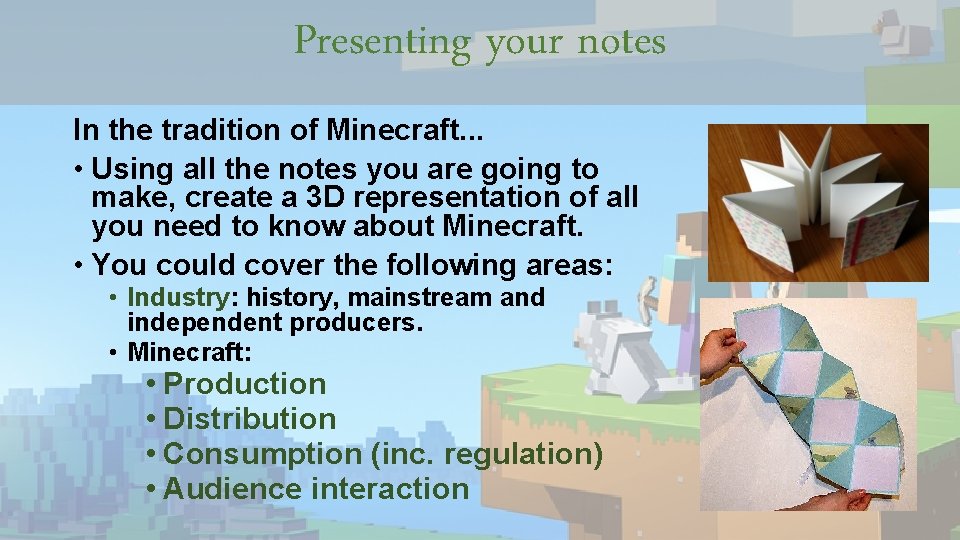
Presenting your notes In the tradition of Minecraft. . . • Using all the notes you are going to make, create a 3 D representation of all you need to know about Minecraft. • You could cover the following areas: • Industry: history, mainstream and independent producers. • Minecraft: • Production • Distribution • Consumption (inc. regulation) • Audience interaction
• Minecraft’s Swedish creator, Markus “Notch” Persson started creating the game in May of 2009 • Minecraft’s initial reception wasn’t commercially viable, seen more as a niche product for players with expert knowledge of computers and programming. • Without the commercial backing of a mainstream publisher, and no money spent on advertising revenue, the game relied on word of mouth between gamers and featured on sites such as the Penny Arcade web comic to generate interest amongst gamers. • Consequently, by January 2011, the beta-version of the game had passed over one million purchases in just only a month, and by April 2011 Persson estimated that US$33 million of revenue had been made.
• In November 2011, prior to the game’s official release, Minecraft had over 16 million registered users and 4 million purchases. • Due to its popularity, Minecraft was released across multiple platforms becoming a commercially viable franchise with increased interactivity. In particular, Minecraft: Pocket Edition was released on Sony Xperia Play, available on Sony Xperia smartphones. Minecraft also become available on Android and i. OS devices shortly after.
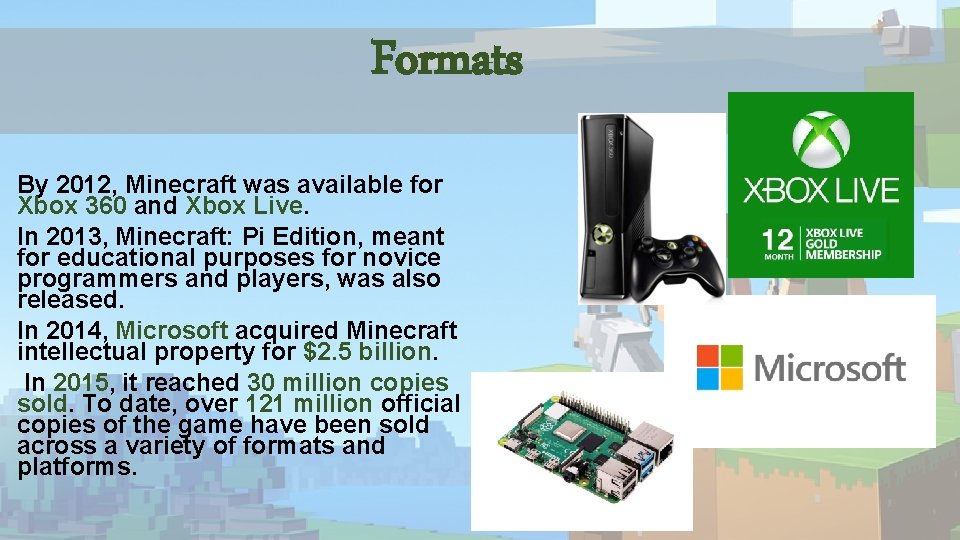
Formats By 2012, Minecraft was available for Xbox 360 and Xbox Live. In 2013, Minecraft: Pi Edition, meant for educational purposes for novice programmers and players, was also released. In 2014, Microsoft acquired Minecraft intellectual property for $2. 5 billion. In 2015, it reached 30 million copies sold. To date, over 121 million official copies of the game have been sold across a variety of formats and platforms.
Distribution Versions of the game can be purchased over the internet using such outlets as the Playstation Network or Xbox Live Arcade. Recent additions include the Nintendo platform which was excluded from the initial Minecraft releases; available to download from December 2015 with physical copies from June 2016 and most recently for Nintendo Switch (May 2017) and Nintendo 3 DS (download only from September 2017). The Minecraft: Story Mode - A Telltale Games series is also available via Steam.
Critical reception and genre Critical Reception: On its release, the game won five awards at three conferences, including an Innovation Award, Best Debut Game, Best Downloadable Game, Audience Award and Seumas Mc. Nally Grand Prize. Genre - Sandbox game: A game free of structure and constraint; players are free to roam and make choices about how they use available content. Sandbox games are often described as having open world settings. Minecraft later created a hybrid genre with the story versions and is sometimes categorised as sandbox, survival.
Processes of production, distribution and circulation by organisations, groups and individuals in a global context • Why do you think OCR has chosen ‘Minecraft’ as a set text for this area of the exam? 1. What makes ‘Minecraft’ different from anything else in the market? (Industry) 2. How has ‘Minecraft’ accessed its audience, and why is this different from normal? (Audience) 3. How has technology changed the video games industry, especially how people get hold of the games? (Industry and audience)
The relationship of recent technological change and media production, distribution and circulation. Due to the original nature of the game, most players simply logged in to play Minecraft and didn’t need a physical copy of the game. Users were often encouraged to download the game through cloud servers rather than a physical copy of the game which would incur more of a cost for the institution. The pattern of release for Minecraft shows that physical copies are often released six months after the downloadable version, most likely as a way to limit the impact of piracy, hacking and file sharing. The introduction of Minecraft Realms (2013) has tried to give the producers more control over the distribution and circulation of the game since some proam consumers were creating their own virtual spaces and hacks across illegitimate servers, such as https: //www. wizardhax. com/ play/ as one example. It would be worth considering how some audiences might be playing Minecraft through these channels and are not included in the extensive official user figures.
The significance of patterns of ownership and control, including conglomerate ownership, vertical integration and diversification. Tasks: 1. Research Mojang Studios: who do they work with? What other games are they involved in? size of company? Profits? Relationships to other big companies such as Napster, Microsoft and Facebook? VR potential? 2. What links to non-profit work does the company have? Why?
The significance of economic factors, including commercial and not-for-profit public funding, to media industries and their products. Minecraft is a good example of a game that was made and developed using readily available open source software within the gaming community; creating the original Minecraft using Java gave it the advantage of being cross-platform: it will run on Windows, Mac OS X, and Linux. Task: Compare this to other mainstream games that require entire teams of programmers, artists and engineers to make video games that have budgets equal or exceeding that of mainstream films.
How media organisations maintain, including through marketing, varieties of audiences nationally and globally • How much of Minecraft’s success was due to word of mouth and audiences sharing their own mods and game footage across web forums and video sharing sites such as You. Tube? Task: • What other promotional products has the Minecraft franchise used for promotional purposes? • What other developers and games studios have made intertextual references to Minecraft?
The regulatory framework of contemporary media in the UK and the impact of ‘new’ digital technologies on media regulation, including the role of individual producers. • Go to www. videostandards. org. uk/Rating. Board/ to look at the PEGI ratings for different versions of the game. • Then look at http: //www. esrb. org/ and compare the ratings. • Does a game such as Minecraft even needs regulating? Consider the impact of freely available, fan-made videos where language and content is likely to be more risqué and unregulated by such bodies. It is also worth considering how material is accessed and played. Minecraft Realms are hosted on specialised servers by Mojang. The terms and conditions are extensive and bring into debate issues of ownership of intellectual content and the disclaimers that now have to be issued by media industries. Most interestingly, there are stipulations by the company that they own everything created using blocks within these virtual worlds and that accreditation for worlds and structures created by fans is not guaranteed. In 2016 a marketplace was created for communities to trade in maps, skins and texture packs.
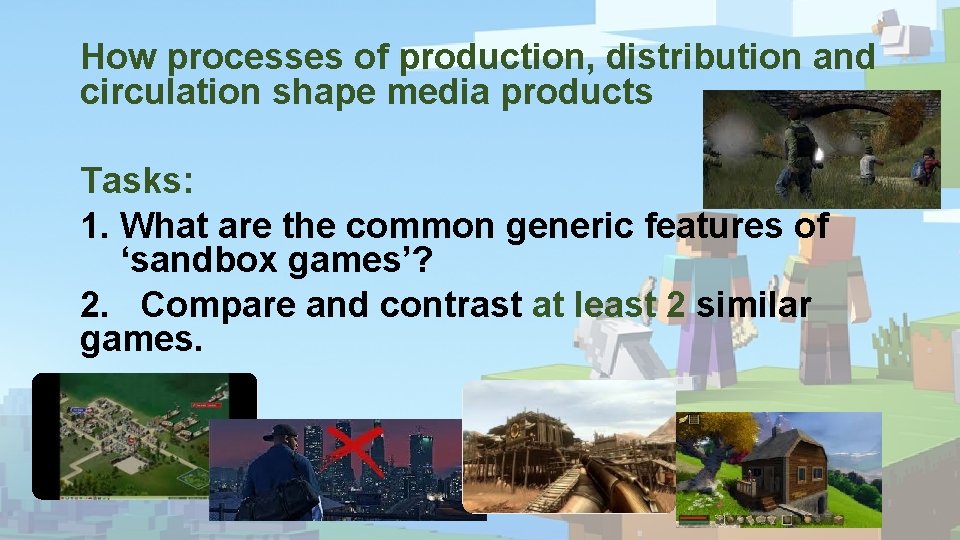
How processes of production, distribution and circulation shape media products Tasks: 1. What are the common generic features of ‘sandbox games’? 2. Compare and contrast at least 2 similar games.
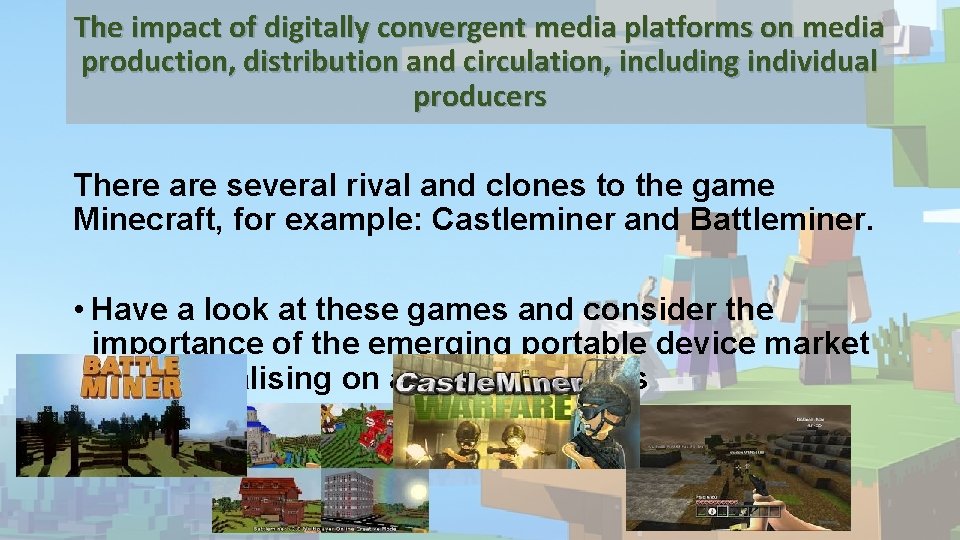
The impact of digitally convergent media platforms on media production, distribution and circulation, including individual producers There are several rival and clones to the game Minecraft, for example: Castleminer and Battleminer. • Have a look at these games and consider the importance of the emerging portable device market and capitalising on audience desires
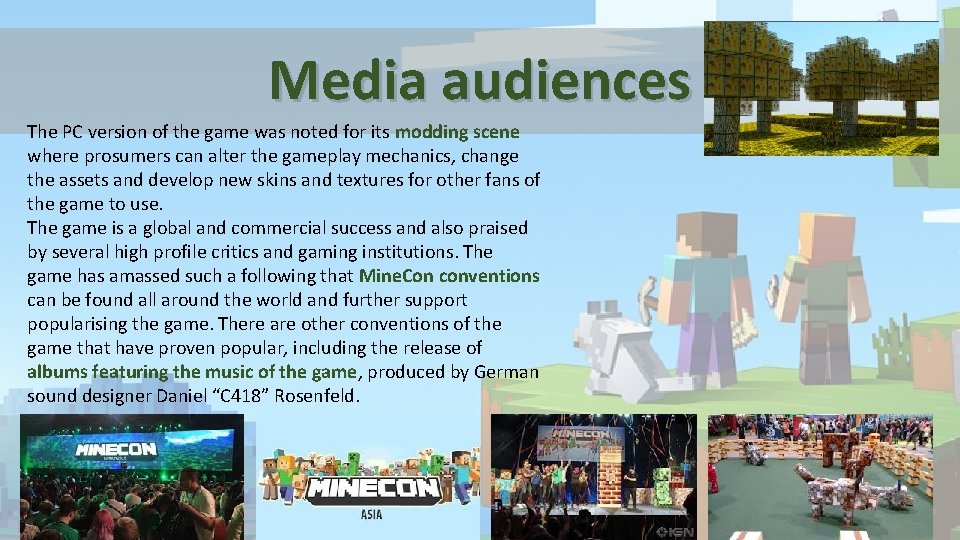
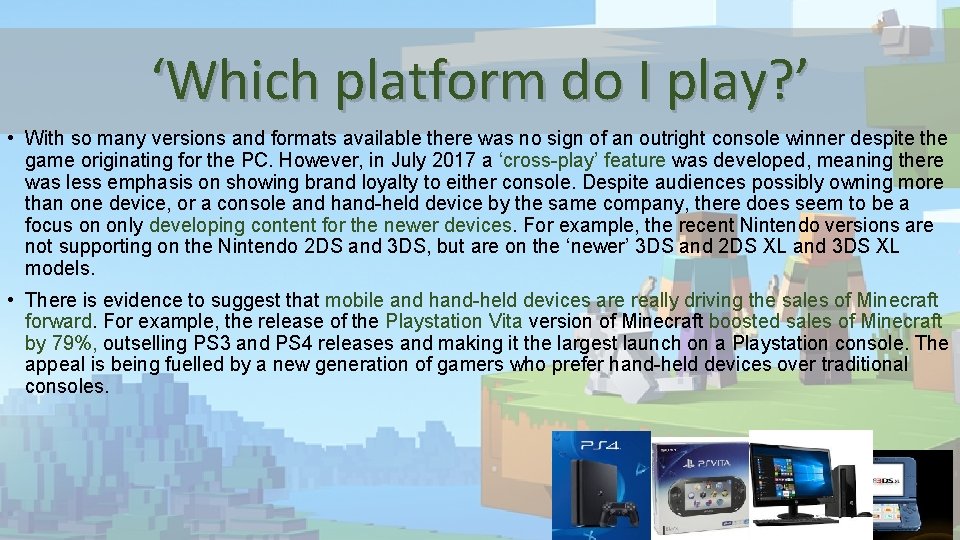
Media audiences The PC version of the game was noted for its modding scene where prosumers can alter the gameplay mechanics, change the assets and develop new skins and textures for other fans of the game to use. The game is a global and commercial success and also praised by several high profile critics and gaming institutions. The game has amassed such a following that Mine. Con conventions can be found all around the world and further support popularising the game. There are other conventions of the game that have proven popular, including the release of albums featuring the music of the game, produced by German sound designer Daniel “C 418” Rosenfeld.
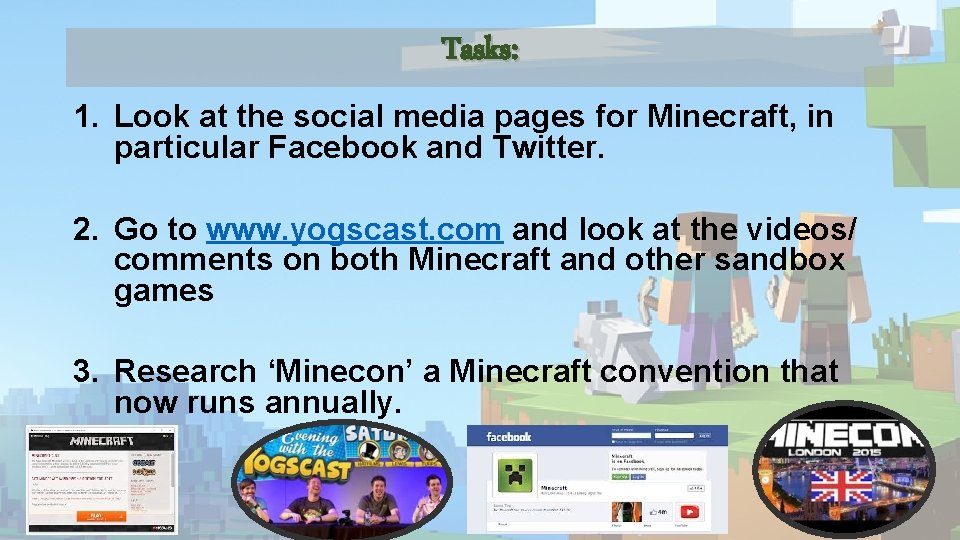
‘Which platform do I play? ’ • With so many versions and formats available there was no sign of an outright console winner despite the game originating for the PC. However, in July 2017 a ‘cross-play’ feature was developed, meaning there was less emphasis on showing brand loyalty to either console. Despite audiences possibly owning more than one device, or a console and hand-held device by the same company, there does seem to be a focus on only developing content for the newer devices. For example, the recent Nintendo versions are not supporting on the Nintendo 2 DS and 3 DS, but are on the ‘newer’ 3 DS and 2 DS XL and 3 DS XL models. • There is evidence to suggest that mobile and hand-held devices are really driving the sales of Minecraft forward. For example, the release of the Playstation Vita version of Minecraft boosted sales of Minecraft by 79%, outselling PS 3 and PS 4 releases and making it the largest launch on a Playstation console. The appeal is being fuelled by a new generation of gamers who prefer hand-held devices over traditional consoles.
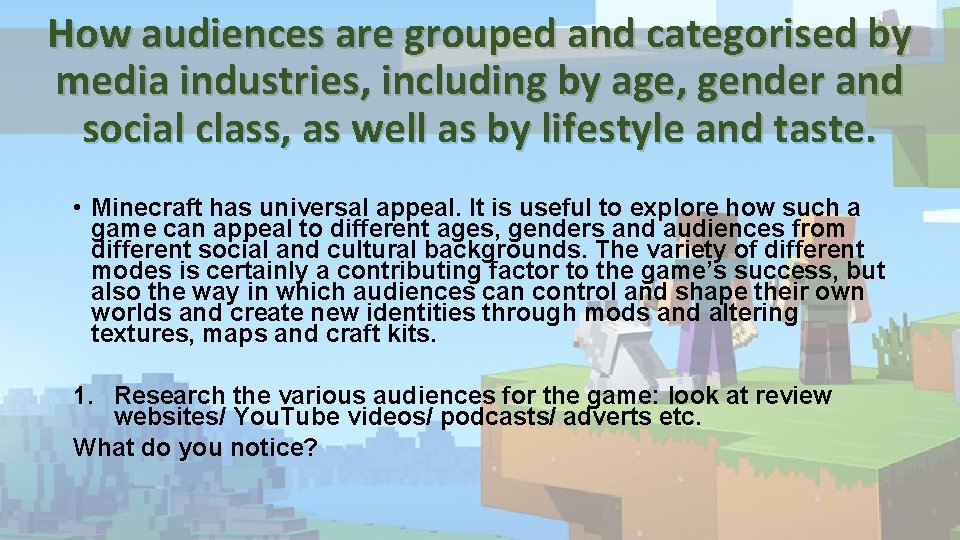
Tasks: 1. Look at the social media pages for Minecraft, in particular Facebook and Twitter. 2. Go to www. yogscast. com and look at the videos/ comments on both Minecraft and other sandbox games 3. Research ‘Minecon’ a Minecraft convention that now runs annually.
How audiences are grouped and categorised by media industries, including by age, gender and social class, as well as by lifestyle and taste. • Minecraft has universal appeal. It is useful to explore how such a game can appeal to different ages, genders and audiences from different social and cultural backgrounds. The variety of different modes is certainly a contributing factor to the game’s success, but also the way in which audiences can control and shape their own worlds and create new identities through mods and altering textures, maps and craft kits. 1. Research the various audiences for the game: look at review websites/ You. Tube videos/ podcasts/ adverts etc. What do you notice?
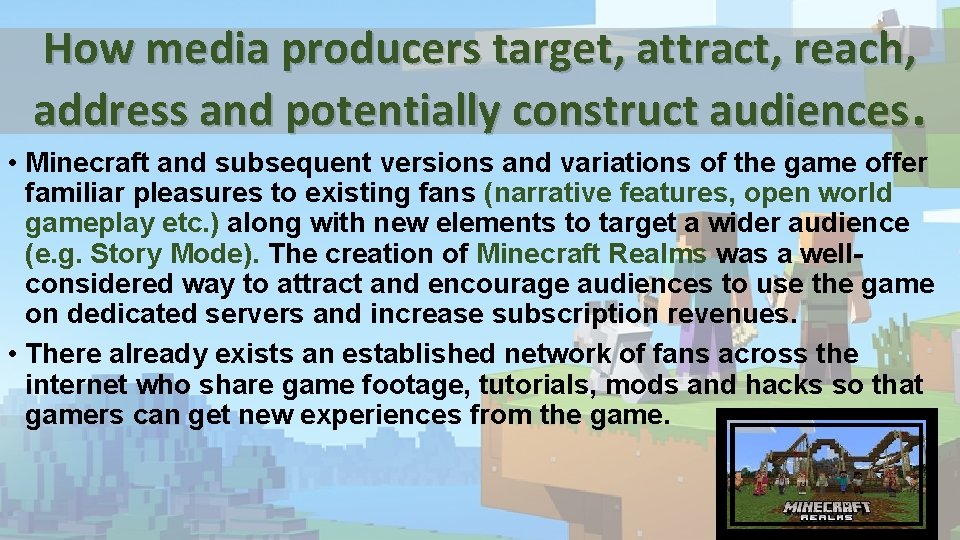
How media producers target, attract, reach, address and potentially construct audiences. • Minecraft and subsequent versions and variations of the game offer familiar pleasures to existing fans (narrative features, open world gameplay etc. ) along with new elements to target a wider audience (e. g. Story Mode). The creation of Minecraft Realms was a wellconsidered way to attract and encourage audiences to use the game on dedicated servers and increase subscription revenues. • There already exists an established network of fans across the internet who share game footage, tutorials, mods and hacks so that gamers can get new experiences from the game.
How media industries target audiences through the content and appeal of media products and through the ways in which they are marketed, distributed and circulated. • Initially there was little work to advertise the original version of Minecraft; it was simply word of mouth across forums that created a buzz about the game. Now that Minecraft is established and owned by a division of a conglomerate, the methods used to distribute and market the game are similar to popular mainstream releases. Research project: Find examples of the different ways that Minecraft has been marketed and produce a deconstruction one of one print-based promotional device and one audio-visual.
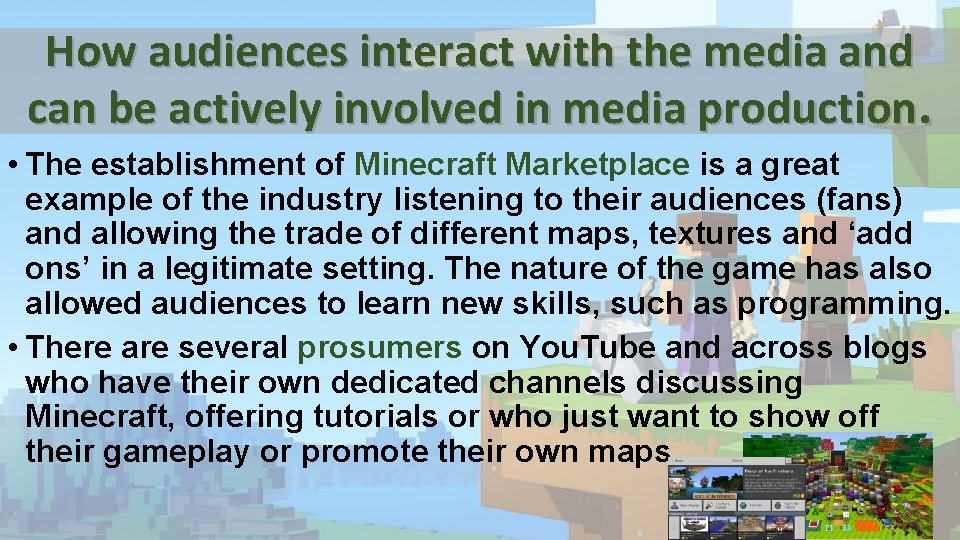
How audiences interact with the media and can be actively involved in media production. • The establishment of Minecraft Marketplace is a great example of the industry listening to their audiences (fans) and allowing the trade of different maps, textures and ‘add ons’ in a legitimate setting. The nature of the game has also allowed audiences to learn new skills, such as programming. • There are several prosumers on You. Tube and across blogs who have their own dedicated channels discussing Minecraft, offering tutorials or who just want to show off their gameplay or promote their own maps.
extra
Theoretical Perspectives Regulation – Sonia Livingstone and Peter Lunt • New technologies (in this case the convergent devices with access to internet, Bluetooth, etc. ) opens up opportunities and risks that complicate regulation. Cultural Industries – David Hesmondhalgh • Explore how cultural industry companies attempt to minimise risk and maximise audiences. The game has a large fan base and is owned by a division of a global conglomerate. The purchase of Mojang for US$2. 5 billion illustrates that Microsoft are clearly attempting to harness the popularity of this franchise to encourage sales both of the game itself and promote Windows 10 and their smartphone market.
Identity – David Gauntlett • Gauntlett conducted a series of studies based around the use of Lego to create and share ideas and has also compared this to how audiences use the internet (one giant allotment). Making is Connecting is all about how people build a stronger sense of self-identity through creative practices. Minecraft adopts the same principles and shows how audiences are not only ‘making and connecting’ but are infinitely more creative through the use of the internet. The critical response of Minecraft as a media text highlights how the game is a way for people to socially create and interact is testimony to this idea. Fandom – Henry Jenkins • Video games offer social experiences (online multi-player options) as well as communities outside of the core game experience. Jenkins’ key quote ‘if it doesn’t spread, it’s dead’ can be used as a discussion point to track the birth and popularity of the franchise. Minecraft has a strong, well developed fan base that could be researched in more detail in relation to Jenkins’ ideas about participatory culture.