
A Level Geography OCR Course outline A level

- Slides: 9
A Level Geography (OCR)
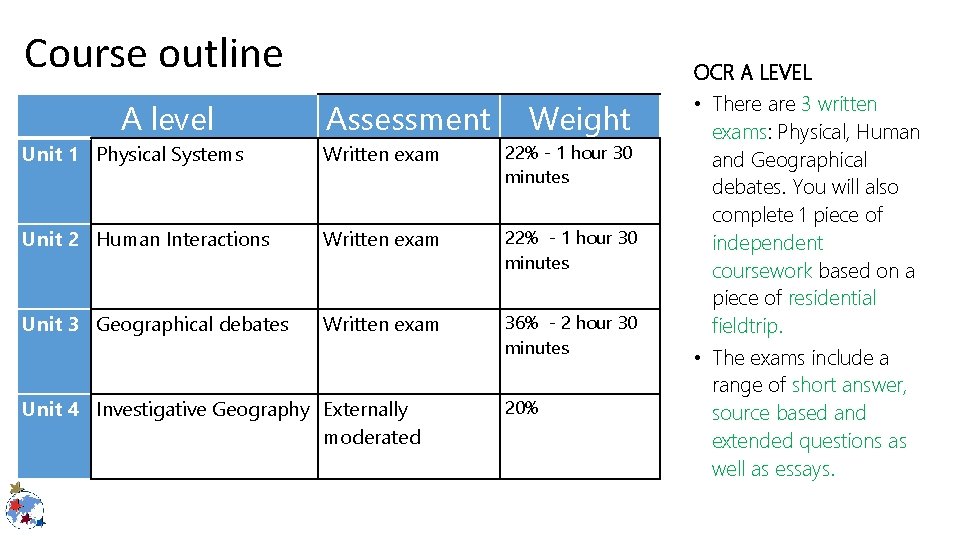
Course outline A level OCR A LEVEL Assessment Weight Unit 1 Physical Systems Written exam 22% - 1 hour 30 minutes Unit 2 Human Interactions Written exam 22% - 1 hour 30 minutes Unit 3 Geographical debates Written exam 36% - 2 hour 30 minutes Unit 4 Investigative Geography Externally moderated 20% • There are 3 written exams: Physical, Human and Geographical debates. You will also complete 1 piece of independent coursework based on a piece of residential fieldtrip. • The exams include a range of short answer, source based and extended questions as well as essays.
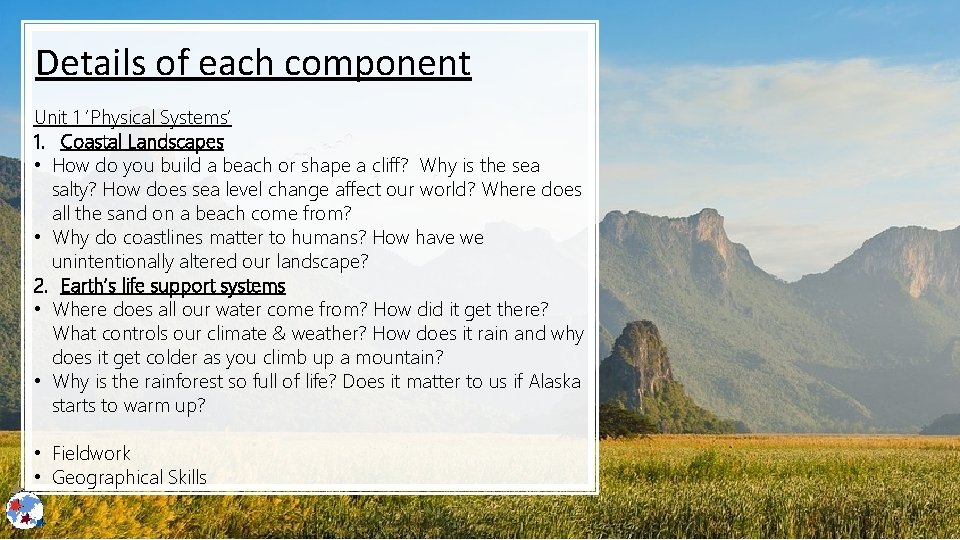
Details of each component Unit 1 ‘Physical Systems’ 1. Coastal Landscapes • How do you build a beach or shape a cliff? Why is the sea salty? How does sea level change affect our world? Where does all the sand on a beach come from? • Why do coastlines matter to humans? How have we unintentionally altered our landscape? 2. Earth’s life support systems • Where does all our water come from? How did it get there? What controls our climate & weather? How does it rain and why does it get colder as you climb up a mountain? • Why is the rainforest so full of life? Does it matter to us if Alaska starts to warm up? • Fieldwork • Geographical Skills
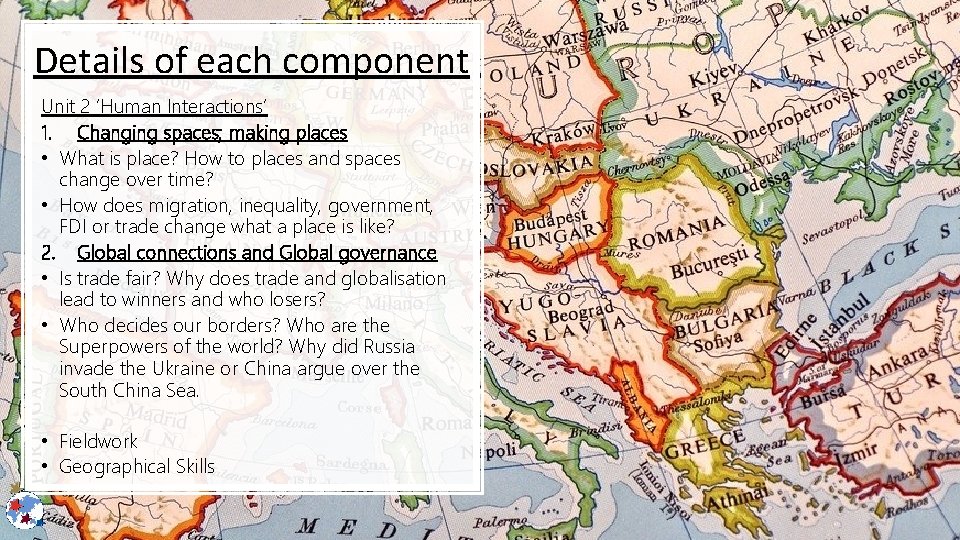
Details of each component Unit 2 ‘Human Interactions’ 1. Changing spaces; making places • What is place? How to places and spaces change over time? • How does migration, inequality, government, FDI or trade change what a place is like? 2. Global connections and Global governance • Is trade fair? Why does trade and globalisation lead to winners and who losers? • Who decides our borders? Who are the Superpowers of the world? Why did Russia invade the Ukraine or China argue over the South China Sea. • Fieldwork • Geographical Skills
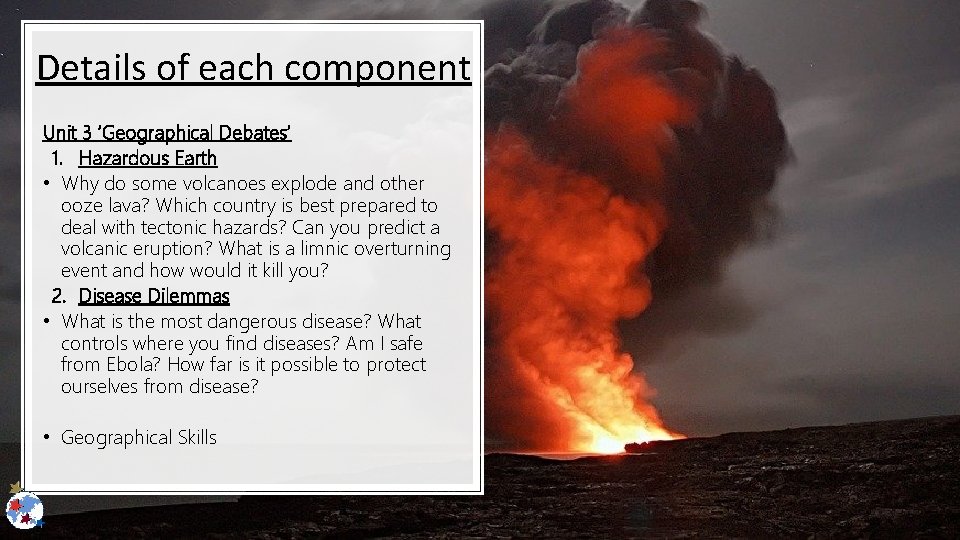
Details of each component Unit 3 ‘Geographical Debates’ 1. Hazardous Earth • Why do some volcanoes explode and other ooze lava? Which country is best prepared to deal with tectonic hazards? Can you predict a volcanic eruption? What is a limnic overturning event and how would it kill you? 2. Disease Dilemmas • What is the most dangerous disease? What controls where you find diseases? Am I safe from Ebola? How far is it possible to protect ourselves from disease? • Geographical Skills
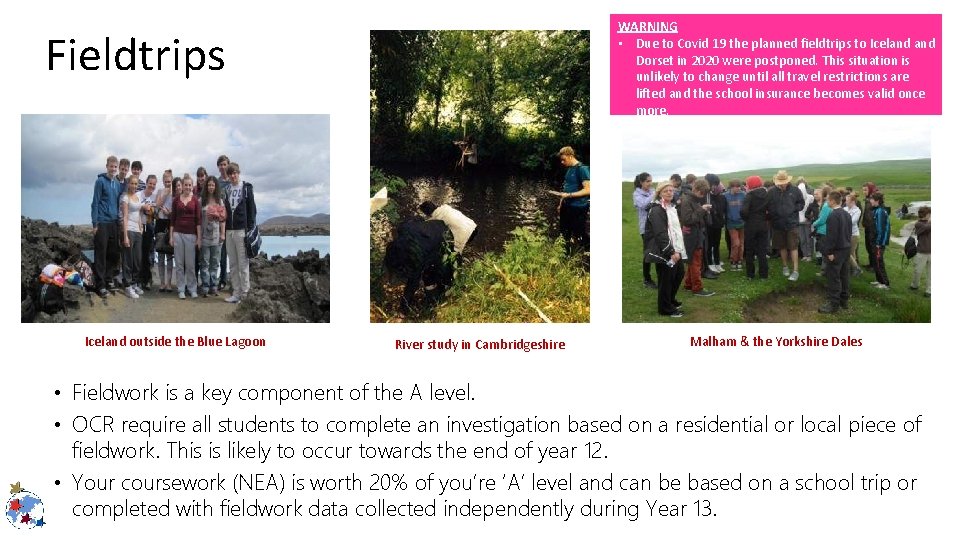
WARNING • Due to Covid 19 the planned fieldtrips to Iceland Dorset in 2020 were postponed. This situation is unlikely to change until all travel restrictions are lifted and the school insurance becomes valid once more. Fieldtrips Iceland outside the Blue Lagoon River study in Cambridgeshire Malham & the Yorkshire Dales • Fieldwork is a key component of the A level. • OCR require all students to complete an investigation based on a residential or local piece of fieldwork. This is likely to occur towards the end of year 12. • Your coursework (NEA) is worth 20% of you’re ‘A’ level and can be based on a school trip or completed with fieldwork data collected independently during Year 13.
Where will A level Geography take me? Geography and the skills it develops can be applied in many different fields of study. These often include students taking degrees in Politics, History, Geology, Earth science, Biology, Sociology as well as Geography itself. Universities regard Geography as a top rated ‘A’ level and is sometimes described as a facilitator subject. • Beyond higher education Geography ties into work with the civil service and local government, the energy and environmental sectors as well as journalism, market research, logistics and distribution and education. • Business – are enthusiastic about people who’ve done Geography, because they know how to: research; use statistical data; interpret and use geographical information systems; and how to synthesise new knowledge with the world around them. Key message = this is a great subject to pick even if you don’t intend on carrying it on beyond A level. •
Geography A Level: Student Testimonies • • For further information, please contact – Mr Purkiss or Mr Kirk: tpurkiss@ccs. northants. sch. uk or jkirk@ccs. northants. sch. uk