
A Level English Literature Year 11 Taster Lesson
- Slides: 9
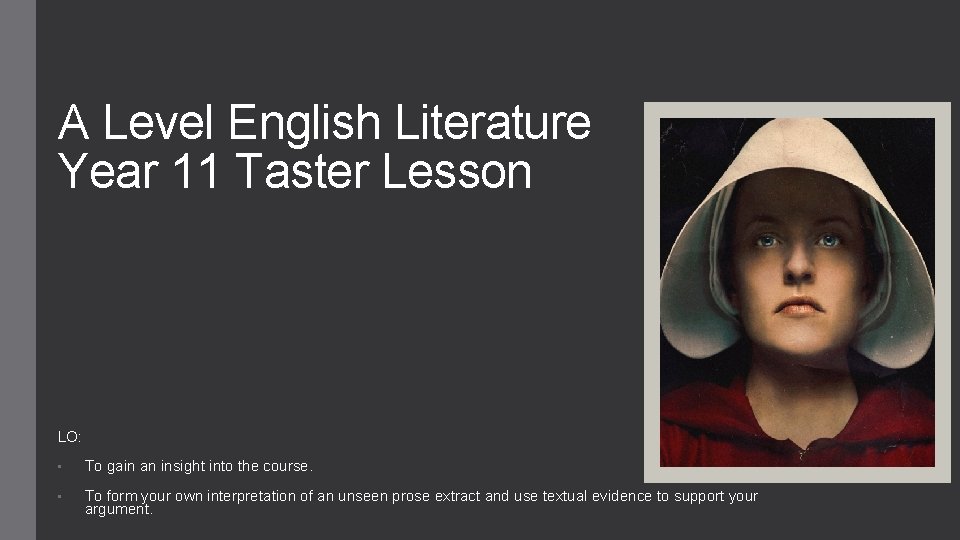
A Level English Literature Year 11 Taster Lesson LO: • To gain an insight into the course. • To form your own interpretation of an unseen prose extract and use textual evidence to support your argument.
A Level English Literature Love Through the Ages Othello Unseen poetry The Great Gatsby/pre-1900 Poetry Anthology Texts in Shared Contexts: Modern Times Feminine Gospels Unseen Prose The Color Purple/Our Country’s Good Texts Across Time
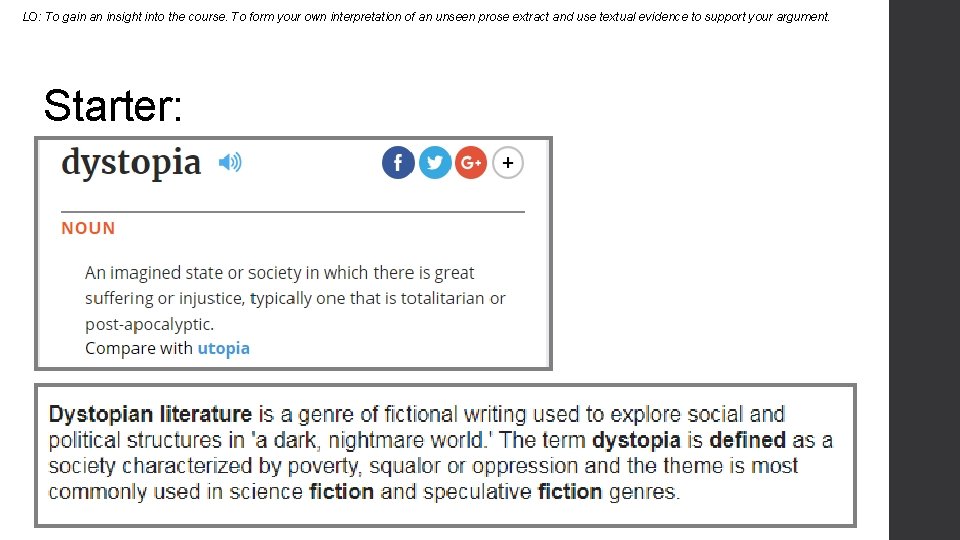
LO: To gain an insight into the course. To form your own interpretation of an unseen prose extract and use textual evidence to support your argument. Starter: § What is a dystopia? § What would you expect when reading dystopian literature?
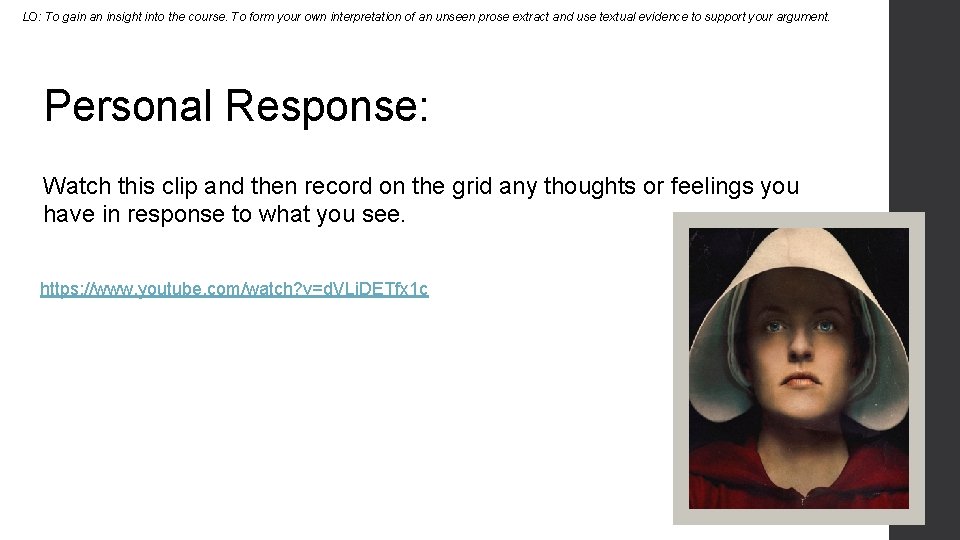
LO: To gain an insight into the course. To form your own interpretation of an unseen prose extract and use textual evidence to support your argument. Personal Response: Watch this clip and then record on the grid any thoughts or feelings you have in response to what you see. https: //www. youtube. com/watch? v=d. VLi. DETfx 1 c
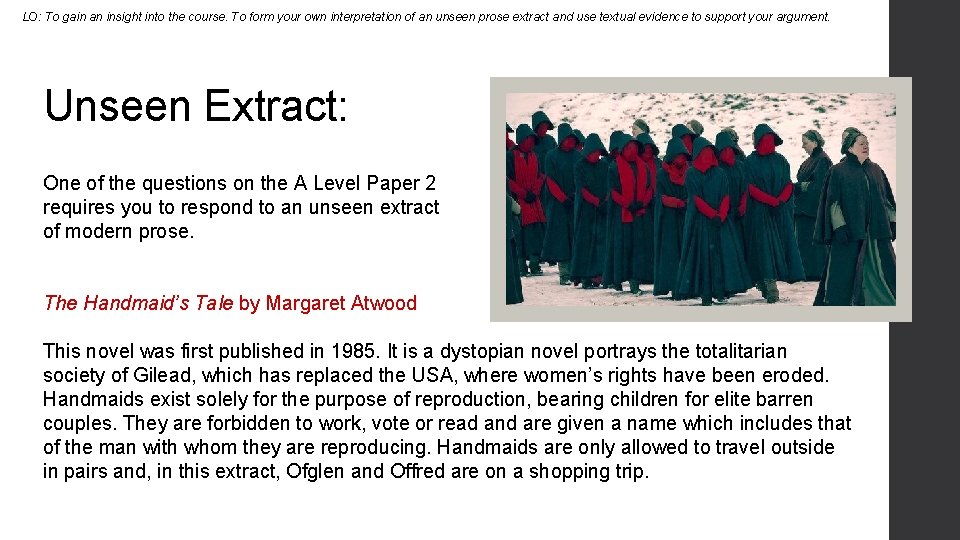
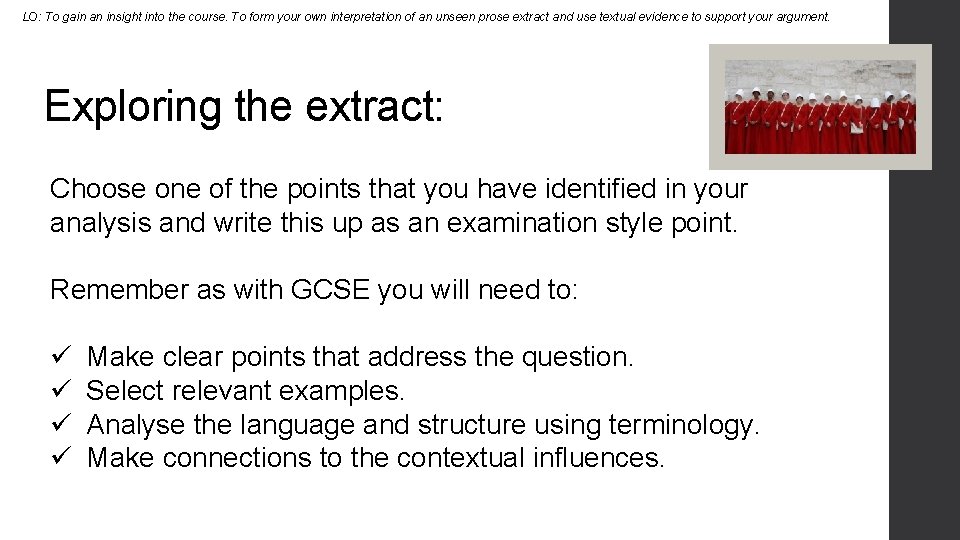
LO: To gain an insight into the course. To form your own interpretation of an unseen prose extract and use textual evidence to support your argument. Unseen Extract: One of the questions on the A Level Paper 2 requires you to respond to an unseen extract of modern prose. The Handmaid’s Tale by Margaret Atwood This novel was first published in 1985. It is a dystopian novel portrays the totalitarian society of Gilead, which has replaced the USA, where women’s rights have been eroded. Handmaids exist solely for the purpose of reproduction, bearing children for elite barren couples. They are forbidden to work, vote or read and are given a name which includes that of the man with whom they are reproducing. Handmaids are only allowed to travel outside in pairs and, in this extract, Ofglen and Offred are on a shopping trip.
LO: To gain an insight into the course. To form your own interpretation of an unseen prose extract and use textual evidence to support your argument. Unseen Extract: In the exam there will be a question that you have to create an argument when answering. What does ‘individuality’ mean to you? Explore the significance of individuality in this extract. Remember to include in your answer relevant detailed analysis of the ways that Atwood shapes meanings.
LO: To gain an insight into the course. To form your own interpretation of an unseen prose extract and use textual evidence to support your argument. Exploring the extract: Be prepared to share your findings! In your pairs you will be identified as an A or a B. A you must track through the extract and highlight evidence that shows a lack of individuality. B you must track through the extract and highlight evidence that shows individuality.
LO: To gain an insight into the course. To form your own interpretation of an unseen prose extract and use textual evidence to support your argument. Initially Atwood presents the Japanese tourists as a “group of people” and through the narrator Offred’s perspective she conforms to a somewhat stereotypical representation of this particular social group – Japanese tourists with cameras “They’re diminutive and neatly turned out; each has his or her camera, his or her smile. ” The collective pronouns and the determiner “each” removes their individuality and identifies them only as a group of identical people. However, their individuality is alluded to through the juxtaposition of one collective with the other – the handmaids. Offred remarks “It’s been a long time since I’ve seen skirts that short on women. ” It is the freedom of the Japanese women to chose their own clothing and chose to display their legs that indicates their individuality and difference from the handmaids.
LO: To gain an insight into the course. To form your own interpretation of an unseen prose extract and use textual evidence to support your argument. Exploring the extract: Choose one of the points that you have identified in your analysis and write this up as an examination style point. Remember as with GCSE you will need to: ü ü Make clear points that address the question. Select relevant examples. Analyse the language and structure using terminology. Make connections to the contextual influences.