
A LEVEL ENGLISH LITERATURE AS LEVEL POETRY modern

- Slides: 36
A LEVEL ENGLISH LITERATURE
AS LEVEL • POETRY modern, published post 2000 • PROSE two novels: pre-19 th century and modern • DRAMA tragedy or comedy
A 2 (FULL A LEVEL) • POETRY AS modern poetry and a poetry from a literary period or named poet • PROSE two novels: pre-19 th century and modern (studied for AS) • DRAMA Shakespeare and play studied for AS • COURSEWORK - comparison of two texts (20%)
WHY ENGLISH LITERATURE? • Where do we start? ! • https: //www. youtube. com/watch? v=MSYw 502 d. JNY&list=PL 8 d. Puua. Lj. Xt. Oe. Ec 9 ME 62 z. Tfqc 0 h 6 Pe 8 vb (7 minutes) • Why do we read? What's the point of reading critically?
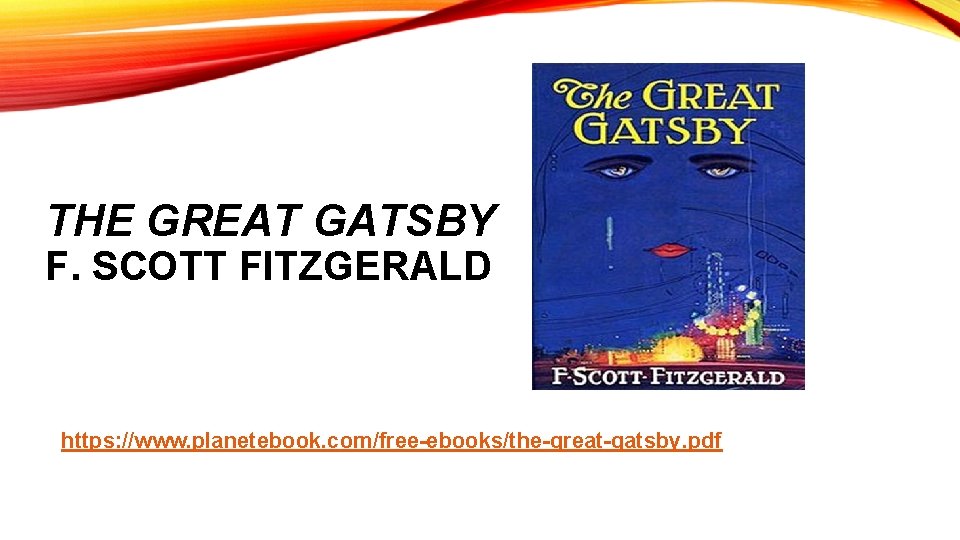
THE GREAT GATSBY F. SCOTT FITZGERALD https: //www. planetebook. com/free-ebooks/the-great-gatsby. pdf
SYNOPSIS https: //www. youtube. com/watch? v=e 6 Iu 29 TNfk. M 8 minutes Reading: about 5 pages from the start, online copy P 9: “And so it happened that on a warm and windy evening I drove over to East Egg to see two old friends whom I scarcely knew at all. ”
NARRATOR AND CHARACTERS • Nick Carraway – (unreliable) narrator and character in the novel • Jay Gatsby – the elusive and enigmatic eponymous protagonist • Daisy and Tom Buchanan – very wealthy married couple. Daisy is Nick’s cousin and Gatsby is in love with her. • Jordan Baker – a friend of the Buchanans, beautiful, cynical, young professional golfer – a sporting celebrity • George Wilson – runs a garage in an area called the Valley of the Ashes on the way to New York • Myrtle Wilson – George’s wife and Tom Buchanan’s mistress
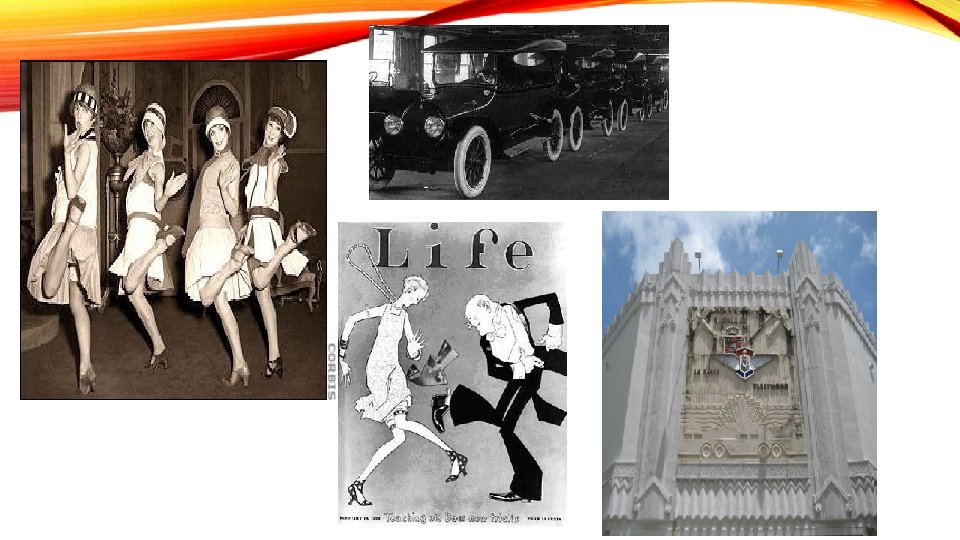
SETTING • The setting of the story is New York City and on Long Island, in two areas known as "West Egg" and "East Egg"—in real life, Great Neck and Port Washington peninsulas on Long Island. • The main events of the novel take place in the summer of 1922, in the period now known as the Jazz Age, just after the First World War and before the Great Depression of the 1930 s. • However, there are flashbacks to Gatsby’s past and the time when he first met Daisy.
SYNOPSIS • Set on Long Island New York City, The Great Gatsby is narrated by 29 -year-old Midwesterner Nick Carraway – also a character in the story, who comes to New York in 1922 to work in the bond business. • He rents a cheap bungalow next door to a mysterious man called Jay Gatsby who lives in a mock French mansion, and who throws extravagant parties every Saturday night. • Nick reconnects with his cousin, a Southern debutante named Daisy, the wife of Nick's racist Yale classmate, the staggeringly wealthy ex-football star Tom Buchanan. • Nick meets Jordan Baker, friend of the Buchanans, the beautiful professional golfer. • He learns that Tom has a mistress, Myrtle Wilson, wife of a garage mechanic in Valley of the Ashes, a grey industrial dumping ground on the way to New York.
SYNOPSIS • Eventually Nick is invited to one of Gatsby’s famous parties and discovers that no one there actually knows who Gatsby is. • However, he meets Gatsby and they become friendly. However, Nick realises that Gatsby lies about his past and he remains a mystery for Nick (and the reader) • Nick discovers that Gatsby is in love with Daisy whom he met and fell in love with during the war when he was in uniform, and therefore unidentifiable as poor and working class, which he was. • Gatsby's obsession with Daisy, whom he loved as a young Army officer stationed in Louisville right before World War I, fuels this tale of longing and loss, of dreams and disillusion.
BUT WHAT IS THE NOVEL ACTUALLY ABOUT? • The American Dream – Gatsby represents America itself • Greed and hypocrisy • Fitzgerald decouples wealth and greatness. In this novel wealth is associated with corruption and amorality. • Truth • Class divisions • A love story – but more! • A reflection on the hollowness of a life of leisure • Gatsby is obsessed with controlling time: he wants to create a beautiful future by restoring the past. This is what leads Gatsby to say his most famous line "Can't change the past? Why, of course you can. "
OTHER IDEAS …IN NO PARTICULAR ORDER! • Daisy – an unlikeable character, but interesting! • She has a sense of entitlement coming from a wealthy, privileged class of inherited wealth; she has limited empathy, is vapid (insipid), unable to make difficult choices. • So is Gatsby really in love with her? Most say he is in love with the DREAM of Daisy and what she represents. • The American Dream – about acquiring wealth and status in society. • For Gatsby, (represents America) it is not enough that Daisy says she loves him, she must also say she never loved Tom. In America, and western cultures – enough is never enough – we always want more, so the dream is doomed.
CHARACTERS … • None of the characters in The Great Gatsby are very likeable. • They are flawed and very hard to sympathise with, but in a sense that is the beauty of the book. • Of course you hate Daisy Buchanan! Of course you hate Tom! You even begin to slightly dislike Gatsby, to whom it is not enough for Daisy to say that she loved him, but he requires her to state that she never in her five year marriage loved her husband Tom, which is unreasonable! • Jordan Baker cheats at golf! • But Gatsby, to most readers, remains Great right until the end of this book.
IRONY … • Fitzgerald further emphasises the cruelty and injustice of the world – because of the irony that only the rich and idle survive in this novel. • The rich continue to be careless, for that is the dream, is it not, for all of us? To live a carefree life? • Yet Fitzgerald highlights the horrors of being a careless person: "They [Tom and Daisy] smashed up things and creatures and then retreated back into their money and vast carelessness. " • However, Tom and Daisy aren't careless to be malicious - that is just their nature. And that in itself is a very sad thing. They do not care for their daughter, for Myrtle, for Gatsby nor even each other. They are unable to care.
IS GATSBY ‘GREAT’? • Fitzgerald’s language elevates Gatsby’s triumphs and tragedies to greatness. • The language is magnificently complex and rich, it is a dense read because every sentence is packed with detail and care. • Many consider The Great Gatsby to be depressing because, in the end, those who dream do not achieve their aspirations. However, the main message that Fitzgerald sends to us is not that dreaming will lead to despair, but that chasing an unworthy dream will lead to tragedy. • Daisy was not a worthy dream, but Gatsby is great because of his courage and that he never lost his sense of hope - he died believing that Daisy would call him back. • He died still reaching towards his dream.
GATSBY – THE AMERICAN DREAM • Gatsby was a ‘great’ man. • Unfortunately, he dreamed for something unworthy of his pursuit. • He was kind and warm and giving, but to all the wrong people. He built himself up from nothing to this fantastic life of mansions and high-class parties. • He was the American Dream. This is what most Americans believe is the American Dream, or a similar variation – and this is what Fitzgerald seems to say – that it is false.
MORE … • Fitzgerald's writing is almost like a work of poetry, with waves of literary brilliance creating a rich and lush rhythm which you can almost tap your foot to. • The descriptions are jarringly, magnificently beautiful so that it almost makes your heart ache.
A COUPLE OF YOUTUBE VIDEOS … ONCE YOU HAVE READ THE NOVEL • https: //www. youtube. com/watch? v=xw 9 Au 9 Oo. N 88 11 minutes – Great Gatsby part 1 crash course – a lively presentation, entertaining as well as informative! • https: //www. youtube. com/watch? v=cn 0 WZ 8 -0 Z 1 Y 8. 49 minutes Part 2 crash course, considers the question: Is Gatsby ‘great’?
• Ch 1 What details about the Buchanans’ house represent money and/or excess?
CLOSE ANALYSIS • Read pp. 45 -47 • 1. ‘There was music from my neighbour’s house through the summer nights. ’ • Music is a motif that patterns the entire text. Daisy’s voice, the Jazz parties; even the rhythm of the novel itself could be said to reflect the spirit of the age, with its intensity and strangeness (cf. p. 44, for instance). Fitzgerald insists on music because it appeals directly to the senses; it is also both inviting and dangerous – as the intertextual allusion to the mythical Sirens suggests.
• 2. ‘In the blue gardens men and girls came and went like moths among the whisperings and the champagne and the stars. ’ • Why (a) ‘blue’ gardens? (b) ‘like moths’ (c) ‘the whisperings etc’ • 3. How many things are numbered in the passage? List them. What do you make of this? • 4. Nick has not yet met Gatsby. What’s the purpose of such a preamble?
• 5. Where do you get a sense that Gatsby has tried to impose his will on the natural landscape? Why might this be important? • 6. Where does Fitzgerald show us a contrast between the rich and poor, leisure and labour? Why do this? • 7. ‘The ravages of the night before. ’ Why use a word like this? What other parts of the passage are suggestive of ruin, devastation etc ? Why would Fitzgerald strike this note at this stage of the text?
• 8. What is the point of the paragraph telling us about a machine for extracting the juice out of oranges? • 9. In a sweeping metaphorical flourish, Gatsby’s garden and the buffet tables of food become a festive Christmas scene. Why? • 10. Paragraph beginning: ‘By seven o’clock…’ How is a sense of hedonistic excitement created? • 11. Why ‘the earth lurches away from the sun’?
• 12. Paragraph beginning: ‘Suddenly…’ People, in the novel, act out the discordant rhythms of the age. How is that apparent here?
CHAPTER 5 • 1) Why does the meeting, at Carraway’s house, so unsettle and embarrass Gatsby? • 2) Why is it symbolically significant that Daisy’s chauffeur is called ‘Ferdie’? • 3) What accounts for the ‘huge change’ in Gatsby? • 4) When in Gatsby’s house, some of the details are telling. Which ones? • 5) The episode with the shirts tells us what? • 6) What role does the rain play in the chapter? • 7) Does Gatsby realise the illusory quality of his dream or cling to it?
GATSBY – OUTSIDE BUCHANAN’S HOUSE CH 7 • Nick’s reaction – ‘I’d had enough of all of them for one day, and suddenly that included Jordan too. ’ • He misunderstands Gatsby’s concern with Daisy – often initial impression of Gatsby is wrong – later truth emerges – fragmented technique
END OF CHAPTER … • Tom and Daisy inside with blind drawn – Nick sees them from outside • They were neither happy nor unhappy – ‘unmistakable air of natural intimacy about the picture … conspiring together. ’ • Gatsby excluded – like Nick’s first glimpse of him – ‘left him standing there in the moonlight – watching over nothing. ’
THE GREAT GATSBY Chapter 8, to p. 161
• 1) The opening sentence. Discuss: (a) Carraway’s insomnia; (b) the ‘groaning’ foghorn; (c) ‘grotesque reality and savage, frightening dreams. ’ • 2) What details about Gatsby’s house seem changed now? How do we read this? • 3) Why couldn’t Carraway bear to shake Gatsby free of ‘some last hope’? • 4) What do you make of the simile ‘Jay Gatsby has broken up like glass…’?
• 5) In Gatsby’s account of his first encounters with Daisy, years ago, how is it clear that, even when Gatsby’s ideal was forming, it was somehow mixed up with the idea of money? • 6) In what way is Gatsby compared to an Medieval quester? Why? • 7) Why is it significant that ‘they have never been closer’ than when Daisy is ‘silent’ or ‘as if asleep’?
• 8) When Daisy is not there, she becomes enlarged, in Gatsby’s imagination. What, on the other hand, happens to Gatsby in Daisy’s imagination when he is away? (p. 157) • 9) What is it that Daisy and the music of the Jazz Age have in common? • 10) There a wealth of symbolic details on p. 159. Discuss some of them. • 11)What is Carraway’s attitude to Gatsby on pp. 160 -161? • 12) How is this ambiguity reflected in the language used about Gatsby on these pages?
• Chapter 8 • pp. 161 -Eo. C
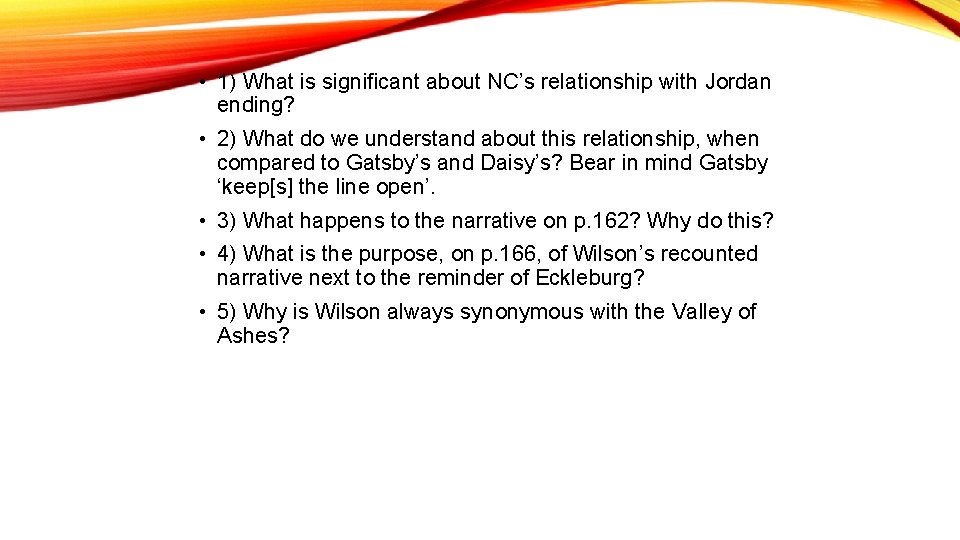
• 1) What is significant about NC’s relationship with Jordan ending? • 2) What do we understand about this relationship, when compared to Gatsby’s and Daisy’s? Bear in mind Gatsby ‘keep[s] the line open’. • 3) What happens to the narrative on p. 162? Why do this? • 4) What is the purpose, on p. 166, of Wilson’s recounted narrative next to the reminder of Eckleburg? • 5) Why is Wilson always synonymous with the Valley of Ashes?
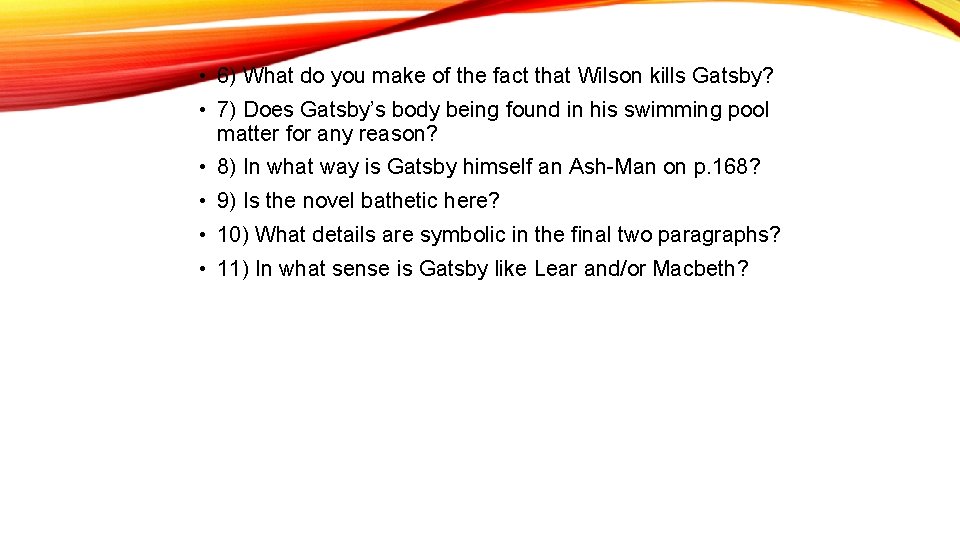
• 6) What do you make of the fact that Wilson kills Gatsby? • 7) Does Gatsby’s body being found in his swimming pool matter for any reason? • 8) In what way is Gatsby himself an Ash-Man on p. 168? • 9) Is the novel bathetic here? • 10) What details are symbolic in the final two paragraphs? • 11) In what sense is Gatsby like Lear and/or Macbeth?
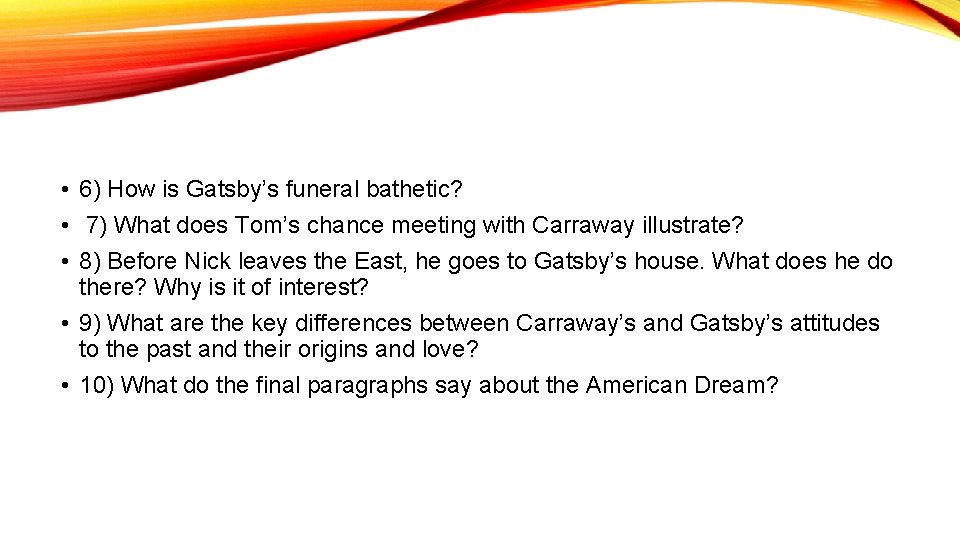
• 6) How is Gatsby’s funeral bathetic? • 7) What does Tom’s chance meeting with Carraway illustrate? • 8) Before Nick leaves the East, he goes to Gatsby’s house. What does he do there? Why is it of interest? • 9) What are the key differences between Carraway’s and Gatsby’s attitudes to the past and their origins and love? • 10) What do the final paragraphs say about the American Dream?