
A LEVEL DANCE ALEVEL DANCE ASSESSMENT OUTCOMES A

- Slides: 16
A LEVEL DANCE
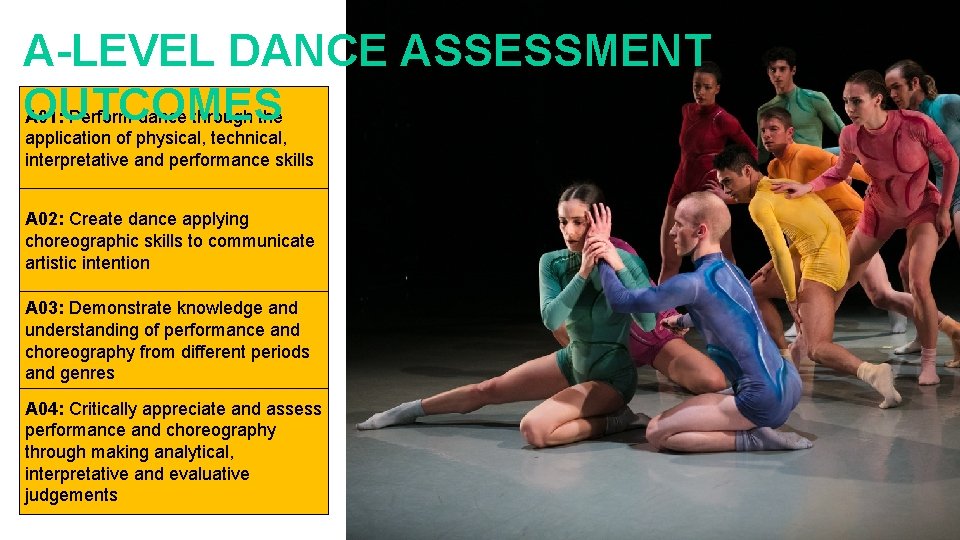
A-LEVEL DANCE ASSESSMENT OUTCOMES A 01: Perform dance through the application of physical, technical, interpretative and performance skills A 02: Create dance applying choreographic skills to communicate artistic intention A 03: Demonstrate knowledge and understanding of performance and choreography from different periods and genres A 04: Critically appreciate and assess performance and choreography through making analytical, interpretative and evaluative judgements
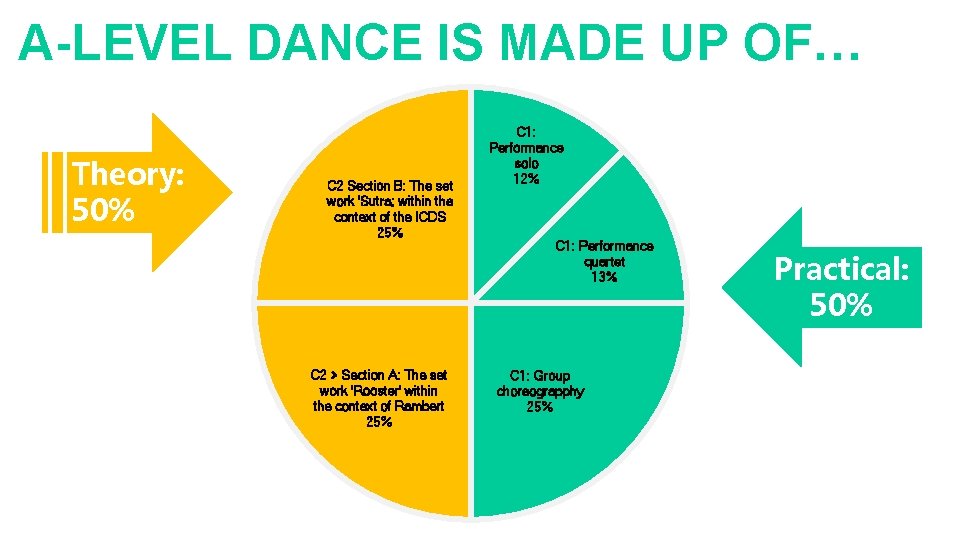
A-LEVEL DANCE IS MADE UP OF… Theory: 50% C 2 Section B: The set work 'Sutra; within the context of the ICDS 25% C 2 > Section A: The set work 'Rooster' within the context of Rambert 25% C 1: Performance solo 12% C 1: Performance quartet 13% C 1: Group choreograpphy 25% Practical: 50%
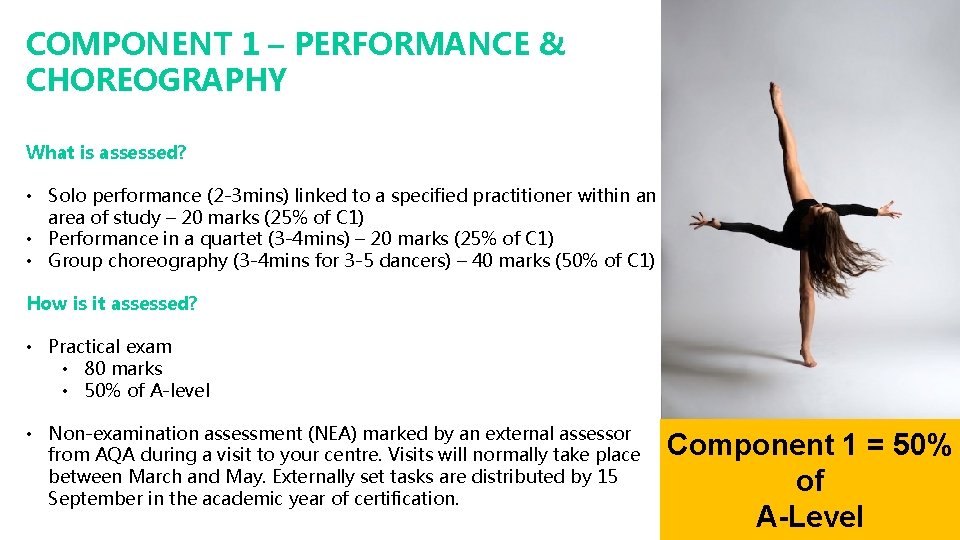
COMPONENT 1 – PERFORMANCE & CHOREOGRAPHY What is assessed? • Solo performance (2 -3 mins) linked to a specified practitioner within an area of study – 20 marks (25% of C 1) • Performance in a quartet (3 -4 mins) – 20 marks (25% of C 1) • Group choreography (3 -4 mins for 3 -5 dancers) – 40 marks (50% of C 1) How is it assessed? • Practical exam • 80 marks • 50% of A-level • Non-examination assessment (NEA) marked by an external assessor from AQA during a visit to your centre. Visits will normally take place between March and May. Externally set tasks are distributed by 15 September in the academic year of certification. Component 1 = 50% of A-Level
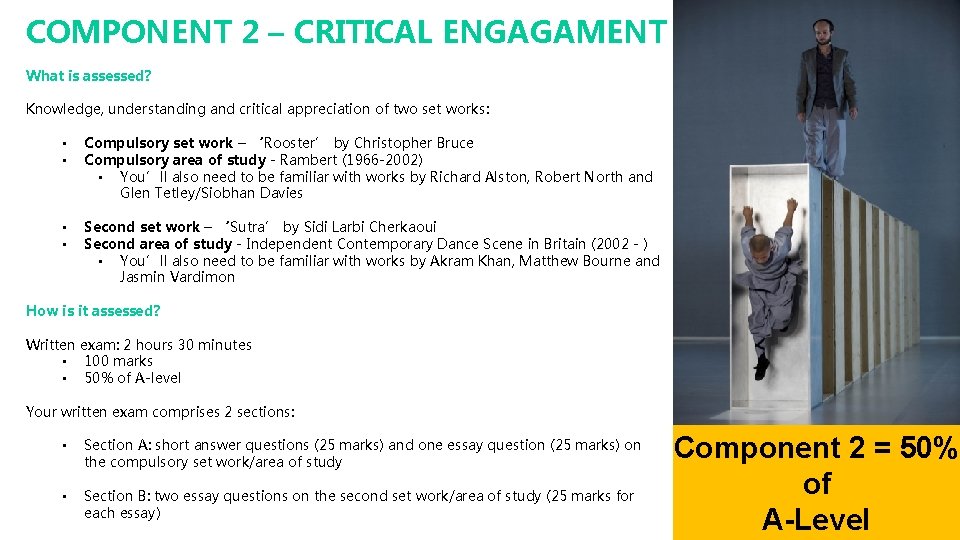
COMPONENT 2 – CRITICAL ENGAGAMENT What is assessed? Knowledge, understanding and critical appreciation of two set works: • • Compulsory set work – ‘Rooster’ by Christopher Bruce Compulsory area of study - Rambert (1966 -2002) • You’ll also need to be familiar with works by Richard Alston, Robert North and Glen Tetley/Siobhan Davies • • Second set work – ‘Sutra’ by Sidi Larbi Cherkaoui Second area of study - Independent Contemporary Dance Scene in Britain (2002 - ) • You’ll also need to be familiar with works by Akram Khan, Matthew Bourne and Jasmin Vardimon How is it assessed? Written exam: 2 hours 30 minutes • 100 marks • 50% of A-level Your written exam comprises 2 sections: • Section A: short answer questions (25 marks) and one essay question (25 marks) on the compulsory set work/area of study • Section B: two essay questions on the second set work/area of study (25 marks for each essay) Component 2 = 50% of A-Level
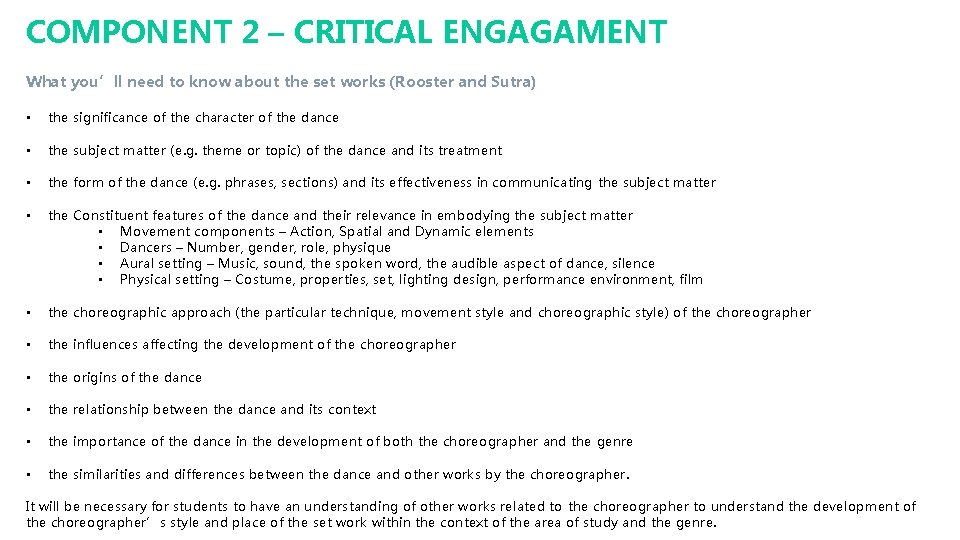
COMPONENT 2 – CRITICAL ENGAGAMENT What you’ll need to know about the set works (Rooster and Sutra) • the significance of the character of the dance • the subject matter (e. g. theme or topic) of the dance and its treatment • the form of the dance (e. g. phrases, sections) and its effectiveness in communicating the subject matter • the Constituent features of the dance and their relevance in embodying the subject matter • Movement components – Action, Spatial and Dynamic elements • Dancers – Number, gender, role, physique • Aural setting – Music, sound, the spoken word, the audible aspect of dance, silence • Physical setting – Costume, properties, set, lighting design, performance environment, film • the choreographic approach (the particular technique, movement style and choreographic style) of the choreographer • the influences affecting the development of the choreographer • the origins of the dance • the relationship between the dance and its context • the importance of the dance in the development of both the choreographer and the genre • the similarities and differences between the dance and other works by the choreographer. It will be necessary for students to have an understanding of other works related to the choreographer to understand the development of the choreographer’s style and place of the set work within the context of the area of study and the genre.
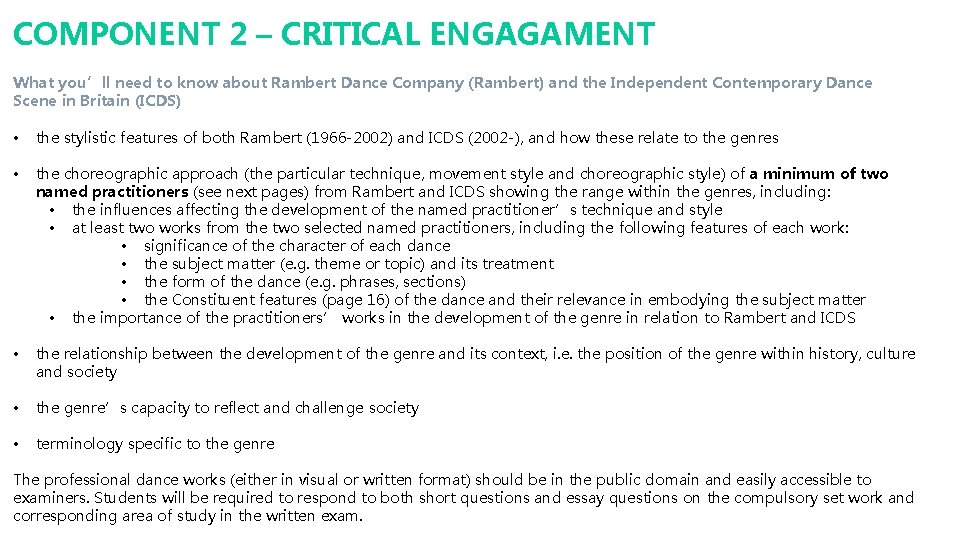
COMPONENT 2 – CRITICAL ENGAGAMENT What you’ll need to know about Rambert Dance Company (Rambert) and the Independent Contemporary Dance Scene in Britain (ICDS) • the stylistic features of both Rambert (1966 -2002) and ICDS (2002 -), and how these relate to the genres • the choreographic approach (the particular technique, movement style and choreographic style) of a minimum of two named practitioners (see next pages) from Rambert and ICDS showing the range within the genres, including: • the influences affecting the development of the named practitioner’s technique and style • at least two works from the two selected named practitioners, including the following features of each work: • significance of the character of each dance • the subject matter (e. g. theme or topic) and its treatment • the form of the dance (e. g. phrases, sections) • the Constituent features (page 16) of the dance and their relevance in embodying the subject matter • the importance of the practitioners’ works in the development of the genre in relation to Rambert and ICDS • the relationship between the development of the genre and its context, i. e. the position of the genre within history, culture and society • the genre’s capacity to reflect and challenge society • terminology specific to the genre The professional dance works (either in visual or written format) should be in the public domain and easily accessible to examiners. Students will be required to respond to both short questions and essay questions on the compulsory set work and corresponding area of study in the written exam.
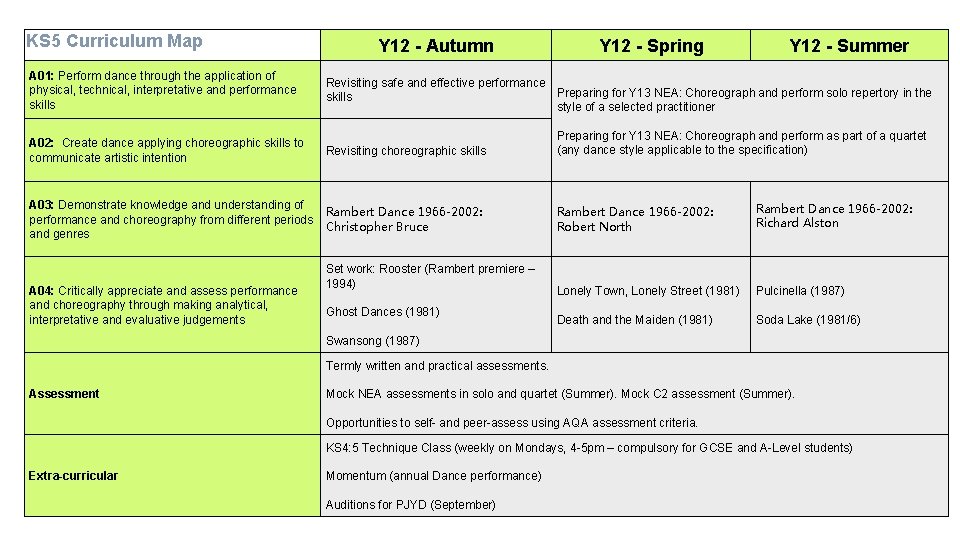
KS 5 Curriculum Map Y 12 - Autumn Y 12 - Spring Y 12 - Summer A 01: Perform dance through the application of physical, technical, interpretative and performance skills Revisiting safe and effective performance Preparing for Y 13 NEA: Choreograph and perform solo repertory in the skills style of a selected practitioner A 02: Create dance applying choreographic skills to communicate artistic intention Revisiting choreographic skills Preparing for Y 13 NEA: Choreograph and perform as part of a quartet (any dance style applicable to the specification) A 03: Demonstrate knowledge and understanding of performance and choreography from different periods and genres Rambert Dance 1966 -2002: Christopher Bruce Rambert Dance 1966 -2002: Robert North Rambert Dance 1966 -2002: Richard Alston Lonely Town, Lonely Street (1981) Pulcinella (1987) Death and the Maiden (1981) Soda Lake (1981/6) A 04: Critically appreciate and assess performance and choreography through making analytical, interpretative and evaluative judgements Set work: Rooster (Rambert premiere – 1994) Ghost Dances (1981) Swansong (1987) Termly written and practical assessments. Assessment Mock NEA assessments in solo and quartet (Summer). Mock C 2 assessment (Summer). Opportunities to self- and peer-assess using AQA assessment criteria. KS 4: 5 Technique Class (weekly on Mondays, 4 -5 pm – compulsory for GCSE and A-Level students) Extra-curricular Momentum (annual Dance performance) Auditions for PJYD (September)
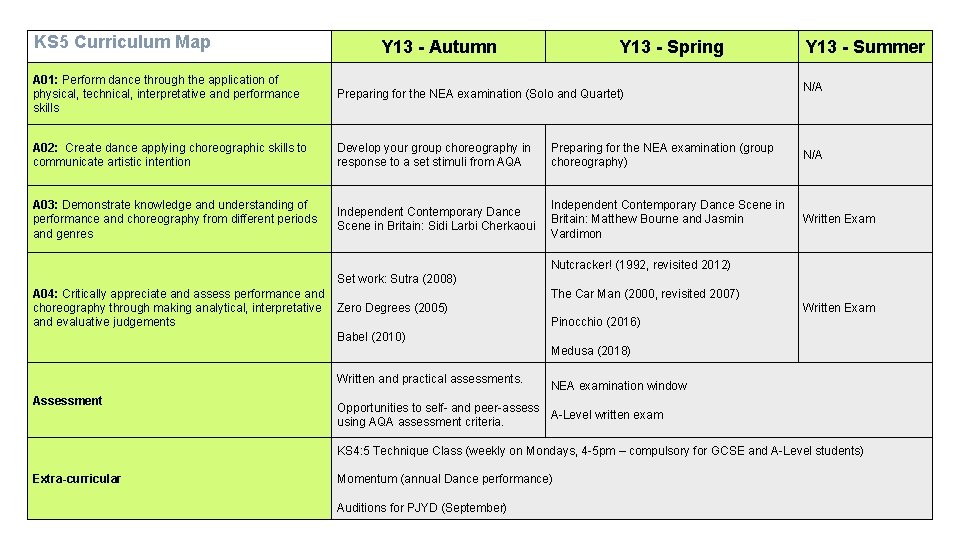
KS 5 Curriculum Map Y 13 - Autumn Y 13 - Spring Y 13 - Summer A 01: Perform dance through the application of physical, technical, interpretative and performance skills Preparing for the NEA examination (Solo and Quartet) A 02: Create dance applying choreographic skills to communicate artistic intention Develop your group choreography in response to a set stimuli from AQA Preparing for the NEA examination (group choreography) N/A A 03: Demonstrate knowledge and understanding of performance and choreography from different periods and genres Independent Contemporary Dance Scene in Britain: Sidi Larbi Cherkaoui Independent Contemporary Dance Scene in Britain: Matthew Bourne and Jasmin Vardimon Written Exam N/A Nutcracker! (1992, revisited 2012) Set work: Sutra (2008) A 04: Critically appreciate and assess performance and choreography through making analytical, interpretative and evaluative judgements The Car Man (2000, revisited 2007) Zero Degrees (2005) Written Exam Pinocchio (2016) Babel (2010) Medusa (2018) Written and practical assessments. Assessment NEA examination window Opportunities to self- and peer-assess A-Level written exam using AQA assessment criteria. KS 4: 5 Technique Class (weekly on Mondays, 4 -5 pm – compulsory for GCSE and A-Level students) Extra-curricular Momentum (annual Dance performance) Auditions for PJYD (September)
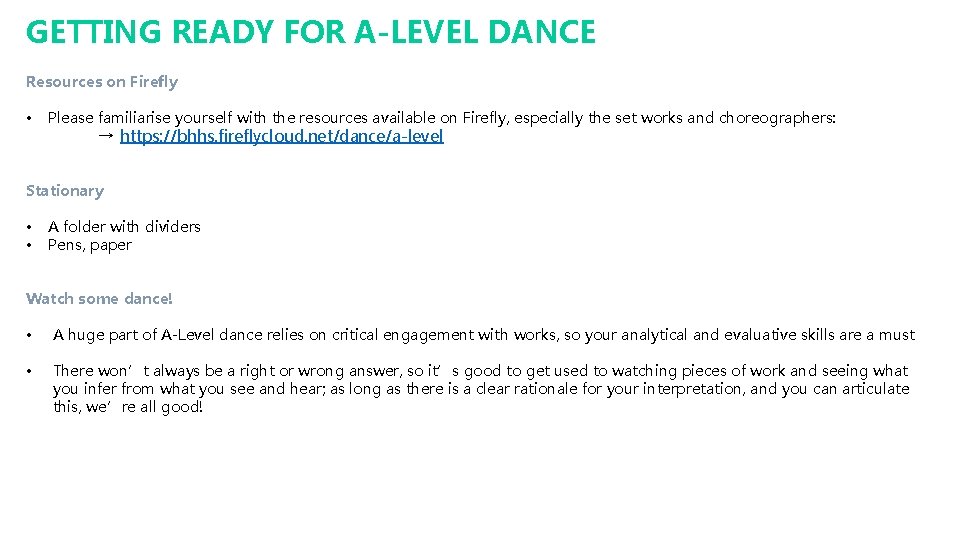
GETTING READY FOR A-LEVEL DANCE Resources on Firefly • Please familiarise yourself with the resources available on Firefly, especially the set works and choreographers: → https: //bhhs. fireflycloud. net/dance/a-level Stationary • • A folder with dividers Pens, paper Watch some dance! • A huge part of A-Level dance relies on critical engagement with works, so your analytical and evaluative skills are a must • There won’t always be a right or wrong answer, so it’s good to get used to watching pieces of work and seeing what you infer from what you see and hear; as long as there is a clear rationale for your interpretation, and you can articulate this, we’re all good!
APPENDICES
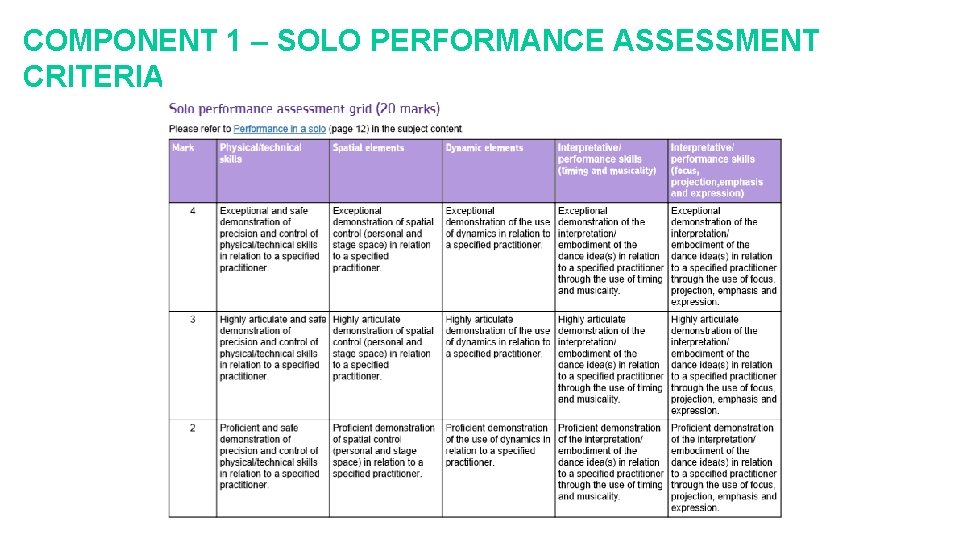
COMPONENT 1 – SOLO PERFORMANCE ASSESSMENT CRITERIA
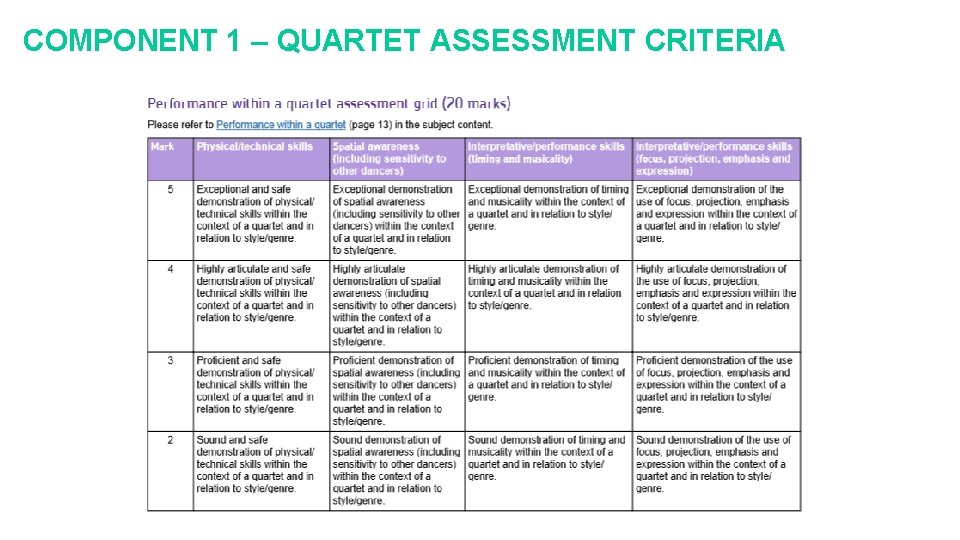
COMPONENT 1 – QUARTET ASSESSMENT CRITERIA
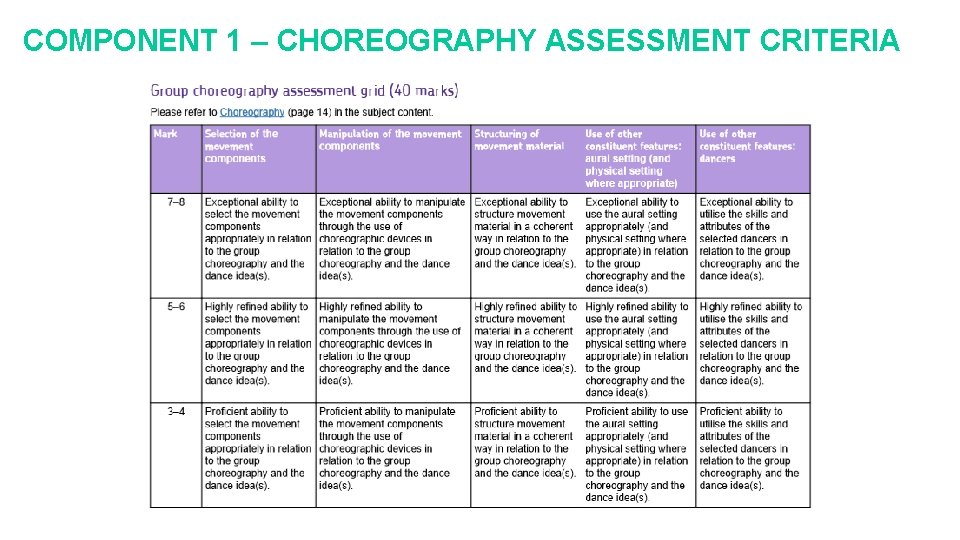
COMPONENT 1 – CHOREOGRAPHY ASSESSMENT CRITERIA
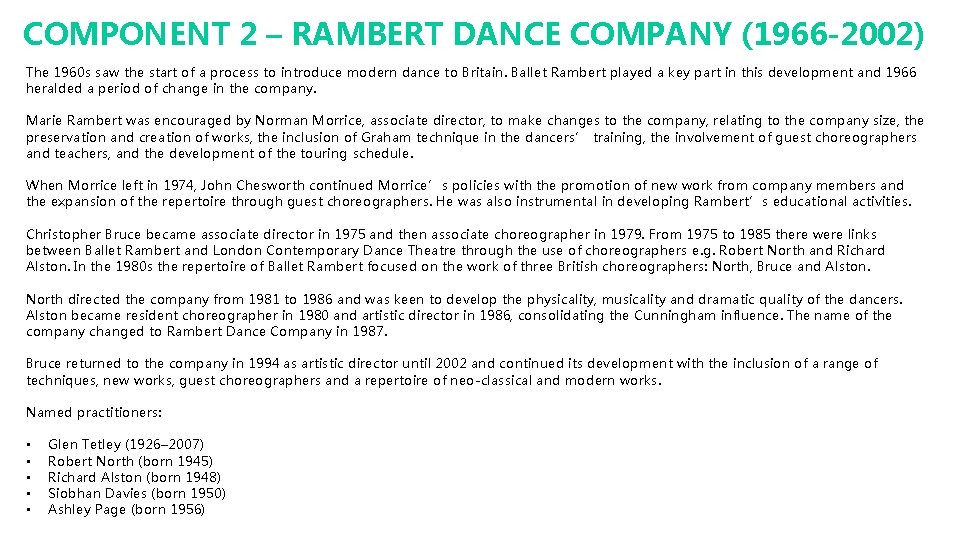
COMPONENT 2 – RAMBERT DANCE COMPANY (1966 -2002) The 1960 s saw the start of a process to introduce modern dance to Britain. Ballet Rambert played a key part in this development and 1966 heralded a period of change in the company. Marie Rambert was encouraged by Norman Morrice, associate director, to make changes to the company, relating to the company size, the preservation and creation of works, the inclusion of Graham technique in the dancers’ training, the involvement of guest choreographers and teachers, and the development of the touring schedule. When Morrice left in 1974, John Chesworth continued Morrice’s policies with the promotion of new work from company members and the expansion of the repertoire through guest choreographers. He was also instrumental in developing Rambert’s educational activities. Christopher Bruce became associate director in 1975 and then associate choreographer in 1979. From 1975 to 1985 there were links between Ballet Rambert and London Contemporary Dance Theatre through the use of choreographers e. g. Robert North and Richard Alston. In the 1980 s the repertoire of Ballet Rambert focused on the work of three British choreographers: North, Bruce and Alston. North directed the company from 1981 to 1986 and was keen to develop the physicality, musicality and dramatic quality of the dancers. Alston became resident choreographer in 1980 and artistic director in 1986, consolidating the Cunningham influence. The name of the company changed to Rambert Dance Company in 1987. Bruce returned to the company in 1994 as artistic director until 2002 and continued its development with the inclusion of a range of techniques, new works, guest choreographers and a repertoire of neo-classical and modern works. Named practitioners: • • • Glen Tetley (1926– 2007) Robert North (born 1945) Richard Alston (born 1948) Siobhan Davies (born 1950) Ashley Page (born 1956)
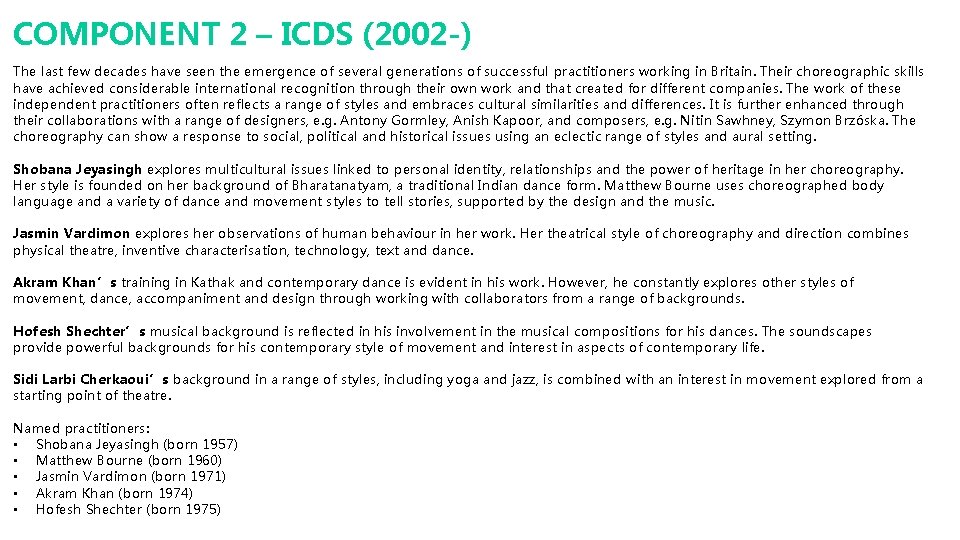
COMPONENT 2 – ICDS (2002 -) The last few decades have seen the emergence of several generations of successful practitioners working in Britain. Their choreographic skills have achieved considerable international recognition through their own work and that created for different companies. The work of these independent practitioners often reflects a range of styles and embraces cultural similarities and differences. It is further enhanced through their collaborations with a range of designers, e. g. Antony Gormley, Anish Kapoor, and composers, e. g. Nitin Sawhney, Szymon Brzóska. The choreography can show a response to social, political and historical issues using an eclectic range of styles and aural setting. Shobana Jeyasingh explores multicultural issues linked to personal identity, relationships and the power of heritage in her choreography. Her style is founded on her background of Bharatanatyam, a traditional Indian dance form. Matthew Bourne uses choreographed body language and a variety of dance and movement styles to tell stories, supported by the design and the music. Jasmin Vardimon explores her observations of human behaviour in her work. Her theatrical style of choreography and direction combines physical theatre, inventive characterisation, technology, text and dance. Akram Khan’s training in Kathak and contemporary dance is evident in his work. However, he constantly explores other styles of movement, dance, accompaniment and design through working with collaborators from a range of backgrounds. Hofesh Shechter’s musical background is reflected in his involvement in the musical compositions for his dances. The soundscapes provide powerful backgrounds for his contemporary style of movement and interest in aspects of contemporary life. Sidi Larbi Cherkaoui’s background in a range of styles, including yoga and jazz, is combined with an interest in movement explored from a starting point of theatre. Named practitioners: • Shobana Jeyasingh (born 1957) • Matthew Bourne (born 1960) • Jasmin Vardimon (born 1971) • Akram Khan (born 1974) • Hofesh Shechter (born 1975)