
A Level Biology Induction RESPECT AMBITION RESPONSIBILITY ENGAGEMENT
A- Level Biology Induction RESPECT AMBITION RESPONSIBILITY ENGAGEMENT RESILIENCE
Biology Entry Requirements §GCSE Combined Science grade 6 -6 or above, Maths 5 or above §Biology grade 6, Chemistry grade 6 and Maths grade 5 §These grades are non-negotiable, past experience shows that those failing to gain the entry requirements struggle massively on the course- Biology is not the easy option §If you fail to meet the entry requirement, we offer BTEC applied Science as an alternative RESPECT AMBITION RESPONSIBILITY ENGAGEMENT RESILIENCE
What is BTEC Applied Science? • Vocational course with a mix of Biology, Chemistry and Physics. • Nationally recognised qualification • Equal UCAS points to A-level (Pass=E; Merit=C; Distinction=A) • 3 exam papers in January (Biology, Chemistry, Physics) in Year 12 and Year 13 (these can be resit) • 50% Coursework (4 assignments based on ‘applied’ science~) • Minimum requirement of 5 -5 in Double Science • We have a 100% pass rate over the last 3 years!!!!!! • If you want to consider BTEC applied Science, please contact Miss Naish, her email address is snaish@wigstonmat. org RESPECT AMBITION RESPONSIBILITY ENGAGEMENT RESILIENCE

RESPECT AMBITION RESPONSIBILITY ENGAGEMENT RESILIENCE
RESPECT AMBITION RESPONSIBILITY ENGAGEMENT RESILIENCE
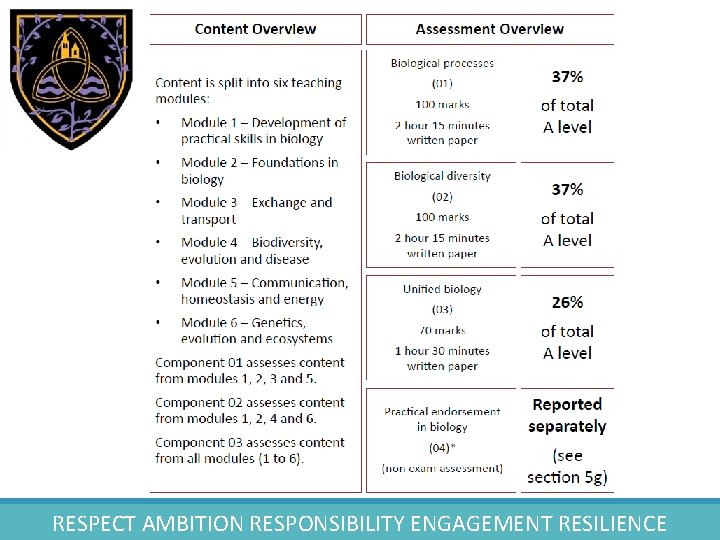
RESPECT AMBITION RESPONSIBILITY ENGAGEMENT RESILIENCE
Transition Packs RESPECT AMBITION RESPONSIBILITY ENGAGEMENT RESILIENCE
Amino Acids Objectives: Be able to: Describe, with the aid of diagrams, the structure of an amino acids Describe, with the aid of diagrams, the formation and breakage of peptide bonds in the synthesis and hydrolysis of dipeptides and polypeptides RESPECT AMBITION RESPONSIBILITY ENGAGEMENT RESILIENCE

Amino Acid Structure Amine Group R Group Carboxyl Group RESPECT AMBITION RESPONSIBILITY ENGAGEMENT RESILIENCE
The structure of an amino acid §All amino acids have the same basic structure a: § carboxyl group at one end, an amine group at the other, with a Carbon in-between. §This is apart from the R-group, which makes each of the 20 individual amino acids different RESPECT AMBITION RESPONSIBILITY ENGAGEMENT RESILIENCE
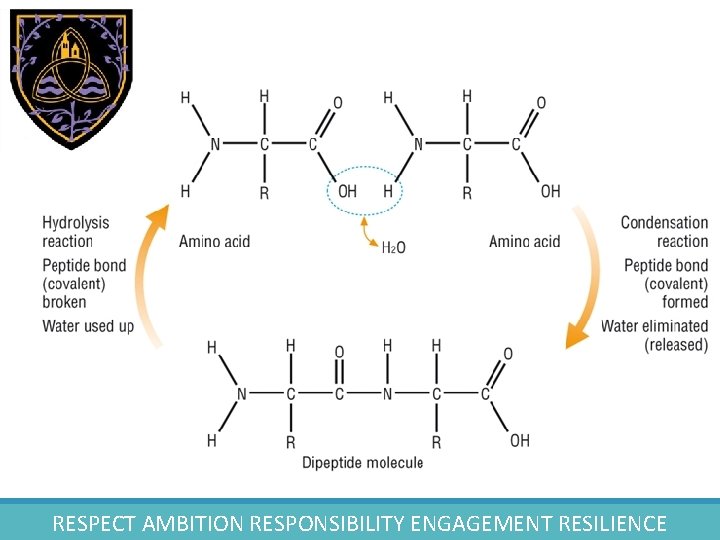
§Amino acids can be joined together to form dipeptides (2 amino acids joined together) and polypeptides (several amino acids joined together). Amino acids in the middle of a polypeptide chain are called amino acid residues. The bonds formed are called peptide bonds. §Peptide bonds are formed by a condensation reactionthis is where water is produced as a by product §Peptide bonds are broken by a hydrolysis reactionwhere water is used to break the peptide bond RESPECT AMBITION RESPONSIBILITY ENGAGEMENT RESILIENCE
RESPECT AMBITION RESPONSIBILITY ENGAGEMENT RESILIENCE
Plants can make all of the amino acids that they require Animals can make their own amino acids, but several (about 8 -10 of the amino acids) cannot be made and have to be taken in as protein in the animals’ diet. These amino acids are essential amino acids Excess amino acids cannot be stored by the body and are broken down in the liver by a process called deamination. This produces urea Excess amino acids can also be converted to amino acids we’re lacking- this is Transamination- this is for only non-essential amino acids RESPECT AMBITION RESPONSIBILITY ENGAGEMENT RESILIENCE
- Slides: 13