
A LargeScale Parallel Computing of Boiling TwoPhase Flow
A Large-Scale Parallel Computing of Boiling Two-Phase Flow Behavior in Advanced Light-Water Reactors K. Takase, H. Yoshida, T. Misawa Thermal & Fluid Engineering Group Japan Atomic Energy Agency VECPAR 2008 Toulouse, France, 24 -27, June 2008
Objectives To establish a new thermal design procedure of nuclear reactors with large-scale numerical simulations; To attain the design by analysis; To simulate precisely two-phase flow characteristics in fuel bundles; and, To clarify physical mechanisms on boiling transition, two-phase turbulent structure, etc.
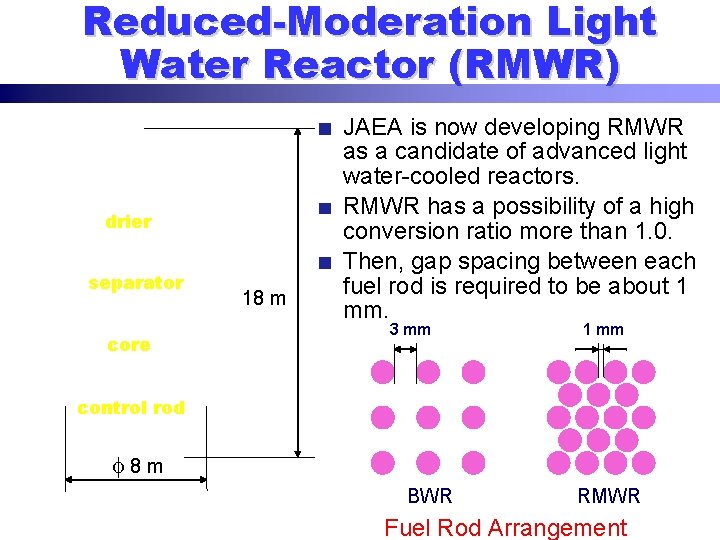
Reduced-Moderation Light Water Reactor (RMWR) drier separator core 18 m JAEA is now developing RMWR as a candidate of advanced light water-cooled reactors. RMWR has a possibility of a high conversion ratio more than 1. 0. Then, gap spacing between each fuel rod is required to be about 1 mm. 3 mm 1 mm control rod 8 m BWR RMWR Fuel Rod Arrangement
Developed Analysis Code The code is discretized by the CIP method (Yabe, 1993). Analyze 3 -dimensional compressible/noncompressible flows. Consider CSF model (Brackbill, 1992) as calculation of surface tension; The interface tracking method (Youngs, 1982) was modified for predicting a water-vapor interface. As a matrix solver, the AMG method was applied. The code was parallelized by MPI and Open MP.
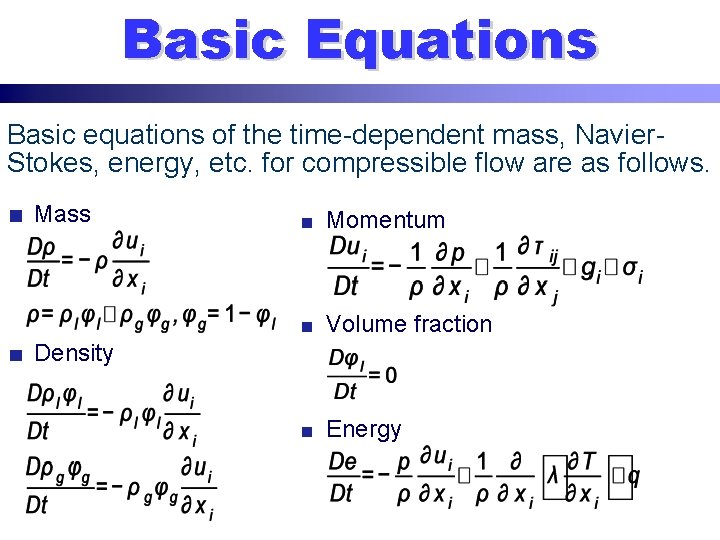
Basic Equations Basic equations of the time-dependent mass, Navier. Stokes, energy, etc. for compressible flow are as follows. Mass Momentum Volume fraction Density Energy

Used Supercomputers ● Earth Simulator (JAMSTEC) Vector parallel computer; 640 nodes, 8 CPU/node, 5120 CPU, 10 TB, 40 TFlops. ● Altix 3700 Bx 2 Earth Simulator (JAEA) Scalar parallel computer; 16 nodes, 128 CPU/node, 2048 CPU, 13 TB, 13 TFlops. Altix 3700 Bx 2
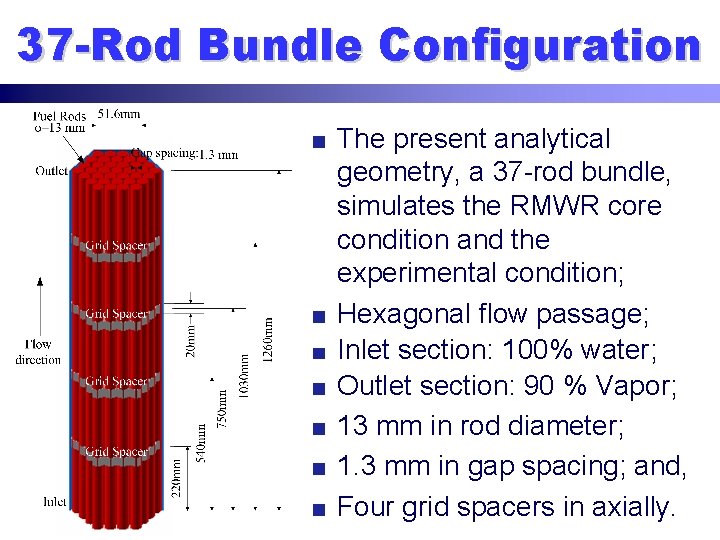
37 -Rod Bundle Configuration The present analytical geometry, a 37 -rod bundle, simulates the RMWR core condition and the experimental condition; Hexagonal flow passage; Inlet section: 100% water; Outlet section: 90 % Vapor; 13 mm in rod diameter; 1. 3 mm in gap spacing; and, Four grid spacers in axially.
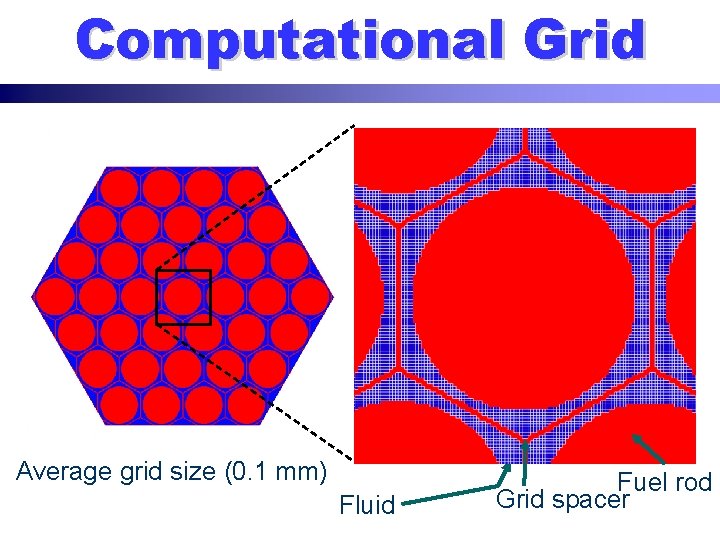
Computational Grid Average grid size (0. 1 mm) Fluid Fuel rod Grid spacer
Analytical Conditions Inlet condition Temperature 288 o. C, pressure 7. 2 MPa, flow rate 400 kg/m 2 s, and the estimated Reynolds number is 40, 000. Boundary conditions No-slip condition on every wall; Velocity profile is uniform at the inlet section; Inlet velocity is set to 0. 5 m/s.

Simulated Liquid Film Flow
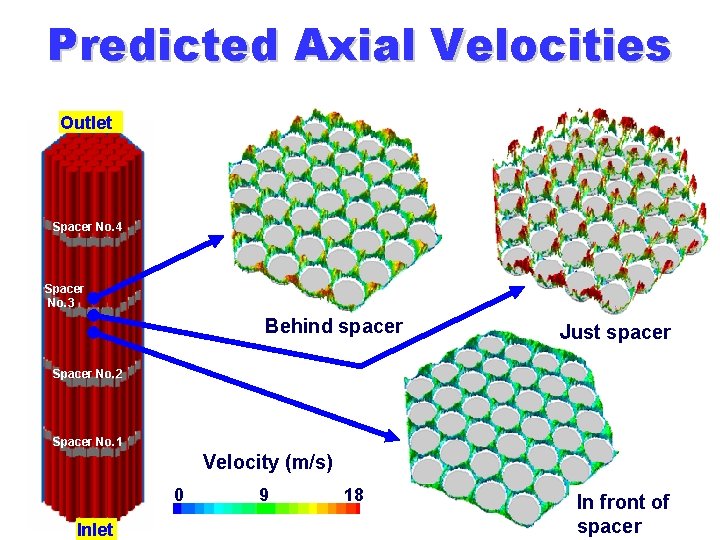
Predicted Axial Velocities Outlet Spacer No. 4 Spacer No. 3 Behind spacer Just spacer Spacer No. 2 Spacer No. 1 Velocity (m/s) 0 Inlet 9 18 In front of spacer
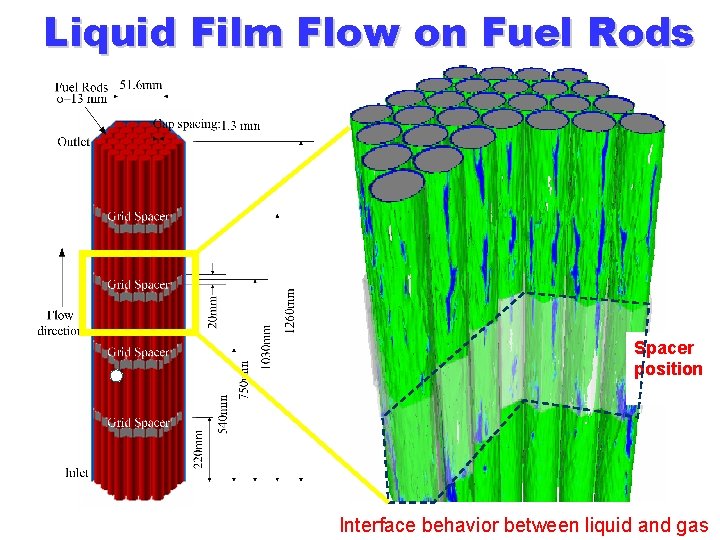
Liquid Film Flow on Fuel Rods Spacer position Interface behavior between liquid and gas
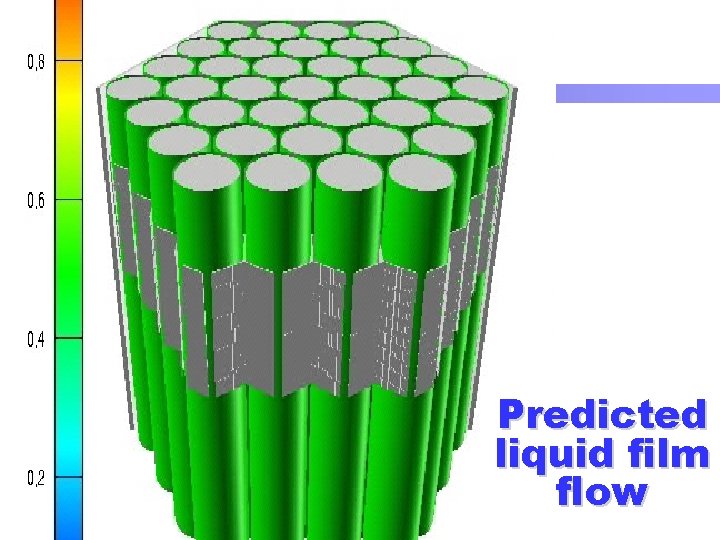
Predicted liquid film flow
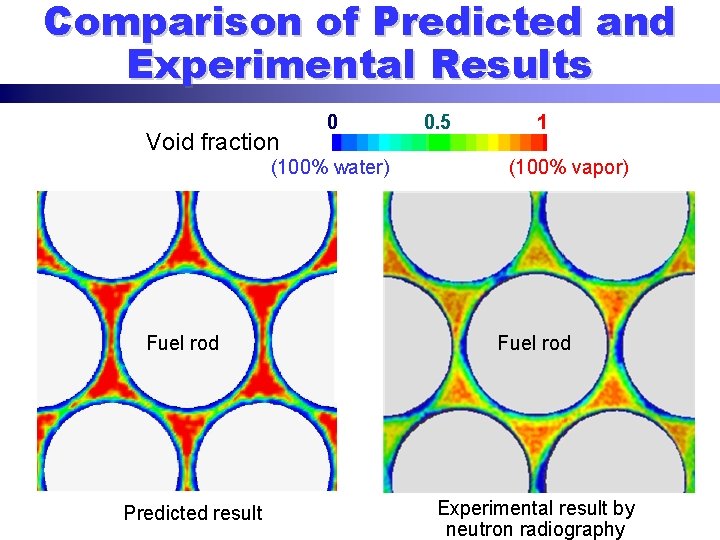
Comparison of Predicted and Experimental Results Void fraction 0 (100% water) Fuel rod Predicted result 0. 5 1 (100% vapor) Fuel rod Experimental result by neutron radiography

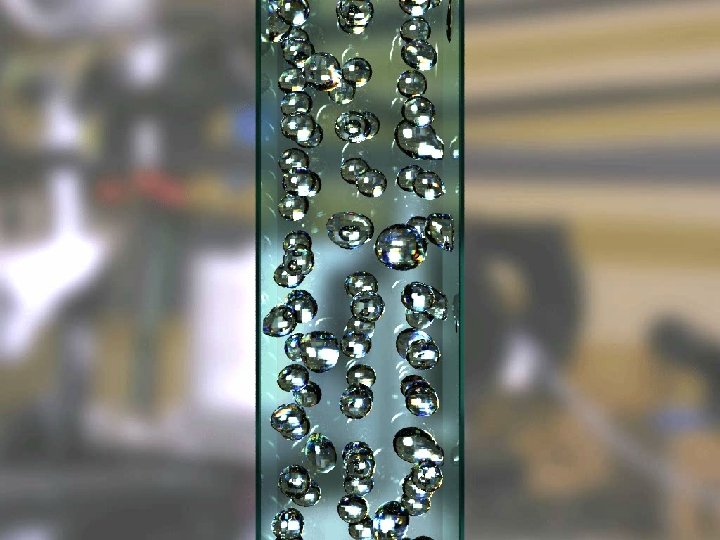
Simulated Bubbly Flow
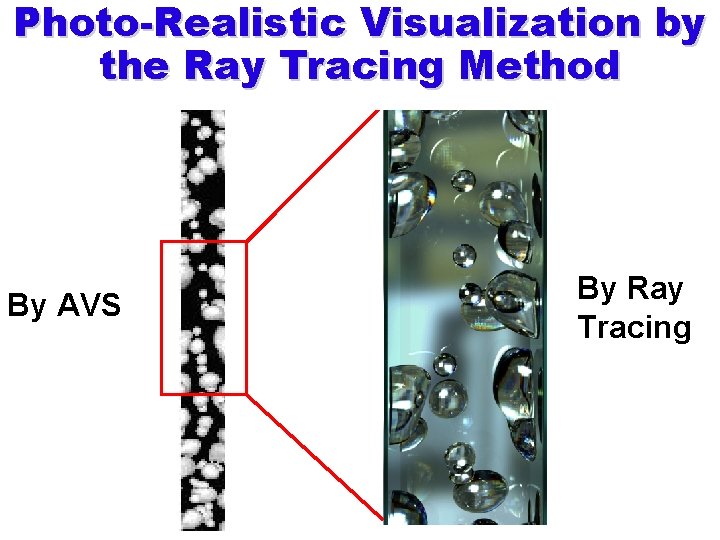
Photo-Realistic Visualization by the Ray Tracing Method By AVS By Ray Tracing
Simulated Boiling Configuration
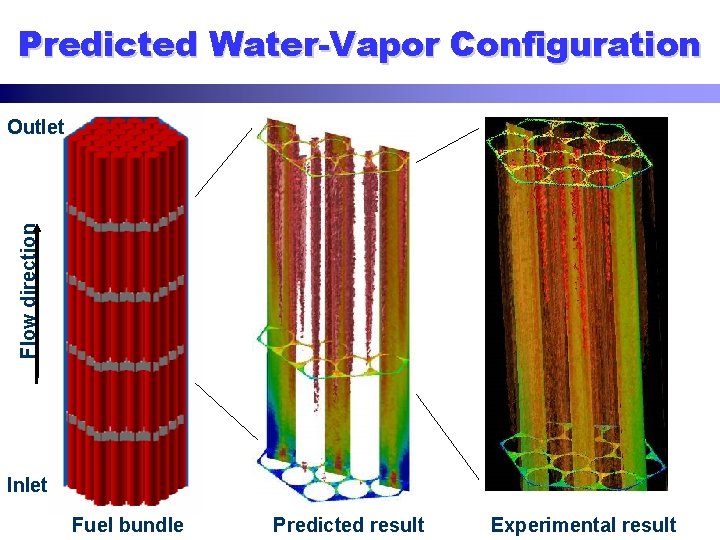
Predicted Water-Vapor Configuration Flow direction Outlet Inlet Fuel bundle Predicted result Experimental result
Conclusions Two-phase flow characteristics on liquid film and bubbly flow were predicted by a newly developed analysis code; When a large-scale simulation is carried out under the simulated reactor core geometry, high performance parallelization approach is the most important key technology; The high prospect was acquired on the possibility of establishment of thermal design procedure of nuclear reactors with numerical simulations; and, Furthermore code validation will be continued.

END
- Slides: 21