
A large acceptance angle detector for the study
- Slides: 1
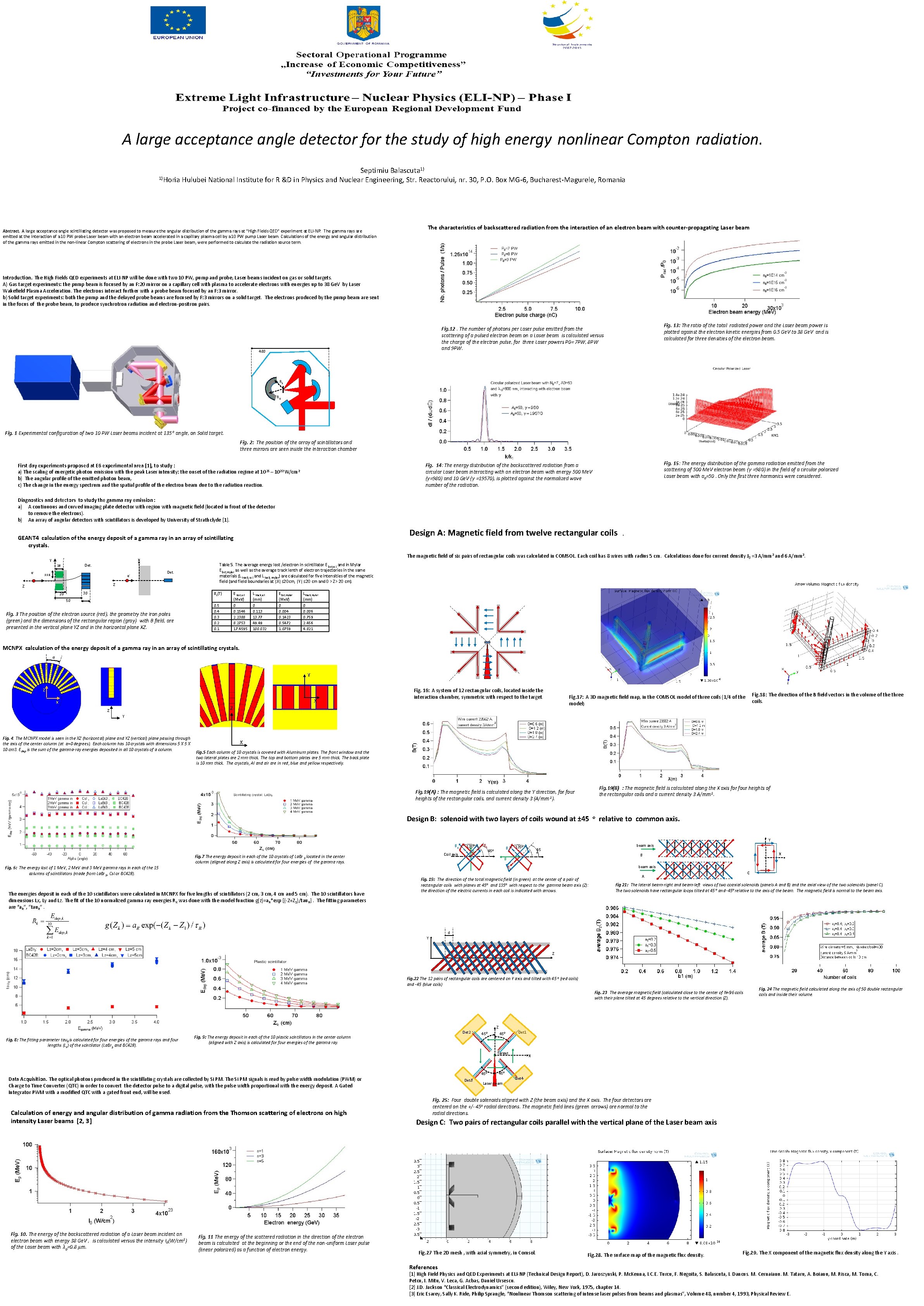
A large acceptance angle detector for the study of high energy nonlinear Compton radiation. Septimiu Balascuta 1) 1)Horia Hulubei National Institute for R &D in Physics and Nuclear Engineering, Str. Reactorului, nr. 30, P. O. Box MG-6, Bucharest-Magurele, Romania Abstract. A large acceptance angle scintillating detector was proposed to measure the angular distribution of the gamma rays at "High Fields QED" experiment at ELI-NP. The gamma rays are emitted at the interaction of a 10 PW probe Laser beam with an electron beam accelerated in a capillary plasma cell by a 10 PW pump Laser beam. Calculations of the energy and angular distribution of the gamma rays emitted in the non-linear Compton scattering of electrons in the probe Laser beam, were performed to calculate the radiation source term. The characteristics of backscattered radiation from the interaction of an electron beam with counter-propagating Laser beam Introduction. The High Fields QED experiments at ELI-NP will be done with two 10 PW, pump and probe, Laser beams incident on gas or solid targets. A) Gas target experiments: the pump beam is focused by an F: 20 mirror on a capillary cell with plasma to accelerate electrons with energies up to 38 Ge. V by Laser Wakefield Plasma Acceleration. The electrons interact further with a probe beam focused by an F: 3 mirror. b) Solid target experiments: both the pump and the delayed probe beams are focused by F: 3 mirrors on a solid target. The electrons produced by the pump beam are sent in the focus of the probe beam, to produce synchrotron radiation and electron-positron pairs. Fig. 13: The ratio of the total radiated power and the Laser beam power is plotted against the electron kinetic energies from 0. 5 Ge. V to 38 Ge. V and is calculated for three densities of the electron beam. Fig. 12. The number of photons per Laser pulse emitted from the scattering of a pulsed electron beam on a Laser beam is calculated versus the charge of the electron pulse, for three Laser powers P 0= 7 PW, 8 PW and 9 PW. 480 R 1 R 2 Fig. 1 Experimental configuration of two 10 PW Laser beams incident at 135 o angle, on Solid target. Fig. 2: The position of the array of scintillators and three mirrors are seen inside the Interaction chamber Fig. 15: The energy distribution of the gamma radiation emitted from the scattering of 500 Me. V electron beam (γ =980) in the field of a circular polarized Laser beam with a 0=50. Only the first three harmonics were considered. Fig. 14: The energy distribution of the backscattered radiation from a circular Laser beam interacting with an electron beam with energy 500 Me. V (γ=980) and 10 Ge. V (γ =19570), is plotted against the normalized wave number of the radiation. First day experiments proposed at E 6 experimental area [1], to study : a) The scaling of energetic photon emission with the peak Laser intensity: the onset of the radiation regime at 10 21 – 1022 W/cm 2 b) The angular profile of the emitted photon beam, c) The change in the energy spectrum and the spatial profile of the electron beam due to the radiation reaction. Diagnostics and detectors to study the gamma ray emission : a) A continuous and curved imaging plate detector with region with magnetic field (located in front of the detector to remove the electrons). b) An array of angular detectors with scintillators is developed by University of Strathclyde [1]. Design A: Magnetic field from twelve rectangular coils. GEANT 4 calculation of the energy deposit of a gamma ray in an array of scintillating crystals. Y e- X Det. 18 The magnetic field of six pairs of rectangular coils was calculated in COMSOL. Each coil has 8 wires with radius 5 cm. Calculations done for current density J 0 =3 A/mm 2 and 6 A/mm 2. e- 11. 5 Det. Z Z 30 20 Table 5. The average energy lost /electron in scintillator E lost, sci and in Mylar Elost, mylar as well as the average track lenth of electron trajectories in the same materials (L track, sci and L tack, mylar) are calculated for five intensities of the magnetic field (and field boundaries at |X|≤ 20 cm, |Y|≤ 20 cm and 0 > Z> 20 cm). Bx(T) 50 Fig. 3 The position of the electron source (red), the geometry the Iron poles (green) and the dimensions of the rectangular region (gray) with B field, are presented in the vertical plane YZ and in the horizontal plane XZ. E lost, sci (Me. V) 0 0. 1546 2. 2388 8. 2753 17. 4595 0. 4 0. 3 0. 2 0. 1 L track, sci (mm) 0 0. 113 13. 77 49. 49 100. 032 Elost, mylar (Me. V) 0 0. 004 0. 1423 0. 5472 1. 0759 Ltrack, mylar (mm) 0 0. 006 0. 759 2. 456 4. 821 MCNPX calculation of the energy deposit of a gamma ray in an array of scintillating crystals. α Y Z X X Fig. 16: A system of 12 rectangular coils, located inside the interaction chamber, symmetric with respect to the target. Z Z Fig. 18: The direction of the B field vectors in the volume of the three coils. Fig. 17: A 3 D magnetic field map, in the COMSOL model of three coils (1/4 of the model) Y Fig. 4. The MCNPX model is seen in the XZ (horizontal) plane and YZ (vertical) plane passing through the axis of the center column (at α=0 degrees). Each column has 10 crystals with dimensions 5 X 10 cm 3. E dep is the sum of the gamma-ray energies deposited in all 10 crystals of a column. X Fig. 5 Each column of 10 crystals is covered with Aluminum plates. The front window and the two lateral plates are 2 mm thick. The top and bottom plates are 5 mm thick. The back plate is 10 mm thick. The crystals, Al and air are in red, blue and yellow respectively. Fig. 19(B) : The magnetic field is calculated along the X axis for four heights of the rectangular coils and a current density 3 A/mm 2. Fig. 19(A) : The magnetic field is calculated along the Y direction, for four heights of the rectangular coils, and current density 3 (A/mm 2). Design B: solenoid with two layers of coils wound at ± 45 o relative to common axis. Y B 2 Coil axis Fig. 7 The energy deposit in each of the 10 crystals of La. Br 3 located in the center column (aligned along Z axis) is calculated for four energies of the gamma rays. Fig. 6: The energy lost of 1 Me. V, 2 Me. V and 3 Me. V gamma rays in each of the 15 columns of scintillators (made from La. Br 3, Cs. I or BC 428). The energies deposit in each of the 10 scintillators were calculated in MCNPX for five lengths of scintillators (2 cm, 3 cm, 4 cm and 5 cm). The 10 scintillators have dimensions Lx, Ly and Lz. The fit of the 10 normalized gamma ray energies Rk was done with the model function g(z)=a. R*exp [(-Z+Z 1)/tau. R]. The fitting parameters are “a. R”, ”tau. R”. 135 o B B 1 B 2 45 o 135 o beam axis 45 o X B B beam axis B 1 Fig. 19: The direction of the total magnetic field (in green) at the center of a pair of rectangular coils with planes at 45 o and 135 o with respect to the gamma beam axis (Z): the direction of the electric currents in each coil is indicated with arrows. C A Fig 21: The lateral beam-right and beam-left views of two coaxial solenoids (panels A and B) and the axial view of the two solenoids (panel C). The two solenoids have rectangular loops tilted at 45 o and -45 o relative to the axis of the beam. The magnetic field is normal to the beam axis. d Y Z Fig. 22 The 12 pairs of rectangular coils are centered on Y axis and tilted with 45 o (red coils) and -45 (blue coils) Fig. 23 The average magnetic field (calculated close to the center of N=96 coils with their plane tilted at 45 degrees relative to the vertical direction (Z). Fig. 8: The fitting parameter tau. R is calculated for four energies of the gamma rays and four lengths (Lz) of the scintilator (La. Br 3 and BC 428). Det 2 Fig. 9: The energy deposit in each of the 10 plastic scintillators in the center column (aligned with Z axis) is calculated for four energies of the gamma ray. Z 45 o Det 1 Target 45 o Data Acquisition. The optical photons produced in the scintillating crystals are collected by Si PM. The Si PM signals is read by pulse width modulation (PWM) or Charge to Time Converter (QTC) in order to convert the detector pulse to a digital pulse, with the pulse width proportional with the energy deposit. A Gated Integrator PWM with a modified QTC with a gated front end, will be used. Calculation of energy and angular distribution of gamma radiation from the Thomson scattering of electrons on high intensity Laser beams [2, 3] Fig. 10. The energy of the backscattered radiation of a Laser beam incident an electron beam with energy 38 Ge. V , is calculated versus the intensity I 0(W/cm 2) of the Laser beam with λ 0=0. 8 μm. Fig. 11 The energy of the scattered radiation in the direction of the electron beam is calculated at the beginning or the end of the non-uniform Laser pulse (linear polarized) as a function of electron energy. Det 3 Fig. 24 The magnetic field calculated along the axis of 50 double rectangular coils and inside their volume. X 45 o Laser beam Det 4 Fig. 25: Four double solenoids aligned with Z (the beam axis) and the X axis. The four detectors are centered on the +/- 45 o radial directions. The magnetic field lines (green arrows) are normal to the radial directions. Design C: Two pairs of rectangular coils parallel with the vertical plane of the Laser beam axis Fig. 27 The 2 D mesh , with axial symmetry, in Comsol. References Fig. 28. The surface map of the magnetic flux density. Fig. 29. The X component of the magnetic flux density along the Y axis. [1] High Field Physics and QED Experiments at ELI-NP (Technical Design Report), D. Jaroszynski, P. Mc. Kenna, I. C. E. Turcu, F. Negoita, S. Balascuta, I. Dancus. M. Cernaianu. M. Tataru, A. Boianu, M. Risca, M. Toma, C. Petcu, I. Mitu, V. Leca, G. Acbas, Daniel Ursescu. [2] J. D. Jackson “Classical Electrodynamics” (second edition), Wiley, New York, 1975, chapter 14. [3] Eric Esarey, Sally K. Ride, Philip Sprangle, “Nonlinear Thomson scattering of intense laser pulses from beams and plasmas”, Volume 48, number 4, 1993, Physical Review E.