
A landscape approach to wetland conservation and wise


- Slides: 44
A landscape approach to wetland conservation and wise use. Peter Bridgewater Secretary General Ramsar Convention
Why landscape approach? SLandscapes are an ecological matrix of patches, boundary types, barriers and networks. SMatrix heterogeneity is controlled by flows of species and genes, energy, nutrients and water.
Why landscape approach? SUnder climate change this matrix will buffer the effects of changes in precipitation, temperature, hydrology and biodiversity. SFaced with the effects of increasing environmental uncertainty, ecosystem managers must use this buffering effect of the matrix to imbue important ecosystems with resilience against such changes.
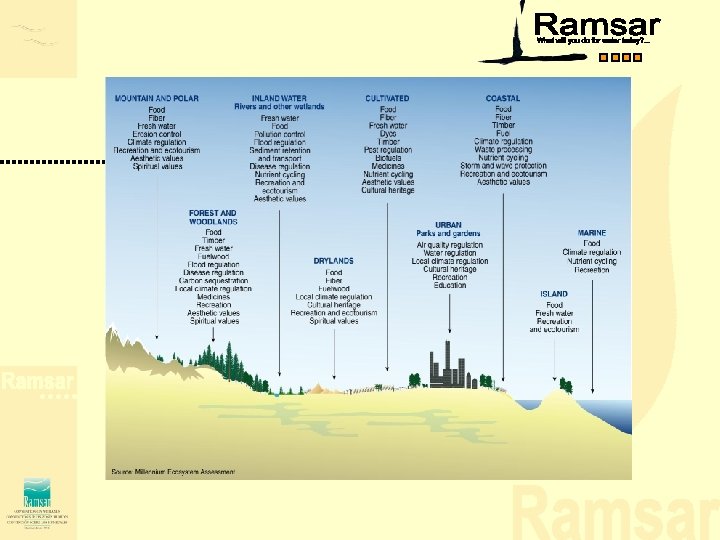
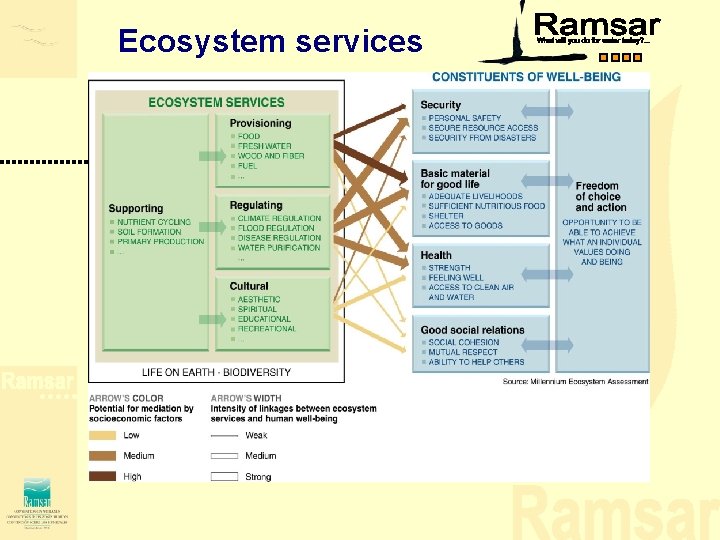
Why landscape approach? SThe ecosystem approach focuses on integrating ecological functions and societal benefits to implement ecosystem management actions. SThe Millennium Ecosystem Assessment has highlighted the importance of understanding drivers of change and the provision of services by ecosystems.
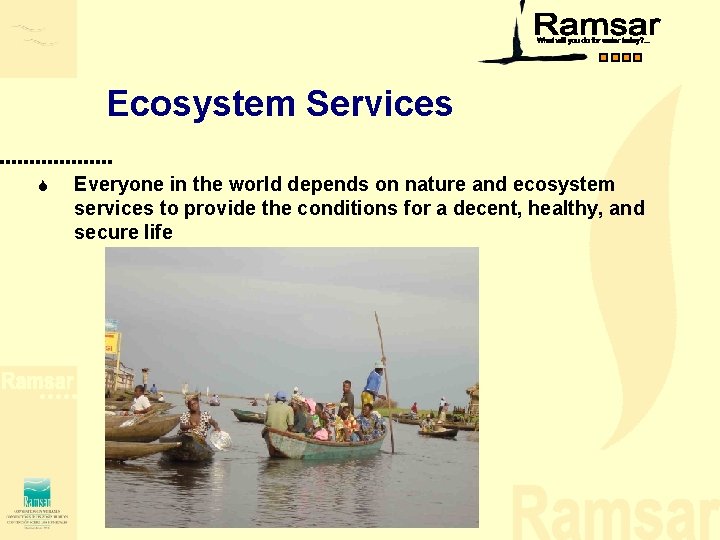
Ecosystem Services S Everyone in the world depends on nature and ecosystem services to provide the conditions for a decent, healthy, and secure life
Ecosystem services
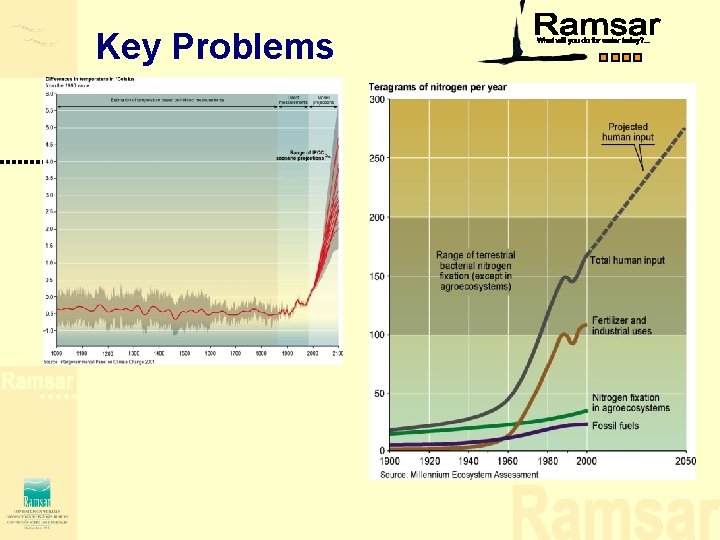
Key Problems Among the outstanding problems identified by the Millennium assessment are the intense vulnerability of the 2 billion people living in dry regions to the loss of ecosystem services, including water supply and the growing threat to ecosystems from climate change and nutrient pollution.
Key Problems
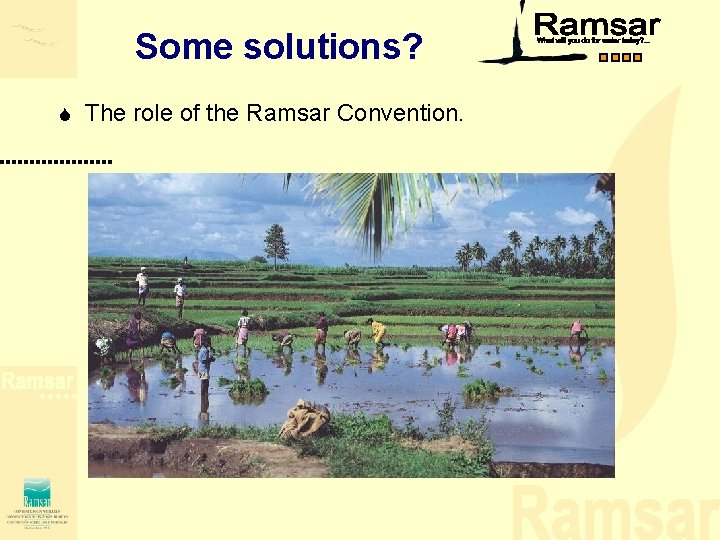
Some solutions? S The role of the Ramsar Convention.
The Ramsar Convention on Wetlands S Mission: “the conservation and wise use of all wetlands through local, regional and national actions and international cooperation, as a contribution towards achieving sustainable development throughout the world”
The Ramsar Convention on Wetlands The Convention has 3 “pillars”: SWise use of all wetlands, with SWetlands of International Importance (Ramsar protected wetlands) at the heart, and SInternational cooperation
The Ramsar Convention on Wetlands S The Convention was the first global intergovernmental treaty to promote integrated management practices for wetlands, river basins and coastal zones, S recognising this as essential in ensuring water resources for the future S provides mechanisms for applying integrated ecosystem-based approaches at all scales
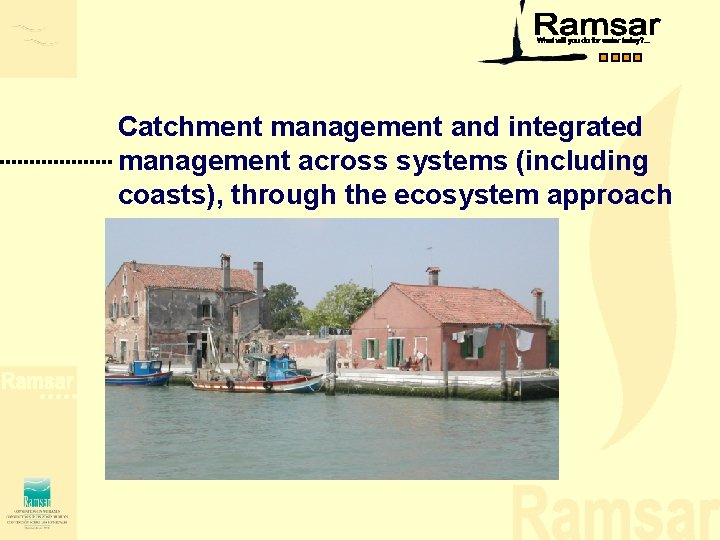
Catchment management and integrated management across systems (including coasts), through the ecosystem approach
The Ramsar Convention on Wetlands Wise use provisions of the Convention apply to all wetlands and their support systems, S both those designated as Wetlands of International Importance (Ramsar sites) and all other wetlands S The wise use concept covers implementation responses at policy level S as well as being directed towards specific wetlands S
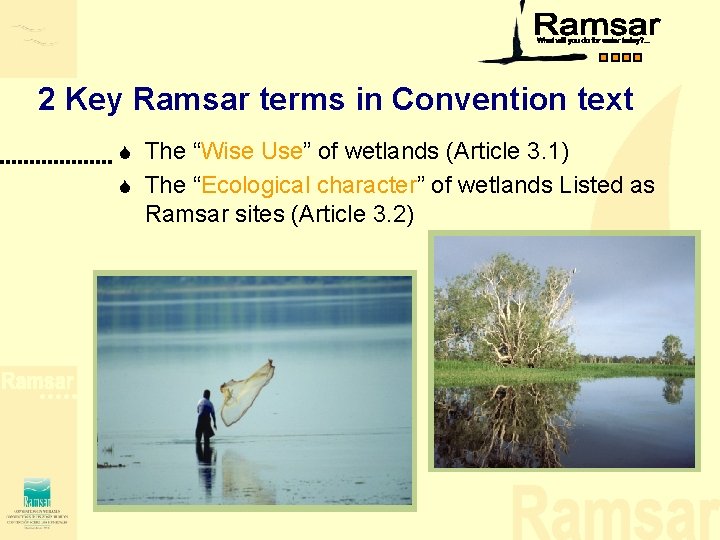
2 Key Ramsar terms in Convention text The “Wise Use” of wetlands (Article 3. 1) S The “Ecological character” of wetlands Listed as Ramsar sites (Article 3. 2) S
Wise use and the ecological character of wetlands Convention indicates that “Wise Use” should be delivered through implementing planning to promote the conservation of wetlands S and for Ramsar sites, to identify and report any change (or likely) change in “ecological character” S
Wise Use definitions S It took 16 years (1987) after adoption of Convention text to define “wise use” of wetlands as: “their sustainable utilisation for the benefit of humankind in a way compatible with the maintenance of the natural properties of the ecosystem”
Wise Use definitions S “sustainable utilisation” was defined as: “human use of a wetland so that it may yield the greatest continuous benefit to present generations while maintaining its potential to meet the needs and aspirations of future generations”.
Ramsar Wise use & sustainable development In same year (1987) Brundtland definition of sustainable development: S "Development that meets the needs of the present without compromising the ability of future generations to meet their own needs. " S
Ramsar Wise use & sustainable development So… rather than original paradigm: û “Wise use = sustainable use”, S simpler and more accurate to define: ü “Wise Use in context of sustainable development” S
“Wise Use” review 2005: S Wise Use needed re-defining: S better related to other more recent terminologies S better linked to “ecological character” definition S “ecological character” also needed redefining – to include wetland ecosystem services
“Wise Use” review 2005: Needed a Conceptual Framework for achieving wise use S The Millennium Ecosystem Assessment’s (MA) terminology and framework is valuable S “Maintaining ecosystem services for human well-being and poverty reduction” S
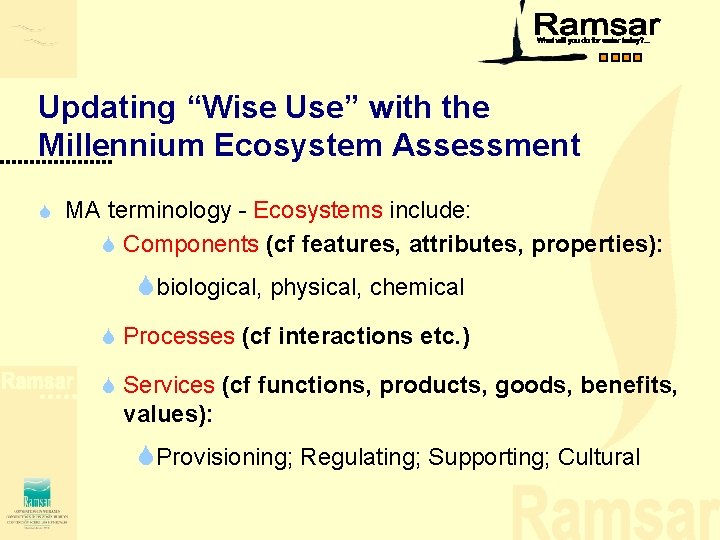
Updating “Wise Use” with the Millennium Ecosystem Assessment S MA terminology - Ecosystems include: S Components (cf features, attributes, properties): Sbiological, physical, chemical S Processes (cf interactions etc. ) S Services (cf functions, products, goods, benefits, values): SProvisioning; Regulating; Supporting; Cultural
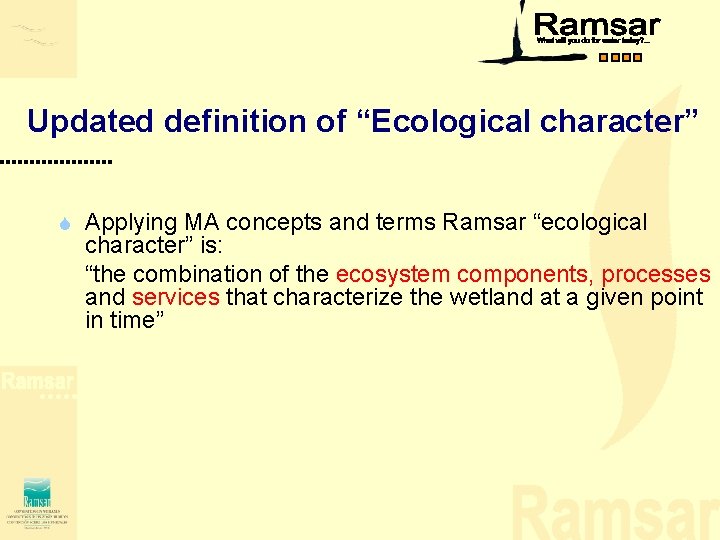
Updated definition of “Ecological character” S Applying MA concepts and terms Ramsar “ecological character” is: “the combination of the ecosystem components, processes and services that characterize the wetland at a given point in time”
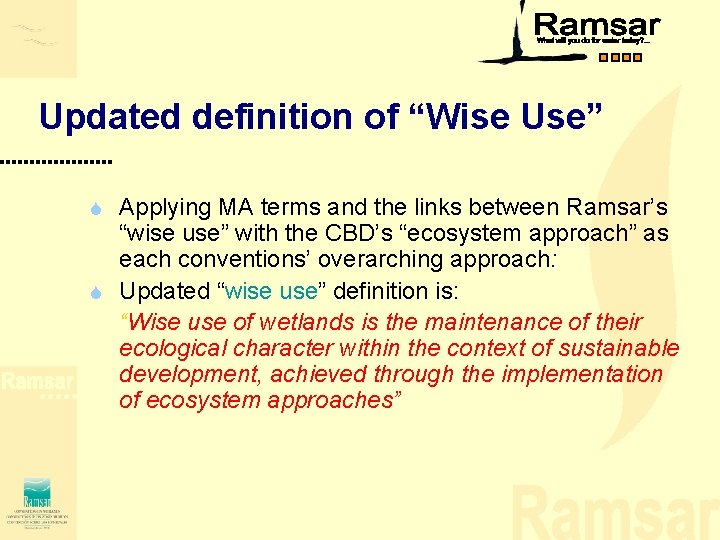
Updated definition of “Wise Use” Applying MA terms and the links between Ramsar’s “wise use” with the CBD’s “ecosystem approach” as each conventions’ overarching approach: S Updated “wise use” definition is: “Wise use of wetlands is the maintenance of their ecological character within the context of sustainable development, achieved through the implementation of ecosystem approaches” S
Taking account of the Landscape approach S Linking the wise use concept P Through understanding conservation of Ramsar sites is at the core P To a need for continued provision of services P Leads to recognition that a landscape scale approach is essential
Taking account of the Landscape approaches mean more management manipulation of ecosystems S Recognition of the emergence of semi-stable and stable novel ecosystems S And planning for a Global Garden vision S
Taking account of the Landscape approach This means for wetlands specifically: Ptwo basic processes with which we need to be involved: S re-inhabitation of our life places, and S restoration of natural systems. S
Taking account of the Landscape approach S At the level of species in the landscape, : • For subpopulations on separate patches, the local extinction rate decreases with greater habitat quality or patch size, and recolonization increases with corridors, stepping stones, a suitable matrix habitat, or short interpatch distance.
Taking account of the Landscape approach S ideal landscape texture is: • A coarse-grained landscape containing finegrained areas is optimum to provide for largepatch ecological benefits multi-habitat species including humans, and a breadth of environmental resources and conditions.
Taking account of the Landscape approach S Landscape change is best seen as: • Land being transformed by several spatial processes overlapping in order, including perforation, fragmentation and attrition, which increase habitat loss and isolation, but otherwise cause very different effects on spatial pattern and ecological processes.
Taking account of the Landscape approach S landscape design best expressed in the following principle: • Land containing humans is best arranged ecologically by aggregating land uses, yet maintaining small patches and corridors of nature throughout developed areas, as well as outliers of human activity spatially arranged along major boundaries.
For wetlands: This means understanding the spatial scales at which wetland processes operate, including hydrological elements, surface as well as ground. S Wetlands should be seen as 3 -dimensional systems in the landscape, not just spots on a 2 -dimensional surface. S Wetlands are Hotspots, even where they are not so recognised! S
For wetlands: Such a strategic approach needs to come from good science, backed by government support, with strong community participation. S Science alone is not enough to solve our problems – we also need to communicate the science effectively! S
//ramsar. org