
A KUBAND GEOSYNCHRONOUS SYNTHETIC APERTURE RADAR MISSION ANALYSIS
A KU-BAND GEOSYNCHRONOUS SYNTHETIC APERTURE RADAR MISSION ANALYSIS WITH MEDIUM TRANSMITTED POWER AND MEDIUM-SIZED ANTENNA Josep Ruiz Rodon, Antoni Broquetas, Andrea Monti Guarnieri, Fabio Rocca 07/27/2011 IGARSS’ 11 Vancouver
Outline • Introduction to GEOSAR • System description: synthetic aperture formation. • GEOSAR constraints and system features. • Image reconstruction GEOSAR raw data. • The APS correction acquisitions. for simulated long term • Conclusions. 07/27/2011 IGARSS’ 11 Vancouver 2/16
Introduction to GEOSAR (I) • What? : Ku-Band monostatic SAR mission to get high resolution images from a radar system placed in a geosynchronous satellite. • How? : relative motion achieved by the slight perturbations (eccentricity and/or inclination) of the non-perfect geostationary orbit → Synthetic Aperture formation. • Why? : constant monitoring of a wide Earth’s area (revisit time limited only by the synthetic aperture integration time). North-South illumination. 07/27/2011 IGARSS’ 11 Vancouver 3/16

Introduction to GEOSAR (II) • Drawbacks: low power echo → increase integration time and/or the resolution cell (degrade resolution). Possible Atmospheric Phase Screen artefacts and target coherence loss due to long integration time. • Configurations: – Monostatic: transceiver on a communications satellite or dedicated geosynchronous satellite. – Bistatic: illuminator of opportunity + receiver tuned to one of the downlink channels or receiver on ground station. 07/27/2011 IGARSS’ 11 Vancouver 4/16
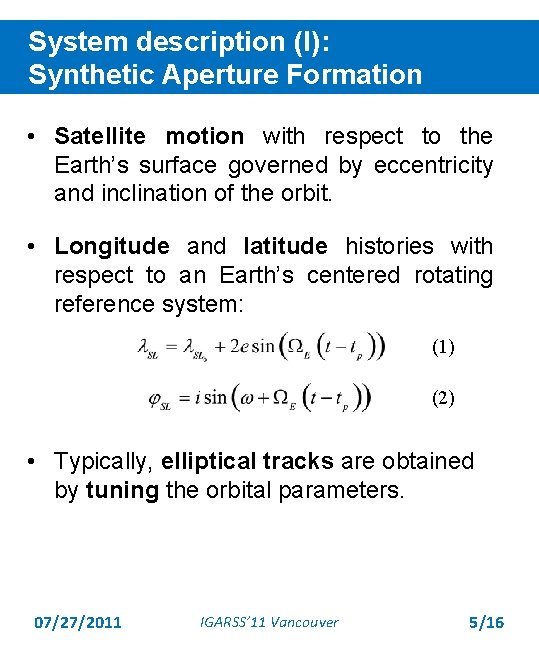
System description (I): Synthetic Aperture Formation • Satellite motion with respect to the Earth’s surface governed by eccentricity and inclination of the orbit. • Longitude and latitude histories with respect to an Earth’s centered rotating reference system: (1) (2) • Typically, elliptical tracks are obtained by tuning the orbital parameters. 07/27/2011 IGARSS’ 11 Vancouver 5/16
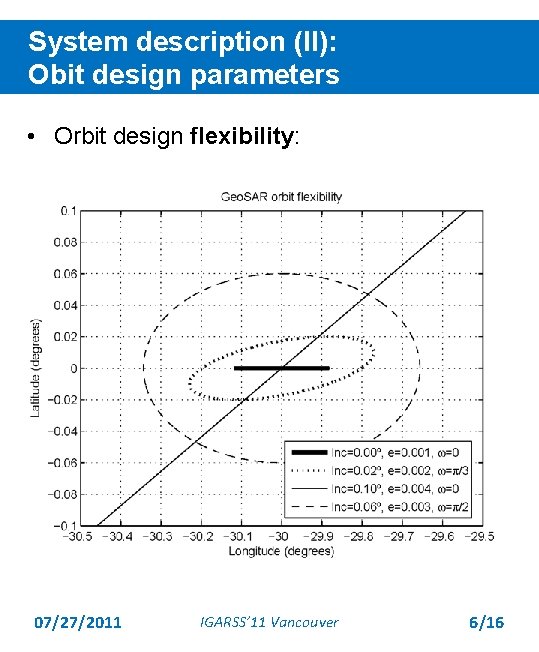
System description (II): Obit design parameters • Orbit design flexibility: 07/27/2011 IGARSS’ 11 Vancouver 6/16

GEOSAR constraints and system features (I): timing and PRF selection • PRF selection: avoid transmission interferences and nadir eclipses. Dartboard diagram PRF=30 Hz 07/27/2011 Dartboard diagram PRF=100 Hz IGARSS’ 11 Vancouver 7/16
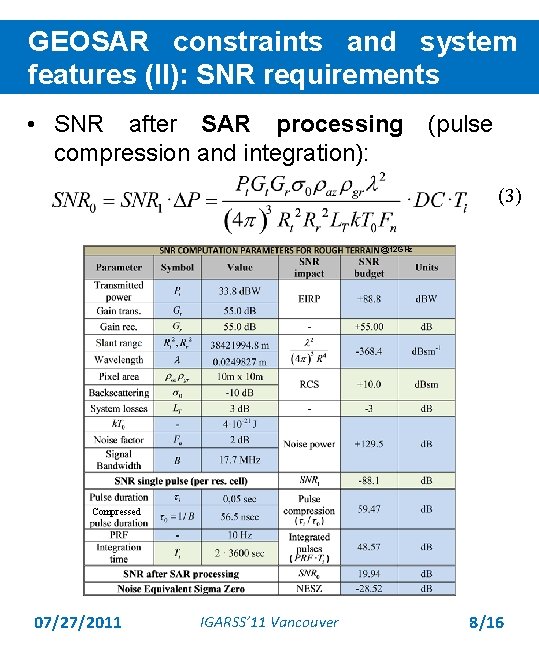
GEOSAR constraints and system features (II): SNR requirements • SNR after SAR processing (pulse compression and integration): (3) @12 GHz Compressed 07/27/2011 IGARSS’ 11 Vancouver 8/16
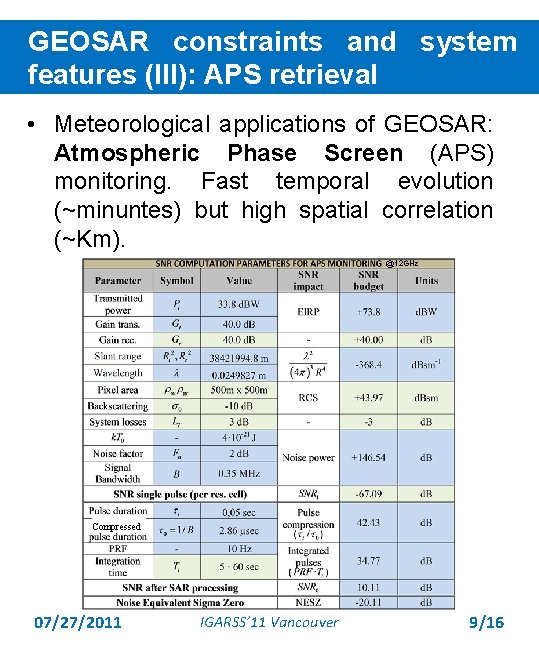
GEOSAR constraints and system features (III): APS retrieval • Meteorological applications of GEOSAR: Atmospheric Phase Screen (APS) monitoring. Fast temporal evolution (~minuntes) but high spatial correlation (~Km). @12 GHz Compressed 07/27/2011 IGARSS’ 11 Vancouver 9/16
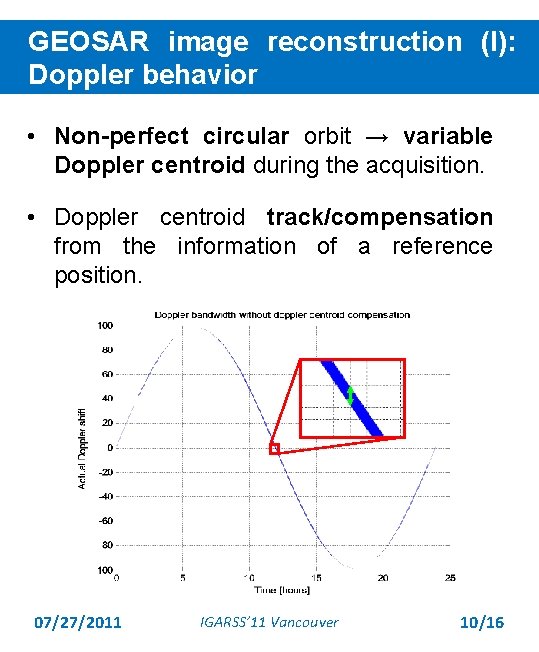
GEOSAR image reconstruction (I): Doppler behavior • Non-perfect circular orbit → variable Doppler centroid during the acquisition. • Doppler centroid track/compensation from the information of a reference position. 07/27/2011 IGARSS’ 11 Vancouver 10/16
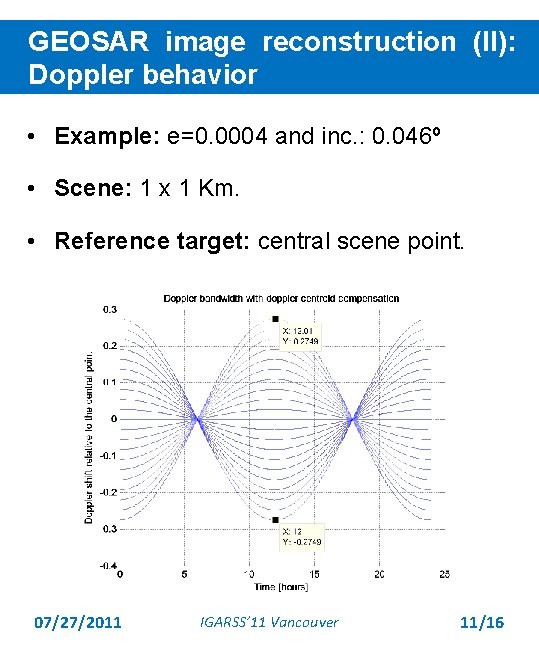
GEOSAR image reconstruction (II): Doppler behavior • Example: e=0. 0004 and inc. : 0. 046º • Scene: 1 x 1 Km. • Reference target: central scene point. 07/27/2011 IGARSS’ 11 Vancouver 11/16
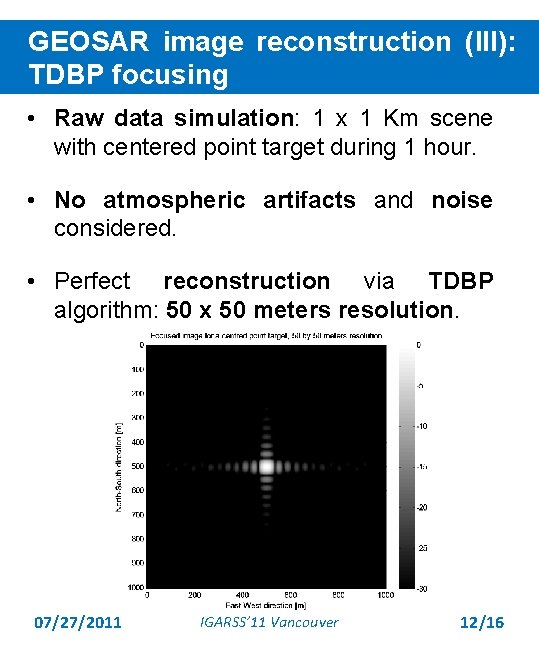
GEOSAR image reconstruction (III): TDBP focusing • Raw data simulation: 1 x 1 Km scene with centered point target during 1 hour. • No atmospheric artifacts and noise considered. • Perfect reconstruction via TDBP algorithm: 50 x 50 meters resolution. 07/27/2011 IGARSS’ 11 Vancouver 12/16
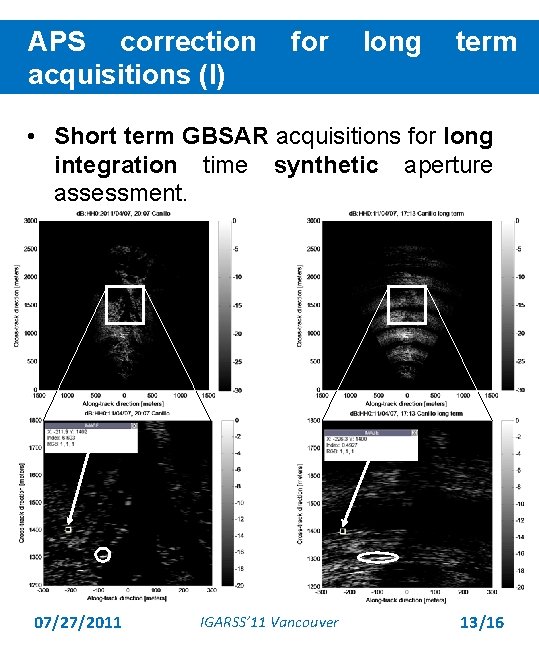
APS correction acquisitions (I) for long term • Short term GBSAR acquisitions for long integration time synthetic aperture assessment. 07/27/2011 IGARSS’ 11 Vancouver 13/16
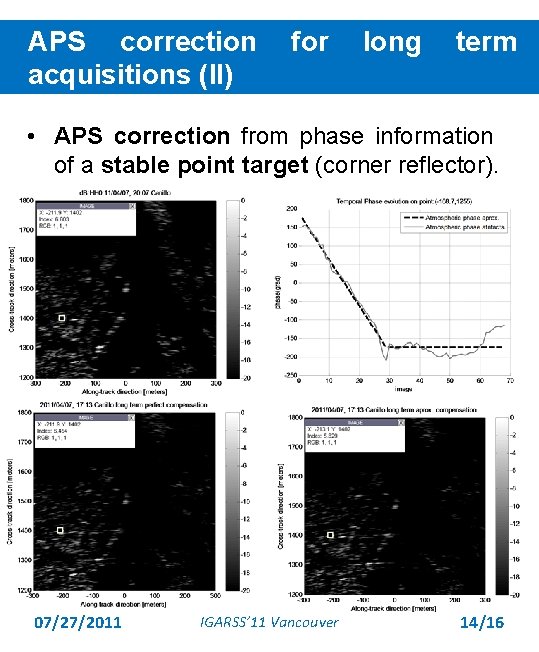
APS correction acquisitions (II) for long term • APS correction from phase information of a stable point target (corner reflector). 07/27/2011 IGARSS’ 11 Vancouver 14/16
Conclusions • Monostatic GEOSAR configuration with typical LEOSAR parameters with long integration. • Synthetic Aperture formation, timing analysis and SNR requirements shows the feasibility of geosynchronous satellites for SAR applications. • TDBP algorithm to focus simulated raw data from a GEOSAR configuration with Doppler centroid compensation. • Atmospheric phase stability in long term acquisition as well as target coherence loss have to be deeply studied in further analysis. 07/27/2011 IGARSS’ 11 Vancouver 15/16

Thank you Josep Ruiz Rodon e-mail: josep. ruiz@tsc. upc. edu Phone: +34 93 401 74 26 http: //www. tsc. upc. edu/rs 07/27/2011 IGARSS’ 11 Vancouver 16/16
- Slides: 16