
A Knowledge Sharing System Architecture for Higher Education
![Knowledge Management Systems • Alavi and Leidner [2] define KMSs as “a class of](https://slidetodoc.com/presentation_image_h2/505288fffa9b625dda8c8a9bc6d05610/image-4.jpg "Knowledge Management Systems • Alavi and Leidner [2] define KMSs as “a class of")
![Research Gap Samoilenko and Nahar [3] have pointed out that existing off‐the‐shelf KMSs often](https://slidetodoc.com/presentation_image_h2/505288fffa9b625dda8c8a9bc6d05610/image-6.jpg "Research Gap Samoilenko and Nahar [3] have pointed out that existing off‐the‐shelf KMSs often")
![Reference List [1] Grant, R. M. : Toward a knowledge‐based theory of the firm.](https://slidetodoc.com/presentation_image_h2/505288fffa9b625dda8c8a9bc6d05610/image-22.jpg "Reference List [1] Grant, R. M. : Toward a knowledge‐based theory of the firm.")

- Slides: 23
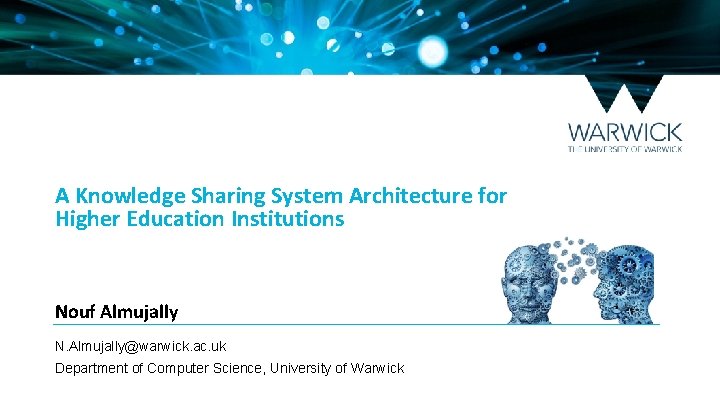
A Knowledge Sharing System Architecture for Higher Education Institutions Nouf Almujally N. Almujally@warwick. ac. uk Department of Computer Science, University of Warwick
Introduction • The emergence of the knowledge‐based economy has emphasized knowledge management (KM) as a key to organization performance. • While KM has been implemented in a large number of sectors and organizations [1], universities and the higher education sector are yet to take full advantage of the capabilities offered by KM. • A practical approach to managing the different types and sources of knowledge used by academics is by sharing knowledge. However, academic institutions face challenges in attempting to improve the sharing of teaching‐related knowledge.
Introduction • Without the sharing of knowledge: • Academics will continuously reinvent themselves, and there will be no way of leveraging experience and expertise. • Therefore: • HEIs need to adopt a proactive approach to KM whereby instructors can create, transfer, share and then apply teaching experience effectively • A Knowledge Management System (KMS) can provide a technological solution to enhance knowledge sharing processes, and consequently boost the application of knowledge in order to improve performance and outcomes in public institutions.
Knowledge Management Systems • Alavi and Leidner [2] define KMSs as “a class of information system applied to manage organizational knowledge”. • a Teaching Practices Management System (TPMS) is defined as an IT-based system which supports and enhances the creation, storage/retrieval, sharing and application of teaching experiences among academics in universities. • benefits : supporting knowledge sharing activities / encouraging employee collaboration / facilitating access to experts and expertise
Knowledge Management Systems • The architecture of a system plays a vital role in managing complex interactions among end‐users. • The system architecture is about a shared understanding of a system’s design, the major components of the system and the way they interact.
Research Gap Samoilenko and Nahar [3] have pointed out that existing off‐the‐shelf KMSs often fail due to inappropriate tools or insufficient understanding of human behavior. Most of the KMS architecture focus on a particular domain and can only be used under specific circumstances. Few researchers have explored KSB in academic institutions KMS architecture do not consider the cycles of knowledge in order to use knowledge management in the system itself. How can a KMS architecture framework be developed based on academics’ knowledge sharing behavior? Research Question
Methodology • Semi‐structured interviews were conducted with 22 academics (five heads of the departments, five assistant professors, eight lecturers, four teacher assistants) who work in Saudi universities. • Aim: • Investigate authentic academics’ knowledge sharing behavior and incorporate it into the design of a KMS architecture • An inductive content analysis approach
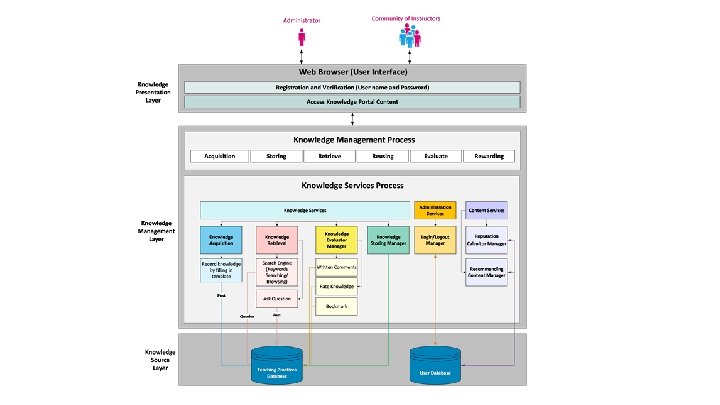
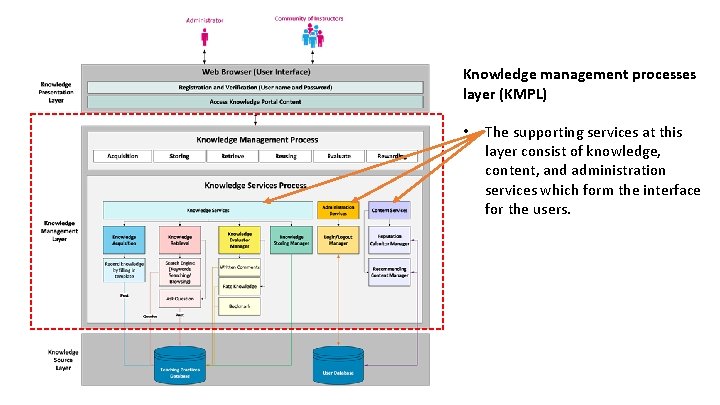
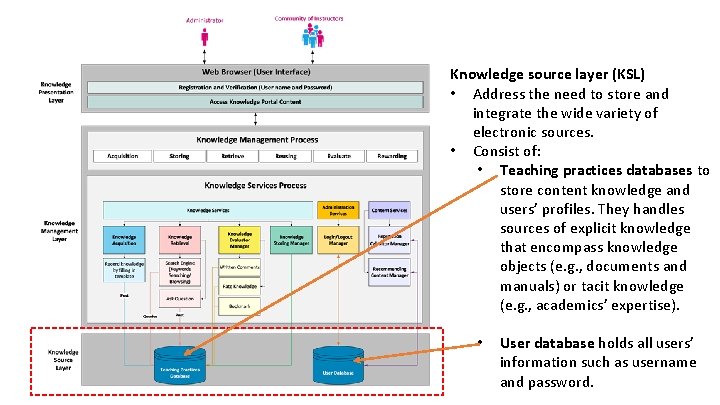
Findings • A comprehensive TPMS Architecture (TPMSA) is proposed to illustrate a new approach for enhancing and facilitating teaching practice sharing based on actual KSB of academics resulted from the qualitative findings.
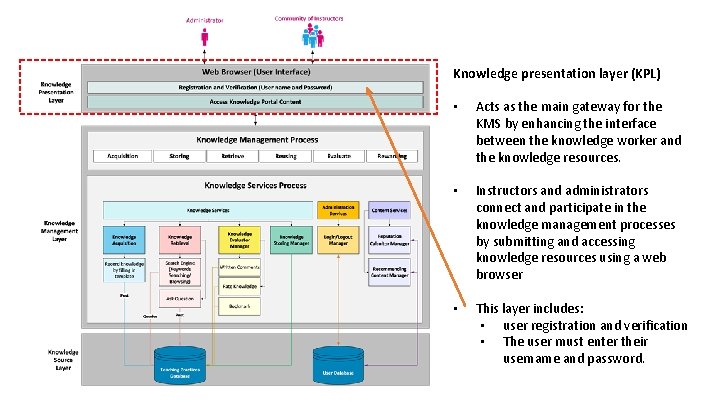
Knowledge presentation layer (KPL) • Acts as the main gateway for the KMS by enhancing the interface between the knowledge worker and the knowledge resources. • Instructors and administrators connect and participate in the knowledge management processes by submitting and accessing knowledge resources using a web browser • This layer includes: • user registration and verification • The user must enter their username and password.
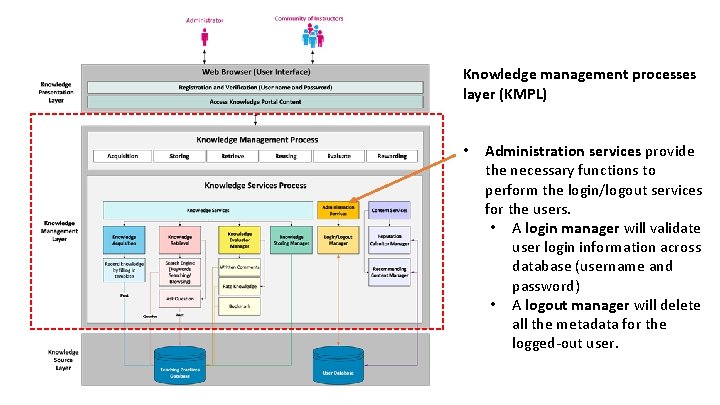
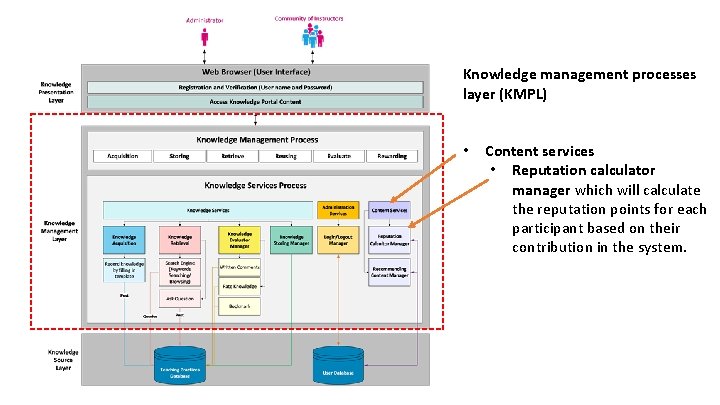
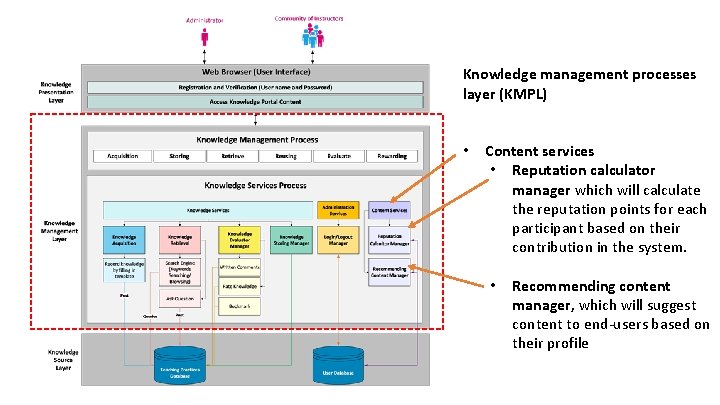
Knowledge management processes layer (KMPL) • The supporting services at this layer consist of knowledge, content, and administration services which form the interface for the users.
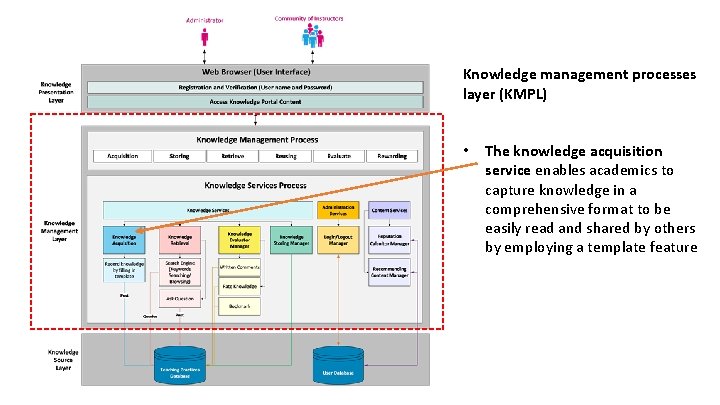
Knowledge management processes layer (KMPL) • The knowledge acquisition service enables academics to capture knowledge in a comprehensive format to be easily read and shared by others by employing a template feature
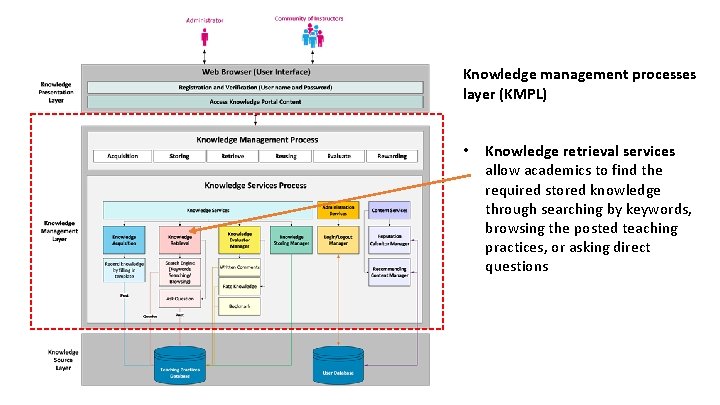
Knowledge management processes layer (KMPL) • Knowledge retrieval services allow academics to find the required stored knowledge through searching by keywords, browsing the posted teaching practices, or asking direct questions
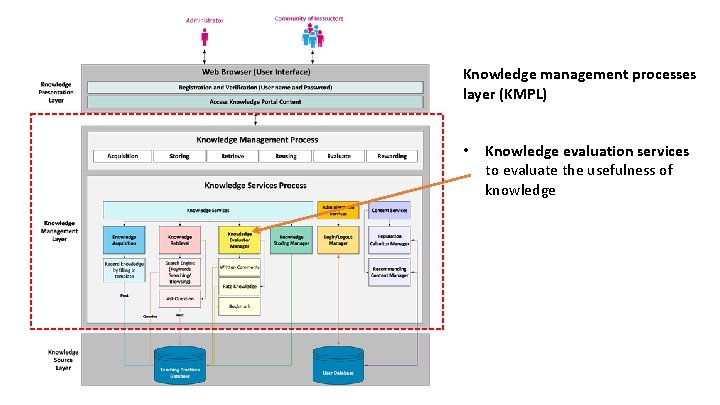
Knowledge management processes layer (KMPL) • Knowledge evaluation services to evaluate the usefulness of knowledge
Knowledge management processes layer (KMPL) • Administration services provide the necessary functions to perform the login/logout services for the users. • A login manager will validate user login information across database (username and password) • A logout manager will delete all the metadata for the logged‐out user.
Knowledge management processes layer (KMPL) • Content services • Reputation calculator manager which will calculate the reputation points for each participant based on their contribution in the system.
Knowledge management processes layer (KMPL) • Content services • Reputation calculator manager which will calculate the reputation points for each participant based on their contribution in the system. • Recommending content manager, which will suggest content to end‐users based on their profile
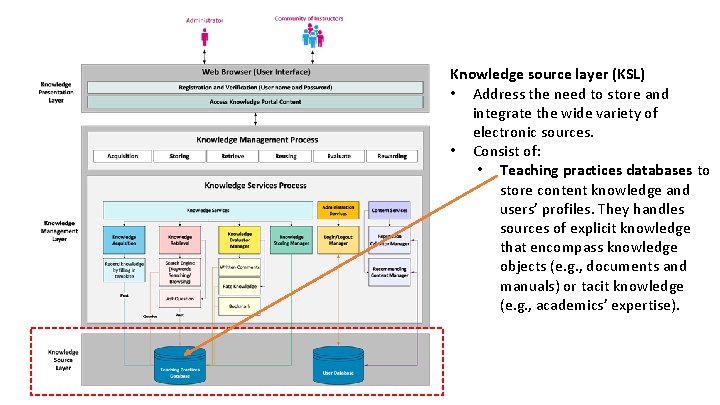
Knowledge source layer (KSL) • Address the need to store and integrate the wide variety of electronic sources. • Consist of: • Teaching practices databases to store content knowledge and users’ profiles. They handles sources of explicit knowledge that encompass knowledge objects (e. g. , documents and manuals) or tacit knowledge (e. g. , academics’ expertise).
Knowledge source layer (KSL) • Address the need to store and integrate the wide variety of electronic sources. • Consist of: • Teaching practices databases to store content knowledge and users’ profiles. They handles sources of explicit knowledge that encompass knowledge objects (e. g. , documents and manuals) or tacit knowledge (e. g. , academics’ expertise). • User database holds all users’ information such as username and password.
Conclusion • This research contributes to the field of KMS through the development of an innovative teaching practice management system architecture (TPMSA) based on an intensive literature review and upon an understanding of academics’ behavior obtained from qualitative findings. • The proposed system architecture is of great potential importance to a higher education institution that intends to implement a KMS in their organization. • It provides a clear, comprehensive, and structured processes for capturing, sharing, searching, and storing teaching practices. • It will become a guideline when designing and implementing a new knowledge sharing system due to the sufficient level of details incorporated in the architecture. • It will assist developers in avoiding the errors and gaining other benefits in terms of time and effort, as well as reducing cost.
Future Work • A new system will be designed based on the proposed TPMSA, and empirically evaluated.
Reference List [1] Grant, R. M. : Toward a knowledge‐based theory of the firm. Strategic management journal 17, 109‐ 122 (1996) [2] foundations and research issues. MIS quarterly 107‐ 136 (2001) [3] Samoilenko, N. , Nahar, N. : Knowledge sharing and application in complex software and systems development in globally distributed high‐tech organizations using suitable IT tools. In: 2013 Proceedings of PICMET'13: Technology Management in the IT‐Driven Services (PICMET), pp. 1280‐ 1294. IEEE, (2013)
Thank You Nouf Almujally N. Almujally@warwick. ac. uk Department of Computer Science, University of Warwick