
A journey to An Integrated Rationalized Coordinated Accessible
A journey to An Integrated, Rationalized, Coordinated, Accessible and Quality Healthcare for the Citizens in the City of Kigali ‘‘TAKING THE URBAN TURN’’ BE-CAUSE HEALTH ANNUAL CONFERENCE, BRUSSELS 15 TH TO 16 TH OCTOBER 2019
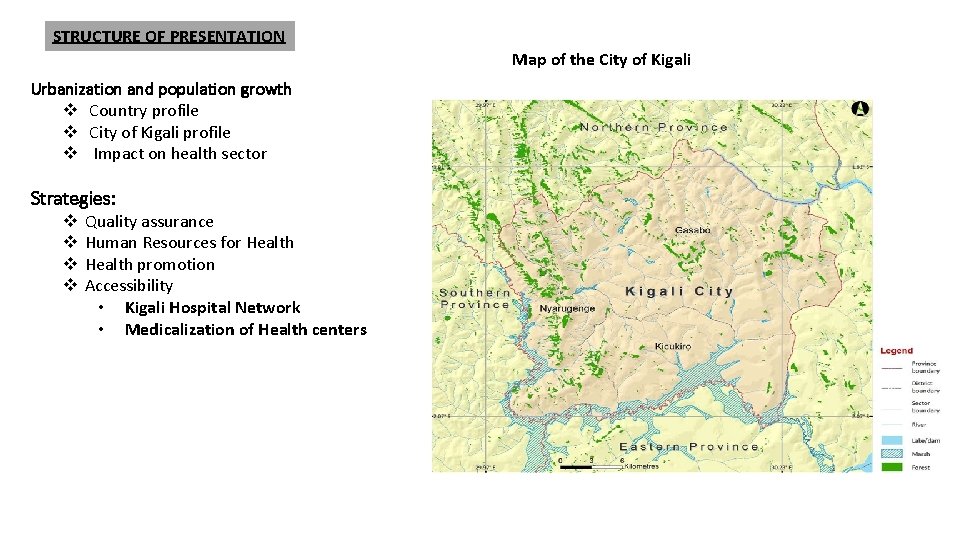
STRUCTURE OF PRESENTATION Map of the City of Kigali Urbanization and population growth v Country profile v City of Kigali profile v Impact on health sector Strategies: v v Quality assurance Human Resources for Health promotion Accessibility • Kigali Hospital Network • Medicalization of Health centers
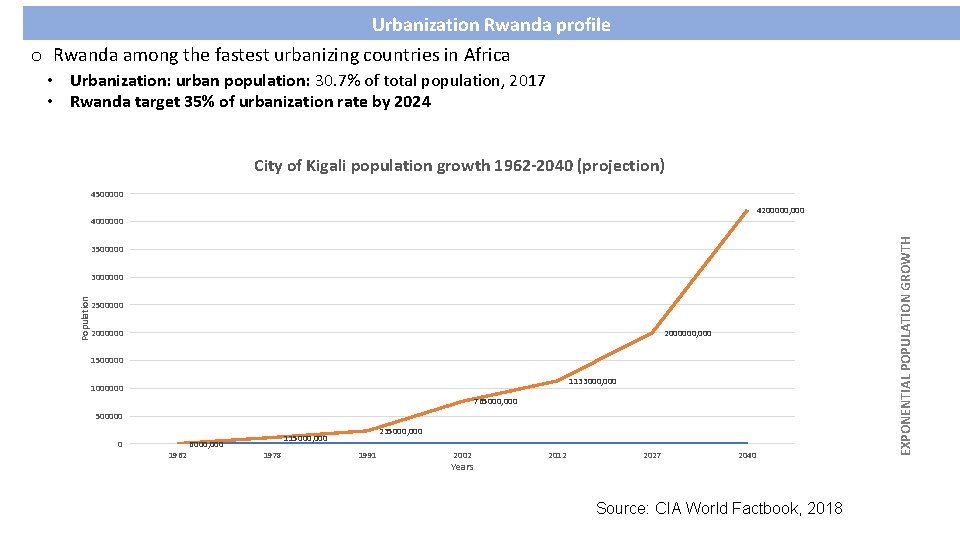
Urbanization Rwanda profile o Rwanda among the fastest urbanizing countries in Africa • Urbanization: urban population: 30. 7% of total population, 2017 • Rwanda target 35% of urbanization rate by 2024 City of Kigali population growth 1962 -2040 (projection) 4500000 4200000, 000 3500000 Population 3000000 2500000 2000000, 000 1500000 1133000, 000 1000000 765000, 000 500000 0 1962 235000, 000 115000, 000 6000, 000 1978 1991 2002 Years 2012 2027 2040 Source: CIA World Factbook, 2018 EXPONENTIAL POPULATION GROWTH 4000000
City of Kigali- Delivery Challenges o Insufficient and uneven distribution of health facilities o Lack of enough skilled personnel o High concentration of people affected by City’s living style e. g. (RTA, Violence, Mental Health, Drug abuse, industries, PTSD, etc. o Environmental issues : air pollution due to road traffic, inefficient waste management systems o Majority of the population (> 80% of the population) is covered by CBHI Scheme, giving only access and reimbursements for services in the public health facilities. o Infectious diseases exacerbated by poor living conditions, high population density, promiscuity o Epidemiologic transition: NCDs & mental health
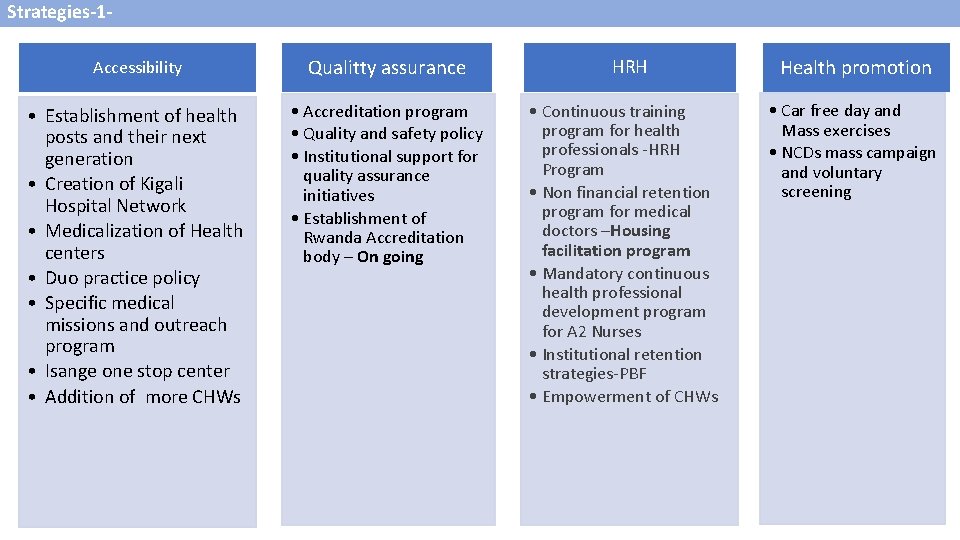
Strategies-1 Accessibility Qualitty assurance • Establishment of health posts and their next generation • Creation of Kigali Hospital Network • Medicalization of Health centers • Duo practice policy • Specific medical missions and outreach program • Isange one stop center • Addition of more CHWs • Accreditation program • Quality and safety policy • Institutional support for quality assurance initiatives • Establishment of Rwanda Accreditation body – On going HRH • Continuous training program for health professionals -HRH Program • Non financial retention program for medical doctors –Housing facilitation program • Mandatory continuous health professional development program for A 2 Nurses • Institutional retention strategies-PBF • Empowerment of CHWs Health promotion • Car free day and Mass exercises • NCDs mass campaign and voluntary screening
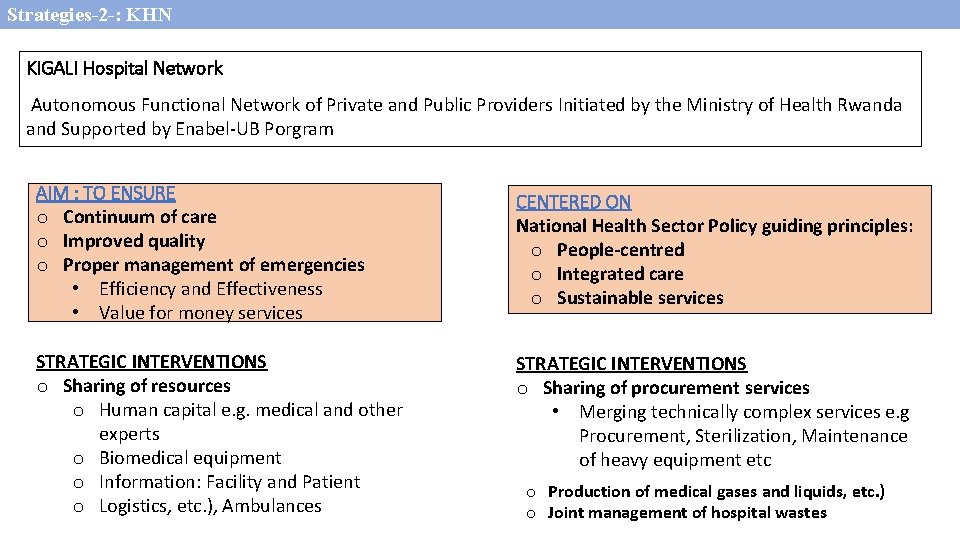
Strategies-2 -: KHN KIGALI Hospital Network Autonomous Functional Network of Private and Public Providers Initiated by the Ministry of Health Rwanda and Supported by Enabel-UB Porgram AIM : TO ENSURE o Continuum of care o Improved quality o Proper management of emergencies • Efficiency and Effectiveness • Value for money services CENTERED ON National Health Sector Policy guiding principles: o People-centred o Integrated care o Sustainable services STRATEGIC INTERVENTIONS o Sharing of resources o Human capital e. g. medical and other experts o Biomedical equipment o Information: Facility and Patient o Logistics, etc. ), Ambulances STRATEGIC INTERVENTIONS o Sharing of procurement services • Merging technically complex services e. g Procurement, Sterilization, Maintenance of heavy equipment etc o Production of medical gases and liquids, etc. ) o Joint management of hospital wastes
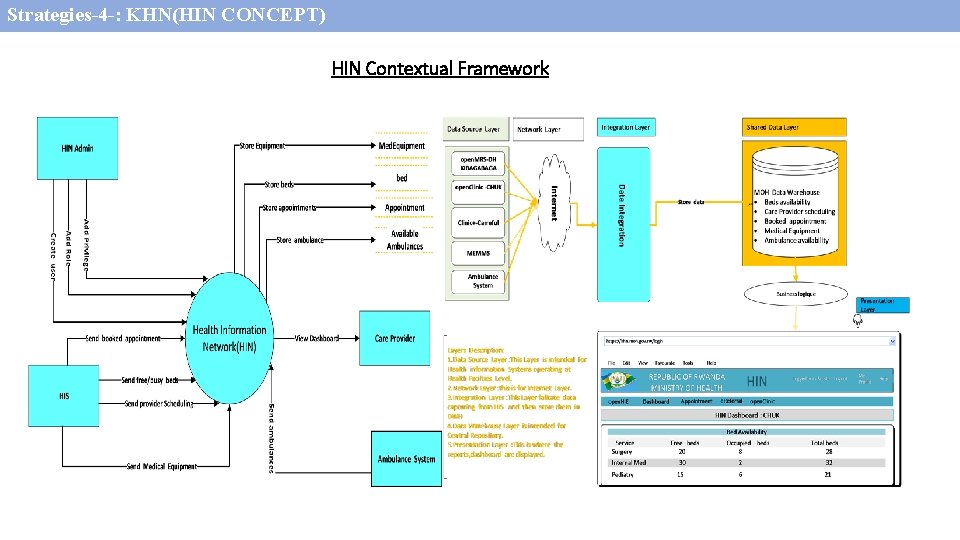
Strategies-4 -: KHN(HIN CONCEPT) Intervention 1 -KHNOrganization and achievements HIN Contextual Framework
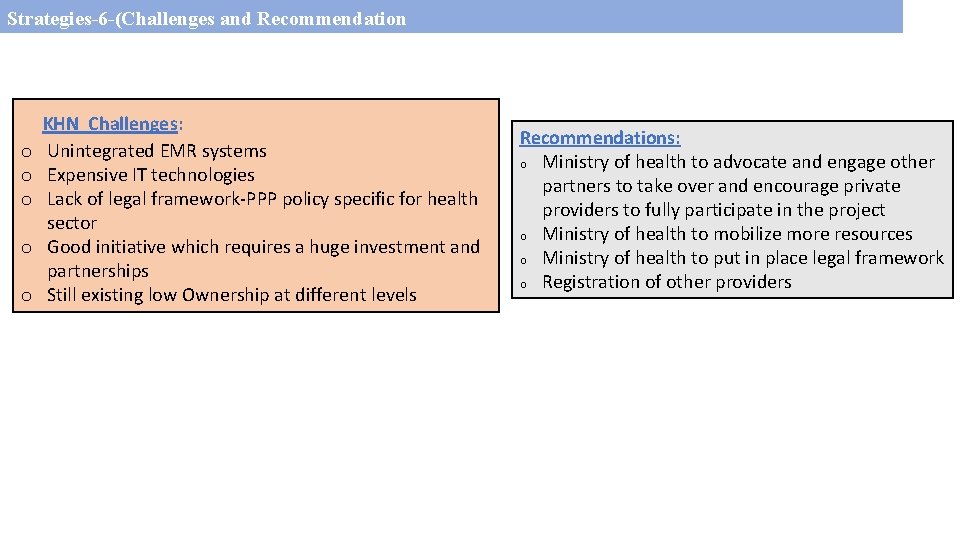
Strategies-6 -(Challenges and Recommendation o o o KHN Challenges: Unintegrated EMR systems Expensive IT technologies Lack of legal framework-PPP policy specific for health sector Good initiative which requires a huge investment and partnerships Still existing low Ownership at different levels Recommendations: o Ministry of health to advocate and engage other partners to take over and encourage private providers to fully participate in the project o Ministry of health to mobilize more resources o Ministry of health to put in place legal framework o Registration of other providers
MEDICALIZATION OF HEALTH CENTERS-1 - Concept: Intermediate between District hospital & Standard Health center- Since 2015 o. Purpose: To bring services closer to the population in a context of growing population. o Strategic objectives: Obj 1: Relieve the burden from DH on ambulatory services (NCDs – dental cares–) Obj 2: Address delays in referral of obstetric cases and other life strengthening conditions As a progression the Mo. H has developed an Extended Health Service Package (EHSP) for Medicalized Health Facilities
MEDICALIZATION OF HEALTH CENTERS-2 Model description o Two medical visits/week at each of the four Health centers: Activities: • Medical consultations • Other general medicine services including ultrasound services -Ultrasound and doppler machines were provided • Mentorship to health providers-Nurses and midwives o Other extra services provided include: • Ultrasound services by nurses • Upgraded laboratory services • Selected drugs including those of NCDs • Basic dental services -Dental chairs were provided
MEDICALIZATION OF HEALTH CENTERS-3 Rollout Phase 1: • Permanent medical doctor- Recruitment in progress • Dental services full package(MPA) • Extended service package for MHCs- Published • Training and privileging nurses and MDWs on the use of US- In progress • Recognition of 4 MHCs for service reimbursement • Continuous mentorship for all MHC staff • Upgrading of laboratory services • Establish official tariff for services provided at MHCs • Develop institutional structure
MEDICALIZATION OF HEALTH CENTERS-3 Rollout Phase 2: o Provision of an extend ambulatory service package and confirming o Equipments – To provide basic physiotherapy & ophthalmology equipment to be provided (if pertinent – phase 1) o Introducing new activities: physiotherapy and ophthalmology services (depending on need and feasibility assessment) Rollout Phase 3: o Implementation of sustainability plan phase 3 Overall Model Challenges: o Weak internal revenue control mechanisms o Financial burden (now still covered by Enabel-UB program) o No official tariff for MHCs o Medicalized health facilities Structure not approved Conclusion and recommendation: Access to quality and quantity healthcare especially in an urban context requires constant review and set up of several innovative strategies eg The current Medicalized HCs.
UPGRADED (MEDICALIZED) HEALTH CENTERGATENGA Thank you Murakoze cyane
- Slides: 13