
A Holographic Formalism for Quantum Gravity Bartomiej Czech
A Holographic Formalism for Quantum Gravity Bartłomiej Czech Institute for Advanced Study, Tsinghua University 中国科学技术大学, 13 December 2019
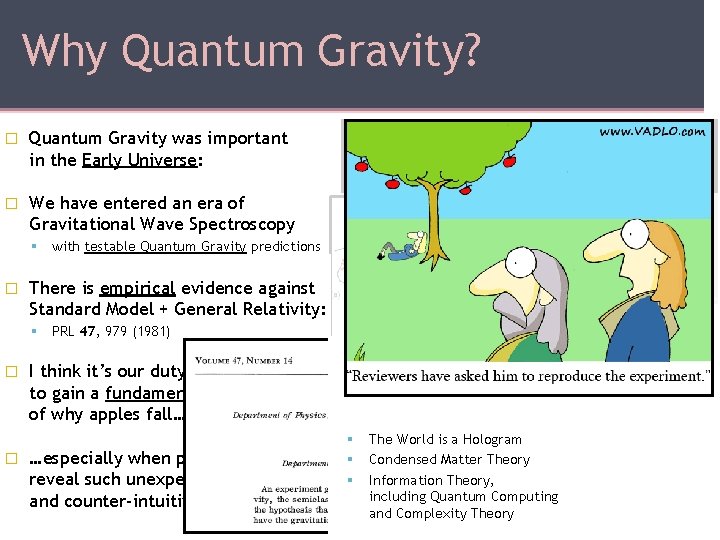
Why Quantum Gravity? � Quantum Gravity was important in the Early Universe: � We have entered an era of Gravitational Wave Spectroscopy � There is empirical evidence against Standard Model + General Relativity: � � with testable Quantum Gravity predictions PRL 47, 979 (1981) I think it’s our duty as a civilization to gain a fundamental understanding of why apples fall… …especially when preliminary results reveal such unexpected connections and counter-intuitive conclusions: The World is a Hologram Condensed Matter Theory Information Theory, including Quantum Computing and Complexity Theory Source: Abbott et al. (LIGO and Virgo Collaborations), PRL (2016).
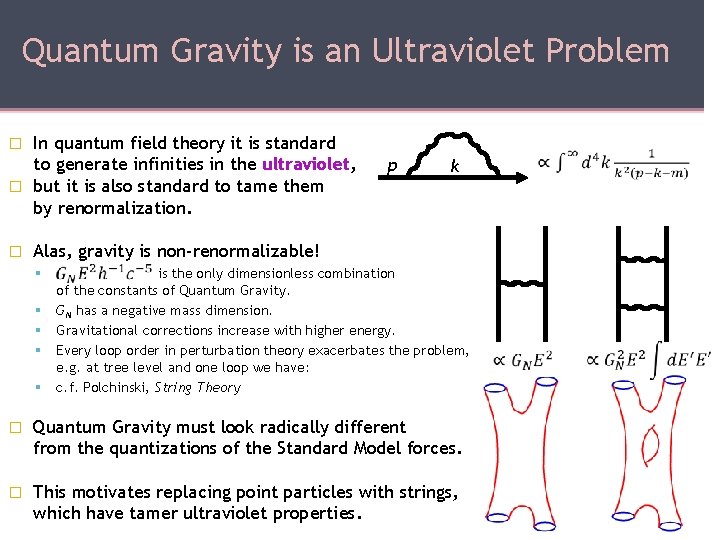
Quantum Gravity is an Ultraviolet Problem In quantum field theory it is standard to generate infinities in the ultraviolet, � but it is also standard to tame them by renormalization. � � p k Alas, gravity is non-renormalizable! is the only dimensionless combination of the constants of Quantum Gravity. GN has a negative mass dimension. Gravitational corrections increase with higher energy. Every loop order in perturbation theory exacerbates the problem, e. g. at tree level and one loop we have: c. f. Polchinski, String Theory � Quantum Gravity must look radically different from the quantizations of the Standard Model forces. � This motivates replacing point particles with strings, which have tamer ultraviolet properties.
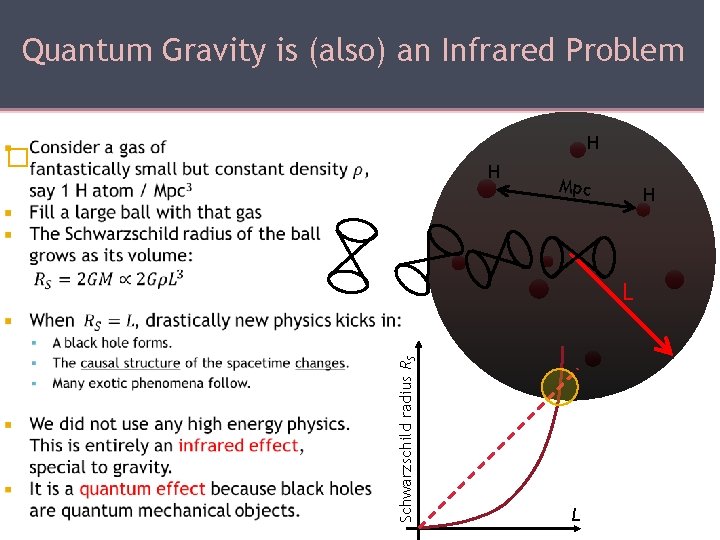
Quantum Gravity is (also) an Infrared Problem H � H Mpc H L Schwarzschild radius RS L
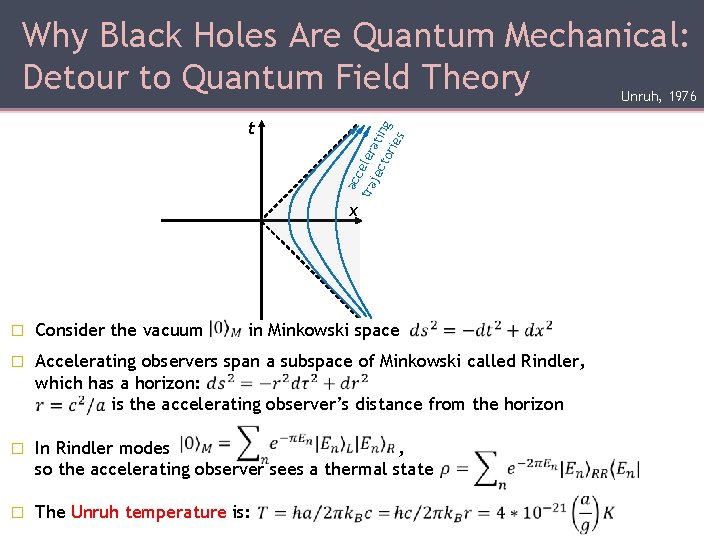
Why Black Holes Are Quantum Mechanical: Detour to Quantum Field Theory t ac c tra eler jec ati tor ng ies Unruh, 1976 x � Consider the vacuum in Minkowski space � Accelerating observers span a subspace of Minkowski called Rindler, which has a horizon: is the accelerating observer’s distance from the horizon � In Rindler modes , so the accelerating observer sees a thermal state � The Unruh temperature is:
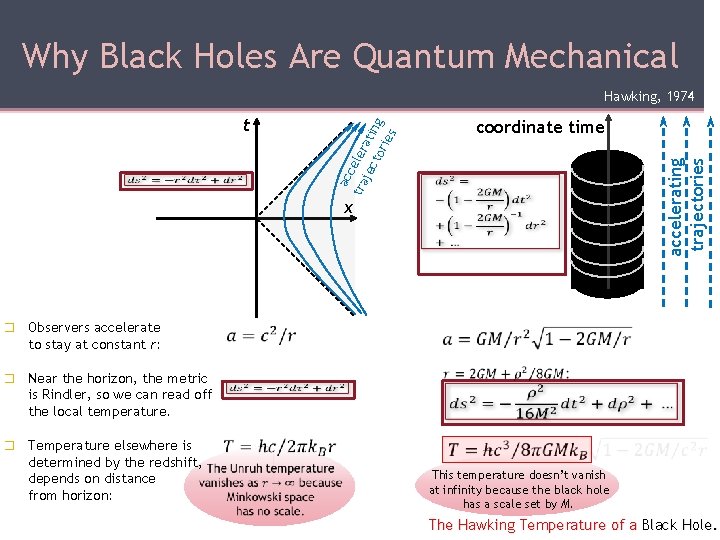
Why Black Holes Are Quantum Mechanical � Observers accelerate to stay at constant r: � Near the horizon, the metric is Rindler, so we can read off the local temperature. � Temperature elsewhere is determined by the redshift, depends on distance from horizon: x coordinate time accelerating trajectories t ac c tra eler jec ati tor ng ies Hawking, 1974 This temperature doesn’t vanish at infinity because the black hole has a scale set by M. The Hawking Temperature of a Black Hole.
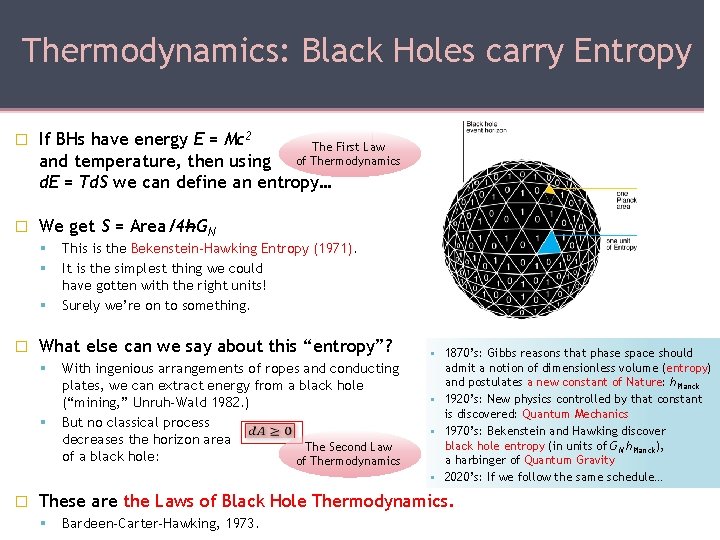
Thermodynamics: Black Holes carry Entropy � If BHs have energy E = Mc 2 The First Law and temperature, then using of Thermodynamics d. E = Td. S we can define an entropy… � We get S = Area/4 h. GN � What else can we say about this “entropy”? � This is the Bekenstein-Hawking Entropy (1971). It is the simplest thing we could have gotten with the right units! Surely we’re on to something. With ingenious arrangements of ropes and conducting plates, we can extract energy from a black hole (“mining, ” Unruh-Wald 1982. ) But no classical process decreases the horizon area The Second Law of a black hole: of Thermodynamics 1870’s: Gibbs reasons that phase space should admit a notion of dimensionless volume (entropy) and postulates a new constant of Nature: h. Planck 1920’s: New physics controlled by that constant is discovered: Quantum Mechanics 1970’s: Bekenstein and Hawking discover black hole entropy (in units of GN h. Planck), a harbinger of Quantum Gravity 2020’s: If we follow the same schedule… These are the Laws of Black Hole Thermodynamics. Bardeen-Carter-Hawking, 1973.
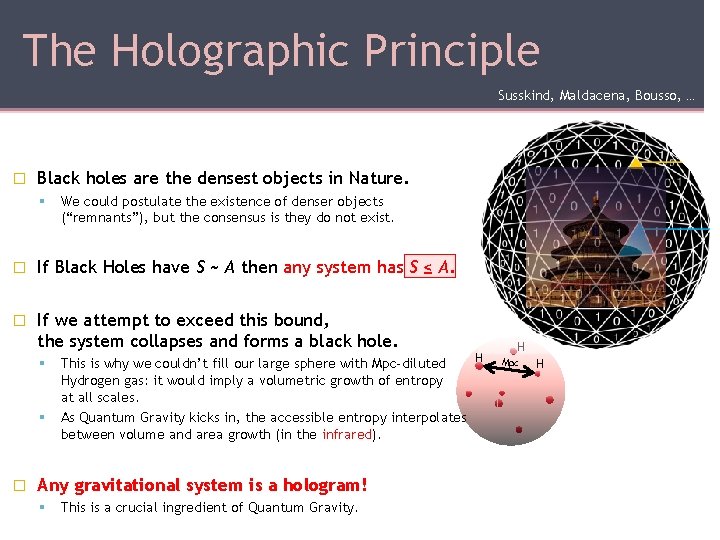
The Holographic Principle Susskind, Maldacena, Bousso, … � Black holes are the densest objects in Nature. We could postulate the existence of denser objects (“remnants”), but the consensus is they do not exist. � If Black Holes have S ~ A then any system has S ≤ A. � If we attempt to exceed this bound, the system collapses and forms a black hole. � This is why we couldn’t fill our large sphere with Mpc-diluted Hydrogen gas: it would imply a volumetric growth of entropy at all scales. As Quantum Gravity kicks in, the accessible entropy interpolates between volume and area growth (in the infrared). Any gravitational system is a hologram! This is a crucial ingredient of Quantum Gravity. H H Mpc H
Summary so far � Quantum Gravity is (also) an Infrared Problem. � Quantum Gravity is holographic: # degrees of freedom scales as area, not volume. �I will tell you today about a new formalism my collaborators and I invented, which automatically captures these two facts about gravity. But before that: � Quantum Gravity involves entanglement… � …and how to use this fact in practice.
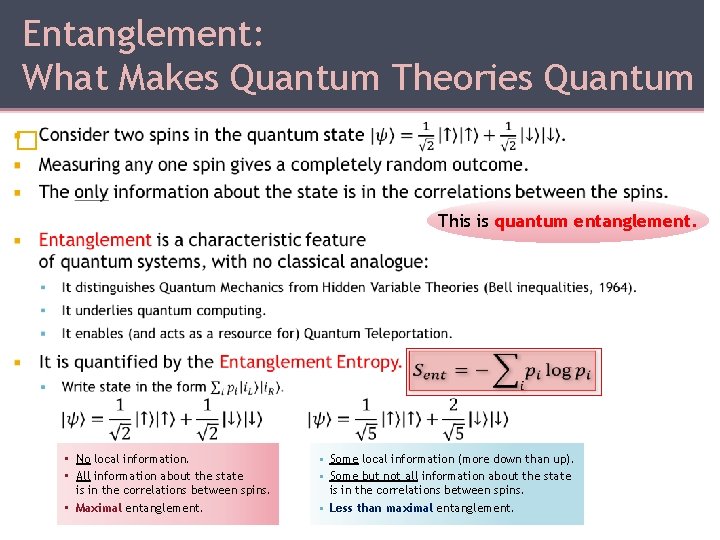
Entanglement: What Makes Quantum Theories Quantum � This is quantum entanglement. • No local information. Some local information (more down than up). • All information about the state Some but not all information about the state is in the correlations between spins. • Maximal entanglement. is in the correlations between spins. Less than maximal entanglement.
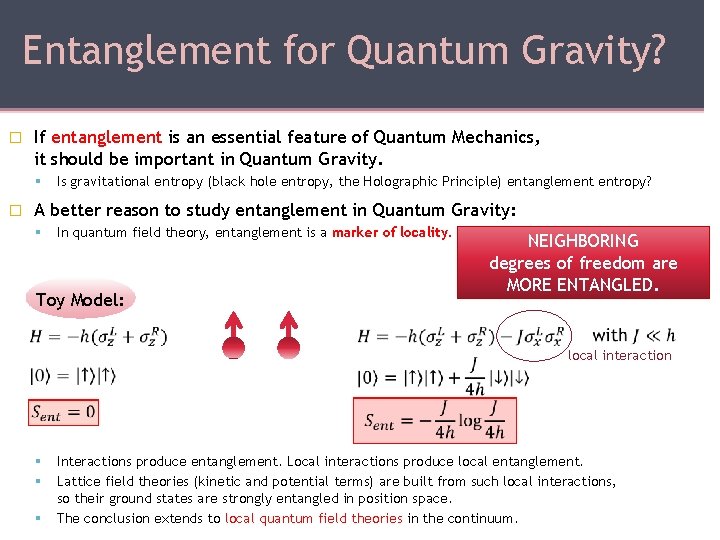
Entanglement for Quantum Gravity? � If entanglement is an essential feature of Quantum Mechanics, it should be important in Quantum Gravity. � Is gravitational entropy (black hole entropy, the Holographic Principle) entanglement entropy? A better reason to study entanglement in Quantum Gravity: In quantum field theory, entanglement is a marker of locality. Toy Model: NEIGHBORING degrees of freedom are MORE ENTANGLED. local interaction Interactions produce entanglement. Local interactions produce local entanglement. Lattice field theories (kinetic and potential terms) are built from such local interactions, so their ground states are strongly entangled in position space. The conclusion extends to local quantum field theories in the continuum.
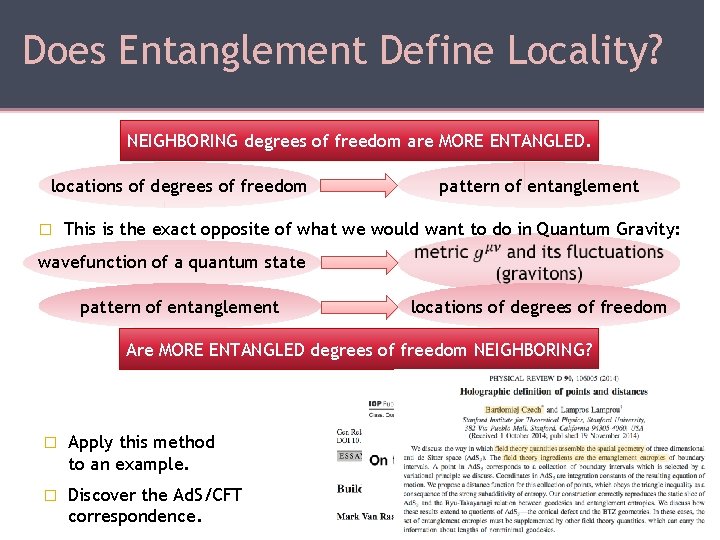
Does Entanglement Define Locality? NEIGHBORING degrees of freedom are MORE ENTANGLED. locations of degrees of freedom pattern of entanglement This is the exact opposite of what we would want to do in Quantum Gravity: wavefunction of a quantum state � pattern of entanglement locations of degrees of freedom Are MORE ENTANGLED degrees of freedom NEIGHBORING? � Apply this method to an example. � Discover the Ad. S/CFT correspondence.
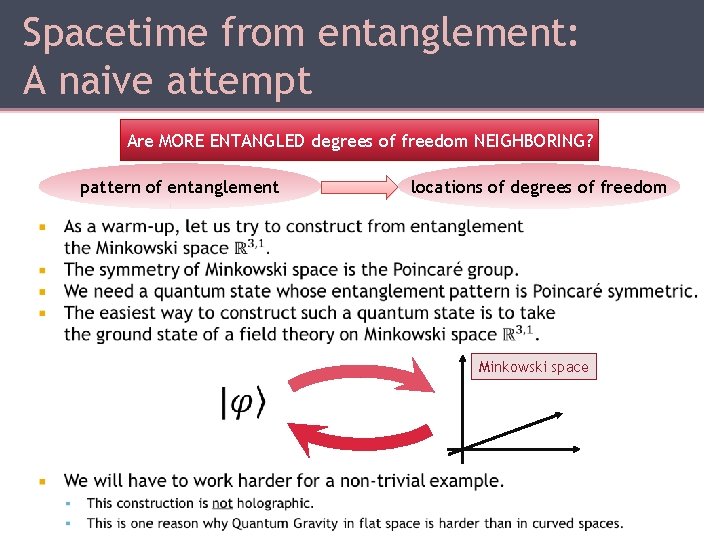
Spacetime from entanglement: A naive attempt Are MORE ENTANGLED degrees of freedom NEIGHBORING? pattern of entanglement locations of degrees of freedom Minkowski space
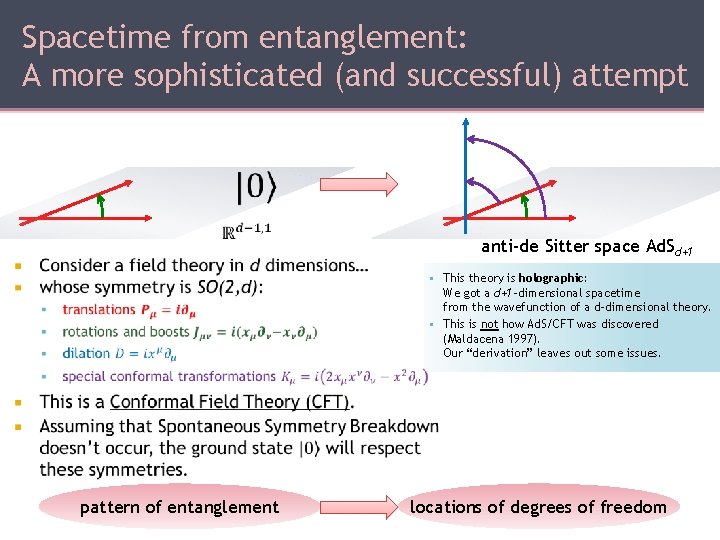
Spacetime from entanglement: A more sophisticated (and successful) attempt anti-de Sitter space Ad. Sd+1 This theory is holographic: We got a d+1 -dimensional spacetime from the wavefunction of a d-dimensional theory. This is not how Ad. S/CFT was discovered (Maldacena 1997). Our “derivation” leaves out some issues. pattern of entanglement locations of degrees of freedom
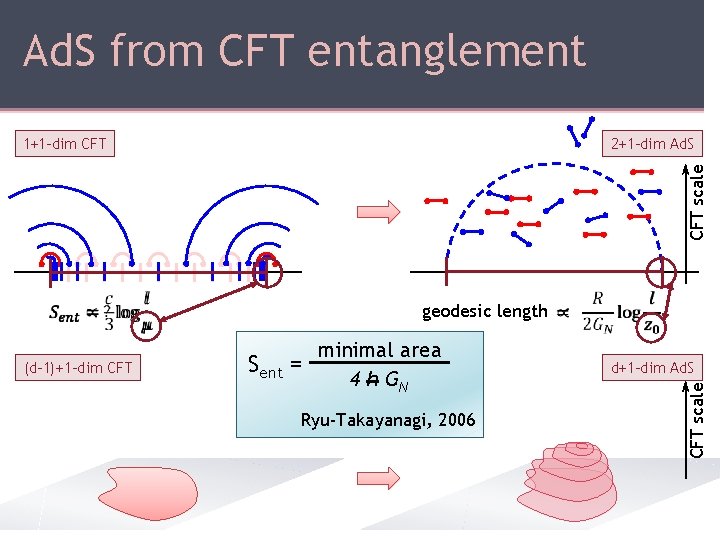
Ad. S from CFT entanglement 2+1 -dim Ad. S CFT scale 1+1 -dim CFT geodesic length (d-1)+1 -dim CFT Sent = minimal area 4 h GN Ryu-Takayanagi, 2006 d+1 -dim Ad. S CFT scale
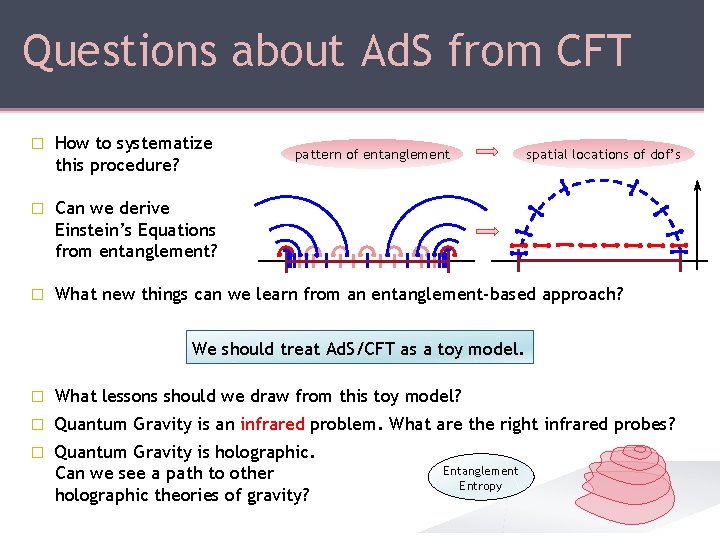
Questions about Ad. S from CFT � How to systematize this procedure? � Can we derive Einstein’s Equations from entanglement? � What new things can we learn from an entanglement-based approach? pattern of entanglement spatial locations of dof’s We should treat Ad. S/CFT as a toy model. � What lessons should we draw from this toy model? � Quantum Gravity is an infrared problem. What are the right infrared probes? � Quantum Gravity is holographic. Can we see a path to other holographic theories of gravity? Entanglement Entropy
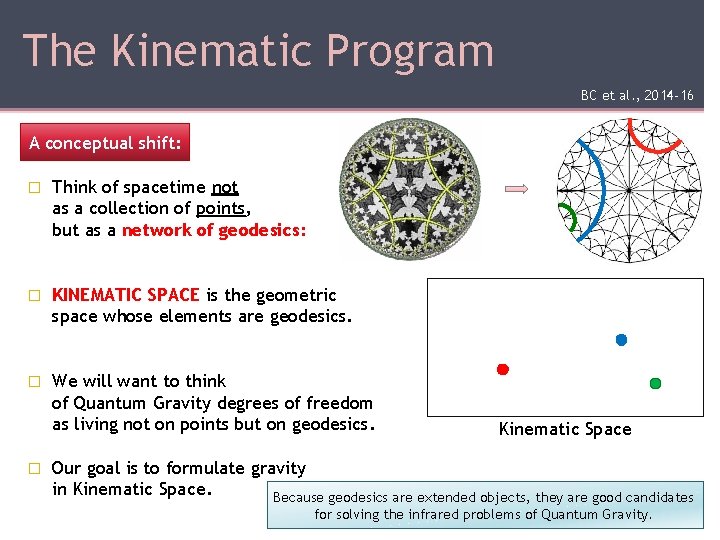
The Kinematic Program BC et al. , 2014 -16 A conceptual shift: � Think of spacetime not as a collection of points, but as a network of geodesics: � KINEMATIC SPACE is the geometric space whose elements are geodesics. � We will want to think of Quantum Gravity degrees of freedom as living not on points but on geodesics. � Kinematic Space Our goal is to formulate gravity in Kinematic Space. Because geodesics are extended objects, they are good candidates for solving the infrared problems of Quantum Gravity.
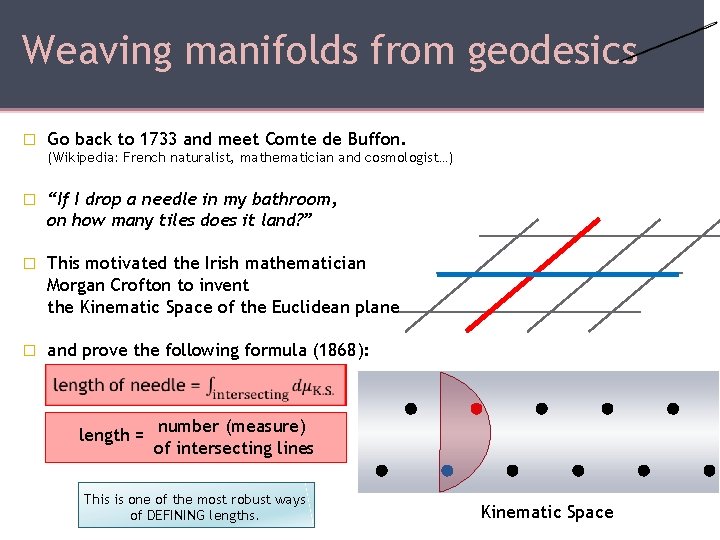
Weaving manifolds from geodesics � Go back to 1733 and meet Comte de Buffon. (Wikipedia: French naturalist, mathematician and cosmologist…) � “If I drop a needle in my bathroom, on how many tiles does it land? ” � This motivated the Irish mathematician Morgan Crofton to invent the Kinematic Space of the Euclidean plane � and prove the following formula (1868): length = number (measure) of intersecting lines This is one of the most robust ways of DEFINING lengths. Kinematic Space
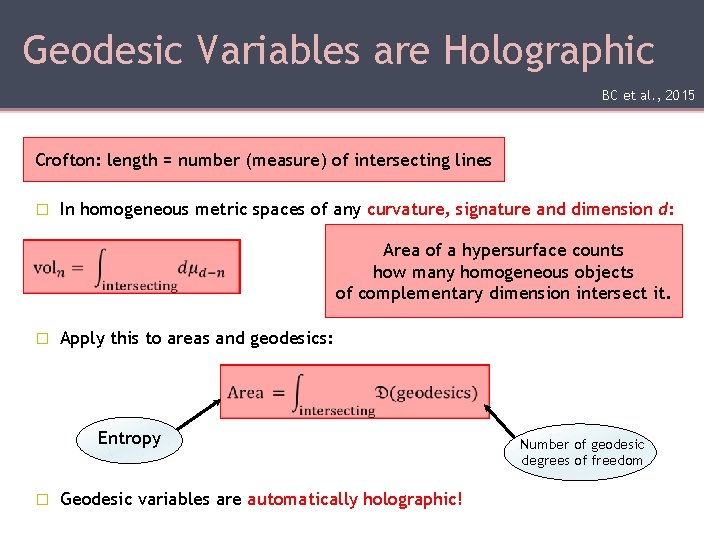
Geodesic Variables are Holographic BC et al. , 2015 Crofton: length = number (measure) of intersecting lines � In homogeneous metric spaces of any curvature, signature and dimension d: Area of a hypersurface counts how many homogeneous objects of complementary dimension intersect it. � Apply this to areas and geodesics: Entropy � Geodesic variables are automatically holographic! Number of geodesic degrees of freedom
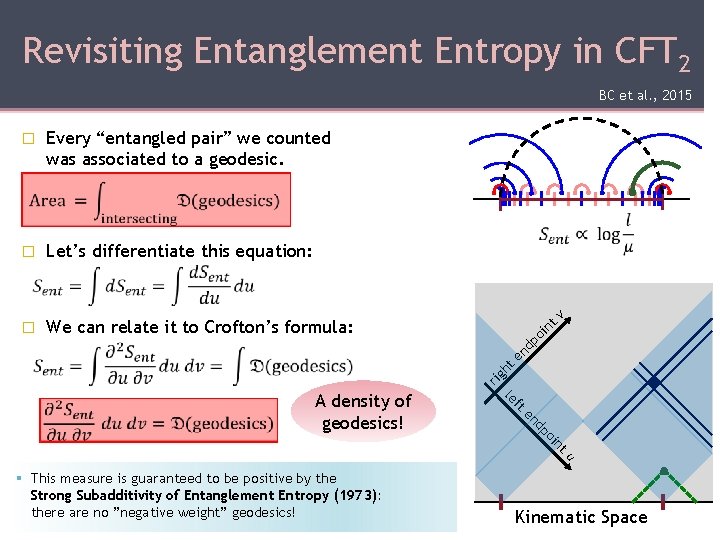
Revisiting Entanglement Entropy in CFT 2 BC et al. , 2015 Every “entangled pair” we counted was associated to a geodesic. � Let’s differentiate this equation: � v en dp oi nt We can relate it to Crofton’s formula: � rig ht ft dp en A density of geodesics! le nt oi u This measure is guaranteed to be positive by the Strong Subadditivity of Entanglement Entropy (1973): there are no ”negative weight” geodesics! Kinematic Space
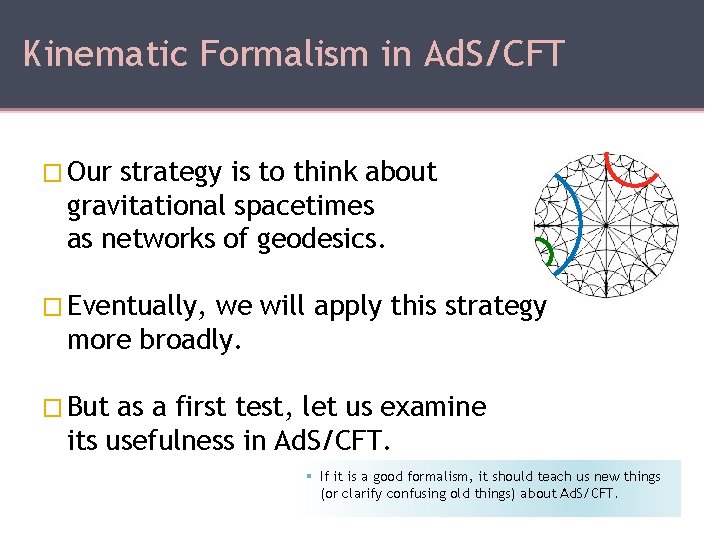
Kinematic Formalism in Ad. S/CFT � Our strategy is to think about gravitational spacetimes as networks of geodesics. � Eventually, we will apply this strategy more broadly. � But as a first test, let us examine its usefulness in Ad. S/CFT. If it is a good formalism, it should teach us new things (or clarify confusing old things) about Ad. S/CFT.
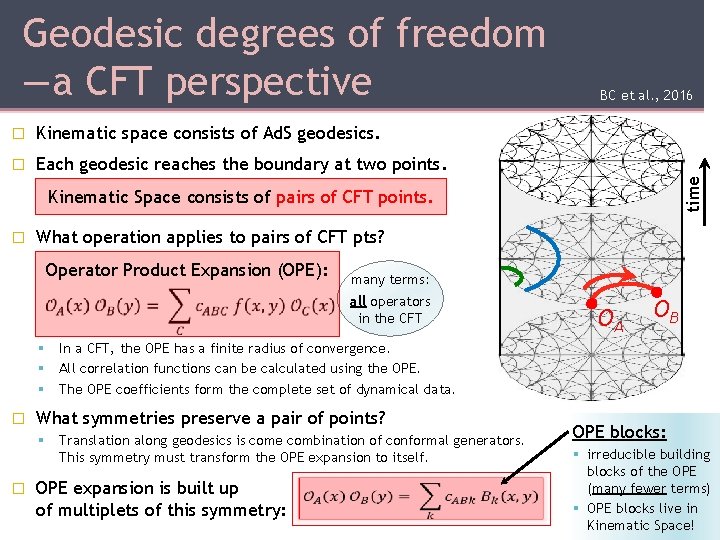
� Kinematic space consists of Ad. S geodesics. � Each geodesic reaches the boundary at two points. BC et al. , 2016 time Geodesic degrees of freedom —a CFT perspective Kinematic Space consists of pairs of CFT points. � What operation applies to pairs of CFT pts? Operator Product Expansion (OPE): � all operators in the CFT OA OB In a CFT, the OPE has a finite radius of convergence. All correlation functions can be calculated using the OPE. The OPE coefficients form the complete set of dynamical data. What symmetries preserve a pair of points? � many terms: Translation along geodesics is come combination of conformal generators. This symmetry must transform the OPE expansion to itself. OPE expansion is built up of multiplets of this symmetry: OPE blocks: irreducible building blocks of the OPE (many fewer terms) OPE blocks live in Kinematic Space!
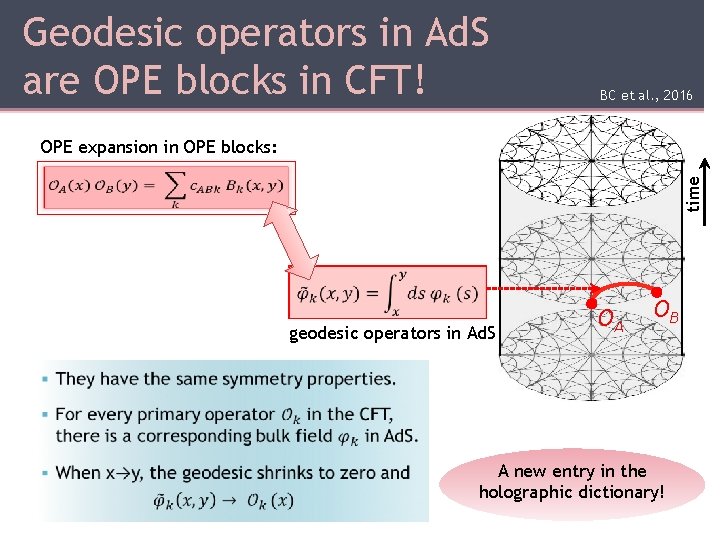
Geodesic operators in Ad. S are OPE blocks in CFT! BC et al. , 2016 OPE expansion in OPE blocks: time geodesic operators in Ad. S OA OB A new entry in the holographic dictionary!
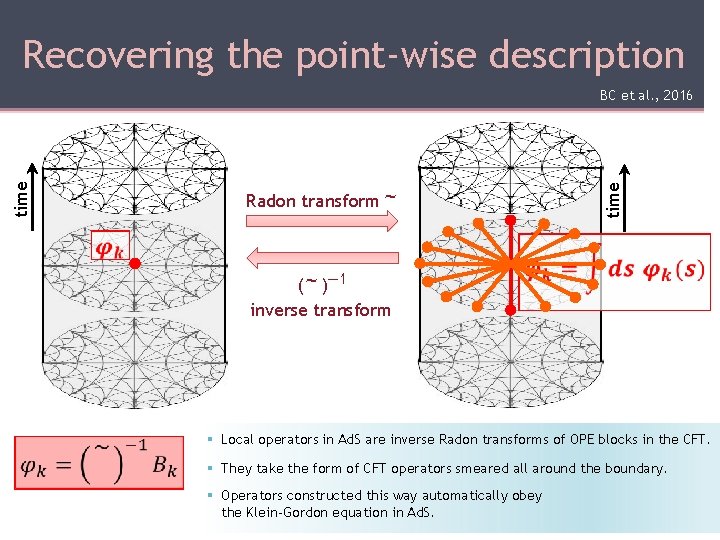
Recovering the point-wise description Radon transform ~ time BC et al. , 2016 ~ ( )— 1 inverse transform Local operators in Ad. S are inverse Radon transforms of OPE blocks in the CFT. They take the form of CFT operators smeared all around the boundary. Operators constructed this way automatically obey the Klein-Gordon equation in Ad. S.
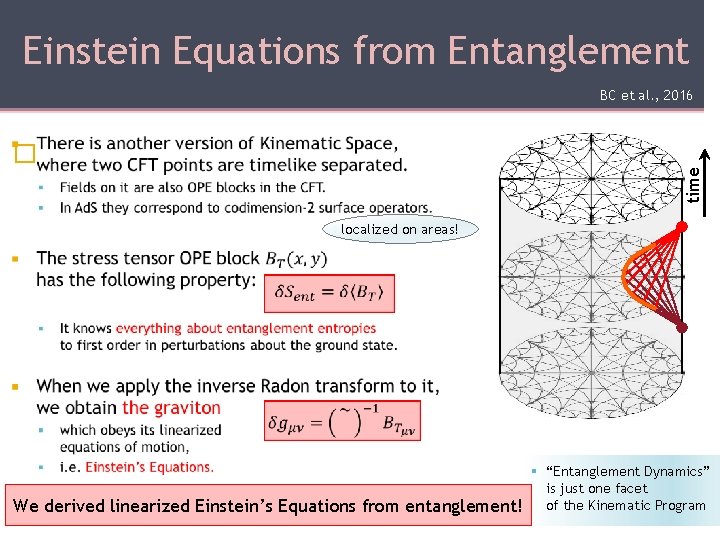
Einstein Equations from Entanglement BC et al. , 2016 time � localized on areas! “Entanglement Dynamics” We derived linearized Einstein’s Equations from entanglement! is just one facet of the Kinematic Program
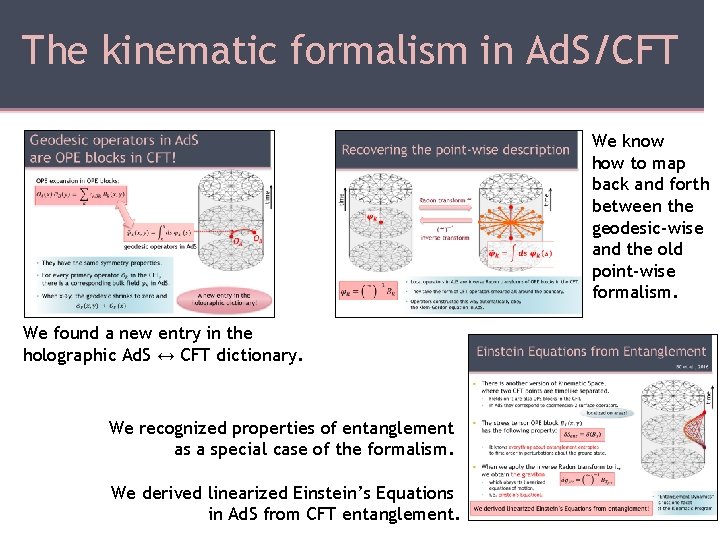
The kinematic formalism in Ad. S/CFT We know how to map back and forth between the geodesic-wise and the old point-wise formalism. We found a new entry in the holographic Ad. S ↔ CFT dictionary. We recognized properties of entanglement as a special case of the formalism. We derived linearized Einstein’s Equations in Ad. S from CFT entanglement.
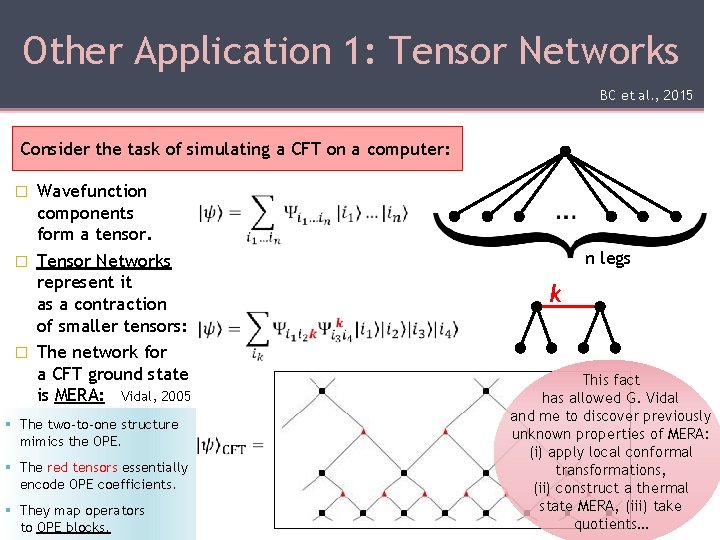
Other Application 1: Tensor Networks BC et al. , 2015 Consider the task of simulating a CFT on a computer: Wavefunction components form a tensor. � Tensor Networks represent it as a contraction of smaller tensors: � The network for a CFT ground state is MERA: Vidal, 2005 � The two-to-one structure mimics the OPE. The red tensors essentially encode OPE coefficients. They map operators to OPE blocks. n legs k This fact has allowed G. Vidal and me to discover previously unknown properties of MERA: (i) apply local conformal transformations, (ii) construct a thermal state MERA, (iii) take quotients…
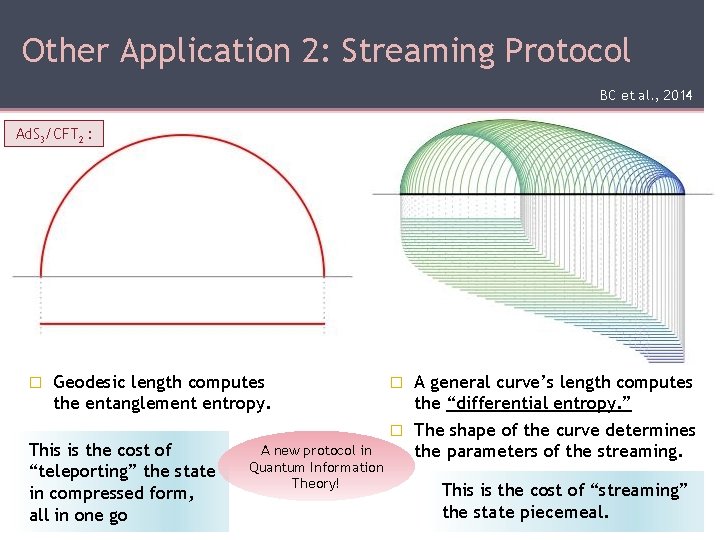
Other Application 2: Streaming Protocol BC et al. , 2014 Ad. S 3/CFT 2 : � Geodesic length computes the entanglement entropy. This is the cost of “teleporting” the state in compressed form, all in one go A new protocol in Quantum Information Theory! A general curve’s length computes the “differential entropy. ” � The shape of the curve determines the parameters of the streaming. � This is the cost of “streaming” the state piecemeal.
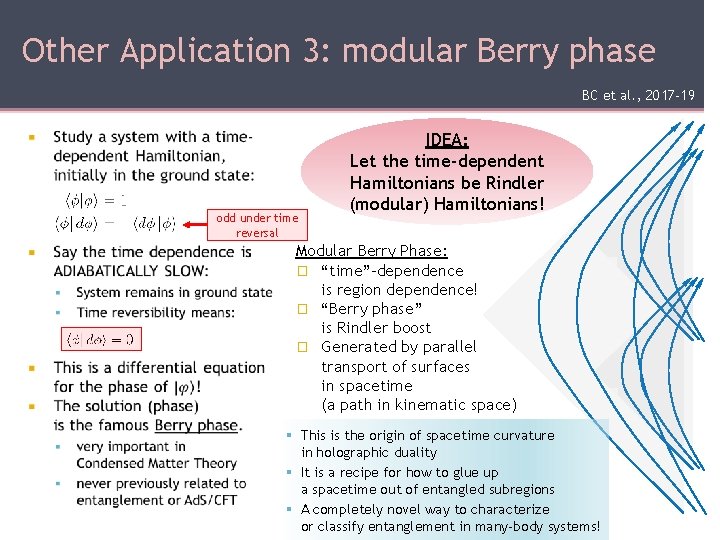
Other Application 3: modular Berry phase BC et al. , 2017 -19 odd under time reversal IDEA: Let the time-dependent Hamiltonians be Rindler (modular) Hamiltonians! Modular Berry Phase: � “time”-dependence is region dependence! � “Berry phase” is Rindler boost � Generated by parallel transport of surfaces in spacetime (a path in kinematic space) This is the origin of spacetime curvature in holographic duality It is a recipe for how to glue up a spacetime out of entangled subregions A completely novel way to characterize or classify entanglement in many-body systems!
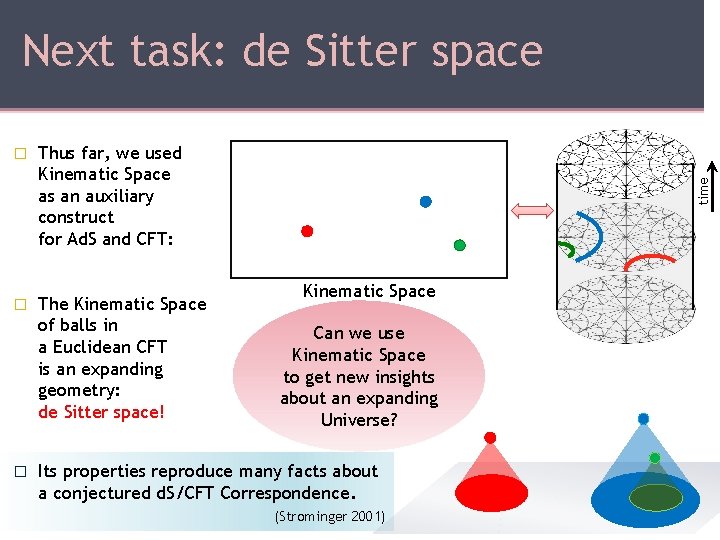
� Thus far, we used Kinematic Space as an auxiliary construct for Ad. S and CFT: � The Kinematic Space of balls in a Euclidean CFT is an expanding geometry: de Sitter space! � time Next task: de Sitter space Kinematic Space Can we use Kinematic Space to get new insights about an expanding Universe? Its properties reproduce many facts about a conjectured d. S/CFT Correspondence. (Strominger 2001)
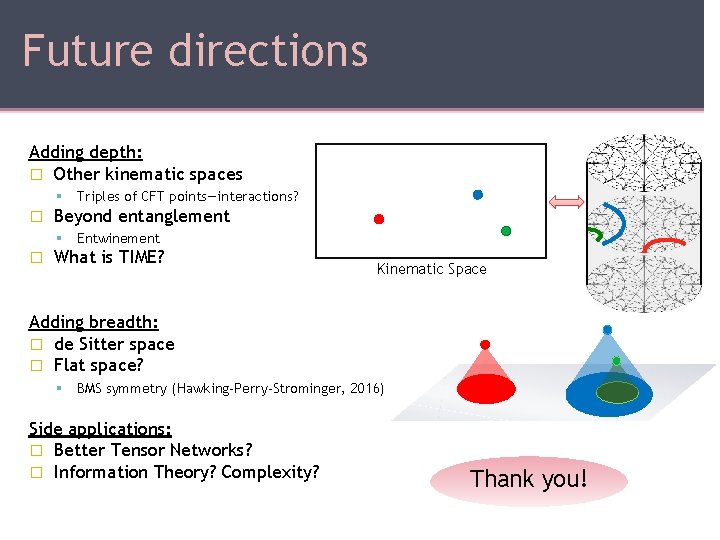
Future directions Adding depth: � Other kinematic spaces � Beyond entanglement � Triples of CFT points—interactions? Entwinement What is TIME? Kinematic Space Adding breadth: � de Sitter space � Flat space? BMS symmetry (Hawking-Perry-Strominger, 2016) Side applications: � Better Tensor Networks? � Information Theory? Complexity? Thank you!
- Slides: 31