
A History of the Ma ori Language By
A History of the Ma ori Language By Christina Hilton & Jolie Gracy
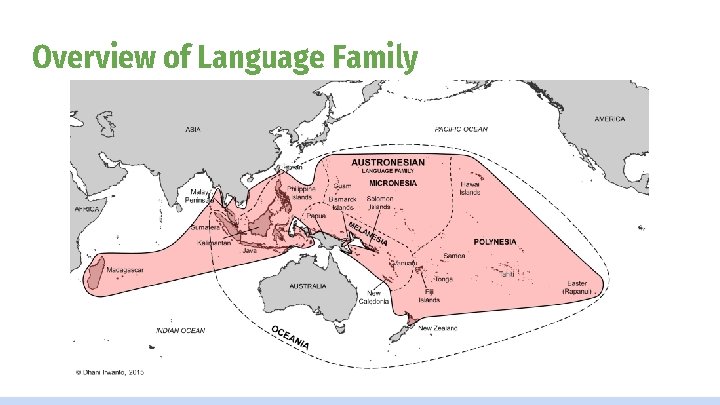
Overview of Language Family
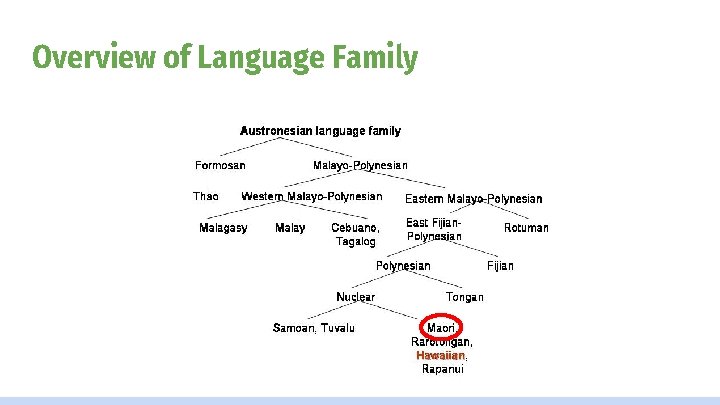
Overview of Language Family
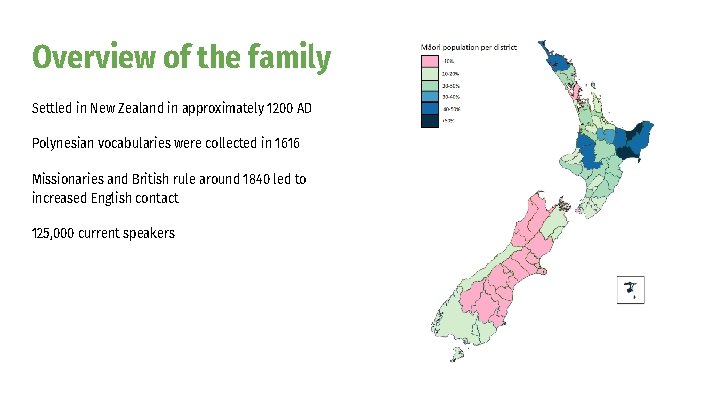
Overview of the family Settled in New Zealand in approximately 1200 AD Polynesian vocabularies were collected in 1616 Missionaries and British rule around 1840 led to increased English contact 125, 000 current speakers
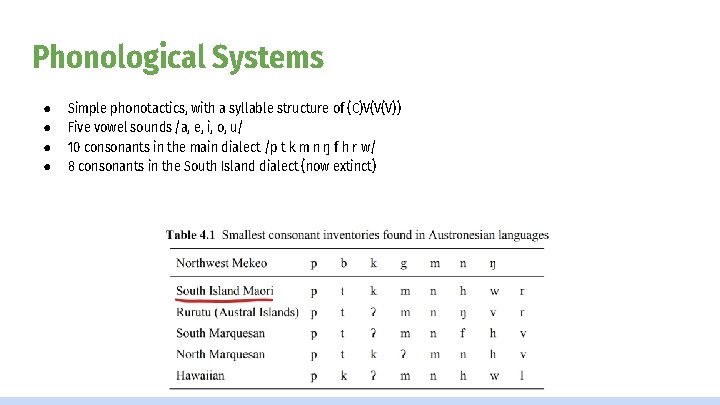
Phonological Systems ● ● Simple phonotactics, with a syllable structure of (C)V(V(V)) Five vowel sounds /a, e, i, o, u/ 10 consonants in the main dialect /p t k m n ŋ f h r w/ 8 consonants in the South Island dialect (now extinct)
Sound Changes Semantic change was triggered by movement to a new environment (evident in naming of birds) Aspiration was introduced into the language through English contact, and young speakers aspirate the non-aspirated consonants /p, t, k/
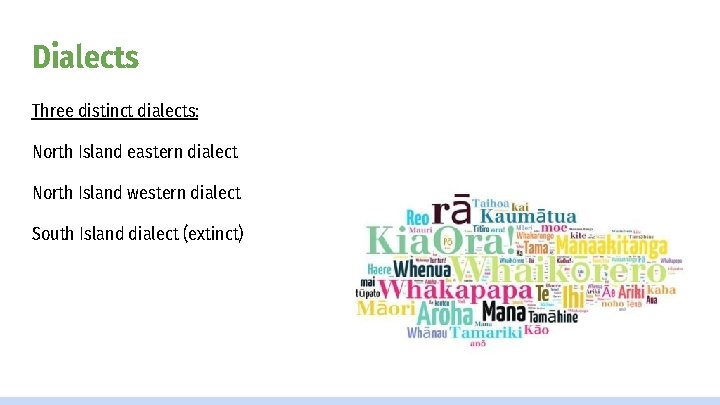
Dialects Three distinct dialects: North Island eastern dialect North Island western dialect South Island dialect (extinct)
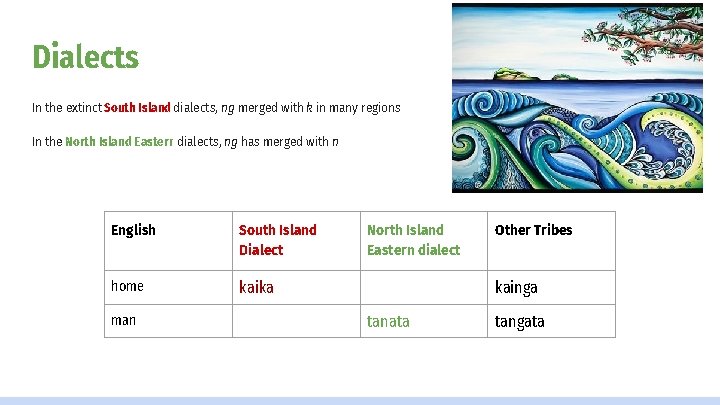
Dialects In the extinct South Island dialects, ng merged with k in many regions In the North Island Eastern dialects, ng has merged with n English South Island Dialect home kaika man North Island Eastern dialect Other Tribes kainga tanata tangata
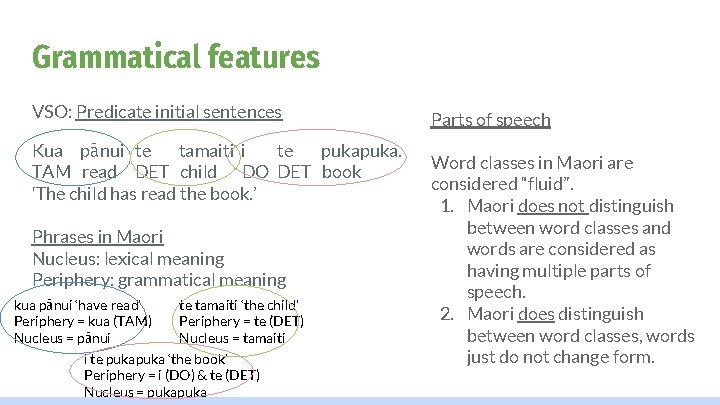
Grammatical features VSO: Predicate initial sentences Kua pānui te tamaiti i te puka. TAM read DET child DO DET book ‘The child has read the book. ’ Phrases in Maori Nucleus: lexical meaning Periphery: grammatical meaning kua pānui ‘have read’ te tamaiti ‘the child’ Periphery = kua (TAM) Periphery = te (DET) Nucleus = pānui Nucleus = tamaiti i te puka ‘the book’ Periphery = i (DO) & te (DET) Nucleus = puka Parts of speech Word classes in Maori are considered “fluid”. 1. Maori does not distinguish between word classes and words are considered as having multiple parts of speech. 2. Maori does distinguish between word classes, words just do not change form.
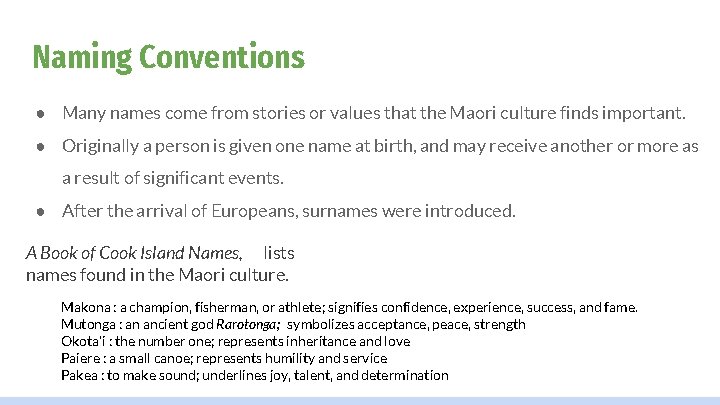
Naming Conventions ● Many names come from stories or values that the Maori culture finds important. ● Originally a person is given one name at birth, and may receive another or more as a result of significant events. ● After the arrival of Europeans, surnames were introduced. A Book of Cook Island Names, lists names found in the Maori culture. Makona : a champion, fisherman, or athlete; signifies confidence, experience, success, and fame. Mutonga : an ancient god Rarotonga; symbolizes acceptance, peace, strength Okota’i : the number one; represents inheritance and love Paiere : a small canoe; represents humility and service Pakea : to make sound; underlines joy, talent, and determination
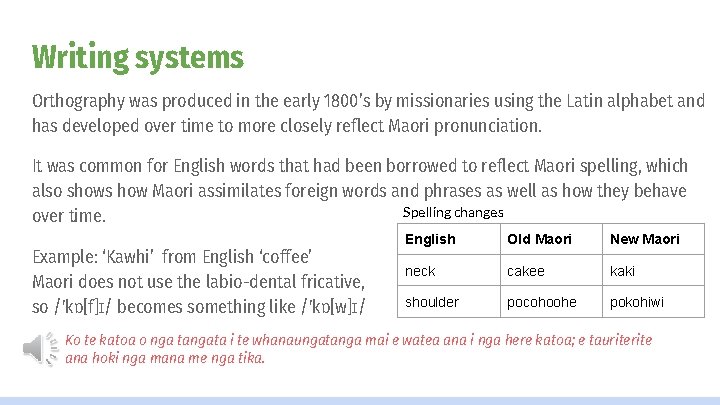
Writing systems Orthography was produced in the early 1800’s by missionaries using the Latin alphabet and has developed over time to more closely reflect Maori pronunciation. It was common for English words that had been borrowed to reflect Maori spelling, which also shows how Maori assimilates foreign words and phrases as well as how they behave Spelling changes over time. Example: ‘Kawhi’ from English ‘coffee’ Maori does not use the labio-dental fricative, so /'kɒ[f]ɪ/ becomes something like /'kɒ[w]ɪ/ English Old Maori New Maori neck cakee kaki shoulder pocohoohe pokohiwi Ko te katoa o nga tangata i te whanaungatanga mai e watea ana i nga here katoa; e taurite ana hoki nga mana me nga tika.
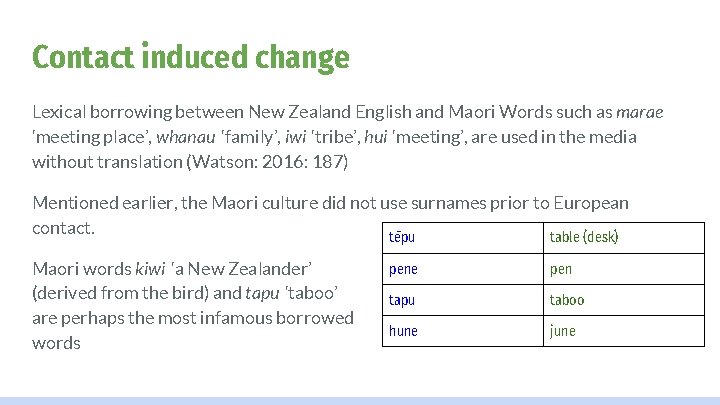
Contact induced change Lexical borrowing between New Zealand English and Maori Words such as marae ‘meeting place’, whanau ‘family’, iwi ‘tribe’, hui ‘meeting’, are used in the media without translation (Watson: 2016: 187) Mentioned earlier, the Maori culture did not use surnames prior to European contact. te pu table (desk) Maori words kiwi ‘a New Zealander’ (derived from the bird) and tapu ‘taboo’ are perhaps the most infamous borrowed words pene pen tapu taboo hune june
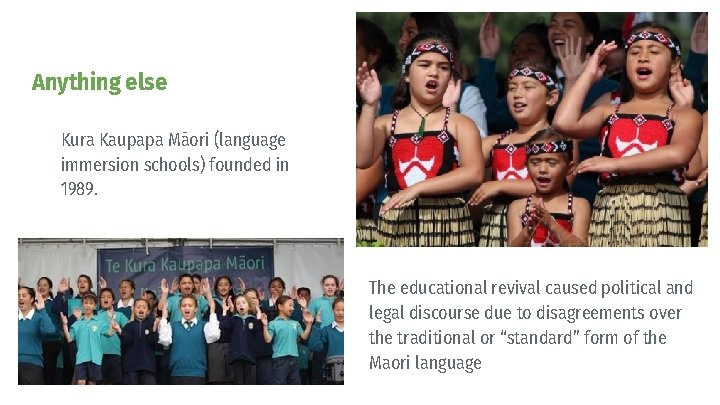
Anything else Kura Kaupapa Māori (language immersion schools) founded in 1989. The educational revival caused political and legal discourse due to disagreements over the traditional or “standard” form of the Maori language
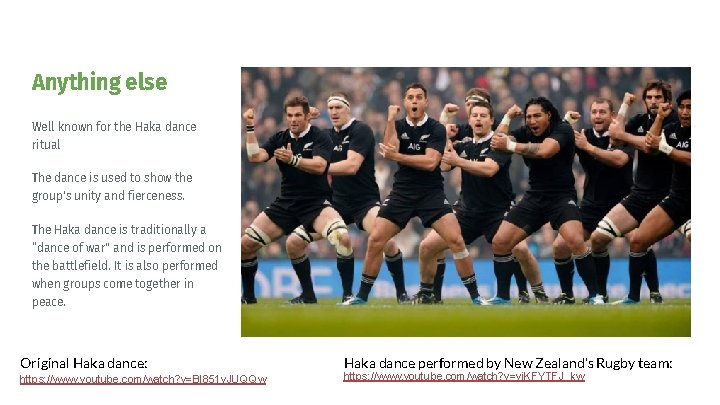
Anything else Well known for the Haka dance ritual The dance is used to show the group’s unity and fierceness. The Haka dance is traditionally a “dance of war” and is performed on the battlefield. It is also performed when groups come together in peace. Original Haka dance: https: //www. youtube. com/watch? v=BI 851 y. JUQQw Haka dance performed by New Zealand’s Rugby team: https: //www. youtube. com/watch? v=yi. KFYTFJ_kw
Sources Bauer, W. (2009). Language, 85(2), 473 -476. Retrieved April 7, 2020, from www. jstor. org/stable/40492881 Blust, R. A. 2013. The Austronesian languages. Revised Edition. Canberra, A. C. T. : Asia-Pacific Linguistics. Crowley, Terry, et al. “The Oceanic Languages. ” Google Books, Google, books. google. com. ph/books? id=Fh. Ousl. PWYGo. C&source=gbs_navlinks_s. Harlow, Ray. 2007. Maori: a linguistic introduction. Cambridge. Hughes, John F. (2004). Was there ever a “Māori English”? . Jonassen, J. (2003). A book of Cook Islands Maori names, ingoa. Suva, Fiji : Institute of Pacific Studies, USP. Lynch, John, Malcolm Ross, and Terry Crowley. 2011. The Oceanic languages. Abingdon, Oxon: Routledge. Maclagan, Margaret & Harlow, Ray & King, Jeanette & Keegan, Peter & Watson, Catherine. (2005). Acoustic Analysis of Maori: Historical Data. Mc. Lintock, A. H. “Dialectal Differences. ” Te Ara - the Encyclopedia of New Zealand. 1966. MAP: Historic expansion of Austronesian speakers. 2018. MAP: Historic expansion of Austronesian speakers. May 2. Smyth, Patrick. “Maori Pronunciation and the Evolution of Written Maori. ” New Zealand Electronic Text Collection, Whitcombe & Tombs LTD. , 2016, nzetc. victoria. ac. nz/tm/scholarly/tei-Smy. Maor-t 1 -body 1 -d 4. html. Yamada, Fumiko S. “MĀORI AS A PHRASE-BASED LANGUAGE. ” UNIVERSITY OF HAWAI‘I AT MĀNOA , 2014.
- Slides: 15