
A History of Knowledge 1 Oldest Knowledge What
- Slides: 65
A History of Knowledge 1. Oldest Knowledge What the Sumerians knew What the Babylonians knew What the Hittites knew What the Persians knew 2. What the Egyptians knew What the Chinese knew 3. What the Indians knew What the Tibetans knew 4. What the Greeks knew What the Phoenicians knew 5. What the Romans knew What the Barbarians knew What the Jews knew What the Christians knew What the Japanese knew What the Koreans knew 6. What the Muslims knew 7. What the Middle Ages knew 8. What the Renaissance knew 9. What the Industrial Age knew 10. What the Modern World knew Timelines 1
What the Jews knew Jesus: "I came into the world to bear witness to the truth" Pilate: "What is truth? " 2
Judaism 2500 BC: Canaanites live in te city-state of Jericho, a tributary of Egypt 1500 BC: a caravan trader, Abraham, leads Semitic nomads from Sumer to Canaan and then on to Egypt (Hebrews) 1400 BC: Canaanites found Urusalim (Jerusalem) 1300 BC: iron age in Palestine 1250 BC: Indo-European tribes (Philistines) move to Palestine (named after them) from the Aegean sea 1250 BC: the Hebrews move from Egypt to Palestine (Moses) 1230 BC: Hebrew leeader Joshua conquers part of Palestine 1125 BC: the Canaanites are definitely defeated by the Hebrews 1020 BC: the Hebrew king David defeats the Philistines and unifies Israel with capital in Jerusalem 3
Judaism 930 BC: David's son Solomon builds a temple in Jerusalem for the Jews 722 BC: Sargon II of Assyria conquers Israel and forcefully relocates Jews (Jewish diaspora) 600 BC: King Josiah of Jerusalem destroys idols of all gods except Yahweh 587 BC: the Babylonians conquers Judea, destroy Jerusalem and deport thousands of Jews to Babylonia (second Jewish diaspora) 550 BC: the Bible is composed 538 BC: Cyrus of Persia sacks Babylon and frees the Jews after 70 years of exile 515 BC: the Jews rebuild the temple of Jerusalem 332 BC: Palestine is invaded by Alexander the Great 4
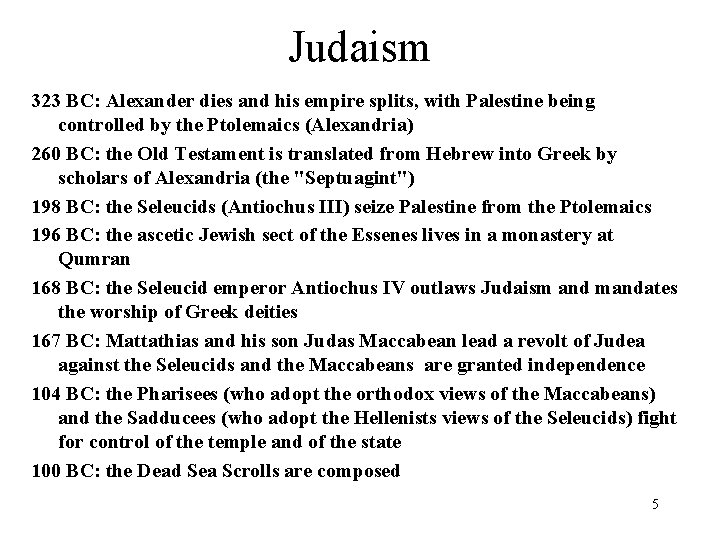
Judaism 323 BC: Alexander dies and his empire splits, with Palestine being controlled by the Ptolemaics (Alexandria) 260 BC: the Old Testament is translated from Hebrew into Greek by scholars of Alexandria (the "Septuagint") 198 BC: the Seleucids (Antiochus III) seize Palestine from the Ptolemaics 196 BC: the ascetic Jewish sect of the Essenes lives in a monastery at Qumran 168 BC: the Seleucid emperor Antiochus IV outlaws Judaism and mandates the worship of Greek deities 167 BC: Mattathias and his son Judas Maccabean lead a revolt of Judea against the Seleucids and the Maccabeans are granted independence 104 BC: the Pharisees (who adopt the orthodox views of the Maccabeans) and the Sadducees (who adopt the Hellenists views of the Seleucids) fight for control of the temple and of the state 100 BC: the Dead Sea Scrolls are composed 5
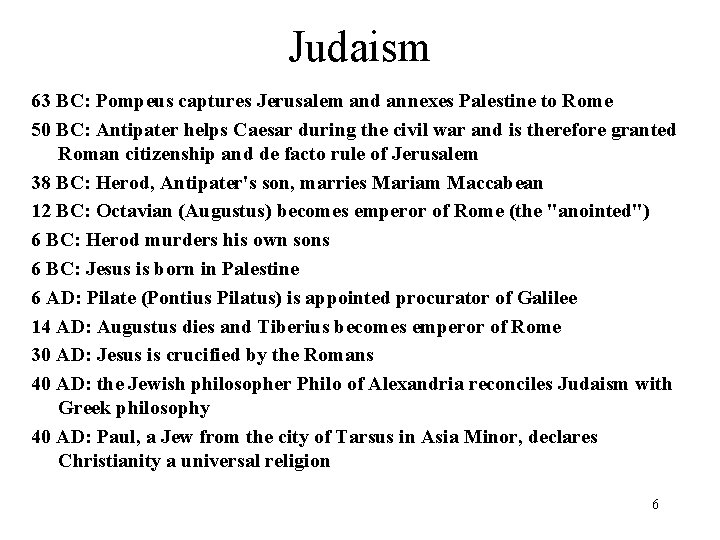
Judaism 63 BC: Pompeus captures Jerusalem and annexes Palestine to Rome 50 BC: Antipater helps Caesar during the civil war and is therefore granted Roman citizenship and de facto rule of Jerusalem 38 BC: Herod, Antipater's son, marries Mariam Maccabean 12 BC: Octavian (Augustus) becomes emperor of Rome (the "anointed") 6 BC: Herod murders his own sons 6 BC: Jesus is born in Palestine 6 AD: Pilate (Pontius Pilatus) is appointed procurator of Galilee 14 AD: Augustus dies and Tiberius becomes emperor of Rome 30 AD: Jesus is crucified by the Romans 40 AD: the Jewish philosopher Philo of Alexandria reconciles Judaism with Greek philosophy 40 AD: Paul, a Jew from the city of Tarsus in Asia Minor, declares Christianity a universal religion 6
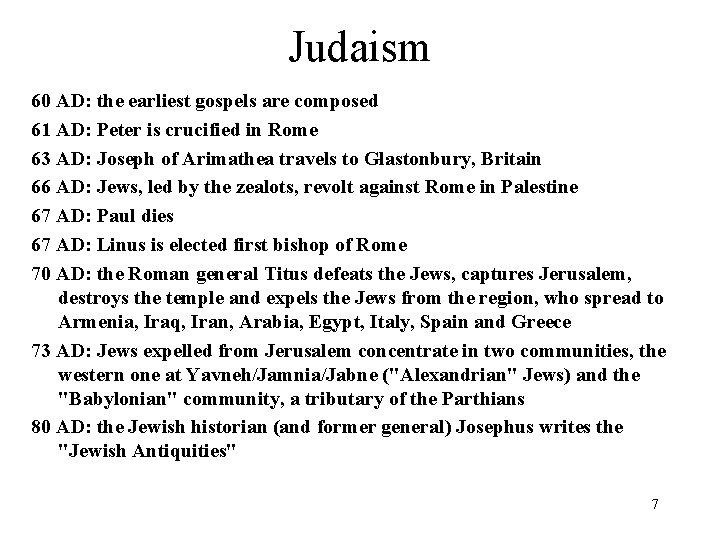
Judaism 60 AD: the earliest gospels are composed 61 AD: Peter is crucified in Rome 63 AD: Joseph of Arimathea travels to Glastonbury, Britain 66 AD: Jews, led by the zealots, revolt against Rome in Palestine 67 AD: Paul dies 67 AD: Linus is elected first bishop of Rome 70 AD: the Roman general Titus defeats the Jews, captures Jerusalem, destroys the temple and expels the Jews from the region, who spread to Armenia, Iraq, Iran, Arabia, Egypt, Italy, Spain and Greece 73 AD: Jews expelled from Jerusalem concentrate in two communities, the western one at Yavneh/Jamnia/Jabne ("Alexandrian" Jews) and the "Babylonian" community, a tributary of the Parthians 80 AD: the Jewish historian (and former general) Josephus writes the "Jewish Antiquities" 7
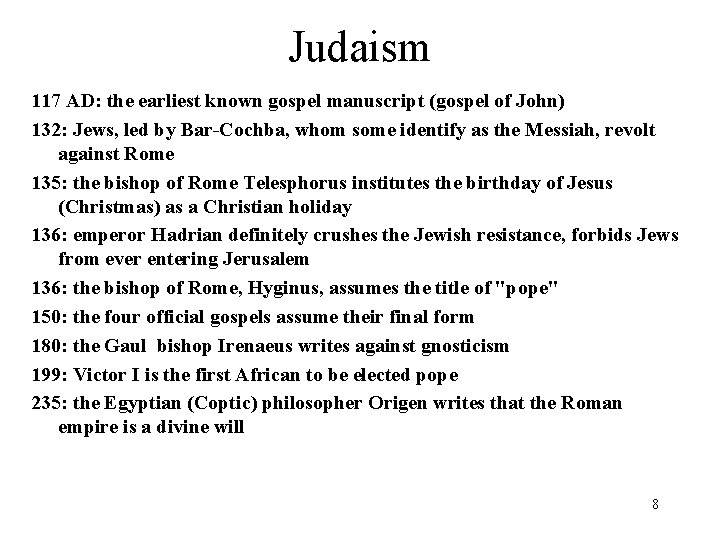
Judaism 117 AD: the earliest known gospel manuscript (gospel of John) 132: Jews, led by Bar-Cochba, whom some identify as the Messiah, revolt against Rome 135: the bishop of Rome Telesphorus institutes the birthday of Jesus (Christmas) as a Christian holiday 136: emperor Hadrian definitely crushes the Jewish resistance, forbids Jews from ever entering Jerusalem 136: the bishop of Rome, Hyginus, assumes the title of "pope" 150: the four official gospels assume their final form 180: the Gaul bishop Irenaeus writes against gnosticism 199: Victor I is the first African to be elected pope 235: the Egyptian (Coptic) philosopher Origen writes that the Roman empire is a divine will 8
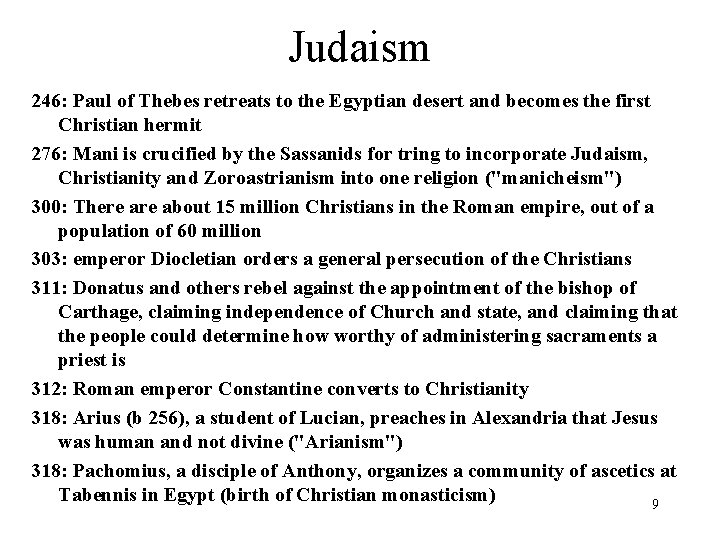
Judaism 246: Paul of Thebes retreats to the Egyptian desert and becomes the first Christian hermit 276: Mani is crucified by the Sassanids for tring to incorporate Judaism, Christianity and Zoroastrianism into one religion ("manicheism") 300: There about 15 million Christians in the Roman empire, out of a population of 60 million 303: emperor Diocletian orders a general persecution of the Christians 311: Donatus and others rebel against the appointment of the bishop of Carthage, claiming independence of Church and state, and claiming that the people could determine how worthy of administering sacraments a priest is 312: Roman emperor Constantine converts to Christianity 318: Arius (b 256), a student of Lucian, preaches in Alexandria that Jesus was human and not divine ("Arianism") 318: Pachomius, a disciple of Anthony, organizes a community of ascetics at Tabennis in Egypt (birth of Christian monasticism) 9
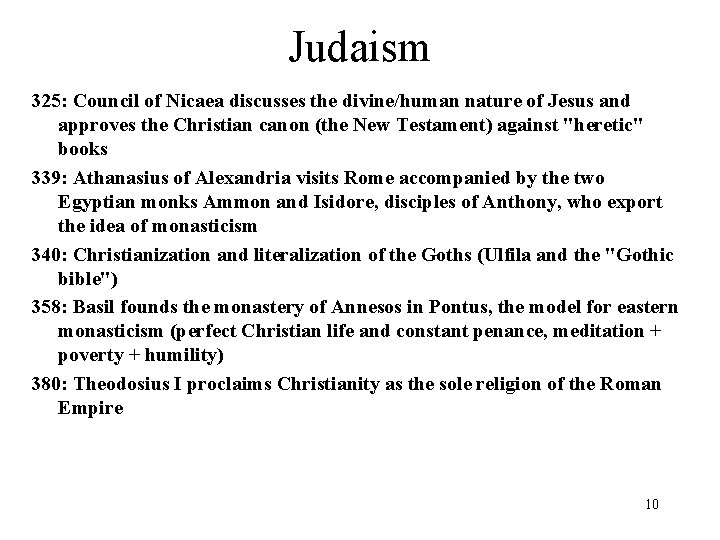
Judaism 325: Council of Nicaea discusses the divine/human nature of Jesus and approves the Christian canon (the New Testament) against "heretic" books 339: Athanasius of Alexandria visits Rome accompanied by the two Egyptian monks Ammon and Isidore, disciples of Anthony, who export the idea of monasticism 340: Christianization and literalization of the Goths (Ulfila and the "Gothic bible") 358: Basil founds the monastery of Annesos in Pontus, the model for eastern monasticism (perfect Christian life and constant penance, meditation + poverty + humility) 380: Theodosius I proclaims Christianity as the sole religion of the Roman Empire 10
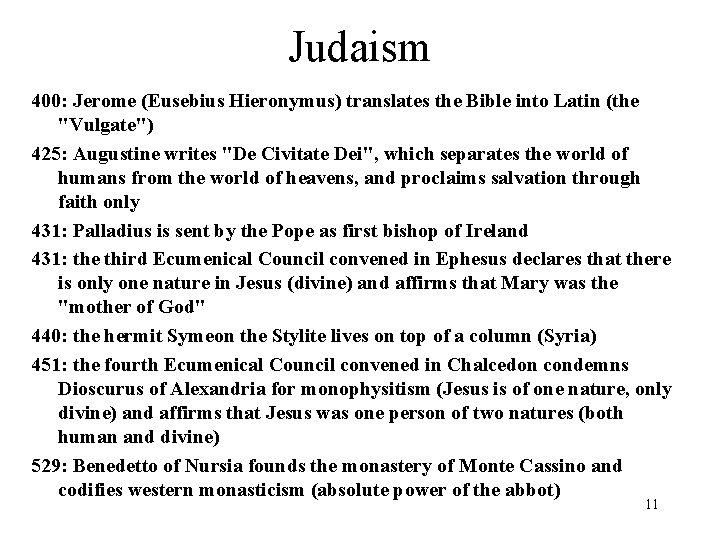
Judaism 400: Jerome (Eusebius Hieronymus) translates the Bible into Latin (the "Vulgate") 425: Augustine writes "De Civitate Dei", which separates the world of humans from the world of heavens, and proclaims salvation through faith only 431: Palladius is sent by the Pope as first bishop of Ireland 431: the third Ecumenical Council convened in Ephesus declares that there is only one nature in Jesus (divine) and affirms that Mary was the "mother of God" 440: the hermit Symeon the Stylite lives on top of a column (Syria) 451: the fourth Ecumenical Council convened in Chalcedon condemns Dioscurus of Alexandria for monophysitism (Jesus is of one nature, only divine) and affirms that Jesus was one person of two natures (both human and divine) 529: Benedetto of Nursia founds the monastery of Monte Cassino and codifies western monasticism (absolute power of the abbot) 11
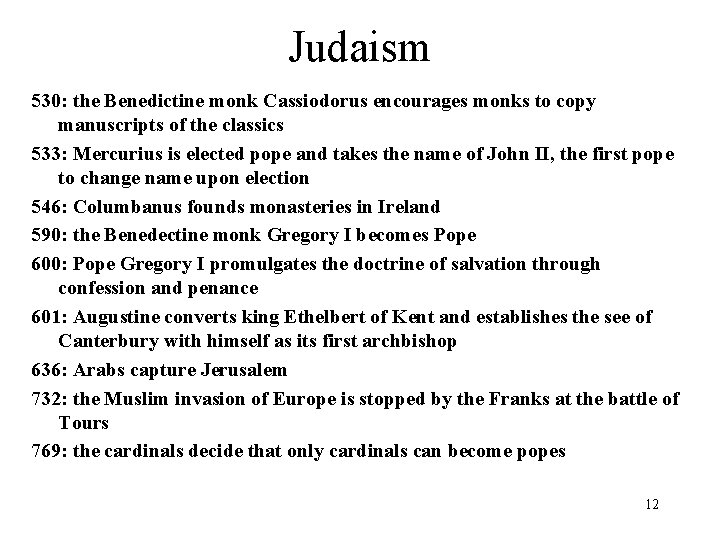
Judaism 530: the Benedictine monk Cassiodorus encourages monks to copy manuscripts of the classics 533: Mercurius is elected pope and takes the name of John II, the first pope to change name upon election 546: Columbanus founds monasteries in Ireland 590: the Benedectine monk Gregory I becomes Pope 600: Pope Gregory I promulgates the doctrine of salvation through confession and penance 601: Augustine converts king Ethelbert of Kent and establishes the see of Canterbury with himself as its first archbishop 636: Arabs capture Jerusalem 732: the Muslim invasion of Europe is stopped by the Franks at the battle of Tours 769: the cardinals decide that only cardinals can become popes 12
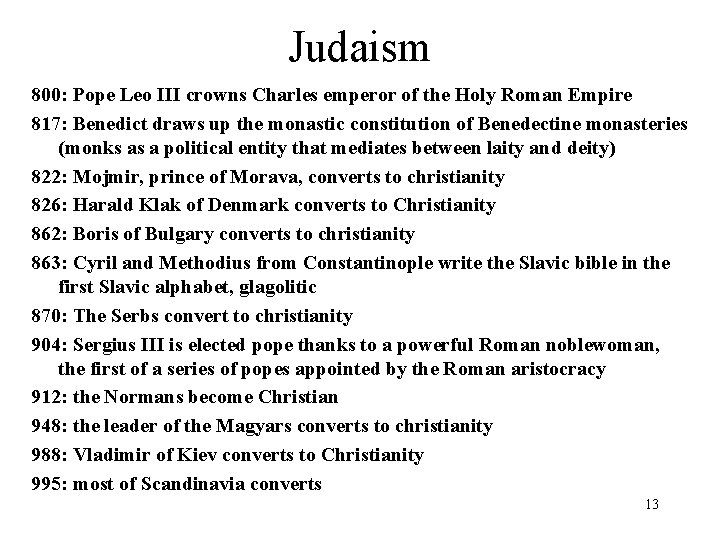
Judaism 800: Pope Leo III crowns Charles emperor of the Holy Roman Empire 817: Benedict draws up the monastic constitution of Benedectine monasteries (monks as a political entity that mediates between laity and deity) 822: Mojmir, prince of Morava, converts to christianity 826: Harald Klak of Denmark converts to Christianity 862: Boris of Bulgary converts to christianity 863: Cyril and Methodius from Constantinople write the Slavic bible in the first Slavic alphabet, glagolitic 870: The Serbs convert to christianity 904: Sergius III is elected pope thanks to a powerful Roman noblewoman, the first of a series of popes appointed by the Roman aristocracy 912: the Normans become Christian 948: the leader of the Magyars converts to christianity 988: Vladimir of Kiev converts to Christianity 995: most of Scandinavia converts 13
What the Jews Knew • Western Semites – Proto-Sinaitic language (1800 BC from Egypt) – Pastoral nomads in the Arabian desert – Habiru: nomad stranger 14
What the Jews Knew • El – God of the Jews – Nomadic God – God talks – God of punishment and wrath – Religion is obedience to God – God = Consciousness – Prophets – Indifference towards unbelievers • Moses (1, 275 BC): Egypt-born founder of Israel (exodus) and Judaism (Pentateuch) 15 • Yahweh (YHWH): faceless god, the only God
What the Jews Knew • Elohim (plural) “created the heavens and the earth” (Genesis 1: 1) – Remains of an early polytheism – Polydemonism of the ancient Semites: the world is surrounded, permeated, ruled by the Elohim, myriads of nameless inseparable supernatural beings – Aryan gods had names and were individuals, Semitic gods had no names and were a crowd – Ethiopians (Amlak), Phoenicians (Elim) • Sumerians (3000): An and his wife Ninhursag fathered all the gods who created the Sumer cities • Akkadians (2000): Eland his wife Asherah fathered the children-gods that created the cities of Mesopotamia • Babylonians (1700): The elohim created the world and 16 eventually Marduk became their supreme god
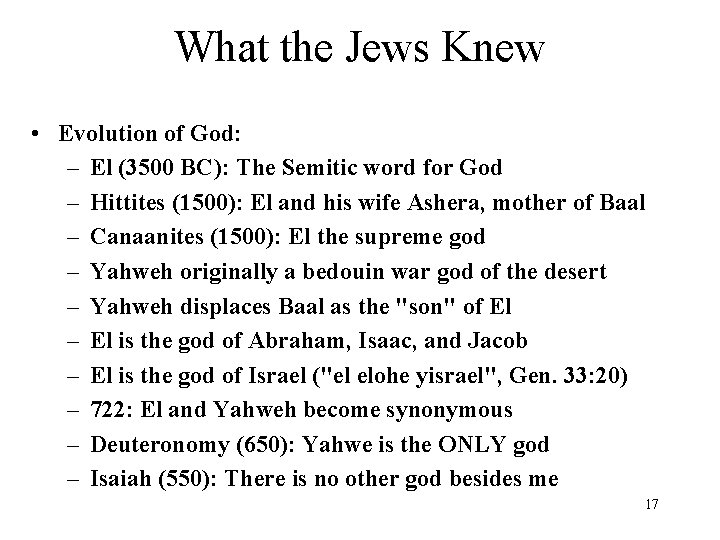
What the Jews Knew • Evolution of God: – El (3500 BC): The Semitic word for God – Hittites (1500): El and his wife Ashera, mother of Baal – Canaanites (1500): El the supreme god – Yahweh originally a bedouin war god of the desert – Yahweh displaces Baal as the "son" of El – El is the god of Abraham, Isaac, and Jacob – El is the god of Israel ("el elohe yisrael", Gen. 33: 20) – 722: El and Yahweh become synonymous – Deuteronomy (650): Yahwe is the ONLY god – Isaiah (550): There is no other god besides me 17
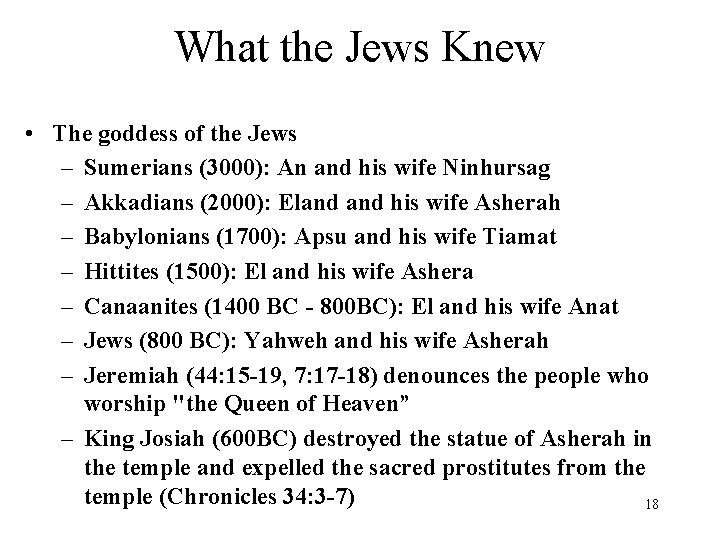
What the Jews Knew • The goddess of the Jews – Sumerians (3000): An and his wife Ninhursag – Akkadians (2000): Eland his wife Asherah – Babylonians (1700): Apsu and his wife Tiamat – Hittites (1500): El and his wife Ashera – Canaanites (1400 BC - 800 BC): El and his wife Anat – Jews (800 BC): Yahweh and his wife Asherah – Jeremiah (44: 15 -19, 7: 17 -18) denounces the people who worship "the Queen of Heaven” – King Josiah (600 BC) destroyed the statue of Asherah in the temple and expelled the sacred prostitutes from the temple (Chronicles 34: 3 -7) 18
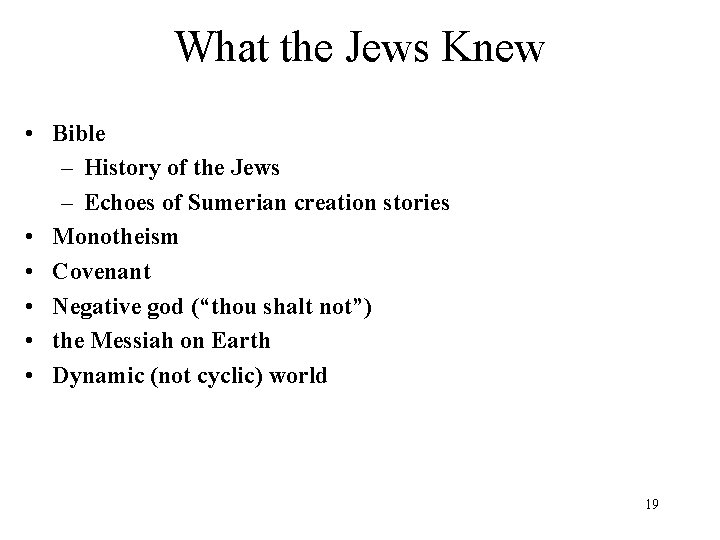
What the Jews Knew • Bible – History of the Jews – Echoes of Sumerian creation stories • Monotheism • Covenant • Negative god (“thou shalt not”) • the Messiah on Earth • Dynamic (not cyclic) world 19
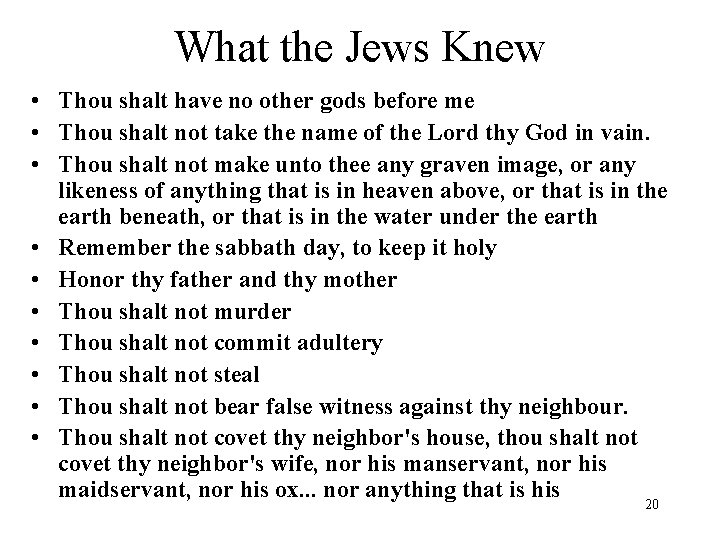
What the Jews Knew • Thou shalt have no other gods before me • Thou shalt not take the name of the Lord thy God in vain. • Thou shalt not make unto thee any graven image, or any likeness of anything that is in heaven above, or that is in the earth beneath, or that is in the water under the earth • Remember the sabbath day, to keep it holy • Honor thy father and thy mother • Thou shalt not murder • Thou shalt not commit adultery • Thou shalt not steal • Thou shalt not bear false witness against thy neighbour. • Thou shalt not covet thy neighbor's house, thou shalt not covet thy neighbor's wife, nor his manservant, nor his maidservant, nor his ox. . . nor anything that is his 20
What the Jews Knew • Hebrew Bible (Old Testament) – Pentateuch – The Prophets – Psalms, Proverbs, etc • Pentateuch – The first five books of the Hebrew Bible (Torah): Genesis, Exodus, Leviticus, Numbers, Deuteronomy – Traditionally attributed to Moses • a Yahwist narrative (950 BC) • an Elohist source (850 BC) • Deuteronomy (650 BC) • a Priestly document (500 BC) 21
What the Jews Knew • Apocalyptic literature (500 BC - 200 BC) – An apocalypse is a revelation of future events – Dream-like vision – Symbolic imagery – Historical view of the era – The powers of evil are attacking God – God shall triumph and a new age will begin – Within the Bible: Revelation, Daniel – Outside the Bible: Enoch, The War of the Sons of Light and the Sons of Darkness, The Apocalypse of Moses, etc 22
What the Jews Knew • The problem of suffering: – Why do sinful Gentiles prosper and conquer the world, while pious Jews languish in captivity? – The Jews will be rewarded in the kingdom that is coming – The Messiah will come • The problem of evil: – Why does evil exist if God is omnipotent? – Because we disobeyed him 23
Jesus • Jesus was born in the Roman Empire during the rule of Augustus, the first emperor • Jesus died under emperor Tiberius. 24
Christianity • The Christianity that we know today is the dogma that the Roman empire forced on all its provinces • Rome was not the place where Christianity had been born and was not the cultural center of the world. • Christianity first spread in Palestine and Syria, then east to Armenia (the first country to convert) and to Greece, that was the cultural center of the empire. • When Christianity became the official religion of the Roman Empire, Christianity was "relocated" from Palestine to Rome • Rome decided to start counting with Peter (the first Christian martyr in Rome) and his descendants, the popes • Rome assembled the “New Testament” centuries after Jesus (325) 25
Christianity • The four official gospels were written in Greece in Greek after the death of Jesus. • Mark, Matthew and Luke (70 -90 AD) derive from a preexisting text, called "Q", that tells the legendary story of Jesus • John (120 AD) is a reinterpretation of Jesus’ ideas in terms of Platonic philosophy (“in the beginning was the word…”) • All four official gospels were written after Paul wrote his letters. Paul's letters are the oldest Christian documents. 26
Christianity • Papias of Hierapolis in 110 talks of the gospel of St Matthew as a collections of oracles, not of miracles. • Clement of Alexandria admits that two versions of Mark's gospel existed but one was being suppressed because it contained two passages that should not be viewed by average Christians • Justin Martyr (150) does not mention a New Testament, does not mention Mark, Matthew, Luke or John: he mentions the "memoirs" of the apostles 27
Christianity • Many Christian texts were banned because they place the blame on the Romans (apocryphal) • "Nag Hammadi library" (the "Gnostic Gospels”) • “Dead Sea Scrolls “ • The gospel of Judas Thomas • The gospel of the Hebrews • Jewish historian Josephus (37 -96 AD) • Irenaeus (125 to 202) • Eusebius (Constantine’s biographer) 28
Christianity • James – The head of early Christianity, who remained in Palestine – Brother of Jesus – The leader of the early Christians in Palestine – Paul treats James like the leader – James was more interested in rebelling against the Romans than in the kingdom of heaven – James was a "purist" who did not tolerate the Greek/Roman contamination of Jewish religion – James' ideology of faith and goodness ("believe and perform good actions") 29
Christianity • James – Martyrdom is not inherent in Paul's preaching, it is in James' ideology – Original Christianity perished in the Roman persecutions of the "disposyni" (Jesus' heirs in Palestine) – Stoned to death in 63 – An inscription in stone, found in 2002 near Jerusalem and written in Aramaic, with the words "James, son of Joseph, brother of Jesus", is the oldest known reference to Jesus 30
Christianity • Paul (Saul) – The Roman dogma (Christianity as we know it today) is based on Paul's understanding of Jesus' message – Paul was not one of the twelve and admits that he never met Jesus – Paul was a literate scholar, not an illiterate fisherman (like the apostles) – Paul was a Roman citizen and proud of it – Paul, unlike James, wanted Christianity for both Jews and non-Jews – Paul's letters date from about the year 50, while the 31 earliest gospel is from 60 -70
Christianity • Paul – Paul's authentic letters talk of allegories (Galatians, 4/24) and symbols (Corinthians 10/6) as if to warn against a literal interpretation of the old testament – Paul’s philosophy is similar to the Platonism preached by Philo of Alexandria (a contemporary of Jesus) – Paul interprets Jesus’ religion as a religion for everybody, not just the Jews – God of love (“thou shall”) instead of the negative god of Judaism (“thou shall not”) – Goodness is inside the human soul, not in the covenant 32
Christianity • Paul – Paul found joy in the suffering – Acceptance, not rebellion – No need for circumcision 33
Christianity • The historical Jesus – There is no record of Pontius Pilate trying and executing a man named Jesus. – Only two Roman writers of Jesus' time mention Christians (Pliny and Svetonius) but they don't mention Jesus. – The first Roman to mention Jesus is Tacitus, but almost a century after the death of Jesus. – Paul admits he never met Jesus, and his letters contain almost no reference at all to Jesus' life. 34
Christianity • Mithraism – Mithras the son of the sun – Mithras sent to the earth to rescue humankind – Mithras was born of a virgin on December 25 in a cave – Mithras sacrificed himself – On the last day Mithras had a supper with twelve of his followers – At that supper Mithras invited his followers to eat his body and drink his blood – He was buried in a tomb and after three days rose again. – Mithras' festival coincided with the Christian Easter. 35
Christianity • Osiris – Osiris was born on the 25 th of December – Osiris died on a friday and resurrected after spending three days in the underworld 36
Christianity • Dionysus – Dionysus was hailed as `The Saviour of Mankind' and `The Son of God’ – Dionysus was born on December 25 when Zeus the God visited Persephone, a mortal virgin – Announced by a star, Dionysus was born in a cowshed and visited by three Magis – Dionysus turns water into wine and raises people from the dead. – Dionysus is followed by twelve apostles – Dionysus resurrected after death 37
Christianity • Dionysus – The rituals in honor of Dionysus included a meal of bread and wine, symbolizing his body and blood. – An amulet of the 3 rd century has been found that depicts a crucified man but bears the inscription "Orpheus Bacchus” – Dionysus was worshipped during a three-day Spring festival 38
Christianity • Augustus – The first Roman emperor, "Augustus", had the title of "saviour of the human race” – The legend was that Augustus had been born nine months after his mother was "visited" by the god Apollo – The greatest Roman poet of all time, Virgil, had foretold in 40 BC that a king would be born of a virgin – Legend had it that, in the year of Augustus' birth, the Roman senate had ordered the murder of all other children. 39
Christianity • John the Baptist – John "initiated" Jesus – Jewish historian Josephus did not know Jesus but he knew well John the Baptist – John the Baptist created a large movement that came to threaten Herod Antipas 40
Christianity • Jewish nationalism – The Jews of Palestine never accepted the rule of Rome. – Jewish prophets were sure that a Jewish kingdom, created by a messiah imbued with divine powers, was coming – After the Romans destroy Jerusalem, the"gnostic" attitude is born: Jesus not as the messiah, but as a message of knowledge, and the promised kingdom moved to the heavens. 41
Christianity • Herod – Married the virgin princess Mary, last of the Maccabeans – Mary committed adultery with Herod's brother Joseph while Herod was in Rome (29 BC) – Herod executed Mary and his own sons (they had Maccabean blood. ) 42
Christianity • Moses – – – Survives slaughter of the innocents Raised by a virgin Stepson of the daughter of the king Performs miracles Leads Jews to the promised kingdom 43
Christianity • The Essenes – The Dead Sea Scrolls – The Essenes are not mentioned in the New Testament – Baptism – Cosmic battle between angels and demons, God and Satan – The forces of evil rule the world – The war in Heaven is also taking place on Earth – Messianic yearning – Monastic life – Armed rebellion against the Romans 44
Christianity • Nag Hammadi – The "twin brother of Jesus" – Buddhist-style cryptic sentences • “The kingdom of Heaven is inside you, and it is outside you” • “The kingdom of Heaven has already come, but you do not recognize it” 45
Christianity • (John 18: 3438) • Jesus: "I came into the world to bear witness to the truth" • Pilate: "What is truth? " 46
What the Christians Knew • Jesus vs Moses • God of love (New Testament) vs God of wrath (Old Testament) • Positive god vs Negative god (“thou shalt not”) Omnipotent and omniscient God • Miracles and Parables vs Prophecies and Histories • Eternal damnation for unbelievers (as opposed to the Judaistic indifference for unbelievers) • Nature is God’s love and Religion is love of God • Self-sacrifice vs Human sacrifices • Charity instead of gifts to the gods • Hermits (ascetism) and monks (piety) 47
What the Christians Knew • The Sermon of The Mount (New laws and old laws) – It was said: "an eye for eye, and a tooth for a tooth", but I say unto you, if anyone strikes you on your right cheek, turn the other also, and if anyone wants to take your coat, give your cloak as well. . . – It was said, "you shall love your neighbor and hate your enemy", but I say unto you, love your enemies, bless them that curse you". . . – You have heard that it was said, "You shall love your neighbor and hate your enemy. ” But I say to you, love your enemies and pray for those who persecute you – (Matthew 5 -6 -7) 48
What the Christians Knew • Heaven • Devil and Hell • Resurrection of the spirit, and life in the otherworld (immortality) • Equality and universality: “there is neither Jew nor Greek… neither male nor female for you are all one in Jesus” (Gal 3: 28) • Appealing for slaves • Church • Problem of evil: – God gave humans free will and evil is due to human's misuse of free will – Humans can do something that God cannot do 49
What the Romans Knew • Platonism: Immortal soul vs mortal body • Philo Judaeus (30 AD) – Unified Platonic and Stoic philosophy and Judaism – Allegorical interpretation of the Jewish scriptures – God as a being without attributes, the ultimate knowledge and goodness – An intermediate world of ideas (Logos) acts between God and the world – These intermediate beings or ideas (Logos) are humandivine beings – Souls share in Logos the divine quaity of God – Souls are immortal because of their divine nature 50 – Paradise is oneness of the soul with God
What the Romans Knew • Origines (220 AD) – The soul pre-exists the body – Nous vs Soul – Synthesis of Christianity and Platonism • Plotinus (250 AD): neo-platonism – The One, the Nous (mind) and the Soul – The Otherworld as the world of ideas – Mystical union with god through Nous 51
What the Christians Knew • Augustine (425) – Two cities (what belongs to Caesar and what belongs to God) – The City of God is a mystical, inner brotherhood – The City of God”is” the church – At the end of history there will be only the City of God – The defeat of Rome (the earthly City) heralds the coming of the heavenly City of God – Fusion of Christian mysticism and Roman legalism 52
What the Christians Knew • Augustine – Linear progression of time (instead of cycles) – History is not cyclic (Jesus died only once) – Second coming of Jesus as end of history – What is time – Primacy of the present (memory is present of past things, expectation is present of future things) – Time is subjective (is in the mind) 53
What the Christians Knew • Augustine – God created matter (not just shaped it) – God created time (there is no time before the creation) – Free will and divine omnipotence (humans are responsible for their sins but not for their salvation) – All humans are sinners (sin is inherited) – Salvation via faith alone – Sin will be punished in the afterlife 54
What the Christians Knew • Augustine – The Christian church is universal (“catholic”) not limited to the pious – The church is the instrument of the Holy Spirit to reform the world (implication: missionary work, especially among the Barbarians) – Sinners and saints will be separated only at the end of history 55
What the Christians Knew • Augustine – Problem of evil • Evil has not been created by God • Evil does not exist • Evil is the absence of good, therefore it is "less", not "more", than God • Evil (lesser degrees of good) emerged with freewilling creatures • We cannot comprehend why God invented such creatures and thus Evil • What appears to us mortals as evil is good in the context of eternity • From God's perspective, evil is good 56
What the Christians Knew • The Christian paradigm – God dwells in Heaven (Paradise) – God is omnipotent, omniscient, infinitely good – The eternal destiny of a human is predetermined by God's decree (predestination) – Humans have free will to act as they please but their final destiny has already been determined – Heresy: you are responsible for your salvation or damnation (no predestination) 57
What the Christians Knew • The Christian paradigm – God is not only omnipotent, God is also Love (divine grace) – The beauty of Nature reflects the Love of God and the beauty of the Heaven – God created humans to live in a new paradise – Humans used free will to disobey God (Adam’s original sin) and are now condemned to Hell – Humans cannot change their destiny – Humans can be saved only by divine grace – The coming of Jesus was a product of his Love – Salvation has been secured for humans by Jesus – Jesus: human, divine, both human and divine? – Trinity: one God in three persons (Father, Son, Holy Spirit) 58
What the Christians Knew • The Christian paradigm – Jesus' human sacrifice (crucifixion and resurrection) reconciled humans to God – Salvation is obtained by faith in Jesus alone (baptism, prayers) – Humans have free will whether to cooperate with divine grace (repent, faith) or not – The souls of the ones who repent are admitted after death into Paradise – God's intention is to grant everybody an everlasting life – The end of the world is coming – Universal judgement, resurrection of all the dead – The imminence of the kingdom of God – The need for immediate repentance 59
What the Christians Knew • The Christian paradigm – "It is easier for a camel to go through a needle's eye, than for a rich man to enter into the kingdom of God" (Luke 18: 25; Matt. 19: 16 -30; Mark 10: 17 -31) 60
What the Christians Knew • The Christian paradigm – Hell • Hell is the place of punishment for Satan, the fallen angels and humans who die unrepentant of the original sin • The Devil hijacked humans • Jesus fought the Devil • Jesus' crucifixion was the defeat of the Devil 61
What the Christians Knew • The Christian paradigm – Satan • Ancient Judaism: creator of divisions, deceiver and accuser (lower case "satan", or "stn"), division within Israel, internal Jewish conflict • Later Judaism: adversary of God who tried to usurp God (Satan) • Revelation 12: 7 -9 (96 AD): a fallen angel ("I beheld Satan as lightning fall from heaven", Luke 10: 18). • Paul: the enemy within, demonizing pagans and heretics • Persia: Ahura-Mazda/Ahriman 62 • Manicheism
What the Christians Knew • Pseudo-Dionysius (500) – Knowledge of God through positive and negative theology – Our knowledge of God is that we cannot comprehend it – One rises to high levels of divine contemplation by defining God by what it is not • Boethius (524) – Happiness is communion with God (stoicism) • Apocalyptic faith 63
What the Christians Knew • Christian bureaucracy modeled after Roman bureaucracy – Pope = Emperor – Cardinals = Senate – Archbishops = Governors – Priests = Bureaucrats 64
Summary • • • Evolution of the Semitic god Linear progression of time Christian god of love Problem of evil Fusion with Plato Fusion with Aristotle 65