
A History and Overview of the OQ Rule


- Slides: 44
A History and Overview of the OQ Rule Tom Meek, Compliance Director
Agenda o History of the Operator Qualification Rule – The OQ Rule o Overview of the Current OQ Rule o Future of the OQ Rule © 2017 Veriforce, LLC. All rights reserved. 2
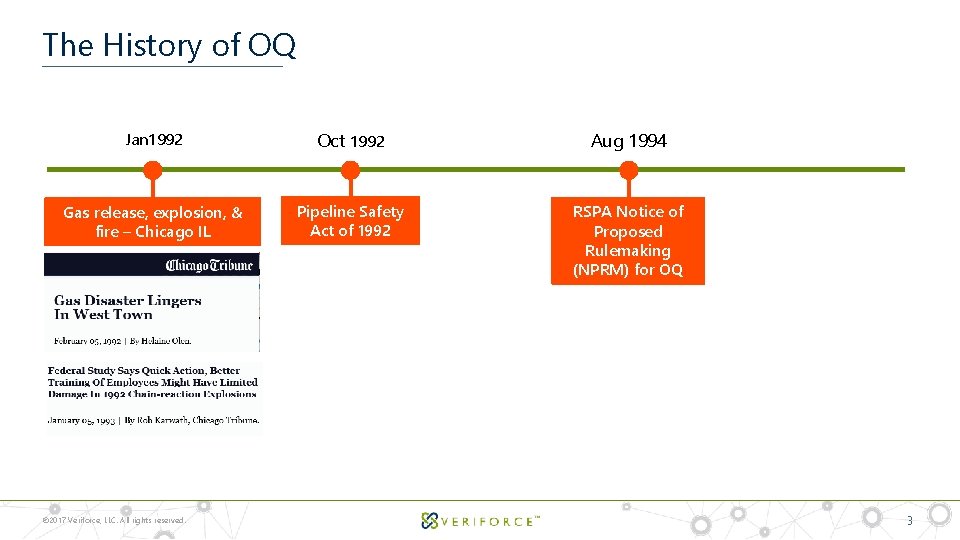
The History of OQ Jan 1992 Oct 1992 Aug 1994 Gas release, explosion, & fire – Chicago IL Pipeline Safety Act of 1992 RSPA Notice of Proposed Rulemaking (NPRM) for OQ © 2017 Veriforce, LLC. All rights reserved. 3
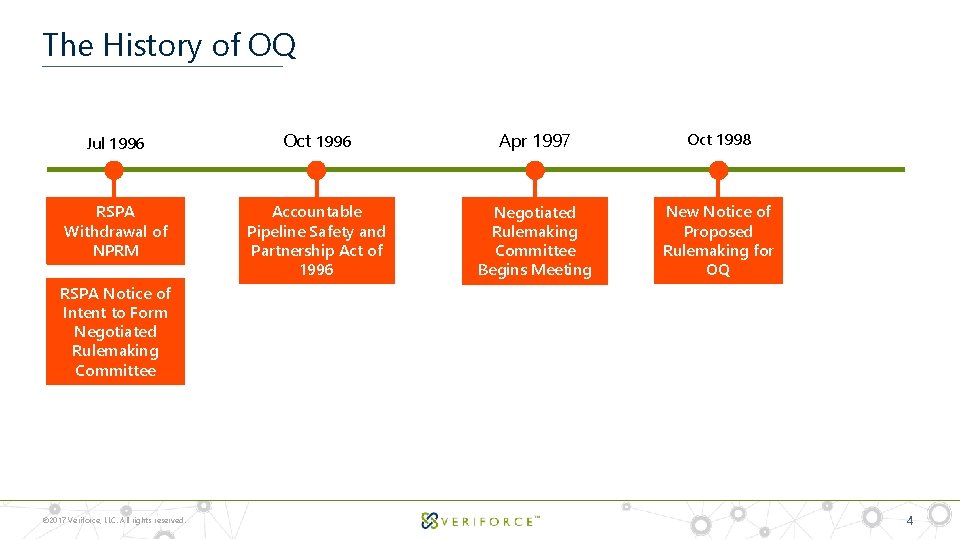
The History of OQ Jul 1996 Oct 1996 Apr 1997 Oct 1998 RSPA Withdrawal of NPRM Accountable Pipeline Safety and Partnership Act of 1996 Negotiated Rulemaking Committee Begins Meeting New Notice of Proposed Rulemaking for OQ RSPA Notice of Intent to Form Negotiated Rulemaking Committee © 2017 Veriforce, LLC. All rights reserved. 4
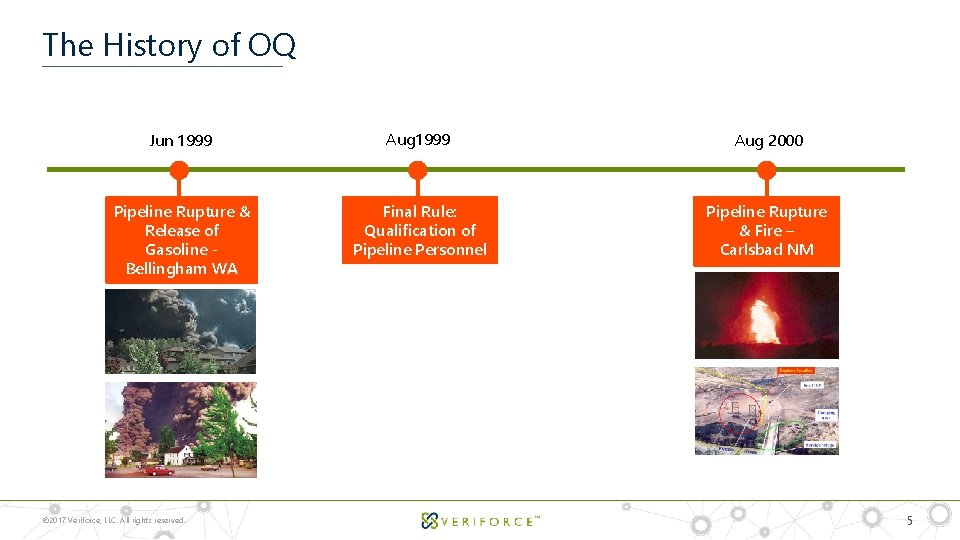
The History of OQ Jun 1999 Aug 2000 Pipeline Rupture & Release of Gasoline Bellingham WA Final Rule: Qualification of Pipeline Personnel Pipeline Rupture & Fire – Carlsbad NM © 2017 Veriforce, LLC. All rights reserved. 5
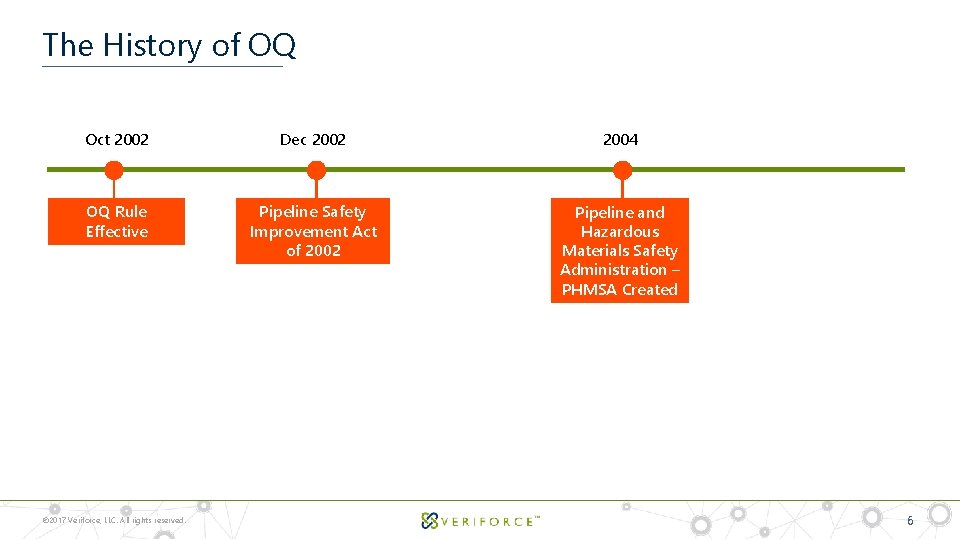
The History of OQ Oct 2002 Dec 2002 2004 OQ Rule Effective Pipeline Safety Improvement Act of 2002 Pipeline and Hazardous Materials Safety Administration – PHMSA Created © 2017 Veriforce, LLC. All rights reserved. 6
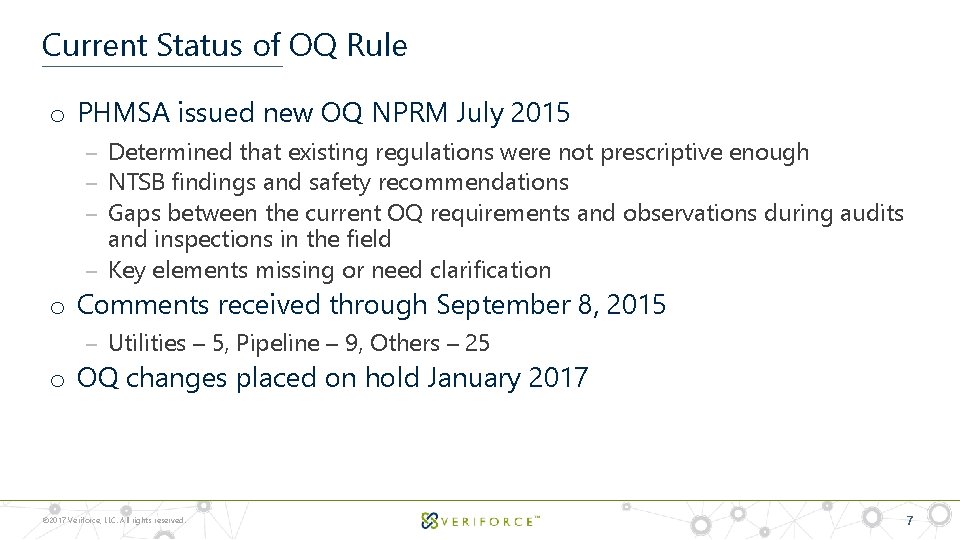
Current Status of OQ Rule o PHMSA issued new OQ NPRM July 2015 ‒ Determined that existing regulations were not prescriptive enough ‒ NTSB findings and safety recommendations ‒ Gaps between the current OQ requirements and observations during audits and inspections in the field ‒ Key elements missing or need clarification o Comments received through September 8, 2015 ‒ Utilities – 5, Pipeline – 9, Others – 25 o OQ changes placed on hold January 2017 © 2017 Veriforce, LLC. All rights reserved. 7
The Current OQ Rule – An Overview
The OQ Rule o The OQ Rule requires affected companies to: ‒ ‒ Identify “covered tasks” and “abnormal operating conditions” Implement a process for evaluating personnel Develop and follow a written qualification program Maintain records to document compliance © 2017 Veriforce, LLC. All rights reserved. 9
Intent of the OQ Rule o Ensure a qualified workforce on regulated pipelines o Reduce the probability and consequence of pipeline incidents or accidents caused by human error © 2017 Veriforce, LLC. All rights reserved. 10
Covered Tasks o A covered task is an activity identified by the operator that has all of the following four characteristics (i. e. , the “ 4 -part” test): ‒ Is performed on a pipeline facility ‒ Is an operations or maintenance task ‒ Is performed as a requirement of 49 CFR Part 192 of the federal pipeline safety regulations ‒ Affects the operation or integrity of the pipeline © 2017 Veriforce, LLC. All rights reserved. 11
Abnormal Operating Conditions (AOC) o Qualified individuals must be able to recognize and react appropriately to an AOC. ‒ Recognize: able to identify a situation or event on the pipeline that is out of the ordinary and could become a hazard to the public or environment if not promptly corrected. ‒ React appropriately: knows what to do to ensure that the hazard is promptly addressed. This could include notifying the employee’s supervisor or site inspector or taking the correct action to mitigate the hazard, whichever is appropriate for the AOC. © 2017 Veriforce, LLC. All rights reserved. 12
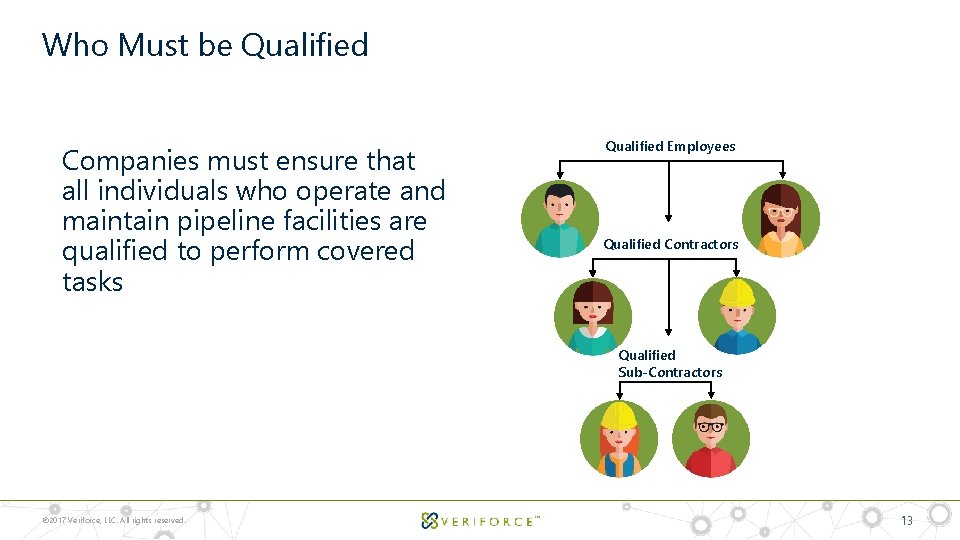
Who Must be Qualified Companies must ensure that all individuals who operate and maintain pipeline facilities are qualified to perform covered tasks Qualified Employees Qualified Contractors Qualified Sub-Contractors © 2017 Veriforce, LLC. All rights reserved. 13
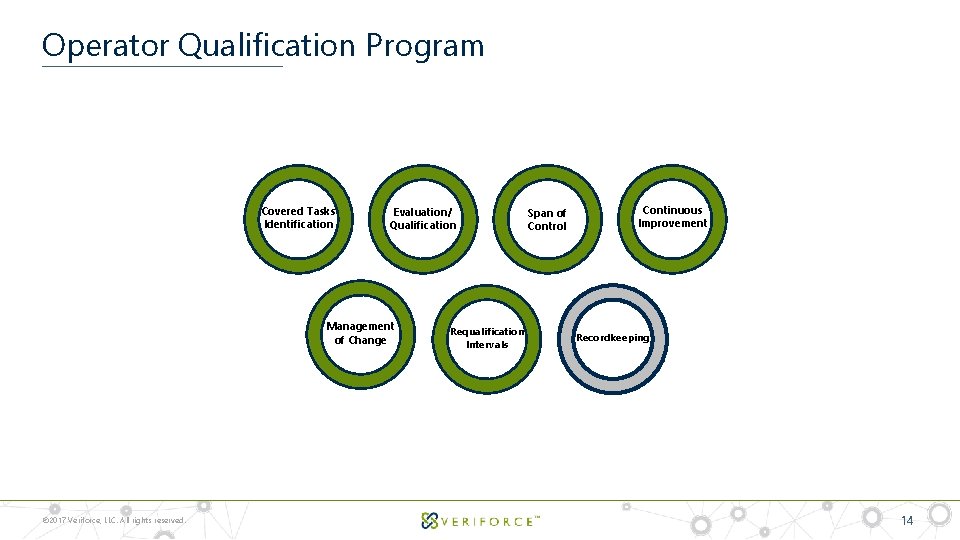
Operator Qualification Program Covered Tasks Identification Evaluation/ Qualification Management of Change © 2017 Veriforce, LLC. All rights reserved. Requalification Intervals Span of Control Continuous Improvement Recordkeeping 14
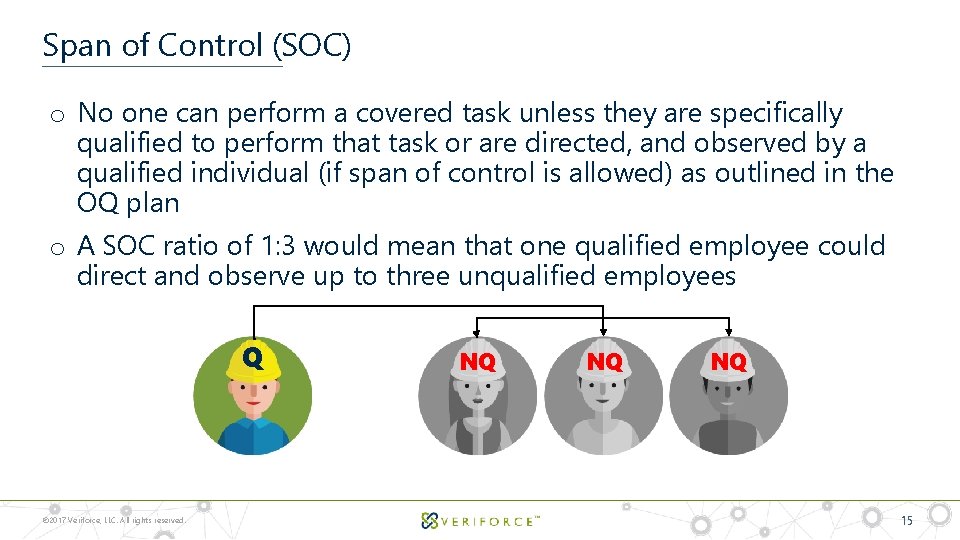
Span of Control (SOC) o No one can perform a covered task unless they are specifically qualified to perform that task or are directed, and observed by a qualified individual (if span of control is allowed) as outlined in the OQ plan o A SOC ratio of 1: 3 would mean that one qualified employee could direct and observe up to three unqualified employees Q © 2017 Veriforce, LLC. All rights reserved. NQ NQ NQ 15
OQ Rule Enforcement o During inspections, PHMSA and state agencies can review records of any operations or maintenance activity o For covered tasks, this includes the: ‒ Qualifications ‒ Evaluation methods ‒ Date each individual was evaluated o Inspectors seek to ensure that each individual is qualified prior to their performance of specific covered tasks on an operator’s pipeline © 2017 Veriforce, LLC. All rights reserved. 16
The Future of the OQ Rule OQ NPRM on hold but be Prepared
Future State of OQ Rule OQ NPRM Status o OQ NPRM put on hold January 26, 2017 Key Areas of the NRPM o What companies can do to prepare with key areas for consideration Technology o Discuss how technology can help companies and what to look for © 2017 Veriforce, LLC. All rights reserved. 18
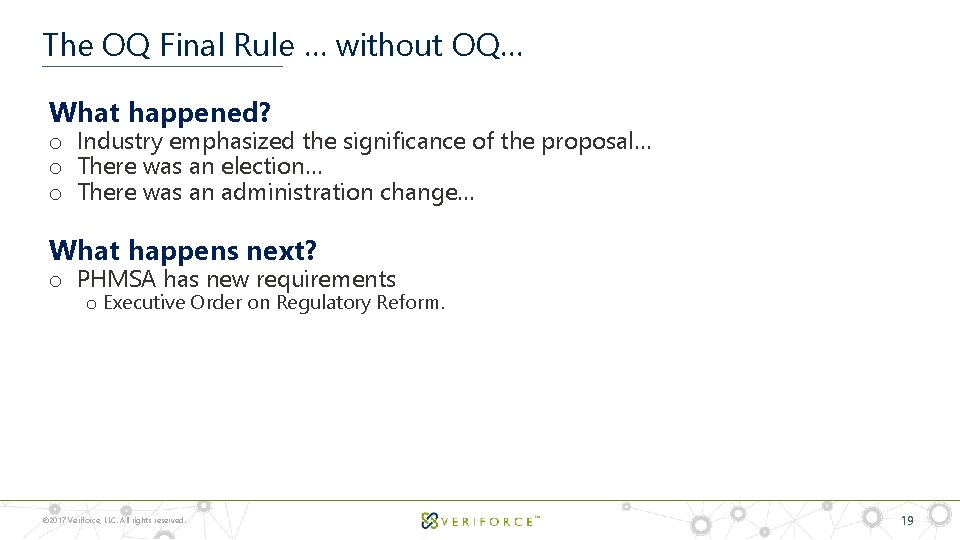
The OQ Final Rule … without OQ… What happened? o Industry emphasized the significance of the proposal… o There was an election… o There was an administration change… What happens next? o PHMSA has new requirements o Executive Order on Regulatory Reform. © 2017 Veriforce, LLC. All rights reserved. 19
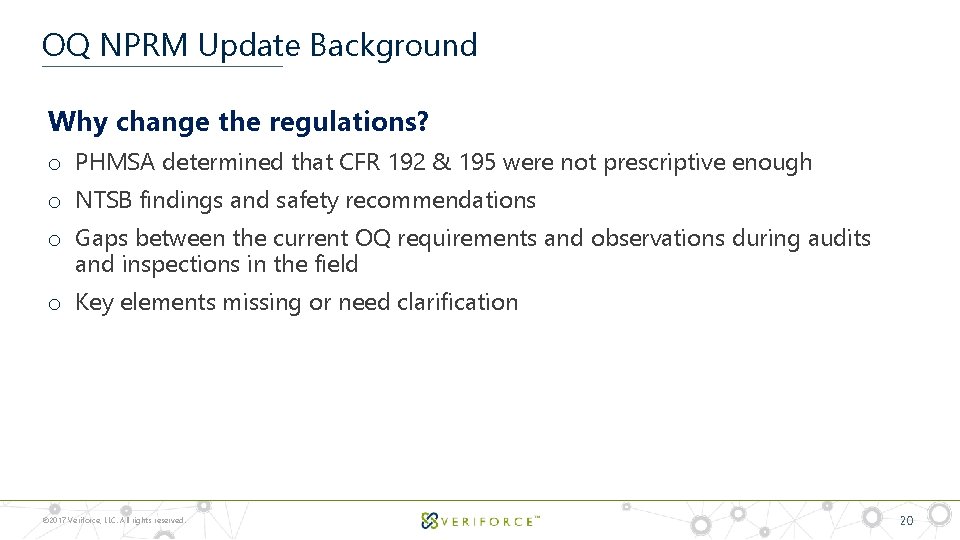
OQ NPRM Update Background Why change the regulations? o PHMSA determined that CFR 192 & 195 were not prescriptive enough o NTSB findings and safety recommendations o Gaps between the current OQ requirements and observations during audits and inspections in the field o Key elements missing or need clarification © 2017 Veriforce, LLC. All rights reserved. 20
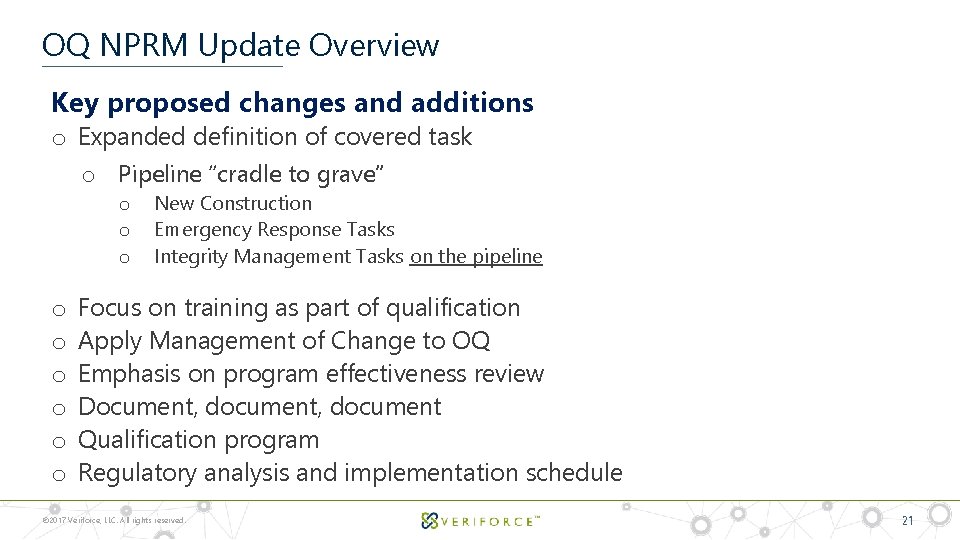
OQ NPRM Update Overview Key proposed changes and additions o Expanded definition of covered task o Pipeline “cradle to grave” o o o o o New Construction Emergency Response Tasks Integrity Management Tasks on the pipeline Focus on training as part of qualification Apply Management of Change to OQ Emphasis on program effectiveness review Document, document Qualification program Regulatory analysis and implementation schedule © 2017 Veriforce, LLC. All rights reserved. 21
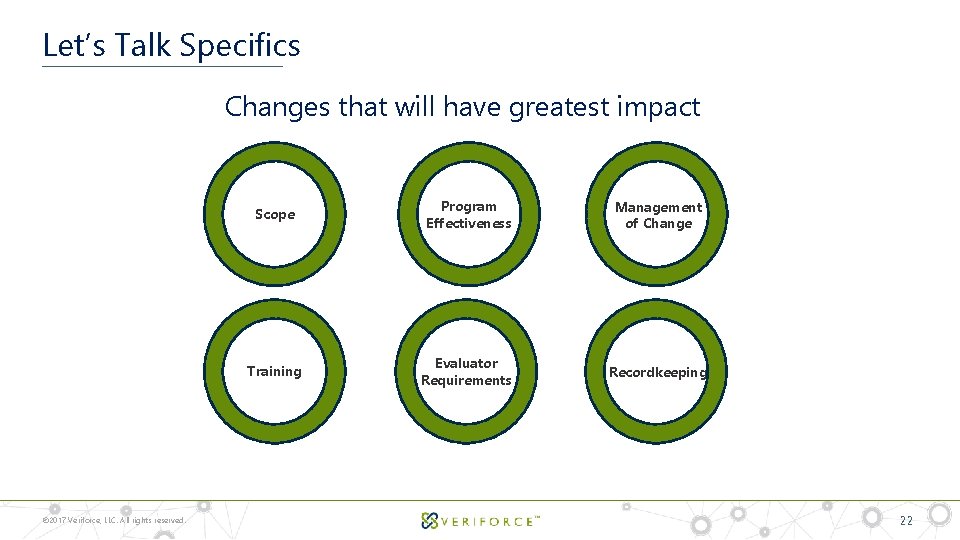
Let’s Talk Specifics Changes that will have greatest impact © 2017 Veriforce, LLC. All rights reserved. Scope Program Effectiveness Management of Change Training Evaluator Requirements Recordkeeping 22
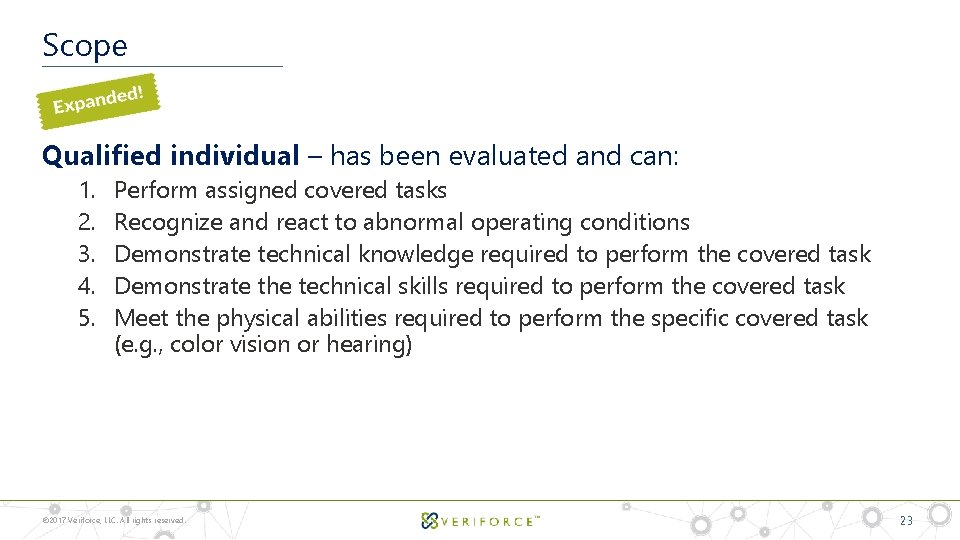
Scope Qualified individual – has been evaluated and can: 1. 2. 3. 4. 5. Perform assigned covered tasks Recognize and react to abnormal operating conditions Demonstrate technical knowledge required to perform the covered task Demonstrate the technical skills required to perform the covered task Meet the physical abilities required to perform the specific covered task (e. g. , color vision or hearing) © 2017 Veriforce, LLC. All rights reserved. 23
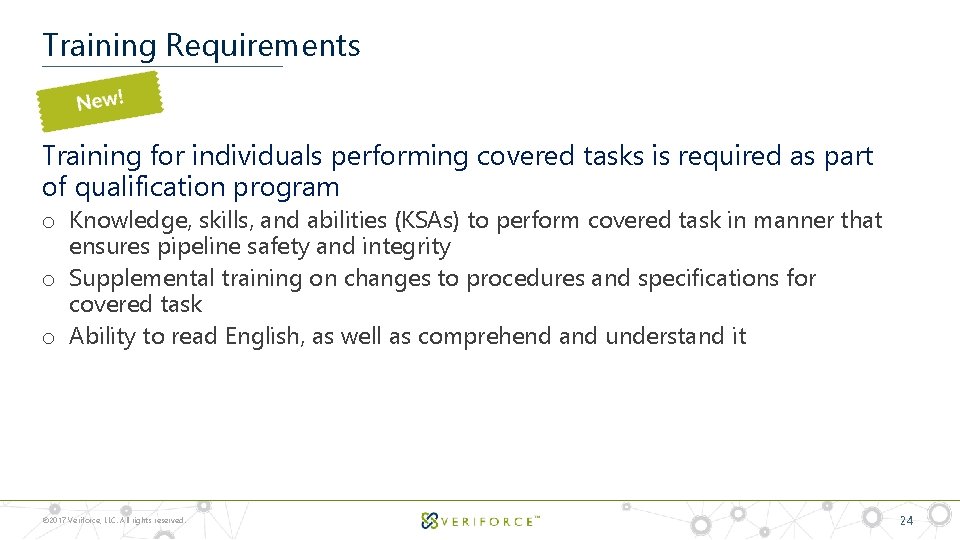
Training Requirements Training for individuals performing covered tasks is required as part of qualification program o Knowledge, skills, and abilities (KSAs) to perform covered task in manner that ensures pipeline safety and integrity o Supplemental training on changes to procedures and specifications for covered task o Ability to read English, as well as comprehend and understand it © 2017 Veriforce, LLC. All rights reserved. 24
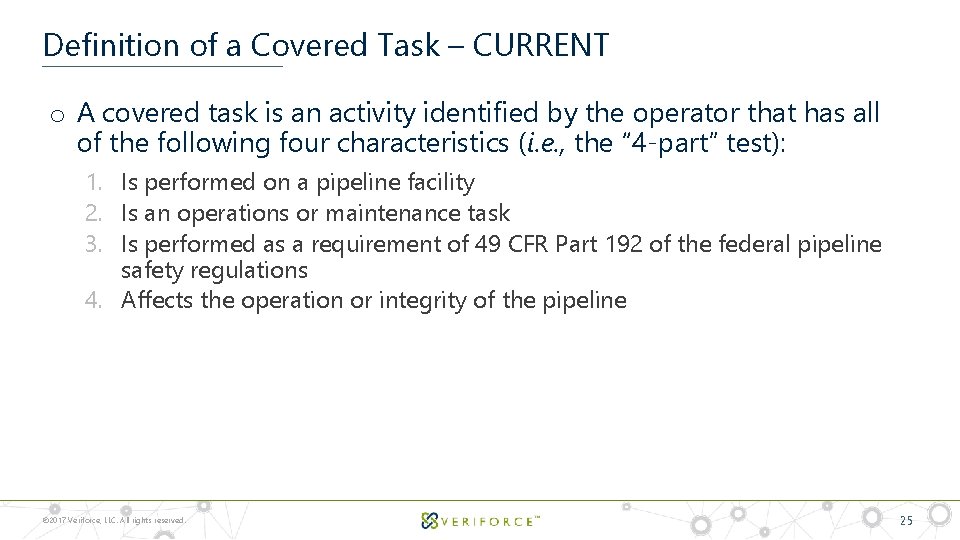
Definition of a Covered Task – CURRENT o A covered task is an activity identified by the operator that has all of the following four characteristics (i. e. , the “ 4 -part” test): 1. Is performed on a pipeline facility 2. Is an operations or maintenance task 3. Is performed as a requirement of 49 CFR Part 192 of the federal pipeline safety regulations 4. Affects the operation or integrity of the pipeline © 2017 Veriforce, LLC. All rights reserved. 25
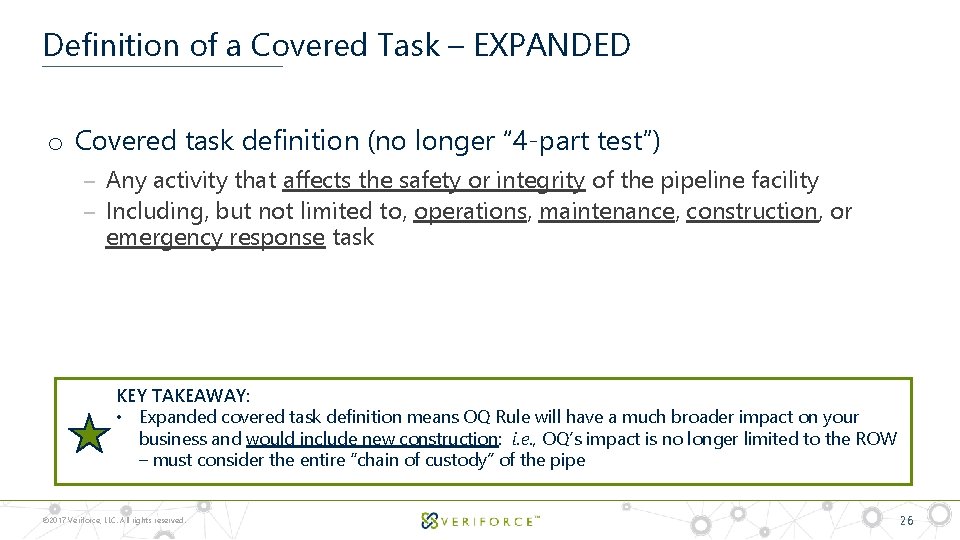
Definition of a Covered Task – EXPANDED o Covered task definition (no longer “ 4 -part test”) ‒ Any activity that affects the safety or integrity of the pipeline facility ‒ Including, but not limited to, operations, maintenance, construction, or emergency response task KEY TAKEAWAY: • Expanded covered task definition means OQ Rule will have a much broader impact on your business and would include new construction: i. e. , OQ’s impact is no longer limited to the ROW – must consider the entire “chain of custody” of the pipe © 2017 Veriforce, LLC. All rights reserved. 26
Task Qualification Training Requirements – NEW o Training = A process which imparts/transfers knowledge to someone so that knowledge can be verified o Under the OQ NPRM, training for individuals performing covered tasks will be required as part of qualification program ‒ Knowledge, skills, and abilities (KSAs) to perform covered task in manner that ensures pipeline safety and integrity ‒ Initial training for each task ‒ Operator-specific training on policies and procedures ‒ Supplemental training on changes to procedures and specifications for covered task © 2017 Veriforce, LLC. All rights reserved. 27
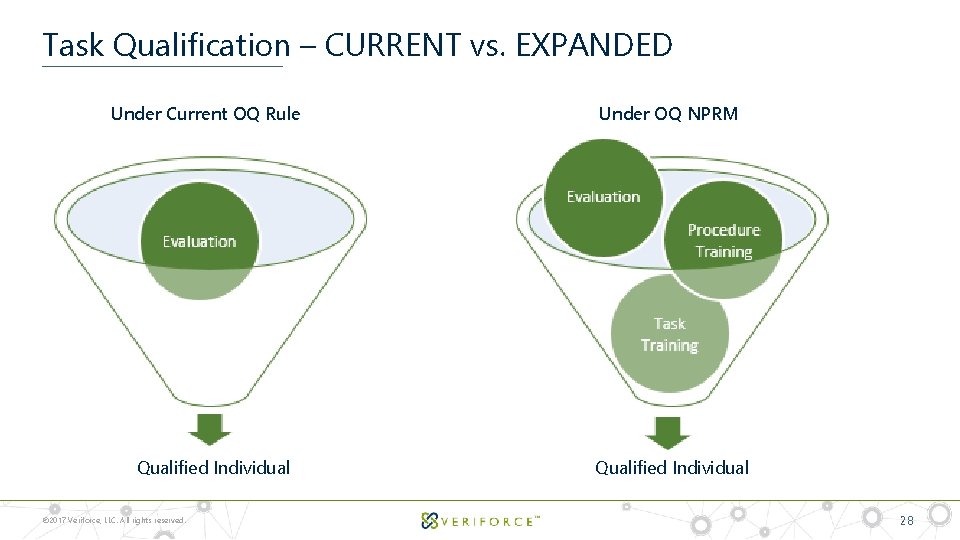
Task Qualification – CURRENT vs. EXPANDED Under Current OQ Rule Qualified Individual © 2017 Veriforce, LLC. All rights reserved. Under OQ NPRM Qualified Individual 28
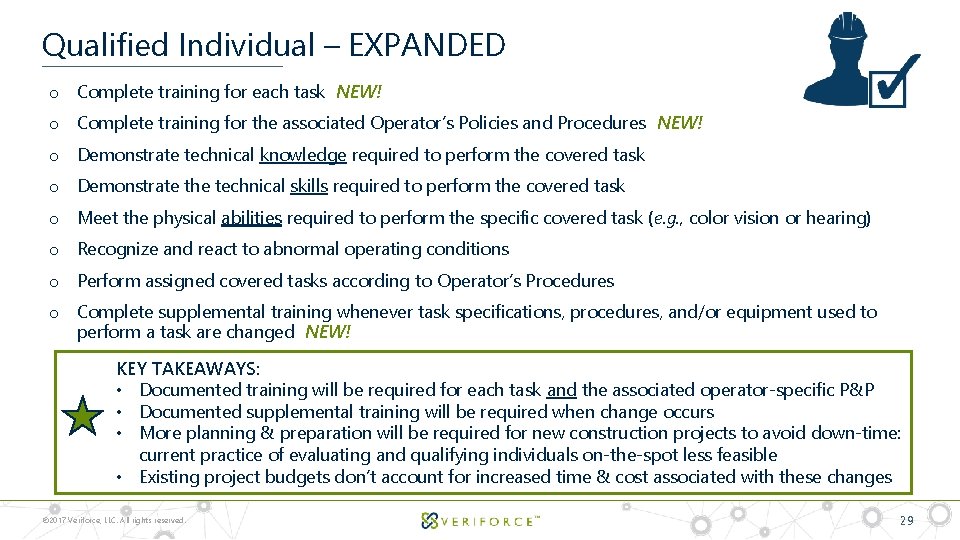
Qualified Individual – EXPANDED o Complete training for each task NEW! o Complete training for the associated Operator’s Policies and Procedures NEW! o Demonstrate technical knowledge required to perform the covered task o Demonstrate the technical skills required to perform the covered task o Meet the physical abilities required to perform the specific covered task (e. g. , color vision or hearing) o Recognize and react to abnormal operating conditions o Perform assigned covered tasks according to Operator’s Procedures o Complete supplemental training whenever task specifications, procedures, and/or equipment used to perform a task are changed NEW! KEY TAKEAWAYS: • Documented training will be required for each task and the associated operator-specific P&P • Documented supplemental training will be required when change occurs • More planning & preparation will be required for new construction projects to avoid down-time: current practice of evaluating and qualifying individuals on-the-spot less feasible • Existing project budgets don’t account for increased time & cost associated with these changes © 2017 Veriforce, LLC. All rights reserved. 29
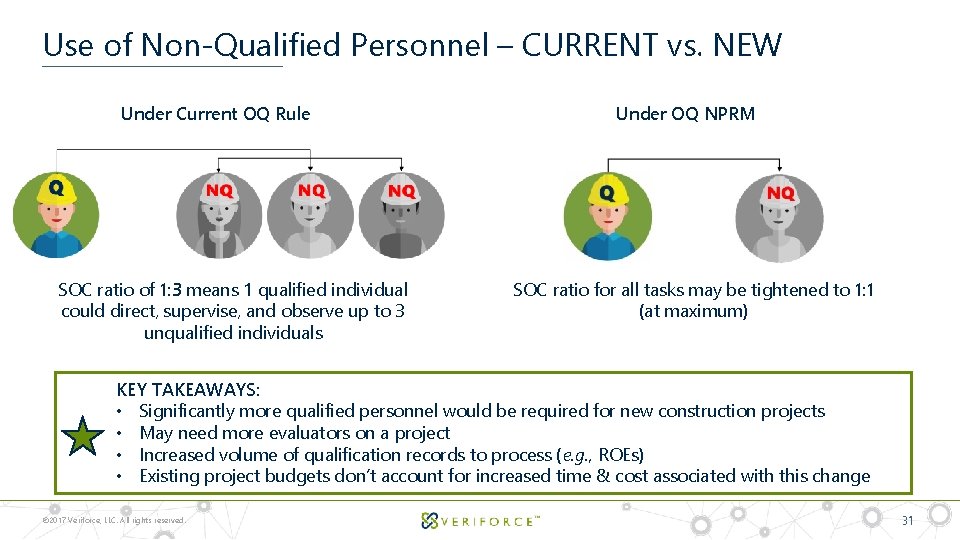
Use of Non-Qualified Personnel – Some Definitions o Span of Control (SOC) – The ratio of qualified to nonqualified individuals, where a qualified individual may direct and observe the nonqualified individual performing a covered task, with consideration of the complexity of the covered task and the operational conditions when performing the covered task o Direct and Observe – A qualified individual personally observes the work of a nonqualified individual as he/she performs a single covered task and is able to take immediate corrective action when necessary © 2017 Veriforce, LLC. All rights reserved. 30
Use of Non-Qualified Personnel – CURRENT vs. NEW Under Current OQ Rule SOC ratio of 1: 3 means 1 qualified individual could direct, supervise, and observe up to 3 unqualified individuals Under OQ NPRM SOC ratio for all tasks may be tightened to 1: 1 (at maximum) KEY TAKEAWAYS: • Significantly more qualified personnel would be required for new construction projects • May need more evaluators on a project • Increased volume of qualification records to process (e. g. , ROEs) • Existing project budgets don’t account for increased time & cost associated with this change © 2017 Veriforce, LLC. All rights reserved. 31
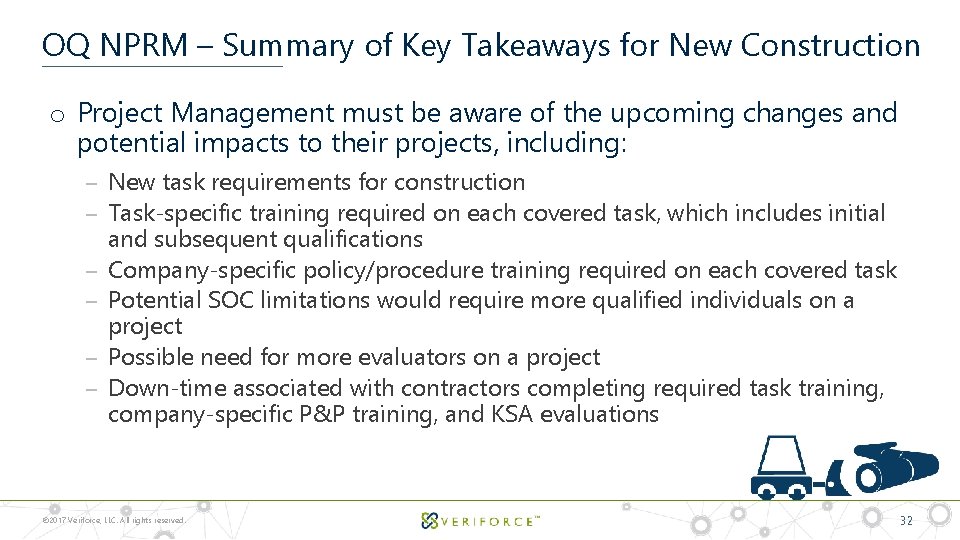
OQ NPRM – Summary of Key Takeaways for New Construction o Project Management must be aware of the upcoming changes and potential impacts to their projects, including: ‒ New task requirements for construction ‒ Task-specific training required on each covered task, which includes initial and subsequent qualifications ‒ Company-specific policy/procedure training required on each covered task ‒ Potential SOC limitations would require more qualified individuals on a project ‒ Possible need for more evaluators on a project ‒ Down-time associated with contractors completing required task training, company-specific P&P training, and KSA evaluations © 2017 Veriforce, LLC. All rights reserved. 32
OQ NPRM – Summary of Key Takeaways for New Construction o Potential impacts to projects, cont’d: ‒ Plan for increased volume of qualification records to avoid delays (e. g. , time to transmit ROEs to Veriforce, time for Veriforce to process ROEs, etc. ) ‒ Recordkeeping ‒ Budgeting for the increased cost and time associated with new requirements o Impacts ongoing and future projects where budgets have already been established and may need to be revisited ‒ Increased scrutiny by PHMSA and state agencies © 2017 Veriforce, LLC. All rights reserved. 33
Program Effectiveness Requirements – NEW o Develop and implement a process to measure OQ program effectiveness ‒ Program effectiveness review once each calendar year – not to exceed 15 months o “Effective” program minimizes human error caused by lack of knowledge, skills, and abilities (KSAs) to perform covered tasks o Written process must: ‒ Evaluate whether program is being implemented and executed as written ‒ Establish provisions to amend the program as necessary to address the review findings o Measures must include, at minimum, number of occurrences caused by any individual whose performance of a covered task adversely affected pipeline safety or integrity due to any specified deficiencies. © 2017 Veriforce, LLC. All rights reserved. 34
Minimum Program Effectiveness Measures o Number of occurrences caused by any individual whose performance of a covered task(s) adversely affected pipeline safety or integrity due to any of the following specified deficiencies: ‒ ‒ Evaluation was not conducted properly KSAs for the specific covered task(s) were not adequately determined Training was not adequate for the specific covered task(s) Change made to a covered task or the KSAs was not adequately evaluated for necessary changes to training or evaluation ‒ Change to covered task(s) or the KSAs was not adequately communicated © 2017 Veriforce, LLC. All rights reserved. 35
Minimum Program Effectiveness Measures continued: o Number of occurrences caused by any individual whose performance of a covered task(s) adversely affected pipeline safety or integrity due to any of the following specified deficiencies: ‒ Individual failed to recognize an AOC, whether it is task specific or non-task specific, which occurs anywhere on the system ‒ Individual failed to take the appropriate action following the recognition of an AOC (task specific or non -task specific), which occurs anywhere on the system ‒ Individual was not qualified ‒ Nonqualified individual was being directed and observed by a qualified individual ‒ Individual did not follow approved procedures and/or use approved equipment ‒ SOC was not followed ‒ Evaluator or training did not follow program or meet requirements ‒ The qualified individual supervised more than one covered task at a time © 2017 Veriforce, LLC. All rights reserved. 36
Evaluator Requirements o Establish criteria and training necessary to be an evaluator of individuals performing covered tasks o Measure and track evaluators’ performance © 2017 Veriforce, LLC. All rights reserved. 37
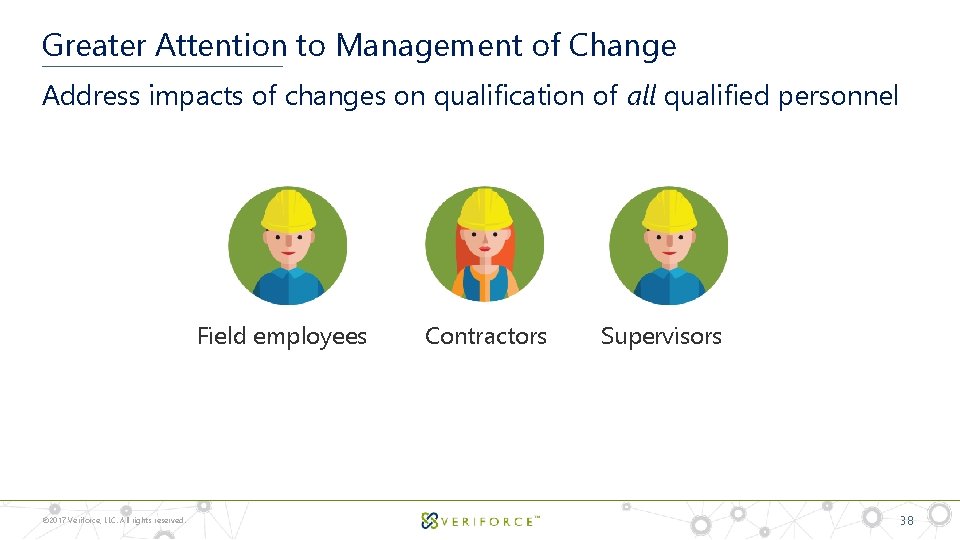
Greater Attention to Management of Change Address impacts of changes on qualification of all qualified personnel Field employees © 2017 Veriforce, LLC. All rights reserved. Contractors Supervisors 38
Recordkeeping Requirements - EXPANDED o Maintain individual qualification records ‒ ‒ ‒ Covered tasks qualified Qualification methods and dates AOC evaluation Evaluator name, date Training required for task and client-specific P&P training NEW!! o Maintain program records ‒ ‒ ‒ ‒ Program effectiveness reviews NEW!! Program changes List of AOCs Program MOC notifications Covered task list For each covered task: SOC ratios, reevaluation intervals, and evaluation methods Evaluator criteria and training © 2017 Veriforce, LLC. All rights reserved. 39
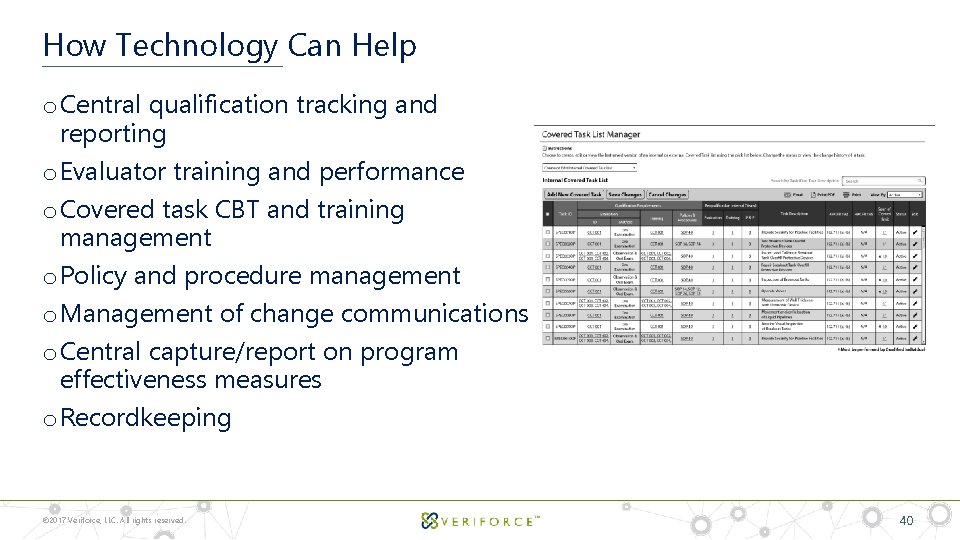
How Technology Can Help o Central qualification tracking and reporting o Evaluator training and performance o Covered task CBT and training management o Policy and procedure management o Management of change communications o Central capture/report on program effectiveness measures o Recordkeeping © 2017 Veriforce, LLC. All rights reserved. 40
Emergency Response – CURRENT o Each operator shall establish and maintain liaison with appropriate fire, police, and other public officials to: ‒ Learn the responsibility and resources of each government organization that may respond to a gas pipeline emergency ‒ Acquaint the officials with the operator's ability in responding to a gas pipeline emergency ‒ Identify the types of gas pipeline emergencies of which the operator notifies the officials and, ‒ Plan how the operator and officials can engage in mutual assistance to minimize hazards to life or property © 2017 Veriforce, LLC. All rights reserved. 41
Emergency Response – NEW o Emergency response tasks included under expanded covered task definition o First responders would need to be qualified under the new task qualification requirements ‒ Knowledge, skills, and abilities (KSAs) to perform covered task in manner that ensures pipeline safety and integrity ‒ Initial training for each task ‒ Operator-specific training on policies and procedures ‒ Supplemental training on changes to procedures and specifications for covered task KEY TAKEAWAY: • If you expect local emergency personnel to perform identified O&M covered tasks that could reasonably be expected to be performed during an emergency to return the pipeline facilities to a safe operating condition, these personnel must be qualified under your program © 2017 Veriforce, LLC. All rights reserved. 42
Questions
Tom Meek, Compliance Director Tom. Meek@Veriforce. com 281 -404 -7104