
A highthroughput DNA microarray platform for the diagnosis
- Slides: 1
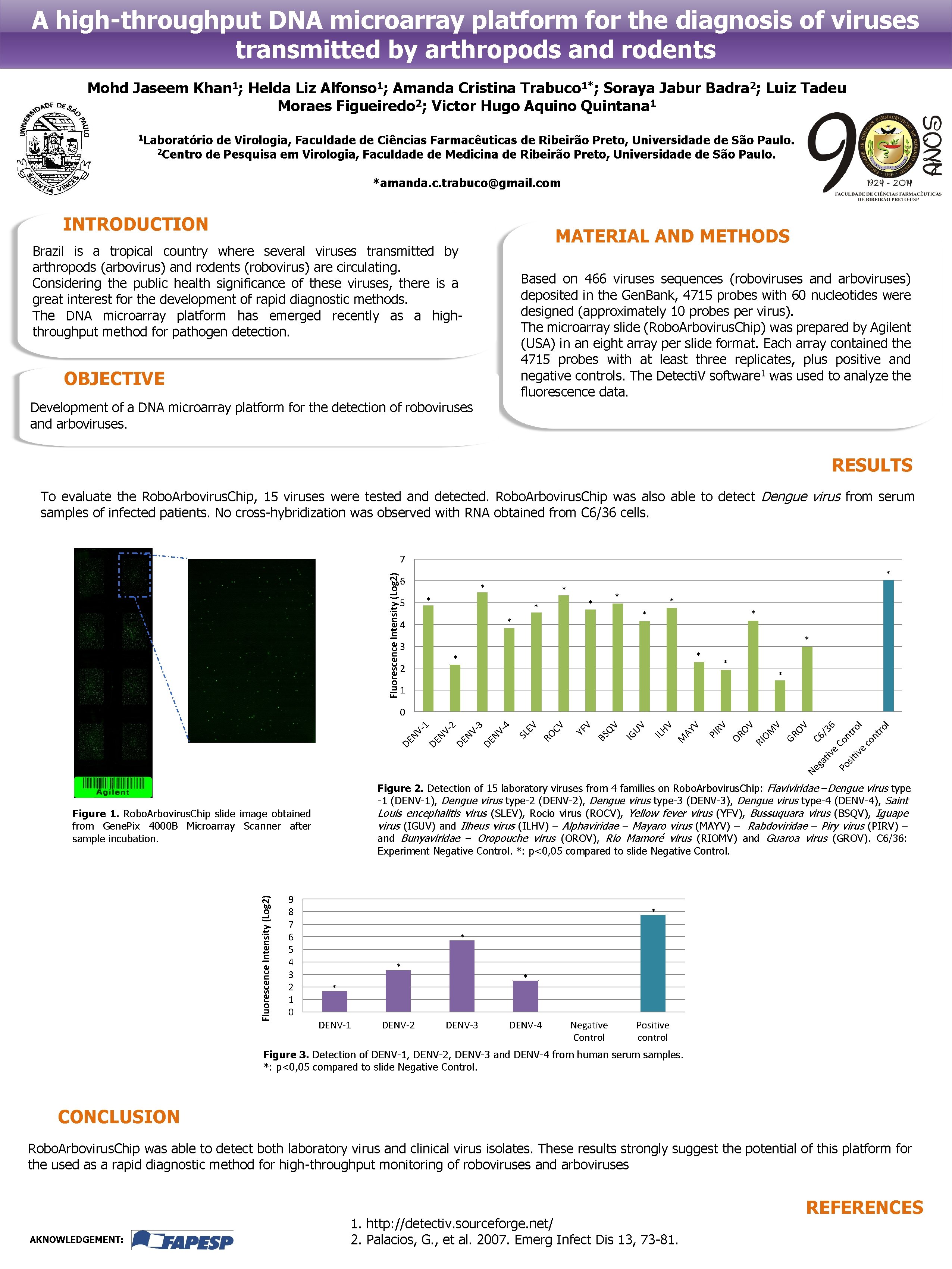
A high-throughput DNA microarray platform for the diagnosis of viruses transmitted by arthropods and rodents Mohd Jaseem Khan 1; Helda Liz Alfonso 1; Amanda Cristina Trabuco 1*; Soraya Jabur Badra 2; Luiz Tadeu Moraes Figueiredo 2; Victor Hugo Aquino Quintana 1 1 Laboratório de Virologia, Faculdade de Ciências Farmacêuticas de Ribeirão Preto, Universidade de São Paulo. 2 Centro de Pesquisa em Virologia, Faculdade de Medicina de Ribeirão Preto, Universidade de São Paulo. *amanda. c. trabuco@gmail. com INTRODUCTION MATERIAL AND METHODS Brazil is a tropical country where several viruses transmitted by arthropods (arbovirus) and rodents (robovirus) are circulating. Considering the public health significance of these viruses, there is a great interest for the development of rapid diagnostic methods. The DNA microarray platform has emerged recently as a highthroughput method for pathogen detection. Based on 466 viruses sequences (roboviruses and arboviruses) deposited in the Gen. Bank, 4715 probes with 60 nucleotides were designed (approximately 10 probes per virus). The microarray slide (Robo. Arbovirus. Chip) was prepared by Agilent (USA) in an eight array per slide format. Each array contained the 4715 probes with at least three replicates, plus positive and negative controls. The Detecti. V software 1 was used to analyze the fluorescence data. OBJECTIVE Development of a DNA microarray platform for the detection of roboviruses and arboviruses. RESULTS To evaluate the Robo. Arbovirus. Chip, 15 viruses were tested and detected. Robo. Arbovirus. Chip was also able to detect Dengue virus from serum samples of infected patients. No cross-hybridization was observed with RNA obtained from C 6/36 cells. Fluorescence Intensity (Log 2) 7 * 6 * * * 5 * * * 4 * * * 3 * * 2 * * 1 Fluorescence Intensity (Log 2) OR OV RI OM V GR OV Ne C 6 ga /3 tiv 6 e Co Po nt sit ive rol co nt ro l RV PI AY V M V ILH UV IG QV BS YF V RO CV EV SL -4 NV DE -3 NV DE -2 NV Figure 2. Detection of 15 laboratory viruses from 4 families on Robo. Arbovirus. Chip: Flaviviridae –Dengue virus type -1 (DENV-1), Dengue virus type-2 (DENV-2), Dengue virus type-3 (DENV-3), Dengue virus type-4 (DENV-4), Saint Louis encephalitis virus (SLEV), Rocio virus (ROCV), Yellow fever virus (YFV), Bussuquara virus (BSQV), Iguape virus (IGUV) and Ilheus virus (ILHV) – Alphaviridae – Mayaro virus (MAYV) – Rabdoviridae – Piry virus (PIRV) – and Bunyaviridae – Oropouche virus (OROV), Rio Mamoré virus (RIOMV) and Guaroa virus (GROV). C 6/36: Experiment Negative Control. *: p<0, 05 compared to slide Negative Control. Figure 1. Robo. Arbovirus. Chip slide image obtained from Gene. Pix 4000 B Microarray Scanner after sample incubation. 9 8 7 6 5 4 3 2 1 0 DE DE NV -1 0 * * * DENV-1 DENV-2 DENV-3 DENV-4 Negative Control Positive control Figure 3. Detection of DENV-1, DENV-2, DENV-3 and DENV-4 from human serum samples. *: p<0, 05 compared to slide Negative Control. CONCLUSION Robo. Arbovirus. Chip was able to detect both laboratory virus and clinical virus isolates. These results strongly suggest the potential of this platform for the used as a rapid diagnostic method for high-throughput monitoring of roboviruses and arboviruses AKNOWLEDGEMENT: 1. http: //detectiv. sourceforge. net/ 2. Palacios, G. , et al. 2007. Emerg Infect Dis 13, 73 -81. REFERENCES