
A High Precision Measurement of the Electrical Charge
- Slides: 1
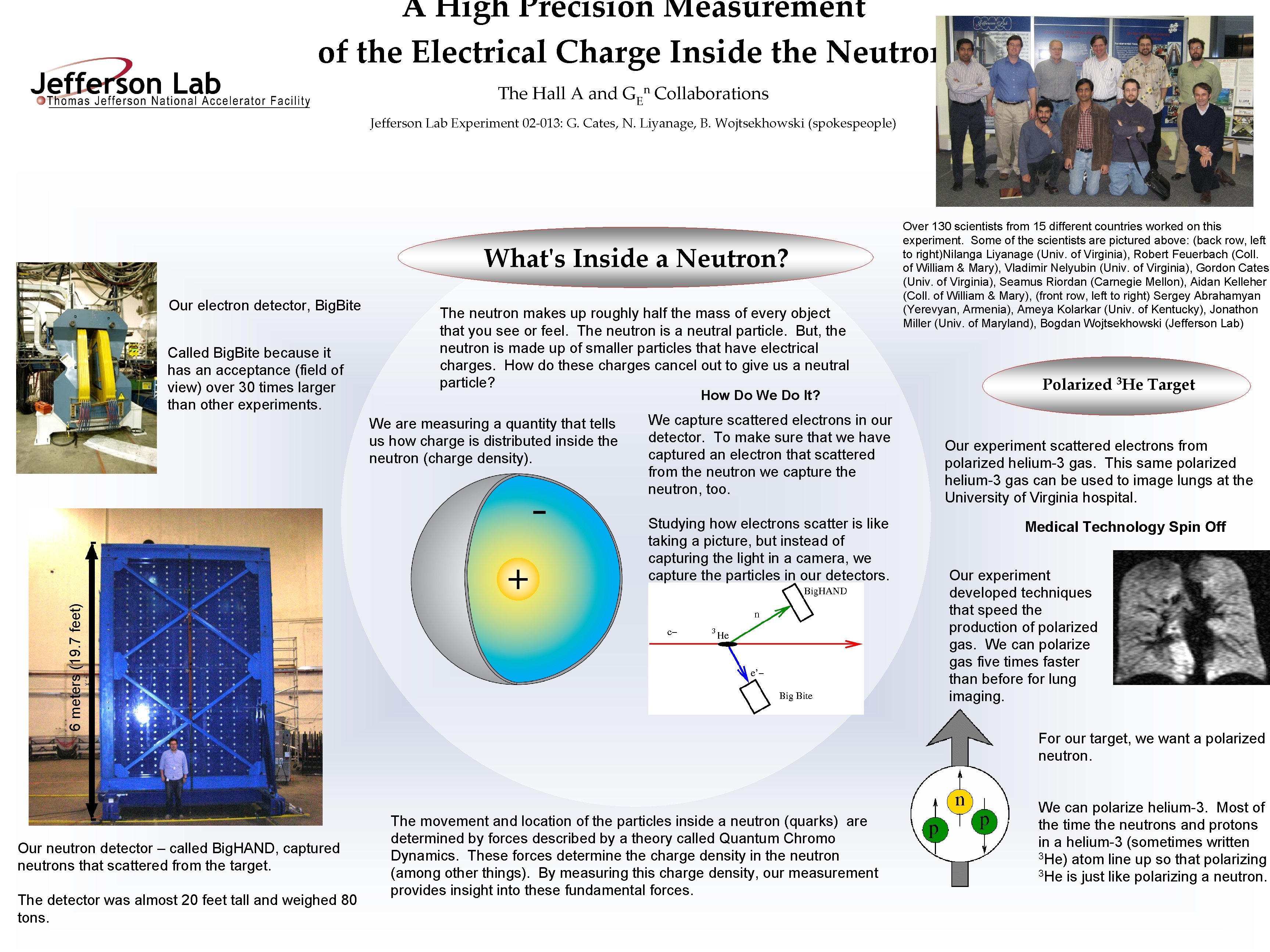
A High Precision Measurement of the Electrical Charge Inside the Neutron The Hall A and GE Collaborations n Jefferson Lab Experiment 02 -013: G. Cates, N. Liyanage, B. Wojtsekhowski (spokespeople) What's Inside a Neutron? Our electron detector, Big. Bite Called Big. Bite because it has an acceptance (field of view) over 30 times larger than other experiments. The neutron makes up roughly half the mass of every object that you see or feel. The neutron is a neutral particle. But, the neutron is made up of smaller particles that have electrical charges. How do these charges cancel out to give us a neutral particle? How Do We Do It? We are measuring a quantity that tells us how charge is distributed inside the neutron (charge density). We capture scattered electrons in our detector. To make sure that we have captured an electron that scattered from the neutron we capture the neutron, too. 6 meters (19. 7 feet) Studying how electrons scatter is like taking a picture, but instead of capturing the light in a camera, we capture the particles in our detectors. Our neutron detector – called Big. HAND, captured neutrons that scattered from the target. The detector was almost 20 feet tall and weighed 80 tons. Over 130 scientists from 15 different countries worked on this experiment. Some of the scientists are pictured above: (back row, left to right)Nilanga Liyanage (Univ. of Virginia), Robert Feuerbach (Coll. of William & Mary), Vladimir Nelyubin (Univ. of Virginia), Gordon Cates (Univ. of Virginia), Seamus Riordan (Carnegie Mellon), Aidan Kelleher (Coll. of William & Mary), (front row, left to right) Sergey Abrahamyan (Yerevyan, Armenia), Ameya Kolarkar (Univ. of Kentucky), Jonathon Miller (Univ. of Maryland), Bogdan Wojtsekhowski (Jefferson Lab) Polarized 3 He Target Our experiment scattered electrons from polarized helium-3 gas. This same polarized helium-3 gas can be used to image lungs at the University of Virginia hospital. Medical Technology Spin Off Our experiment developed techniques that speed the production of polarized gas. We can polarize gas five times faster than before for lung imaging. For our target, we want a polarized neutron. The movement and location of the particles inside a neutron (quarks) are determined by forces described by a theory called Quantum Chromo Dynamics. These forces determine the charge density in the neutron (among other things). By measuring this charge density, our measurement provides insight into these fundamental forces. We can polarize helium-3. Most of the time the neutrons and protons in a helium-3 (sometimes written 3 He) atom line up so that polarizing 3 He is just like polarizing a neutron.