
A Hierarchical Model for Reliability Analysis of Sensor
A Hierarchical Model for Reliability Analysis of Sensor Networks Dong Seong Kim, Rahul Ghosh, Kishor S. Trivedi Dept. of Electrical&Computer Eng. , Duke University, USA dk 76@duke. edu, rg 51@duke. edu, kst@ee. duke. edu
Outline • Introduction • System Model • Proposed Model • Numerical Results • Conclusions 2
Introduction • Prior to field deployment, mission critical sensor networks should be analyzed for high reliability assurance. • Past research only focused on reliability models for sensor node or network in isolation. • This paper presents a comprehensive approach for reliability analysis of a cluster-based sensor network via hierarchical model 3
Contributions • Comprehensive model incorporates failure and recoveries behavior for § Components of a sensor node § Cluster of sensor nodes, base station, and channel at sensor network level • In three level hierarchical model § Reliability analysis § Sensitivity analysis § Mixture of CTMC and DTMC in underlying Markov sub-models. 4
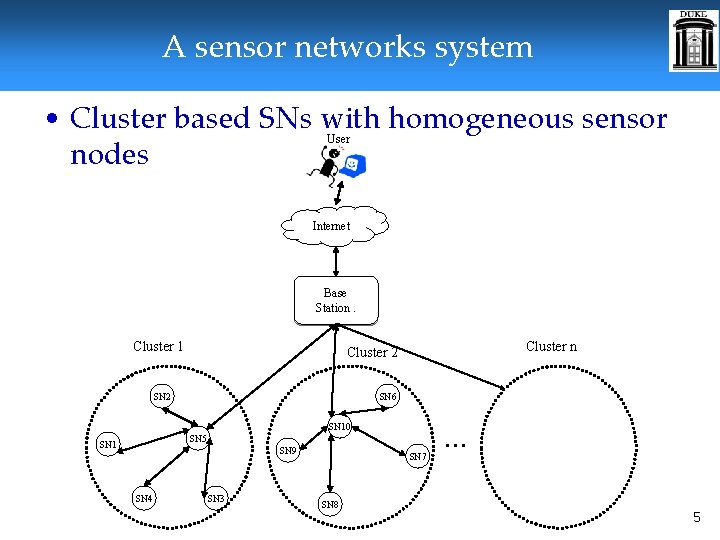
A sensor networks system • Cluster based SNs with homogeneous sensor nodes User Internet Base Station. Cluster 1 Cluster n Cluster 2 SN 6 SN 10 SN 5 SN 1 SN 9 SN 4 SN 3 SN 7 SN 8 … 5
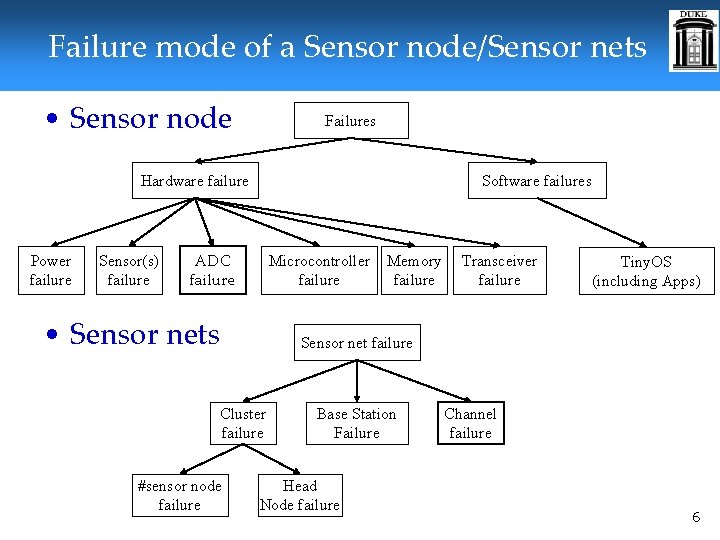
Failure mode of a Sensor node/Sensor nets • Sensor node Failures Hardware failure Power failure Sensor(s) failure Software failures ADC failure Microcontroller failure • Sensor nets Transceiver failure Tiny. OS (including Apps) Sensor net failure Cluster failure #sensor node failure Memory failure Base Station Failure Head Node failure Channel failure 6
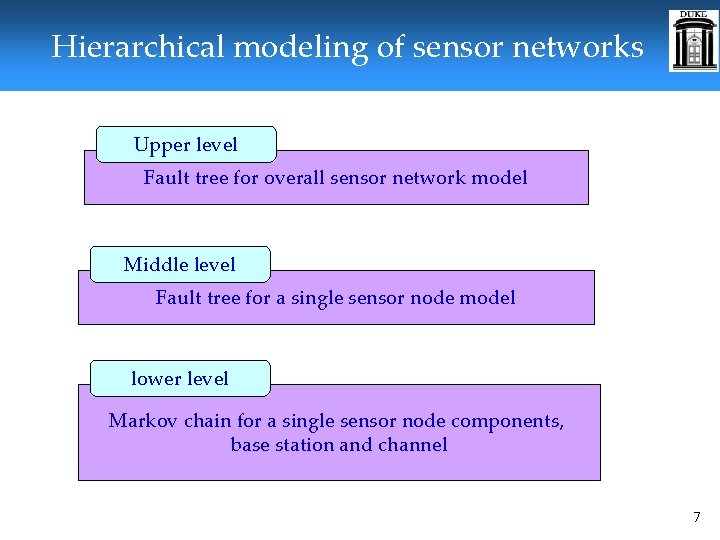
Hierarchical modeling of sensor networks Upper level Fault tree for overall sensor network model Middle level Fault tree for a single sensor node model lower level Markov chain for a single sensor node components, base station and channel 7
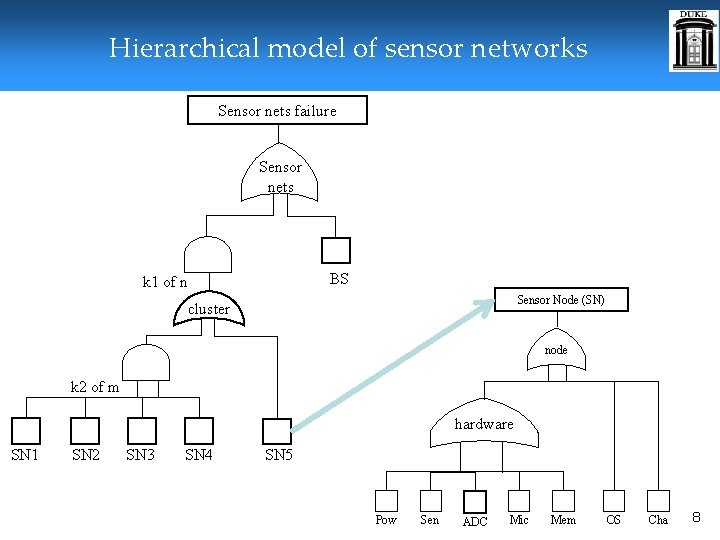
Hierarchical model of sensor networks Sensor nets failure Sensor nets BS k 1 of n Sensor Node (SN) cluster node k 2 of m hardware SN 1 SN 2 SN 3 SN 4 SN 5 Pow Sen ADC Mic Mem OS Cha 8
![Reliability of a sensor node • SHARPE [5] to compute the reliability of a](http://slidetodoc.com/presentation_image_h/1394b61a8d28050db503d268567d849a/image-9.jpg "Reliability of a sensor node • SHARPE [5] to compute the reliability of a")
Reliability of a sensor node • SHARPE [5] to compute the reliability of a single sensor node and the sensor network. • The reliability of a single sensor node over time with different MTTF values of hardware components (such as the sensor) 9
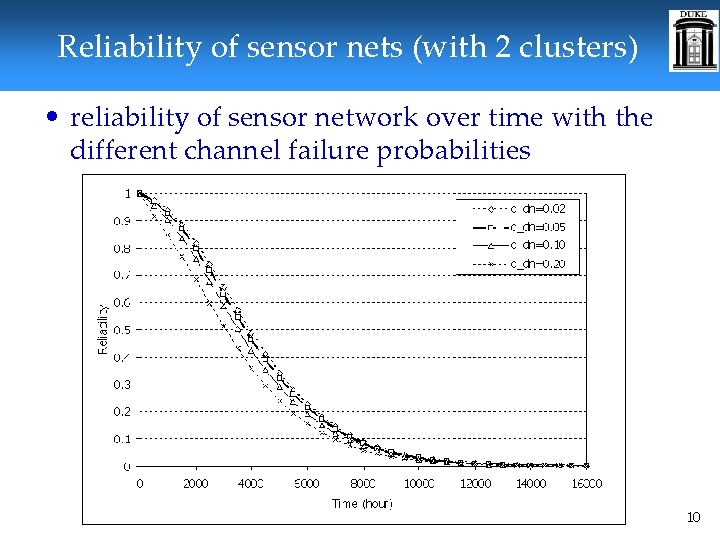
Reliability of sensor nets (with 2 clusters) • reliability of sensor network over time with the different channel failure probabilities 10
Conclusions • We have presented a comprehensive hierarchical model for the reliability analysis of sensor nodes and a sensor network. § capture the hardware/software failures of a sensor node, failures of clusters and base station as well as channel failure. § The Markov chains in sensor node fault tree can be extended to include more detail behaviors. § Will incorporate not only the reliability but also other dependability and security measures such as security and survivability in future work. 11

Thanks! 12

References • I. F. Akyildiz, et al. , A Survey on Sensor Networks, IEEE Communication Magazine, August 2002 • I. Eusgeld, et al. , Dependability Metrics: Advanced Lectures, LNCS 4909, 2008. • H. Karl and A. Willig, Protocols and Architectures for Wireless Sensor Networks, Wiley, June 2005 • K. S. Trivedi, Probability and Statistics with Reliability, Queuing, and Computer Science Applicatitons, John Wiley, New York, 2001 • K. S. Trivedi and R. Sahner, “SHARPE at the age of twenty two”, ACM Sigmetrics Performanance Evaluation Review, 36(4): 52 -57, 2009. 13
Backup slides 14
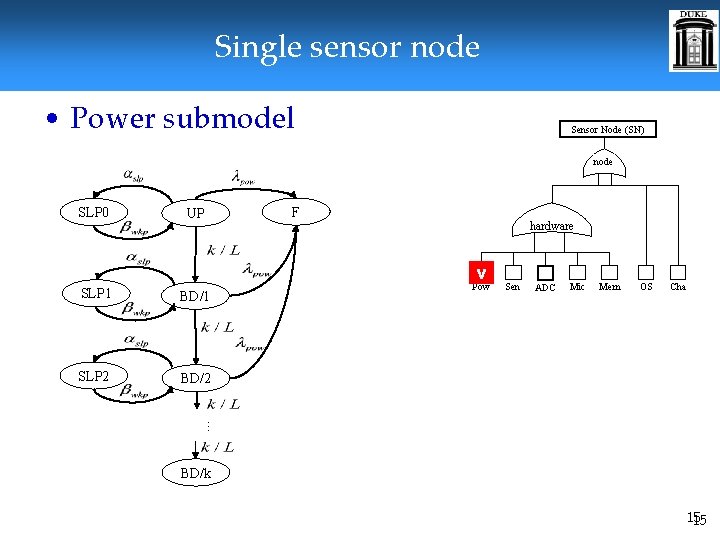
Single sensor node • Power submodel Sensor Node (SN) node SLP 0 F UP hardware v SLP 1 BD/1 SLP 2 BD/2 Pow Sen ADC Mic Mem OS Cha … BD/k 15 15
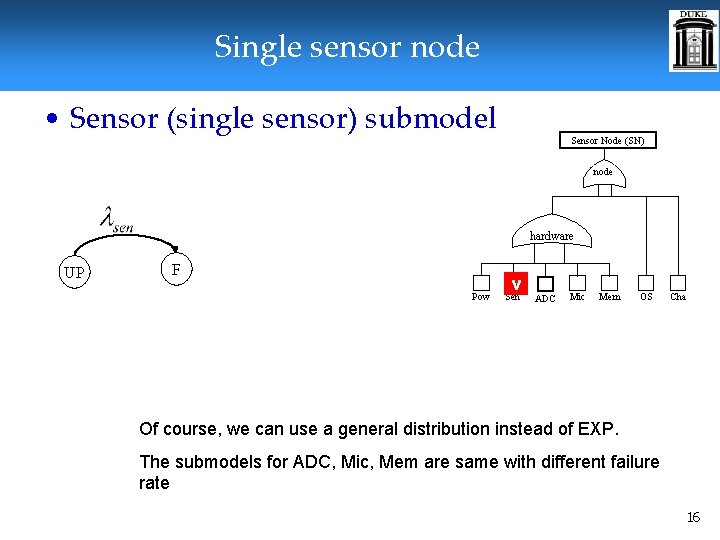
Single sensor node • Sensor (single sensor) submodel Sensor Node (SN) node hardware UP F Pow v Sen ADC Mic Mem OS Cha Of course, we can use a general distribution instead of EXP. The submodels for ADC, Mic, Mem are same with different failure rate 16
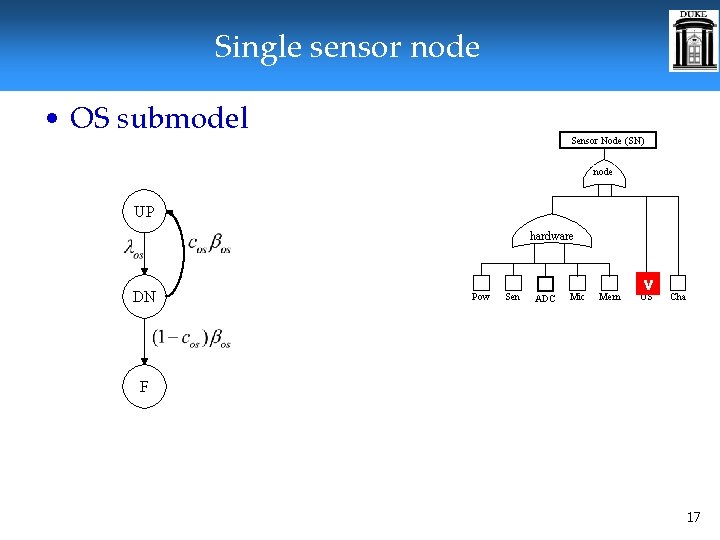
Single sensor node • OS submodel Sensor Node (SN) node UP hardware DN Pow Sen ADC Mic Mem v OS Cha F 17
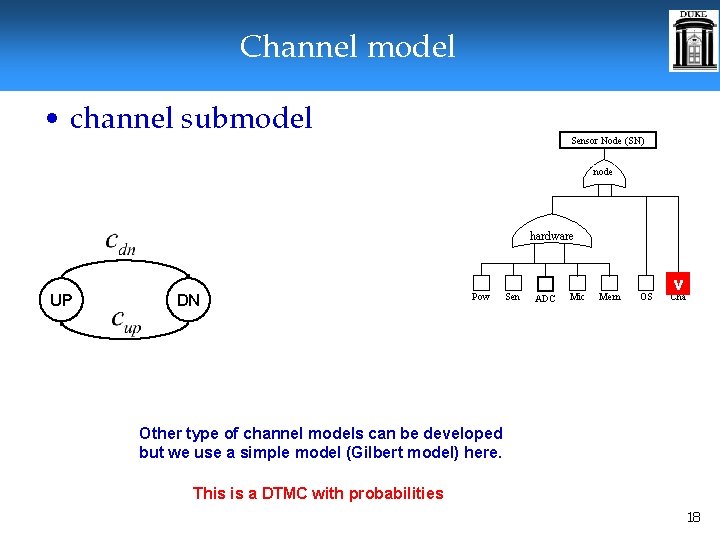
Channel model • channel submodel Sensor Node (SN) node hardware UP DN Pow Sen ADC Mic Mem OS v Cha Other type of channel models can be developed but we use a simple model (Gilbert model) here. This is a DTMC with probabilities 18
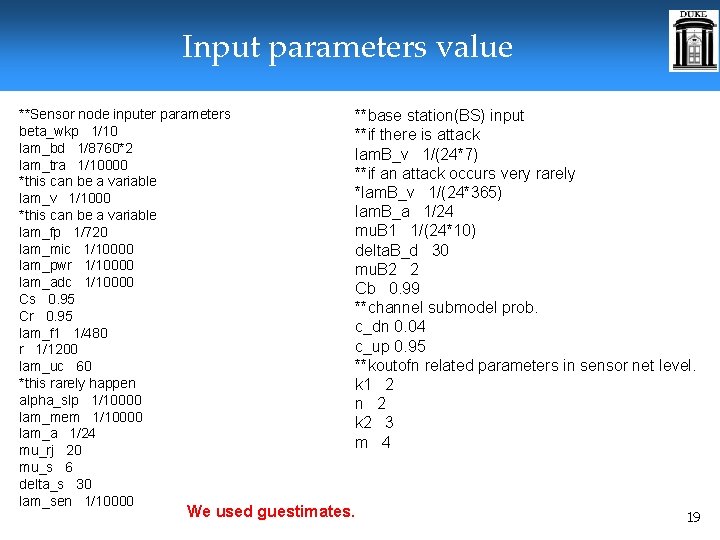
Input parameters value **Sensor node inputer parameters beta_wkp 1/10 lam_bd 1/8760*2 lam_tra 1/10000 *this can be a variable lam_v 1/1000 *this can be a variable lam_fp 1/720 lam_mic 1/10000 lam_pwr 1/10000 lam_adc 1/10000 Cs 0. 95 Cr 0. 95 lam_f 1 1/480 r 1/1200 lam_uc 60 *this rarely happen alpha_slp 1/10000 lam_mem 1/10000 lam_a 1/24 mu_rj 20 mu_s 6 delta_s 30 lam_sen 1/10000 We used guestimates. **base station(BS) input **if there is attack lam. B_v 1/(24*7) **if an attack occurs very rarely *lam. B_v 1/(24*365) lam. B_a 1/24 mu. B 1 1/(24*10) delta. B_d 30 mu. B 2 2 Cb 0. 99 **channel submodel prob. c_dn 0. 04 c_up 0. 95 **koutofn related parameters in sensor net level. k 1 2 n 2 k 2 3 m 4 19
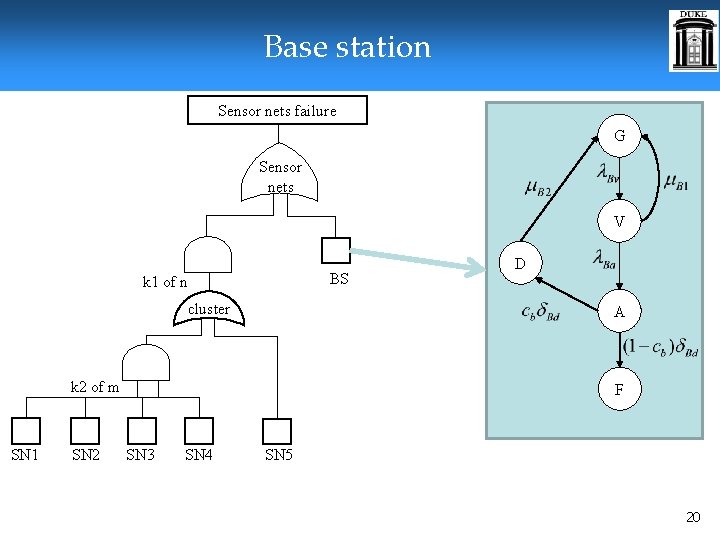
Base station Sensor nets failure G Sensor nets V BS k 1 of n cluster A k 2 of m SN 1 SN 2 D F SN 3 SN 4 SN 5 20
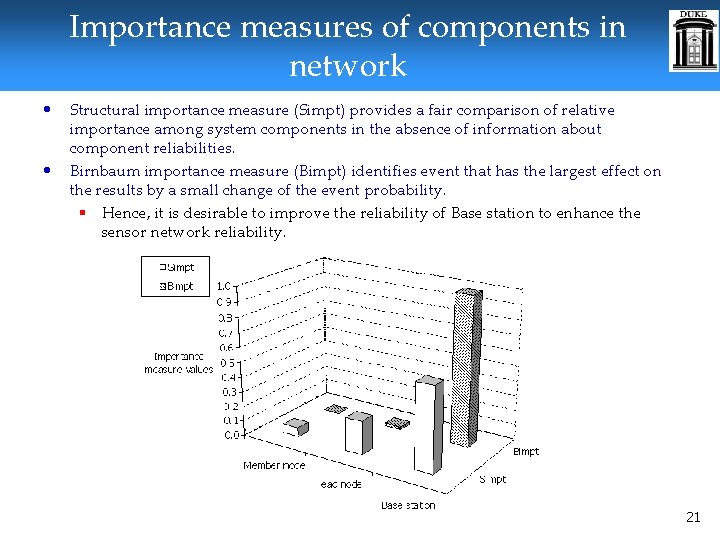
Importance measures of components in network • • Structural importance measure (Simpt) provides a fair comparison of relative importance among system components in the absence of information about component reliabilities. Birnbaum importance measure (Bimpt) identifies event that has the largest effect on the results by a small change of the event probability. § Hence, it is desirable to improve the reliability of Base station to enhance the sensor network reliability. 21
- Slides: 21