
A Helpful Guide to Understanding Visual Art Elements

- Slides: 51
A Helpful Guide to Understanding Visual Art Elements and Design Principles © 2015 Museo Art Academy & Gallery LLC. All Right Reserved . click to begin
Art Elements Color Form Line © 2015 Museo Art Academy & Gallery LLC. All Right Reserved Texture Value Shape Space . click to next page
Color - Subtractive Color Theory: Primary, Secondary & Tertiary - Warm vs. Cool - Complementary & Analogous - Tints, Shade & Tones - Hue © 2015 Museo Art Academy & Gallery LLC. All Right Reserved . click to next page
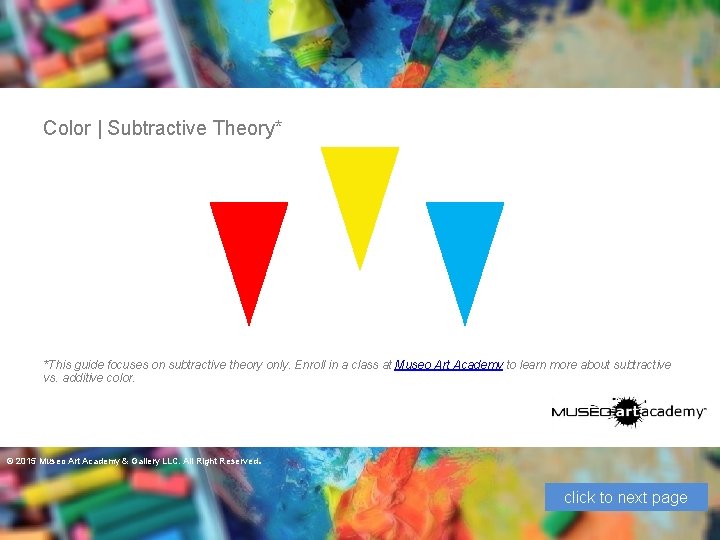
Color | Subtractive Theory* *This guide focuses on subtractive theory only. Enroll in a class at Museo Art Academy to learn more about subtractive vs. additive color. © 2015 Museo Art Academy & Gallery LLC. All Right Reserved . click to next page
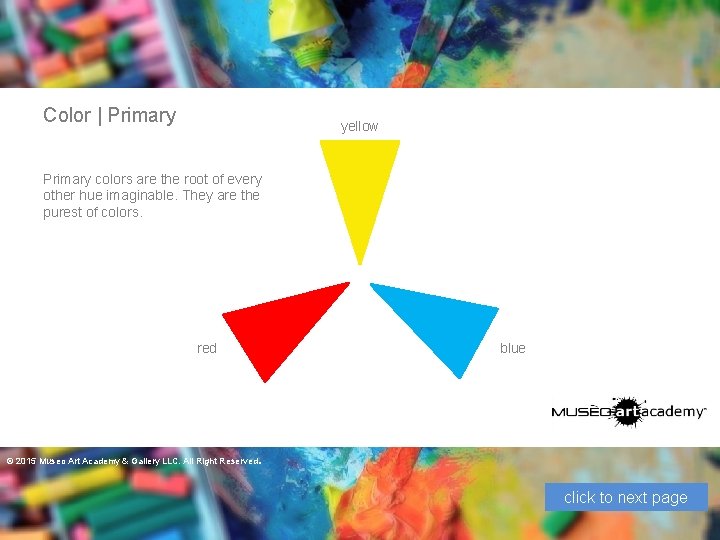
Color | Primary yellow Primary colors are the root of every other hue imaginable. They are the purest of colors. blue red © 2015 Museo Art Academy & Gallery LLC. All Right Reserved . click to next page
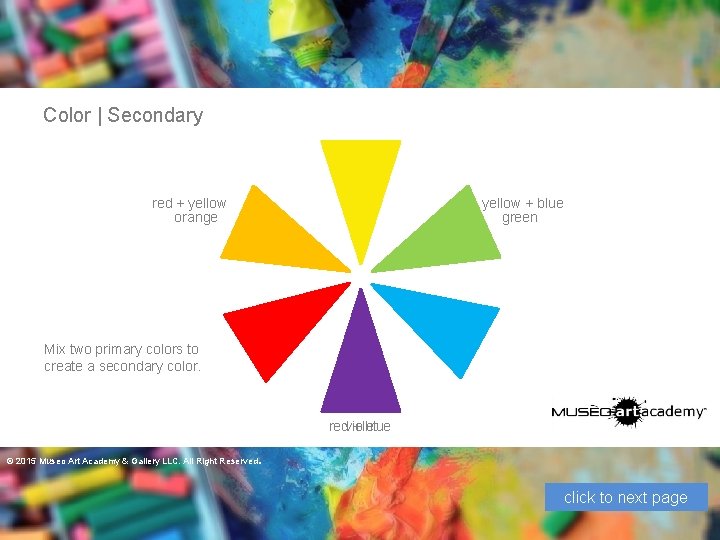
Color | Secondary yellow + blue green red + yellow orange Mix two primary colors to create a secondary color. redviolet + blue © 2015 Museo Art Academy & Gallery LLC. All Right Reserved . click to next page
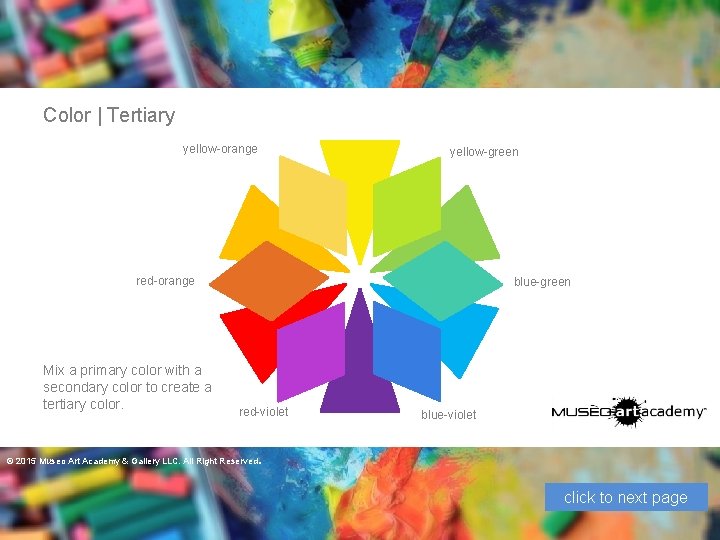
Color | Tertiary yellow-orange yellow-green red-orange Mix a primary color with a secondary color to create a tertiary color. blue-green red-violet © 2015 Museo Art Academy & Gallery LLC. All Right Reserved blue-violet . click to next page
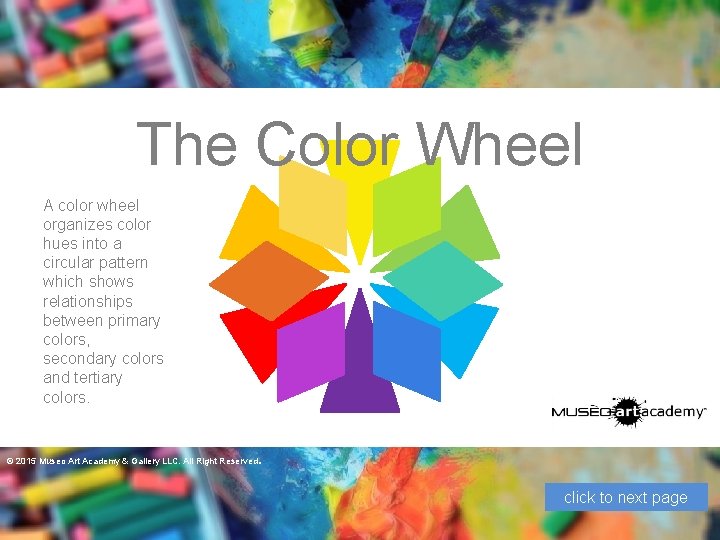
The Color Wheel A color wheel organizes color hues into a circular pattern which shows relationships between primary colors, secondary colors and tertiary colors. © 2015 Museo Art Academy & Gallery LLC. All Right Reserved . click to next page
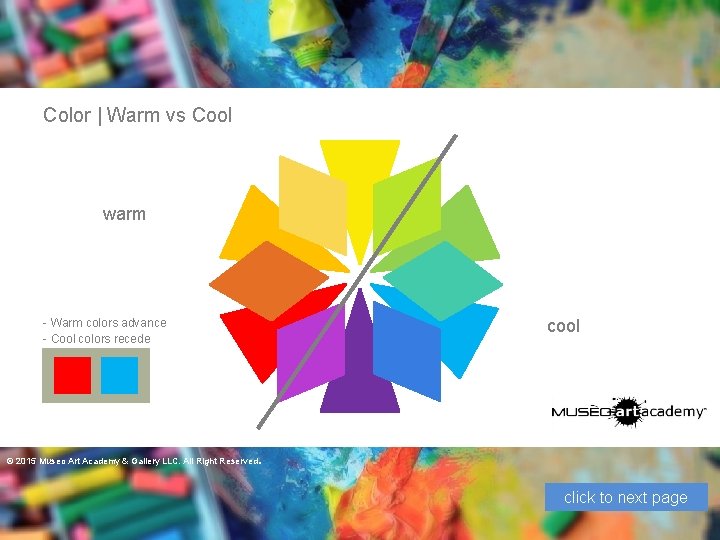
Color | Warm vs Cool warm cool - Warm colors advance - Cool colors recede © 2015 Museo Art Academy & Gallery LLC. All Right Reserved . click to next page
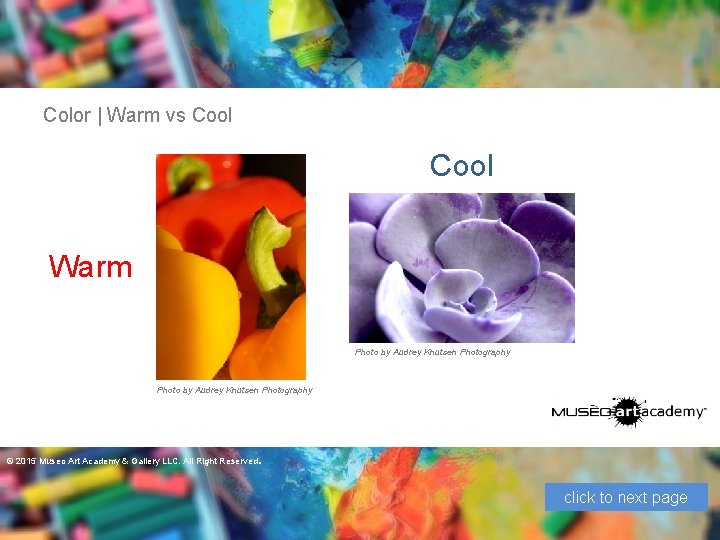
Color | Warm vs Cool Warm Photo by Audrey Knutsen Photography © 2015 Museo Art Academy & Gallery LLC. All Right Reserved . click to next page
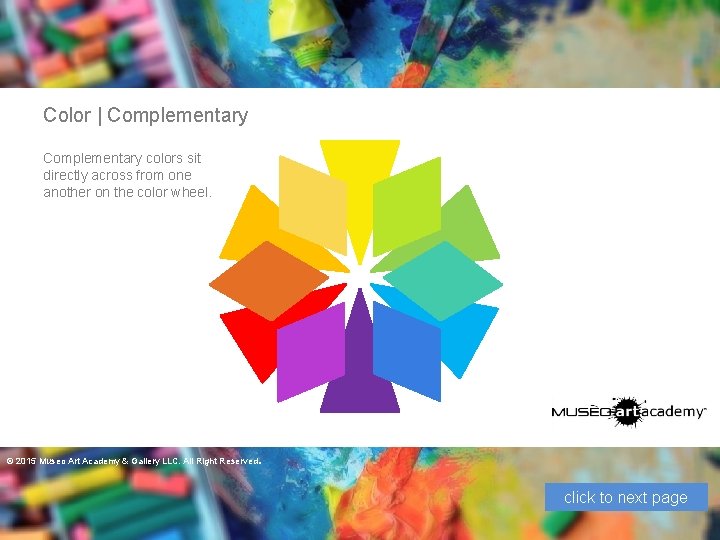
Color | Complementary colors sit directly across from one another on the color wheel. © 2015 Museo Art Academy & Gallery LLC. All Right Reserved . click to next page
Color | The Science of Seeing Step 1 Stare at the white dot in the center of the image for one minute (it’s ok if you blink). Step 2 Click to the next page and stare at the black dot in the open white space. Jasper Johns, Flag, 1965 © 2015 Museo Art Academy & Gallery LLC. All Right Reserved . click to next page
Color | The Science of Seeing What do you see? Enroll in a class at Museo Art Academy to learn why this happens. © 2015 Museo Art Academy & Gallery LLC. All Right Reserved . click to next page
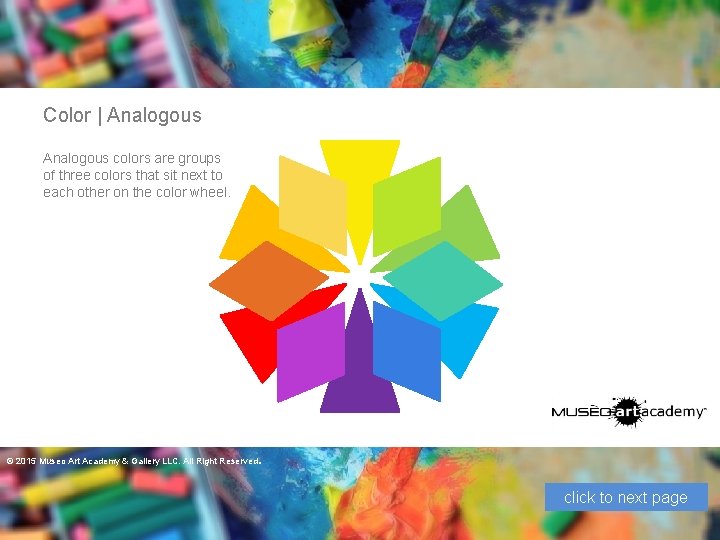
Color | Analogous colors are groups of three colors that sit next to each other on the color wheel. © 2015 Museo Art Academy & Gallery LLC. All Right Reserved . click to next page
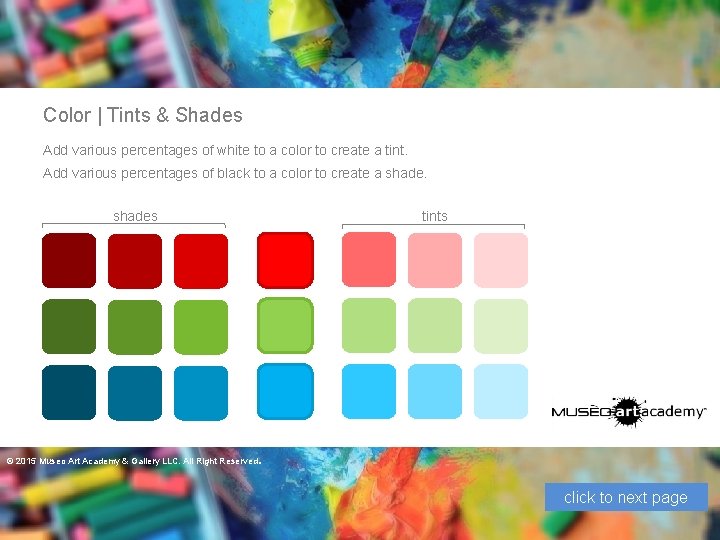
Color | Tints & Shades Add various percentages of white to a color to create a tint. Add various percentages of black to a color to create a shades © 2015 Museo Art Academy & Gallery LLC. All Right Reserved tints . click to next page
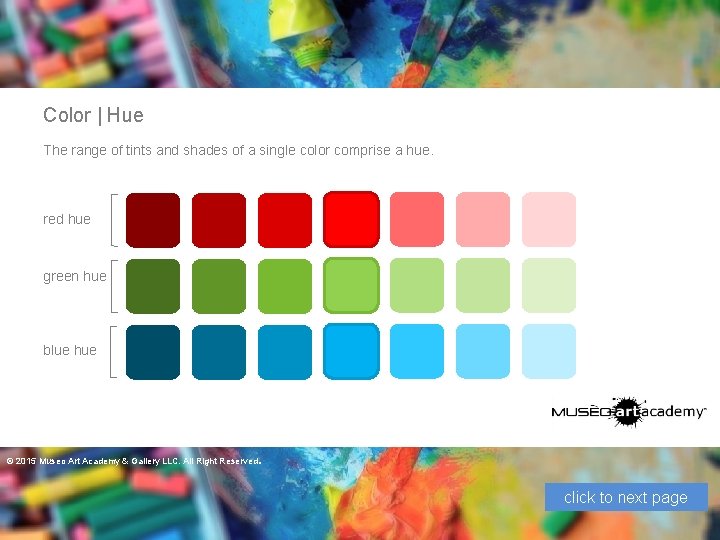
Color | Hue The range of tints and shades of a single color comprise a hue. red hue green hue blue hue © 2015 Museo Art Academy & Gallery LLC. All Right Reserved . click to next page
Art Elements Color Form Line © 2015 Museo Art Academy & Gallery LLC. All Right Reserved Texture Value Shape Space . click to next page
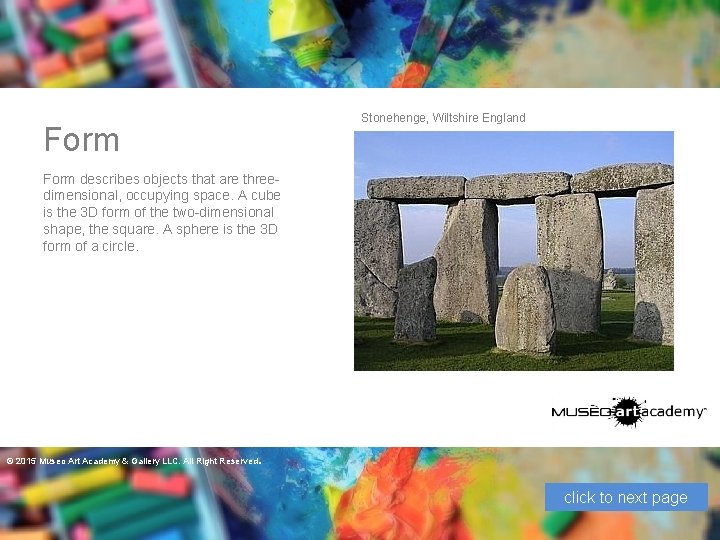
Stonehenge, Wiltshire England Form describes objects that are threedimensional, occupying space. A cube is the 3 D form of the two-dimensional shape, the square. A sphere is the 3 D form of a circle. © 2015 Museo Art Academy & Gallery LLC. All Right Reserved . click to next page
Art Elements Color Form Line Texture Value Shape Space click to next page © 2015 Museo Art Academy & Gallery LLC. All Right Reserved .
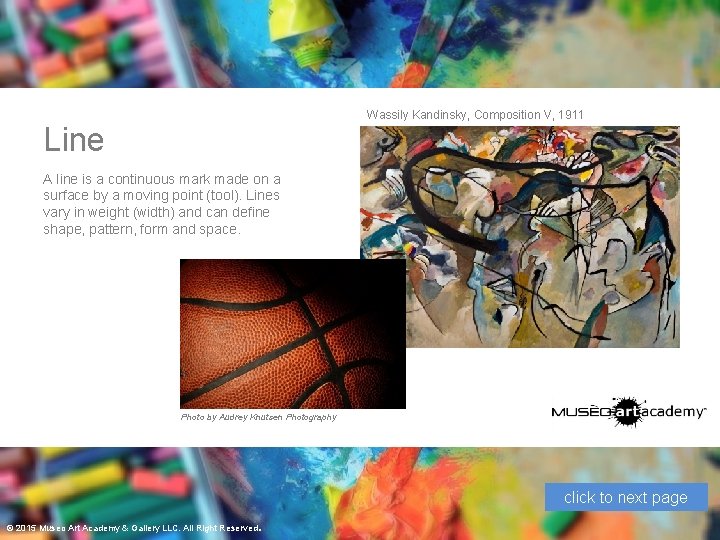
Wassily Kandinsky, Composition V, 1911 Line A line is a continuous mark made on a surface by a moving point (tool). Lines vary in weight (width) and can define shape, pattern, form and space. Photo by Audrey Knutsen Photography click to next page © 2015 Museo Art Academy & Gallery LLC. All Right Reserved .
Art Elements Color Form Line © 2015 Museo Art Academy & Gallery LLC. All Right Reserved Texture Value Shape Space . click to next page
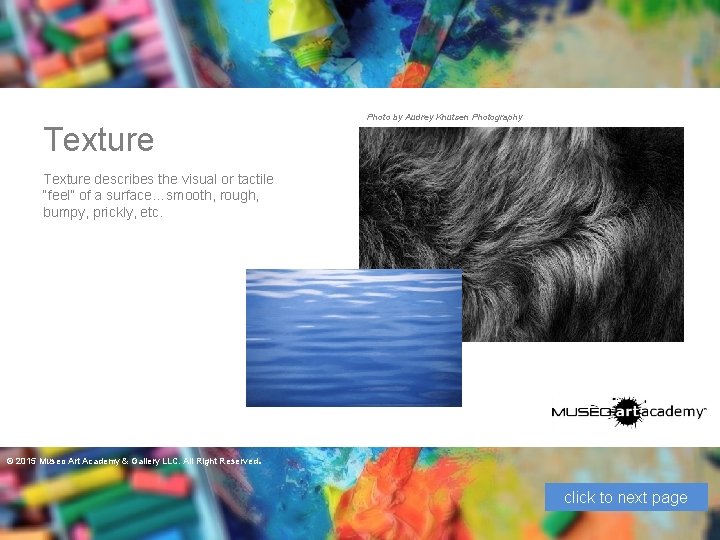
Photo by Audrey Knutsen Photography Texture describes the visual or tactile “feel” of a surface…smooth, rough, bumpy, prickly, etc. © 2015 Museo Art Academy & Gallery LLC. All Right Reserved . click to next page
Art Elements Color Form Line © 2015 Museo Art Academy & Gallery LLC. All Right Reserved Texture Value Shape Space . click to next page
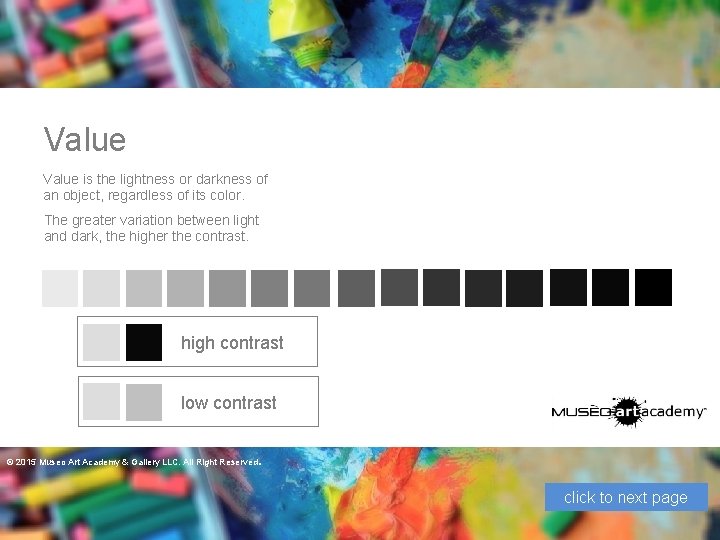
Value is the lightness or darkness of an object, regardless of its color. The greater variation between light and dark, the higher the contrast. high contrast low contrast © 2015 Museo Art Academy & Gallery LLC. All Right Reserved . click to next page
Art Elements Color Form Line © 2015 Museo Art Academy & Gallery LLC. All Right Reserved Texture Value Shape Space . click to next page
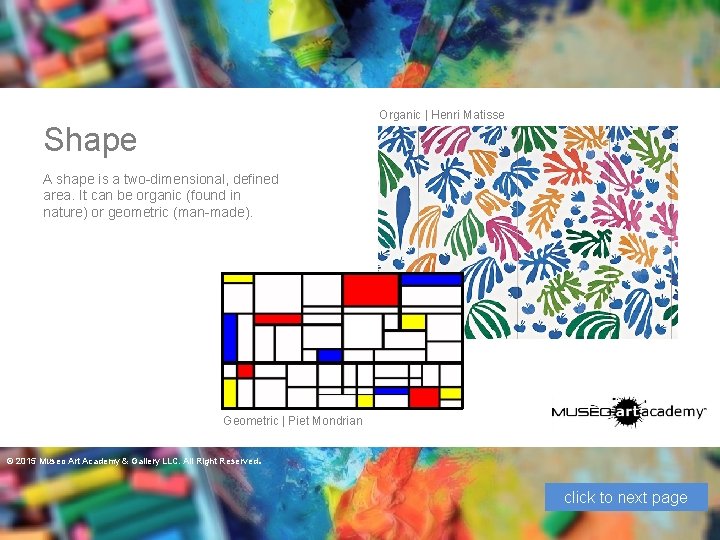
Organic | Henri Matisse Shape A shape is a two-dimensional, defined area. It can be organic (found in nature) or geometric (man-made). Geometric | Piet Mondrian © 2015 Museo Art Academy & Gallery LLC. All Right Reserved . click to next page
Art Elements Color Form Line © 2015 Museo Art Academy & Gallery LLC. All Right Reserved Texture Value Shape Space . click to next page
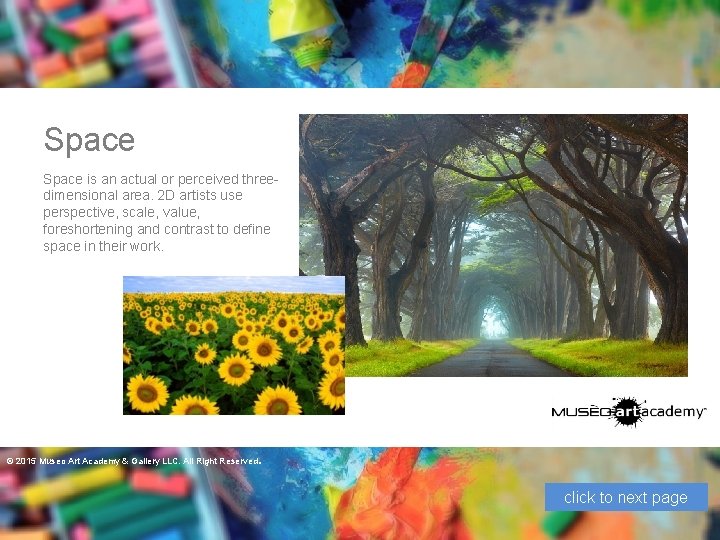
Space is an actual or perceived threedimensional area. 2 D artists use perspective, scale, value, foreshortening and contrast to define space in their work. © 2015 Museo Art Academy & Gallery LLC. All Right Reserved . click to next page
Design Principles © 2015 Museo Art Academy & Gallery LLC. All Right Reserved . click to next page
Design Principles Balance Contrast Pattern © 2015 Museo Art Academy & Gallery LLC. All Right Reserved Emphasis Rhythm Movement Unity . click to next page
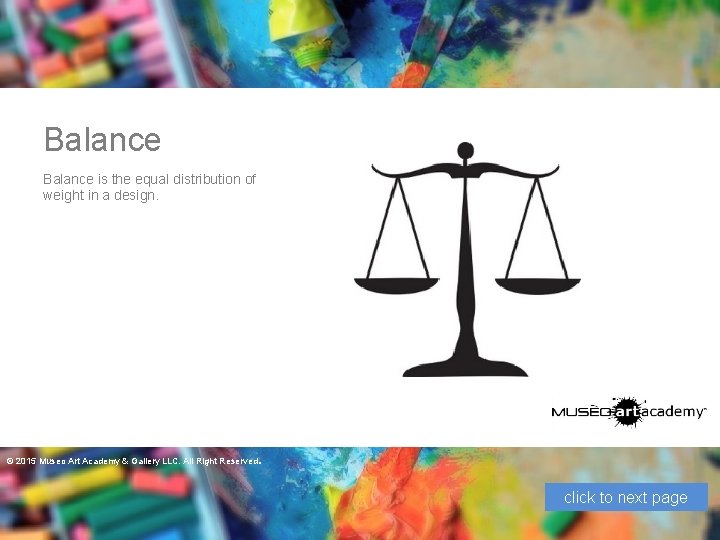
Balance is the equal distribution of weight in a design. © 2015 Museo Art Academy & Gallery LLC. All Right Reserved . click to next page
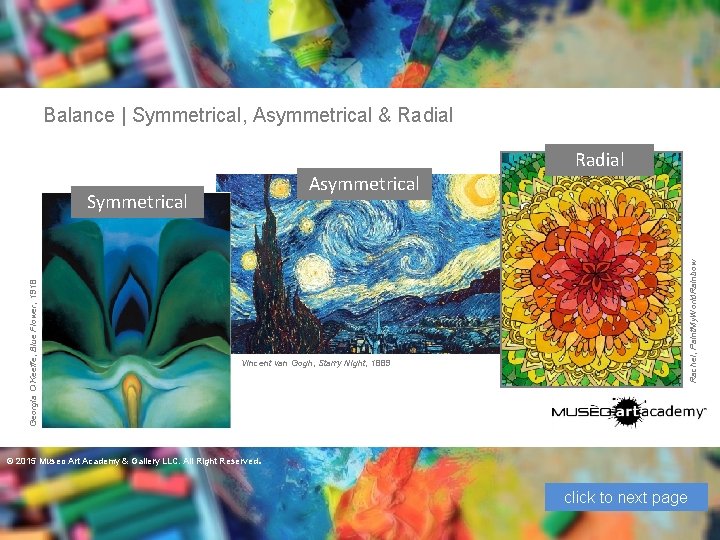
Balance | Symmetrical, Asymmetrical & Radial Georgia O’Keeffe, Blue Flower, 1918 Symmetrical Rachel, Paint. My. World. Rainbow Asymmetrical Radial Vincent van Gogh, Starry Night, 1889 © 2015 Museo Art Academy & Gallery LLC. All Right Reserved . click to next page
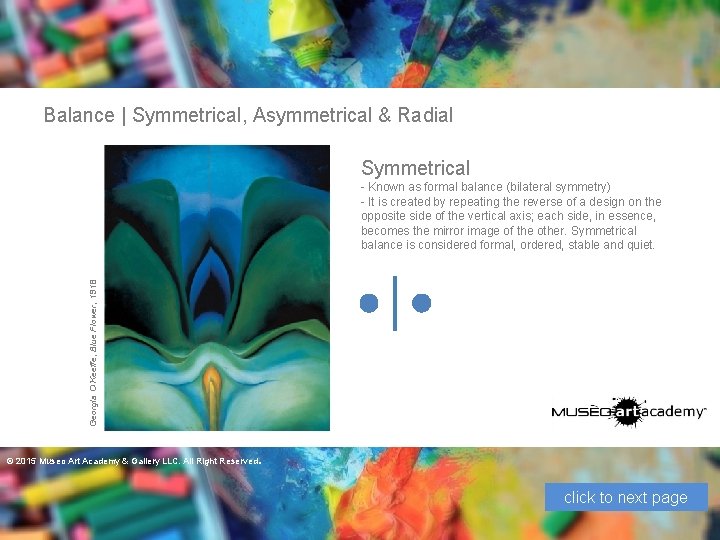
Balance | Symmetrical, Asymmetrical & Radial Symmetrical Georgia O’Keeffe, Blue Flower, 1918 - Known as formal balance (bilateral symmetry) - It is created by repeating the reverse of a design on the opposite side of the vertical axis; each side, in essence, becomes the mirror image of the other. Symmetrical balance is considered formal, ordered, stable and quiet. © 2015 Museo Art Academy & Gallery LLC. All Right Reserved . click to next page
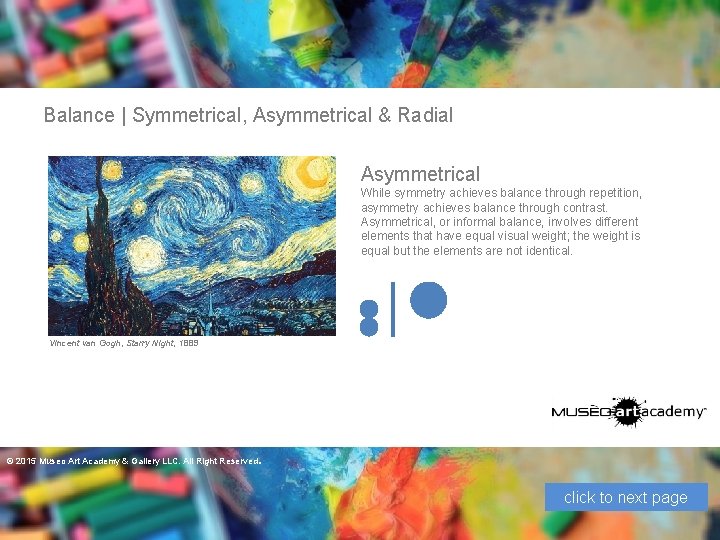
Balance | Symmetrical, Asymmetrical & Radial Asymmetrical While symmetry achieves balance through repetition, asymmetry achieves balance through contrast. Asymmetrical, or informal balance, involves different elements that have equal visual weight; the weight is equal but the elements are not identical. Vincent van Gogh, Starry Night, 1889 © 2015 Museo Art Academy & Gallery LLC. All Right Reserved . click to next page
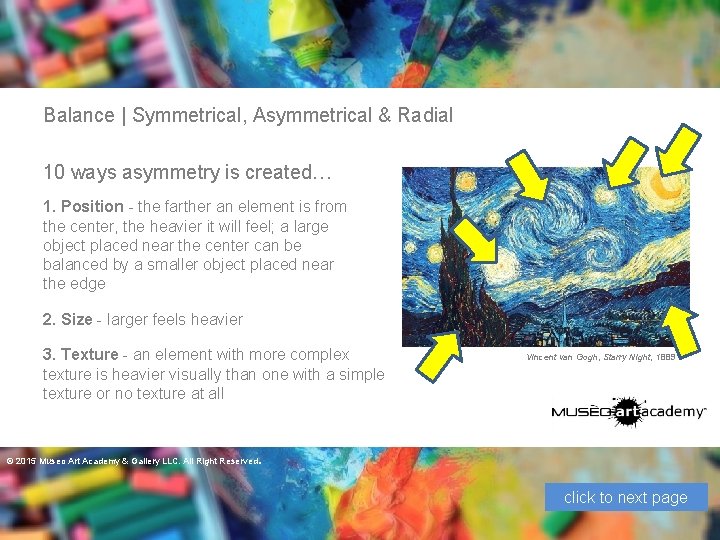
Balance | Symmetrical, Asymmetrical & Radial 10 ways asymmetry is created… 1. Position - the farther an element is from the center, the heavier it will feel; a large object placed near the center can be balanced by a smaller object placed near the edge 2. Size - larger feels heavier 3. Texture - an element with more complex texture is heavier visually than one with a simple texture or no texture at all © 2015 Museo Art Academy & Gallery LLC. All Right Reserved Vincent van Gogh, Starry Night, 1889 . click to next page
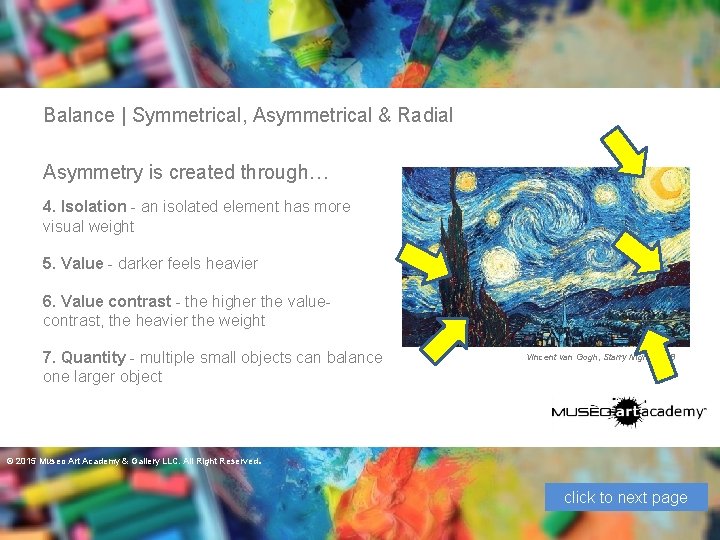
Balance | Symmetrical, Asymmetrical & Radial Asymmetry is created through… 4. Isolation - an isolated element has more visual weight 5. Value - darker feels heavier 6. Value contrast - the higher the valuecontrast, the heavier the weight 7. Quantity - multiple small objects can balance one larger object © 2015 Museo Art Academy & Gallery LLC. All Right Reserved Vincent van Gogh, Starry Night, 1889 . click to next page
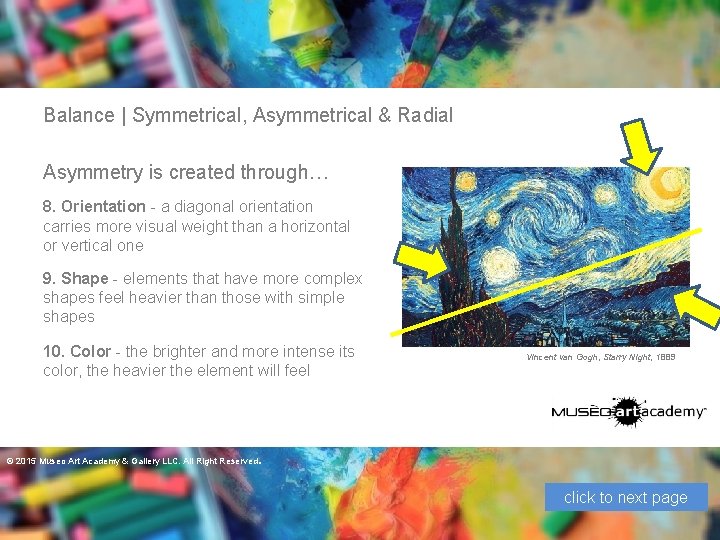
Balance | Symmetrical, Asymmetrical & Radial Asymmetry is created through… 8. Orientation - a diagonal orientation carries more visual weight than a horizontal or vertical one 9. Shape - elements that have more complex shapes feel heavier than those with simple shapes 10. Color - the brighter and more intense its color, the heavier the element will feel © 2015 Museo Art Academy & Gallery LLC. All Right Reserved Vincent van Gogh, Starry Night, 1889 . click to next page
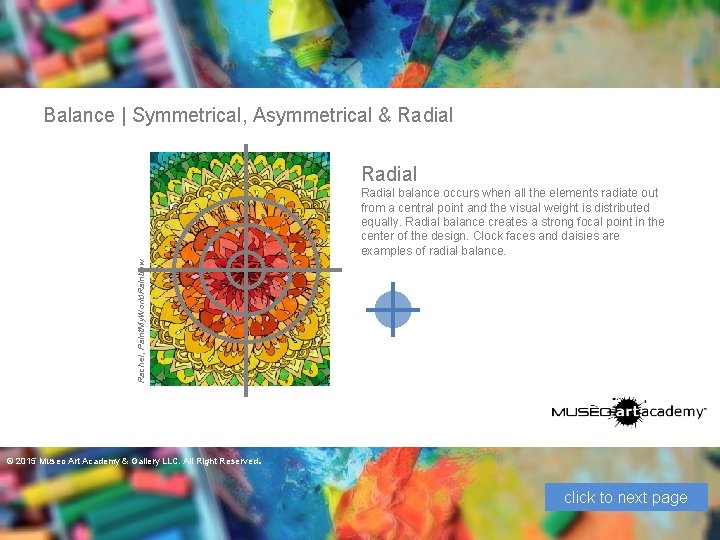
Balance | Symmetrical, Asymmetrical & Radial Rachel, Paint. My. World. Rainbow Radial balance occurs when all the elements radiate out from a central point and the visual weight is distributed equally. Radial balance creates a strong focal point in the center of the design. Clock faces and daisies are examples of radial balance. © 2015 Museo Art Academy & Gallery LLC. All Right Reserved . click to next page
Design Principles Balance Contrast Pattern © 2015 Museo Art Academy & Gallery LLC. All Right Reserved Emphasis Rhythm Movement Unity . click to next page
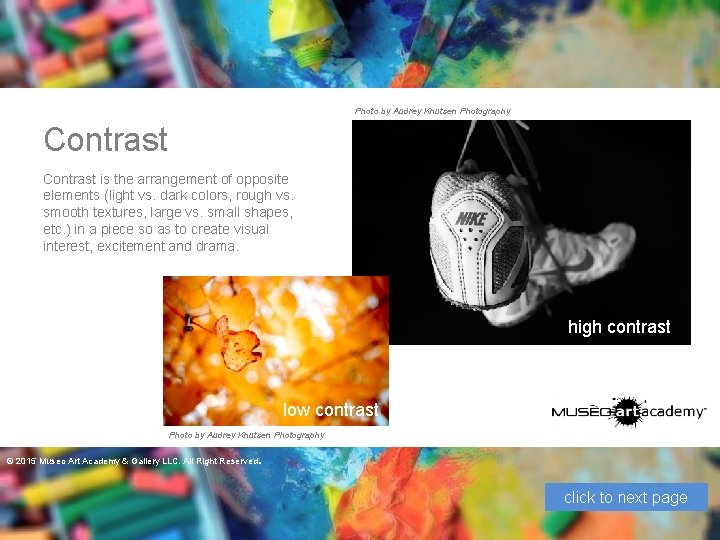
Photo by Audrey Knutsen Photography Contrast is the arrangement of opposite elements (light vs. dark colors, rough vs. smooth textures, large vs. small shapes, etc. ) in a piece so as to create visual interest, excitement and drama. high contrast low contrast Photo by Audrey Knutsen Photography © 2015 Museo Art Academy & Gallery LLC. All Right Reserved . click to next page
Design Principles Balance Contrast Pattern © 2015 Museo Art Academy & Gallery LLC. All Right Reserved Emphasis Rhythm Movement Unity . click to next page
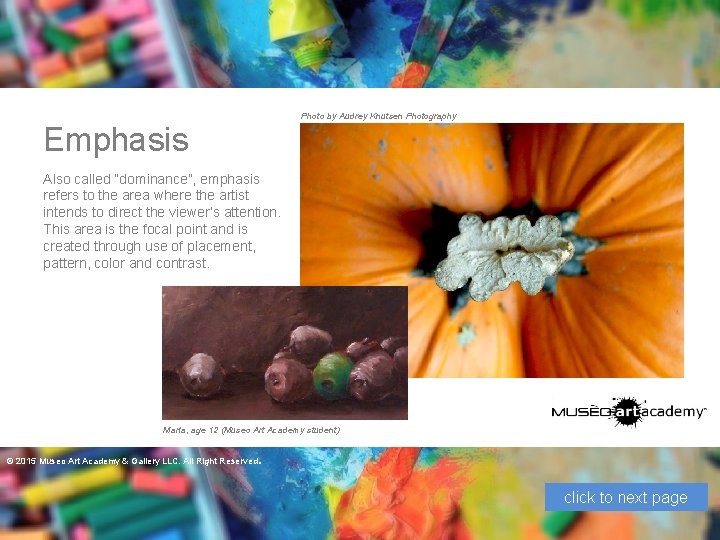
Photo by Audrey Knutsen Photography Emphasis Also called “dominance”, emphasis refers to the area where the artist intends to direct the viewer’s attention. This area is the focal point and is created through use of placement, pattern, color and contrast. Maria, age 12 (Museo Art Academy student) © 2015 Museo Art Academy & Gallery LLC. All Right Reserved . click to next page
Design Principles Balance Contrast Pattern © 2015 Museo Art Academy & Gallery LLC. All Right Reserved Emphasis Rhythm Movement Unity . click to next page
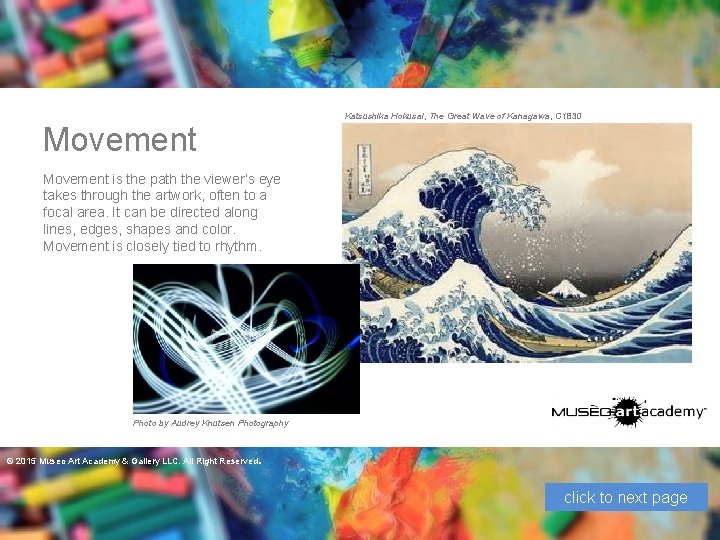
Katsushika Hokusai, The Great Wave of Kanagawa, C 1830 Movement is the path the viewer’s eye takes through the artwork, often to a focal area. It can be directed along lines, edges, shapes and color. Movement is closely tied to rhythm. Photo by Audrey Knutsen Photography © 2015 Museo Art Academy & Gallery LLC. All Right Reserved . click to next page
Design Principles Balance Contrast Pattern © 2015 Museo Art Academy & Gallery LLC. All Right Reserved Emphasis Rhythm Movement Unity . click to next page
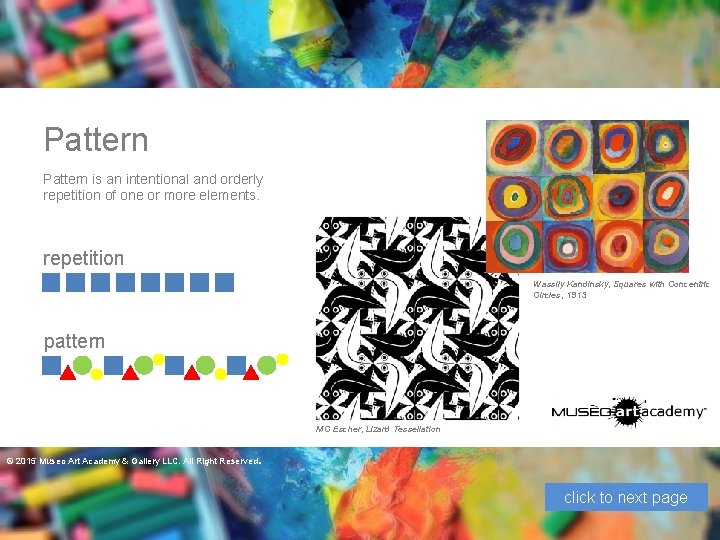
Pattern is an intentional and orderly repetition of one or more elements. repetition Wassily Kandinsky, Squares with Concentric Circles, 1913 pattern MC Escher, Lizard Tessellation © 2015 Museo Art Academy & Gallery LLC. All Right Reserved . click to next page
Design Principles Balance Contrast Pattern © 2015 Museo Art Academy & Gallery LLC. All Right Reserved Emphasis Rhythm Movement Unity . click to next page
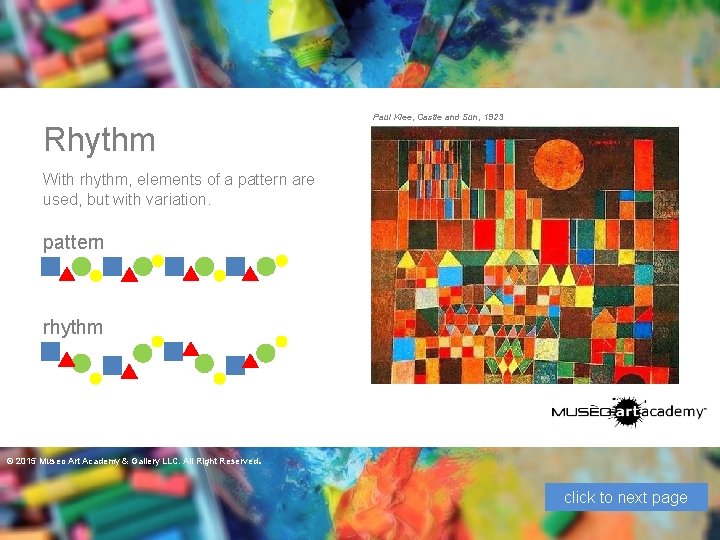
Paul Klee, Castle and Sun, 1923 Rhythm With rhythm, elements of a pattern are used, but with variation. pattern rhythm © 2015 Museo Art Academy & Gallery LLC. All Right Reserved . click to next page
Design Principles Balance Contrast Pattern © 2015 Museo Art Academy & Gallery LLC. All Right Reserved Emphasis Rhythm Movement Unity . click to next page
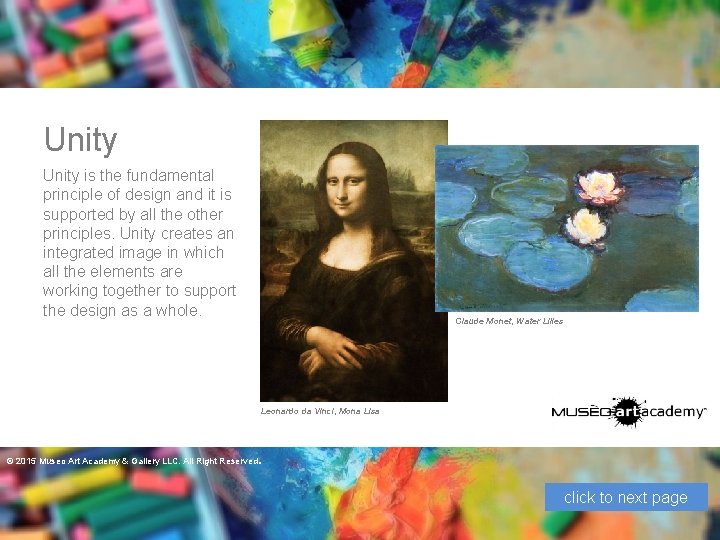
Unity is the fundamental principle of design and it is supported by all the other principles. Unity creates an integrated image in which all the elements are working together to support the design as a whole. Claude Monet, Water Lilies Leonardo da Vinci, Mona Lisa © 2015 Museo Art Academy & Gallery LLC. All Right Reserved . click to next page
presented by Museo Art Academy cultivating creativity and individual expression in each and every student Museo. Art. com | Museo. Art. Academy@Live. com | 425. 391. 0244 © 2015 Museo Art Academy & Gallery LLC. All Right Reserved .