
A Guided Pathways Mosaic Breakout Session 4 4
A Guided Pathways Mosaic Breakout Session 4 | 4: 30 -5: 30
Presenters Janet Fulks, ASCCC Guided Pathways Task Force Co-Chair Jeffrey Hernandez, ASCCC Guided Pathways Task Force Lead Ginni May, ASCCC Vice President, Guided Pathways Task Force Co-Chair ASCCC Fall Plenary Session 2020
Breakout Description As funding for the Guided Pathways Award Program is winding down (really, when? ), it may be time for a self-assessment. What has been accomplished? What still needs to be done? How will we keep going with redesign efforts that utilize data and advance equity? Join this session for an update on the goals of the ASCCC Guided Pathways Task Force, learn how and why the ASCCC is integrating its Guided Pathways work into its committee structures, and share ideas about what might be done at the local level to sustain momentum of the college-wide redesign resulting from implementing Guided Pathways frameworks. ASCCC Fall Plenary Session 2020
Overview • Guided Pathways Award Program: recap and update on program and funding • Assessing the state of your college’s Guided Pathways efforts: • • • Optimizing Student Success Scale of Adoption Assessment (SOAA) Examining data other means… Activity • ASCCC Guided Pathways Goals • ASCCC Guided Pathways Integration Plan • Integrating Guided Pathways into your college structures Theme: Successful integration will be needed to sustain data-informed redesign that enhances equity. ASCCC Fall Plenary Session 2020
![California Community Colleges Guided Pathways Grant [Award] Program: Funding • Overall funding (https: //www.](http://slidetodoc.com/presentation_image_h2/5db834c14fd67be594bbf2d34d71a657/image-5.jpg "California Community Colleges Guided Pathways Grant [Award] Program: Funding • Overall funding (https: //www.")
California Community Colleges Guided Pathways Grant [Award] Program: Funding • Overall funding (https: //www. cccco. edu/-/media/CCCCO-Website/Files/Guided-Pathways/guidedpathways-program-faqs-10 -16 -17. pdf) • 20% distributed equally among all participating colleges • 35% distributed based on the percentage of FTES at each participating college • 45% distributed based on the percentage of Pell Grants students at each participating college • $150 million allocated for Guided Pathways was more heavily invested to colleges earlier during the five-year period, allocated incrementally through June 30, 2022. • Funding by college: https: //ccconlineed. instructure. com/courses/2634/files/477128/download? wrap=1 • Year 1: 25% Year 2: 30% Year 3: 25% Year 4: 10% Year 5: 10% ASCCC Fall Plenary Session 2020
Spring 2019 Resolution 05. 02 https: //asccc. org/resolutions/guided-pathways-budget-development Resolved, That the ASCCC: • urge local senates to ensure collegial and transparent guided pathways budget development…; • work with system partners to ensure collegiality and transparency in local guided pathways budget development processes; and • work with the CCCCO and system partners to make available information regarding how statewide resources have been invested in the design and implementation of guided pathways. ASCCC Fall Plenary Session 2020
![Allocation of Statewide Resources • The California Community Colleges Grant [Award] Program allocated $150](http://slidetodoc.com/presentation_image_h2/5db834c14fd67be594bbf2d34d71a657/image-7.jpg "Allocation of Statewide Resources • The California Community Colleges Grant [Award] Program allocated $150")
Allocation of Statewide Resources • The California Community Colleges Grant [Award] Program allocated $150 M with $135 M designated for colleges • $108 M was allocated to 114 colleges during years 1 through 3 • $15 M expended to CCCCO for indirect support from 2018 through the end of 2020 • Additional CCCCO directed funds have been drawn from both IEPI, and the SEA Program $40 M 1. 2. 3. 4. Technology, Communication and Outreach ($16 M) Technical Assistance and Professional Development ($18 M) Staffing such as Consultants, Employees and Advisors ($16 M) Projects and Events such as MMAP, College Roadtrip, etc. ($5 M)
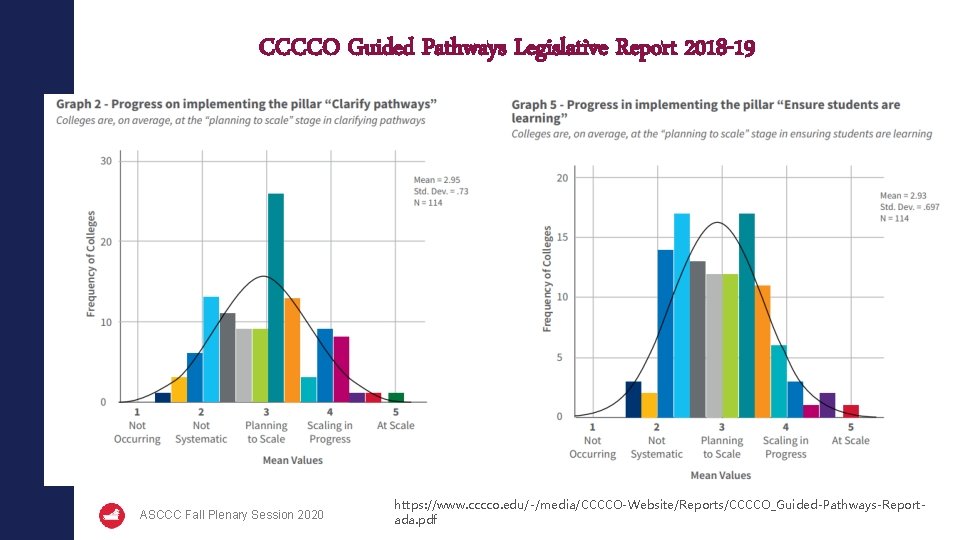
CCCCO Guided Pathways Legislative Report 2018 -19 ASCCC Fall Plenary Session 2020 https: //www. cccco. edu/-/media/CCCCO-Website/Reports/CCCCO_Guided-Pathways-Reportada. pdf
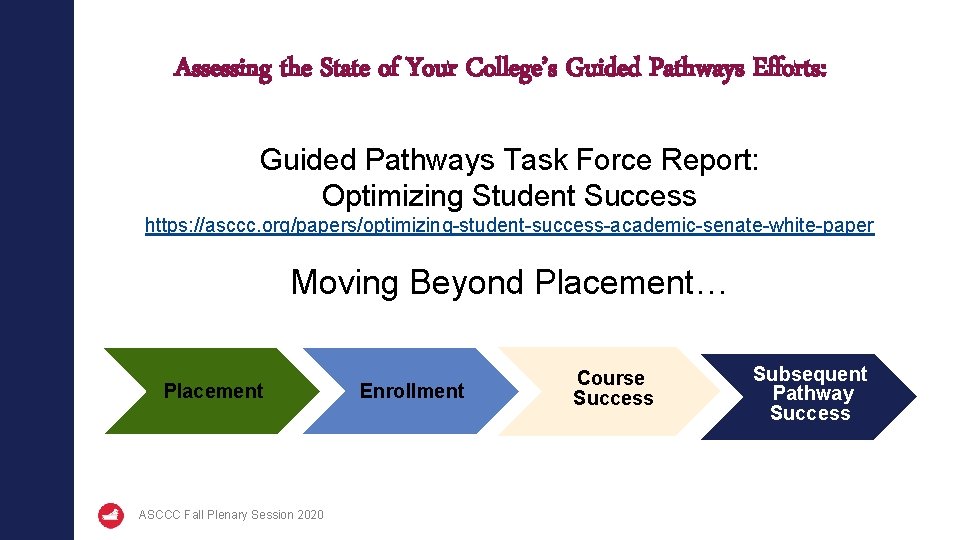
Assessing the State of Your College’s Guided Pathways Efforts: Guided Pathways Task Force Report: Optimizing Student Success https: //asccc. org/papers/optimizing-student-success-academic-senate-white-paper Moving Beyond Placement… Placement ASCCC Fall Plenary Session 2020 Enrollment Course Success Subsequent Pathway Success
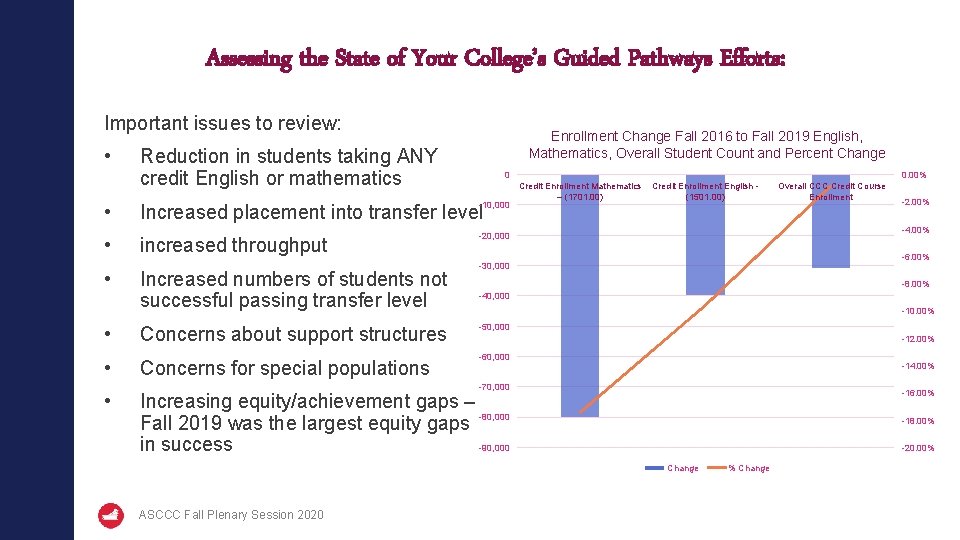
Assessing the State of Your College’s Guided Pathways Efforts: Important issues to review: • • Enrollment Change Fall 2016 to Fall 2019 English, Mathematics, Overall Student Count and Percent Change Reduction in students taking ANY credit English or mathematics 0 -10, 000 Increased placement into transfer level increased throughput Increased numbers of students not successful passing transfer level Concerns about support structures Concerns for special populations 0. 00% Credit Enrollment Mathematics – (1701. 00) Credit Enrollment English (1501. 00) -2. 00% -4. 00% -20, 000 -6. 00% -30, 000 -8. 00% -40, 000 -10. 00% -50, 000 -12. 00% -60, 000 -14. 00% -70, 000 -16. 00% Increasing equity/achievement gaps – Fall 2019 was the largest equity gaps -80, 000 -90, 000 in success -18. 00% -20. 00% Change ASCCC Fall Plenary Session 2020 Overall CCC Credit Course Enrollment % Change
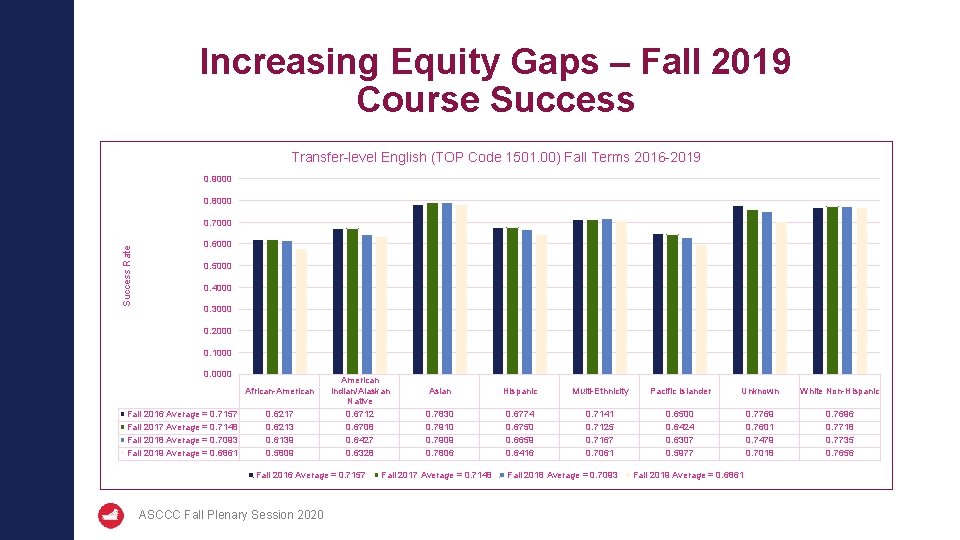
Increasing Equity Gaps – Fall 2019 Course Success Transfer-level English (TOP Code 1501. 00) Fall Terms 2016 -2019 0. 9000 0. 8000 Success Rate 0. 7000 0. 6000 0. 5000 0. 4000 0. 3000 0. 2000 0. 1000 0. 0000 African-American Fall 2016 Average = 0. 7157 Fall 2017 Average = 0. 7148 Fall 2018 Average = 0. 7093 Fall 2019 Average = 0. 6861 0. 6217 0. 6213 0. 6139 0. 5809 American Indian/Alaskan Native 0. 6712 0. 6708 0. 6427 0. 6328 Fall 2016 Average = 0. 7157 ASCCC Fall Plenary Session 2020 Asian Hispanic Multi-Ethnicity Pacific Islander Unknown White Non-Hispanic 0. 7830 0. 7910 0. 7909 0. 7806 0. 6774 0. 6750 0. 6659 0. 6416 0. 7141 0. 7125 0. 7167 0. 7061 0. 6500 0. 6424 0. 6307 0. 5977 0. 7769 0. 7601 0. 7479 0. 7018 0. 7696 0. 7718 0. 7735 0. 7656 Fall 2017 Average = 0. 7148 Fall 2018 Average = 0. 7093 Fall 2019 Average = 0. 6861
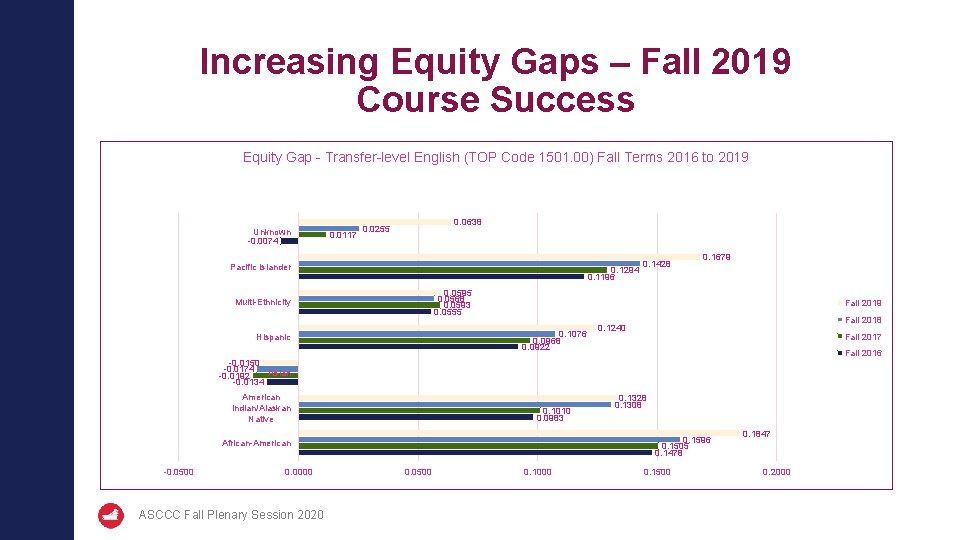
Increasing Equity Gaps – Fall 2019 Course Success Equity Gap - Transfer-level English (TOP Code 1501. 00) Fall Terms 2016 to 2019 Unknown -0. 0074 0. 0117 0. 0638 0. 0255 Pacific Islander 0. 1294 0. 1196 0. 1428 0. 1679 0. 0595 0. 0568 0. 0593 0. 0555 Multi-Ethnicity Fall 2019 0. 1076 0. 0968 0. 0922 Hispanic Fall 2018 0. 1240 Fall 2017 Fall 2016 -0. 0150 -0. 0174 Asian -0. 0192 -0. 0134 American Indian/Alaskan Native 0. 1010 0. 0983 0. 1596 0. 1505 0. 1478 African-American -0. 0500 0. 0000 ASCCC Fall Plenary Session 2020 0. 1328 0. 1308 0. 0500 0. 1000 0. 1500 0. 1847 0. 2000
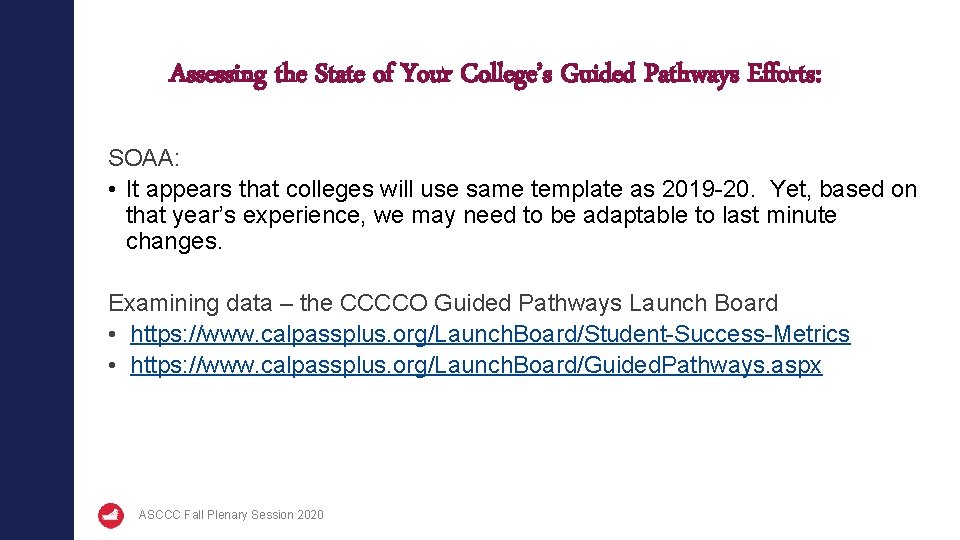
Assessing the State of Your College’s Guided Pathways Efforts: SOAA: • It appears that colleges will use same template as 2019 -20. Yet, based on that year’s experience, we may need to be adaptable to last minute changes. Examining data – the CCCCO Guided Pathways Launch Board • https: //www. calpassplus. org/Launch. Board/Student-Success-Metrics • https: //www. calpassplus. org/Launch. Board/Guided. Pathways. aspx ASCCC Fall Plenary Session 2020
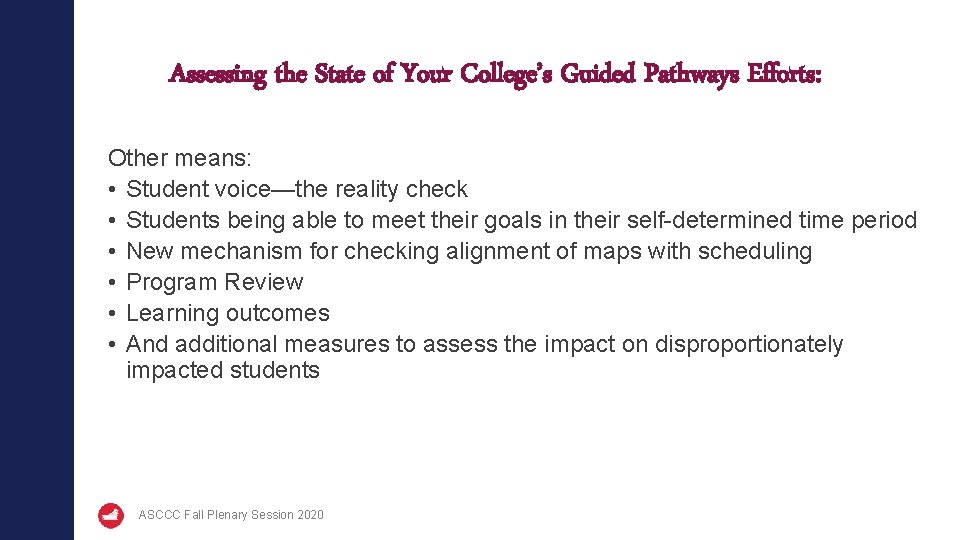
Assessing the State of Your College’s Guided Pathways Efforts: Other means: • Student voice—the reality check • Students being able to meet their goals in their self-determined time period • New mechanism for checking alignment of maps with scheduling • Program Review • Learning outcomes • And additional measures to assess the impact on disproportionately impacted students ASCCC Fall Plenary Session 2020
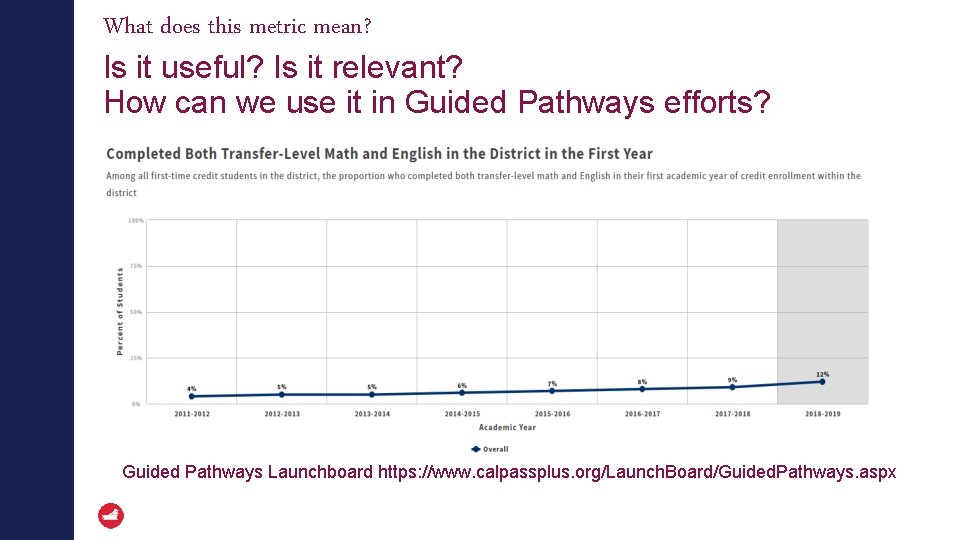
What does this metric mean? Is it useful? Is it relevant? How can we use it in Guided Pathways efforts? Guided Pathways Launchboard https: //www. calpassplus. org/Launch. Board/Guided. Pathways. aspx
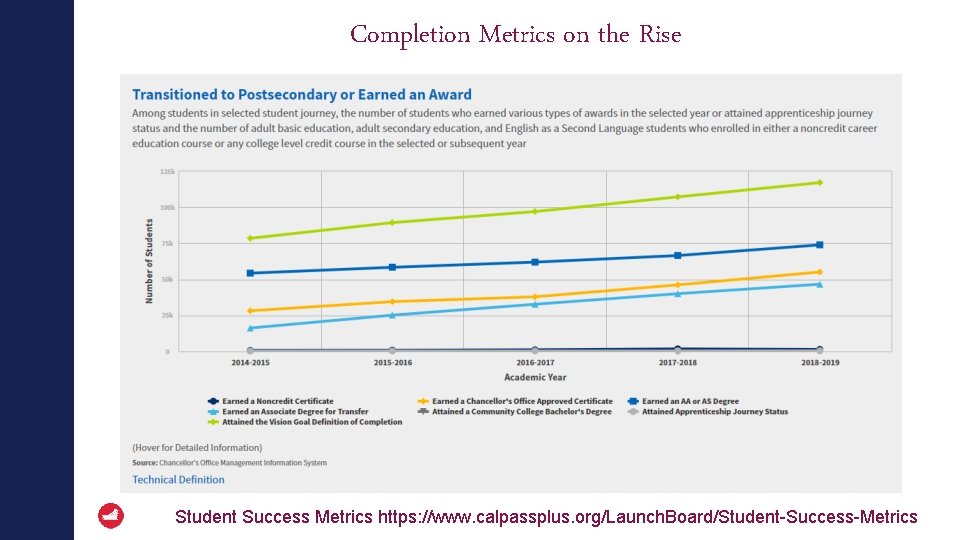
Completion Metrics on the Rise Student Success Metrics https: //www. calpassplus. org/Launch. Board/Student-Success-Metrics
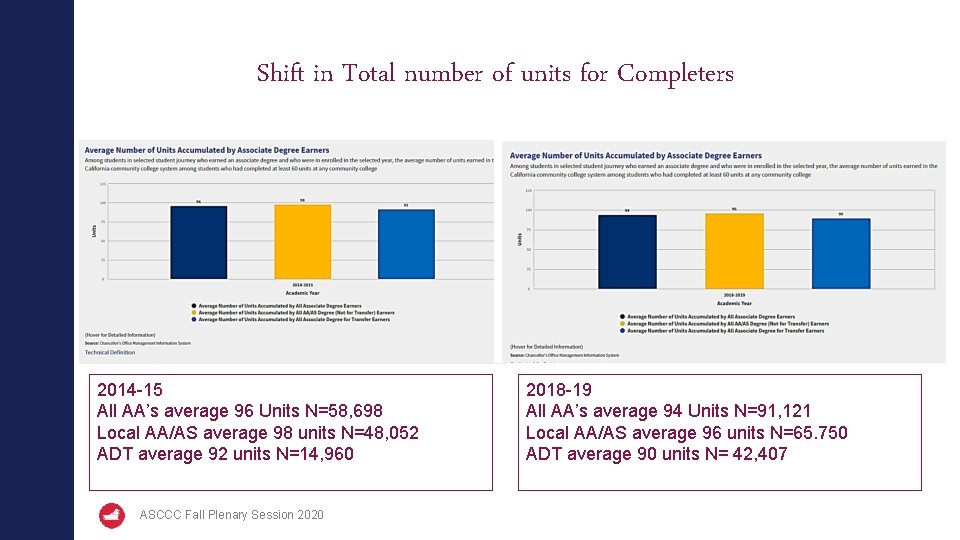
Shift in Total number of units for Completers 2014 -15 All AA’s average 96 Units N=58, 698 Local AA/AS average 98 units N=48, 052 ADT average 92 units N=14, 960 ASCCC Fall Plenary Session 2020 2018 -19 All AA’s average 94 Units N=91, 121 Local AA/AS average 96 units N=65. 750 ADT average 90 units N= 42, 407
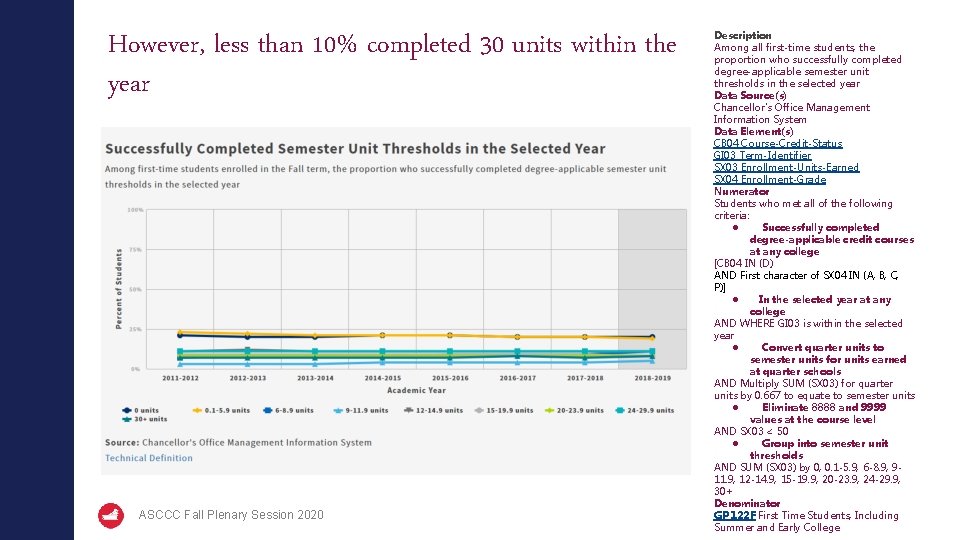
However, less than 10% completed 30 units within the year ASCCC Fall Plenary Session 2020 Description Among all first-time students, the proportion who successfully completed degree-applicable semester unit thresholds in the selected year Data Source(s) Chancellor's Office Management Information System Data Element(s) CB 04 Course-Credit-Status GI 03 Term-Identifier SX 03 Enrollment-Units-Earned SX 04 Enrollment-Grade Numerator Students who met all of the following criteria: ● Successfully completed degree-applicable credit courses at any college [CB 04 IN (D) AND First character of SX 04 IN (A, B, C, P)] ● In the selected year at any college AND WHERE GI 03 is within the selected year ● Convert quarter units to semester units for units earned at quarter schools AND Multiply SUM (SX 03) for quarter units by 0. 667 to equate to semester units ● Eliminate 8888 and 9999 values at the course level AND SX 03 < 50 ● Group into semester unit thresholds AND SUM (SX 03) by 0, 0. 1 -5. 9, 6 -8. 9, 911. 9, 12 -14. 9, 15 -19. 9, 20 -23. 9, 24 -29. 9, 30+ Denominator GP 122 F First Time Students, Including Summer and Early College
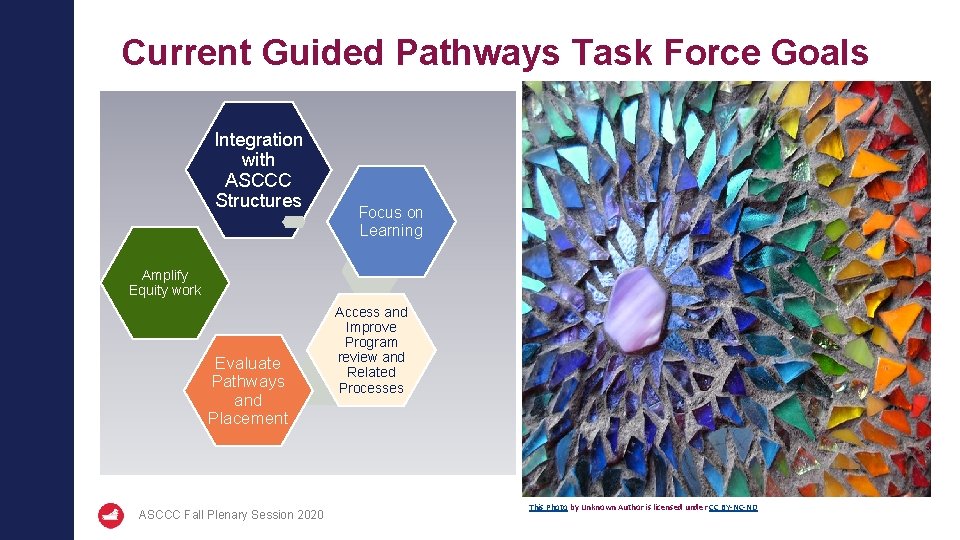
Current Guided Pathways Task Force Goals Integration with ASCCC Structures Focus on Learning Amplify Equity work Evaluate Pathways and Placement ASCCC Fall Plenary Session 2020 Access and Improve Program review and Related Processes This Photo by Unknown Author is licensed under CC BY-NC-ND

ession 2020
ASCCC Guided Pathways Integration Plan • ASCCC Executive Committee—Integration Plan Report • ASCCC Grant for GP work ends December 2020 • Standing Committee chairs or 2 nds serving on GPTF • Outcomes of November 4 Executive Committee Meeting • GPTF Goals (fall 2020) • Optimizing Student Success Report: Evaluating Pathways and Placement, Amplify Equity Work • The Fall 2020 Academic Academy highlighting OERI courses: Focus on Ensuring Learning, Amplify Equity Work • Guided Pathways Webinars: All five • Rostrum Articles: Amplify Equity Work, Evaluating Pathways and Placement, Assess and Improve Program Review and Related Processes • College Visits: All five ASCCC Fall Plenary Session 2020
Integrating Guided Pathways into Your College Structures • • • Review existing committee charges Examine role of GP and where the goals should be expanded Consider adding or swapping out committee members Consider program review goals and data How is GP driving funding discussions Where do/should these discussions take place at your college? (Type your answer in the chat. ) ASCCC Fall Plenary Session 2020

QUESTIONS? ASCCC Fall Plenary Session 2020
Resources • ASCCC Information: info@asccc. org • GPTF Report: Optimizing Student Success https: //asccc. org/papers/optimizing-student-success-academic-senate-whitepaper • GP Allocation memo: https: //www. cccco. edu/-/media/CCCCOWebsite/Files/Guided-Pathways/guided-pathways-program-faqs-10 -16 -17. pdf • SOAA FAQs: https: //www. cccco. edu/-/media/CCCCO-Website/Files/Guided. Pathways/scale-of-adoption-assessment-faqs-011520 -a 11 y. pdf • CCCCO 2018 -19 report on GP: https: //www. cccco. edu/-/media/CCCCOWebsite/Reports/CCCCO_Guided-Pathways-Report-ada. pdf • Student Success Metrics: https: //www. calpassplus. org/Launch. Board/Student. Success-Metrics • Guided Pathways Launchboard Metrics: https: //www. calpassplus. org/Launch. Board/Guided. Pathways. aspx ASCCC Fall Plenary Session 2020
- Slides: 24