
A Guided ActiveLearning Activity for SophomoreLevel Library Experiences
A Guided Active-Learning Activity for Sophomore-Level Library Experiences by Caroline Geck, Kean University Librarian Ø My presentation describes the process of creating an active-learning exercise that can be used in place of a traditional library instruction session (a lecture and hands-on experiences) for sophomore-level Research and Technology general education courses, especially when I serve as a traveling librarian and visit the students’ classroom labs.
My Goal Ø I wanted to design an activity that meets a major learning goal for a research-geared course like that of Research and Technology. Ø I decided to focus on further developing students’ metacognitive schemas or strategies for scholarly article identification. (The recognition of the difference between scholarly journals and trade and popular magazines also meets ACRL Information Literacy Competency Standards for Higher Education 1. 2. d and 3. 2. a. )
Meta-Cognitive Schemas? Ø Meta-cognition refers to thinking about one’s thinking. Meta-cognitive schemas can be defined as a process of learning in which individuals build upon their prior knowledge representations or schemas. New learning occurs when new connections are constructed from prior schemas. Ø Meta-cognitive schemas or knowledge representations are also called mind maps and visually represented by concept maps.
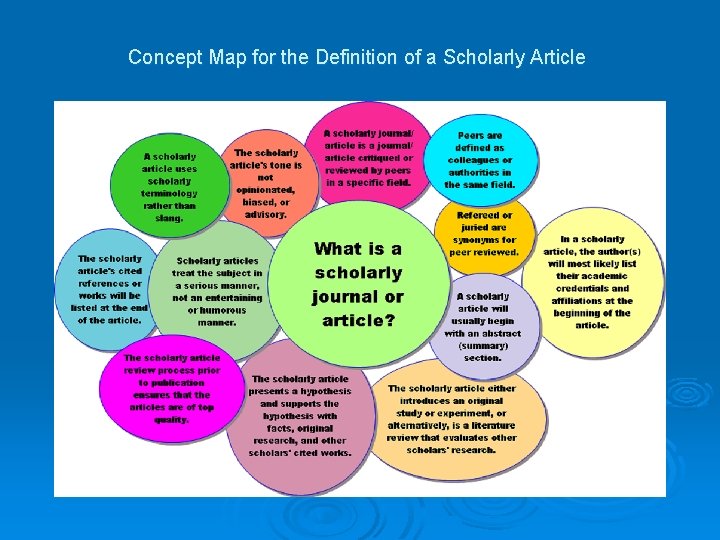
Concept Map for the Definition of a Scholarly Article
Let’s Team Up to Explore Scholarly and Popular Articles Online: An Active-Learning Activity Ø Students work in groups of three to five, and the activity has three explicit objectives: ü ü ü Learning to access electronic resources (E-resources) from the library’s homepage. Being able to distinguish quickly between scholarly and popular articles by noting differences in content, writing styles, and formats. Developing skills in evaluating information while working in multi-window environments. Ø The objectives are followed by brief directions about how to begin retrieving the full texts corresponding to an APA-formatted References list and then completing the worksheet with critical skills questions comparing and contrasting scholarly and non-scholarly items. These questions are then used to answer the final question “Define a scholarly article? ” Ø Students are also told to be prepared to present their worksheet answers to the rest of the class and to give reasons for their choices.
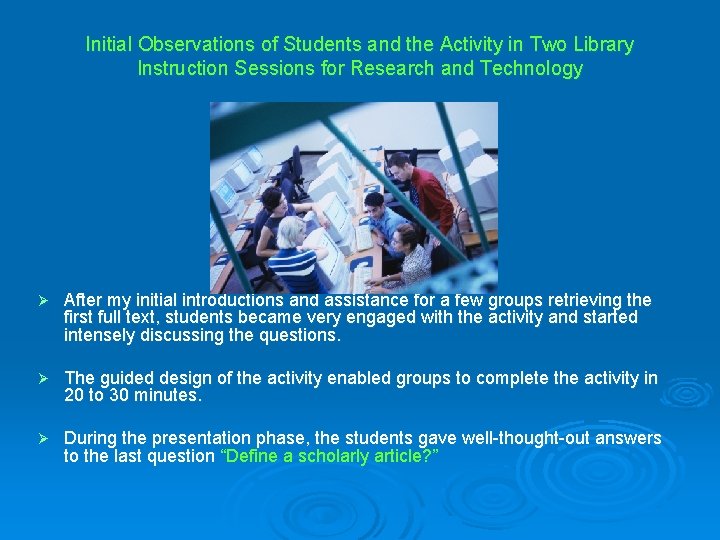
Initial Observations of Students and the Activity in Two Library Instruction Sessions for Research and Technology Ø After my initial introductions and assistance for a few groups retrieving the first full text, students became very engaged with the activity and started intensely discussing the questions. Ø The guided design of the activity enabled groups to complete the activity in 20 to 30 minutes. Ø During the presentation phase, the students gave well-thought-out answers to the last question “Define a scholarly article? ”
Presentations and My Opportunity to Ask Students about the Activity Ø I asked the students if there were too many questions on the worksheet? The overwhelming majority of students said either “no” or that the activity had the right number of questions. Ø I asked the students whether I should use the activity in future classes? Many students commented that they liked the assignment and encouraged me to use the assignment in future classes. Ø Students made comments similar to the statement that they would find scholarly articles in the future to support their research. These comments indicate that the students realized that scholarly articles would lend more support to their research than other types of articles. Ø One student even said that he had “gained new strategies to identify scholarly articles. ”
Unexpected Benefits Ø The active learning exercise seemed to reinvigorate learning and interest in the information seeking process: ü Teams that finished early became very curious about the library’s database page and wanted to know if they could use the same databases for their own projects. Students also asked for database recommendations based on their topic of research. ü Several students commented that they were not aware of these databases and would have liked to been introduced to these databases earlier in their careers. ü Other students asked me about their search strategies and research topics. ü The overwhelmingly majority of students stayed after the activity was completed to conduct their own research.
Some Final Thoughts Ø This activity can be adapted to your own needs in freshmen-level and sophomore-level library experiences and is an example of the integration of information literacy skills directly into the university and college classroom. Ø This activity can also be adapted to an online environment, and its learning benefits can be further enhanced through a combined process of discussion and reflection. Ø Learning can be deepened in a physical classroom or online by letting students generate their own questions for group discussion.

Constructive Learning in Library Instruction: How Does IT Compare With the Traditional Method? Ma Lei Hsieh Monmouth University
Objectives of the Library Instruction Session Students will be able to: Find journal articles in databases Find books in the Library Catalog Use Library Services
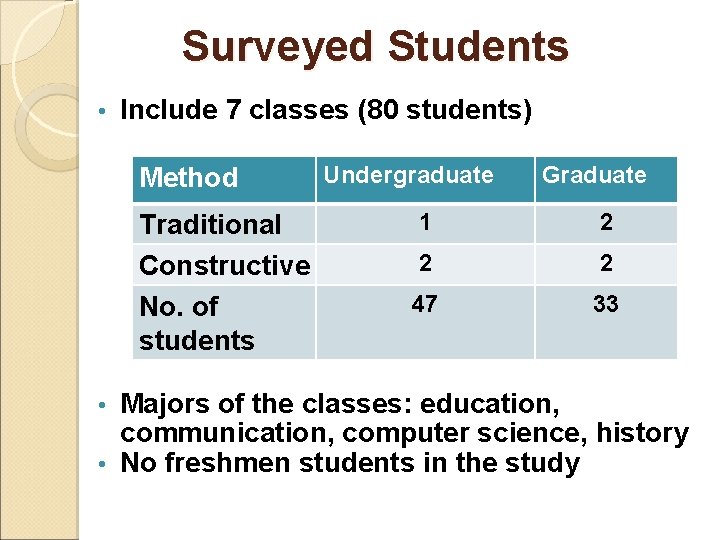
Surveyed Students • Include 7 classes (80 students) Method Traditional Constructive No. of students Undergraduate Graduate 1 2 2 2 47 33 Majors of the classes: education, communication, computer science, history • No freshmen students in the study •
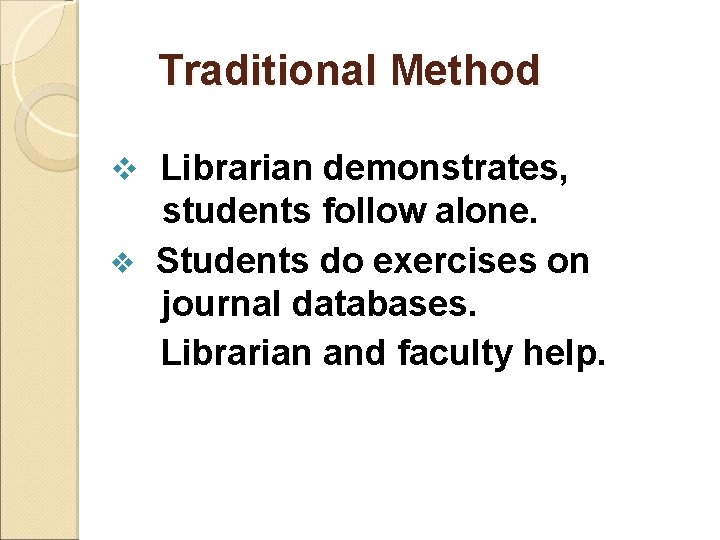
Traditional Method v Librarian demonstrates, students follow alone. v Students do exercises on journal databases. Librarian and faculty help.
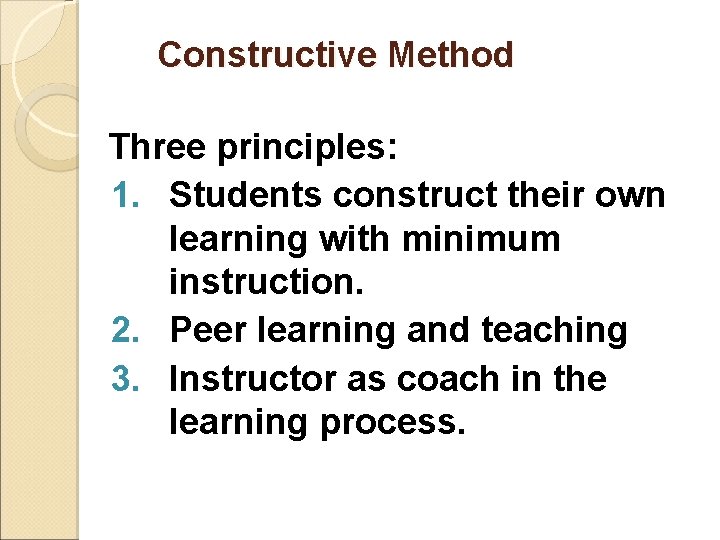
Constructive Method Three principles: 1. Students construct their own learning with minimum instruction. 2. Peer learning and teaching 3. Instructor as coach in the learning process.
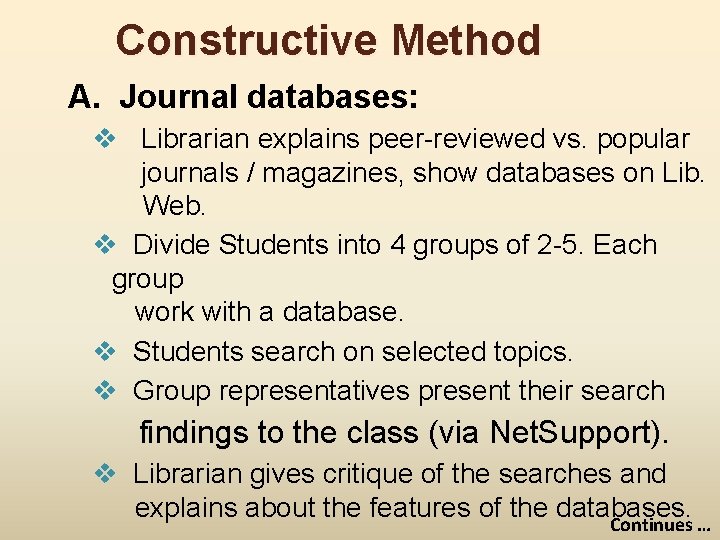
Constructive Method A. Journal databases: v Librarian explains peer-reviewed vs. popular journals / magazines, show databases on Lib. Web. v Divide Students into 4 groups of 2 -5. Each group work with a database. v Students search on selected topics. v Group representatives present their search findings to the class (via Net. Support). v Librarian gives critique of the searches and explains about the features of the databases. Continues …
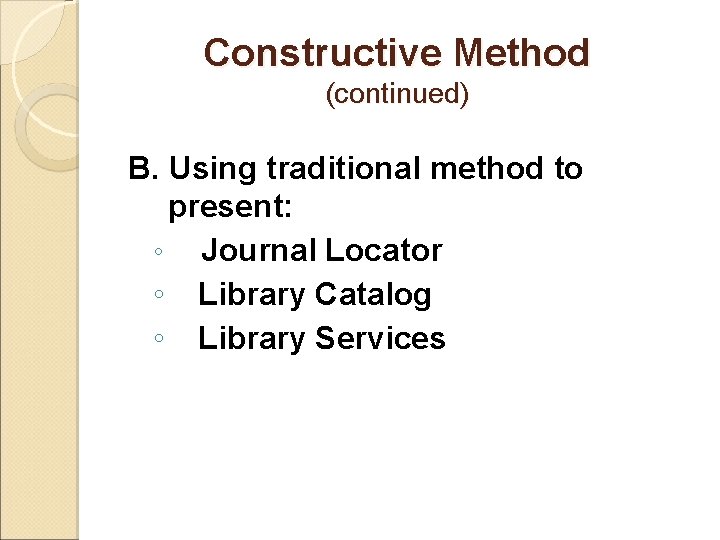
Constructive Method (continued) B. Using traditional method to present: ◦ Journal Locator ◦ Library Catalog ◦ Library Services
Evaluation All classes give evaluation at the end: 1. Grade level 2. Had a Library Instruction (ILI) Before? 3. Three things learned in this session. 4. What still confused you. 5. Met your expectations?
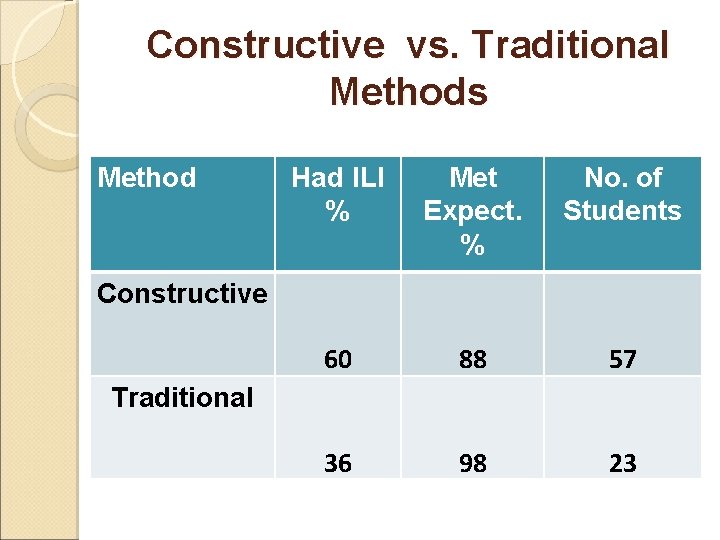
Constructive vs. Traditional Methods Method Had ILI % Met Expect. % No. of Students 60 88 57 36 98 23 Constructive Traditional
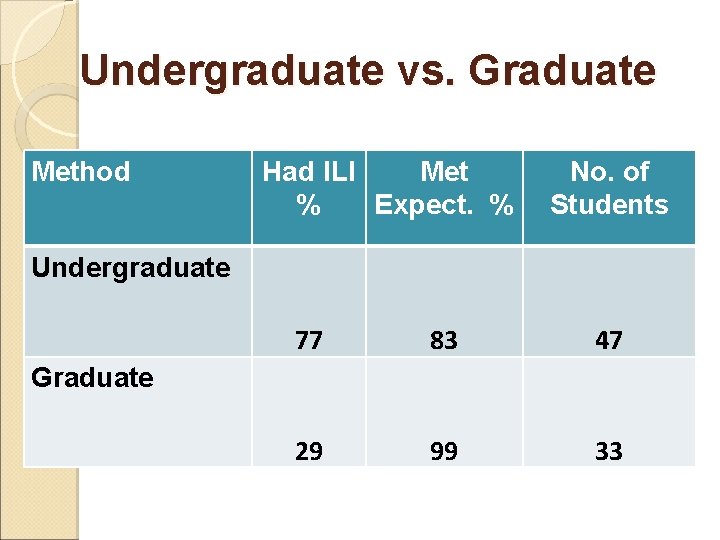
Undergraduate vs. Graduate Method Had ILI Met % Expect. % No. of Students Undergraduate 77 83 47 29 99 33 Graduate
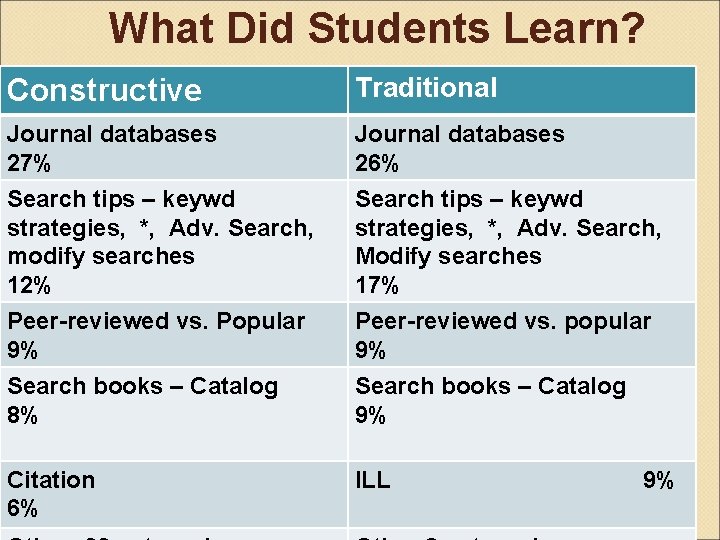
What Did Students Learn? Constructive Traditional Journal databases 27% Search tips – keywd strategies, *, Adv. Search, modify searches 12% Journal databases 26% Search tips – keywd strategies, *, Adv. Search, Modify searches 17% Peer-reviewed vs. Popular 9% Search books – Catalog 8% Peer-reviewed vs. popular 9% Search books – Catalog 9% Citation 6% ILL 9%
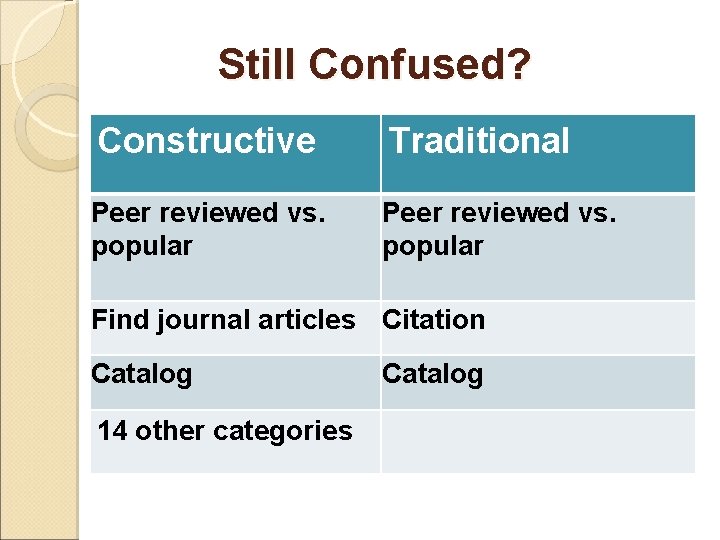
Still Confused? Constructive Traditional Peer reviewed vs. popular Find journal articles Citation Catalog 14 other categories Catalog
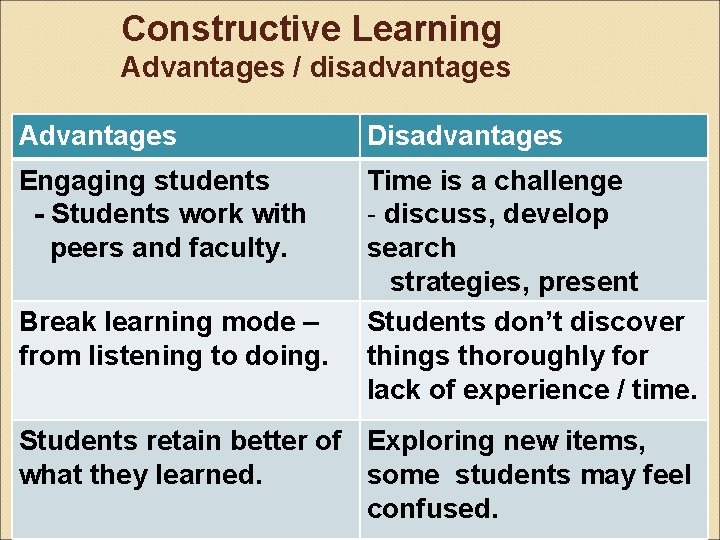
Constructive Learning Advantages / disadvantages Advantages Disadvantages Engaging students - Students work with peers and faculty. Time is a challenge - discuss, develop search strategies, present Students don’t discover things thoroughly for lack of experience / time. Break learning mode – from listening to doing. Students retain better of Exploring new items, what they learned. some students may feel confused.
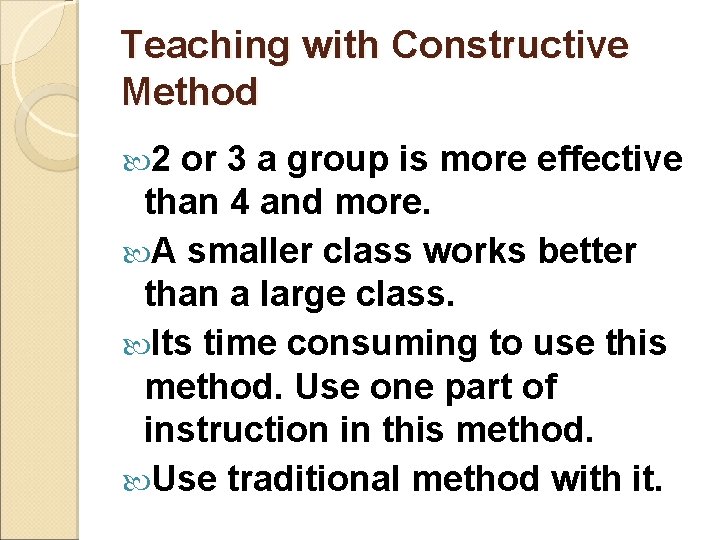
Teaching with Constructive Method 2 or 3 a group is more effective than 4 and more. A smaller class works better than a large class. Its time consuming to use this method. Use one part of instruction in this method. Use traditional method with it.
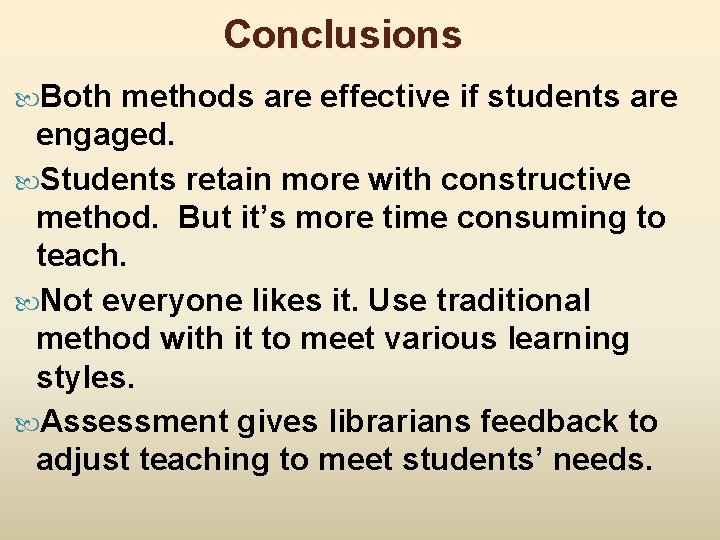
Conclusions Both methods are effective if students are engaged. Students retain more with constructive method. But it’s more time consuming to teach. Not everyone likes it. Use traditional method with it to meet various learning styles. Assessment gives librarians feedback to adjust teaching to meet students’ needs.

Jacqui Da. Costa The College of New Jersey
What is the Cephalonian Method? • A fusion of color, images, humor and music! • A way to involve participants in the session and to encourage questions • An attempt to relieve the boredom for all involved!
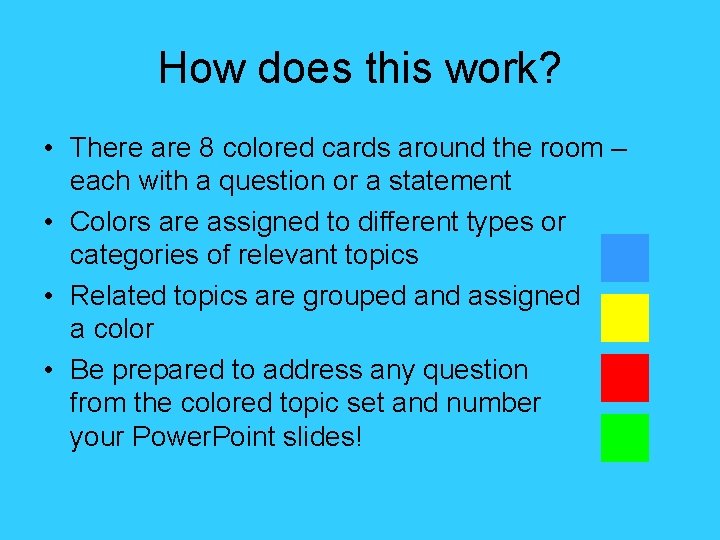
How does this work? • There are 8 colored cards around the room – each with a question or a statement • Colors are assigned to different types or categories of relevant topics • Related topics are grouped and assigned a color • Be prepared to address any question from the colored topic set and number your Power. Point slides!
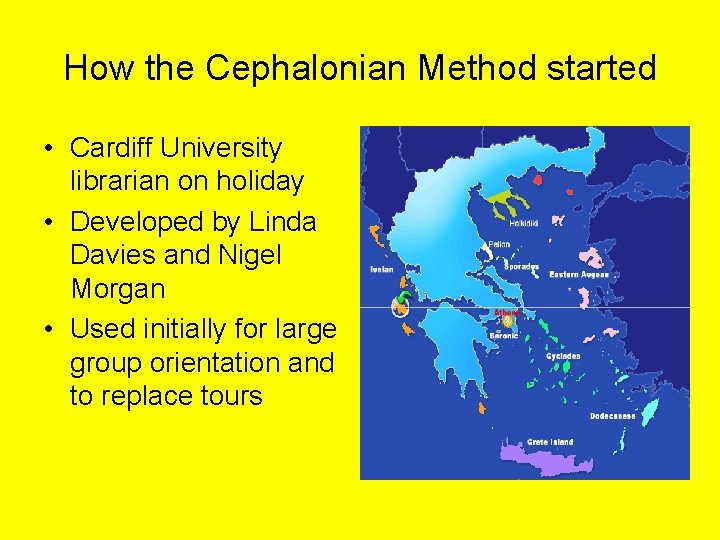
How the Cephalonian Method started • Cardiff University librarian on holiday • Developed by Linda Davies and Nigel Morgan • Used initially for large group orientation and to replace tours
Popularity of the Cephalonian Method • Revealed to the unsuspecting British librarian public in 2004! • Been used – For large groups and small groups – At different types of institutions – With undergraduates and graduates – For orientation and other teaching sessions
My Mom’s e-mailed me a picture of Miguel, my pet iguana. Where can I print him out? 2 • • • PC rooms (24 hour access) Microsoft applications Subject databases Internet & email access • Network printing accounts • Laser printing
What really irritates us? Eating & drinking Excessive noise Theft Cell phones !!!
Reactions to the Cephalonian Method? Students • They seem to like it – it’s something different • They laugh with you and are keen to see what is coming next Faculty • “Wonderful” • “Superb” • They like the style
What can go wrong? • Need a contingency plan for the technology to let you down! • You are inviting a moderate amount of chaos into your classroom • You can’t audition the students – Shyness – Audibility – Color blindness
Benefits of the Cephalonian Method • A good icebreaker • Adaptable for different audiences • It can make the students look forward to their next library session! • Achieves certain active learning objectives – Interaction – Discussion and questions
- Slides: 36