
A Guide to the Qualitative and Quantitative Assessment


- Slides: 27
A Guide to the Qualitative and Quantitative Assessment of Value for Money in PPPs Knut Gummert, Adviser European PPP Expertise Centre European Investment Bank Tirana, Albania 11 October 2018 1
Content 1. EPEC Vf. M Assessment Guide for the Western Balkans 2. What is Value for Money? 3. How, why and when to assess Value for Money? 4. Qualitative Vf. M Assessment Process 5. Quantitative Vf. M Assessment Process 6. Questions 2
1. EPEC Vf. M Assessment Guide for the Western Balkans 3
Guidance documents throughout the project life cycle: Phase 1 Project identification Phase 2 Phase 3 Project preparation Phase 4 Project procurement Project implementation A Guide to the Qualitative and Quantitative Assessment of Vf. M in PPPs This document A Guide to Preparing and Procuring a PPP project PPP Procurement Handbook A Guide to the Main Provisions of an Availability-based PPP Contract 4
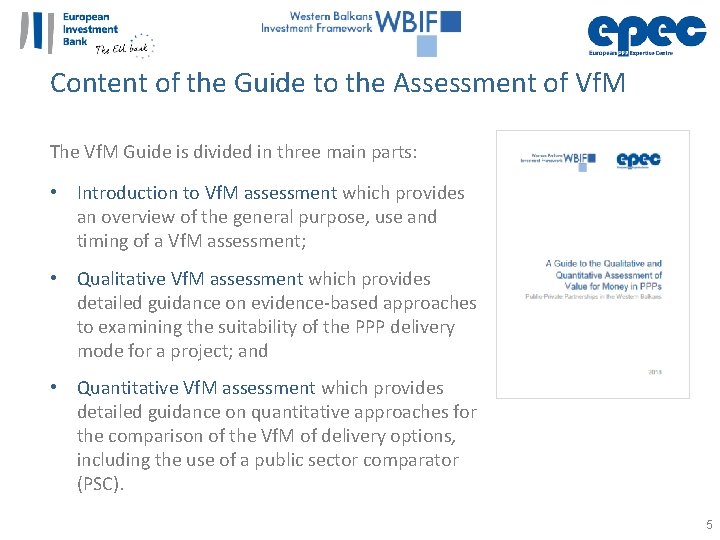
Content of the Guide to the Assessment of Vf. M The Vf. M Guide is divided in three main parts: • Introduction to Vf. M assessment which provides an overview of the general purpose, use and timing of a Vf. M assessment; • Qualitative Vf. M assessment which provides detailed guidance on evidence-based approaches to examining the suitability of the PPP delivery mode for a project; and • Quantitative Vf. M assessment which provides detailed guidance on quantitative approaches for the comparison of the Vf. M of delivery options, including the use of a public sector comparator (PSC). 5
2. What is Value for Money? 6
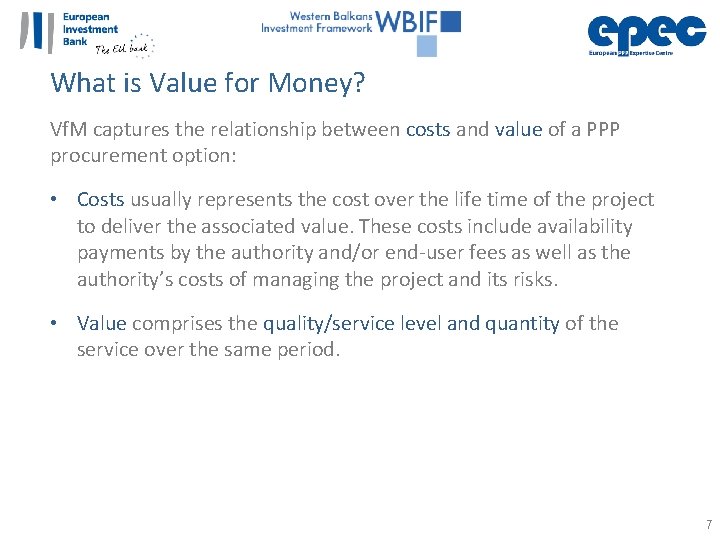
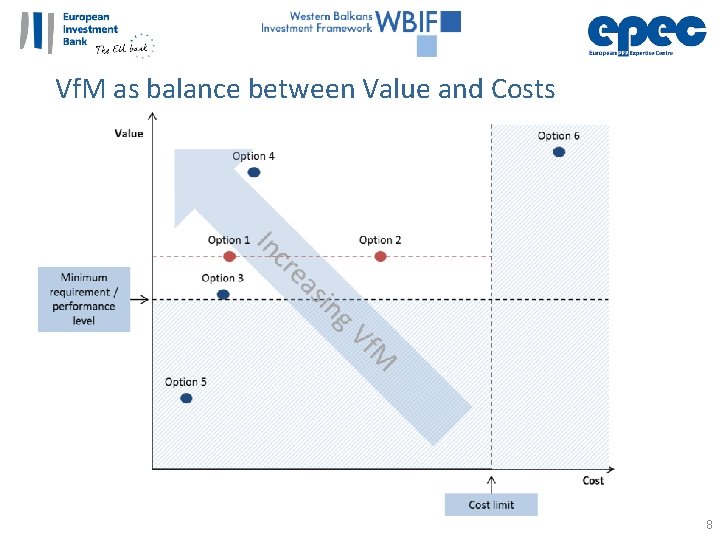
What is Value for Money? Vf. M captures the relationship between costs and value of a PPP procurement option: • Costs usually represents the cost over the life time of the project to deliver the associated value. These costs include availability payments by the authority and/or end-user fees as well as the authority’s costs of managing the project and its risks. • Value comprises the quality/service level and quantity of the service over the same period. 7
Vf. M as balance between Value and Costs 8
What are drivers of Vf. M in PPP projects? • Project teams with the knowledge, skills and experience to prepare, procure and monitor PPP projects and manage them throughout their life time to ensure Vf. M over the project’s life time. • A competitive bidding process between at least three capable bidders is a prerequisite for ensuring Vf. M. Competition incentivises efficiency gains through innovative approaches to deliver services, lower costs and/or improved asset/service quality. • Others: — Existence of a reliable and transparent quality control and approval process throughout the project preparation, procurement and management. — Active contract management to ensure the delivery of the services to the agreed quality and quantity 9
3. How, why and when to assess Value for Money? 10
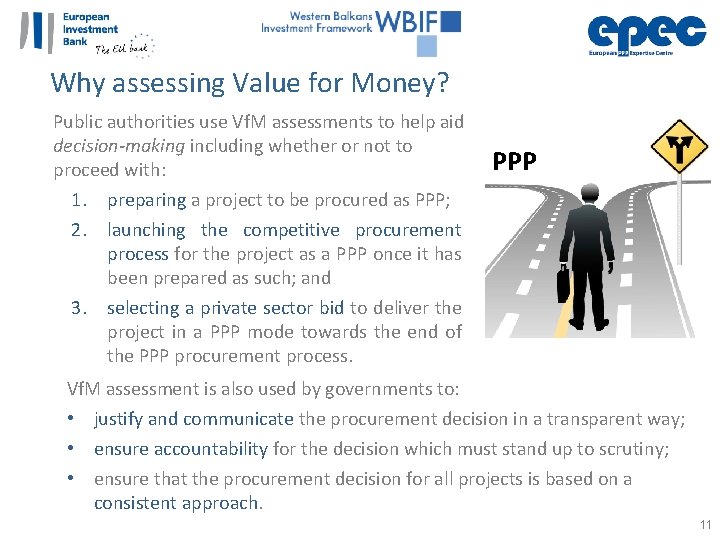
Why assessing Value for Money? Public authorities use Vf. M assessments to help aid decision-making including whether or not to proceed with: 1. preparing a project to be procured as PPP; 2. launching the competitive procurement process for the project as a PPP once it has been prepared as such; and 3. selecting a private sector bid to deliver the project in a PPP mode towards the end of the PPP procurement process. PPP Vf. M assessment is also used by governments to: • justify and communicate the procurement decision in a transparent way; • ensure accountability for the decision which must stand up to scrutiny; • ensure that the procurement decision for all projects is based on a consistent approach. 11
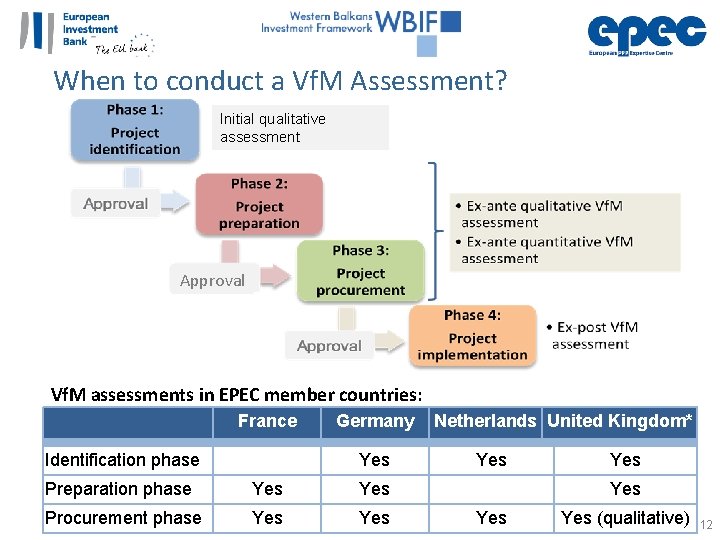
When to conduct a Vf. M Assessment? Initial qualitative assessment Approval Vf. M assessments in EPEC member countries: France Germany Netherlands United Kingdom* Identification phase Yes Yes Preparation phase Yes Yes Procurement phase Yes Yes (qualitative) 12
4. Qualitative Vf. M Assessment Process 13
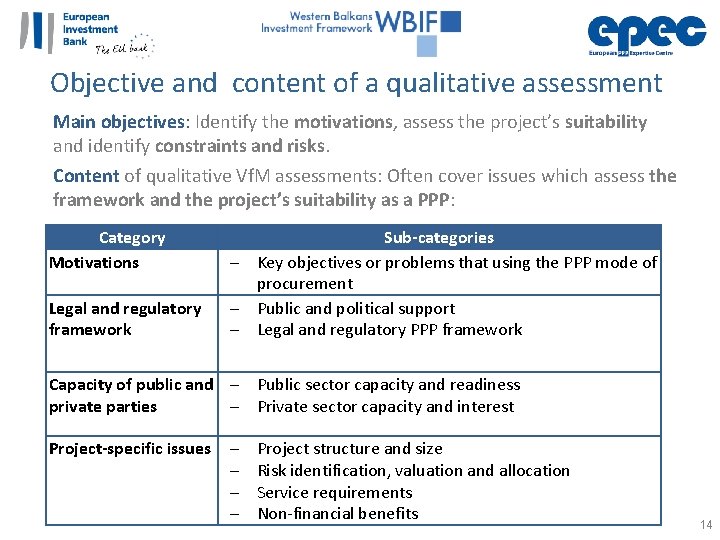
Objective and content of a qualitative assessment Main objectives: Identify the motivations, assess the project’s suitability and identify constraints and risks. Content of qualitative Vf. M assessments: Often cover issues which assess the framework and the project’s suitability as a PPP: Category Motivations Legal and regulatory framework Sub-categories Key objectives or problems that using the PPP mode of procurement Public and political support Legal and regulatory PPP framework Capacity of public and Public sector capacity and readiness private parties Private sector capacity and interest Project-specific issues Project structure and size Risk identification, valuation and allocation Service requirements Non-financial benefits 14
Qualitative Vf. M assessment (1) Initial assessment (identification phase) • Content: A simple and effective assessment during the identification phase to screen a project’s suitability to deliver Vf. M as a PPP The initial assessment reflects the limited amount of information and data available at the identification stage • Purpose: This assessment only serves the identify unsuitable projects. This avoids the unnecessary costs of assessing in detail projects that are intrinsically unsuitable to deliver Vf. M as a PPP (unsuitable project) • Next steps: Proceed with more detailed preparation of the projects as potential PPP (suitable project) 16
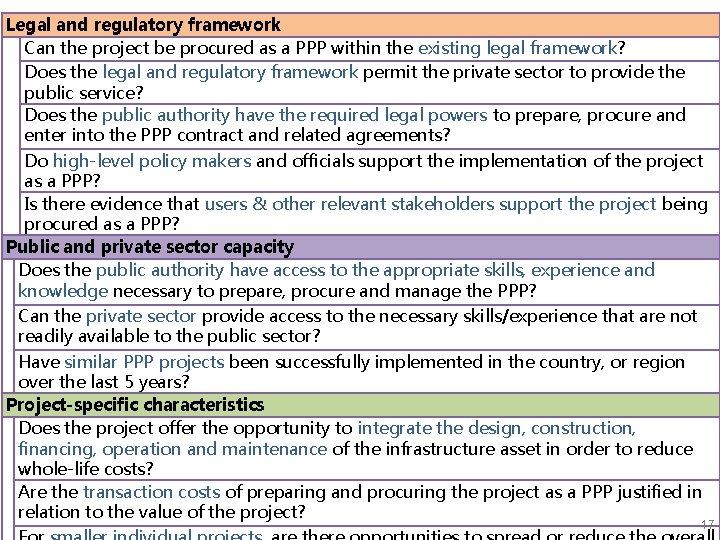
Legal and regulatory framework Can the project be procured as a PPP within the existing legal framework? Does the legal and regulatory framework permit the private sector to provide the public service? Does the public authority have the required legal powers to prepare, procure and enter into the PPP contract and related agreements? Do high-level policy makers and officials support the implementation of the project as a PPP? Is there evidence that users & other relevant stakeholders support the project being procured as a PPP? Public and private sector capacity Does the public authority have access to the appropriate skills, experience and knowledge necessary to prepare, procure and manage the PPP? Can the private sector provide access to the necessary skills/experience that are not readily available to the public sector? Have similar PPP projects been successfully implemented in the country, or region over the last 5 years? Project-specific characteristics Does the project offer the opportunity to integrate the design, construction, financing, operation and maintenance of the infrastructure asset in order to reduce whole-life costs? Are the transaction costs of preparing and procuring the project as a PPP justified in relation to the value of the project? 17
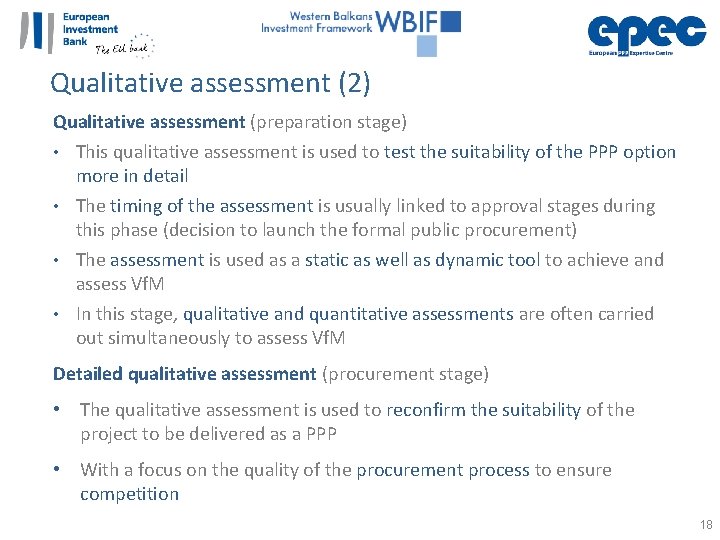
Qualitative assessment (2) Qualitative assessment (preparation stage) • This qualitative assessment is used to test the suitability of the PPP option more in detail • The timing of the assessment is usually linked to approval stages during this phase (decision to launch the formal public procurement) • The assessment is used as a static as well as dynamic tool to achieve and assess Vf. M • In this stage, qualitative and quantitative assessments are often carried out simultaneously to assess Vf. M Detailed qualitative assessment (procurement stage) • The qualitative assessment is used to reconfirm the suitability of the project to be delivered as a PPP • With a focus on the quality of the procurement process to ensure competition 18
5. Quantitative Vf. M Assessment Process 19
What are the objectives of a quantitative assessment? A quantitative Vf. M assessment has the main objectives: 1. to compare a PPP option with a potential public procurement option (PSC) to determine the preferred procurement option, 2. to compare the Vf. M of actual private sector bids to identify the bid offering the best price-quality ratio (identify the preferred bidder), or 3. to compare a (preferred) private sector bid with the public sector comparator (PSC) (sense and affordability check) Advantages of conducting a quantitative Vf. M assessment: • Obliges more analysis of costs (e. g. design, financing, construction, management, operation) and risks (pricing and allocation) • Development of a database of cost and risk information • Negotiating tool with private sector bidders • ‘Sense’ and affordability check of private sector bids 20
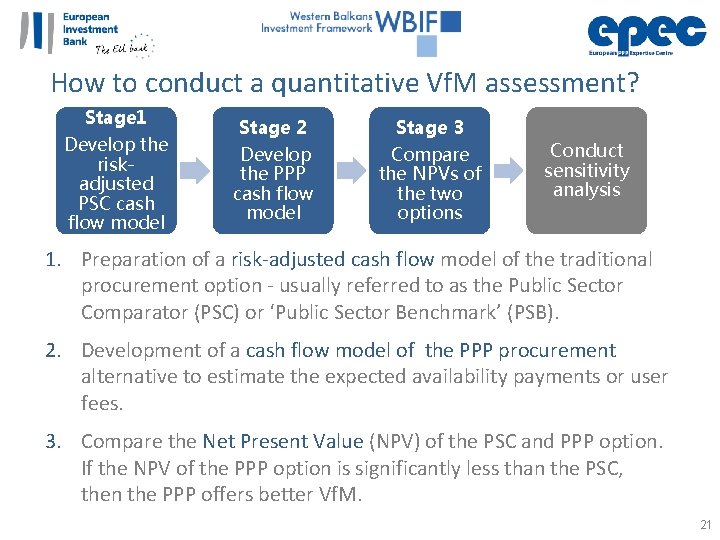
How to conduct a quantitative Vf. M assessment? Stage 1 Develop the riskadjusted PSC cash flow model Stage 2 Stage 3 Develop the PPP cash flow model Compare the NPVs of the two options Conduct sensitivity analysis 1. Preparation of a risk-adjusted cash flow model of the traditional procurement option - usually referred to as the Public Sector Comparator (PSC) or ‘Public Sector Benchmark’ (PSB). 2. Development of a cash flow model of the PPP procurement alternative to estimate the expected availability payments or user fees. 3. Compare the Net Present Value (NPV) of the PSC and PPP option. If the NPV of the PPP option is significantly less than the PSC, then the PPP offers better Vf. M. 21
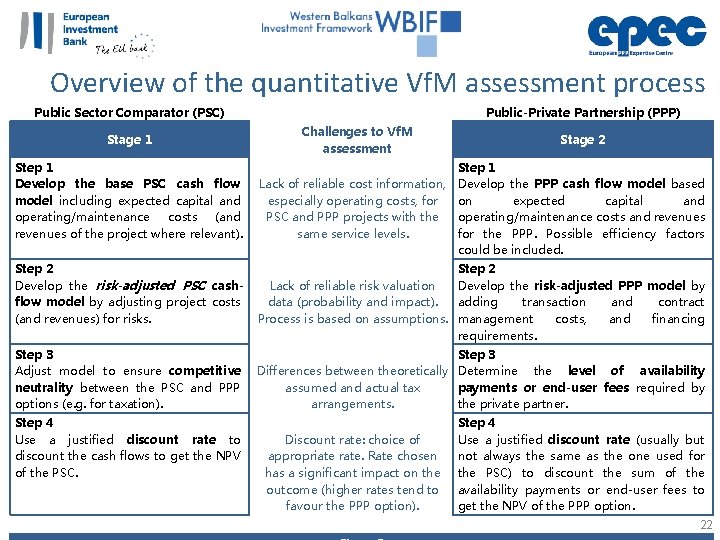
Overview of the quantitative Vf. M assessment process Public Sector Comparator (PSC) Stage 1 Public-Private Partnership (PPP) Challenges to Vf. M assessment Stage 2 Step 1 Develop the base PSC cash flow model including expected capital and operating/maintenance costs (and revenues of the project where relevant). Lack of reliable cost information, especially operating costs, for PSC and PPP projects with the same service levels. Step 1 Develop the PPP cash flow model based on expected capital and operating/maintenance costs and revenues for the PPP. Possible efficiency factors could be included. Step 2 Develop the risk-adjusted PSC cashflow model by adjusting project costs (and revenues) for risks. Lack of reliable risk valuation data (probability and impact). Process is based on assumptions. Step 2 Develop the risk-adjusted PPP model by adding transaction and contract management costs, and financing requirements. Step 3 Adjust model to ensure competitive neutrality between the PSC and PPP options (e. g. for taxation). Differences between theoretically assumed and actual tax arrangements. Step 3 Determine the level of availability payments or end-user fees required by the private partner. Step 4 Use a justified discount rate to discount the cash flows to get the NPV of the PSC. Discount rate: choice of appropriate rate. Rate chosen has a significant impact on the outcome (higher rates tend to favour the PPP option). Step 4 Use a justified discount rate (usually but not always the same as the one used for the PSC) to discount the sum of the availability payments or end-user fees to get the NPV of the PPP option. 22
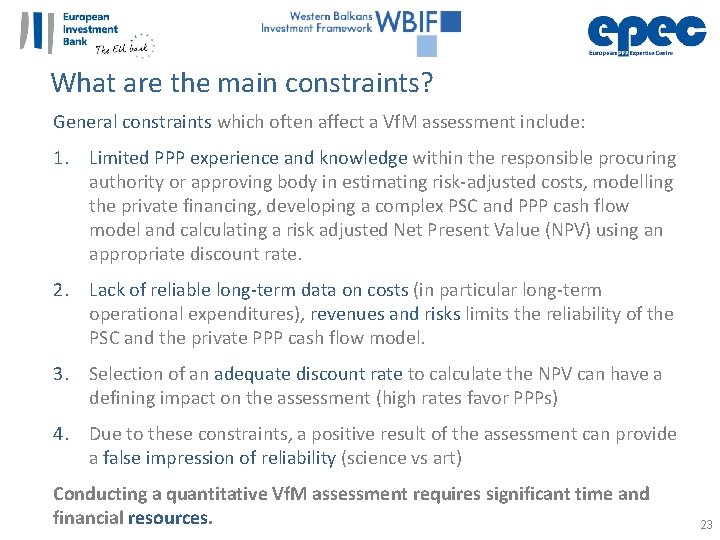
What are the main constraints? General constraints which often affect a Vf. M assessment include: 1. Limited PPP experience and knowledge within the responsible procuring authority or approving body in estimating risk-adjusted costs, modelling the private financing, developing a complex PSC and PPP cash flow model and calculating a risk adjusted Net Present Value (NPV) using an appropriate discount rate. 2. Lack of reliable long-term data on costs (in particular long-term operational expenditures), revenues and risks limits the reliability of the PSC and the private PPP cash flow model. 3. Selection of an adequate discount rate to calculate the NPV can have a defining impact on the assessment (high rates favor PPPs) 4. Due to these constraints, a positive result of the assessment can provide a false impression of reliability (science vs art) Conducting a quantitative Vf. M assessment requires significant time and financial resources. 23
How and when to use a quantitative assessment? The use of quantitative Vf. M assessments should be influenced by the size and complexity of projects. Determinants on the use of quantitative Vf. M assessments: • larger and rather complex projects should be examined using qualitative and quantitative assessments, due to their large potential fiscal impact • for smaller projects, a simplified Vf. M assessment might be appropriate to reduce high transaction costs which otherwise might constrain projects’ affordability • for often implemented projects with a proven track record of delivering Vf. M, a simplified or mainly qualitative Vf. M assessment might be appropriate 24
How to strengthen the Vf. M assessment process? • Establishing a specialised unit (e. g. a PPP unit) which supports procuring authorities or directly conducts the Vf. M assessment • Including a wider set of criteria in the assessment (e. g. a qualitative Vf. M assessment) instead of relying only on a quantitative assessment • Developing templates and standardised Vf. M assessment processes which assist less experienced procuring authorities and improve reliability, consistency and cost-efficiency of these assessments • Strengthening overall project quality control and approval processes 25
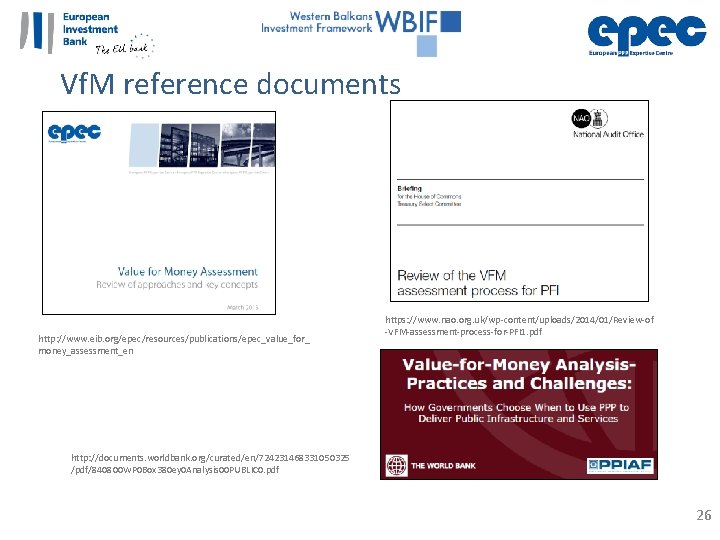
Vf. M reference documents http: //www. eib. org/epec/resources/publications/epec_value_for_ money_assessment_en https: //www. nao. org. uk/wp-content/uploads/2014/01/Review-of -VFM-assessment-process-for-PFI 1. pdf http: //documents. worldbank. org/curated/en/724231468331050325 /pdf/840800 WP 0 Box 380 ey 0 Analysis 00 PUBLIC 0. pdf • 26 26
Questions? 27
European PPP Expertise Centre epec@eib. org www. eib. org/epec Twitter: @Epec. News Fernando CRESPO DIU Principal Adviser f. crespodiu@eib. org +352 43 79 83 696 Knut Gummert Adviser k. gummert@eib. org +352 43 79 82 757 28