
A guide to notetaking TAKING CORNELL STYLE NOTES
- Slides: 41
A guide to note-taking TAKING CORNELL STYLE NOTES
You are required to take notes following the guidelines in this presentation.
The notes will be turned in and graded.
Your notes will be returned to you. You will put them in your notebook, in order!
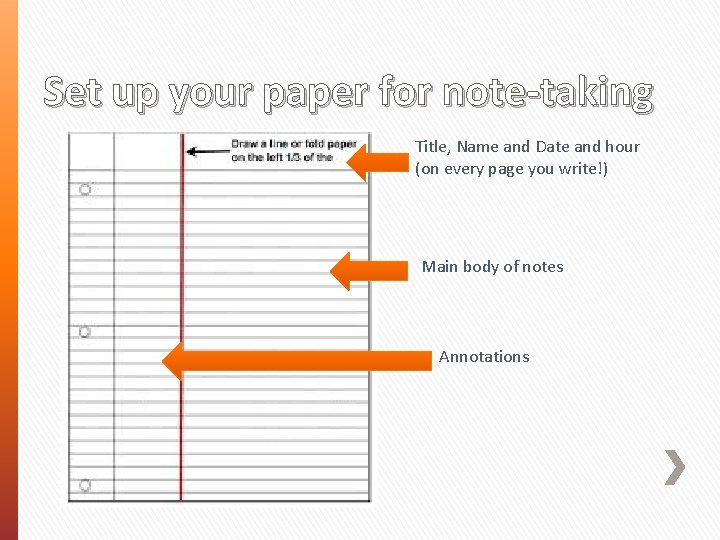
Set up your paper for note-taking Title, Name and Date and hour (on every page you write!) Main body of notes Annotations
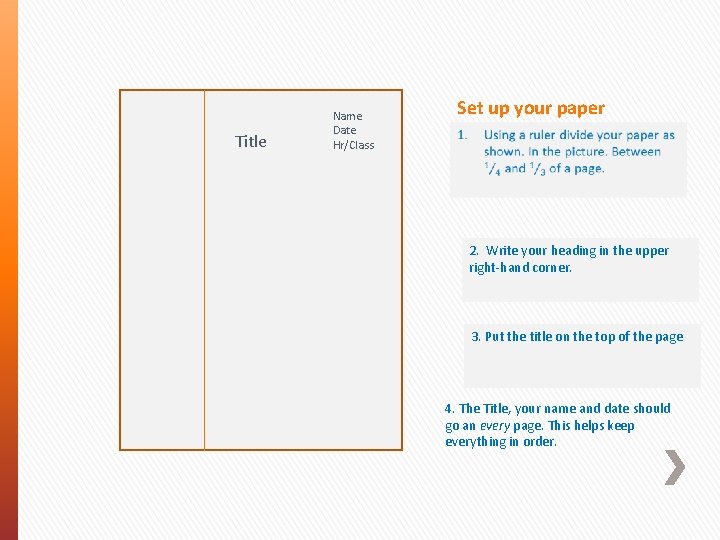
Title Name Date Hr/Class Set up your paper 2. Write your heading in the upper right-hand corner. 3. Put the title on the top of the page 4. The Title, your name and date should go an every page. This helps keep everything in order.
A guide to note-taking TAKING CORNELL STYLE NOTES
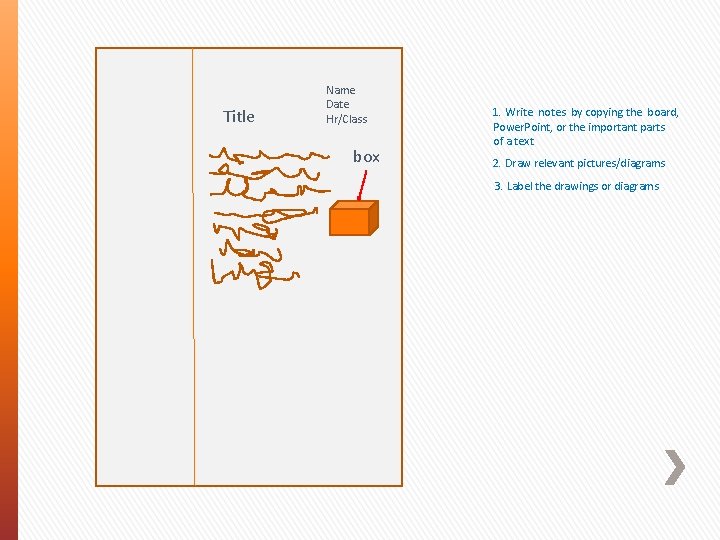
Title Name Date Hr/Class box 1. Write notes by copying the board, Power. Point, or the important parts of a text 2. Draw relevant pictures/diagrams 3. Label the drawings or diagrams
» » What are Cornell Notes? What is the cue column used for? How do these notes help me? How will my notes be graded in Chemistry? Essential Questions
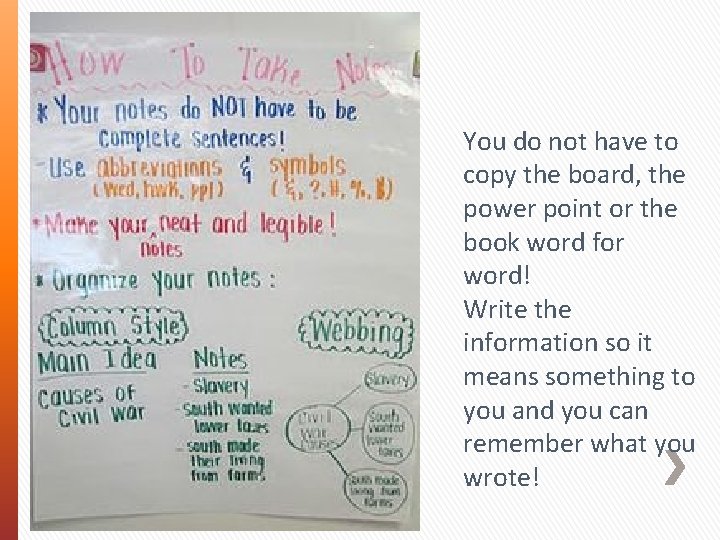
You do not have to copy the board, the power point or the book word for word! Write the information so it means something to you and you can remember what you wrote!
Annotating keeps the reader engaged with the text. While you are reading or taking notes, use one or more of these strategies to mark the article you are reading or add to the notes from class. Annotations include your thoughts and questions.
Write annotations in the margins of the article or in an area of your paper set aside for annotations or on sticky notes if it is not possible to write on the article or book. Annotations can be: Questions Opinions Comments
Where do you write the annotations for your notes?
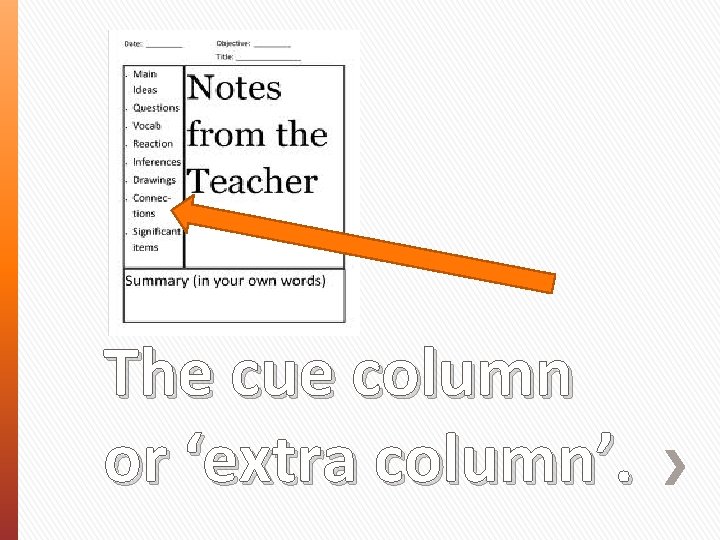
The cue column or ‘extra column’.
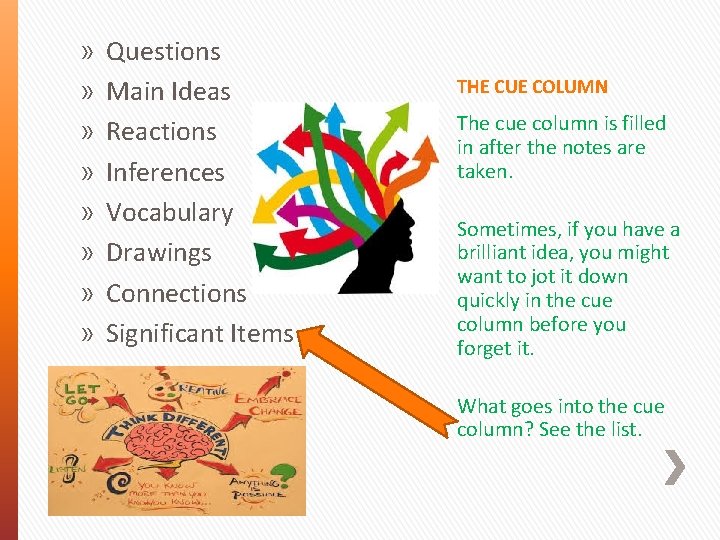
» » » » Questions Main Ideas Reactions Inferences Vocabulary Drawings Connections Significant Items THE CUE COLUMN The cue column is filled in after the notes are taken. Sometimes, if you have a brilliant idea, you might want to jot it down quickly in the cue column before you forget it. What goes into the cue column? See the list.
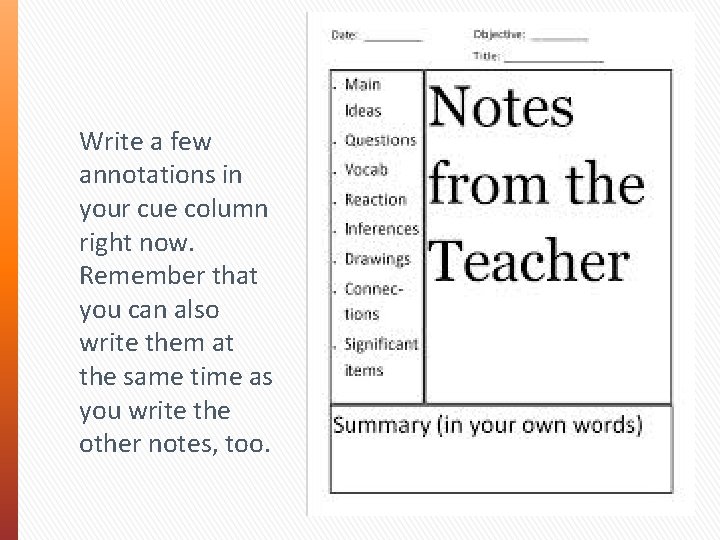
Write a few annotations in your cue column right now. Remember that you can also write them at the same time as you write the other notes, too.
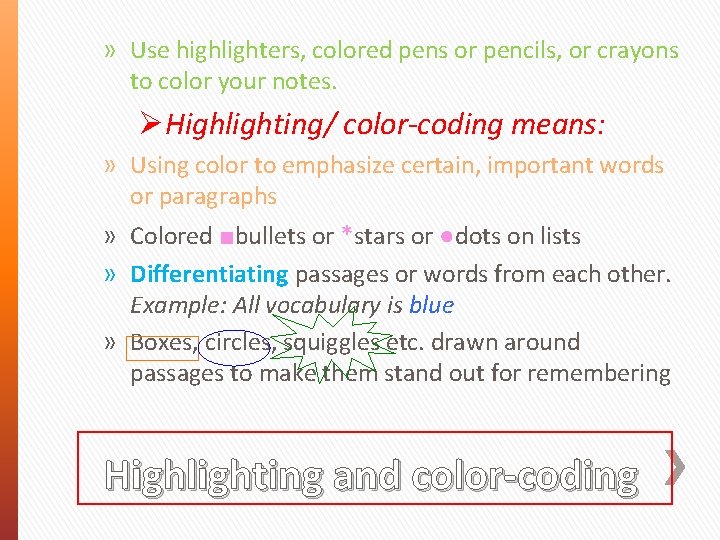
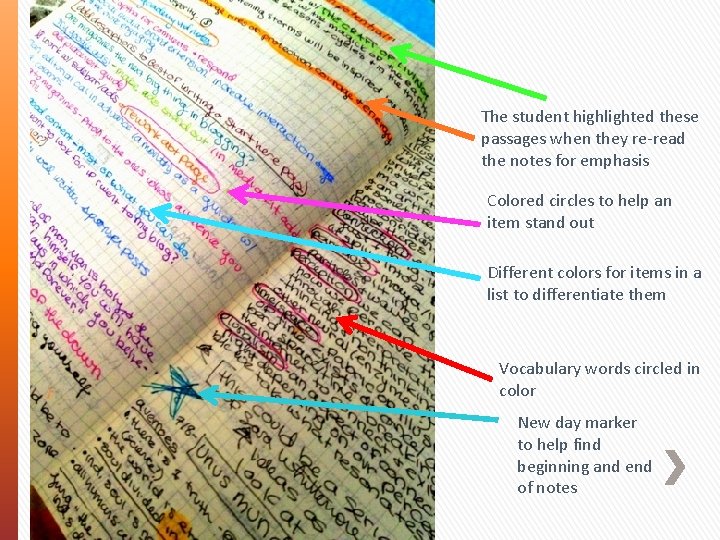
» Use highlighters, colored pens or pencils, or crayons to color your notes. ØHighlighting/ color-coding means: » Using color to emphasize certain, important words or paragraphs » Colored ■bullets or *stars or ●dots on lists » Differentiating passages or words from each other. Example: All vocabulary is blue » Boxes, circles, squiggles etc. drawn around passages to make them stand out for remembering Highlighting and color-coding
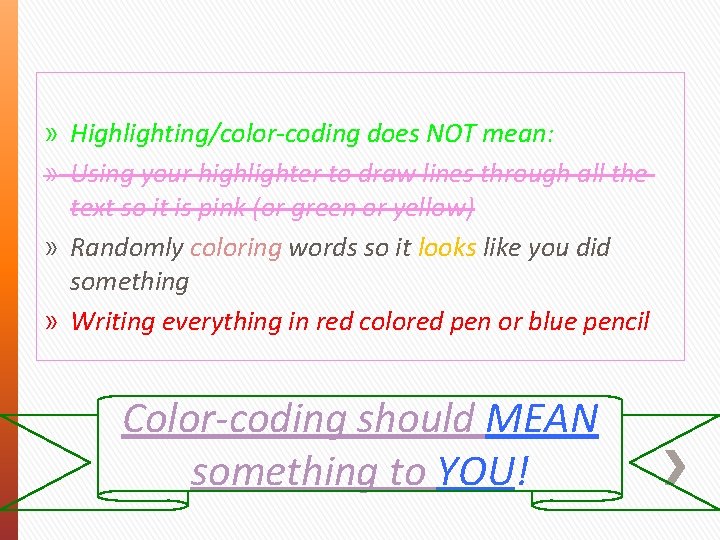
» Highlighting/color-coding does NOT mean: » Using your highlighter to draw lines through all the text so it is pink (or green or yellow) » Randomly coloring words so it looks like you did something » Writing everything in red colored pen or blue pencil Color-coding should MEAN something to YOU!
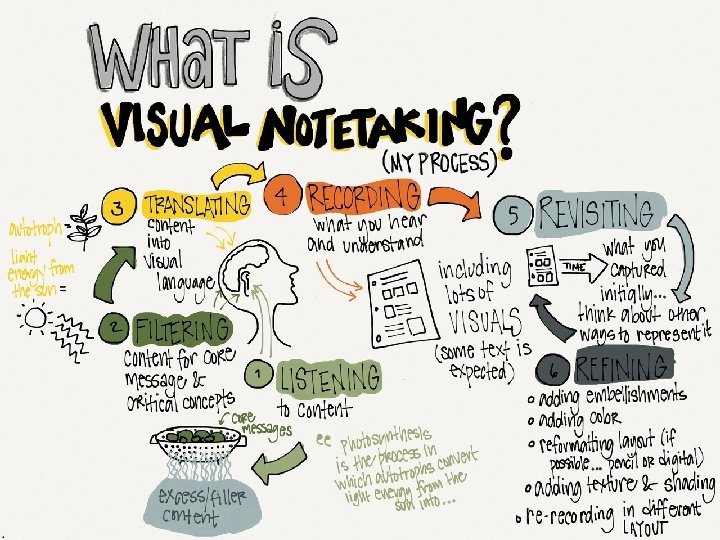
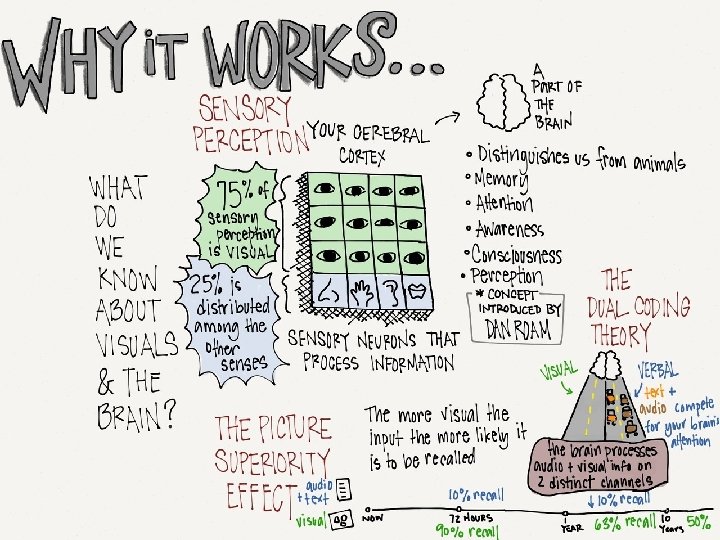
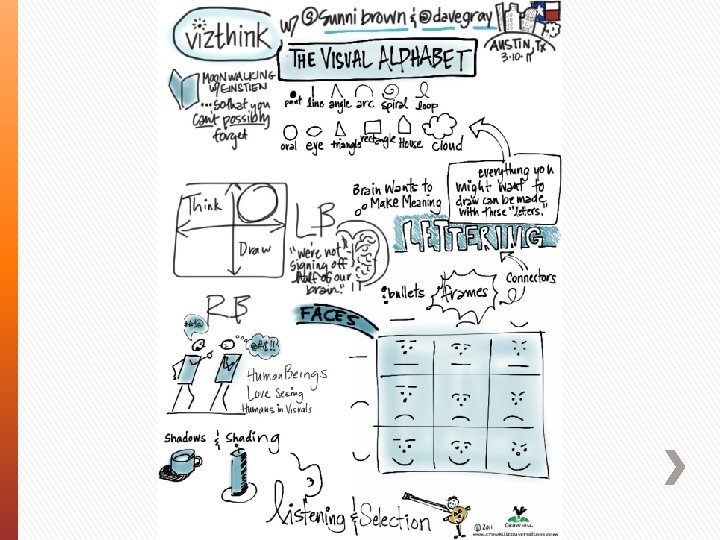
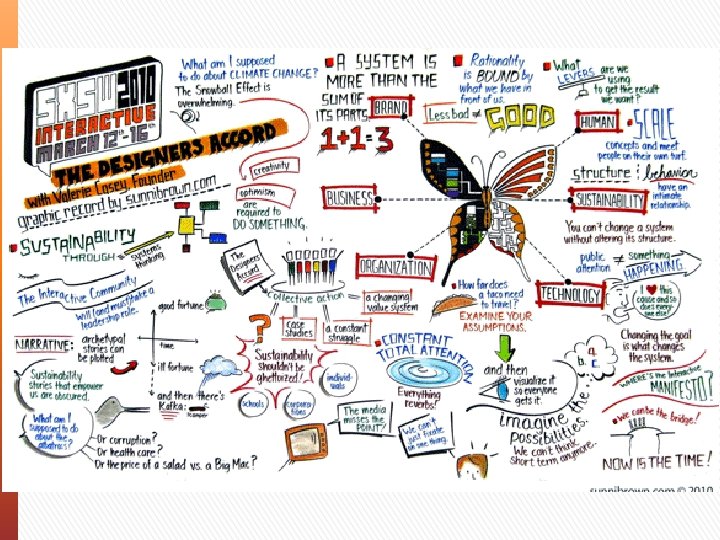
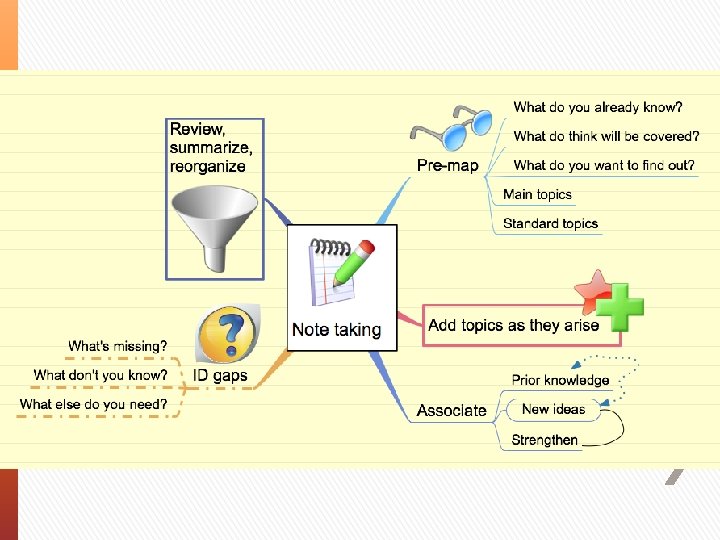
» The following slides will show you some techniques of color-coding your notes. » There also slides on ‘visual note-taking’ which is a pictorial method of note-taking that also uses color. » You must use at least 3 colors on your notes in my class. » The coloring is up to you but it must be MEANINGFUL! Not just a random blob of color. Color-coding notes
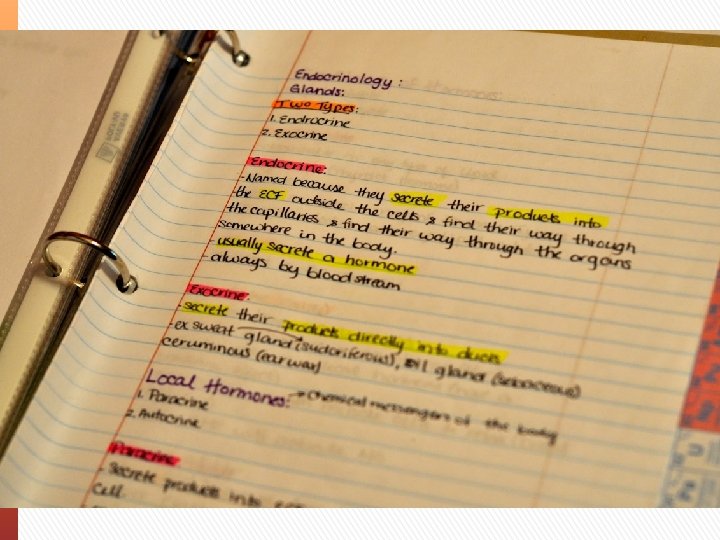
The student highlighted these passages when they re-read the notes for emphasis Colored circles to help an item stand out Different colors for items in a list to differentiate them Vocabulary words circled in color New day marker to help find beginning and end of notes
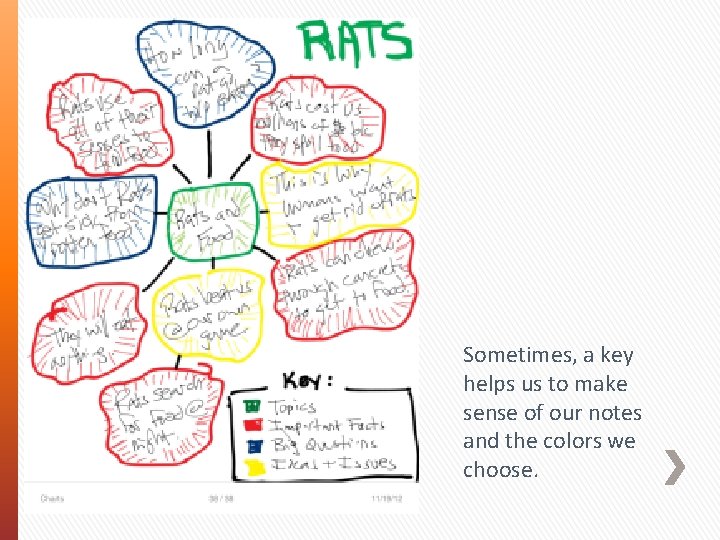
Sometimes, a key helps us to make sense of our notes and the colors we choose.
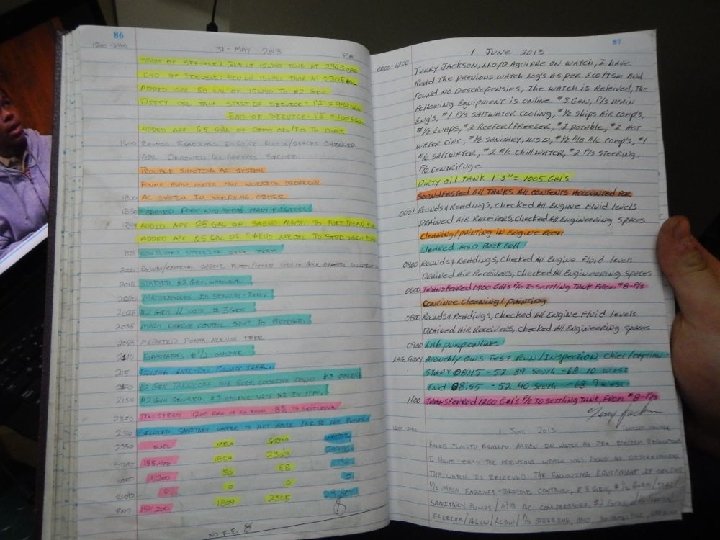
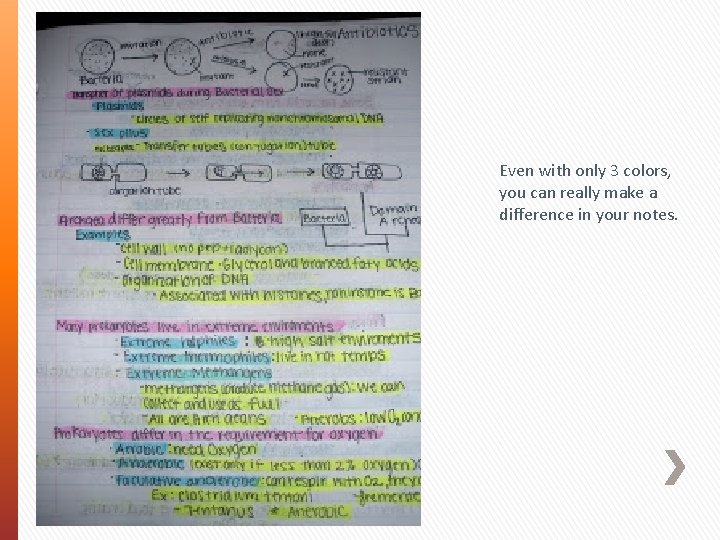
Even with only 3 colors, you can really make a difference in your notes.
» Whether you decide to take your notes in a visual style, or more traditional, is purely a personal choice. What makes more sense to you? » Remember, notes are for YOU, not the teacher! » As you practice with the different methods, find the way that helps you most. » You can change your method from one set of notes to the next. You will be graded on taking notes, not which form you use. Choosing your style
» When your notes are » You will also write a “Response completed, you will summarize or Reflection Paragraph”. what you learned in the lesson » You will summarize your in a SHOW ME paragraph in annotations inferences, your own words. connections and reactions to » Be careful! Don’t say, “We the notes in this paragraph. learned about. . ” ‘We » This is also where you can learned about the sun today. ’ evaluate the lesson or your will not help you study for a understanding of the material. test! » Be specific, think of the summary or SHOW ME as a cheat sheet. Tell details. Finishing up! The following slides will discuss these 2 paragraphs in more detail.
» When you re-read your notes to add annotations and color, mark the main ideas. » These main ideas can be used to write your summary paragraph. » Be specific, but not too detailed. You want to review what you learned and not just mention the topic. Writing that you ‘learned about’ something will not help you study! » Imagine you are going to have a quiz over the topic and you can bring a 3 x 5 card or a post-it note to the quiz as a cheat sheet, what would you write?
Response or Reflection paragraphs are your thoughts about the subject. This is where you make connections to your life or experiences. You can use your annotations to help.
Connecting in this way helps you remember the material and you can see what impact the knowledge has on your life. In this class we will write response paragraphs for: Notes Articles Dialectical Journals * *A dialectical journal shows your conversation with a movie or text. It is used to question, make connections, and explore ideas you had as you watch the movie or read the article or book. Other assignments
» I guess/predict/imagine that. . . » This part about ____ makes me wonder. . . » These are similar because. . . » These are different because. . . » What would happen if. . . » Why. . . » I think/believe that. . . » I think this section about ____ means. . . » This reminds me of. . . » This part is like. . . » This is similar to. . . » The differences are. . . » I also. . . » . » » » I never. . . This topic reminds me of. . . This is good because. . . This is hard because. . . This is confusing because. . . I like the part where. . . I don’t like this part because. . . My favorite part so far is. . . I think that. . . Oh, I get. . . Now I understand. . . I will remember ____ because it reminds me of. . These are sentence starters for your responses or annotations. You can use more than one in a response. You don’t have to use them but they can help you.
You will be graded in this manner. Do your notes have: 1. A copy of the notes the teacher provided including heading and title 2. Color coding of the notes with at least 3 colors 3. Filling in the cue column 4. A summary or SHOW ME paragraph (or equivalent) 5. A Response or Reflection paragraph (or equivalent) Total points possible 25 pts Grading the notes 5 pts 5 pts
Putting note-taking into practice
» Now that you have written the notes from the presentation, lets practice finishing them. » Re-read your notes. Add some more annotations in the annotation column. Annotations
» With at least 3 different colors, re-read your notes and add color to the parts that you: ˃ ˃ ˃ Want to remember Think are important Need help in identifying Think should be different form the rest for one reason or another Remember, you should know why you colored or marked something Color code the notes
» Summary/Show Me ˃ First, think of the most important things you learned in these notes. Re-write them in YOUR OWN WORDS in some way that you can remember and understand. ˃ Be thorough, and don’t leave anything out ˃ But also, don’t just copy. ˃ Remember DO NOT WRITE, “We learned about. . . ” » Response/Reflection ˃ Using one or more of the sentence starters in these notes, or use the annotation hints from the previous lesson, write a response, telling what you think about these notes. ˃ This is where you put down connections your brain makes with the material. Write a Summary and Response
» You should have a great set of notes on notetaking now. » Be sure your name, date and title are on ALL pages to avoid losing them » Turn in these notes. » They will be graded according to the guidelines I gave you. Turn in your work!