
A Guide to Early Reading and Writing Objectives
A Guide to Early Reading and Writing
Objectives � You ◦ ◦ ◦ will understand How children become readers and writers How early reading and writing develops How phonics works and progresses What comes after phonics in reading and spelling How the teaching of writing varies for different age groups
An overview of reading
How we read and spell � Graudle � Thoted � Kerming
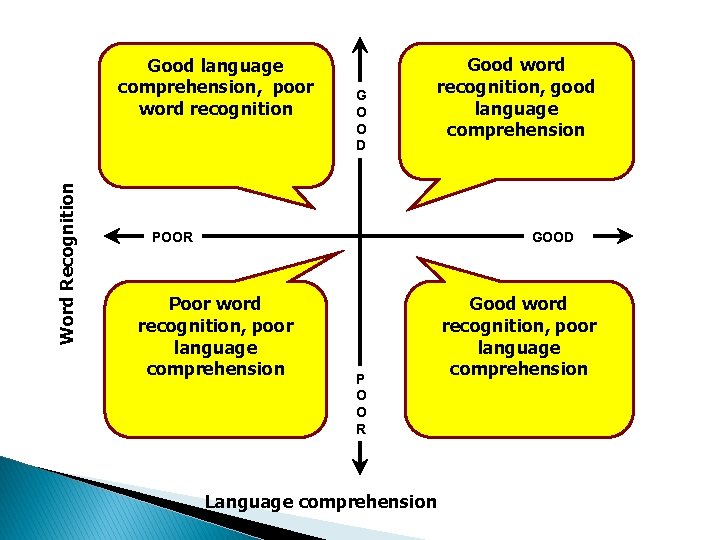
Word Recognition Good language comprehension, poor word recognition G O O D POOR Good word recognition, good language comprehension GOOD Poor word recognition, poor language comprehension P O O R Language comprehension Good word recognition, poor language comprehension
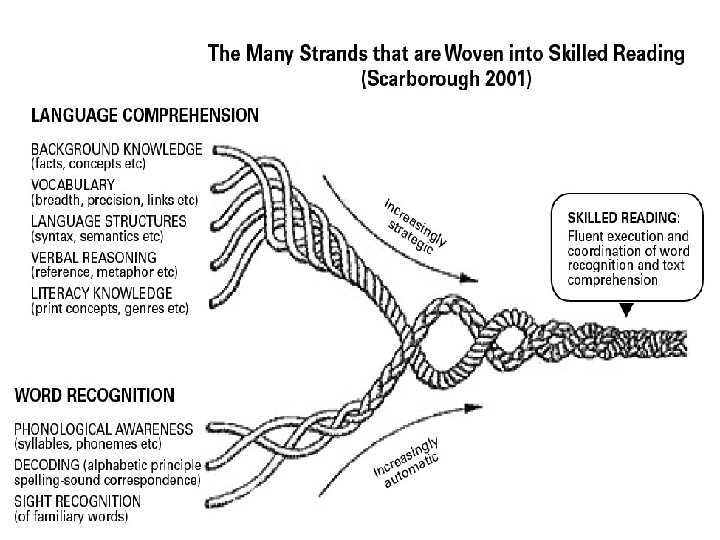

The Big Five – The crucial components for the teaching of reading From ‘The National Reading Panel Report’, 2000
How to teach phonics
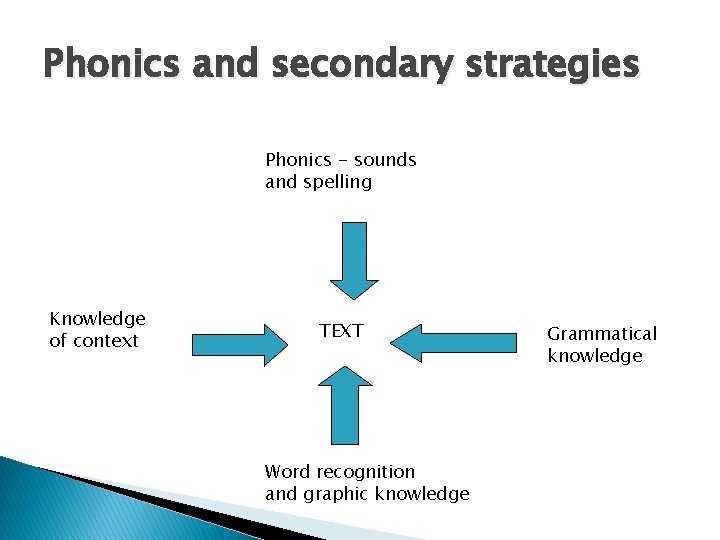
Phonics and secondary strategies Phonics - sounds and spelling Knowledge of context TEXT Word recognition and graphic knowledge Grammatical knowledge
What’s a phoneme?
The Phoneme �A phoneme is the smallest unit of sound in a word � b-a-t, sh-e-d and ch-ee-se all contain three phonemes � Play ‘phoneme’ count. How many phonemes in each word?
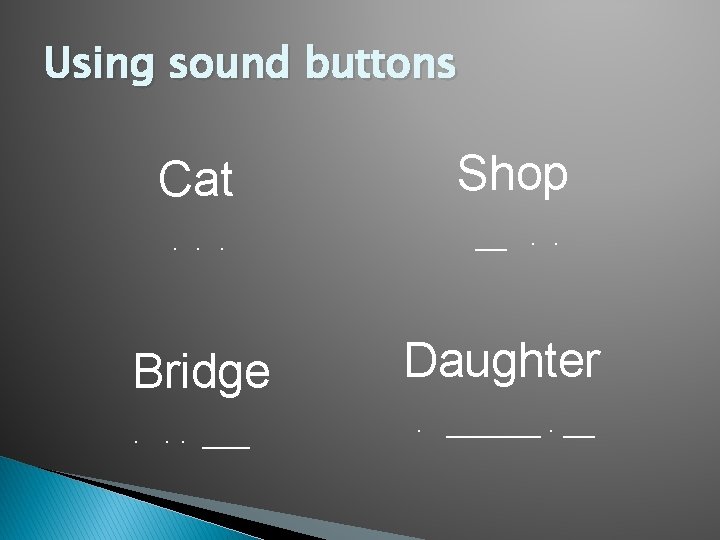
Using sound buttons Cat Shop . . . __. . Bridge. . . ___ Daughter. ______. __
Phoneme Count � Sprint � Chair � Weigh � Dolphin � Scratch � Pheasant � Blink � Fox
Types of Phoneme � The 44 phonemes are made up from: 24 consonant phonemes 20 vowel phonemes Mr Thorne does Phonics
Where do children begin?
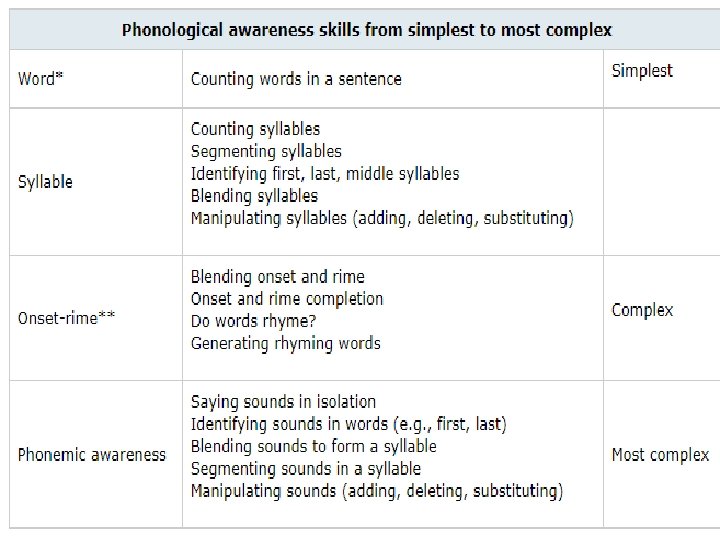
The phonics journey Phonological awareness refers to a global awareness of the sound structures of speech and the ability to manipulate those structures. It is an umbrella term that encompasses both basic levels of awareness of speech sounds, such as rhyming, alliteration, the number of words in a sentence, and the syllables within words, as well as more advanced levels of awareness such as full phonemic awareness. It refers to oral language. � Phonemic awareness is the most advanced level of phonological awareness. It refers to a child’s awareness of the individual phonemes — the smallest units of sound — in spoken words, and the ability to manipulate those sounds. � Phonics refers to knowledge of letter sounds and the ability to apply that knowledge in decoding unfamiliar words. It refers to print. �
Two crucial skills � Both phonological awareness and phonics are very important and tend to interact in reading development, but they are distinct skills; children can have weaknesses in one of them but not the other. � For example, a child who knows letter sounds but cannot blend the sounds to form the whole word has a phonological awareness (specifically, a phonemic awareness) problem. � Conversely, a child who can orally blend sounds with ease but mixes up vowel letter sounds, reading pit for pet and set for sit, has a phonics problem
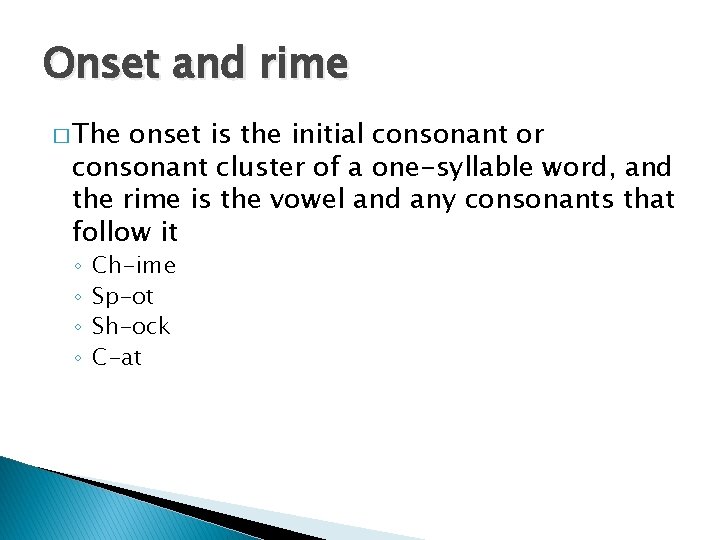
Onset and rime � The onset is the initial consonant or consonant cluster of a one-syllable word, and the rime is the vowel and any consonants that follow it ◦ ◦ Ch-ime Sp-ot Sh-ock C-at
What’s a grapheme?
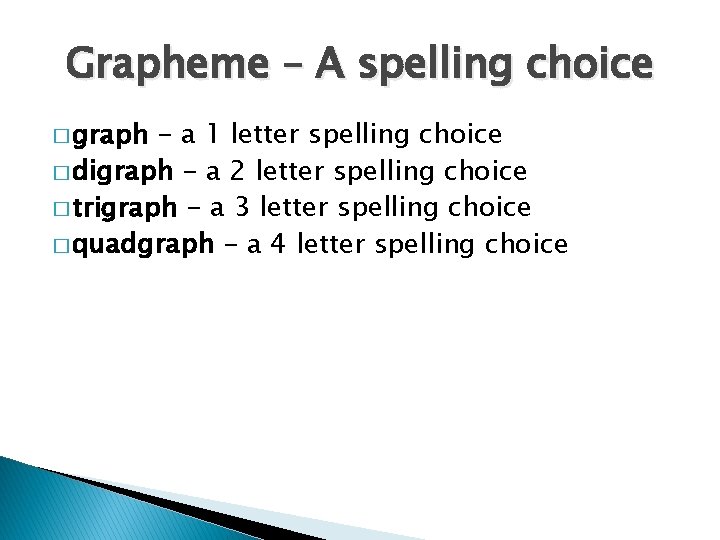
Grapheme – A spelling choice � graph - a 1 letter spelling choice � digraph - a 2 letter spelling choice � trigraph - a 3 letter spelling choice � quadgraph - a 4 letter spelling choice
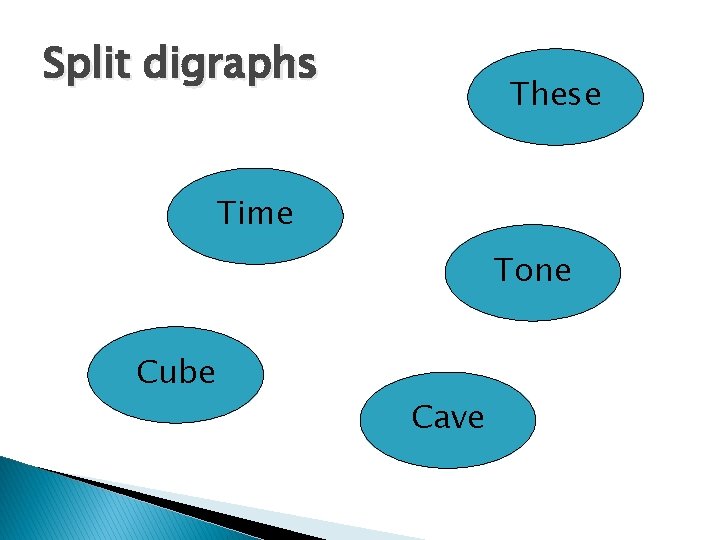
Split digraphs These Time Tone Cube Cave
Principles of the alphabetic code � Phonemes (sounds) are represented by letters (graphemes) � Some of these graphemes are represented by more than one letter � Some phonemes can be represented by different graphemes � Some graphemes represent more than one phoneme � Letters have names
What are blending and segmenting?
Reading and Spelling � Reading involves changing graphemes to phonemes. This is known as ‘blending’ � Spelling involves changing phonemes to graphemes. This is known as ‘segmenting’

What about cl, sp etc.
Consonant Clusters or blends � Consonant clusters/blends - may be represented by, for example: i. two graphs, e. g. ‘tr’ = ‘t’ and ‘r’ ii. digraph and graph, e. g. ‘shr’ ‘sh’ and ‘r’
High frequency words � Some are decodable high frequency words e. g. can, with, back, time � ‘Tricky words’ are non-decodable high frequency words e. g. go, they, have, people
What’s a CVC word?
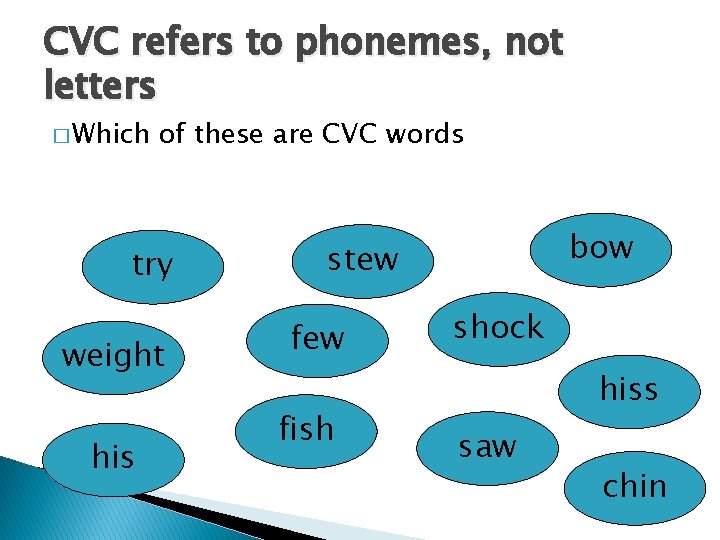
CVC refers to phonemes, not letters � Which of these are CVC words try weight his bow stew fish shock hiss saw chin
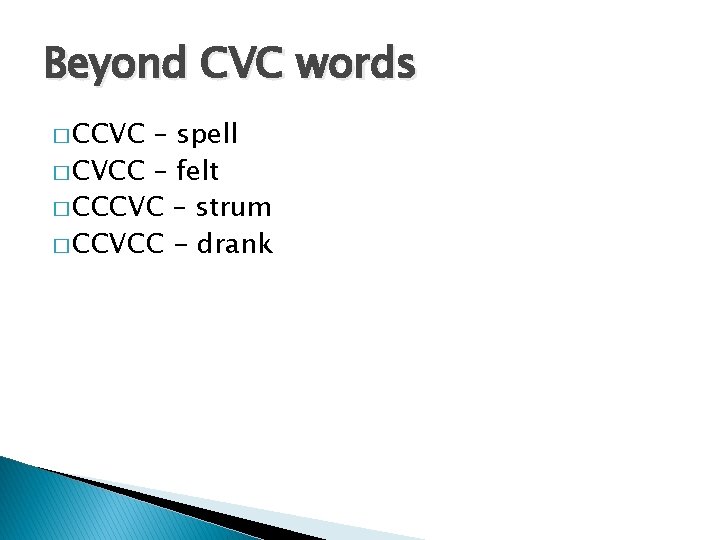
Beyond CVC words � CCVC – spell � CVCC – felt � CCCVC – strum � CCVCC - drank
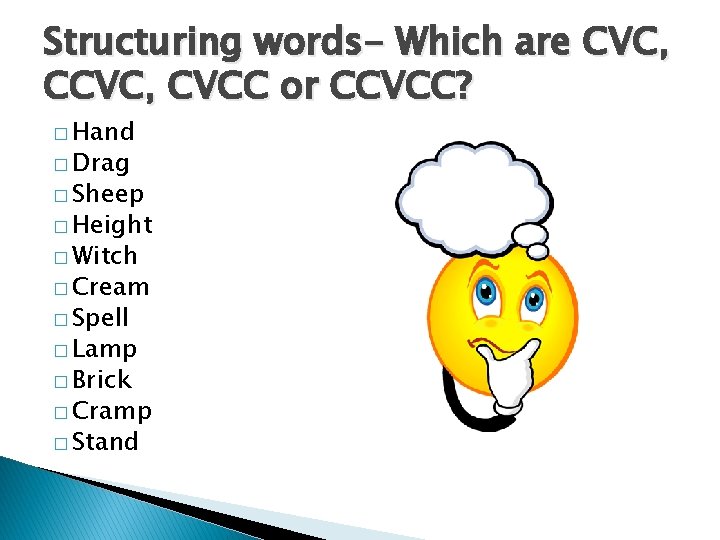
Structuring words- Which are CVC, CVCC or CCVCC? � Hand � Drag � Sheep � Height � Witch � Cream � Spell � Lamp � Brick � Cramp � Stand
How do we develop visual discrimination?
Investigating frequency and position � List as many words as you can with the /ae/ sound in � Group them under the different representations of the /ae/ sound � Which are most common? � Where do they commonly appear in words
Developing visual discrimination � Trying out different spelling choices � Knowing the most common spelling choices � Knowing where certain spelling choices are likely to occur in a word
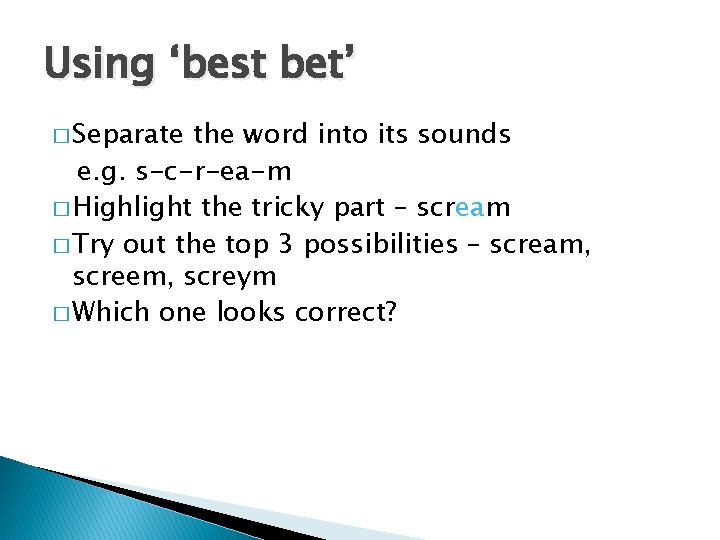
Using ‘best bet’ � Separate the word into its sounds e. g. s-c-r-ea-m � Highlight the tricky part – scream � Try out the top 3 possibilities – scream, screem, screym � Which one looks correct?
How does phonics progress?
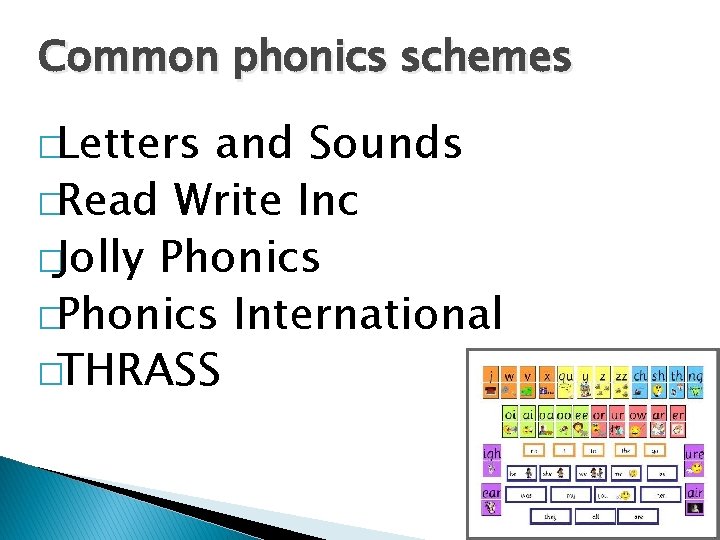
Common phonics schemes �Letters and Sounds �Read Write Inc �Jolly Phonics �Phonics International �THRASS
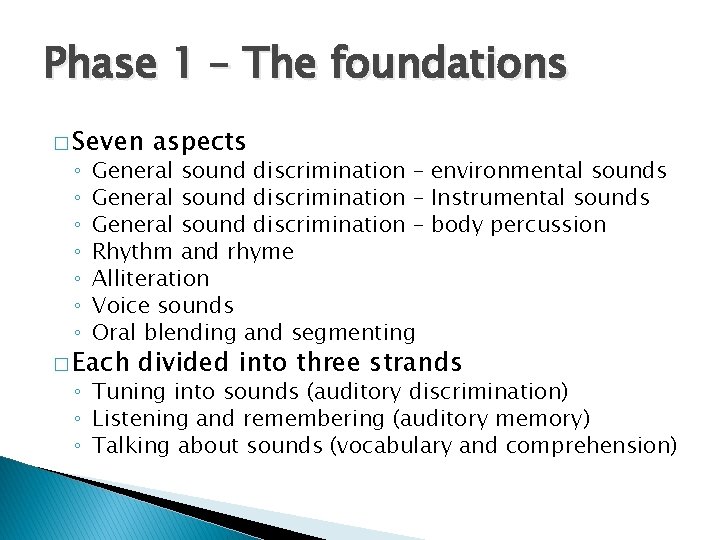
Phase 1 – The foundations � Seven ◦ ◦ ◦ ◦ aspects General sound discrimination – environmental sounds General sound discrimination – Instrumental sounds General sound discrimination – body percussion Rhythm and rhyme Alliteration Voice sounds Oral blending and segmenting � Each divided into three strands ◦ Tuning into sounds (auditory discrimination) ◦ Listening and remembering (auditory memory) ◦ Talking about sounds (vocabulary and comprehension)
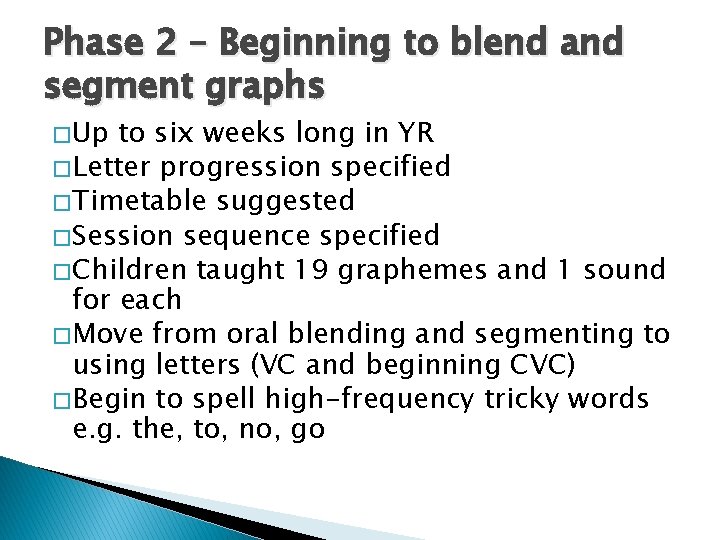
Phase 2 – Beginning to blend and segment graphs � Up to six weeks long in YR � Letter progression specified � Timetable suggested � Session sequence specified � Children taught 19 graphemes and 1 sound for each � Move from oral blending and segmenting to using letters (VC and beginning CVC) � Begin to spell high-frequency tricky words e. g. the, to, no, go
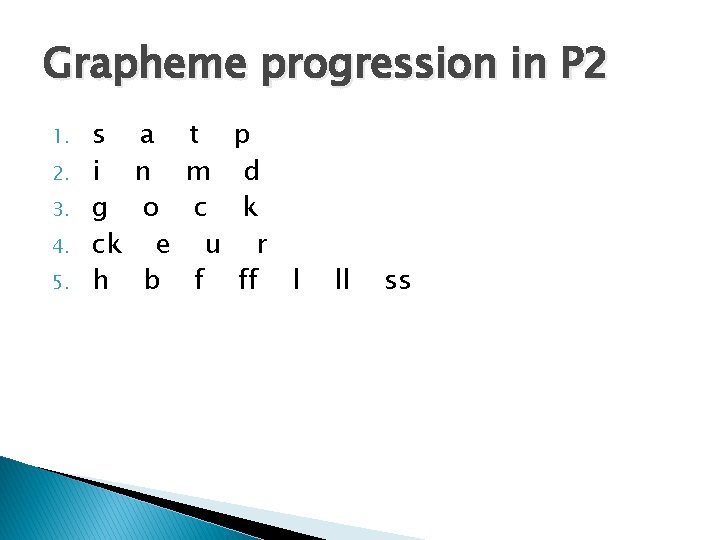
Grapheme progression in P 2 1. 2. 3. 4. 5. s i g ck h a n o e b t m c u f p d k r ff l ll ss
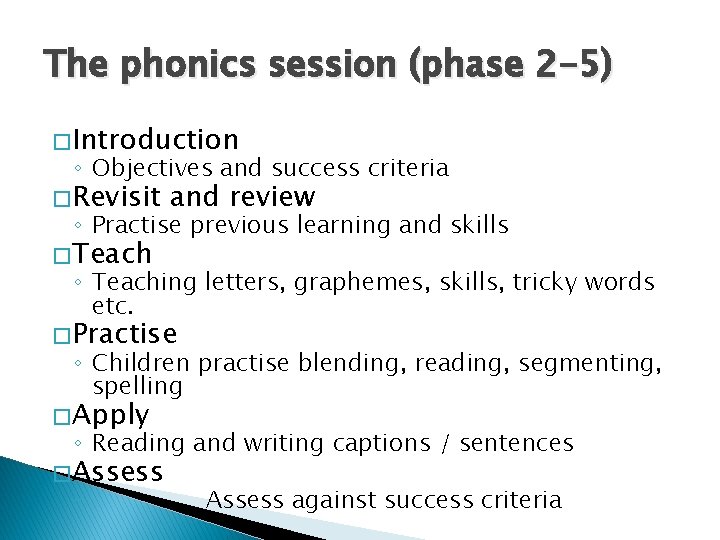
The phonics session (phase 2 -5) � Introduction ◦ Objectives and success criteria � Revisit and review ◦ Practise previous learning and skills � Teach ◦ Teaching letters, graphemes, skills, tricky words etc. � Practise ◦ Children practise blending, reading, segmenting, spelling � Apply ◦ Reading and writing captions / sentences � Assess ◦ Assess against success criteria
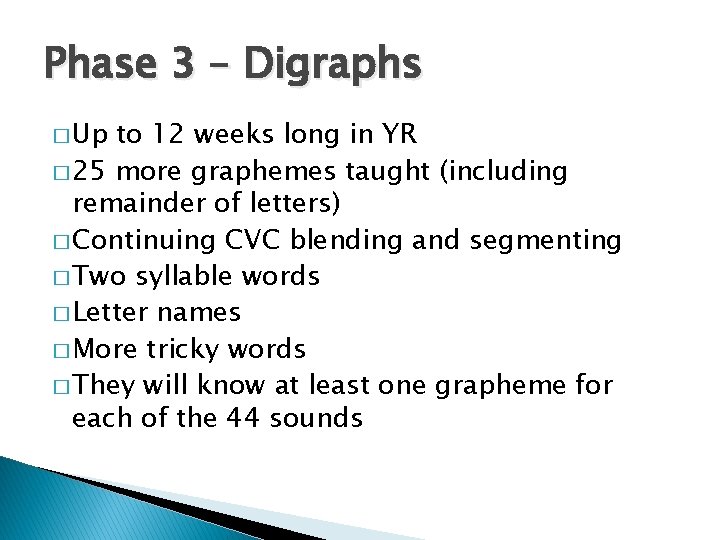
Phase 3 – Digraphs � Up to 12 weeks long in YR � 25 more graphemes taught (including remainder of letters) � Continuing CVC blending and segmenting � Two syllable words � Letter names � More tricky words � They will know at least one grapheme for each of the 44 sounds
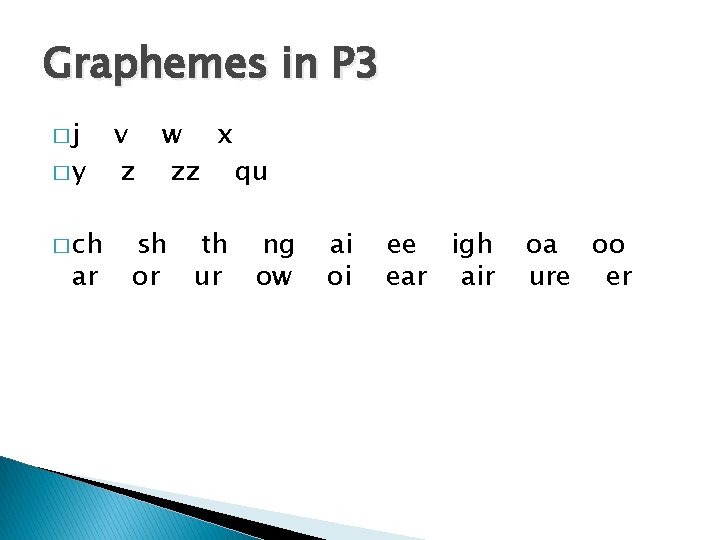
Graphemes in P 3 �j �y � ch ar v w x z zz qu sh th or ur ng ow ai oi ee igh ear air oa oo ure er
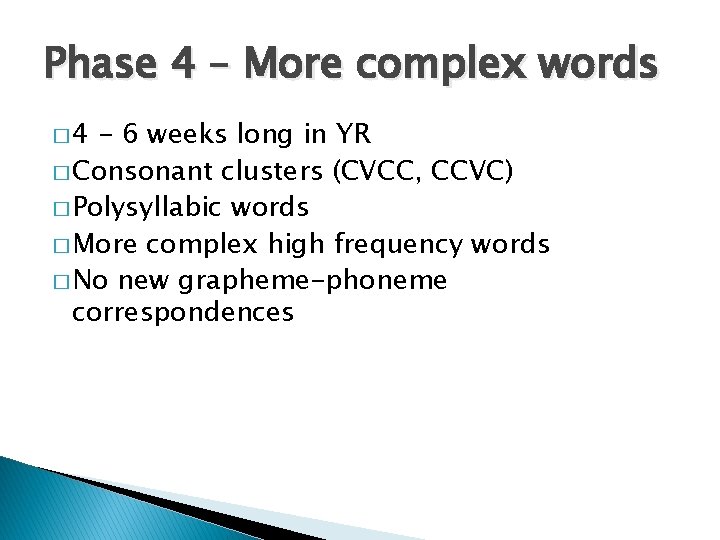
Phase 4 – More complex words � 4 - 6 weeks long in YR � Consonant clusters (CVCC, CCVC) � Polysyllabic words � More complex high frequency words � No new grapheme-phoneme correspondences
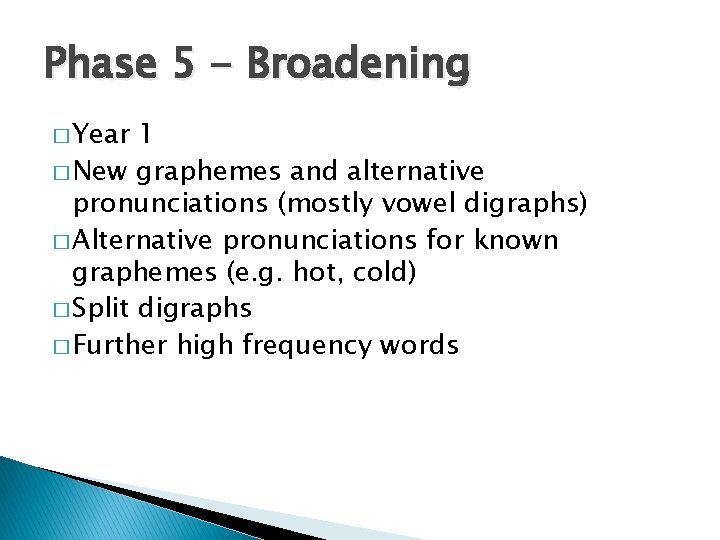
Phase 5 - Broadening � Year 1 � New graphemes and alternative pronunciations (mostly vowel digraphs) � Alternative pronunciations for known graphemes (e. g. hot, cold) � Split digraphs � Further high frequency words
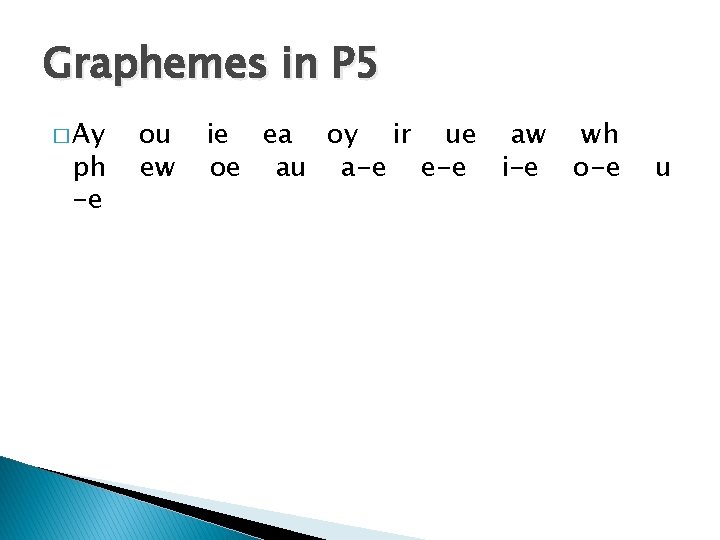
Graphemes in P 5 � Ay ph -e ou ew ie ea oy ir ue aw wh oe au a-e e-e i-e o-e u
How is phonics taught?
Features of high quality phonic work • Brisk pace of learning • Systematic • Ambitious • Active participation by all • Well planned • Progress is monitored carefully • Teaching is adapted to achieve optimum progress for each child • Praise and reinforcement • Applied outside phonic sessions Babcock LDP Phonics Play
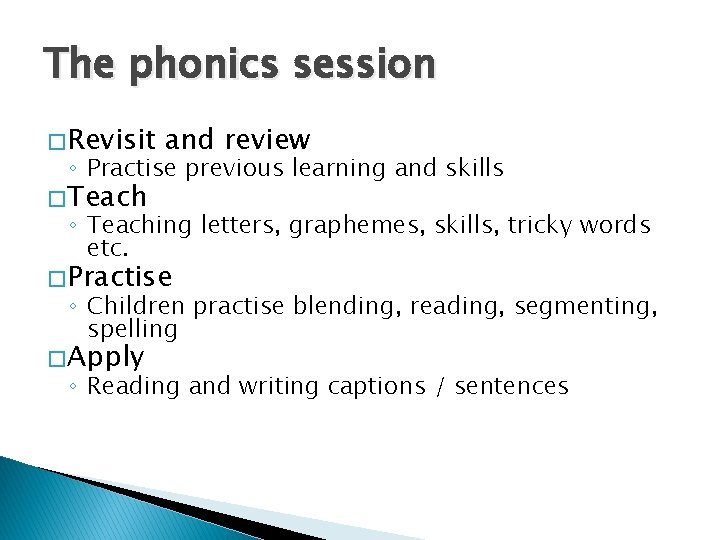
The phonics session � Revisit and review ◦ Practise previous learning and skills � Teach ◦ Teaching letters, graphemes, skills, tricky words etc. � Practise ◦ Children practise blending, reading, segmenting, spelling � Apply ◦ Reading and writing captions / sentences
How do we teach spelling beyond phonics?
Marvellous morphemes �. . . ing �. . . ed �. . . s �. . . er �. . . able � Un. . . � pre. . .
Count the morphemes � How ◦ ◦ ◦ many morphemes in each word Horses Anticlockwise Prewashed Unchangeable Badger
Teaching morphemes � Be clear on the meanings of morphemes where possible � Don’t use phonics to sound them out � Collect words with particular morphemes � Real word/ not real word � Count the morphemes � Word construction (try build) � Morpheme snap
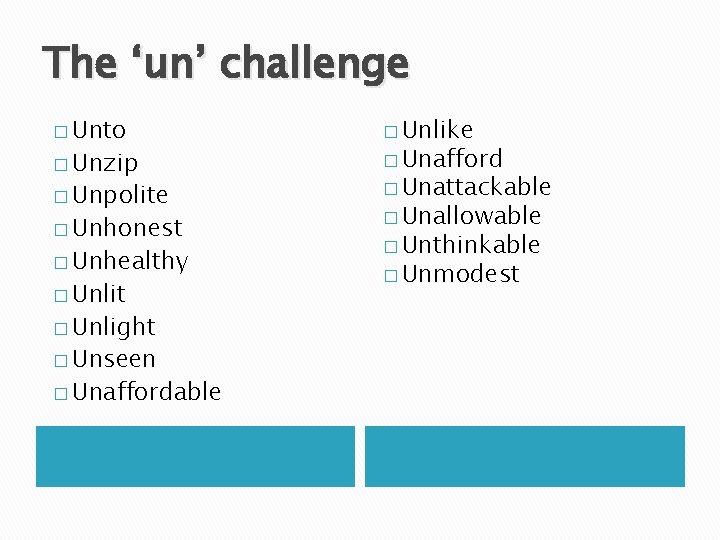
The ‘un’ challenge � Unto � Unlike � Unpolite � Unattackable � Unzip � Unhonest � Unhealthy � Unlit � Unlight � Unseen � Unaffordable � Unafford � Unallowable � Unthinkable � Unmodest
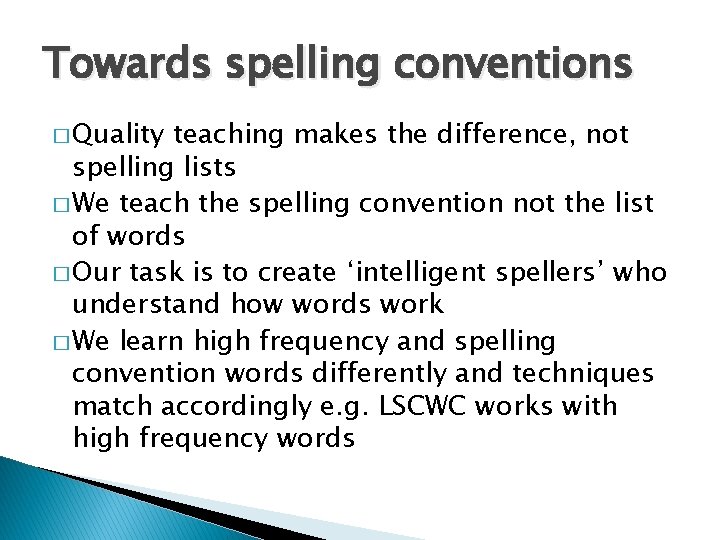
Towards spelling conventions � Quality teaching makes the difference, not spelling lists � We teach the spelling convention not the list of words � Our task is to create ‘intelligent spellers’ who understand how words work � We learn high frequency and spelling convention words differently and techniques match accordingly e. g. LSCWC works with high frequency words
How do we teach reading beyond phonics?
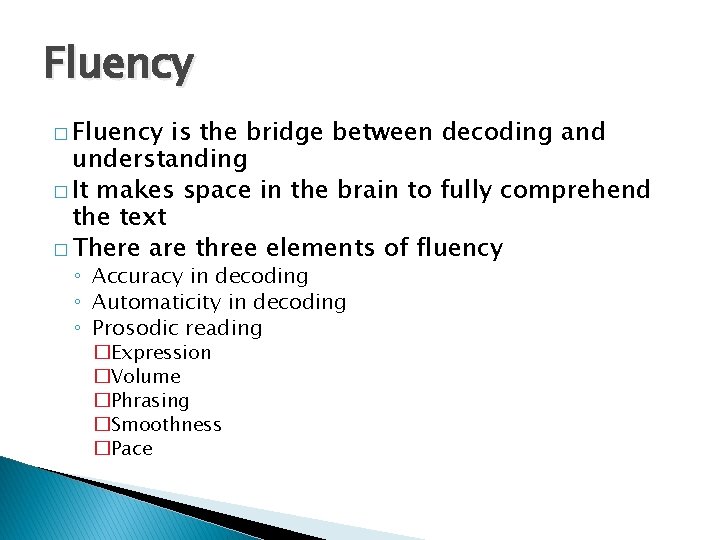
Fluency � Fluency is the bridge between decoding and understanding � It makes space in the brain to fully comprehend the text � There are three elements of fluency ◦ Accuracy in decoding ◦ Automaticity in decoding ◦ Prosodic reading �Expression �Volume �Phrasing �Smoothness �Pace
Reading comprehension skills � Clarifying – Understanding what you have read (both text, words and phrases) � Inferring – Reading between the lines � Predicting – Suggesting what will happen next � Linking – Making connections to other knowledge � Imagining – using imagination and empathy to gain a better understanding
� Summarising – Spotting the key points and summing them up � Understanding purpose and viewpoint – recognising, comparing and explaining � Understanding text organisation - how and why authors have structured, ordered and organised their writing in certain ways � Understanding writers’ use of language - how and why authors have used language for effect
Question time � Where is the story set? � How do you know that it is set in a different time? � What order does the author tell you things in? Why? � How do the townspeople feel? � Is the mayor the right man to solve the problem? � How does the writer use sentences to describe the rats? What’s the effect? � What does the author want you to think about the Pied Piper? � What are the key points in this introduction? � What will happen next? How do you know? What’s your evidence?
How children develop as writers
Role Play Writing
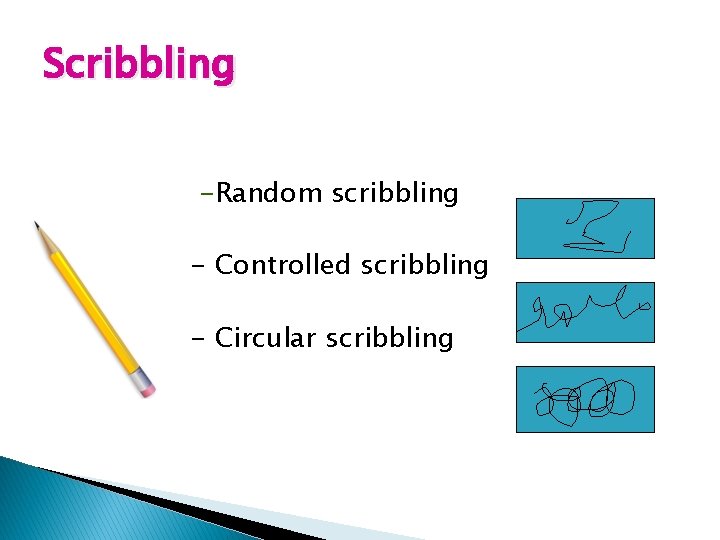
Scribbling -Random scribbling - Controlled scribbling - Circular scribbling
What moves children through this stage? � Referring to words, spaces, letters, lines, left to right, top to bottom etc. � Counting and clapping words � Practical games using magnetic letters, letter cards etc. � Pointing out and talking about print � Using name cards � Talking about writing and drawing separately � Modelling some basic conventions
Experimental Writing
What moves children through this stage? � Playing with predictable texts � Predicting words � Rearranging words to make different sentences � Building up sight words � Using word walls and alphabet charts � Regular, high quality phonics � Modelling common punctuation
Early Writing
A writer at the end of Y 1 �I can write a series of sentences � I use full stops at the end of most sentences � I use capital letters to mark the start of most sentences � I use the phonics I have learnt � I use the high frequency words I have learnt � I can read my writing to an adult � My letters are formed correctly � My writing can be read by an adult
A writer at the end of Y 2 � My writing has a clear beginning, middle and end � I can use structures for different types of writing � I can use simple adverbs e. g. suddenly, slowly, next, finally � I can use words that are appropriate to the type of writing � I can use a range of simple conjunctions e. g. but, then, so, or, because, when � I can keep writing in the same tense � I can use question marks, exclamation marks, basic apostrophes and commas in lists � I can spell most simply structured words correctly � I am joining my letters
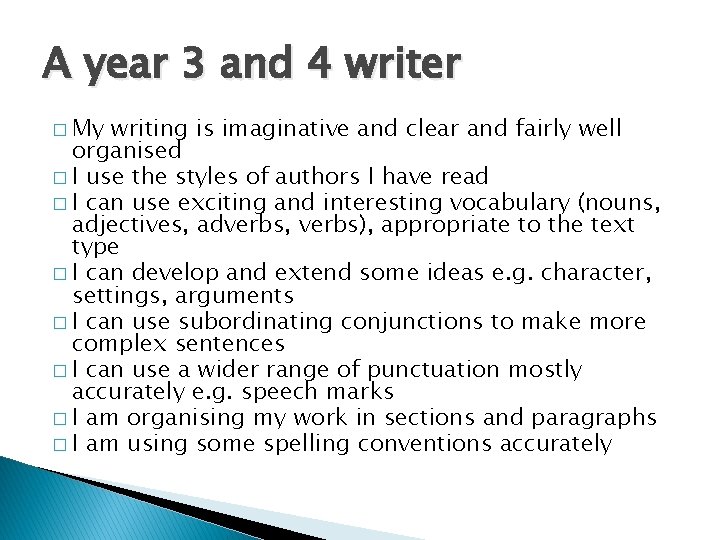
A year 3 and 4 writer � My writing is imaginative and clear and fairly well organised � I use the styles of authors I have read � I can use exciting and interesting vocabulary (nouns, adjectives, adverbs, verbs), appropriate to the text type � I can develop and extend some ideas e. g. character, settings, arguments � I can use subordinating conjunctions to make more complex sentences � I can use a wider range of punctuation mostly accurately e. g. speech marks � I am organising my work in sections and paragraphs � I am using some spelling conventions accurately
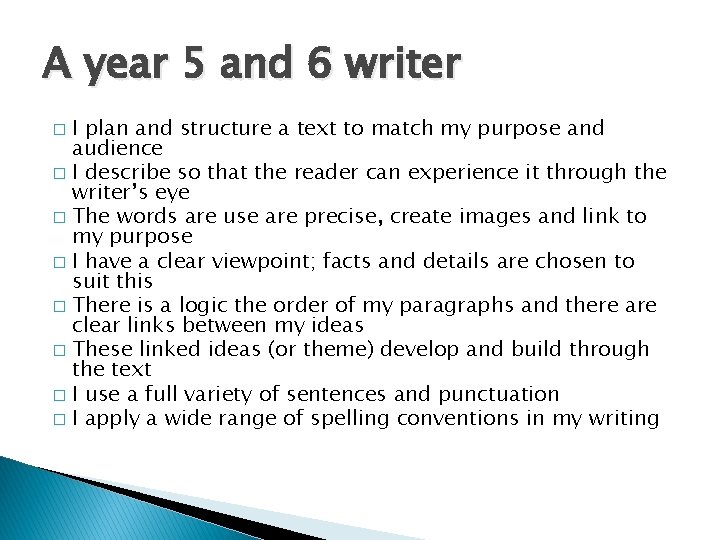
A year 5 and 6 writer I plan and structure a text to match my purpose and audience � I describe so that the reader can experience it through the writer’s eye � The words are use are precise, create images and link to my purpose � I have a clear viewpoint; facts and details are chosen to suit this � There is a logic the order of my paragraphs and there are clear links between my ideas � These linked ideas (or theme) develop and build through the text � I use a full variety of sentences and punctuation � I apply a wide range of spelling conventions in my writing �
Teaching writing
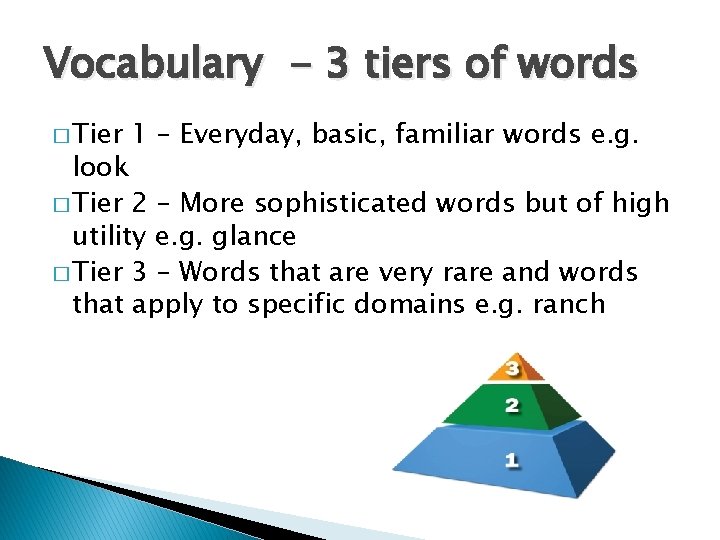
Vocabulary - 3 tiers of words � Tier 1 – Everyday, basic, familiar words e. g. look � Tier 2 – More sophisticated words but of high utility e. g. glance � Tier 3 – Words that are very rare and words that apply to specific domains e. g. ranch
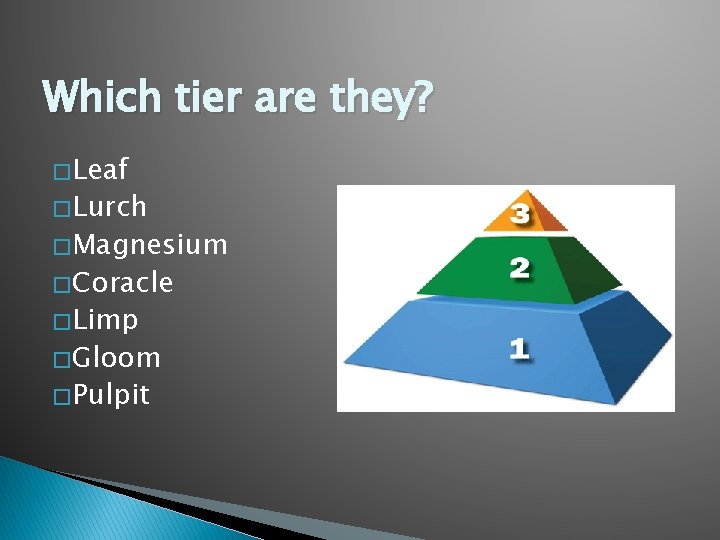
Which tier are they? � Leaf � Lurch � Magnesium � Coracle � Limp � Gloom � Pulpit
Indirect and direct teaching � Indirect ◦ Engaging in oral language ◦ Listening to adults read ◦ Reading themselves � Direct ◦ Teaching specific words before reading ◦ Teaching words over a unit ◦ Repeated exposure to vocabulary in many contexts
Writing in FS � Daily phonics and daily letter formation � Daily sentence writing (after some phonics has been taught) � Explicit speaking and writing activities in (and for) the role play area � Writing activities � Writing in other activities � Guided writing � Motor activities � Guided talk
Developing letter formation � EYFS 40 -60 months - Uses a pencil and holds it effectively to form recognisable letters, most of which are correctly formed. � Daily practice in YR, Y 1 and Y 2 � An early focus on posture and tripod grip � Keep to the same style � Ensuring correct letter formation is achieved by all by the end of year 1 at the latest � Joined writing by the end of Y 2 � Pen in year 3 � High expectations
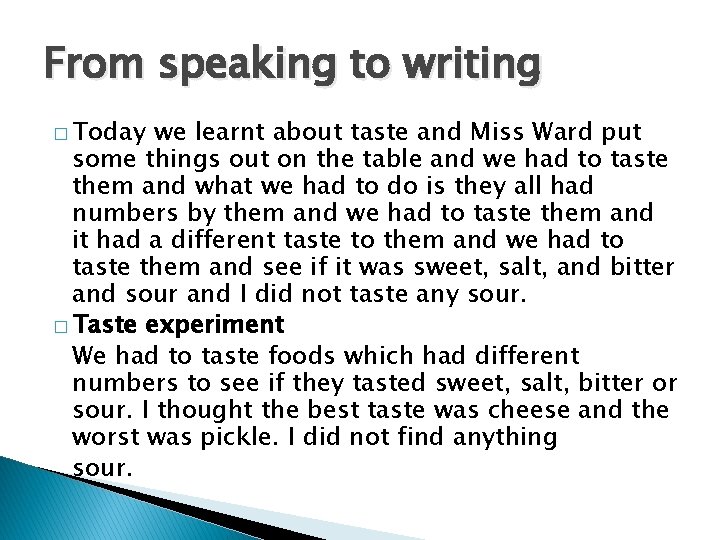
From speaking to writing � Today we learnt about taste and Miss Ward put some things out on the table and we had to taste them and what we had to do is they all had numbers by them and we had to taste them and it had a different taste to them and we had to taste them and see if it was sweet, salt, and bitter and sour and I did not taste any sour. � Taste experiment We had to taste foods which had different numbers to see if they tasted sweet, salt, bitter or sour. I thought the best taste was cheese and the worst was pickle. I did not find anything sour.
Building the importance of the sentence in YR � Writing: children use their phonic knowledge to write words in ways which match their spoken sounds. They also write some irregular common words. They write simple sentences which can be read by themselves and others. Some words are spelt correctly and others are phonetically plausible. �A balance of developmental writing and instruction

Early Writing An improving writer Emergent / developmental writing Direct teaching of phonics and writing
A developmental approach � Right from the start children are expected to have a go at writing without waiting for a model or help with spelling � During this the teacher offers encouragement and support � After this, the teacher discusses the content, the letters chosen etc. � The teacher provides a correct model of the writing for the child to consider and discusses it with them
Advantages of a developmental approach � Children believe in themselves as writers from the outset and are happy to attempt writing � They are likely to focus in more on the genre, content and vocabulary � Self esteem remains high and they develop positive attitudes towards writing � Children become independent writers and teachers are freed up to work in a more focused way
Using direct teaching � Embedding phonics early on means that pupils quickly learn to write simple words and sentences. � Encourage them to compose each sentence aloud until they are confident to write independently. � Make sure they write every day as soon as possible � Pupils write at the level of their spelling knowledge � The quality of the vocabulary they use in their writing reflects the language they have heard in the books the teacher has read to them
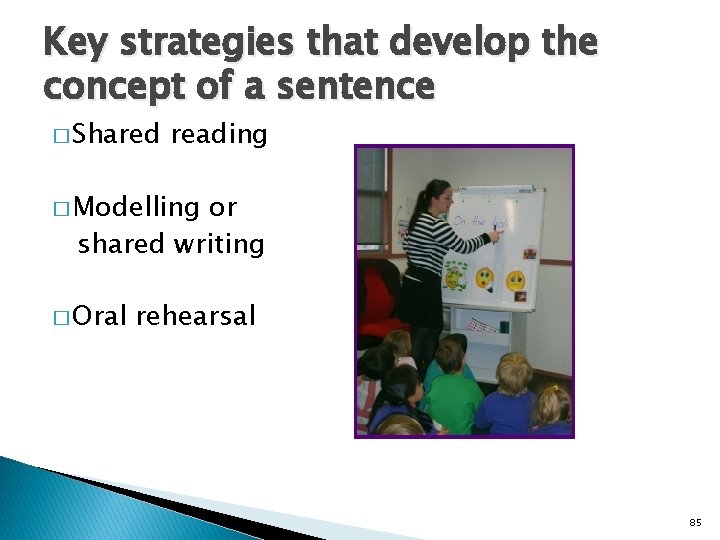
Key strategies that develop the concept of a sentence � Shared reading � Modelling or shared writing � Oral rehearsal 85
Early writing instruction 1. 2. 3. 4. 5. 6. 7. Model composing a sentence out loud Children repeat this back several times to hold it in their heads Model writing the sentence. Children contribute. Hide the sentence Children repeat sentence orally Children write sentence independently on paper Children read the sentence aloud to their partner and congratulate them Enthusiasm and positivity
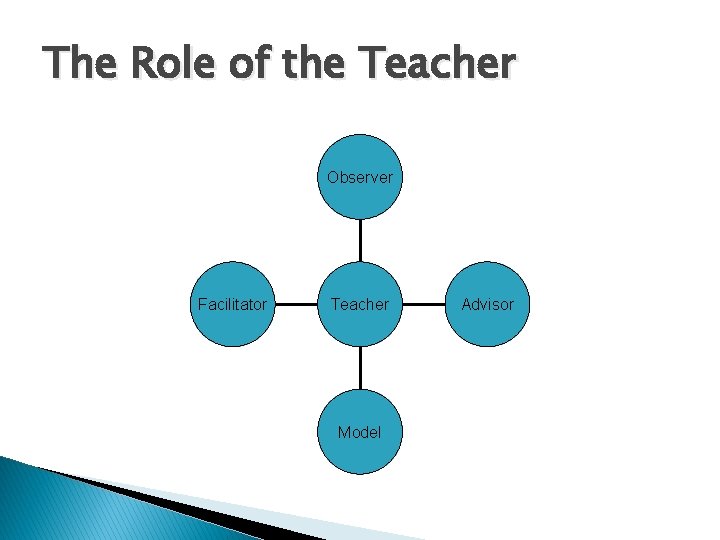
The Role of the Teacher Observer Facilitator Teacher Model Advisor
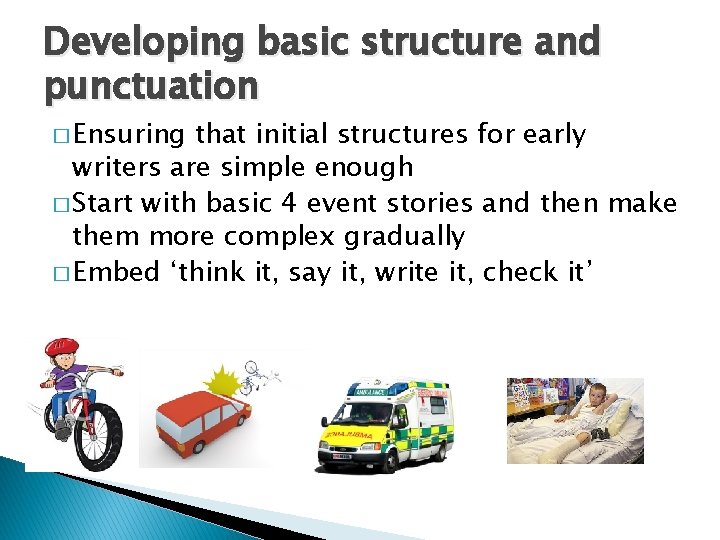
Developing basic structure and punctuation � Ensuring that initial structures for early writers are simple enough � Start with basic 4 event stories and then make them more complex gradually � Embed ‘think it, say it, write it, check it’
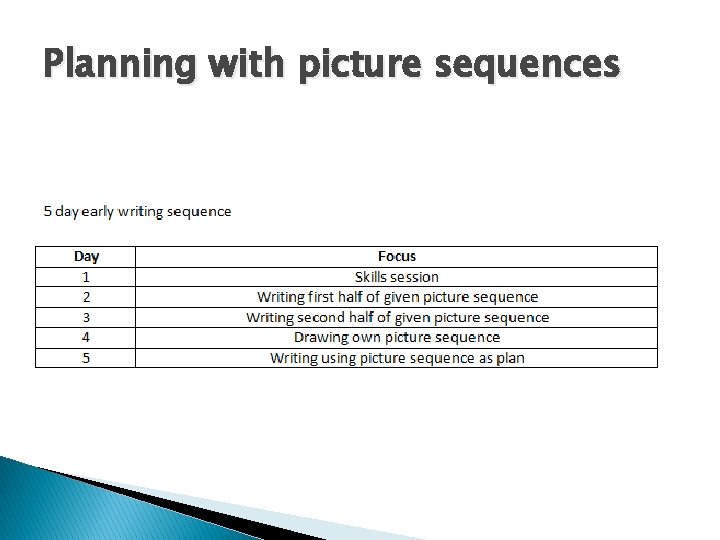
Planning with picture sequences
Increasing length and complexity � Increase the length of picture stories and the number of sentences � Then leave them behind and enable children to write independently � They will need ◦ To understand the text type and have a model ◦ Direct teaching of necessary skills (creating a toolkit) ◦ A stimulus ◦ Shared writing ◦ Time and a calm working atmosphere
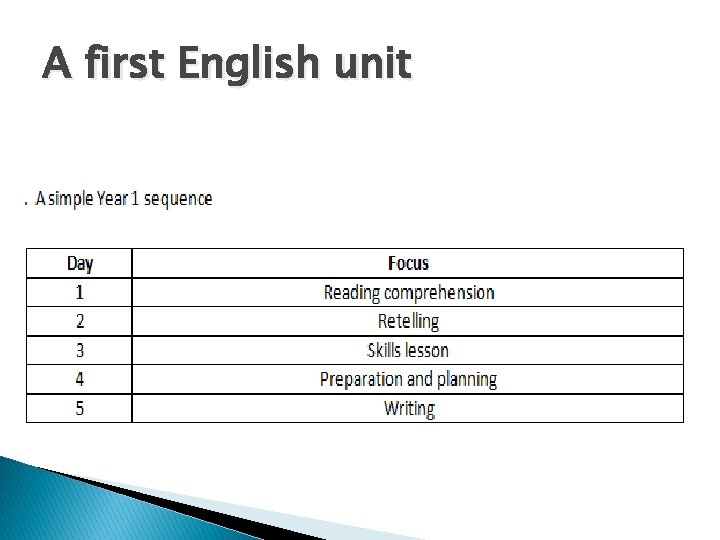
A first English unit
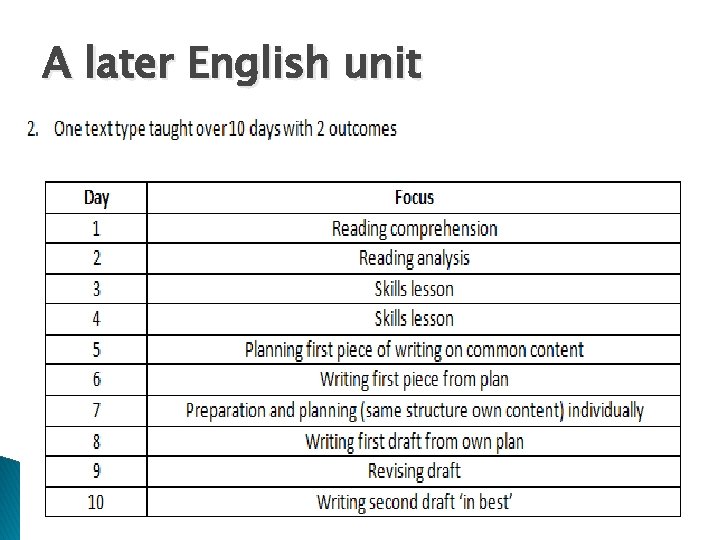
A later English unit
Thoughts, questions, next steps…
- Slides: 93