
A guide for Scientific Writing By Dr Najla
A guide for Scientific Writing By Dr. Najla Abdulrahman Al-Nabhan Assistant Vice-Dean for Academic Affairs, Assistant Professor, Computer Science Department, College of Computer and Information Sciences (CCIS)
• Bio-note Dr. Najla Alnabhan works as an Assistant Vice-Dean for Academic Affairs, College of Computer and Information Sciences (CCIS). She is also an Assistant Professor, at Computer Science Department. • She received her BSc (Hon) and MSc degrees in Computer Science from King Saud University. She also received her Ph. D. degree in Computer Science, College of Computer and Information Science, King Saud University. She was a visiting Ph. D student in GWU, IEEE member and a research fellow in Brunel and Imperial University London. • Her research interest includes wireless networks (specifically sensor networks), mobile computing, distributed systems, ubiquitous computing, cloud computing, Emergency management, and Io. T. • She has awarded a US patent and the top prize in the “King’s Ambition For a Nation’s Future” competition. Dr. Al-nabhan has more than 12 published papers and she is a reviewer in a number of specialized journals. By Dr. Najla Alnabhan 2
Tips on How to Write a Good Research Paper?
What is Scientific Research? • Scientific research is the systematic investigation of scientific theories and hypotheses. • Research is the systematic collection, analysis and interpretation of data to answer a certain question or solve a specific problem. By Dr. Najla Alnabhan 4
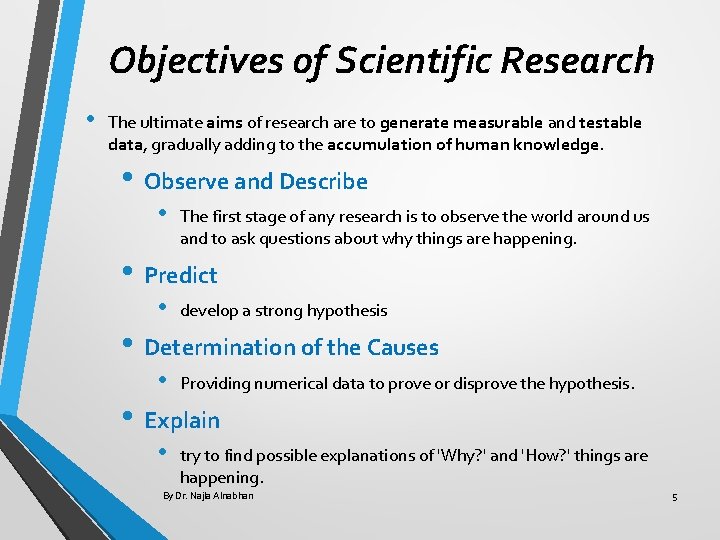
Objectives of Scientific Research • The ultimate aims of research are to generate measurable and testable data, gradually adding to the accumulation of human knowledge. • Observe and Describe • The first stage of any research is to observe the world around us and to ask questions about why things are happening. • Predict • develop a strong hypothesis • Determination of the Causes • Providing numerical data to prove or disprove the hypothesis. • Explain • try to find possible explanations of 'Why? ' and 'How? ' things are happening. By Dr. Najla Alnabhan 5
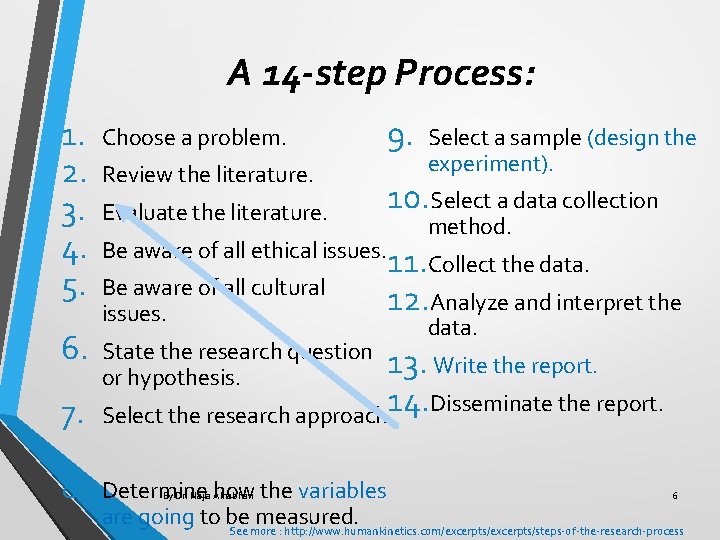
A 14 -step Process: 1. 2. 3. 4. 5. 6. Choose a problem. Review the literature. Evaluate the literature. 9. 10. Select a data collection Be aware of all ethical issues. Be aware of all cultural issues. State the research question or hypothesis. Select a sample (design the experiment). method. 11. Collect the data. 12. Analyze and interpret the data. 13. Write the report. 7. Select the research approach. 14. Disseminate the report. 8. Determine how the variables By Dr. Najla Alnabhan 6 are going to be measured. See more : http: //www. humankinetics. com/excerpts/steps-of-the-research-process
A Fact. . • A scientific experiment is not complete until the results understood. have been published and • A scientific paper is a written and published to describe original research results. By Dr. Najla Alnabhan 7
What is Scientific Writing The purpose of scientific writing is to communicate new scientific findings. Thus it has to be clear, simple and well-ordered communication to transmit new scientific findings. Scientific writing must use proper English which gives the sense in the fewest short words. By Dr. Najla Alnabhan 8
What is the structure of a scientific paper? • All scientific papers have almost the same format. • They are divided into distinct sections and each section contains a specific type of information. • The number and the headings of sections may vary among journals, but for the most part a basic structure is maintained. • Because scientific papers are organized in this way, a reader knows what to expect from each part of the paper, and they can quickly locate a specific type of information. 9 By Dr. Najla Alnabhan
What is the general structure of a scientific paper? • Typically, scientific papers are comprised of the following parts: • • • Title. Abstract. Introduction. Related Work. Methodology/ Your approach/work. Results. Discussion & Conclusion. Acknowledgments. References. By Dr. Najla Alnabhan 10
How to Find a Good (Well-written) Paper • We need an example on how a good paper looks like! v. KSU digital library: v. Library. ksu. edu. sa v. Webof. Science. com (KSU domain) vhttps: //www. youtube. com/watch? v=M 7 WQMALBg 8 w &t=4 s v. Pick a paper(or 3) in your specialty or area of interest to use it throughout this presentation, By Dr. Najla Alnabhan 11
Essential Parts of a Scientific paper 1. Title: Describes concisely the core contents of the paper. 2. Abstract: Summarizes the major elements of the paper. 3. Introduction: provides context and rationale for the study. 4. Literature review: surveys scientific articles, books, journals, dissertations & other sources relevant to the research question. 5. The Approach: Materials: Describes the experimental design so it is reproducible. Methods: Describes the experimental procedures. 6. Results: Summarizes the findings without interpretation. 7. Discussion: Interprets the findings of the study. 8. Conclusion: Summarizes the findings. 9. Acknowledgement: Give credit to those who helped you. 10. References: Lists all scientific papers, books and websites that you cited. 12 By Dr. Najla Alnabhan

PAPER TITLE By Dr. Najla Alnabhan
The Title • The title will help you to determine if an article is interesting or relevant for your project. • Well-written titles give a reasonably complete description of the conducted study, and sometimes even highlights the findings. By Dr. Najla Alnabhan 14
Why the Title is Important? • The title is extremely important and must be chosen with great care as it will be read by thousands, whereas few will read the entire paper. • Indexing and abstracting of the paper depends on the accuracy of the title. An improperly titled paper will get lost and will never be read. By Dr. Najla Alnabhan 15
Tips on Writing a Good Title Length: • A good title is defined as the fewest possible words that adequately describe the contents of the paper. • Titles should neither be too short nor too long as to be meaningless • Waste words • i. e. studies on, investigations on, a, an, the. By Dr. Najla Alnabhan 16
Tips on Writing a Good Title (cont. ) • Syntax (words order) must be very carefully considered. • It should contain the keywords that reflect the contents of the paper. • It should be meaningful and not general. • It should be concise, specific and informative. • It should capture the fundamental nature of the experiments and findings. By Dr. Najla Alnabhan 17
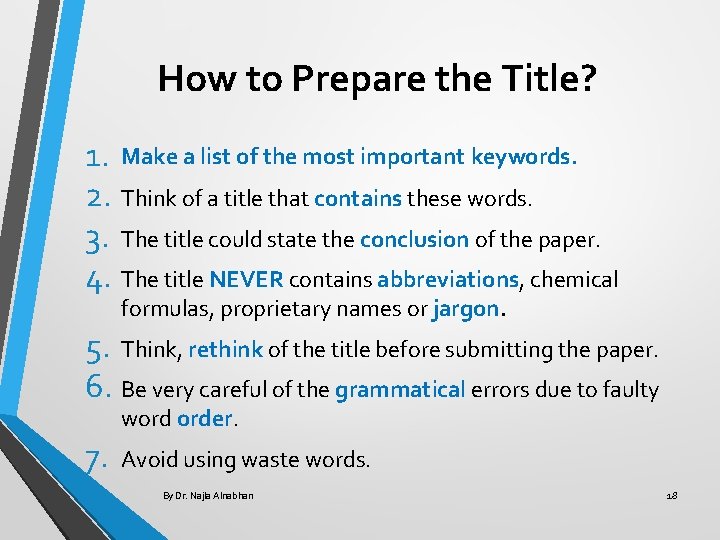
How to Prepare the Title? 1. Make a list of the most important keywords. 2. Think of a title that contains these words. 3. The title could state the conclusion of the paper. 4. The title NEVER contains abbreviations, chemical formulas, proprietary names or jargon. 5. Think, rethink of the title before submitting the paper. 6. Be very careful of the grammatical errors due to faulty word order. 7. Avoid using waste words. By Dr. Najla Alnabhan 18
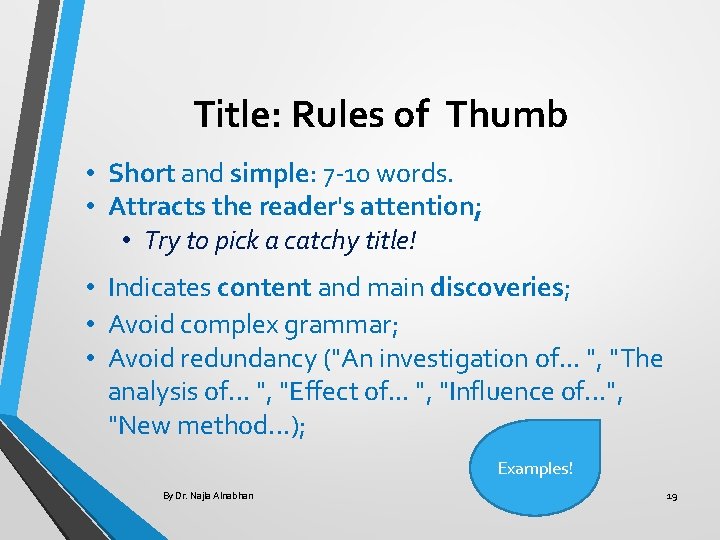
Title: Rules of Thumb • Short and simple: 7 -10 words. • Attracts the reader's attention; • Try to pick a catchy title! • Indicates content and main discoveries; • Avoid complex grammar; • Avoid redundancy ("An investigation of. . . ", "The analysis of. . . ", "Effect of. . . ", "Influence of. . . ", "New method. . . ); Examples! By Dr. Najla Alnabhan 19

The ABSTRACT By Dr. Najla Alnabhan
ABSTRACT • Abstract provides you with a complete, but very brief summary of the paper. • Something that is briefly and clearly expressed. • Abstracts are often included in article databases, and are usually free to a large audience. • The most widely read portions of scientific papers. • Abstract is the first and sometimes the only part of the manuscript read. By Dr. Najla Alnabhan 21
The Abstract • An abstract can be defined as a summary of the information in a document. • An abstract contains brief statements of the 1)purpose, 2)methods, 3)results, and 4)conclusions of a study. • It provides a brief summary of each of the main sections of the paper. • It is easier to write the abstract after completion of the paper By Dr. Najla Alnabhan 22
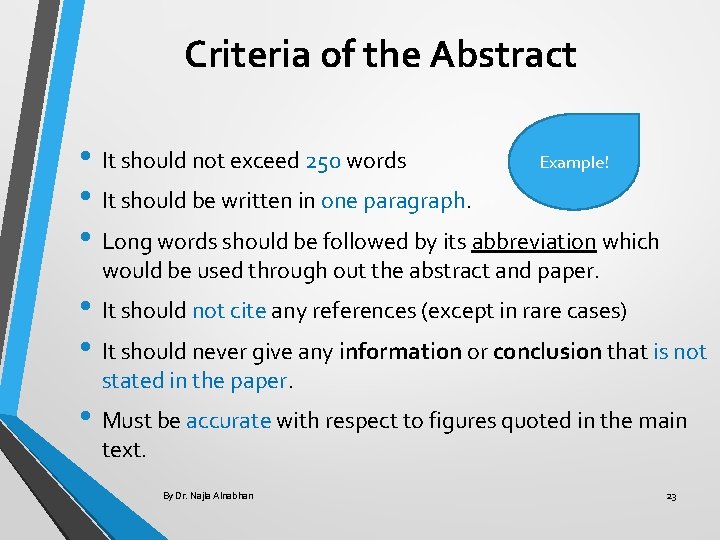
Criteria of the Abstract Example! • It should not exceed 250 words • It should be written in one paragraph. • Long words should be followed by its abbreviation which would be used through out the abstract and paper. • It should not cite any references (except in rare cases) • It should never give any information or conclusion that is not stated in the paper. • Must be accurate with respect to figures quoted in the main text. By Dr. Najla Alnabhan 23
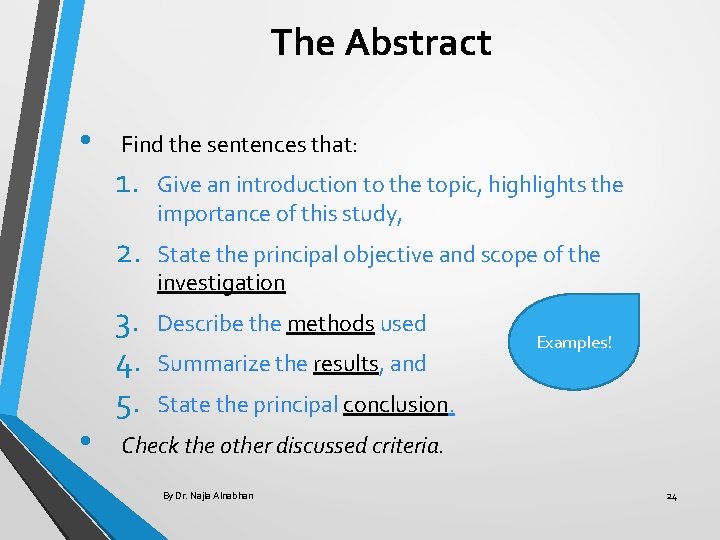
The Abstract • • Find the sentences that: 1. Give an introduction to the topic, highlights the importance of this study, 2. State the principal objective and scope of the investigation 3. 4. 5. Describe the methods used Summarize the results, and Examples! State the principal conclusion. Check the other discussed criteria. By Dr. Najla Alnabhan 24
Abstract: Rules of Thumb • Abstract should be short but give the overall idea on: • what was done, • what was found and • what are the main conclusions • bring summary 'numbers‘. By Dr. Najla Alnabhan 25

Key Words (Or index words) By Dr. Najla Alnabhan
Key Words • Keywords are important words/concepts found in your research question or paper. • Keywords make your paper searchable and ensure that you get more citations. • Therefore, it is important to include the most relevant keywords that will help other authors find your paper. • A quick way to pull keywords from a research question is to choose the most important nouns; all other words are irrelevant. • Using keywords to search will always retrieve more results than phrases or sentences. By Dr. Najla Alnabhan 27
Key Words: Tips • Here a few tips that will help you create relevant and effective keywords for your paper: 1. Think from the point of view of the reader. • What keywords would the reader search for that would help retrieve your article? 2. Keywords should ideally be phrases of 4 -5 words • Journals ask for anywhere between 3 -8 keywords. • single word keywords are acceptable, but they may lead to many false matches. By Dr. Najla Alnabhan 28
Key Words: Tips 3. Keywords should contain words and phrases that suggest what the topic is about. 4. Also include words and phrases that are closely related to your topic. • (For example, if the paper is about heart diseases, use words like stroke, circulatory system, blood, etc. 5. Also use variants terms or phrases that readers are likely to use. • (For example, if the paper is about spine disorders, use words like spinal cord, vertebral column, backbone, etc. ) 6. Full forms of shortened words and abbreviations could be 29 included as well. By Dr. Najla Alnabhan
Keywords: Rules of Thumb • when selecting keywords, imagine you are searching for your article in some database. By Dr. Najla Alnabhan 30

INTRODUCTION
INTRODUCTION • You will find background information and a statement of the author's hypothesis in the introduction. • An introduction usually describes theoretical background, indicates why the work is important, states a specific research question, and poses a specific hypothesis to be tested. By Dr. Najla Alnabhan 32
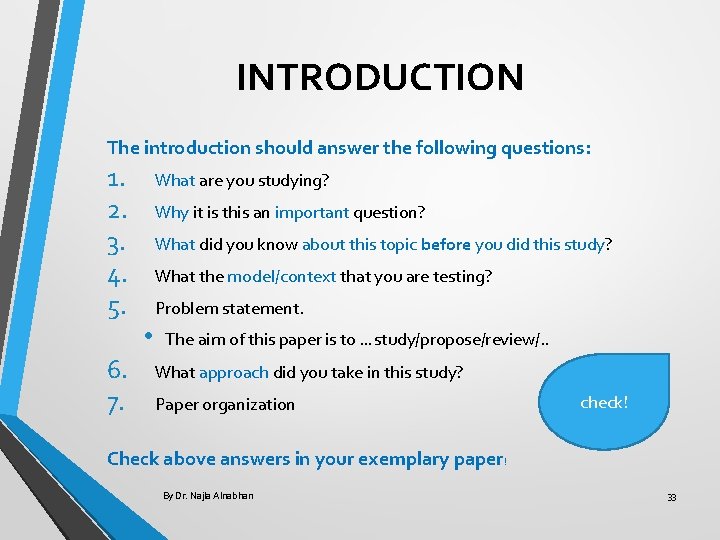
INTRODUCTION The introduction should answer the following questions: 1. 2. 3. 4. 5. 6. 7. What are you studying? Why it is this an important question? What did you know about this topic before you did this study? What the model/context that you are testing? Problem statement. • The aim of this paper is to … study/propose/review/. . What approach did you take in this study? Paper organization check! Check above answers in your exemplary paper! By Dr. Najla Alnabhan 33
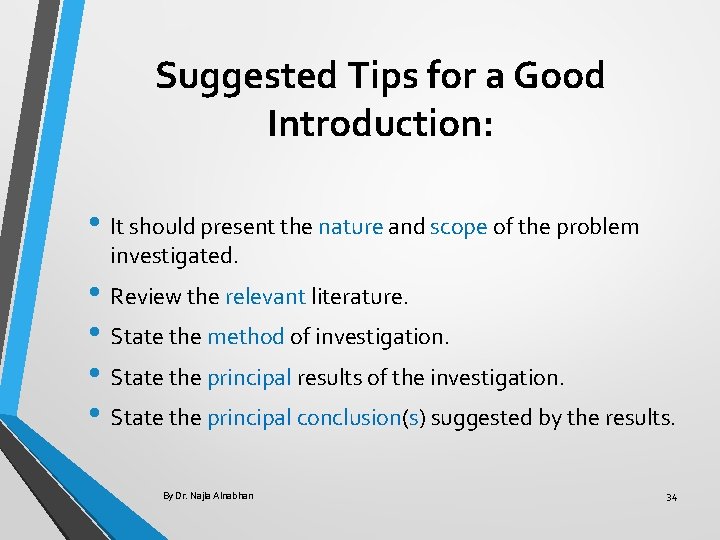
Suggested Tips for a Good Introduction: • It should present the nature and scope of the problem investigated. • Review the relevant literature. • State the method of investigation. • State the principal results of the investigation. • State the principal conclusion(s) suggested by the results. By Dr. Najla Alnabhan 34
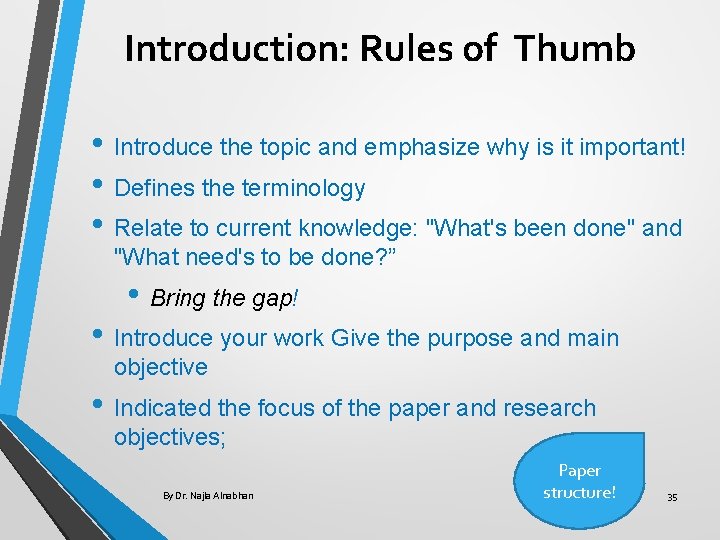
Introduction: Rules of Thumb • Introduce the topic and emphasize why is it important! • Defines the terminology • Relate to current knowledge: "What's been done" and "What need's to be done? ” • Bring the gap! • Introduce your work Give the purpose and main objective • Indicated the focus of the paper and research objectives; By Dr. Najla Alnabhan Paper structure! 35

LITERATURE REVIEW Or Related Work
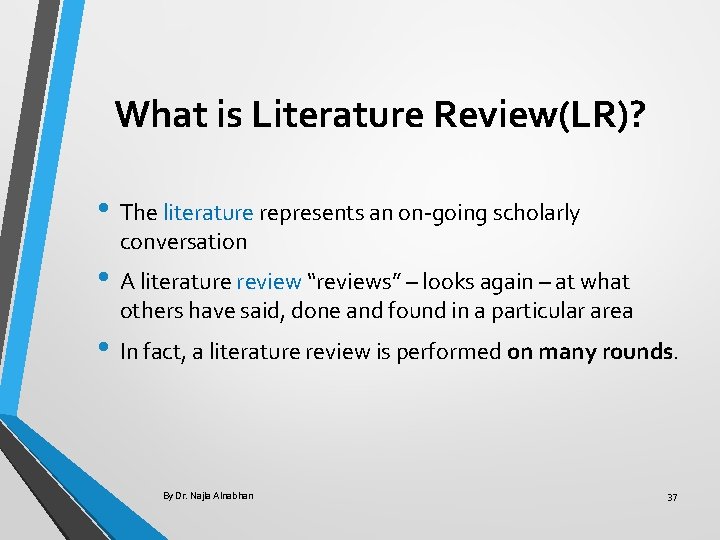
What is Literature Review(LR)? • The literature represents an on-going scholarly conversation • A literature review “reviews” – looks again – at what others have said, done and found in a particular area • In fact, a literature review is performed on many rounds. By Dr. Najla Alnabhan 37
Sources of Literature 1) Journal articles: • these are good sources, especially for up-to-date information. • They are frequently used in literature reviews because they offer a relatively concise, up-to-date format for research. • Depending on the publication, these materials may be refereed materials. By Dr. Najla Alnabhan 38
What about Non-refereed Journals? • Non-refereed materials such as Trade Journals, or magazines use less precise standards of screening prior to publication. • Non-refereed materials may not be checked as intensely as refereed materials, but many can still be considered useful, although not for scientific literature and research. By Dr. Najla Alnabhan 39
Sources of Literature (cont. ) 2) Books: remember that books tend to be less up-todate, as it takes longer for a book to be published than for a journal article. • They are still likely to be useful for including in your literature review as they offer a good starting point from which to find more detailed and up-to-date sources of information. By Dr. Najla Alnabhan 40
Sources of Literature (cont. ) 3) Conference proceedings: these can be useful in providing the latest research, or research that has not been published. • They are also helpful in providing information about people in different research areas, and so can be helpful in tracking down other work by the same researchers. By Dr. Najla Alnabhan 41
Sources of Literature (cont. ) 4) Government/corporate reports: • Many government departments and corporations commission carry out research. • Their published findings can provide a useful source of information, depending on your field of study. By Dr. Najla Alnabhan 42
Sources of Literature (cont. ) 5) Thesis and dissertations: can be useful sources of information. However there are disadvantages: • they can be difficult to obtain since they are not published, but are generall only available from the library or interlibrary systems • the student may not be an experienced researcher and therefore you might have to treat their findings with more caution than published research. • describe more than one topic, and it may present more than one approach to some topics. • The thesis may present all or most of the data obtained in the student’s thesis related research. • longer than a scientific paper. By Dr. Najla Alnabhan 43
Sources of Literature (cont. ) 6) Internet: the fastest-growing source of information is on the Internet. • bear in mind that anyone can post information on the Internet so the quality may not be reliable • the information you find may be intended for a general audience and so not be suitable for inclusion in your literature review (information for a general audience is usually less detailed). By Dr. Najla Alnabhan 44
General Rules in Writing Related Work • Use the active voice as much as possible • Avoid lengthy or unfocused reviews of previous research. • Cite peer-reviewed scientific literature or scholarly reviews. • Avoid general reference works. • Define any specialized terms or abbreviations. By Dr. Najla Alnabhan 45

Annotated Bibliography • An annotated bibliography is a list of citations to books, articles, and documents. Each citation is followed by a brief (usually about 150 words) descriptive and evaluative paragraph, the annotation. • The purpose of the annotation is to inform the reader of the relevance, accuracy, and quality of the sources cited. By Dr. Najla Alnabhan 46
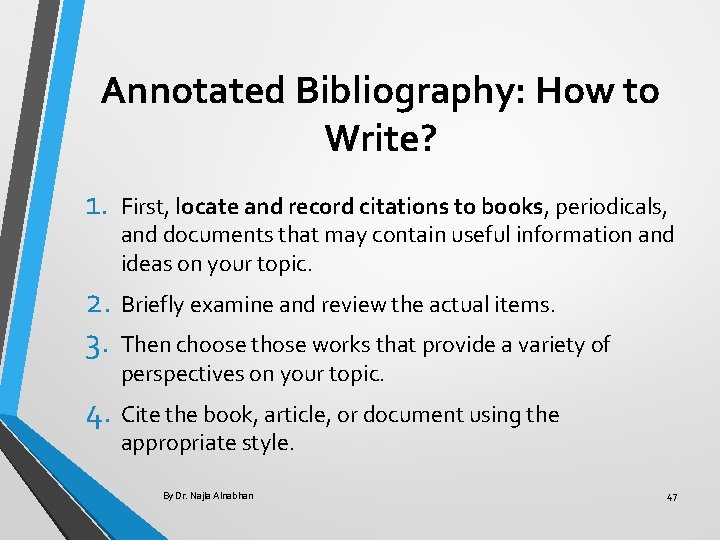
Annotated Bibliography: How to Write? 1. First, locate and record citations to books, periodicals, and documents that may contain useful information and ideas on your topic. 2. Briefly examine and review the actual items. 3. Then choose those works that provide a variety of perspectives on your topic. 4. Cite the book, article, or document using the appropriate style. By Dr. Najla Alnabhan 47
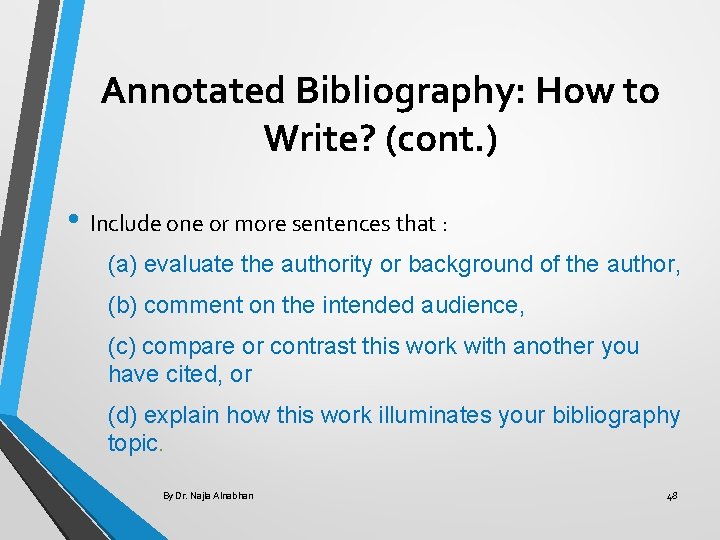
Annotated Bibliography: How to Write? (cont. ) • Include one or more sentences that : (a) evaluate the authority or background of the author, (b) comment on the intended audience, (c) compare or contrast this work with another you have cited, or (d) explain how this work illuminates your bibliography topic. By Dr. Najla Alnabhan 48
LITERATURE CITED (References) • The last section of your paper: References. • It provides the sources cited throughout the paper. • The literature cited section is also helpful for generating a list of background reading on the topic under study. By Dr. Najla Alnabhan 49
THE METHODOLOGY How to Present your Approach/Work?
METHODS • The methods section will help you determine exactly how the authors performed the experiment. • The methods describes both specific techniques and the overall experimental strategy used by the scientists. • It should define: • • The assumptions (justified). Specify the context. Material: Tools. Procedures: Methods. By Dr. Najla Alnabhan 51
Methods • This part of the manuscript must be clear, precise and concise so that it can be reproducible. • If the method is new, all details must be provided • If the method has been previously published in a scientific journal, only the reference should be given with some identification • Questions such as “how” or “how much” must be answered and not left to be puzzled over • Methods used for statistical analyses must be mentioned; ordinary ones without comments, but advanced or unusual ones require literature citation By Dr. Najla Alnabhan 52
METHODS • The methods section will help you determine exactly how the authors performed the experiment. • The methods describes both specific techniques and the overall experimental strategy used by the scientists. • • Mention everything you did that can make importance to the results; establish an authors voice • • if a technique is familiar, only use its name • • ("we decided to ignored this data") (don't re-explain) use simple(st) example to explain complex methodology. By Dr. Najla Alnabhan 53
How to write the Materials and Methods section • Provide full details so that the experiments are reproducible • If the peer reviewer has doubts that the experiments could be repeated, the manuscript will be rejected. • Organize the methods under subheadings, with related methods described together (e. g. subjects, experimental design, Measurement of…, Hormonal assays etc…). • Describe the experimental design in detail. • Do not mix some of the Results in this section. By Dr. Najla Alnabhan 54
Materials (Tools) • Must identify accurately experimental animals, plants, and microorganisms used by genus, species and strain • The source of subjects studied, number of individuals in each group used, their sex, age, and weight must be clearly stated • If human subjects are used, the criteria for selection should be described, and consent • For chemicals used, include exact technical specifications and source or method of preparation. • Avoid the use of trade names of chemicals, generic or chemical names are preferred. By Dr. Najla Alnabhan 55
METHODOLOGY: Rules of Thumb • Describe Experimental set-up. • The assumptions and context. • who, what, when, where, how and why? • Explain the used techniques. • Provide a detailed explanation of the proposed solution • Reseach paper is like a cook-book! Be specific and provide all necessary detail By Dr. Najla Alnabhan 56

RESULTS By Dr. Najla Alnabhan
RESULTS • The results section contains the data collected during experimentation. • The results section is the heart of a scientific paper. • In this section, much of the important information may be in the form of tables or graphs. • When reading this section, do not readily accept an author's statements about the results. • Rather, carefully analyze the raw data in tables and figures to draw your own conclusions. By Dr. Najla Alnabhan 58
How to Write the Results • It is the core or heart of the paper. • It needs to be clearly and simply stated since it constitutes the new knowledge contributed to the world. • The purpose of this section is to summarize and illustrate the findings in an orderly and logical sequence, without interpretation. • The text should guide the reader through the findings, stressing the major points. • Do not describe methods that have already been described in the methodology section or omitted. By Dr. Najla Alnabhan 59
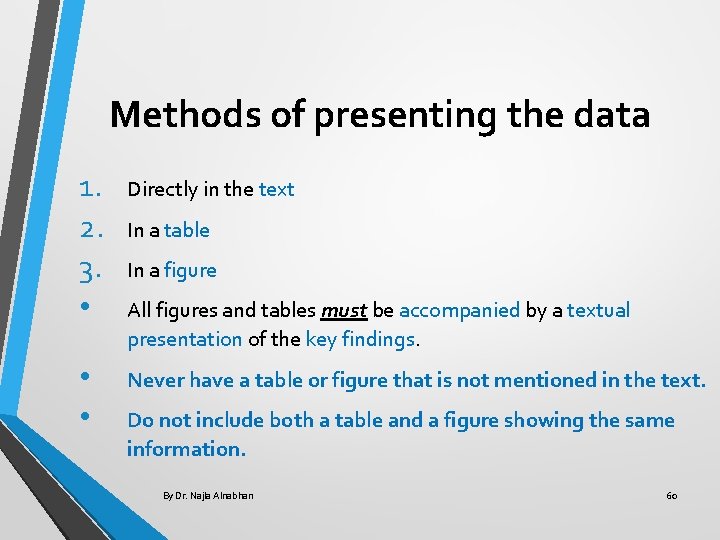
Methods of presenting the data 1. 2. 3. • Directly in the text • • Never have a table or figure that is not mentioned in the text. In a table In a figure All figures and tables must be accompanied by a textual presentation of the key findings. Do not include both a table and a figure showing the same information. By Dr. Najla Alnabhan 60
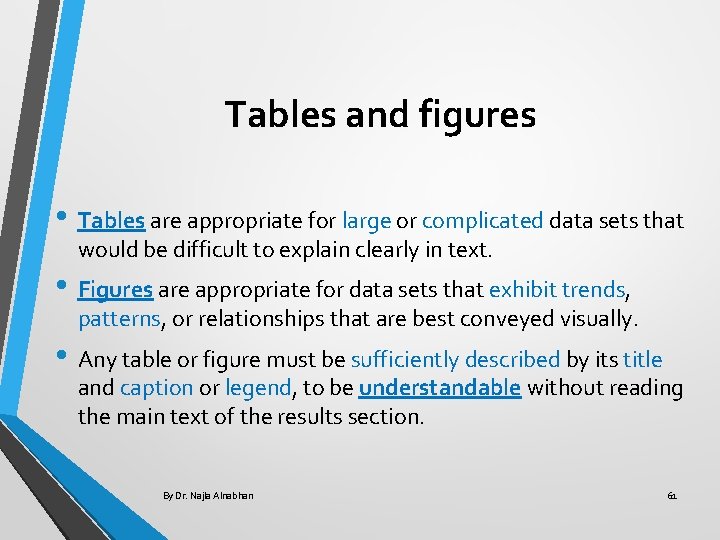
Tables and figures • Tables are appropriate for large or complicated data sets that would be difficult to explain clearly in text. • Figures are appropriate for data sets that exhibit trends, patterns, or relationships that are best conveyed visually. • Any table or figure must be sufficiently described by its title and caption or legend, to be understandable without reading the main text of the results section. By Dr. Najla Alnabhan 61

DISCUSSION This Section is Usually Combined with the RESULTS Section By Dr. Najla Alnabhan
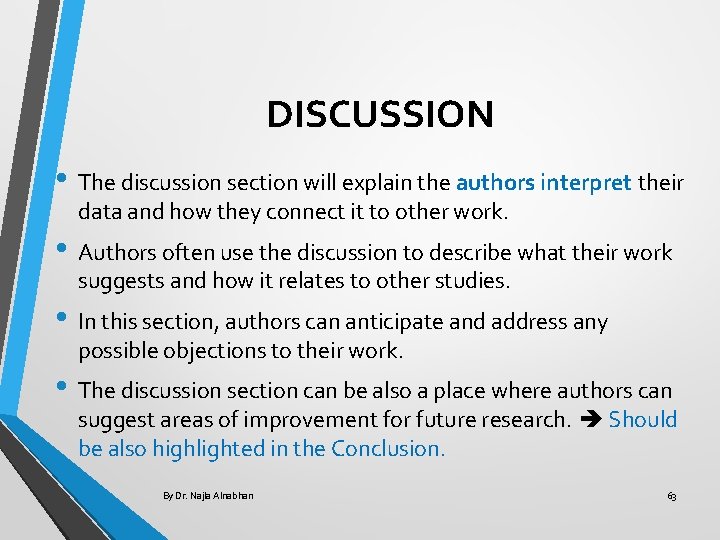
DISCUSSION • The discussion section will explain the authors interpret their data and how they connect it to other work. • Authors often use the discussion to describe what their work suggests and how it relates to other studies. • In this section, authors can anticipate and address any possible objections to their work. • The discussion section can be also a place where authors can suggest areas of improvement for future research. Should be also highlighted in the Conclusion. By Dr. Najla Alnabhan 63
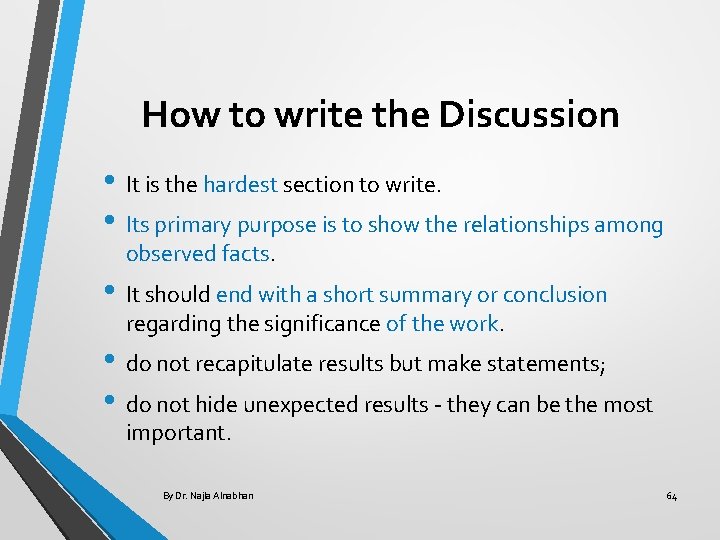
How to write the Discussion • It is the hardest section to write. • Its primary purpose is to show the relationships among observed facts. • It should end with a short summary or conclusion regarding the significance of the work. • do not recapitulate results but make statements; • do not hide unexpected results - they can be the most important. By Dr. Najla Alnabhan 64
Components of the discussion • Try to present the principles, relationships, and generalizations shown by the Results. • Point out any exceptions or any lack of correlation and define unsettled points • Show your results and interpretations agree or contrast with previously published work • Discuss theoretical implications of your work, and any possible practical applications. By Dr. Najla Alnabhan 65
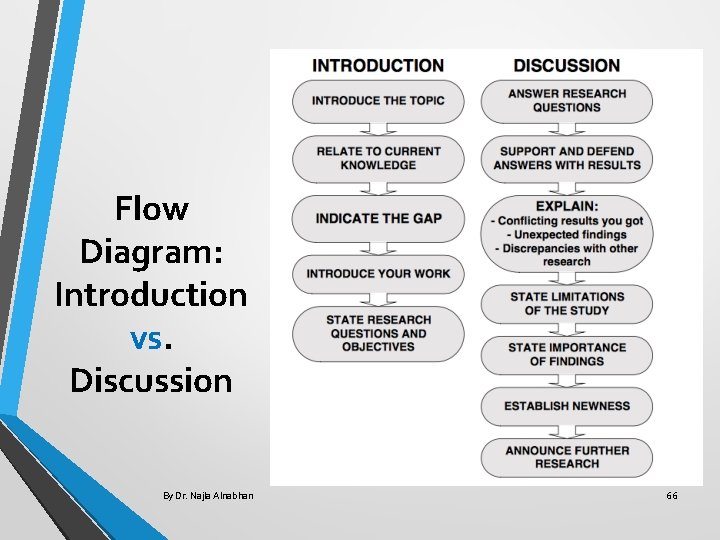
Flow Diagram: Introduction vs. Discussion By Dr. Najla Alnabhan 66

CONCLUSION This Section is Sometimes Combined with the Discussion Section By Dr. Najla Alnabhan
CONCLUSION • It mirrors the Abstract section. • answers research questions/objectives; • explains discrepancies and unexpected findings; • states importance of discoveries and future implications; By Dr. Najla Alnabhan 68
CONCLUSION: Rules of Thumb • State your conclusions as clearly as possible. • Summarize your evidence for each conclusion. • make strong statements (avoid "It may be concluded. . . " style). By Dr. Najla Alnabhan 69

ACKNOWLEDGMENTS By Dr. Najla Alnabhan

ACKNOWLEDGMENTS • The acknowledgments tell you what people or institutions (in addition to the authors) contributed to the work. • In reading the acknowledgments, you can see what sources provided financial support for the study. You might want to know an industry group or the federal government funded the study. By Dr. Najla Alnabhan 71
How to State the Acknowledgments • You should acknowledge: 1. 2. 3. • • Any significant technical help that you have received from any individual in your lab or elsewhere. The source of special equipment, cultures, or any other material. Any outside financial assistance, such as grants, contracts or fellowships Do not use the word “wish”, simply write “I thank …. . ” and not “I wish to thank…” Show the proposed wording of the Acknowledgement to the person whose help you are acknowledging. By Dr. Najla Alnabhan 72

REFERENCES By Dr. Najla Alnabhan
References What is referencing? • Referencing is a standardized way of acknowledging the sources of information and ideas that you have used in your document. • A list of ALL the references used in the text must be written. • Reference format varies widely: ØHarvard format (the name and year system) is the most widely used. ØAlphabet-Number system is a modification of name and year system. ØCitation order system. By Dr. Najla Alnabhan 74
Reference List • Gives list of related literature and information sources; • Any papers not cited in the text should not be included in the reference list. • Reference lists allow readers to investigate the subject in greater depth. • A reference list contains only the books, articles, and web pages etc that are cited in the text of the document. • A bibliography includes all sources consulted for background or further reading. By Dr. Najla Alnabhan 75
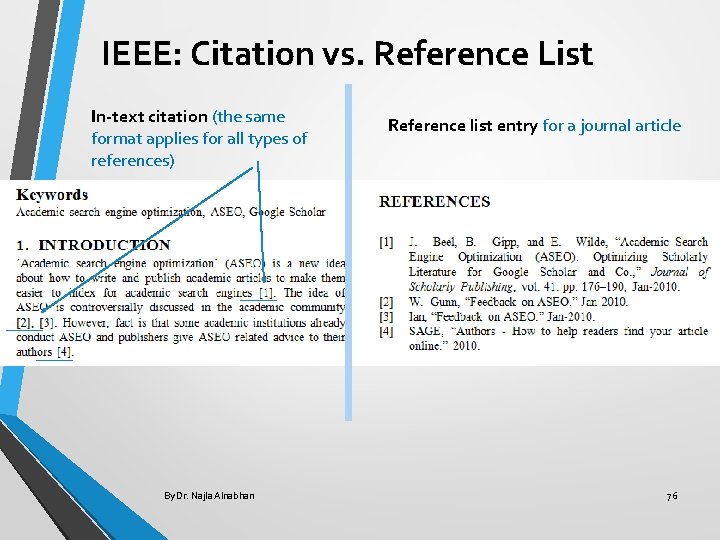
IEEE: Citation vs. Reference List In-text citation (the same format applies for all types of references) By Dr. Najla Alnabhan Reference list entry for a journal article 76
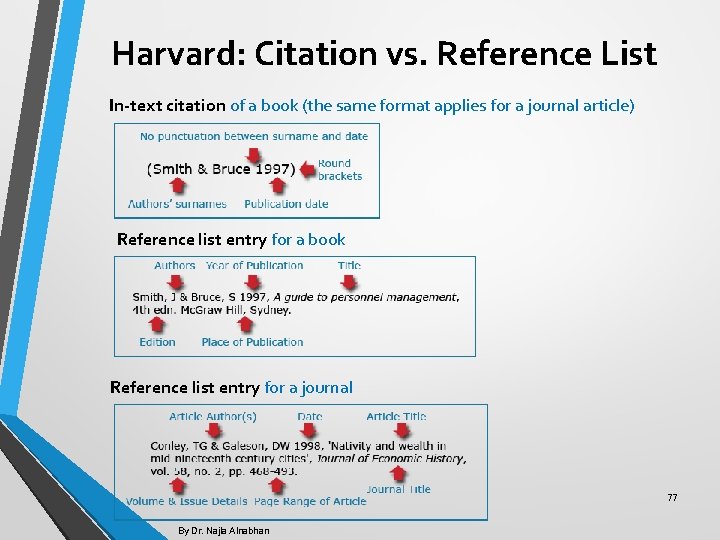
Harvard: Citation vs. Reference List In-text citation of a book (the same format applies for a journal article) Reference list entry for a book Reference list entry for a journal 77 By Dr. Najla Alnabhan
Reference List: Rules of Thumb • Always cite the most accessible references. • Cite primary source rather than review papers. By Dr. Najla Alnabhan 78

nalnabhan@ksu. edu. sa By Dr. Najla Alnabhan 79
- Slides: 79