
A Graphical and Generalized Linear Model Approach to

- Slides: 44
A Graphical and Generalized Linear Model Approach to Latent Variable Modeling Frank Rijmen, AIR AMERICAN INSTITUTES FOR RESEARCH
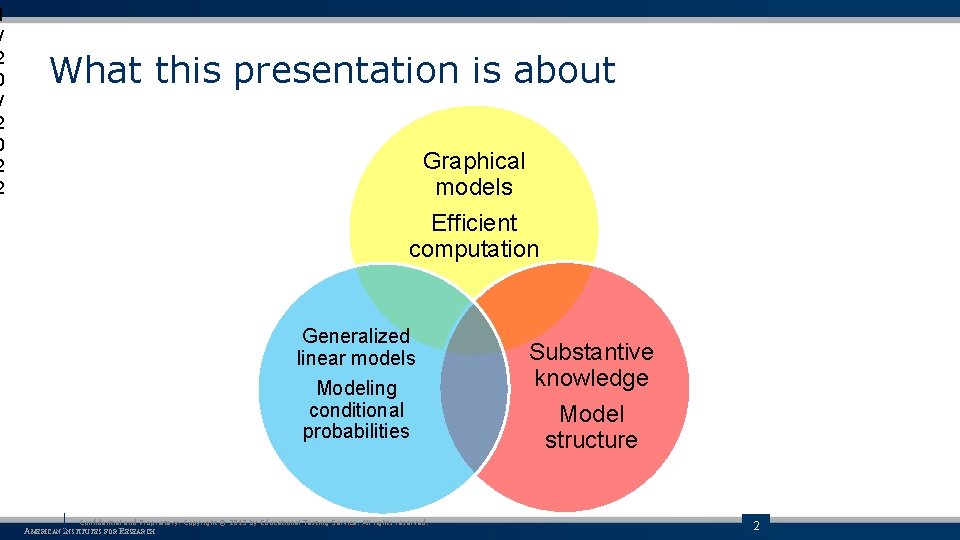
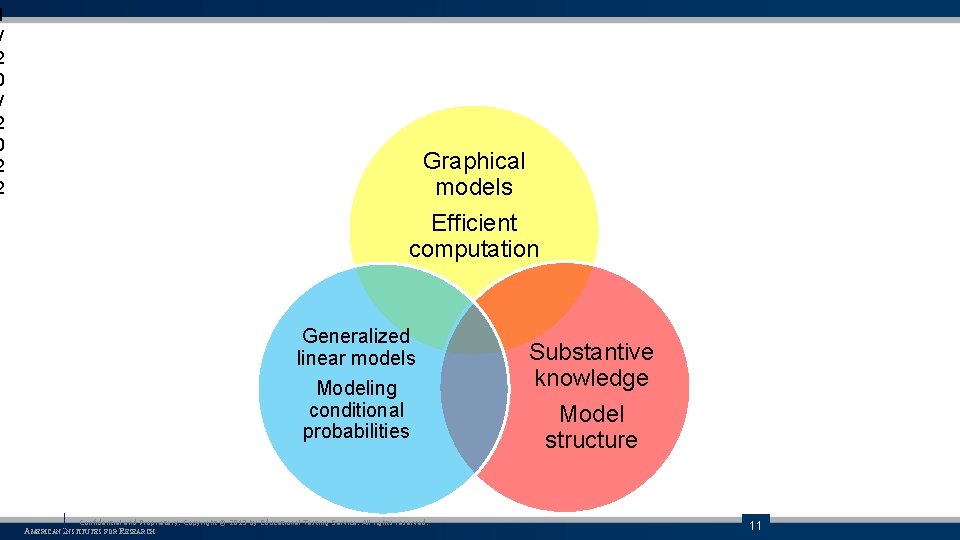
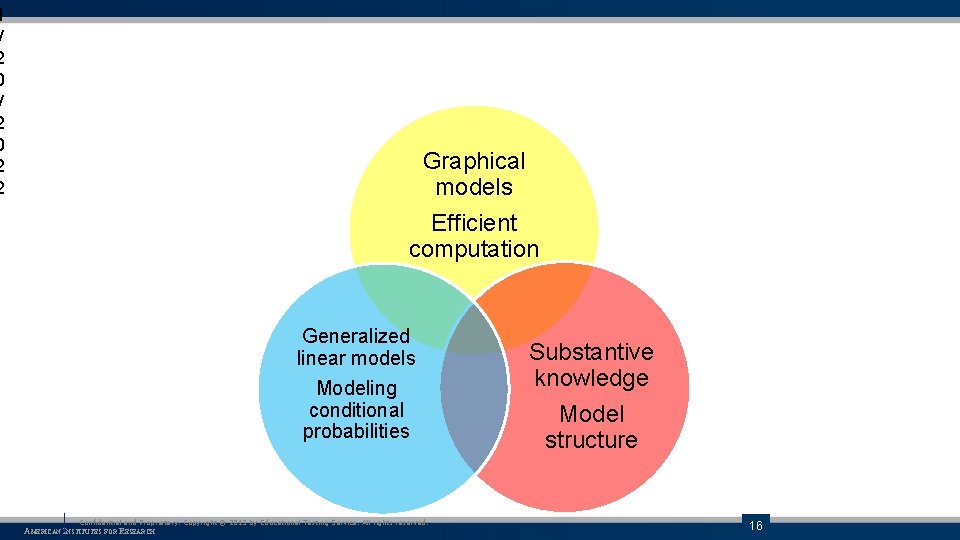
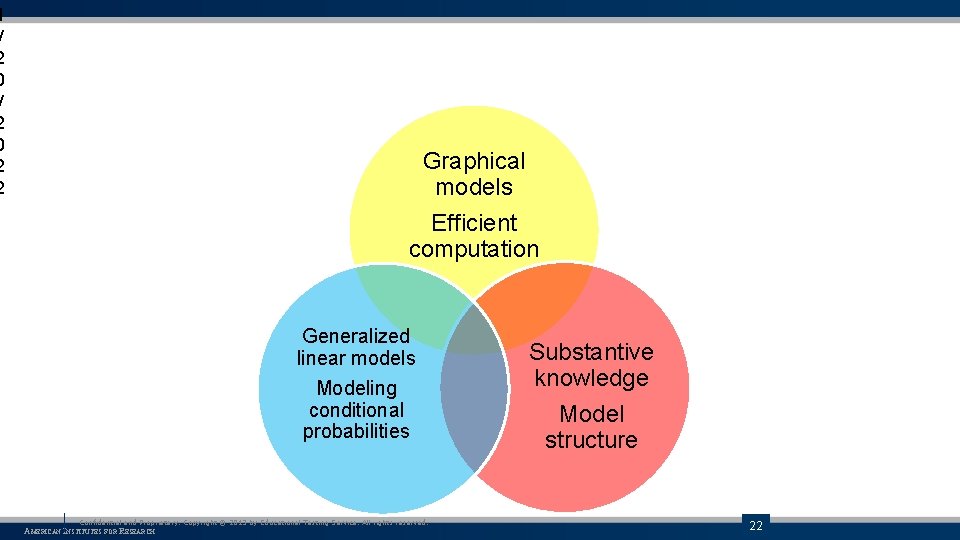
1 / 2 0 2 2 What this presentation is about Graphical models Efficient computation Generalized linear models Modeling conditional probabilities Confidential and Proprietary. Copyright © 2013 by Educational Testing Service. All rights reserved. AMERICAN INSTITUTES FOR RESEARCH Substantive knowledge Model structure 2
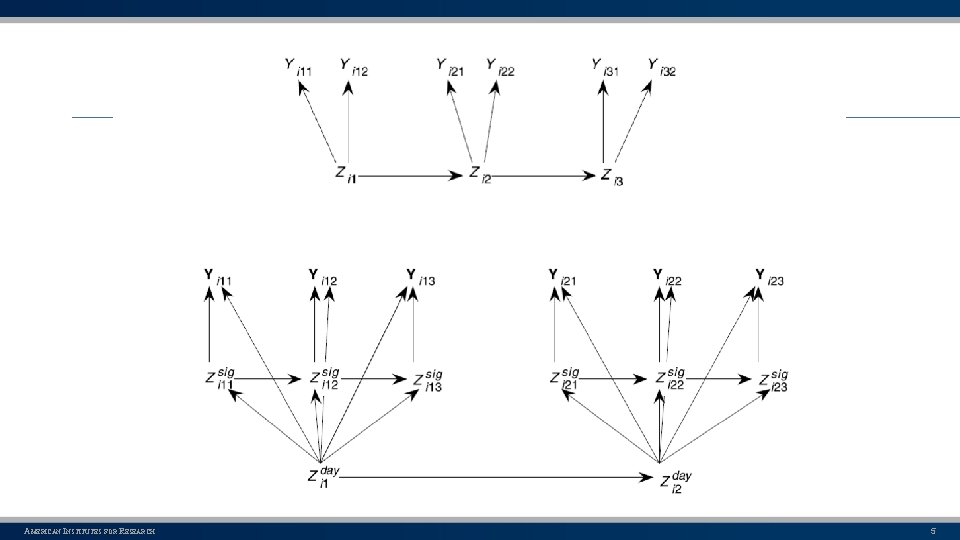
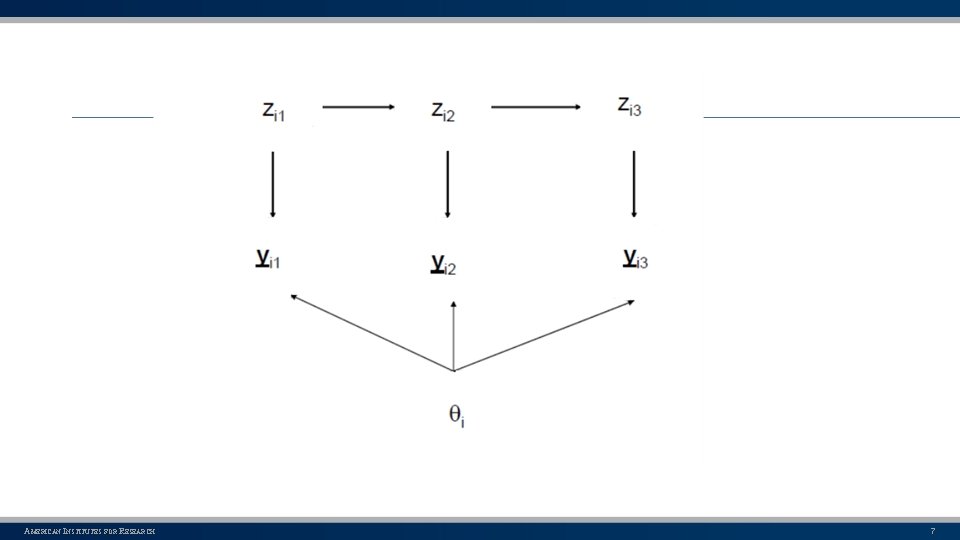
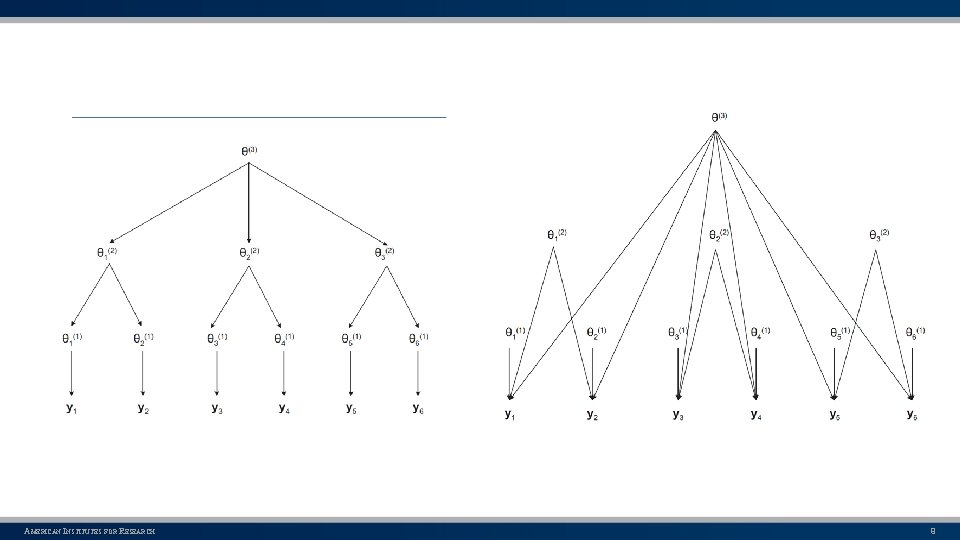
1. Substantive Knowledge: Model Structure • Latent variables are widely used in the behavioral and social sciences – To explain the statistical dependencies among a set of observed variables – The latent structure is often of primary interest • Interest in relatively complex (= many latent variables) models • Models are inspired by substantive theories, and hence differ from application to application • Examples – Discrete latent variables, representing emotional states, to model between-and within-person differences in responses to questions about the presence of emotions – Discrete and continuous latent variables to model illness progression – Hierarchical and higher-order models in educational measurement » Including third-order/trifactor models and two-tier models AMERICAN INSTITUTES FOR RESEARCH 3
1. Substantive Knowledge: Model Structure • Latent variables are widely used in the behavioral and social sciences – To explain the statistical dependencies among a set of observed variables – The latent structure is often of primary interest • Interest in relatively complex (= many latent variables) models • Models are inspired by substantive theories, and hence differ from application to application • Examples – Discrete latent variables, representing emotional states, to model between-and within-person differences in responses to questions about the presence of emotions – Discrete and continuous latent variables to model illness progression – Hierarchical and higher-order models in educational measurement » Including third-order/trifactor models and two-tier models AMERICAN INSTITUTES FOR RESEARCH 4
AMERICAN INSTITUTES FOR RESEARCH 5
1. Substantive Knowledge: Model Structure • Latent variables are widely used in the behavioral and social sciences – To explain the statistical dependencies among a set of observed variables – The latent structure is often of primary interest • Interest in relatively complex (= many latent variables) models • Models are inspired by substantive theories, and hence differ from application to application • Examples – Discrete latent variables, representing emotional states, to model between-and within-person differences in responses to questions about the presence of emotions – Discrete and continuous latent variables to model illness progression – Hierarchical and higher-order models in educational measurement » Including third-order/trifactor models and two-tier models AMERICAN INSTITUTES FOR RESEARCH 6
AMERICAN INSTITUTES FOR RESEARCH 7
1. Substantive Knowledge: Model Structure • Latent variables are widely used in the behavioral and social sciences – To explain the statistical dependencies among a set of observed variables – The latent structure is often of primary interest • Interest in relatively complex (= many latent variables) models • Models are inspired by substantive theories, and hence differ from application to application • Examples – Discrete latent variables, representing emotional states, to model between-and within-person differences in responses to questions about the presence of emotions – Discrete and continuous latent variables to model illness progression – Hierarchical and higher-order models in educational measurement » Including third-order/trifactor models and two-tier models AMERICAN INSTITUTES FOR RESEARCH 8
AMERICAN INSTITUTES FOR RESEARCH 9
The Challenge • Practioners need a general estimation framework that produces accurate results in limited time • For continuous (normally distributed) variables, such a framework exists: structural equation models • For categorical data, it does not – Maximum likelihood estimation involves numerical integration over the latent space » All latent variables are treated to be discrete – Number of computations in brute force integration is exponential in the number of latent variables (not in limited time) – The quality of approximative estimation techniques is often questionable (not accurate) – Bayesian estimation in itself is not a solution (not in limited time) – More efficient ML techniques are developed for specific models (not general) AMERICAN INSTITUTES FOR RESEARCH 10
1 / 2 0 2 2 Graphical models Efficient computation Generalized linear models Modeling conditional probabilities Confidential and Proprietary. Copyright © 2013 by Educational Testing Service. All rights reserved. AMERICAN INSTITUTES FOR RESEARCH Substantive knowledge Model structure 11
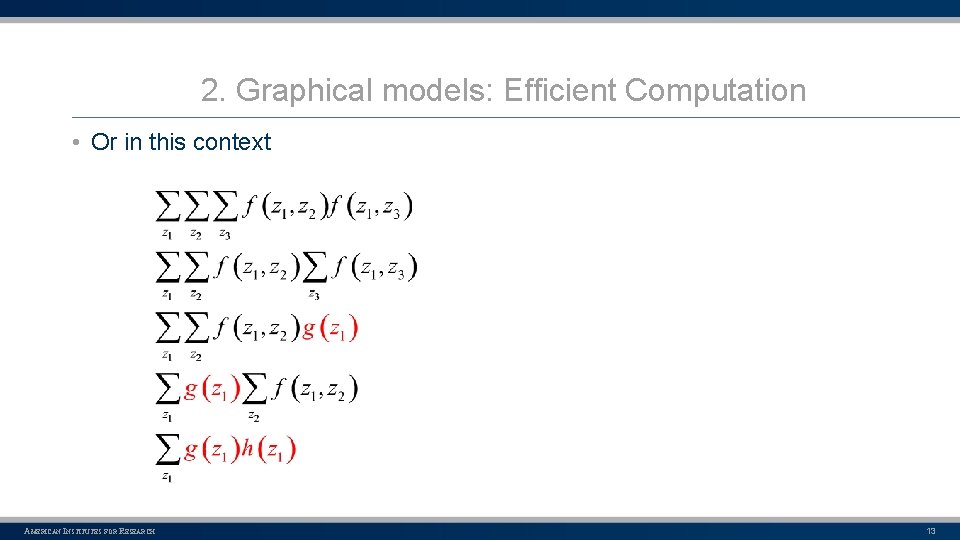
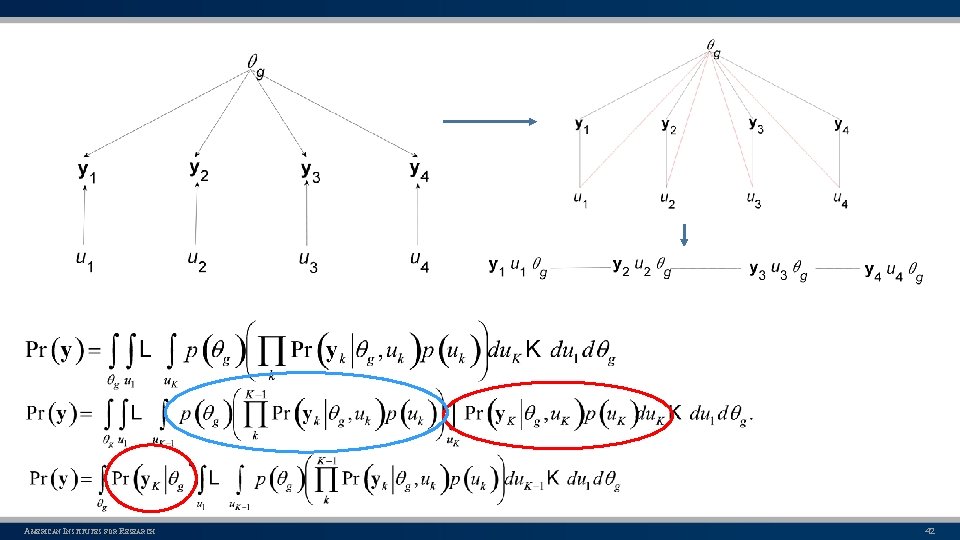
2. Graphical models: Efficient Computation • For any of the models presented, brute force integrations can be avoided • Exploitation of the conditional independence relations implied by the models • Underlying principle: Multiplication is distributive over addition a(b+c)= ab+ac AMERICAN INSTITUTES FOR RESEARCH 12
2. Graphical models: Efficient Computation • Or in this context AMERICAN INSTITUTES FOR RESEARCH 13
2. Graphical models: Efficient Computation • We could spend the rest of this presentation showing how this is instantiated for each of the models presented as illustrations • However: • Graphical models provide a general and efficient way to organize the order of multiplications and summations – – Separation in the graph corresponds to conditional independence Graphs are formal structures on which algorithms can operate – No need for tedious, error-prone derivations for every “new” model – (as if there is a finite number of possible models) AMERICAN INSTITUTES FOR RESEARCH 14
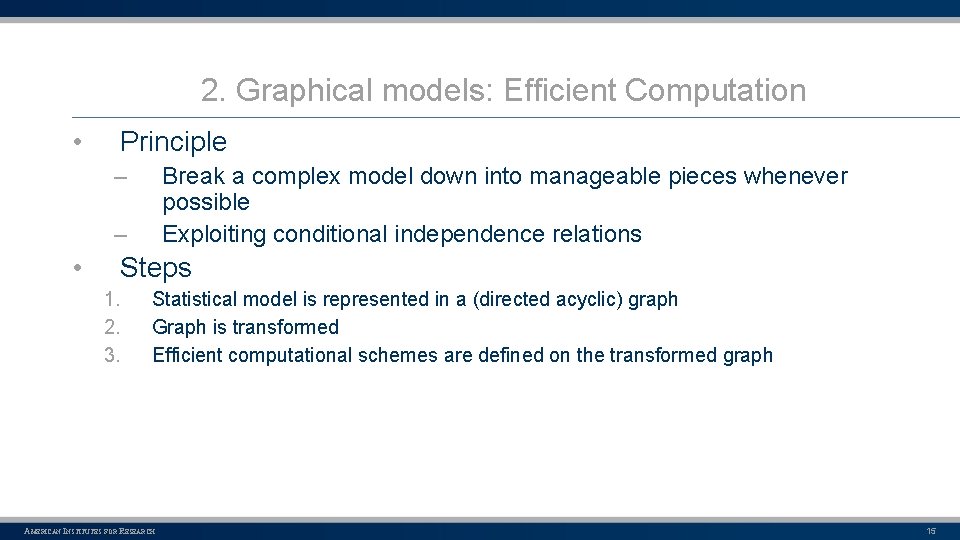
2. Graphical models: Efficient Computation • Principle – Break a complex model down into manageable pieces whenever possible Exploiting conditional independence relations – • Steps 1. 2. 3. Statistical model is represented in a (directed acyclic) graph Graph is transformed Efficient computational schemes are defined on the transformed graph AMERICAN INSTITUTES FOR RESEARCH 15
1 / 2 0 2 2 Graphical models Efficient computation Generalized linear models Modeling conditional probabilities Confidential and Proprietary. Copyright © 2013 by Educational Testing Service. All rights reserved. AMERICAN INSTITUTES FOR RESEARCH Substantive knowledge Model structure 16
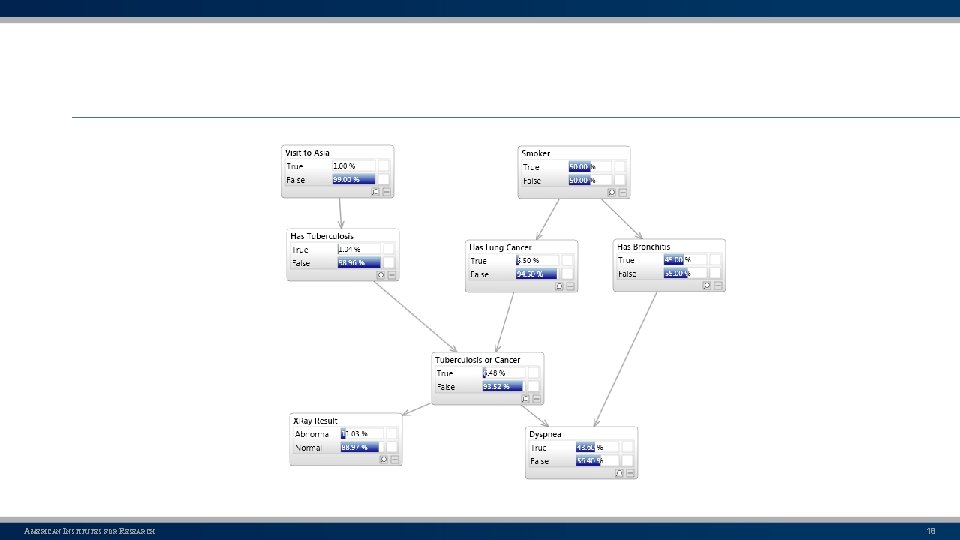
3. Generalized Linear Models: Modeling Conditional Probabilities • In the graphical model literature – Focus is on efficient ‘propagation of evidence’ – Not so much on defining a parametric (sub)model for each variable AMERICAN INSTITUTES FOR RESEARCH 17
AMERICAN INSTITUTES FOR RESEARCH 18
3. Generalized Linear Models: Modeling Conditional Probabilities • Integrate GLM theory with a graphical model framework – Every node is modeled as a GLM, conditional on the ‘parent’ variables in the graph – Generalized linear models are flexible tools for defining parametric models » Statistical properties are well understood » Estimation methods are established – GLMs in themselves are modular » Probability distribution » Linear predictor » Link function AMERICAN INSTITUTES FOR RESEARCH 19
3. Generalized Linear Models: Modeling Conditional Probabilities • Some advantages of specifying a GLM for each variable – Parsimony (number of probabilities increases exponentially in the number of parent variables under a saturated model) » Saturated model as special case – Covariates can be included in a natural way – Ordered categorical variables – Parameters can be shared across models for the individual variables – Linear constraints (including equality constraints) can be specified easily – Parameters can be fixed to specific values AMERICAN INSTITUTES FOR RESEARCH 20
3. Generalized Linear Models: Modeling Conditional Probabilities • Some advantages of specifying a GLM for each variable (continued) – Priors (Bayes modal estimation) – State-of-the-art integration over random effects (GLMMS) – Due to the modularity of GLMs, extensions can be incorporated easily » Nonlinear predictors AMERICAN INSTITUTES FOR RESEARCH 21
1 / 2 0 2 2 Graphical models Efficient computation Generalized linear models Modeling conditional probabilities Confidential and Proprietary. Copyright © 2013 by Educational Testing Service. All rights reserved. AMERICAN INSTITUTES FOR RESEARCH Substantive knowledge Model structure 22
Advantages of an Integrated Approach • Flexibility • It forces one to work out general solutions that often work better than customized approaches applied to scaled-up problems – For customized approaches, it is almost by definition hard to forecast what future applications will call for – A lot of things do not matter until they do » See second part of this presentation – The cost of general approaches is often low if using the right tools » For example: sparse matrices – Special cases can always be defined as a ‘layer’ on top of a more general approach AMERICAN INSTITUTES FOR RESEARCH 23
Case Study: NGSS 24 Confidential and Proprietary. Copyright © 2013 by Educational Testing Service. All rights reserved. AMERICAN INSTITUTES FOR RESEARCH
The Next Generation of Science Standards • NGSS provides a three-dimensional paradigm for learning science – Crosscutting concepts (CCC) across four disciplines of science: Physical Science, Life Science, Earth and Space Science, and Engineering Design. – Science and Engineering Practices (SEP) which describes what scientists do to investigate the natural world and what engineers do to use science to design and build systems. – Disciplinary Core Ideas (DCIs) which are the key ideas in science that are important across all science and engineering disciplines AMERICAN INSTITUTES FOR RESEARCH
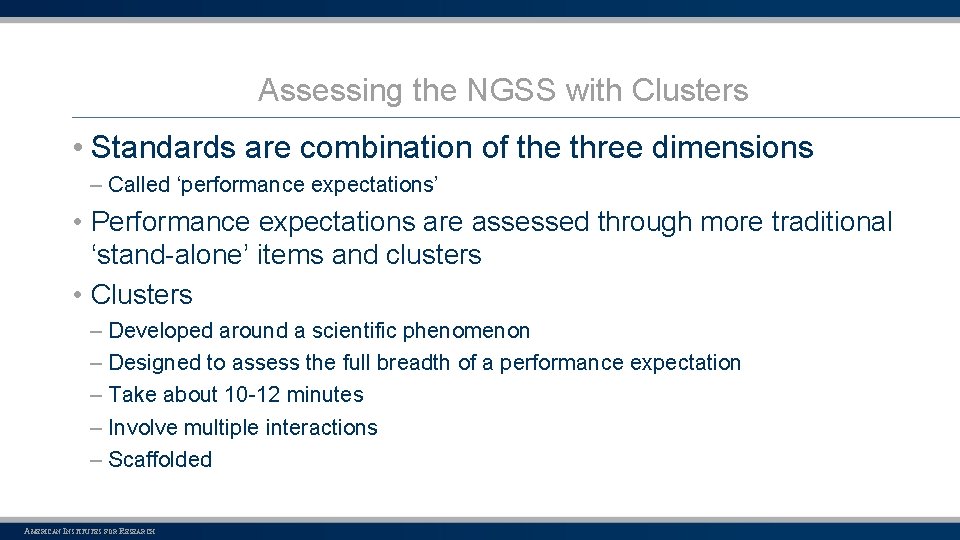
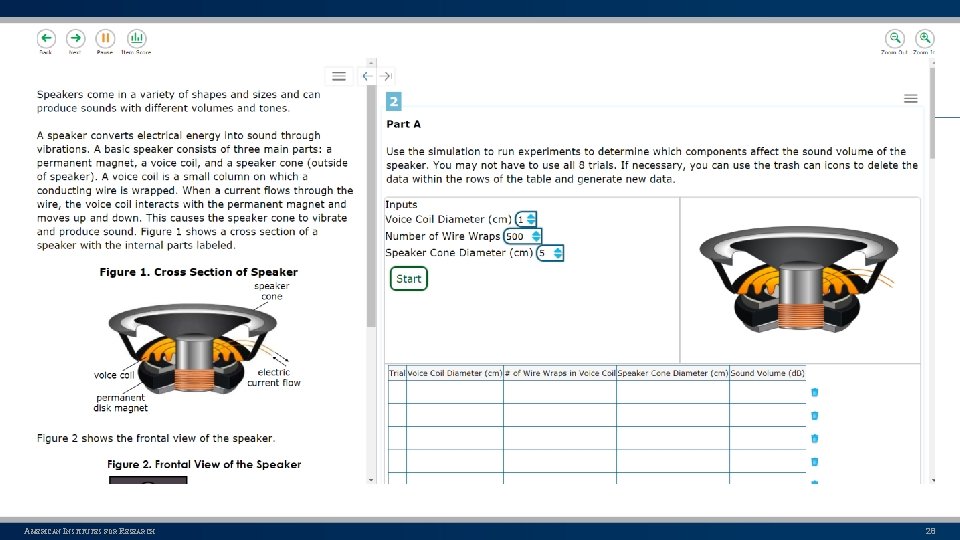
Assessing the NGSS with Clusters • Standards are combination of the three dimensions – Called ‘performance expectations’ • Performance expectations are assessed through more traditional ‘stand-alone’ items and clusters • Clusters – Developed around a scientific phenomenon – Designed to assess the full breadth of a performance expectation – Take about 10 -12 minutes – Involve multiple interactions – Scaffolded AMERICAN INSTITUTES FOR RESEARCH
Assessing the NGSS with Clusters • https: //demo. tds. airast. org/ngss/ AMERICAN INSTITUTES FOR RESEARCH
AMERICAN INSTITUTES FOR RESEARCH 28
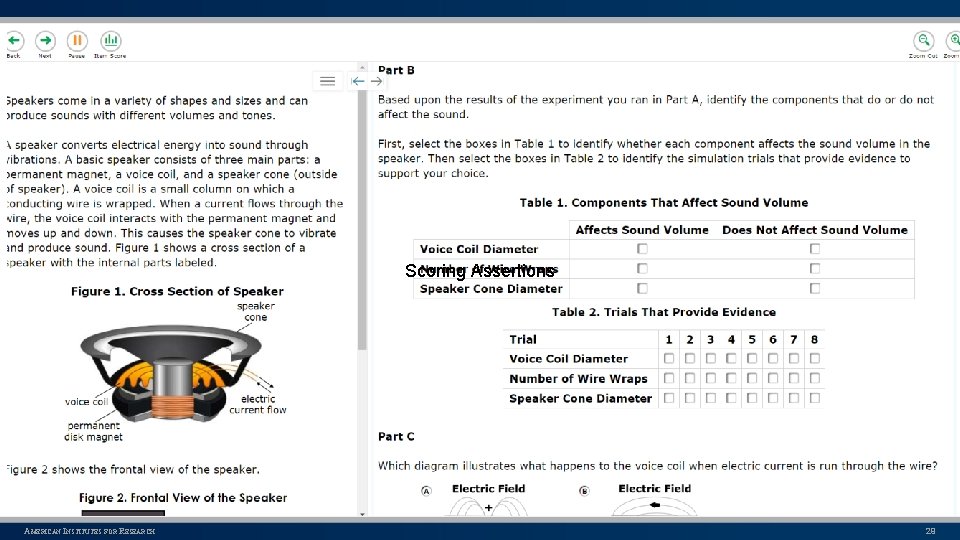
Scoring Assertions AMERICAN INSTITUTES FOR RESEARCH 29
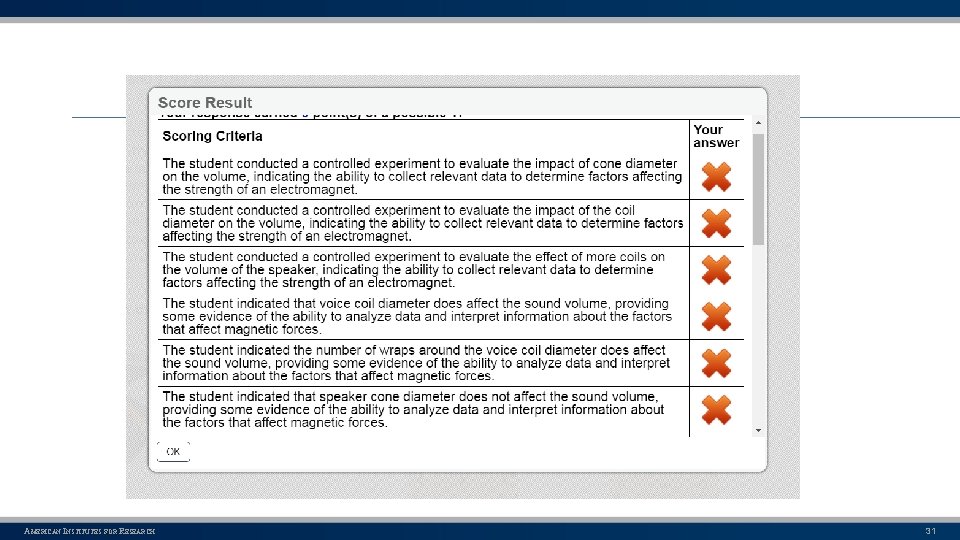
Scoring Assertions • Within each item cluster, a series of explicit assertions can be made about the knowledge and skills that a student has demonstrated based on specific features of the student’s responses • Scoring assertions can be supported based on students’ responses in one or more interactions within an item cluster. • Dependent scoring • Scoring assertions are the basic units of analysis AMERICAN INSTITUTES FOR RESEARCH 30
AMERICAN INSTITUTES FOR RESEARCH 31
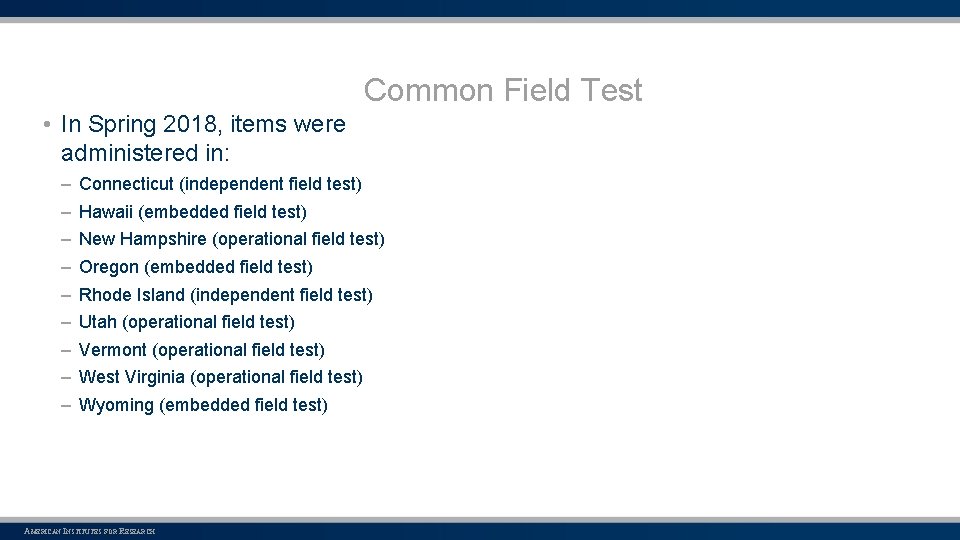
Common Field Test • In Spring 2018, items were administered in: – – – – – Connecticut (independent field test) Hawaii (embedded field test) New Hampshire (operational field test) Oregon (embedded field test) Rhode Island (independent field test) Utah (operational field test) Vermont (operational field test) West Virginia (operational field test) Wyoming (embedded field test) AMERICAN INSTITUTES FOR RESEARCH
Common Field Test • Incomplete data collection designs – Balanced incomplete (fixed form) – Linear on the fly AMERICAN INSTITUTES FOR RESEARCH
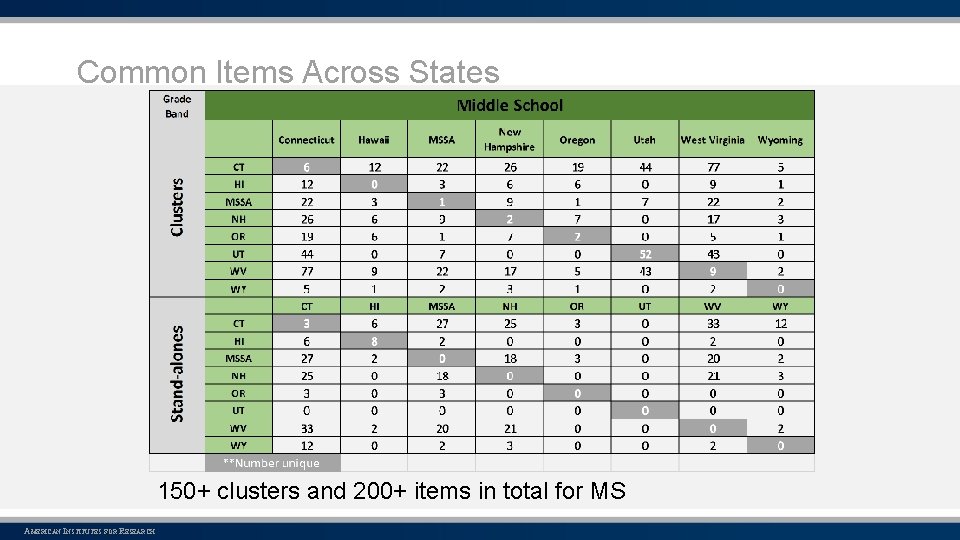
Common Items Across States 150+ clusters and 200+ items in total for MS AMERICAN INSTITUTES FOR RESEARCH
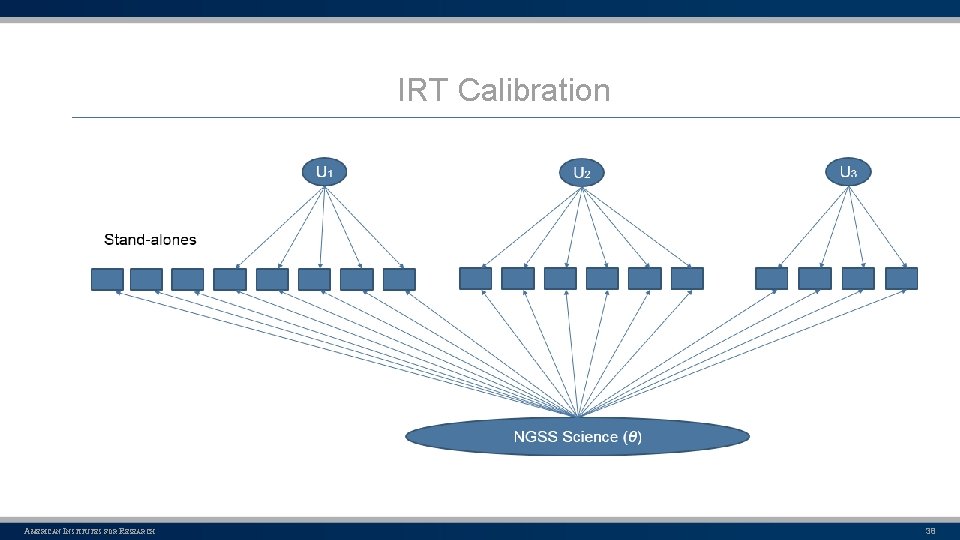
IRT Calibration • Traditional unidimensional IRT models assume conditional independence – All correlations between item responses are accounted for by a single proficiency variable • It is unlikely that this assumption will hold for NGSS assessments – We expect stronger correlations between assertions pertaining to the same cluster than between assertions from different clusters AMERICAN INSTITUTES FOR RESEARCH
IRT Calibration • Ignoring item clustering effects results in – Biased item parameter estimates – Biased ability estimates – Underestimation of the standard errors of measurements • One approach, followed in traditional assessments with item clusters (e. g. , passages in ELA), is to minimize dependencies during item construction and to ignore remaining statistical dependencies • This does not work for NGSS assessments AMERICAN INSTITUTES FOR RESEARCH
IRT Calibration • AMERICAN INSTITUTES FOR RESEARCH
IRT Calibration AMERICAN INSTITUTES FOR RESEARCH 38
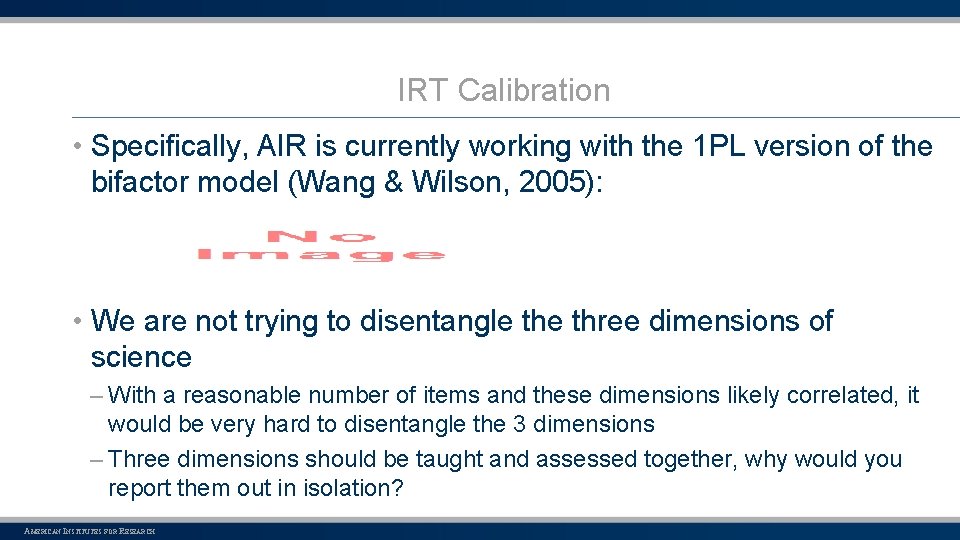
IRT Calibration • Specifically, AIR is currently working with the 1 PL version of the bifactor model (Wang & Wilson, 2005): • We are not trying to disentangle three dimensions of science – With a reasonable number of items and these dimensions likely correlated, it would be very hard to disentangle the 3 dimensions – Three dimensions should be taught and assessed together, why would you report them out in isolation? AMERICAN INSTITUTES FOR RESEARCH
IRT Calibration • Joint calibration with overall group differences taken into account – Group-specific mean and variance for the overall science proficiency • Advantages of joint calibration – More efficient than post-equating methods » Item parameters are based on student responses from multiple states – Differences in mean and variance of the overall proficiency between states/grades are taken into account, just like post-equating methods do • The result is a common item bank on a (robust) common scale AMERICAN INSTITUTES FOR RESEARCH
IRT Calibration • Clear example where all 3 components of the integrated approach play a role • Model structure – Interest in measuring overall science – Presence of local dependencies (item cluster effects) • Modeling conditional probabilities – 1 PL formulation – Group effects • Efficient computation – 150+ dimensional space, but computations can be carried out in two-dimensional subspaces AMERICAN INSTITUTES FOR RESEARCH
AMERICAN INSTITUTES FOR RESEARCH 42
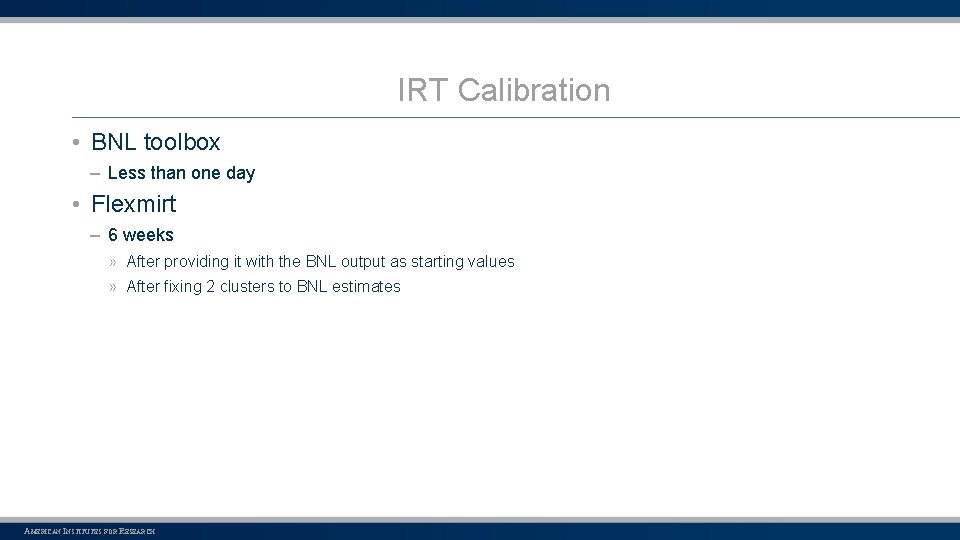
IRT Calibration • BNL toolbox – Less than one day • Flexmirt – 6 weeks » After providing it with the BNL output as starting values » After fixing 2 clusters to BNL estimates AMERICAN INSTITUTES FOR RESEARCH
If you have questions or comments: frijmen@air. org AMERICAN INSTITUTES FOR RESEARCH 44