
A GPU Accelerated Algorithm for 3 D Delaunay


- Slides: 24
A GPU Accelerated Algorithm for 3 D Delaunay Triangulation THANH-TUNG CAO, TODD MINGCEN GAO TIOW-SENG TAN ASHWIN NANJAPPA National University of Singapore Bioinformatics Institute Singapore
Outline Background 2 �Background �Related work �Algorithm �Implementation �Result i 3 D '14 10/6/2020
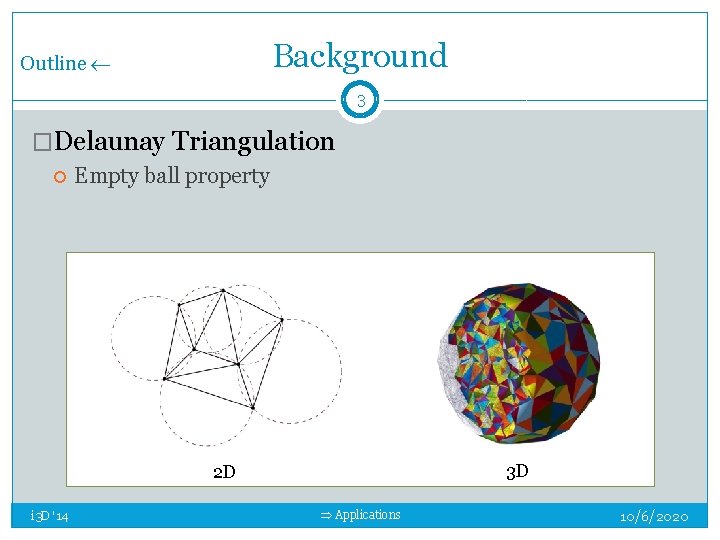
Background Outline 3 �Delaunay Triangulation Empty ball property 3 D 2 D i 3 D '14 Applications 10/6/2020
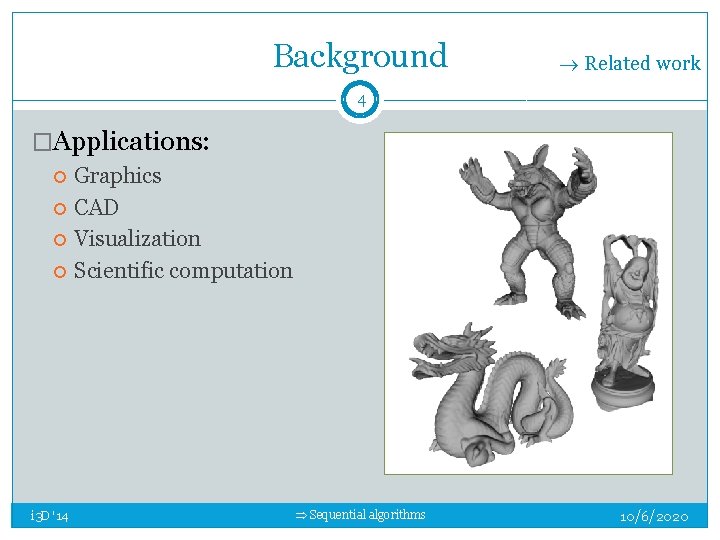
Background Related work 4 �Applications: i 3 D '14 Graphics CAD Visualization Scientific computation Sequential algorithms 10/6/2020
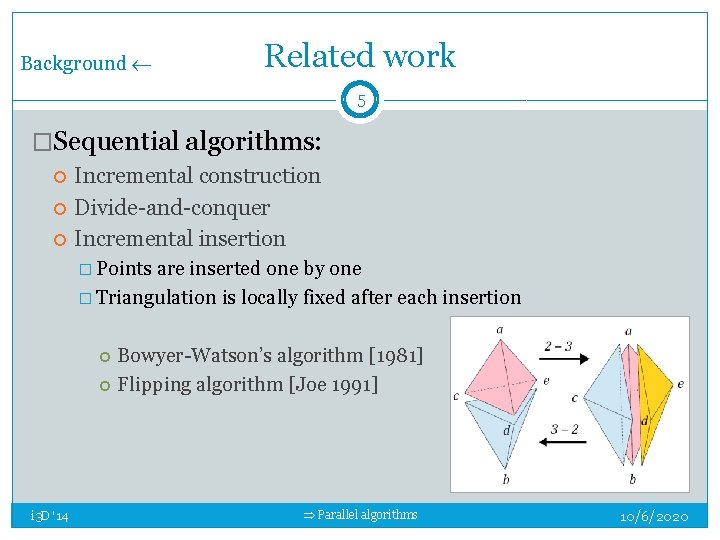
Background Related work 5 �Sequential algorithms: Incremental construction Divide-and-conquer Incremental insertion � Points are inserted one by one � Triangulation is locally fixed after each insertion Bowyer-Watson’s algorithm [1981] Flipping algorithm [Joe 1991] i 3 D '14 Parallel algorithms 10/6/2020
Related work 6 �Parallel and multi-core algorithms: Incremental construction high complexity Domain partitioning GPU needs thousands of partitions Incremental insertion [Batista et al. 2010] � Several points are inserted at a time � Each insertion modifies a small region � Conflict Rollback i 3 D '14 GPU algorithms 10/6/2020
Related work Algorithm 7 �GPU algorithms: Experiment with Batista et al. ’s approach � 1 million points � At most 2000 -3000 points can be inserted in each round Digital Voronoi diagram approach [Qi et al. 2012] � Dualization i 3 D '14 not working in 3 D Our algorithm 10/6/2020
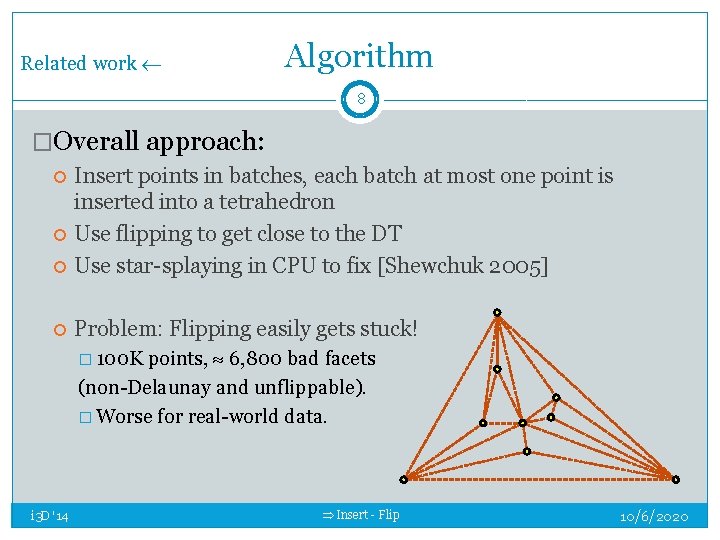
Related work Algorithm 8 �Overall approach: Insert points in batches, each batch at most one point is inserted into a tetrahedron Use flipping to get close to the DT Use star-splaying in CPU to fix [Shewchuk 2005] Problem: Flipping easily gets stuck! points, 6, 800 bad facets (non-Delaunay and unflippable). � Worse for real-world data. � 100 K i 3 D '14 Insert - Flip 10/6/2020
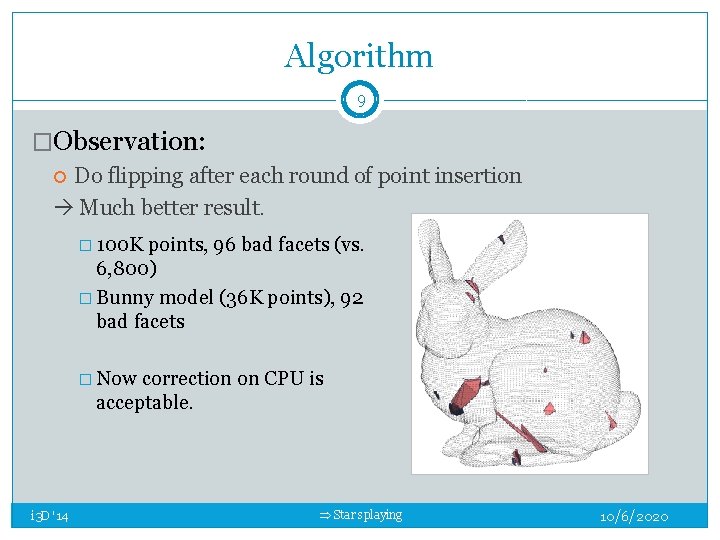
Algorithm 9 �Observation: Do flipping after each round of point insertion Much better result. � 100 K points, 96 bad facets (vs. 6, 800) � Bunny model (36 K points), 92 bad facets � Now correction on CPU is acceptable. i 3 D '14 Star splaying 10/6/2020
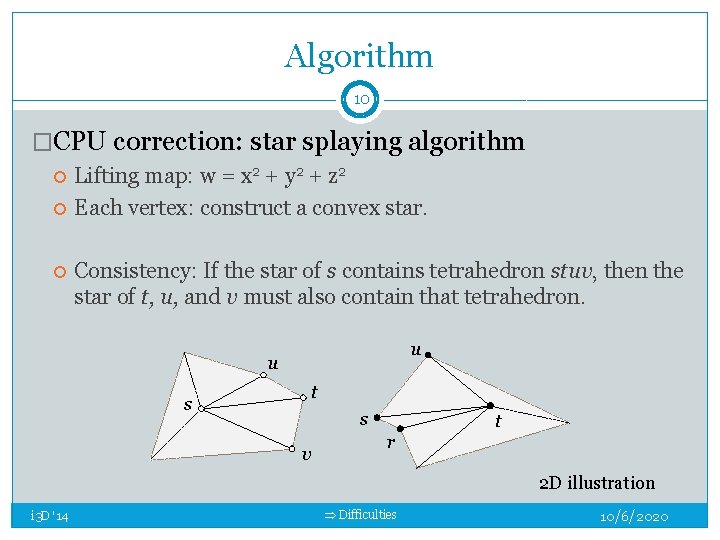
Algorithm 10 �CPU correction: star splaying algorithm Lifting map: w = x 2 + y 2 + z 2 Each vertex: construct a convex star. Consistency: If the star of s contains tetrahedron stuv, then the star of t, u, and v must also contain that tetrahedron. u u t s s v t r 2 D illustration i 3 D '14 Difficulties 10/6/2020
Algorithm 11 �CPU correction: star splaying algorithm Difficulties: Time consuming � Construct convex stars (incremental insertion) � Check all the stars for inconsistencies � Convert stars back to mesh representation i 3 D '14 Adaptive star splaying 10/6/2020
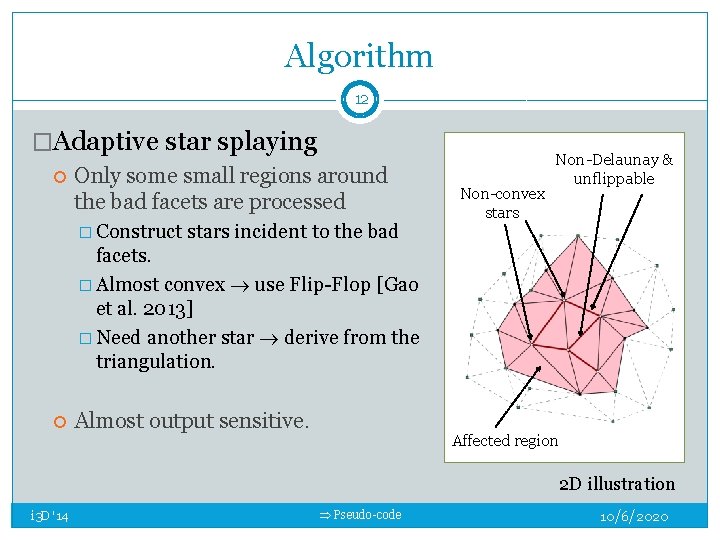
Algorithm 12 �Adaptive star splaying Only some small regions around the bad facets are processed � Construct stars incident to the bad Non-convex stars Non-Delaunay & unflippable facets. � Almost convex use Flip-Flop [Gao et al. 2013] � Need another star derive from the triangulation. Almost output sensitive. Affected region 2 D illustration i 3 D '14 Pseudo-code 10/6/2020
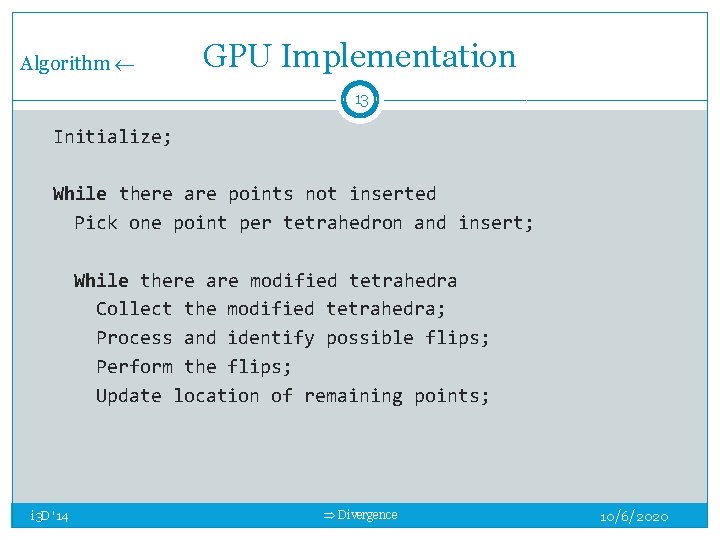
Algorithm GPU Implementation 13 Initialize; While there are points not inserted Pick one point per tetrahedron and insert; While there are modified tetrahedra Collect the modified tetrahedra; Process and identify possible flips; Perform the flips; Update location of remaining points; i 3 D '14 Divergence 10/6/2020
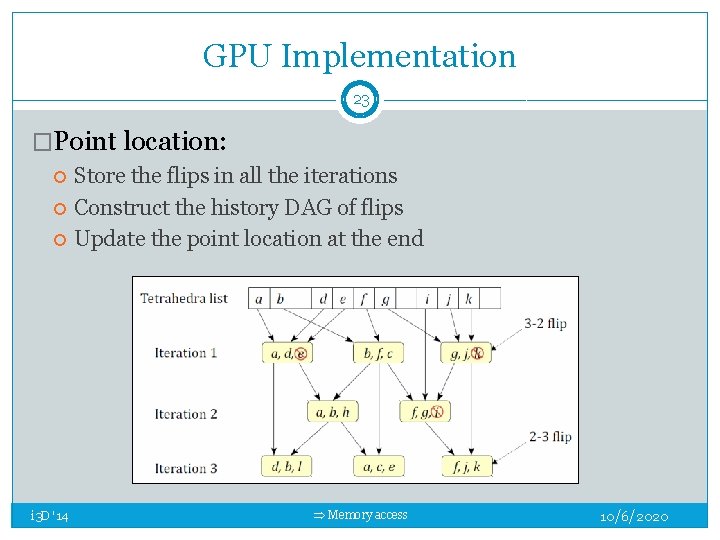
GPU Implementation 14 �Thread divergence: Compact the list of modified tetrahedra before processing Exact predicates [Shewchuk 1996] � Use only fast check in 1 st kernel � Collect those that require exact computation � Do the exact computation in 2 nd kernel Point location: � Store the flips, build flip history DAG � Trace the DAG to locate i 3 D '14 Memory 10/6/2020
GPU Implementation Result 15 �Memory access: Rearrange the data to improve the GPU cache efficiency. � Sort the input points by the Z-curve � Sort the tetrahedra list by the minimum vertex indices. i 3 D '14 Experiment setting 10/6/2020
Implementation Result 16 �Experiment settings: CPU: Intel I 7 2600 K 3. 4 Ghz, 16 GB RAM GPU: NVIDIA GTX 580, 3 GB VRAM CUDA 5. 0, VS 2012. CGAL 4. 2 i 3 D '14 3 D Speedup 10/6/2020
Result 17 � 3 D Speedup: Synthetic data: Uniform, Gaussian, sphere, grid. � Up to 1. 5 million points � 8 -10 times faster than CGAL Real models: Armadillo, Angel, Dragon, Happy Buddha… � 6 -9 i 3 D '14 times speedup over CGAL 2 D Speedup 10/6/2020
Result 18 �Also implement for 2 D DT: Synthetic data: � 10 times over Triangle, 7 times over CGAL � 2 times faster than [Qi et al. 2012] i 3 D '14 Time breakdown 10/6/2020
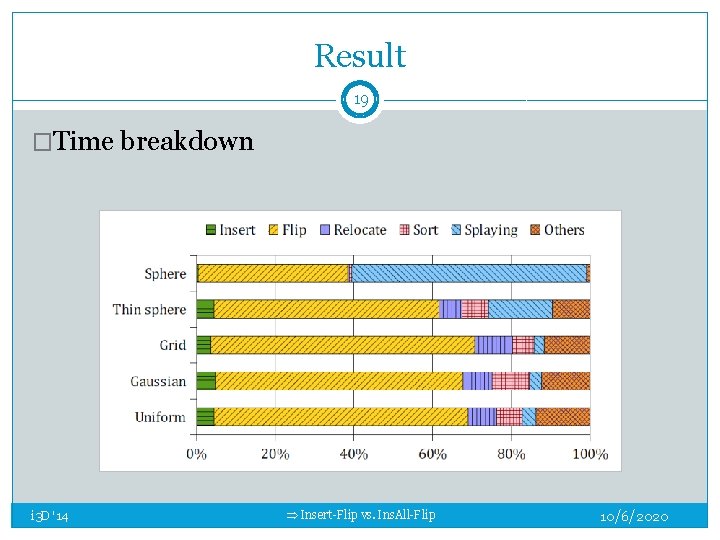
Result 19 �Time breakdown i 3 D '14 Insert-Flip vs. Ins. All-Flip 10/6/2020
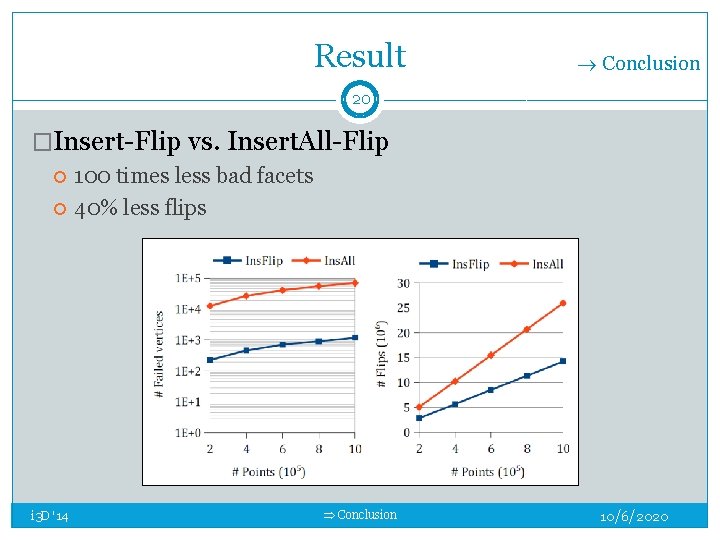
Result Conclusion 20 �Insert-Flip vs. Insert. All-Flip i 3 D '14 100 times less bad facets 40% less flips Conclusion 10/6/2020
Result Conclusion 21 �New algorithm for DT construction on GPU �Both 2 D and 3 D (possibly higher) �Uniform and non-uniform point set �Exact computation, robust. �Limitation: i 3 D '14 Needs to copy the result to CPU for splaying Sequential flipping on some pathological cases Memory bound implementation END 10/6/2020
End 22 Thank you! i 3 D '14 10/6/2020
GPU Implementation 23 �Point location: i 3 D '14 Store the flips in all the iterations Construct the history DAG of flips Update the point location at the end Memory access 10/6/2020
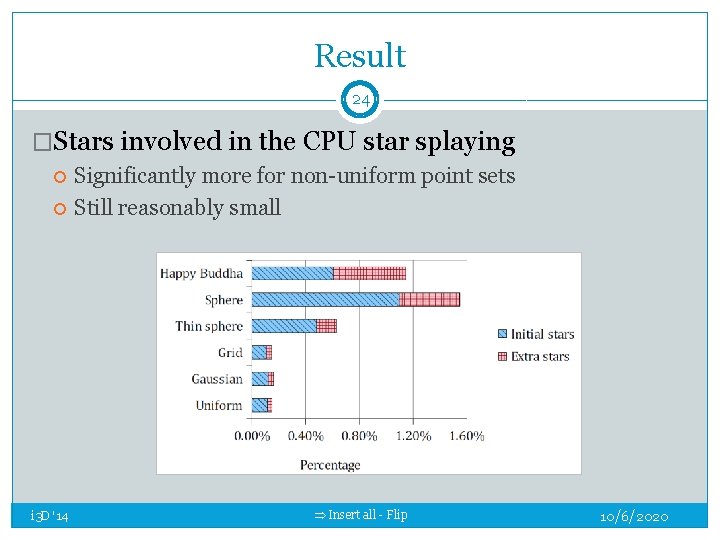
Result 24 �Stars involved in the CPU star splaying i 3 D '14 Significantly more for non-uniform point sets Still reasonably small Insert all - Flip 10/6/2020