
A Good Husband Does Not Feed His Wife
A Good Husband Does Not Feed His Wife Sweets Men’s Studies and Vietnamese Masculinity
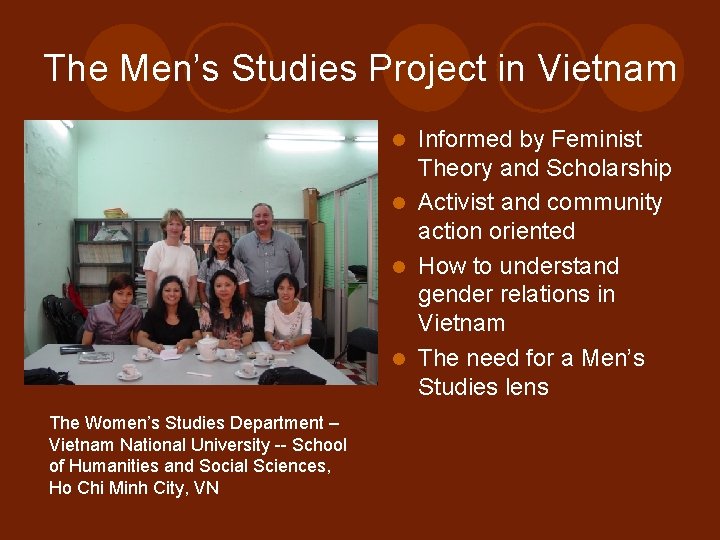
The Men’s Studies Project in Vietnam Informed by Feminist Theory and Scholarship l Activist and community action oriented l How to understand gender relations in Vietnam l The need for a Men’s Studies lens l The Women’s Studies Department – Vietnam National University -- School of Humanities and Social Sciences, Ho Chi Minh City, VN
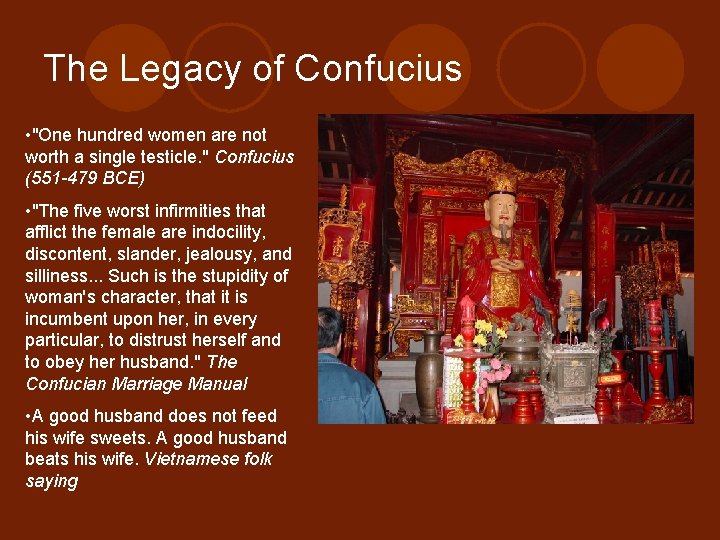
The Legacy of Confucius • "One hundred women are not worth a single testicle. " Confucius (551 -479 BCE) • "The five worst infirmities that afflict the female are indocility, discontent, slander, jealousy, and silliness. . . Such is the stupidity of woman's character, that it is incumbent upon her, in every particular, to distrust herself and to obey her husband. " The Confucian Marriage Manual • A good husband does not feed his wife sweets. A good husband beats his wife. Vietnamese folk saying
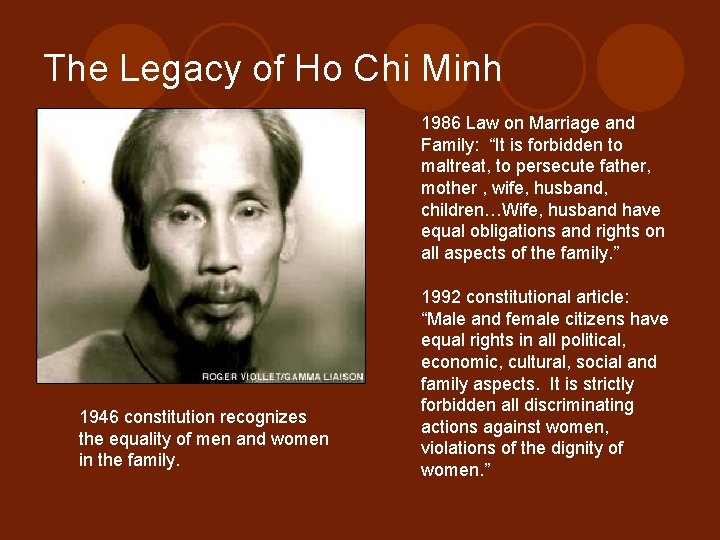
The Legacy of Ho Chi Minh 1986 Law on Marriage and Family: “It is forbidden to maltreat, to persecute father, mother , wife, husband, children…Wife, husband have equal obligations and rights on all aspects of the family. ” 1946 constitution recognizes the equality of men and women in the family. 1992 constitutional article: “Male and female citizens have equal rights in all political, economic, cultural, social and family aspects. It is strictly forbidden all discriminating actions against women, violations of the dignity of women. ”
Vietnamese Feminist Studies l Vietnamese feminist studies as SOCIAL ECOLOGY (the transformation of gender relations will occur naturally – Eco-Socialism) ¡ ¡ Confucian order -- the maintenance of cultural equilibrium, unity, harmony, balance, compromise and solidarity comprise the primary ethic of social integration Marxist socialism -- an evolutionary claim to revolutionary activity. The final results of communistic and socialistic revolutionary struggle can be nothing less than social arrangements that provide for the fair and equitable distribution of society’s opportunities and rewards to all citizens, regardless of gender
An Example of Eco-Socialism l “We have found that there is a CENTRAL THEME in the odyssey of Vietnamese women: official moral rules might have been advocated and state laws might have been promulgated to impose inequality on women, but THE REAL POPULAR CUSTOMS, nourished by the realityimposed functions of women, HAVE CONSISTENTLY SUPPORTED AN EQUAL ROLE FOR VIETNAMESE WOMEN, THUS DEFEATING THE MAN-INSPIRED STEREOTYPES, AND THE LAW EVENTUALLY HAS ALSO TO ADAPT TO THIS EGALITARIAN DRIVE AND GRANTED EQUAL STATUS TO WOMEN” (Tai Van Ta, 1997, her emphases).
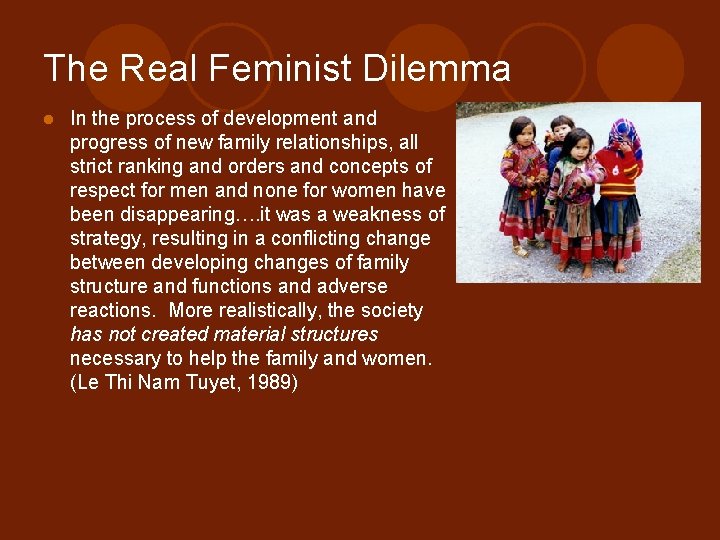
The Real Feminist Dilemma l In the process of development and progress of new family relationships, all strict ranking and orders and concepts of respect for men and none for women have been disappearing…. it was a weakness of strategy, resulting in a conflicting change between developing changes of family structure and functions and adverse reactions. More realistically, the society has not created material structures necessary to help the family and women. (Le Thi Nam Tuyet, 1989)
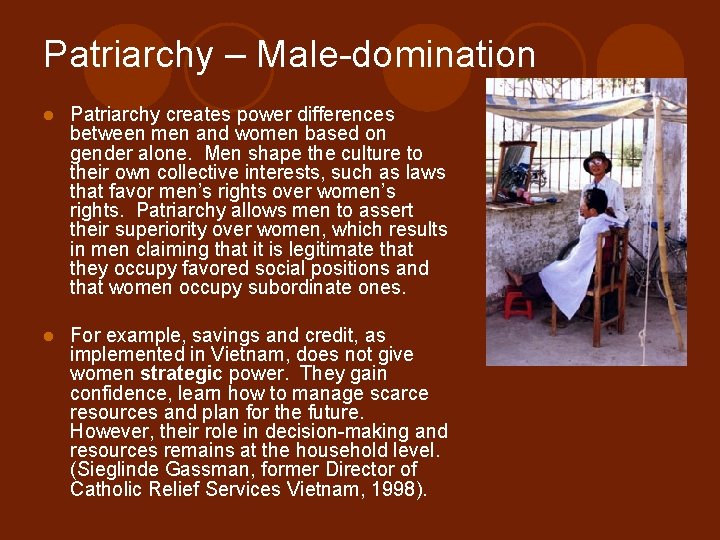
Patriarchy – Male-domination l Patriarchy creates power differences between men and women based on gender alone. Men shape the culture to their own collective interests, such as laws that favor men’s rights over women’s rights. Patriarchy allows men to assert their superiority over women, which results in men claiming that it is legitimate that they occupy favored social positions and that women occupy subordinate ones. l For example, savings and credit, as implemented in Vietnam, does not give women strategic power. They gain confidence, learn how to manage scarce resources and plan for the future. However, their role in decision-making and resources remains at the household level. (Sieglinde Gassman, former Director of Catholic Relief Services Vietnam, 1998).
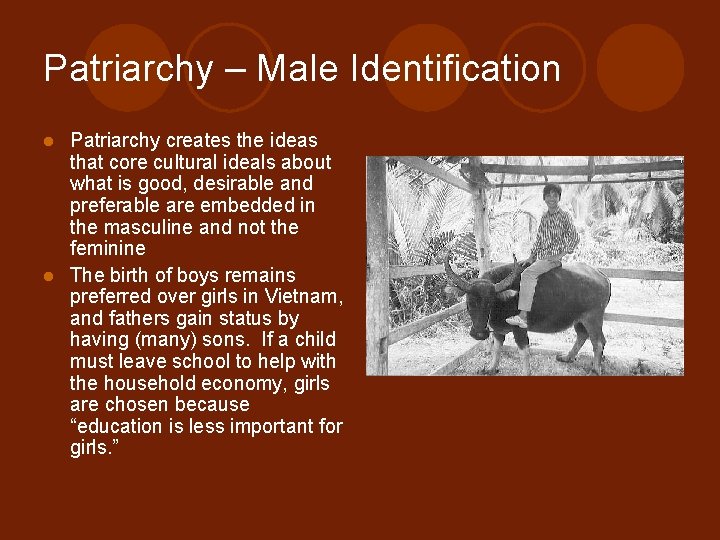
Patriarchy – Male Identification Patriarchy creates the ideas that core cultural ideals about what is good, desirable and preferable are embedded in the masculine and not the feminine l The birth of boys remains preferred over girls in Vietnam, and fathers gain status by having (many) sons. If a child must leave school to help with the household economy, girls are chosen because “education is less important for girls. ” l
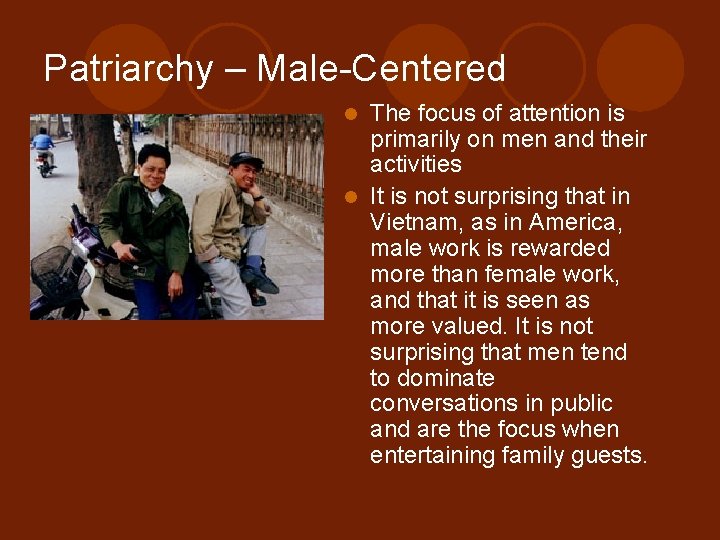
Patriarchy – Male-Centered The focus of attention is primarily on men and their activities l It is not surprising that in Vietnam, as in America, male work is rewarded more than female work, and that it is seen as more valued. It is not surprising that men tend to dominate conversations in public and are the focus when entertaining family guests. l
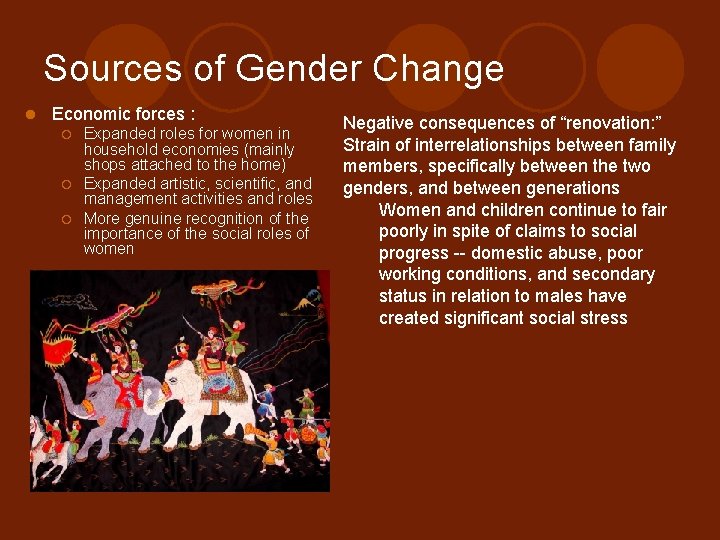
Sources of Gender Change l Economic forces : ¡ ¡ ¡ Expanded roles for women in household economies (mainly shops attached to the home) Expanded artistic, scientific, and management activities and roles More genuine recognition of the importance of the social roles of women Negative consequences of “renovation: ” Strain of interrelationships between family members, specifically between the two genders, and between generations Women and children continue to fair poorly in spite of claims to social progress -- domestic abuse, poor working conditions, and secondary status in relation to males have created significant social stress
Men’s Studies and Community Action l Women experience the problem, but the problem resides with men ¡ Domestic Violence ¡ Trafficking in Women ¡ Family Size ¡ Women’s Double Burden l Men’s Studies provides theory and the research base that directs additional community action activities towards men
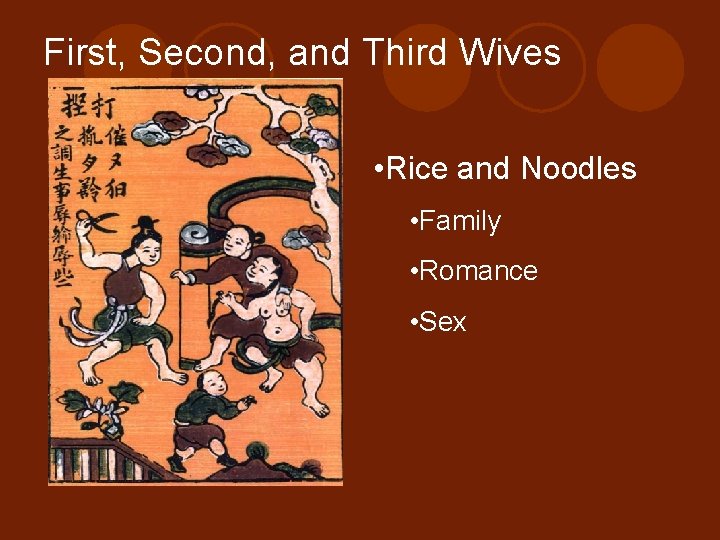
First, Second, and Third Wives • Rice and Noodles • Family • Romance • Sex
Domestic Violence and Masculinity l “It was once I beat my wife because of love. It was a rainy day, and my wife went to work on the farm although she was sick. I told her to come home but she didn’t listen, and she only came home when I angrily gave her a few slaps on the face. ” l Reactions of women on being persecuted: 60% resign quietly, 20% fight back, 15% seek the help of neighbors, and 5% run out of the house. Institutional claim that violence is the “result of poverty” l Men claim the excuse that they are anxious and stressed l More often than not, the men have been drinking l
Smoking and Masculinity "Vietnam: A Tobacco Epidemic in the Making" (Pham, Do, Truong and Jenkins, 1995) l l Smoking rates highest among men who enjoy l l more social privilege and position, more disposable income, entertain guests both during their work and at home, are invited to social functions where smoking is the norm, and may be offered cigarettes as bribery in return for favors. The study ignores the gendered nature of such consumption ¡ Men perceive smoking as “manly” ¡ Cigarettes are an important part of social and economic exchange among men. l ¡ Cigarettes create a bond of recognition between men “as men, ” ¡ Men sustain high smoking rates by reinforcing each other that smoking is masculine and confirms social power and position. Authors' suggested interventions: These smoking rates can only be lowered if the government firmly forbids the offering of cigarettes and bans smoking during meetings at all levels. Health education should emphasize the health effects of smoking on smokers and others. Women also bear a responsibility for men's smoking. There is a need to raise their capacity and empower them to participate in the education of men about the health hazards of smoking. Women now see the image of man smoking as normal. We must change that image. (p. 9) Italics mine. The authors want to blame women for male smoking behavior as if the men smoke to impress the women. But the opposite is true: men smoke to impress other men that they are masculine.
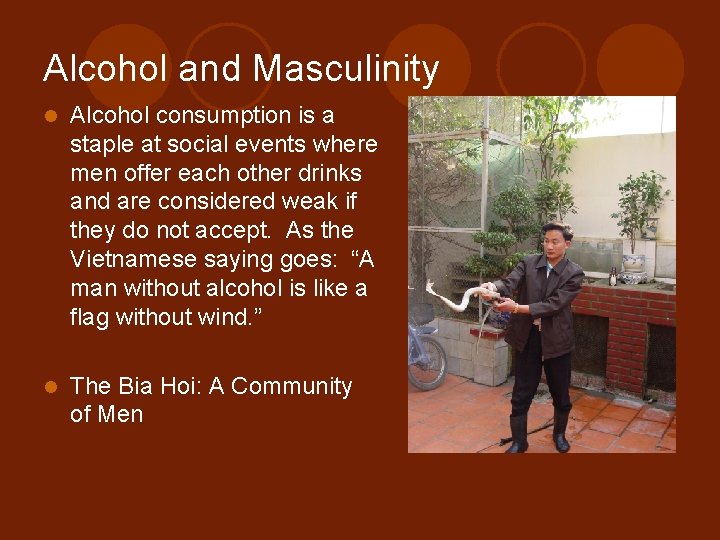
Alcohol and Masculinity l Alcohol consumption is a staple at social events where men offer each other drinks and are considered weak if they do not accept. As the Vietnamese saying goes: “A man without alcohol is like a flag without wind. ” l The Bia Hoi: A Community of Men
Family Planning and Masculinity l Quaker Service and Population Council study, "Male Attitudes Towards Family Planning" ¡ ¡ ¡ Two rural communes in northern Vietnam shows that it is men who make the decisions regarding family planning. However, most of the family planning materials are and have been directed towards women. This awareness of the role that men play in family reproductive decisions is benefiting from a men's studies approach. How are reproductive decisions sustained in the social definition of "masculinity, " and how is it sustained in family interaction and relationships? What are the countervailing forces that might come in to play that would allow men to release the "power" and "identity" held so dear in this family drama? Are there other aspects of male identity and identification that may be drawn upon that supercede the signifier of manhood that is sexual potency and baby making? How may this personal and social display of power find other private and public outlets that promote a strong sense of "manliness" while having more positive social consequences for the family?
Homosexuality and Masculinity l Homosexuality is condemned in Vietnam, and yet it flourishes. To the untrained eye, homosexuality is rendered invisible and is not addressed in sociological research. While AIDS has received some attention, most of the warning signs are about the dangers of intravenous drug use, and the social illegitimacy of homosexuality makes it difficult to address the subject of this male sexual activity.
These are Men’s Studies Issues l What is it about male experience that accounts for: ¡ ¡ ¡ the systematic sexism by men toward women, resulting in “ 80% of female laborers [having] low or no professional skills…; ” the increase in the illiteracy rate for women “to 17. 69% in 1992 as against 8. 6% for men; ” the low level of female participation in People’s Councils and Peoples Committees of less than 15% Why have women been “left behind in education, training, science and technology as … post-graduate education, the proportion of women decreased significantly within the last 10 years (1984 -1995) although the quantity increased from 3 -4 times? l What is it about male experience that accounts for the pervasiveness of men’s violence against women? “With this change violence against women is becoming increasingly a public reality. … less acknowledged, yet increasingly evident is the increase in the public incidence of rape, a widespread diffusion of pornography and an industrialization of prostitution” (Kathleen Barry, 1996). l Le Thi Quy states, “violence caused by the husband’s drinking, gambling, adultery and jealousy has increased at an alarming rate” l l Current interventions do not address the Vietnamese male experience
The New “Good Husband” l “The new Vietnamese “good husband” shares in the responsibility for “family happiness: ” He is a good citizen with a good reputation, he provides economic and social care for his wife and children, and supports the social and economic life of his wife, demonstrated by his showing confidence in her abilities and taking some of the domestic burden. The task is to nurture equality and equity in gender relations while embracing male-female difference. ” (Le Thi Nam Tuyet)
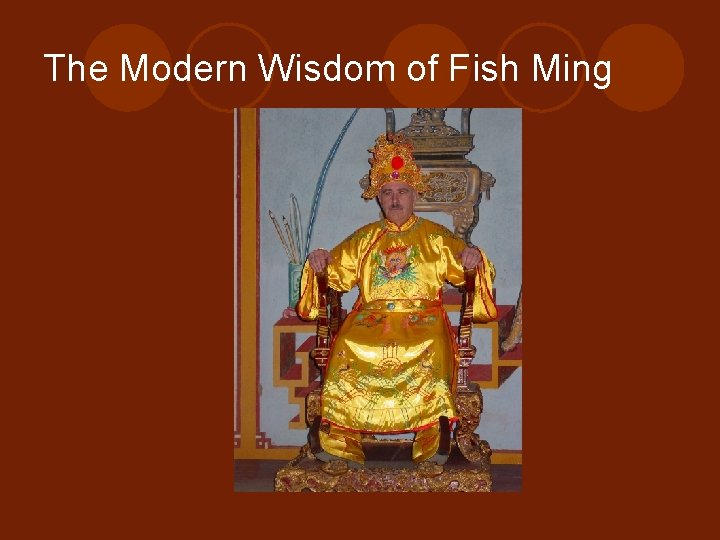
The Modern Wisdom of Fish Ming
- Slides: 21