
A Global View on Spectrum for IMT2000 Fabio
A Global View on Spectrum for IMT-2000 Fabio Leite, IMT-2000 Project Manager International Telecommunication Union (ITU) fabio. leite@itu. int
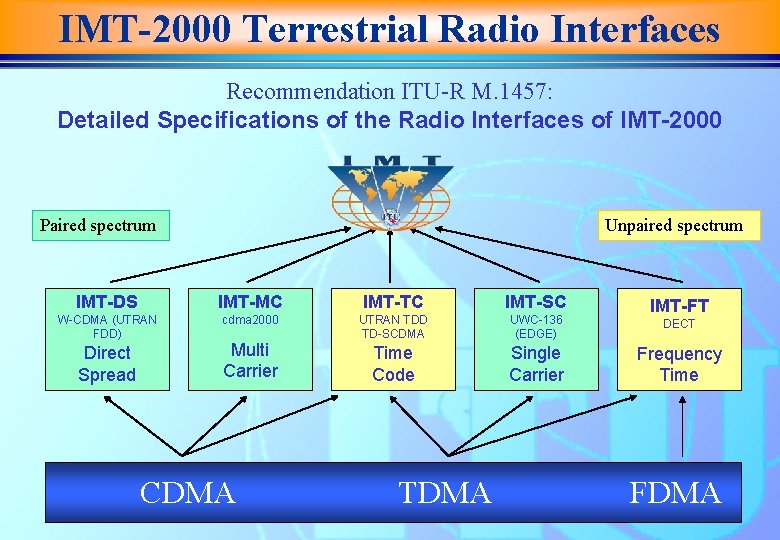
IMT-2000 Terrestrial Radio Interfaces Recommendation ITU-R M. 1457: Detailed Specifications of the Radio Interfaces of IMT-2000 Paired spectrum Unpaired spectrum IMT-DS IMT-MC IMT-TC IMT-SC W-CDMA (UTRAN FDD) cdma 2000 UTRAN TDD TD-SCDMA UWC-136 (EDGE) Time Code Single Carrier Direct Spread Multi Carrier CDMA TDMA IMT-FT DECT Frequency Time FDMA
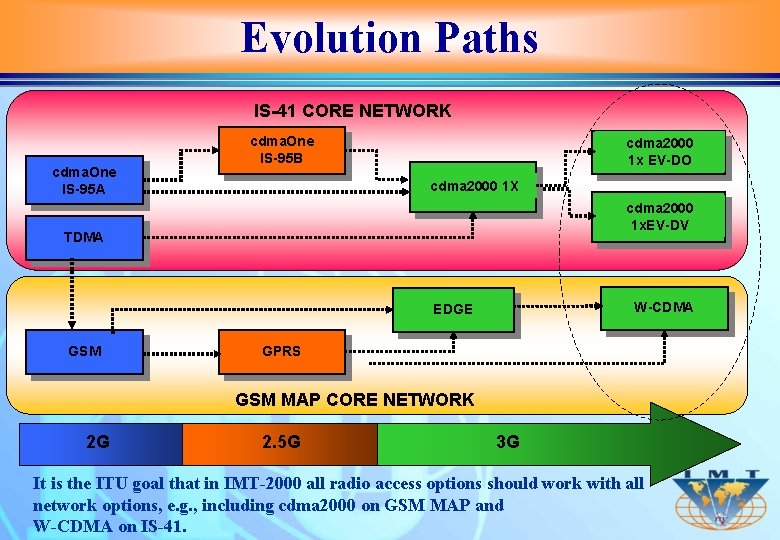
Evolution Paths IS-41 CORE NETWORK cdma. One IS-95 A cdma. One IS-95 B cdma 2000 1 x EV-DO cdma 2000 1 X cdma 2000 1 x. EV-DV TDMA W-CDMA EDGE GSM GPRS GSM MAP CORE NETWORK 2 G 2. 5 G 3 G It is the ITU goal that in IMT-2000 all radio access options should work with all network options, e. g. , including cdma 2000 on GSM MAP and W-CDMA on IS-41.
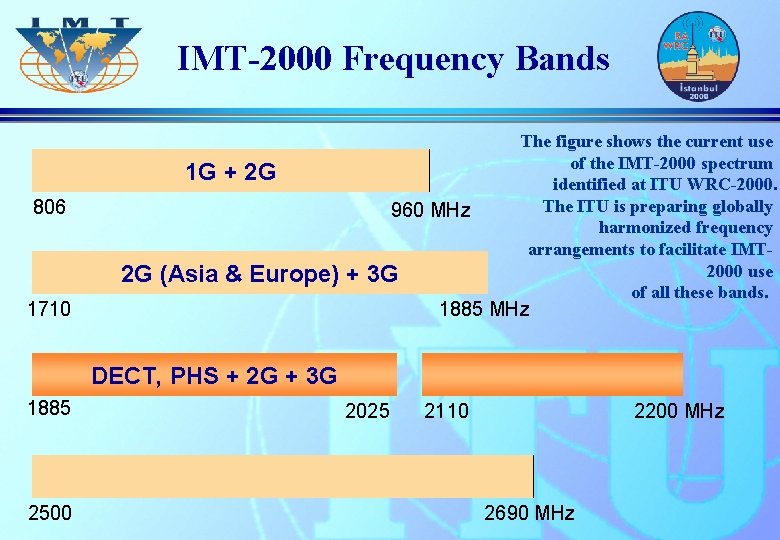
IMT-2000 Frequency Bands 1 G + 2 G 806 960 MHz 2 G (Asia & Europe) + 3 G 1710 The figure shows the current use of the IMT-2000 spectrum identified at ITU WRC-2000. The ITU is preparing globally harmonized frequency arrangements to facilitate IMT 2000 use of all these bands. 1885 MHz DECT, PHS + 2 G + 3 G 1885 2500 2025 2110 2200 MHz 2690 MHz

IMT-2000 Frequency Spectrum after WRC-2000 800 ITU Allocations 850 Japan, Korea (w/o PHS) 950 1000 1750 IMT 2000 Europe China 900 GSM 1800 GSM PDC 1850 1900 IMT 2000 GSM Cellular 1800 GSM 1800, PCS 2000 2050 2100 2150 2200 2250 2500 2550 2600 IMT 2000 MSS IMT 2000 UMTS MSS UMTS IMT 2000 MSS DECT IMT 2000 PHS PDC 1950 MSS IMT 2000 MSS 2650 PCS North America Brasil, Venezuela Cellular A D B EF C Cell. A D B EF C IMT 2000 MSS Reserve MSS IMT 2000 ITU Radio Regulations: 750 MHz of spectrum identified for IMT-2000 2700
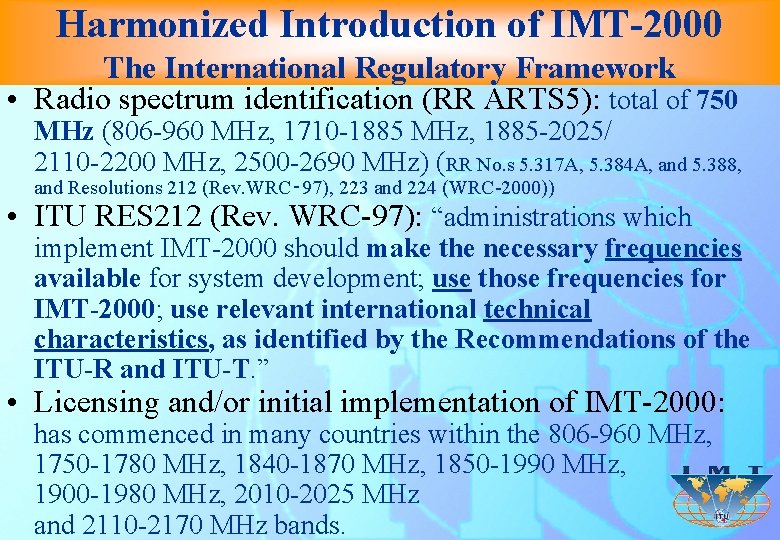
Harmonized Introduction of IMT-2000 The International Regulatory Framework • Radio spectrum identification (RR ARTS 5): total of 750 MHz (806 -960 MHz, 1710 -1885 MHz, 1885 -2025/ 2110 -2200 MHz, 2500 -2690 MHz) (RR No. s 5. 317 A, 5. 384 A, and 5. 388, and Resolutions 212 (Rev. WRC‑ 97), 223 and 224 (WRC-2000)) • ITU RES 212 (Rev. WRC-97): “administrations which implement IMT-2000 should make the necessary frequencies available for system development; use those frequencies for IMT-2000; use relevant international technical characteristics, as identified by the Recommendations of the ITU-R and ITU-T. ” • Licensing and/or initial implementation of IMT-2000: has commenced in many countries within the 806 -960 MHz, 1750 -1780 MHz, 1840 -1870 MHz, 1850 -1990 MHz, 1900 -1980 MHz, 2010 -2025 MHz and 2110 -2170 MHz bands.
![IMT-2000 Spectrum Harmonization • ITU-R WP 8 F (WG-SPEC) Rec. M. 1036[-2] on frequency](http://slidetodoc.com/presentation_image_h2/089250057a8e0382ba65fd9294b275a8/image-7.jpg "IMT-2000 Spectrum Harmonization • ITU-R WP 8 F (WG-SPEC) Rec. M. 1036[-2] on frequency")
IMT-2000 Spectrum Harmonization • ITU-R WP 8 F (WG-SPEC) Rec. M. 1036[-2] on frequency arrangements for implementation of IMT-2000 (bands identified at WRC-2000) (3 Q 2002) • ITU Workshop on IMT-2000 Spectrum Implementation (Geneva, 19 -20. 10. 2000) Regulators & industry open discussions on IMT-2000 spectrum issues • WRC-03/06 Spectrum requirements for future developments of IMT-2000 & beyond systems
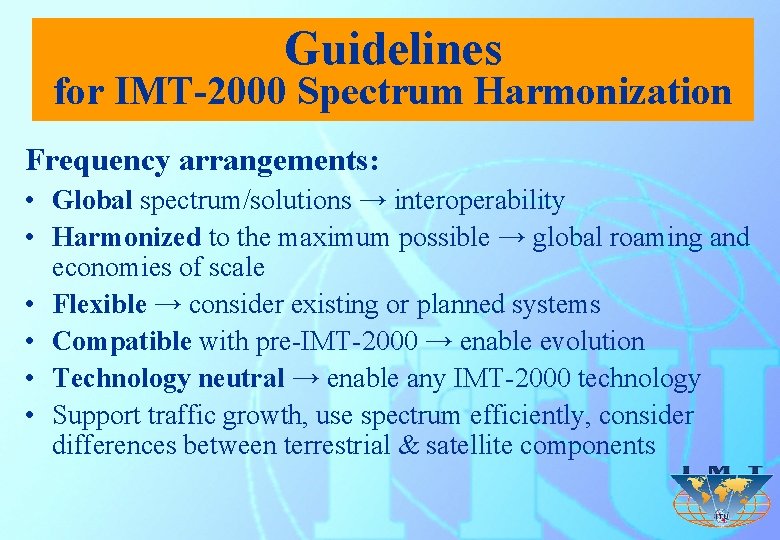
Guidelines for IMT-2000 Spectrum Harmonization Frequency arrangements: • Global spectrum/solutions → interoperability • Harmonized to the maximum possible → global roaming and economies of scale • Flexible → consider existing or planned systems • Compatible with pre-IMT-2000 → enable evolution • Technology neutral → enable any IMT-2000 technology • Support traffic growth, use spectrum efficiently, consider differences between terrestrial & satellite components
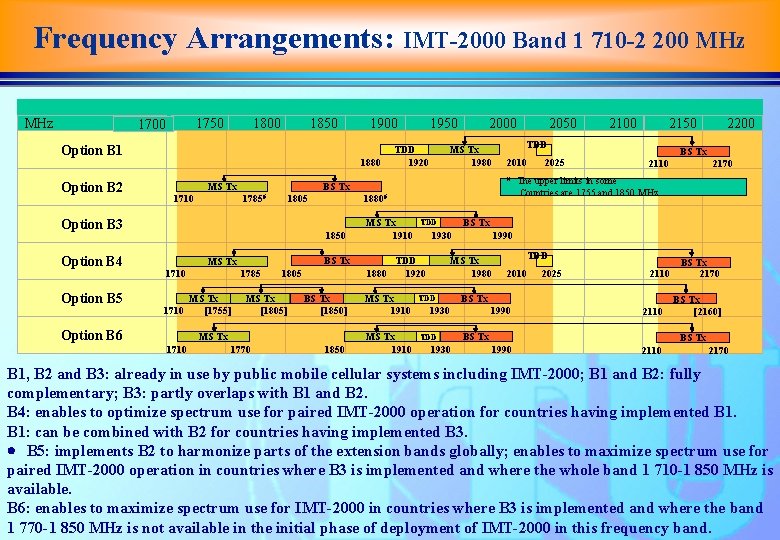
Frequency Arrangements: IMT-2000 Band 1 710 -2 200 MHz 1750 1700 1850 Option B 1 Option B 2 1880 MS Tx 1710 1785# Option B 5 1805 BS Tx MS Tx 1710 Option B 6 1785 MS Tx [1755] 1805 MS Tx [1805] MS Tx 1980 1770 MS Tx 1910 1930 TDD 1850 MS Tx 1910 2150 2025 2010 2200 BS Tx 2110 2170 The upper limits in some Countries are 1755 and 1850 MHz 1990 MS Tx 1980 MS Tx 1910 2100 BS Tx TDD 1880 1920 2050 TDD # BS Tx [1850] MS Tx 1710 TDD 1920 2000 1880# 1850 1710 1950 BS Tx Option B 3 Option B 4 1900 2010 2025 2110 BS Tx 1930 TDD 1990 2110 BS Tx 2170 BS Tx [2160] BS Tx 2170 B 1, B 2 and B 3: already in use by public mobile cellular systems including IMT-2000; B 1 and B 2: fully complementary; B 3: partly overlaps with B 1 and B 2. B 4: enables to optimize spectrum use for paired IMT-2000 operation for countries having implemented B 1: can be combined with B 2 for countries having implemented B 3. · B 5: implements B 2 to harmonize parts of the extension bands globally; enables to maximize spectrum use for paired IMT-2000 operation in countries where B 3 is implemented and where the whole band 1 710 -1 850 MHz is available. B 6: enables to maximize spectrum use for IMT-2000 in countries where B 3 is implemented and where the band 1 770 -1 850 MHz is not available in the initial phase of deployment of IMT-2000 in this frequency band.
- Slides: 9