
A GLOBAL MODEL FOR THE ATMOSPHERIC PRESSURE PLASMA
A GLOBAL MODEL FOR THE ATMOSPHERIC PRESSURE PLASMA SURFACE FUNCTIONALIZATION OF POLYSTYRENE* Jordyn Polito and Mark J. Kushner University of Michigan, Ann Arbor, MI 48109 -2122 USA jopolito@umich. edu, mjkush@umich. edu Mark Denning, David Frost, and Richard Stewart Agilent Technologies 11 th Annual MIPSE Symposium November 17 th, 2020 * This work was supported by Agilent Technologies and the Department of Energy Office of Fusion Energy Science.
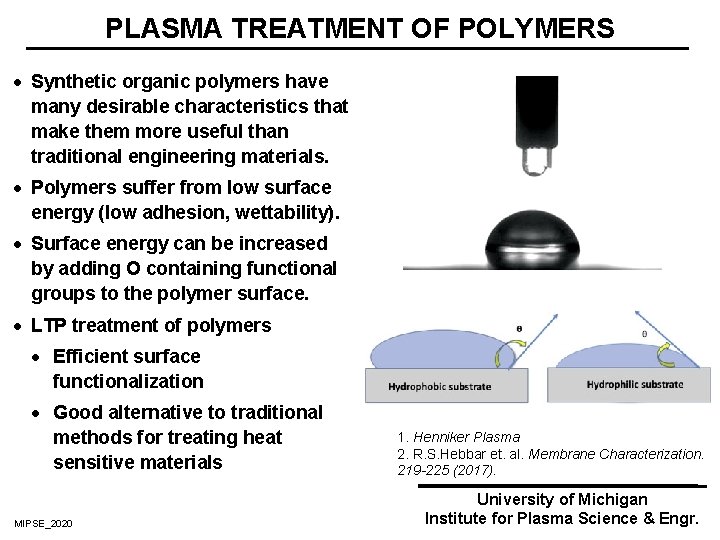
PLASMA TREATMENT OF POLYMERS · Synthetic organic polymers have many desirable characteristics that make them more useful than traditional engineering materials. · Polymers suffer from low surface energy (low adhesion, wettability). · Surface energy can be increased by adding O containing functional groups to the polymer surface. · LTP treatment of polymers · Efficient surface functionalization · Good alternative to traditional methods for treating heat sensitive materials MIPSE_2020 1. Henniker Plasma 2. R. S. Hebbar et. al. Membrane Characterization. 219 -225 (2017). University of Michigan Institute for Plasma Science & Engr.
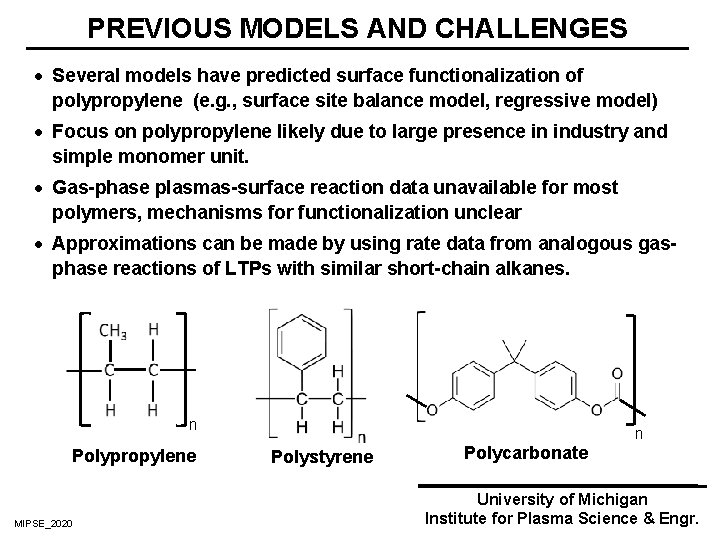
PREVIOUS MODELS AND CHALLENGES · Several models have predicted surface functionalization of polypropylene (e. g. , surface site balance model, regressive model) · Focus on polypropylene likely due to large presence in industry and simple monomer unit. · Gas-phase plasmas-surface reaction data unavailable for most polymers, mechanisms for functionalization unclear · Approximations can be made by using rate data from analogous gasphase reactions of LTPs with similar short-chain alkanes. n Polypropylene MIPSE_2020 n Polystyrene Polycarbonate University of Michigan Institute for Plasma Science & Engr.
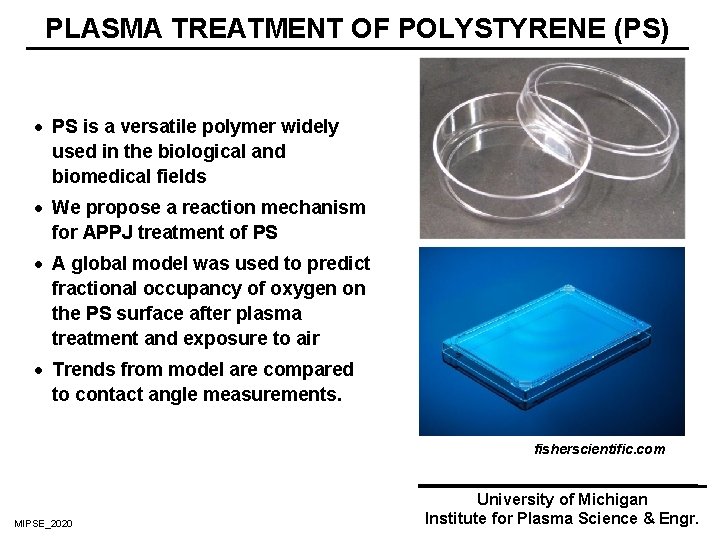
PLASMA TREATMENT OF POLYSTYRENE (PS) · PS is a versatile polymer widely used in the biological and biomedical fields · We propose a reaction mechanism for APPJ treatment of PS · A global model was used to predict fractional occupancy of oxygen on the PS surface after plasma treatment and exposure to air · Trends from model are compared to contact angle measurements. fisherscientific. com MIPSE_2020 University of Michigan Institute for Plasma Science & Engr.
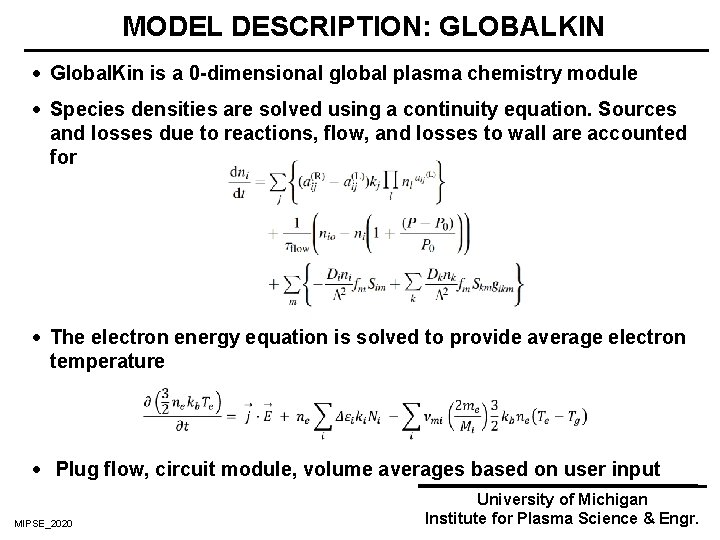
MODEL DESCRIPTION: GLOBALKIN · Global. Kin is a 0 -dimensional global plasma chemistry module · Species densities are solved using a continuity equation. Sources and losses due to reactions, flow, and losses to wall are accounted for · The electron energy equation is solved to provide average electron temperature · Plug flow, circuit module, volume averages based on user input MIPSE_2020 University of Michigan Institute for Plasma Science & Engr.
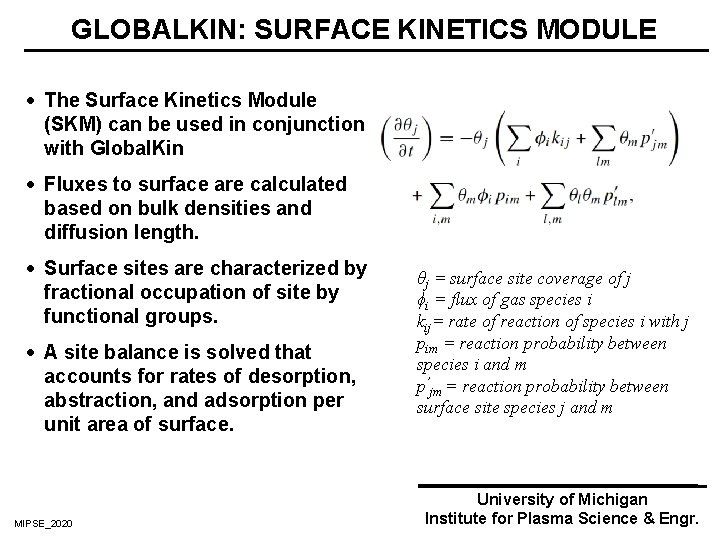
GLOBALKIN: SURFACE KINETICS MODULE · The Surface Kinetics Module (SKM) can be used in conjunction with Global. Kin · Fluxes to surface are calculated based on bulk densities and diffusion length. · Surface sites are characterized by fractional occupation of site by functional groups. · A site balance is solved that accounts for rates of desorption, abstraction, and adsorption per unit area of surface. MIPSE_2020 θj = surface site coverage of j ϕi = flux of gas species i kij= rate of reaction of species i with j pim = reaction probability between species i and m p’jm = reaction probability between surface site species j and m University of Michigan Institute for Plasma Science & Engr.
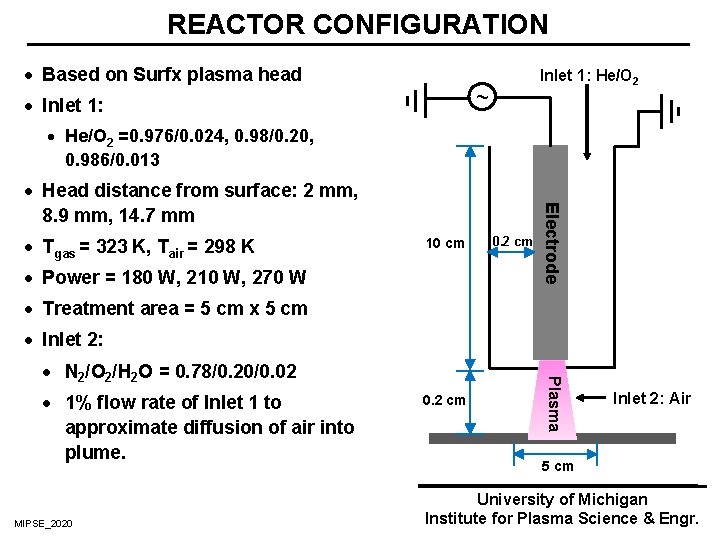
REACTOR CONFIGURATION · Based on Surfx plasma head Inlet 1: He/O 2 ~ · Inlet 1: · He/O 2 =0. 976/0. 024, 0. 98/0. 20, 0. 986/0. 013 · Tgas = 323 K, Tair = 298 K 10 cm · Power = 180 W, 210 W, 270 W 0. 2 cm Electrode · Head distance from surface: 2 mm, 8. 9 mm, 14. 7 mm · Treatment area = 5 cm x 5 cm · Inlet 2: · 1% flow rate of Inlet 1 to approximate diffusion of air into plume. MIPSE_2020 0. 2 cm Plasma · N 2/O 2/H 2 O = 0. 78/0. 20/0. 02 Inlet 2: Air 5 cm University of Michigan Institute for Plasma Science & Engr.
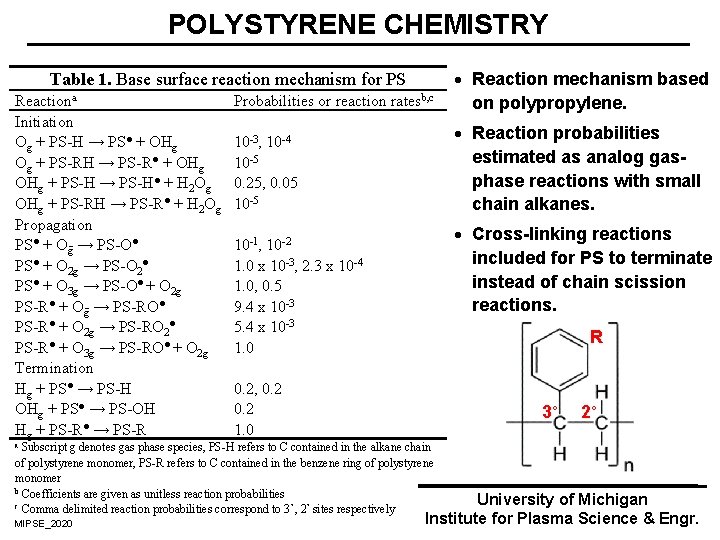
POLYSTYRENE CHEMISTRY Probabilities or reaction ratesb, c · Reaction mechanism based on polypropylene. 10 3, 10 4 10 5 0. 25, 0. 05 10 5 · Reaction probabilities estimated as analog gasphase reactions with small chain alkanes. Table 1. Base surface reaction mechanism for PS Reactiona Initiation Og + PS H → PS● + OHg Og + PS RH → PS R● + OHg + PS H → PS H● + H 2 Og OHg + PS RH → PS R● + H 2 Og Propagation PS● + O g → PS O● PS● + O 2 g → PS O 2● PS● + O 3 g → PS O● + O 2 g PS R● + O g → PS RO● PS R● + O 2 g → PS RO 2● PS R● + O 3 g → PS RO● + O 2 g Termination Hg + PS● → PS H OHg + PS● → PS OH Hg + PS R● → PS R · Cross-linking reactions included for PS to terminate instead of chain scission reactions. 10 1, 10 2 1. 0 x 10 3, 2. 3 x 10 4 1. 0, 0. 5 9. 4 x 10 3 5. 4 x 10 3 1. 0 R 0. 2, 0. 2 1. 0 3° Subscript g denotes gas phase species, PS H refers to C contained in the alkane chain of polystyrene monomer, PS R refers to C contained in the benzene ring of polystyrene monomer b Coefficients are given as unitless reaction probabilities c Comma delimited reaction probabilities correspond to 3 °, 2° sites respectively 2° a MIPSE_2020 University of Michigan Institute for Plasma Science & Engr.
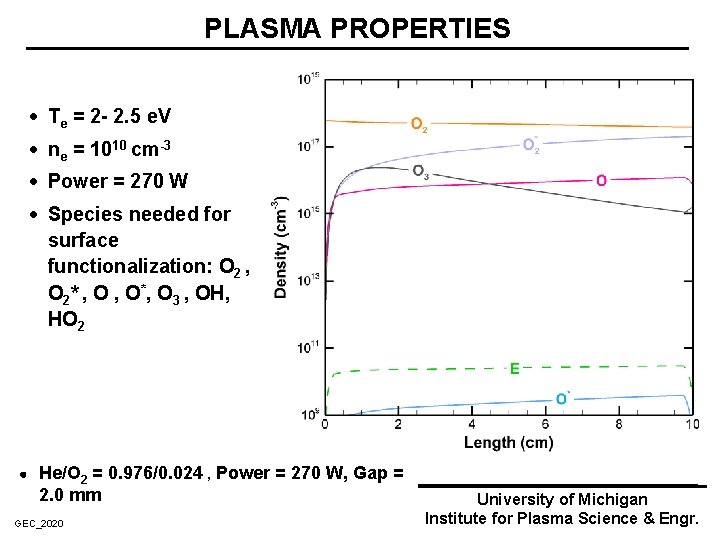
PLASMA PROPERTIES · Te = 2 - 2. 5 e. V · ne = 1010 cm-3 · Power = 270 W · Species needed for surface functionalization: O 2 , O 2* , O*, O 3 , OH, HO 2 He/O 2 = 0. 976/0. 024 , Power = 270 W, Gap = 2. 0 mm GEC_2020 University of Michigan Institute for Plasma Science & Engr.
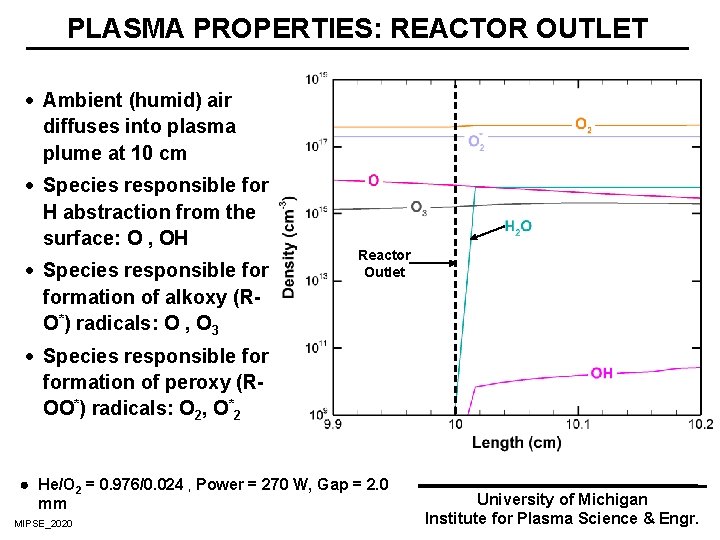
PLASMA PROPERTIES: REACTOR OUTLET · Ambient (humid) air diffuses into plasma plume at 10 cm · Species responsible for H abstraction from the surface: O , OH · Species responsible formation of alkoxy (RO*) radicals: O , O 3 Reactor Outlet · Species responsible formation of peroxy (ROO*) radicals: O 2, O*2 He/O 2 = 0. 976/0. 024 , Power = 270 W, Gap = 2. 0 mm MIPSE_2020 University of Michigan Institute for Plasma Science & Engr.
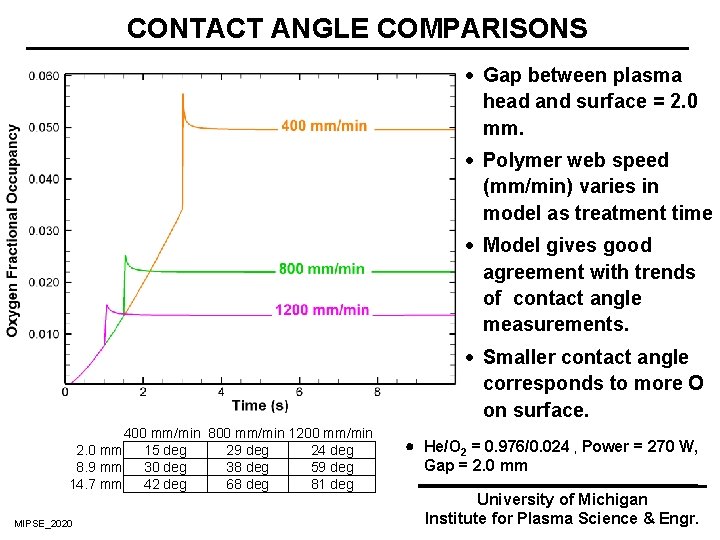
CONTACT ANGLE COMPARISONS · Gap between plasma head and surface = 2. 0 mm. · Polymer web speed (mm/min) varies in model as treatment time · Model gives good agreement with trends of contact angle measurements. · Smaller contact angle corresponds to more O on surface. 400 mm/min 800 mm/min 1200 mm/min 2. 0 mm 15 deg 29 deg 24 deg 8. 9 mm 30 deg 38 deg 59 deg 14. 7 mm 42 deg 68 deg 81 deg MIPSE_2020 He/O 2 = 0. 976/0. 024 , Power = 270 W, Gap = 2. 0 mm University of Michigan Institute for Plasma Science & Engr.
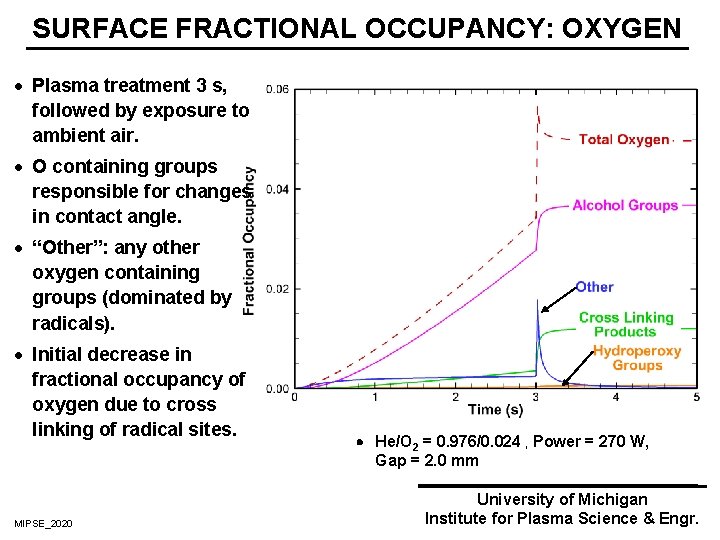
SURFACE FRACTIONAL OCCUPANCY: OXYGEN · Plasma treatment 3 s, followed by exposure to ambient air. · O containing groups responsible for changes in contact angle. · “Other”: any other oxygen containing groups (dominated by radicals). · Initial decrease in fractional occupancy of oxygen due to cross linking of radical sites. He/O 2 = 0. 976/0. 024 , Power = 270 W, Gap = 2. 0 mm MIPSE_2020 University of Michigan Institute for Plasma Science & Engr.
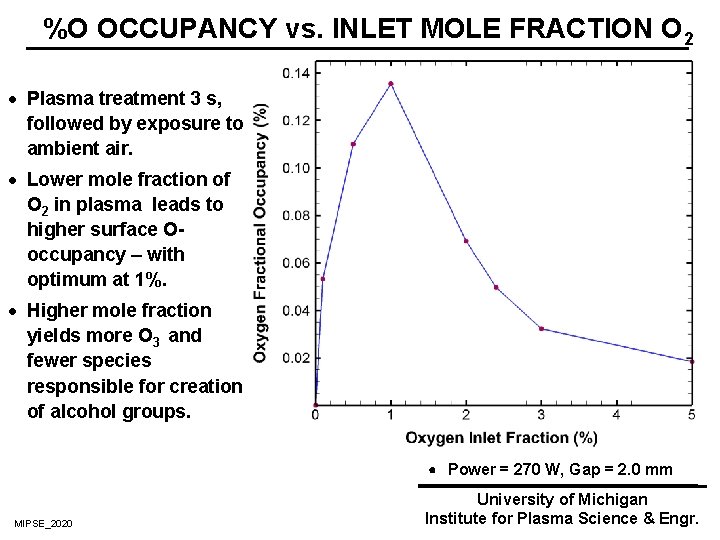
%O OCCUPANCY vs. INLET MOLE FRACTION O 2 · Plasma treatment 3 s, followed by exposure to ambient air. · Lower mole fraction of O 2 in plasma leads to higher surface Ooccupancy – with optimum at 1%. · Higher mole fraction yields more O 3 and fewer species responsible for creation of alcohol groups. Power = 270 W, Gap = 2. 0 mm MIPSE_2020 University of Michigan Institute for Plasma Science & Engr.
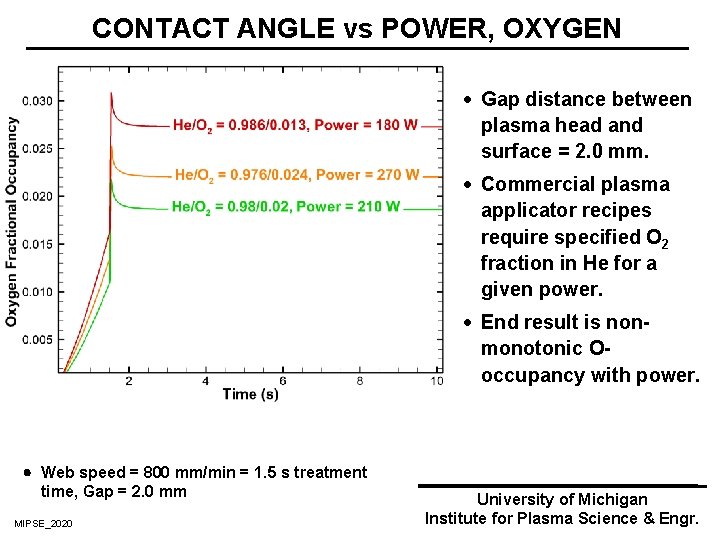
CONTACT ANGLE vs POWER, OXYGEN · Gap distance between plasma head and surface = 2. 0 mm. · Commercial plasma applicator recipes require specified O 2 fraction in He for a given power. · End result is nonmonotonic Ooccupancy with power. Web speed = 800 mm/min = 1. 5 s treatment time, Gap = 2. 0 mm MIPSE_2020 University of Michigan Institute for Plasma Science & Engr.
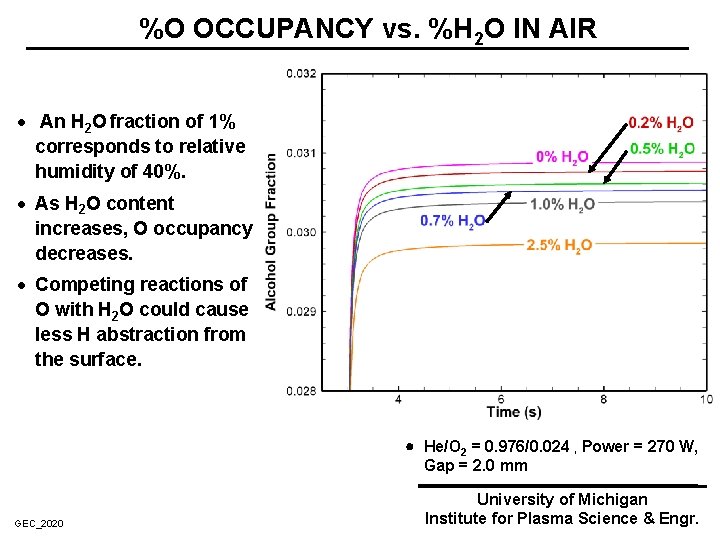
%O OCCUPANCY vs. %H 2 O IN AIR · An H 2 O fraction of 1% corresponds to relative humidity of 40%. · As H 2 O content increases, O occupancy decreases. · Competing reactions of O with H 2 O could cause less H abstraction from the surface. He/O 2 = 0. 976/0. 024 , Power = 270 W, Gap = 2. 0 mm GEC_2020 University of Michigan Institute for Plasma Science & Engr.
CONCLUDING REMARKS · A mechanism for plasma functionalization of PS was developed including post-plasma treatment exposure to ambient air. · Trends in oxygen fractional occupancy agree with contact angle measurements. · The model predicts that changes in contact angle of the PS are mainly due to formation of alcohol groups and cross linking products on the surface. · Cross linking is generally responsible for stabilizing the surface. · Future work includes creation of a mechanism plasma functionalization of polyethylene terephthalate (PET). · Comparison of results from treatment of different polymers will be used to better understanding of plasma functionalization of polymers containing various functional groups GEC_2020 University of Michigan Institute for Plasma Science & Engr.
- Slides: 16