
A Global Geometric Framework for Nonlinear Dimensionality Reduction
A Global Geometric Framework for Nonlinear Dimensionality Reduction Joshua B. Tenenbaum, Vin de Silva, John C. Langford Presented by Napat Triroj
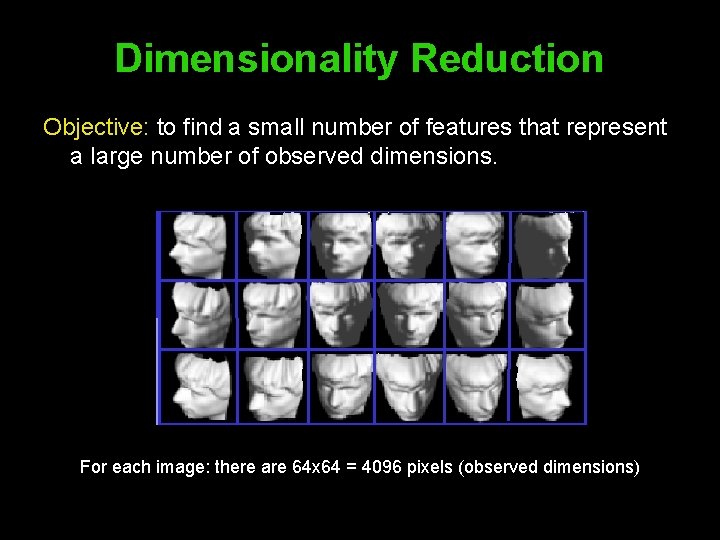
Dimensionality Reduction Objective: to find a small number of features that represent a large number of observed dimensions. For each image: there are 64 x 64 = 4096 pixels (observed dimensions)
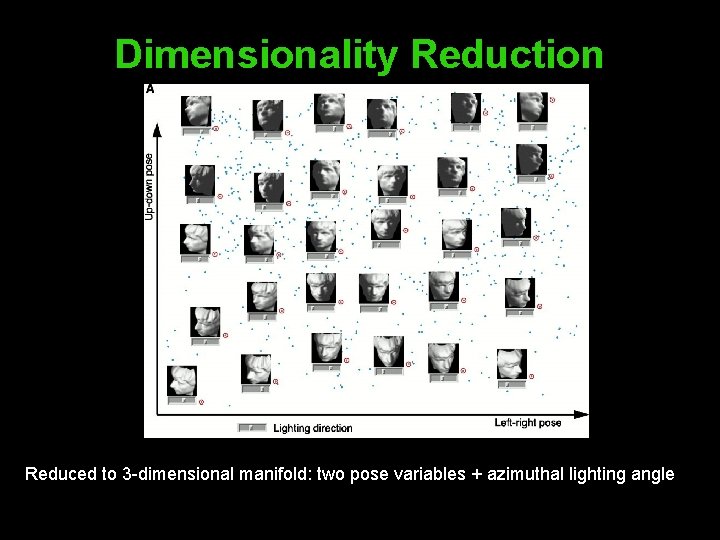
Dimensionality Reduction Reduced to 3 -dimensional manifold: two pose variables + azimuthal lighting angle
Isometric Feature Mapping (Isomap) • A nonlinear method for dimensionality reduction • Finds the map that preserves the global, nonlinear geometry of the data by preserving the geodesic manifold interpoint distances • Geodesic: Shortest curve along the manifold connecting two points • First approximates the geodesic interpoint distances, then runs MDS to find the projection that preserves these distances 2 components: - How do we measure the geodesic distances on the manifold? - How to map points on the Euclidean space in lower dimensional space?
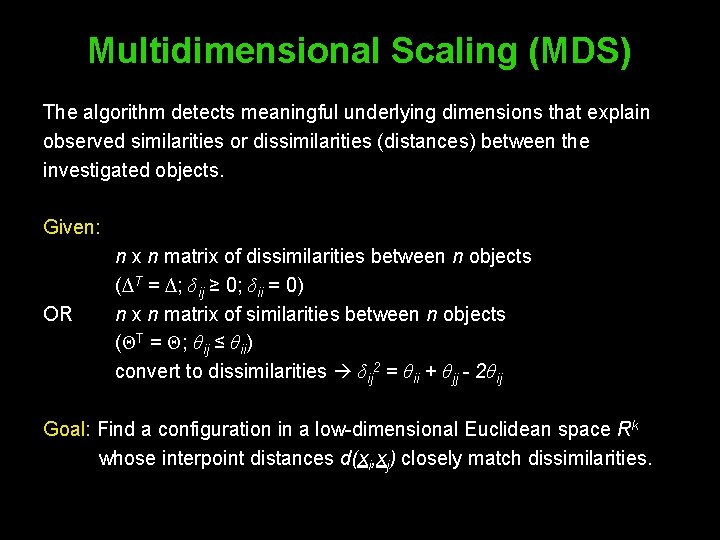
Multidimensional Scaling (MDS) The algorithm detects meaningful underlying dimensions that explain observed similarities or dissimilarities (distances) between the investigated objects. Given: OR n x n matrix of dissimilarities between n objects (∆T = ∆; δij ≥ 0; δii = 0) n x n matrix of similarities between n objects (ΘT = Θ; θij ≤ θii) convert to dissimilarities δij 2 = θii + θjj - 2θij Goal: Find a configuration in a low-dimensional Euclidean space Rk whose interpoint distances d(xi, xj) closely match dissimilarities.
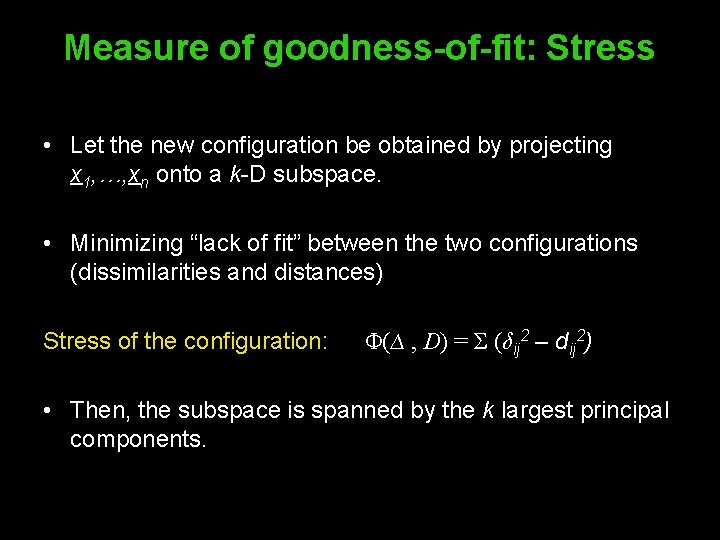
Measure of goodness-of-fit: Stress • Let the new configuration be obtained by projecting x 1, …, xn onto a k-D subspace. • Minimizing “lack of fit” between the two configurations (dissimilarities and distances) Stress of the configuration: Φ(∆ , D) = Σ (δij 2 – dij 2) • Then, the subspace is spanned by the k largest principal components.
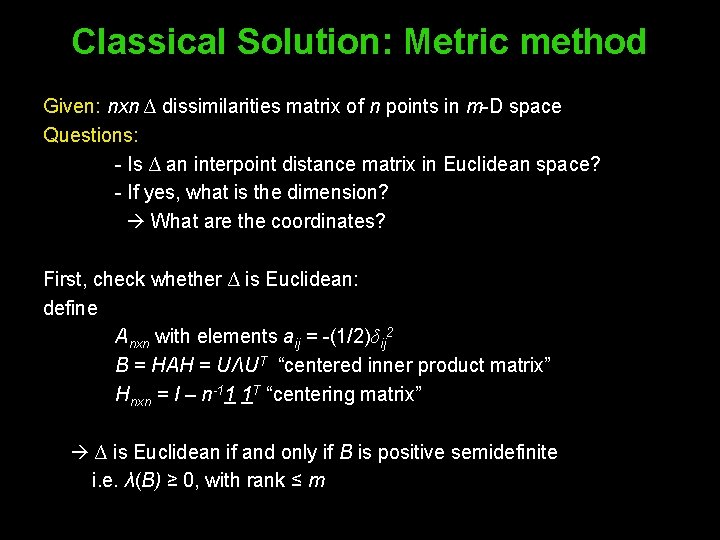
Classical Solution: Metric method Given: nxn ∆ dissimilarities matrix of n points in m-D space Questions: - Is ∆ an interpoint distance matrix in Euclidean space? - If yes, what is the dimension? What are the coordinates? First, check whether ∆ is Euclidean: define Anxn with elements aij = -(1/2)δij 2 B = HAH = UΛUT “centered inner product matrix” Hnxn = I – n-11 1 T “centering matrix” ∆ is Euclidean if and only if B is positive semidefinite i. e. λ(B) ≥ 0, with rank ≤ m
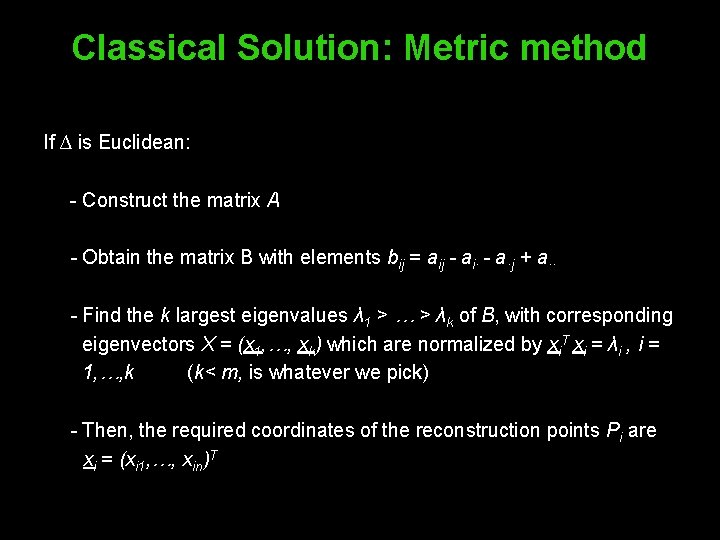
Classical Solution: Metric method If ∆ is Euclidean: - Construct the matrix A - Obtain the matrix B with elements bij = aij - ai· - a·j + a·· - Find the k largest eigenvalues λ 1 > … > λk of B, with corresponding eigenvectors X = (x 1, …, xk) which are normalized by xi. T xi = λi , i = 1, …, k (k< m, is whatever we pick) - Then, the required coordinates of the reconstruction points Pi are xi = (xi 1, …, xin)T
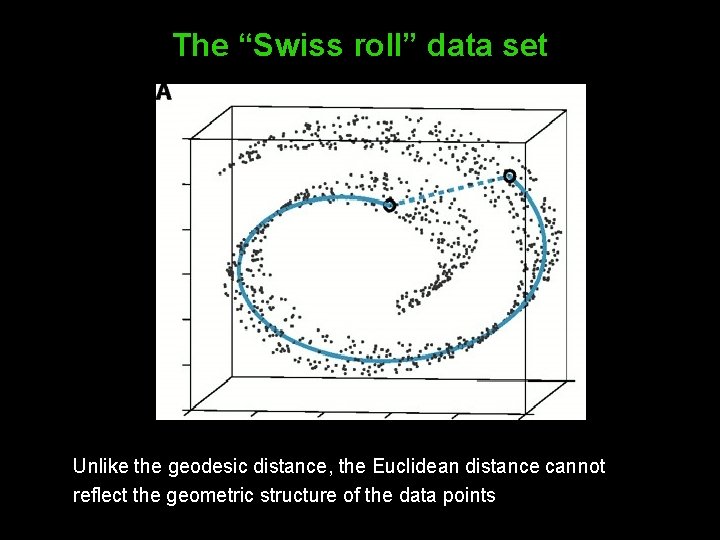
The “Swiss roll” data set Unlike the geodesic distance, the Euclidean distance cannot reflect the geometric structure of the data points
Approximating Geodesic Distances Neighboring points: input-space distance Faraway points: a sequence of “short hops” between neighboring points Method: Finding shortest paths in a graph with edges connecting neighboring data points
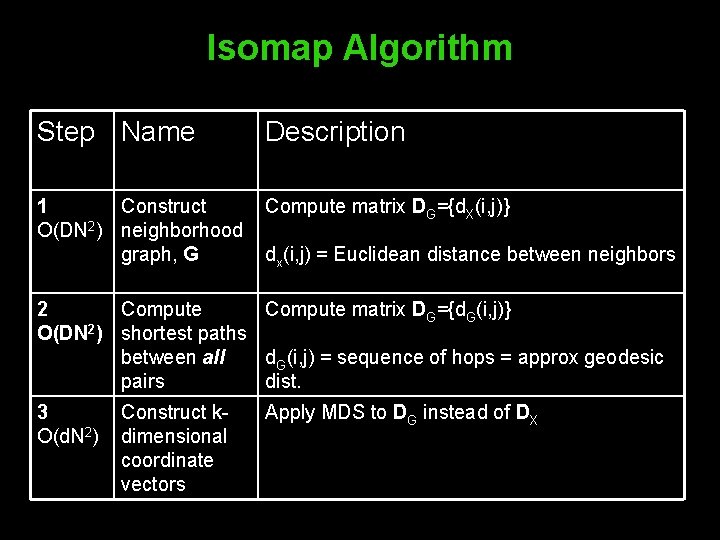
Isomap Algorithm Step Name Description 1 Construct O(DN 2) neighborhood graph, G Compute matrix DG={d. X(i, j)} dx(i, j) = Euclidean distance between neighbors 2 Compute matrix DG={d. G(i, j)} O(DN 2) shortest paths between all d. G(i, j) = sequence of hops = approx geodesic pairs dist. 3 O(d. N 2) Construct kdimensional coordinate vectors Apply MDS to DG instead of DX
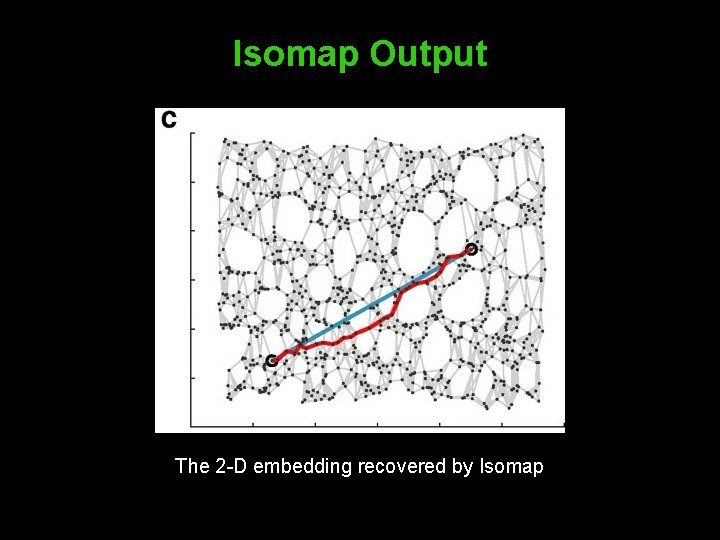
Isomap Output The 2 -D embedding recovered by Isomap
Summary on Isomap Algorithm Advantages: • Nonlinear • Non-iterative • Globally optimal • Parameters: k or ε (chosen fixed radius) Disadvantages: • Graph discreteness overestimates the geodesic distance • k must be high to avoid “linear shortcuts” near regions of high surface curvature
- Slides: 13