
A Glimpse of Game Theory 1 2 Games
- Slides: 40
A Glimpse of Game Theory 1
2
Games and Game Theory • Much effort to develop computer programs for artificial games like chess or poker commonly played for entertainment • Larger issue: account for, model and predict how agents (human or artificial) interact with other agents • Game theory accounts for mixture of cooperative and competitive behavior • Applies to zero-sum and non-zero-sum games 3
Basic Ideas of Game Theory • Game theory studies how strategic interactions among rational players produce outcomes with respect to the players’ preferences (or utilities) – Outcomes might not have been intended • It offers a general theory of strategic behavior • Generally depicted in mathematical form • Plays important role in economics, decision theory and multi-agent systems 4
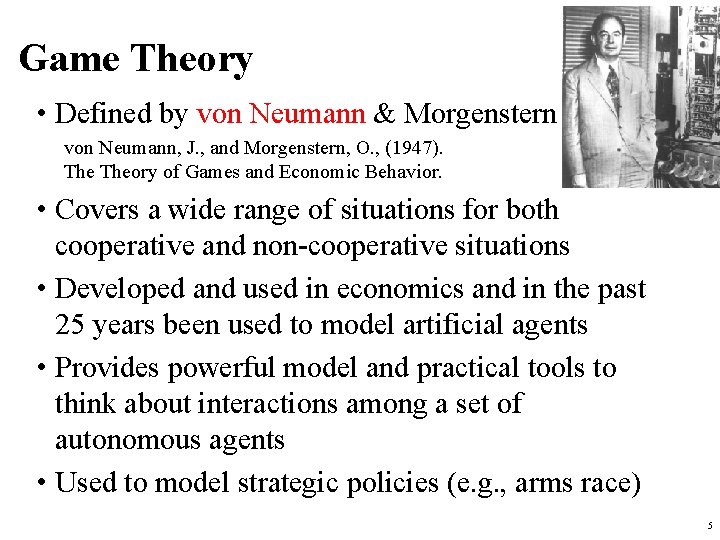
Game Theory • Defined by von Neumann & Morgenstern von Neumann, J. , and Morgenstern, O. , (1947). Theory of Games and Economic Behavior. • Covers a wide range of situations for both cooperative and non-cooperative situations • Developed and used in economics and in the past 25 years been used to model artificial agents • Provides powerful model and practical tools to think about interactions among a set of autonomous agents • Used to model strategic policies (e. g. , arms race) 5
Zero Sum Games • Zero-sum: participant's gain/loss exactly balanced by losses/gains of the other participants • Total gains of participants minus total losses = 0 Poker is zero sum game: money won = money lost • Commercial trade is not a zero sum game If a country with an excess of bananas trades with another for their excess of apples, both may benefit • Non-zero sum games more complex to analyze • More non-zero sum games as world becomes more complex, specialized and interdependent 6
Rules, Strategies, Payoffs & Equilibrium Situations are treated as games: • Rules of game: who can do what, and when they can do it • Player's strategy: plan for actions in each possible situation in the game • Player's payoff: amount that the player wins or loses in a particular situation in a game • Player has a dominant strategy if her best strategy doesn’t depend on what others do 7
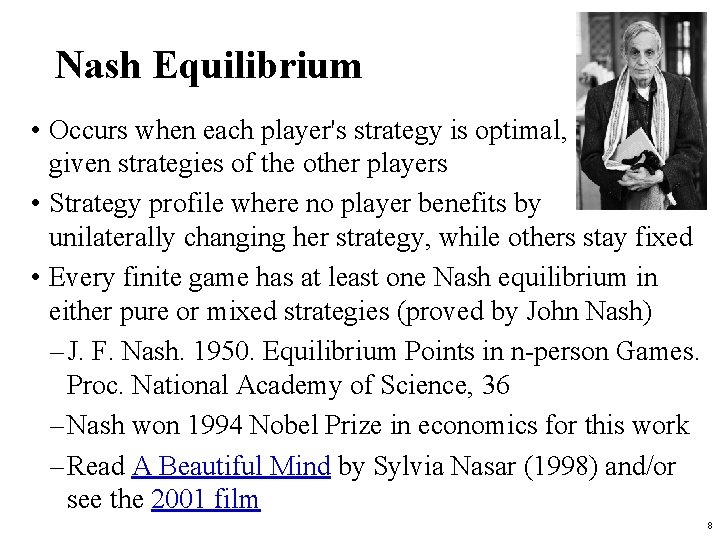
Nash Equilibrium • Occurs when each player's strategy is optimal, given strategies of the other players • Strategy profile where no player benefits by unilaterally changing her strategy, while others stay fixed • Every finite game has at least one Nash equilibrium in either pure or mixed strategies (proved by John Nash) – J. F. Nash. 1950. Equilibrium Points in n-person Games. Proc. National Academy of Science, 36 – Nash won 1994 Nobel Prize in economics for this work – Read A Beautiful Mind by Sylvia Nasar (1998) and/or see the 2001 film 8
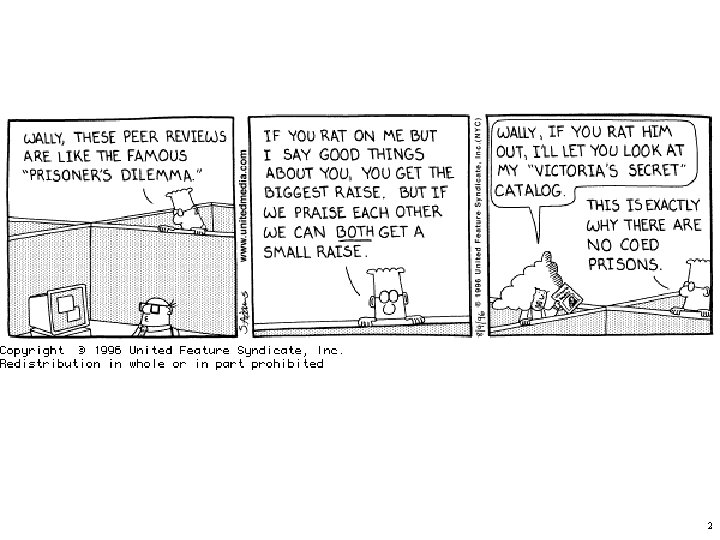
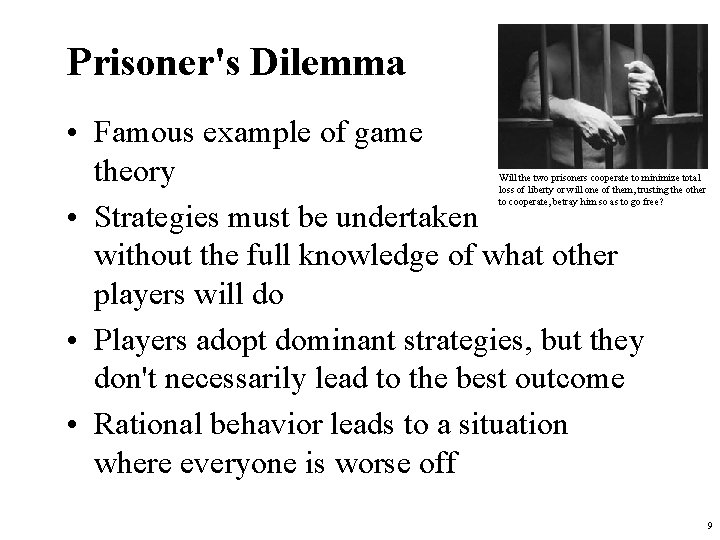
Prisoner's Dilemma • Famous example of game theory • Strategies must be undertaken without the full knowledge of what other players will do • Players adopt dominant strategies, but they don't necessarily lead to the best outcome • Rational behavior leads to a situation where everyone is worse off Will the two prisoners cooperate to minimize total loss of liberty or will one of them, trusting the other to cooperate, betray him so as to go free? 9
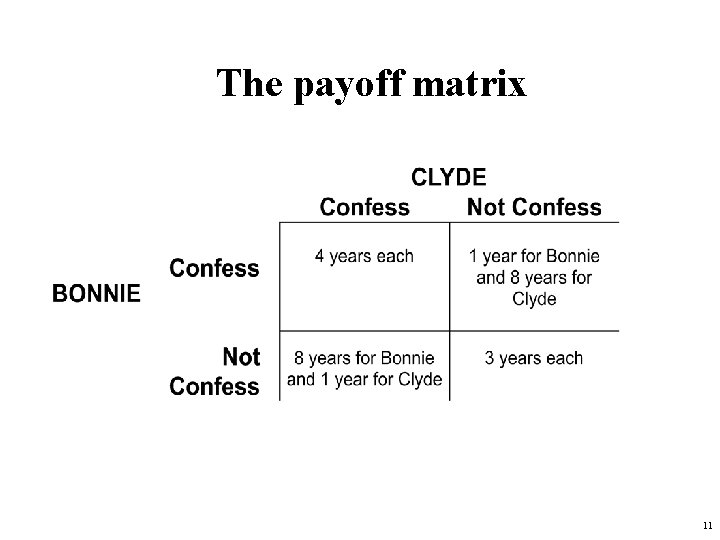
Bonnie and Clyde are arrested and charged with crimes. They’re questioned separately, unable to communicate. They know how it works: – If both proclaim mutual innocence (cooperating), they will be found guilty anyway and get a three year sentences for robbery – If one confesses (defecting) and the other doesn’t (cooperating), the confessor is rewarded with a light, one-year sentence and the other gets a severe 8 -year sentence – If both confess (defecting), then the judge sentences both to a moderate 4 years in prison What should Bonnie do? What should Clyde do? 10
The payoff matrix 11
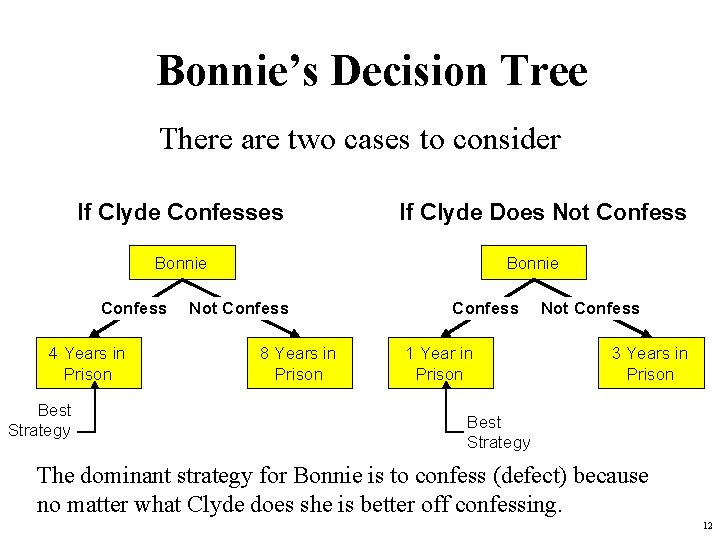
Bonnie’s Decision Tree There are two cases to consider If Clyde Confesses If Clyde Does Not Confess Bonnie Confess 4 Years in Prison Best Strategy Bonnie Not Confess 8 Years in Prison Confess 1 Year in Prison Not Confess 3 Years in Prison Best Strategy The dominant strategy for Bonnie is to confess (defect) because no matter what Clyde does she is better off confessing. 12
So what? • It seems we should always defect and never cooperate • No wonder Economics is called the dismal science 13
Some PD examples • There are lots of examples of the Prisoner’s Dilemma situations in the real world • It makes it difficult for “players” to avoid the bad outcome of both defecting – – – Cheating on a cartel Trade wars between countries Arms races Advertising Communal coffee pot Class team project 14
Cheating on a Cartel: association of manufacturers or suppliers with purpose of maintaining prices at a high level and restricting competition – Cartel members' possible strategies range from abiding by their agreement to cheating – Cartel members can charge the monopoly price or a lower price – Cheating firms can increase profits – The best strategy is charging the low price
Trade Wars Between Countries • Free trade benefits both trading countries • Tariffs can benefit one trading country • Imposing tariffs can be a dominant strategy and establish a Nash equilibrium even though it may be inefficient 16
Advertising • Advertising is expensive • All firms advertising tends to equalize the effects • Everyone would gain if no one advertised • But firms increase their advertising to gain advantage • Which makes their competition do the same • It’s an arms race 17
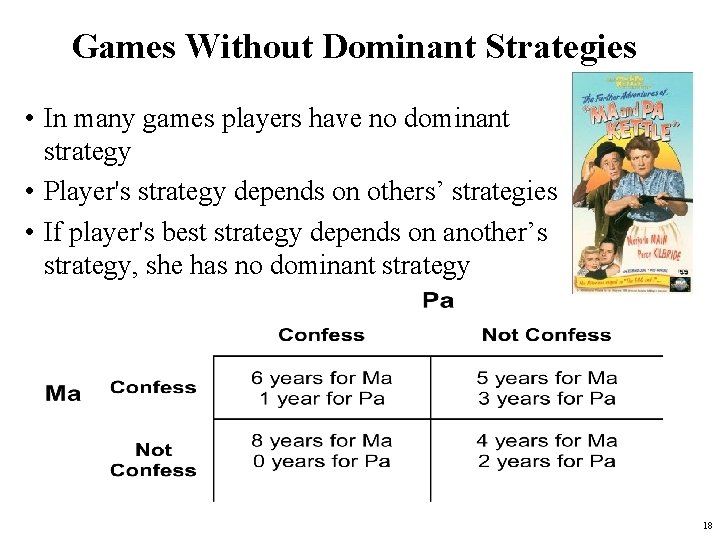
Games Without Dominant Strategies • In many games players have no dominant strategy • Player's strategy depends on others’ strategies • If player's best strategy depends on another’s strategy, she has no dominant strategy 18
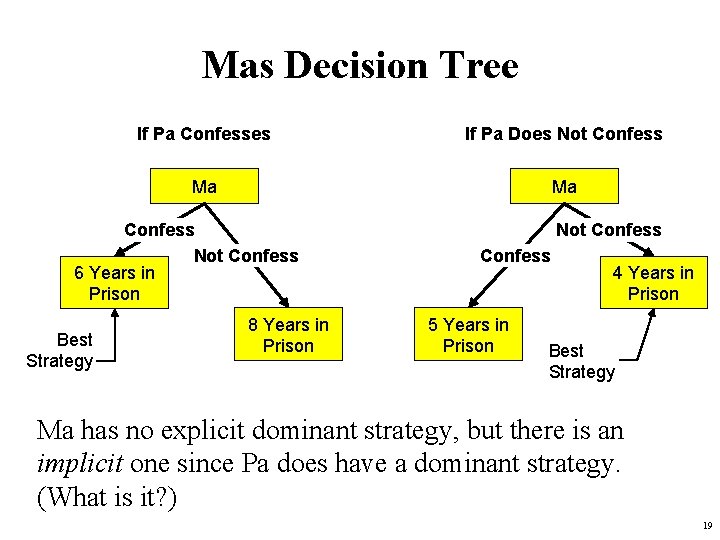
Mas Decision Tree If Pa Confesses If Pa Does Not Confess Ma Ma Confess Not Confess 6 Years in Prison Best Strategy 8 Years in Prison Not Confess 5 Years in Prison 4 Years in Prison Best Strategy Ma has no explicit dominant strategy, but there is an implicit one since Pa does have a dominant strategy. (What is it? ) 19
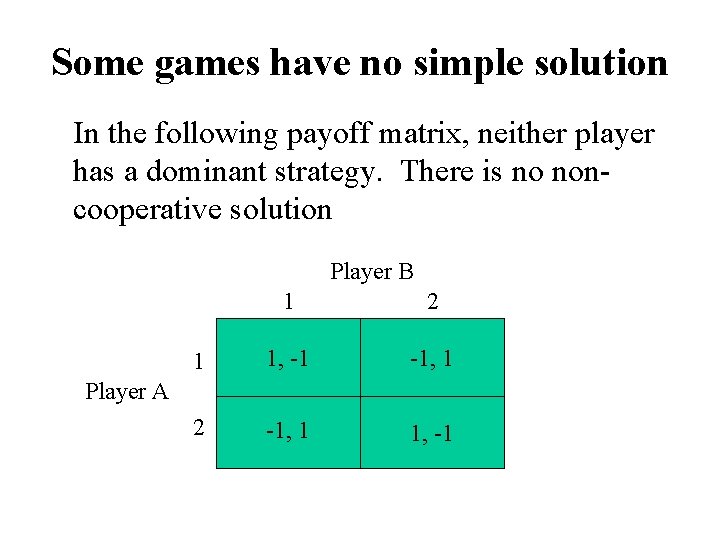
Some games have no simple solution In the following payoff matrix, neither player has a dominant strategy. There is no noncooperative solution Player B 1 2 1 1, -1 -1, 1 2 -1, 1 1, -1 Player A
Repeated Games • A repeated game is a game that the same players play more than once • Repeated games differ form one-shot games because a player’s current actions can depend on the past behavior of other players • Cooperation is encouraged
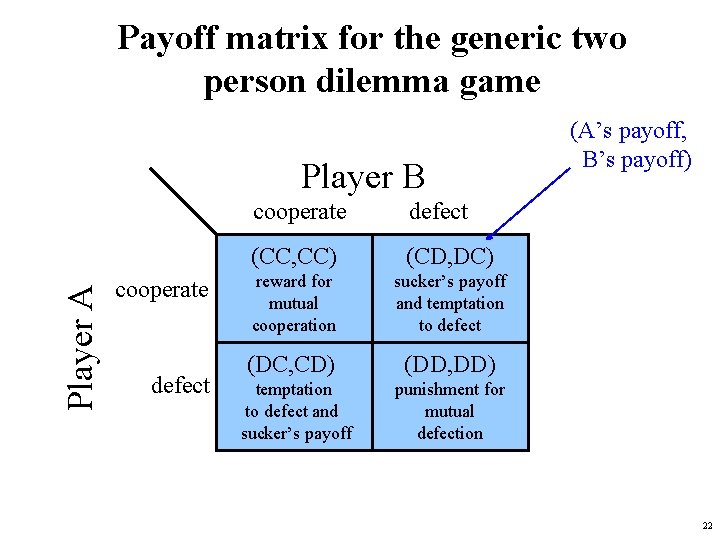
Payoff matrix for the generic two person dilemma game Player A Player B cooperate defect (CC, CC) (CD, DC) reward for mutual cooperation sucker’s payoff and temptation to defect (DC, CD) (DD, DD) temptation to defect and sucker’s payoff punishment for mutual defection (A’s payoff, B’s payoff) 22
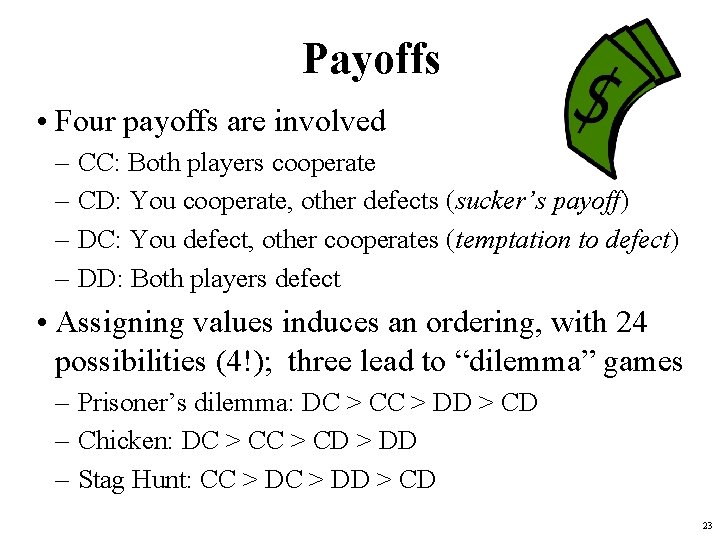
Payoffs • Four payoffs are involved – – CC: Both players cooperate CD: You cooperate, other defects (sucker’s payoff) DC: You defect, other cooperates (temptation to defect) DD: Both players defect • Assigning values induces an ordering, with 24 possibilities (4!); three lead to “dilemma” games – Prisoner’s dilemma: DC > CC > DD > CD – Chicken: DC > CD > DD – Stag Hunt: CC > DD > CD 23
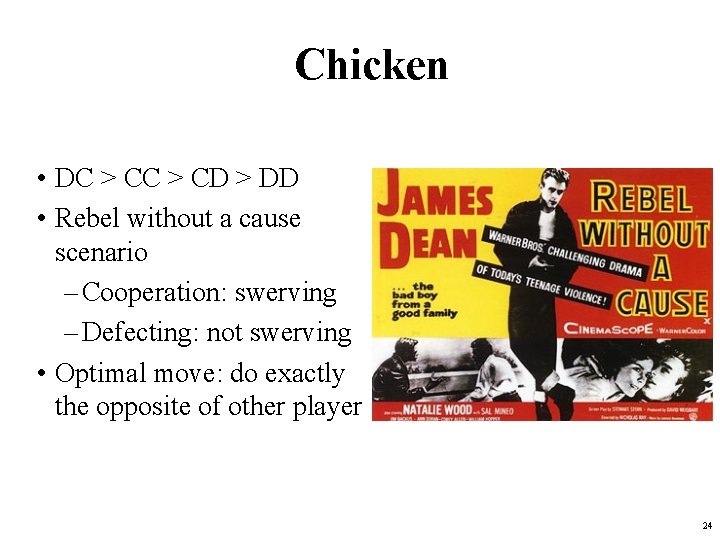
Chicken • DC > CD > DD • Rebel without a cause scenario – Cooperation: swerving – Defecting: not swerving • Optimal move: do exactly the opposite of other player 24
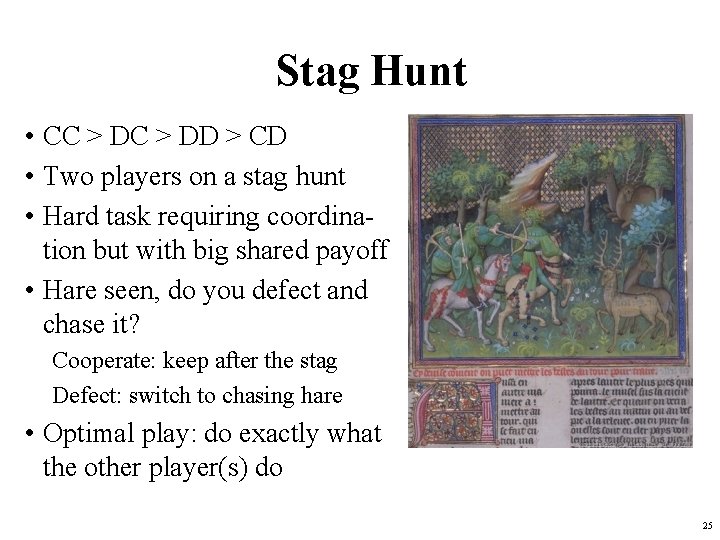
Stag Hunt • CC > DD > CD • Two players on a stag hunt • Hard task requiring coordination but with big shared payoff • Hare seen, do you defect and chase it? Cooperate: keep after the stag Defect: switch to chasing hare • Optimal play: do exactly what the other player(s) do 25
Prisoner’s dilemma • DC > CC > DD > CD • Optimal play: always defect • Two rational players will always defect. • Thus, (naïve) individual rationality subverts their common good 26
More examples of the PD in real life • Communal coffeepot – Cooperate by making new pot of coffee if you take last cup – Defect by taking last cup and not making new pot, depending on the next coffee seeker to do it – DC > CC > DD > CD • Class team project – Cooperate by doing your part well and on time – Defect by slacking, hoping other team members will come through and sharing benefits of good grade – (Arguable) DC > CC > DD > CD 27
Iterated Prisoner’s Dilemma • Game theory shows that rational players should always defect when engaged in a PD situation • In real situations, people don’t always do this • Why not? Possible explanations: – People aren’t rational – Morality – Social pressure – Fear of consequences – Evolution of species-favoring genes • Which make sense? How can we formalize?
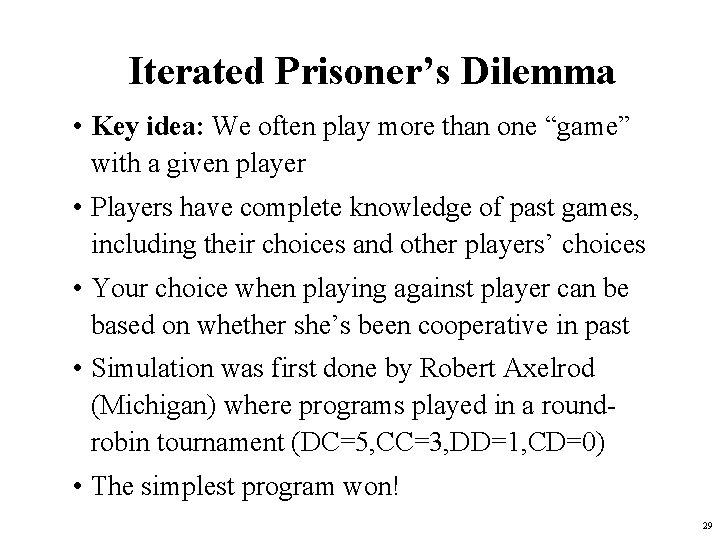
Iterated Prisoner’s Dilemma • Key idea: We often play more than one “game” with a given player • Players have complete knowledge of past games, including their choices and other players’ choices • Your choice when playing against player can be based on whether she’s been cooperative in past • Simulation was first done by Robert Axelrod (Michigan) where programs played in a roundrobin tournament (DC=5, CC=3, DD=1, CD=0) • The simplest program won! 29
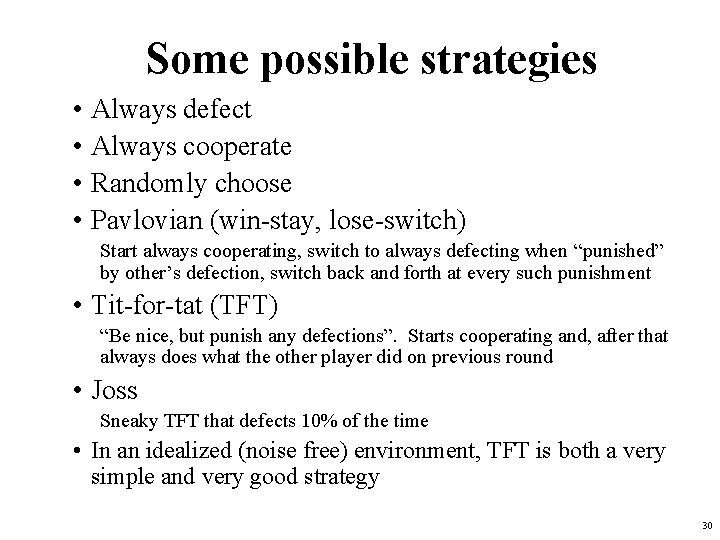
Some possible strategies • Always defect • Always cooperate • Randomly choose • Pavlovian (win-stay, lose-switch) Start always cooperating, switch to always defecting when “punished” by other’s defection, switch back and forth at every such punishment • Tit-for-tat (TFT) “Be nice, but punish any defections”. Starts cooperating and, after that always does what the other player did on previous round • Joss Sneaky TFT that defects 10% of the time • In an idealized (noise free) environment, TFT is both a very simple and very good strategy 30
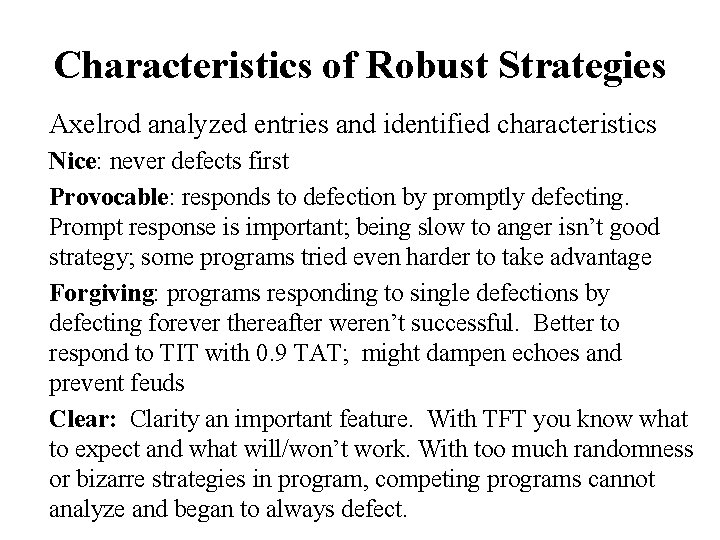
Characteristics of Robust Strategies Axelrod analyzed entries and identified characteristics Nice: never defects first Provocable: responds to defection by promptly defecting. Prompt response is important; being slow to anger isn’t good strategy; some programs tried even harder to take advantage Forgiving: programs responding to single defections by defecting forever thereafter weren’t successful. Better to respond to TIT with 0. 9 TAT; might dampen echoes and prevent feuds Clear: Clarity an important feature. With TFT you know what to expect and what will/won’t work. With too much randomness or bizarre strategies in program, competing programs cannot analyze and began to always defect.
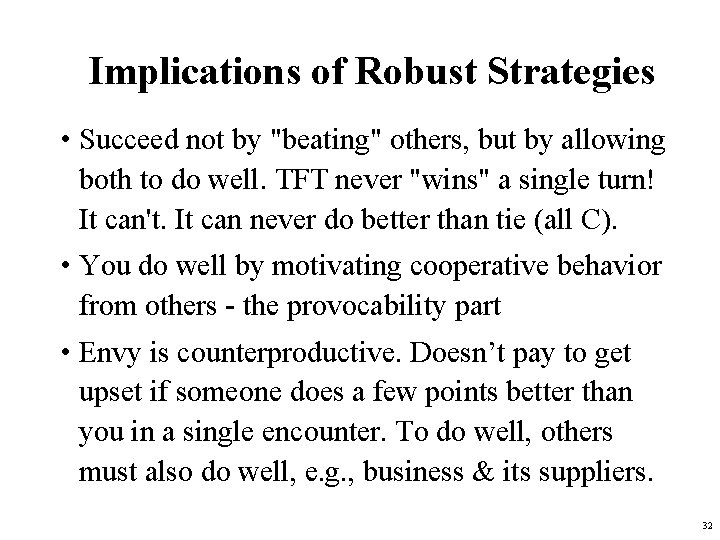
Implications of Robust Strategies • Succeed not by "beating" others, but by allowing both to do well. TFT never "wins" a single turn! It can't. It can never do better than tie (all C). • You do well by motivating cooperative behavior from others - the provocability part • Envy is counterproductive. Doesn’t pay to get upset if someone does a few points better than you in a single encounter. To do well, others must also do well, e. g. , business & its suppliers. 32
Implications of Robust Strategies • You need not be smart to do well. You don't even have to be conscious! TFT models cooperative relations with bacteria and hosts. • Cosmic threats and promises aren’t necessary, though they may be helpful • Central authority unnecessary, though it may be helpful • Optimum strategy depends on environment. TFT is not necessarily best program in all cases. It may be too unforgiving of JOSS & too lenient with RANDOM 33
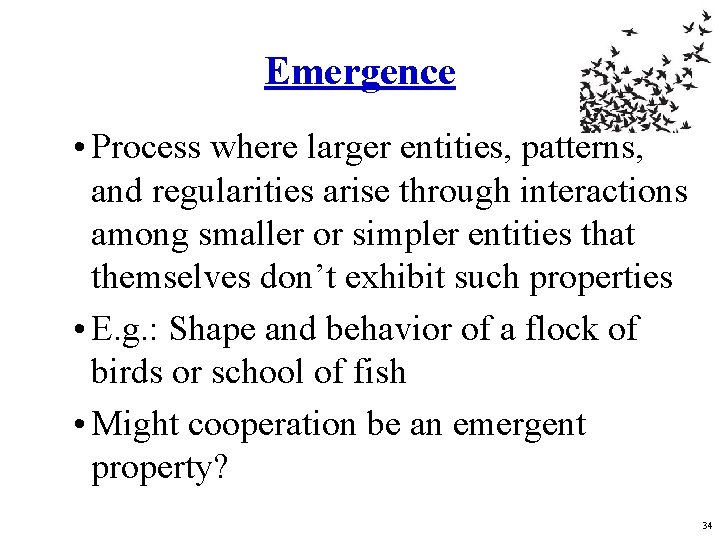
Emergence • Process where larger entities, patterns, and regularities arise through interactions among smaller or simpler entities that themselves don’t exhibit such properties • E. g. : Shape and behavior of a flock of birds or school of fish • Might cooperation be an emergent property? 34
Required for emergent cooperation • A non-zero sum situation • Players with equal power and no discrimination or status differences • Repeated encounters with another player you can recognize Garages depending on repeat business versus those on busy highways. Gypsies. Being unlikely to ever see someone again => a non-iterated dilemma. • A temptation payoff that isn't too great If defecting makes you a millionaire, you're likely to do it. "Every man has his price. " 35
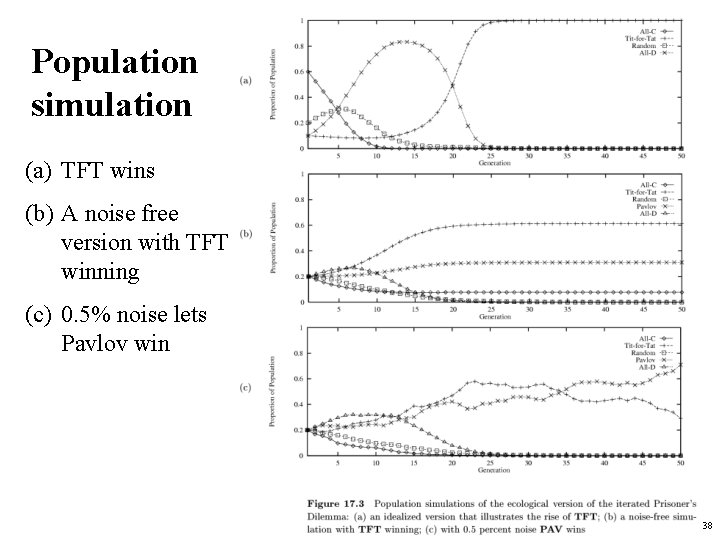
Ecological model • Assume an ecological system can support N players • Players accumulate or loose points on each round • After each round, poorest players die and richest multiply • Noise in the environment can model likelihood that an agent makes errors in following a strategy misinterpret another’s choice • A simple way of modeling this is described in. The Computational Beauty of Nature 36
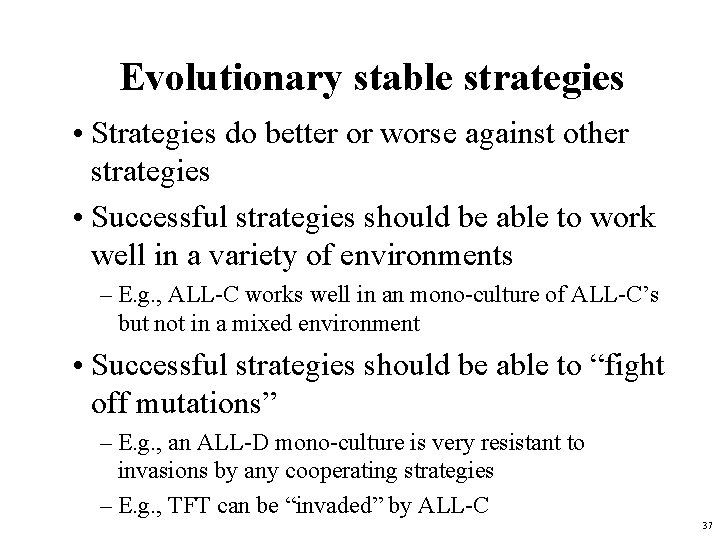
Evolutionary stable strategies • Strategies do better or worse against other strategies • Successful strategies should be able to work well in a variety of environments – E. g. , ALL-C works well in an mono-culture of ALL-C’s but not in a mixed environment • Successful strategies should be able to “fight off mutations” – E. g. , an ALL-D mono-culture is very resistant to invasions by any cooperating strategies – E. g. , TFT can be “invaded” by ALL-C 37
Population simulation (a) TFT wins (b) A noise free version with TFT winning (c) 0. 5% noise lets Pavlov win 38
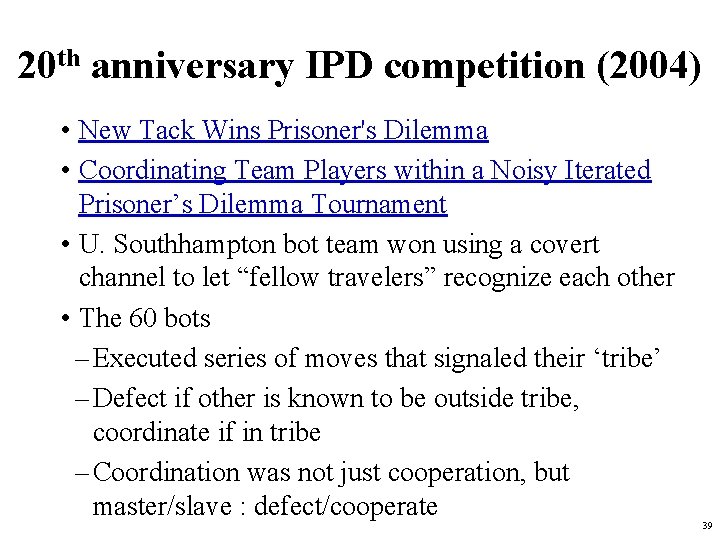
20 th anniversary IPD competition (2004) • New Tack Wins Prisoner's Dilemma • Coordinating Team Players within a Noisy Iterated Prisoner’s Dilemma Tournament • U. Southhampton bot team won using a covert channel to let “fellow travelers” recognize each other • The 60 bots – Executed series of moves that signaled their ‘tribe’ – Defect if other is known to be outside tribe, coordinate if in tribe – Coordination was not just cooperation, but master/slave : defect/cooperate 39
For more information • Prisoner's Dilemma: John von Neumann, Game Theory, and the Puzzle of the Bomb, William Poundstone, Anchor Books, Doubleday, 1993. • The Origins of Virtue: Human Instincts and the Evolution of Cooperation, Matt Ridley, Penguin, 1998. • Games of Life : Explorations in Ecology, Evolution and Behaviour, Karl Sigmund, 1995. • Nowak, M. A. , R. M. May and K. Sigmund (1995). The Arithmetic of Mutual Help. Scientific American, 272(6). • Robert Axelrod, The Evolution of Cooperation, Basic Books, 1984. • The Computational Beauty of Nature: Computer Explorations of Fractals, Chaos, Complex Systems, and Adaptation, Gary William Flake, MIT Press, 2000. • New Tack Wins Prisoner's Dilemma, By Wendy M. Grossman, Wired News, October 2004. 40