
A glimpse into theoretical physics Alessandra Gnecchi CERN



- Slides: 45
A glimpse into theoretical physics Alessandra Gnecchi CERN, Theoretical Physics Department 17 July 2018 H 2020 -MSCA-IF-2015 702548 Gauged. BH
Outline 1. 2. Introduction 1. Physical principles and equations of motion 2. What is a theory? 3. Why a new theory? Dark matter, dark energy Gravity and its issues 1. The Planck scale 2. Gravity as a wave 3. Detection of gravitational waves 2
Why a theory? The work of a physicists is to find laws that govern phenomena we observe. • Look for principles that explain fundamental forces. • Physicists describe these principle through the language of mathematics. It is easy to check the consistency of the mathematics language and follow its logic to make new predictions. We need this mathematical setup to derive the equations that nature obeys. 3
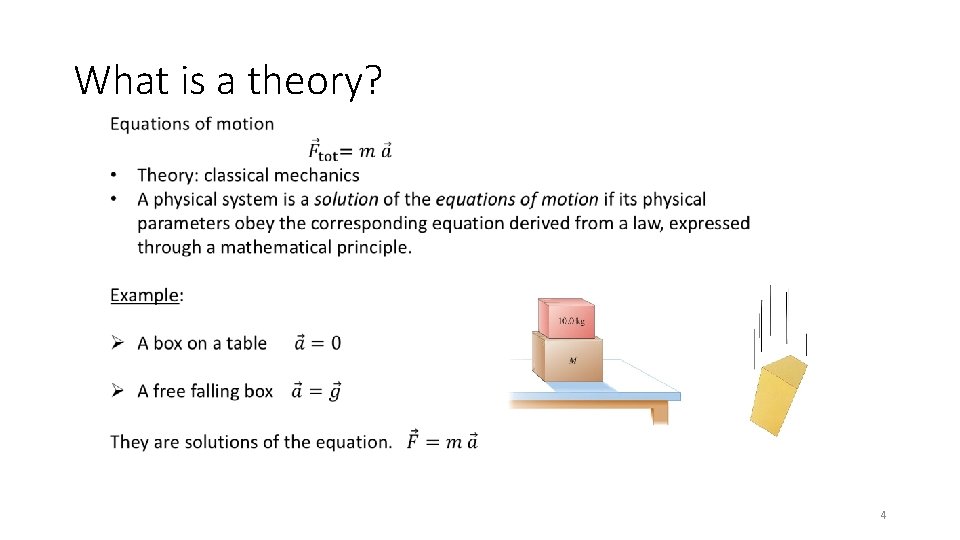
What is a theory? • 4
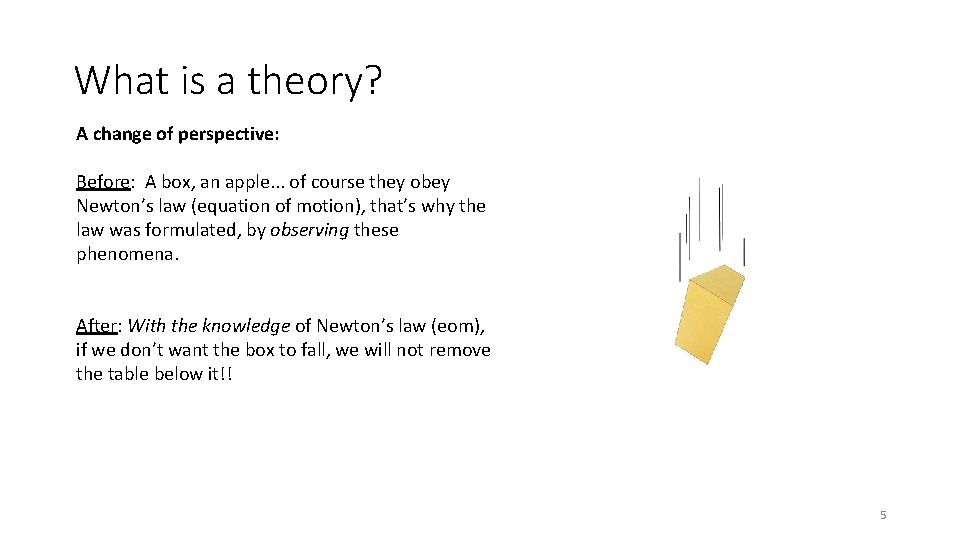
What is a theory? A change of perspective: Before: A box, an apple. . . of course they obey Newton’s law (equation of motion), that’s why the law was formulated, by observing these phenomena. After: With the knowledge of Newton’s law (eom), if we don’t want the box to fall, we will not remove the table below it!! 5
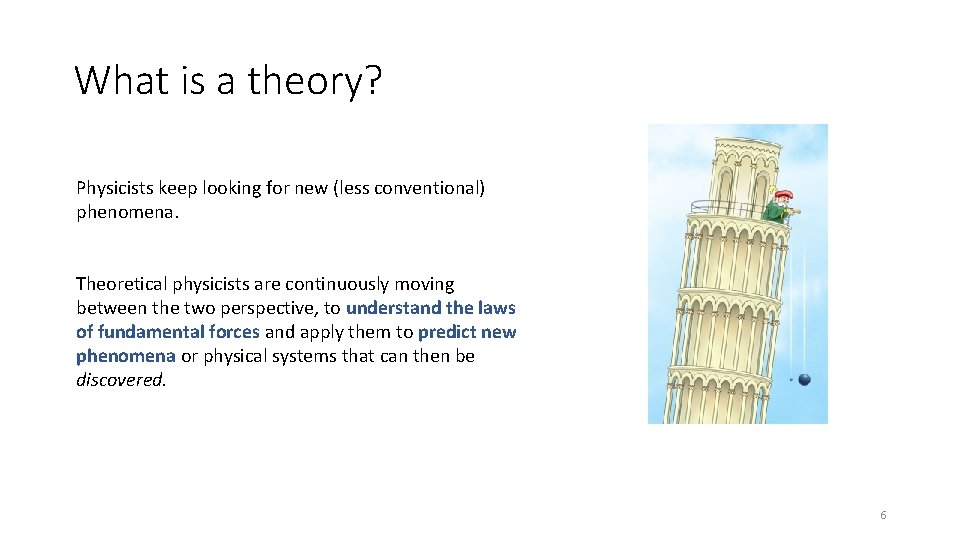
What is a theory? Physicists keep looking for new (less conventional) phenomena. Theoretical physicists are continuously moving between the two perspective, to understand the laws of fundamental forces and apply them to predict new phenomena or physical systems that can then be discovered. 6
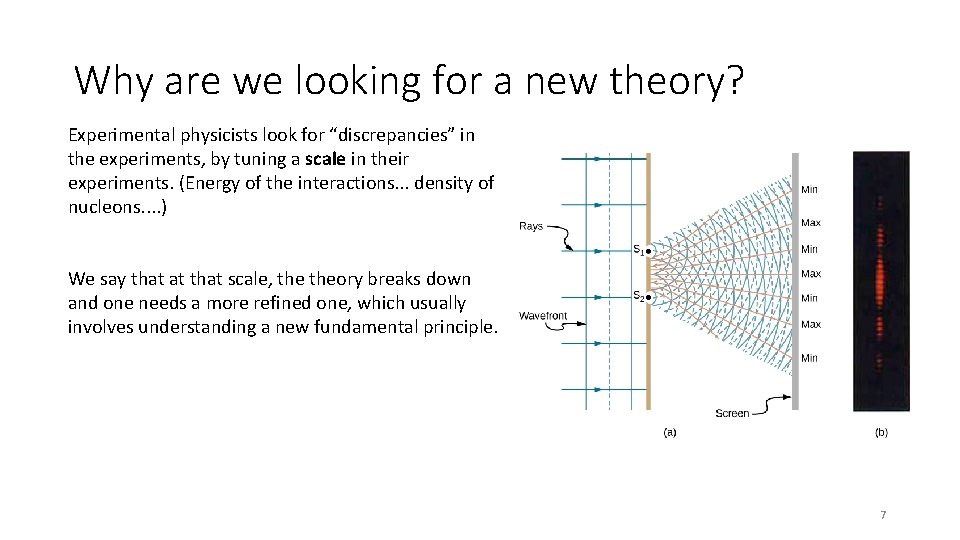
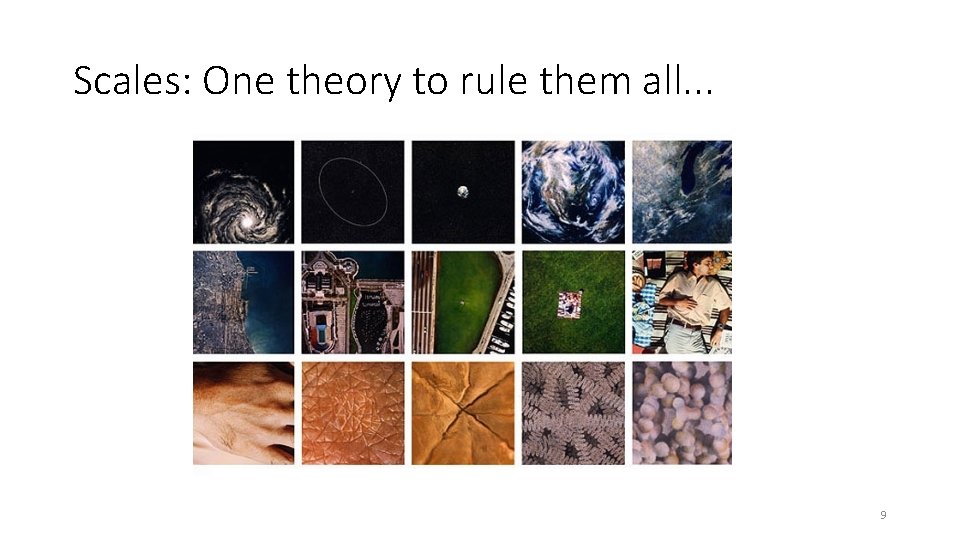
Why are we looking for a new theory? Experimental physicists look for “discrepancies” in the experiments, by tuning a scale in their experiments. (Energy of the interactions. . . density of nucleons. . ) We say that at that scale, theory breaks down and one needs a more refined one, which usually involves understanding a new fundamental principle. 7
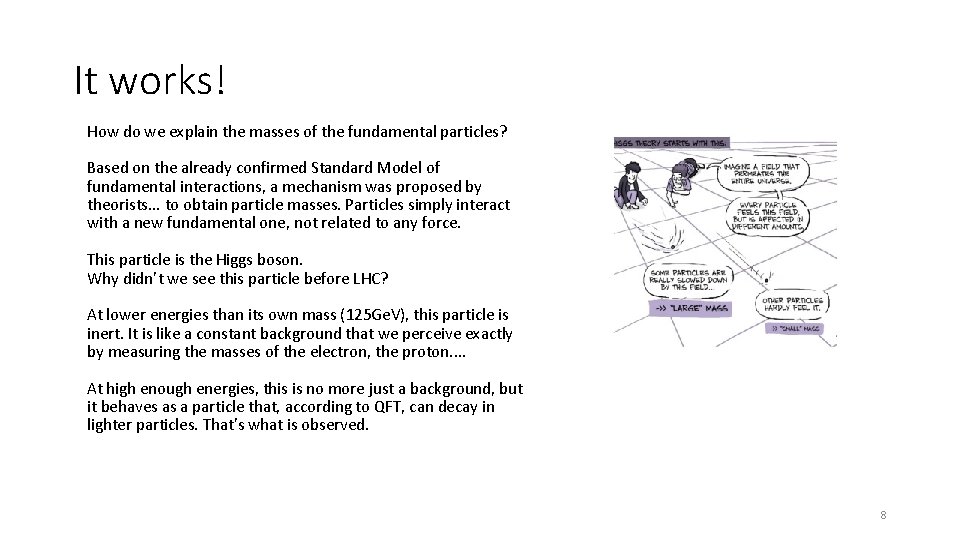
It works! How do we explain the masses of the fundamental particles? Based on the already confirmed Standard Model of fundamental interactions, a mechanism was proposed by theorists. . . to obtain particle masses. Particles simply interact with a new fundamental one, not related to any force. This particle is the Higgs boson. Why didn’t we see this particle before LHC? At lower energies than its own mass (125 Ge. V), this particle is inert. It is like a constant background that we perceive exactly by measuring the masses of the electron, the proton. . At high enough energies, this is no more just a background, but it behaves as a particle that, according to QFT, can decay in lighter particles. That’s what is observed. 8
Scales: One theory to rule them all. . . 9
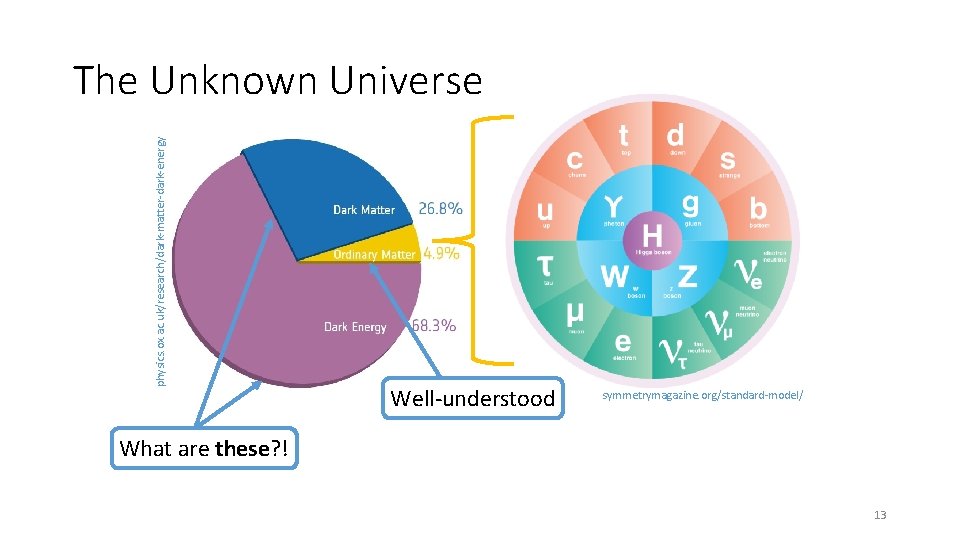
Unexplained observations aka Why are we looking for new theories?
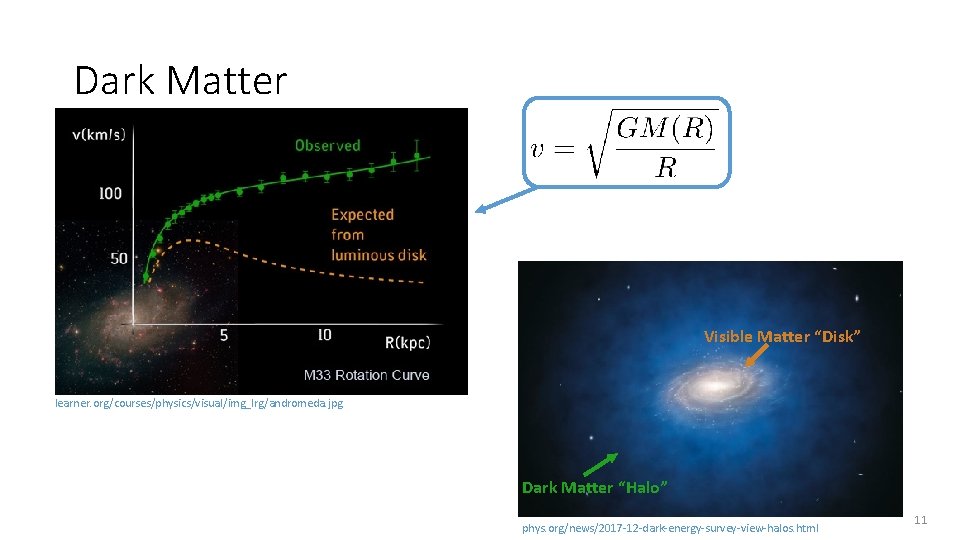
Dark Matter Visible Matter “Disk” learner. org/courses/physics/visual/img_lrg/andromeda. jpg Dark Matter “Halo” phys. org/news/2017 -12 -dark-energy-survey-view-halos. html 11
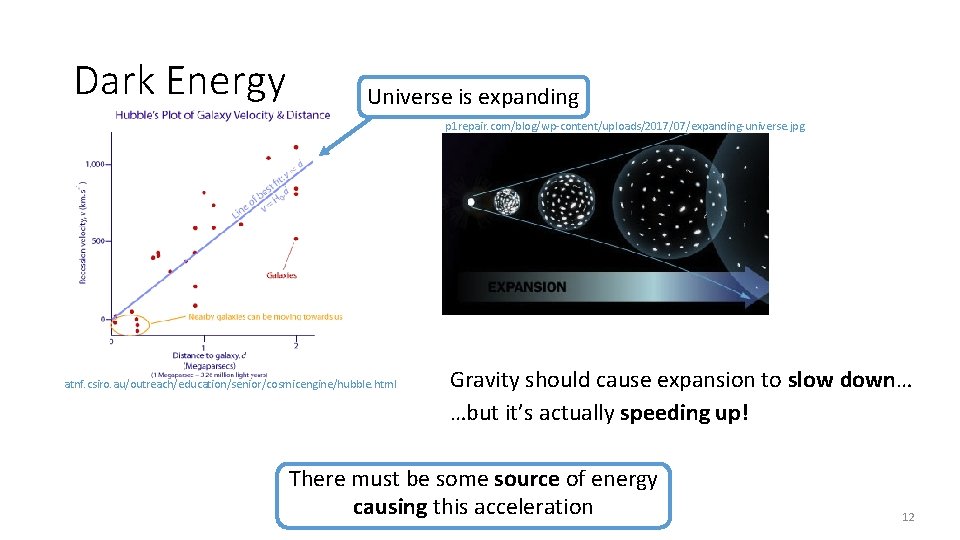
Dark Energy Universe is expanding p 1 repair. com/blog/wp-content/uploads/2017/07/expanding-universe. jpg atnf. csiro. au/outreach/education/senior/cosmicengine/hubble. html Gravity should cause expansion to slow down… …but it’s actually speeding up! There must be some source of energy causing this acceleration 12
physics. ox. ac. uk/research/dark-matter-dark-energy The Unknown Universe Well-understood symmetrymagazine. org/standard-model/ What are these? ! 13
Gravity
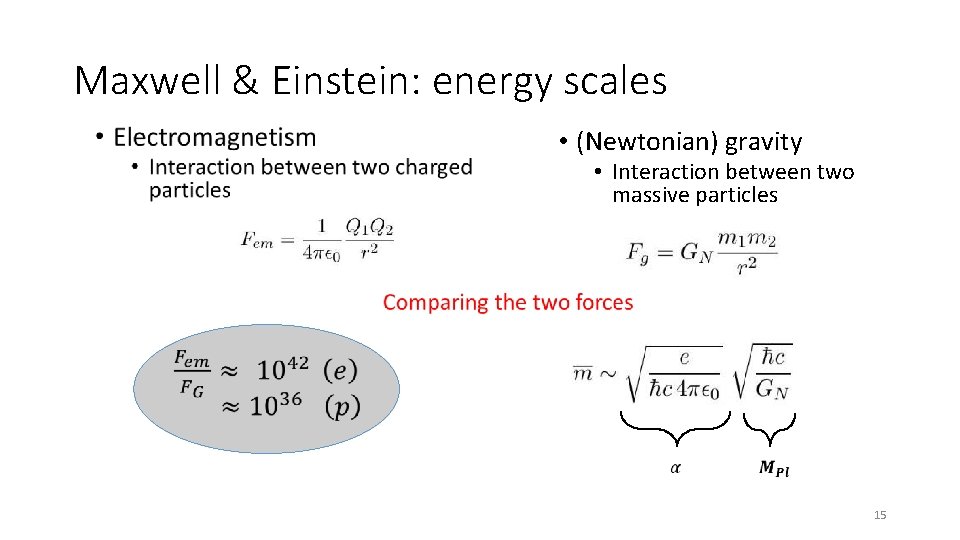
Maxwell & Einstein: energy scales • • (Newtonian) gravity • Interaction between two massive particles 15
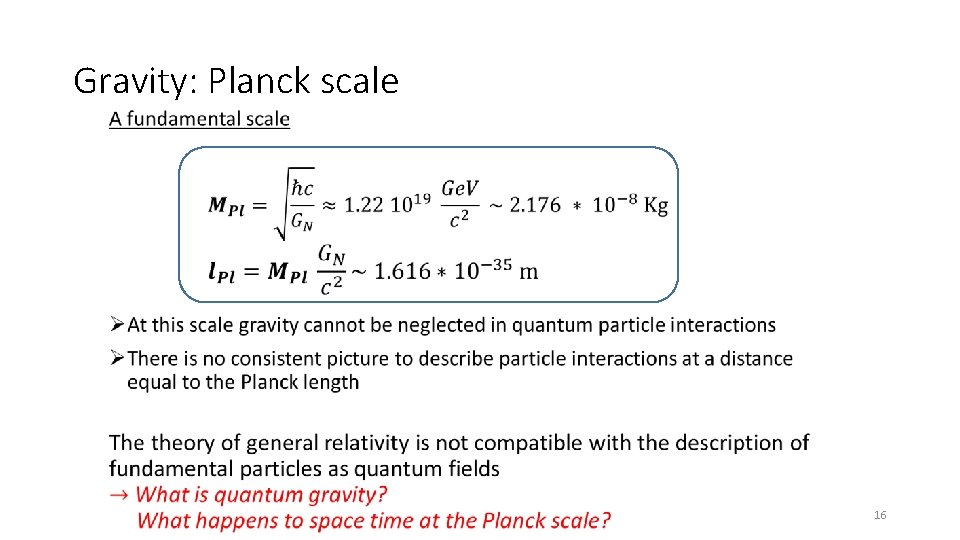
Gravity: Planck scale • 16
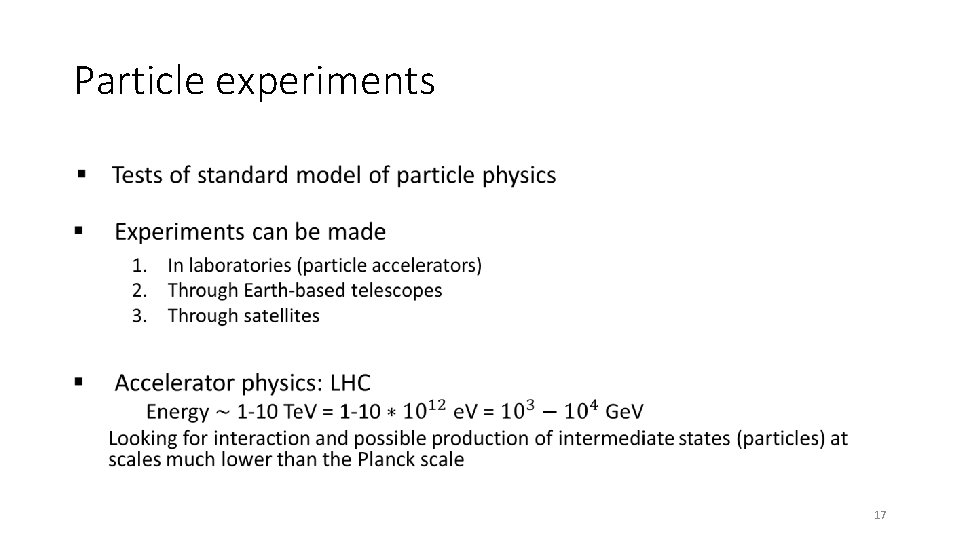
Particle experiments • 17
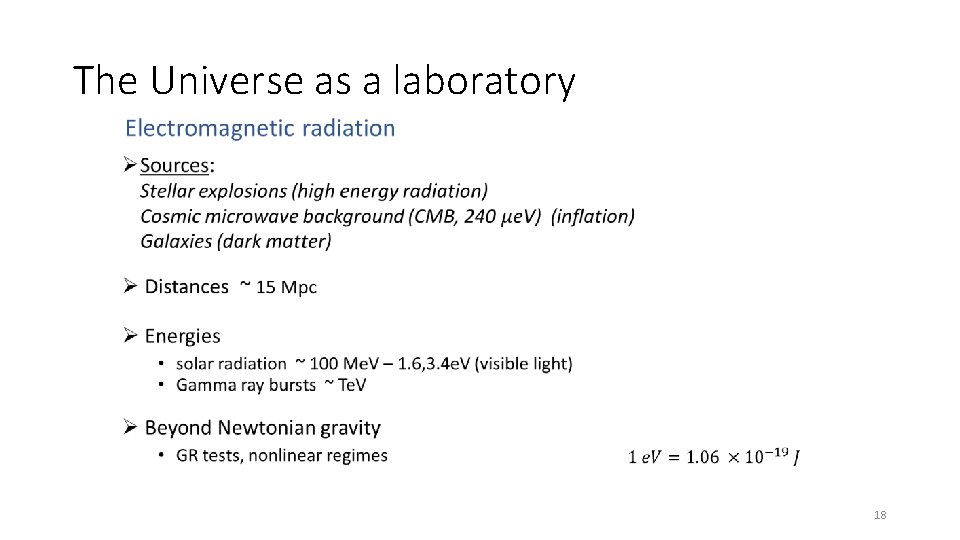
The Universe as a laboratory • 18
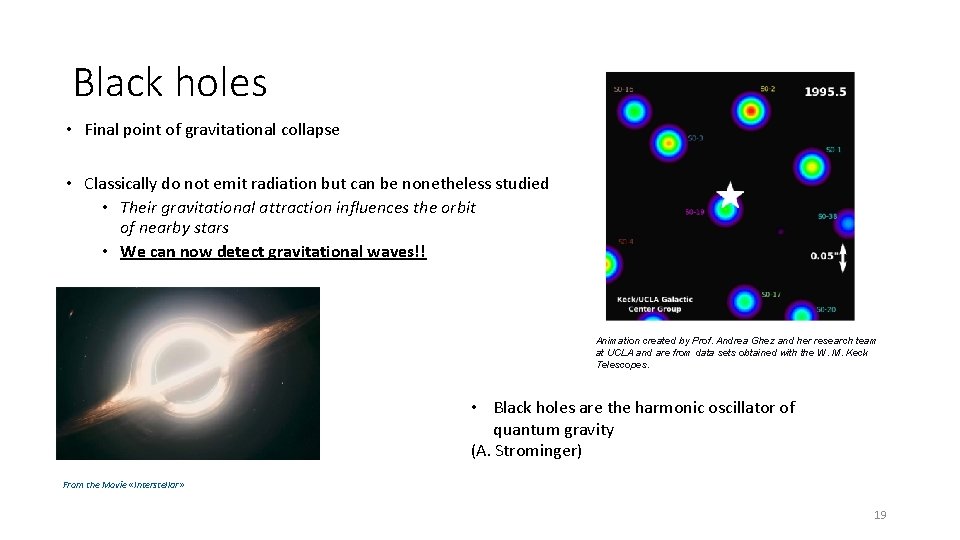
Black holes • Final point of gravitational collapse • Classically do not emit radiation but can be nonetheless studied • Their gravitational attraction influences the orbit of nearby stars • We can now detect gravitational waves!! Animation created by Prof. Andrea Ghez and her research team at UCLA and are from data sets obtained with the W. M. Keck Telescopes. • Black holes are the harmonic oscillator of quantum gravity (A. Strominger) From the Movie «Interstellar» 19
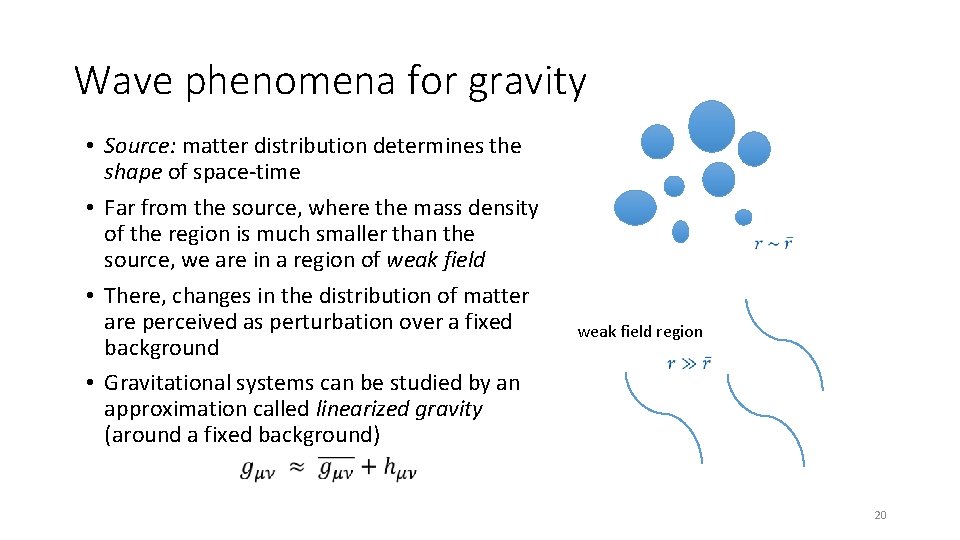
Wave phenomena for gravity • Source: matter distribution determines the shape of space-time • Far from the source, where the mass density of the region is much smaller than the source, we are in a region of weak field • There, changes in the distribution of matter are perceived as perturbation over a fixed background • Gravitational systems can be studied by an approximation called linearized gravity (around a fixed background) weak field region 20
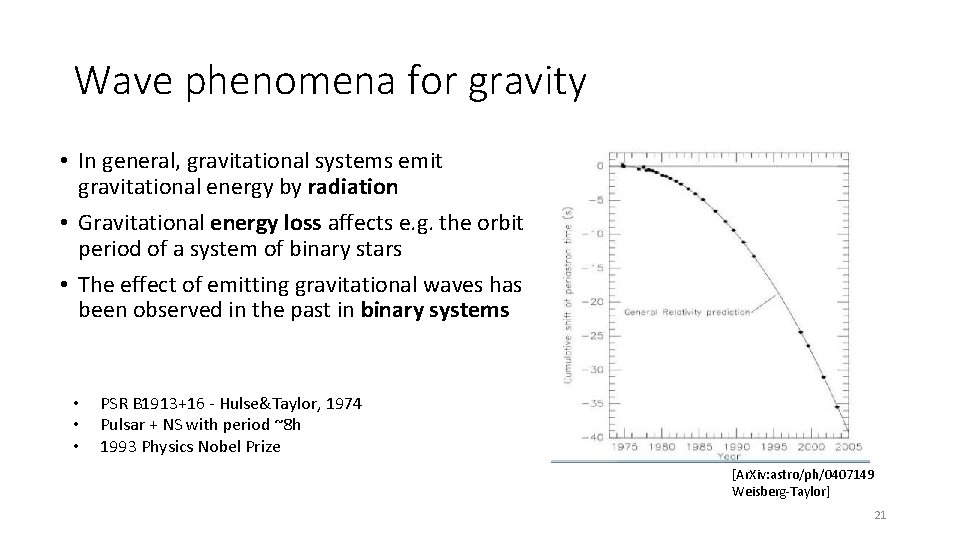
Wave phenomena for gravity • In general, gravitational systems emit gravitational energy by radiation • Gravitational energy loss affects e. g. the orbit period of a system of binary stars • The effect of emitting gravitational waves has been observed in the past in binary systems • • • PSR B 1913+16 - Hulse&Taylor, 1974 Pulsar + NS with period ~8 h 1993 Physics Nobel Prize [Ar. Xiv: astro/ph/0407149 Weisberg-Taylor] 21
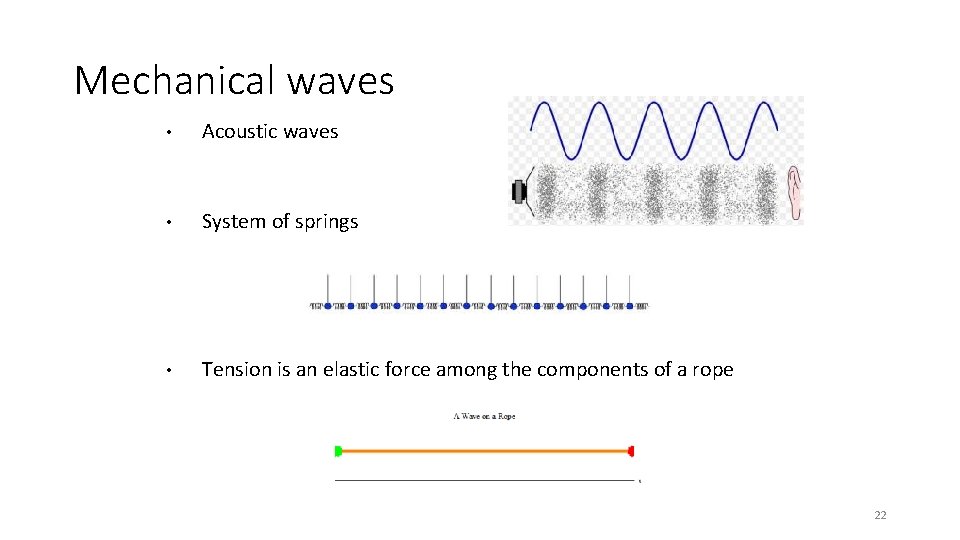
Mechanical waves • Acoustic waves • System of springs • Tension is an elastic force among the components of a rope 22
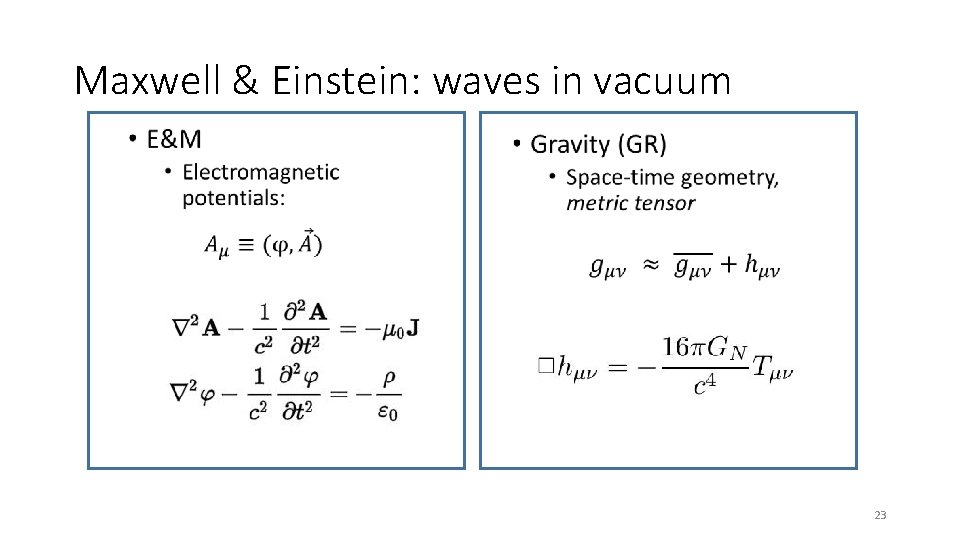
Maxwell & Einstein: waves in vacuum • • 23
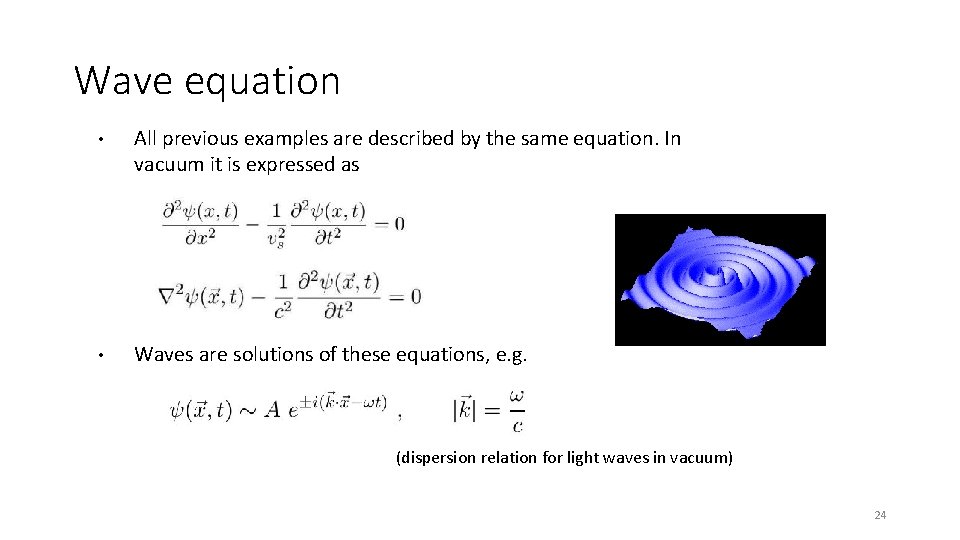
Wave equation • All previous examples are described by the same equation. In vacuum it is expressed as • Waves are solutions of these equations, e. g. (dispersion relation for light waves in vacuum) 24
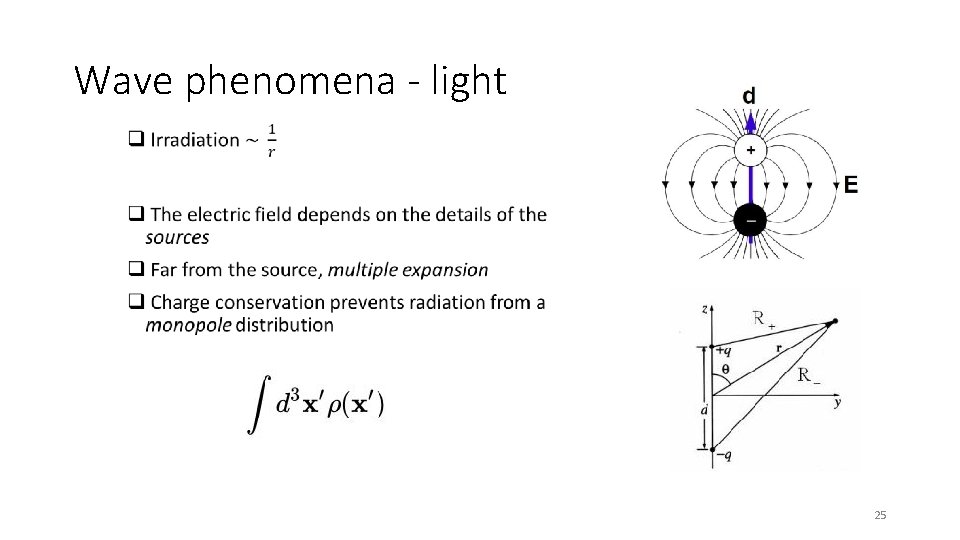
Wave phenomena - light • 25
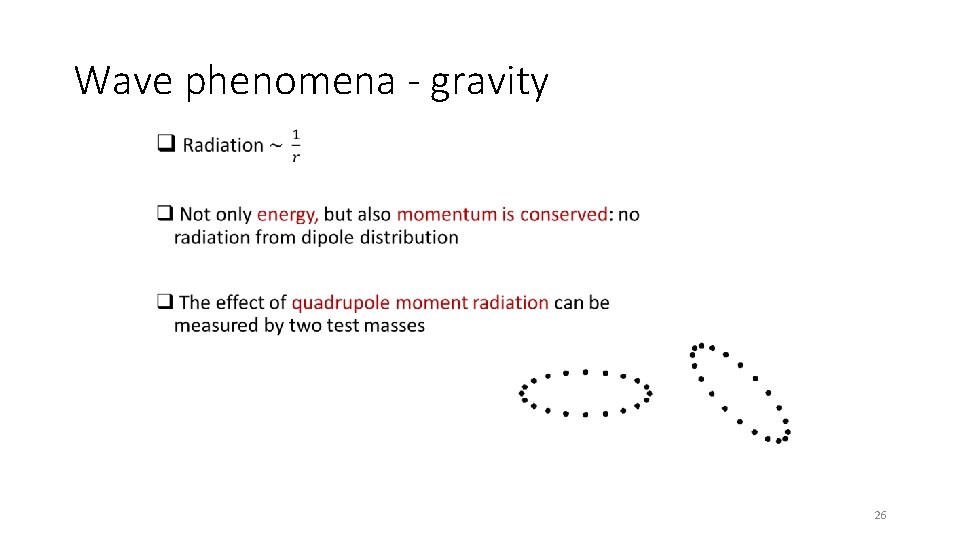
Wave phenomena - gravity • 26
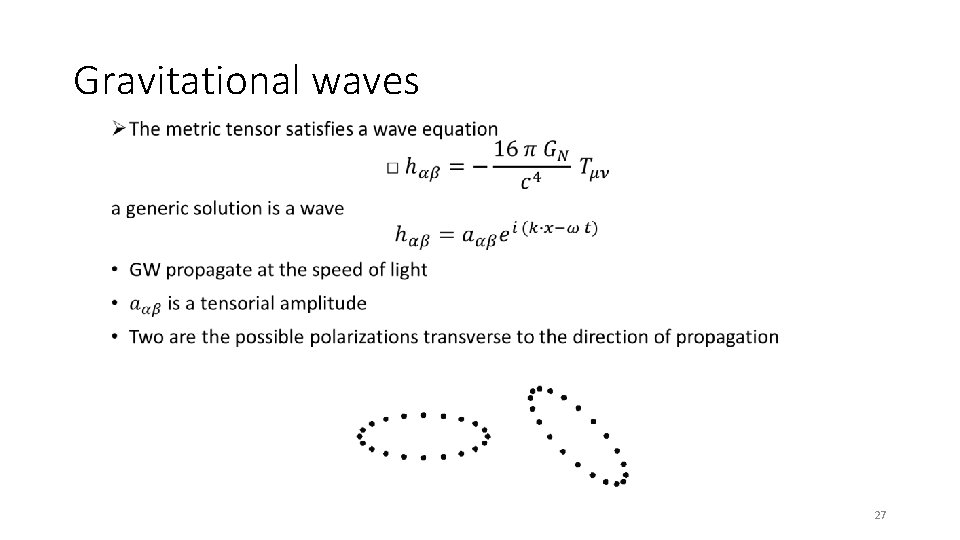
Gravitational waves • 27
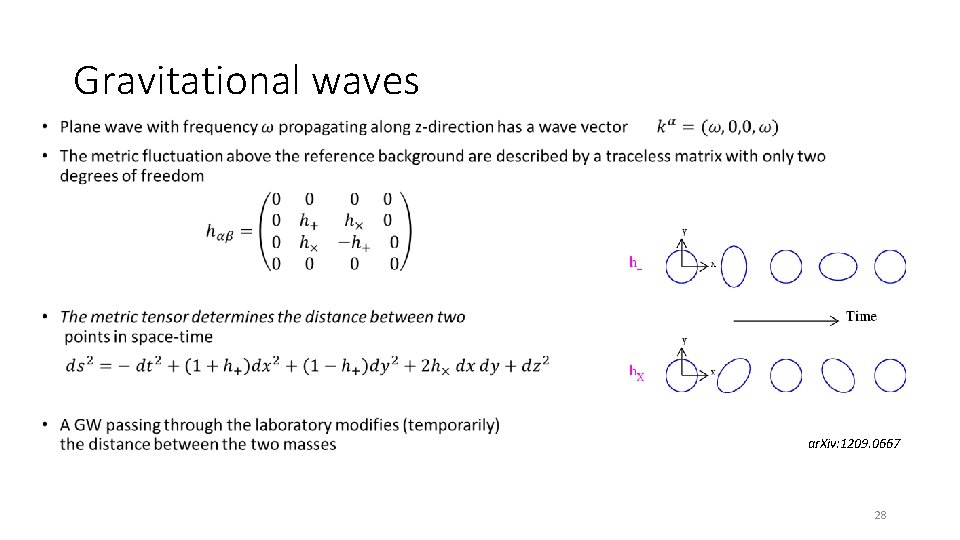
Gravitational waves • ar. Xiv: 1209. 0667 28
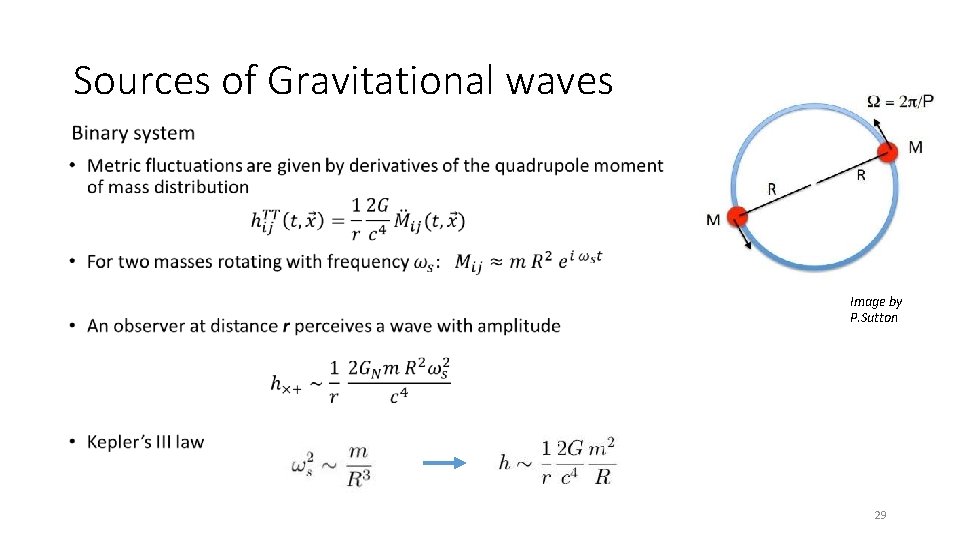
Sources of Gravitational waves • Image by P. Sutton 29
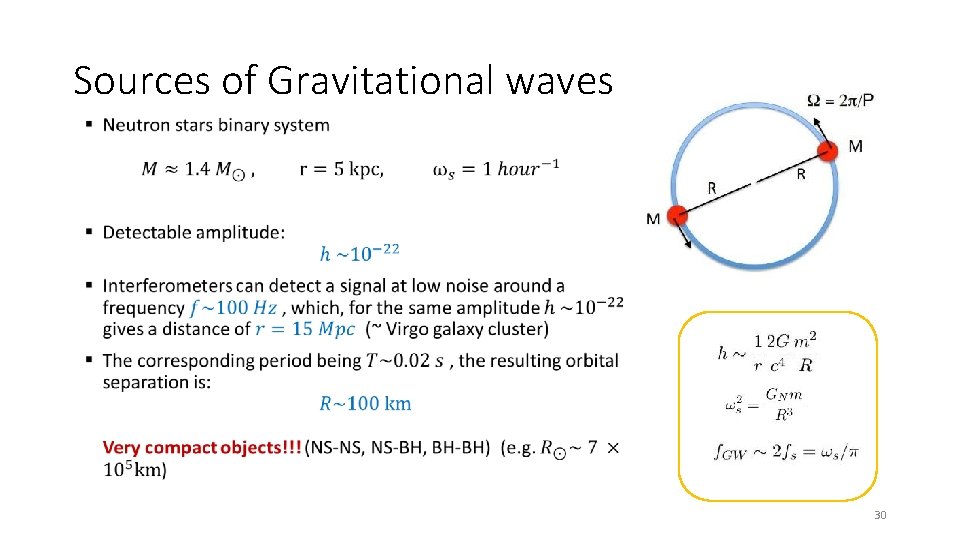
Sources of Gravitational waves • 30
Detection of Gravitational Waves
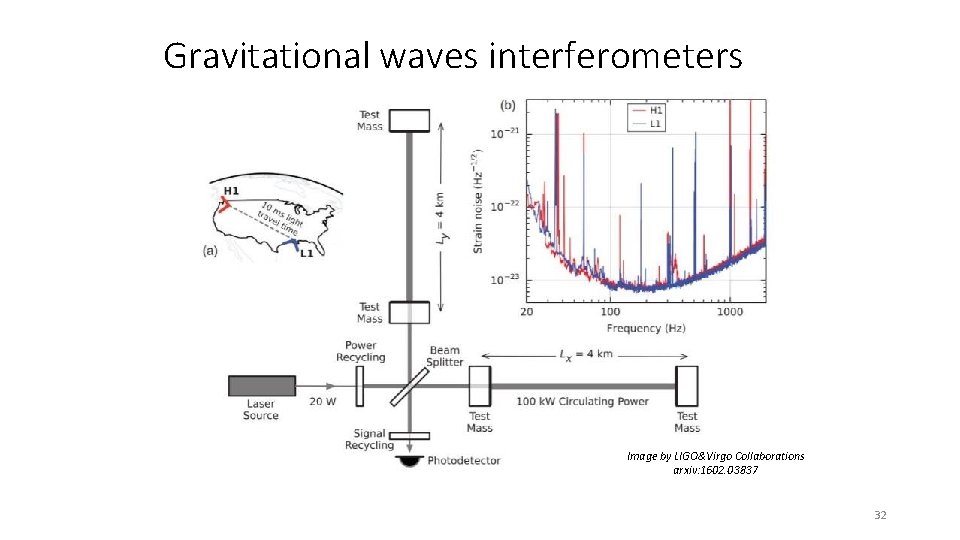
Gravitational waves interferometers Image by LIGO&Virgo Collaborations arxiv: 1602. 03837 32
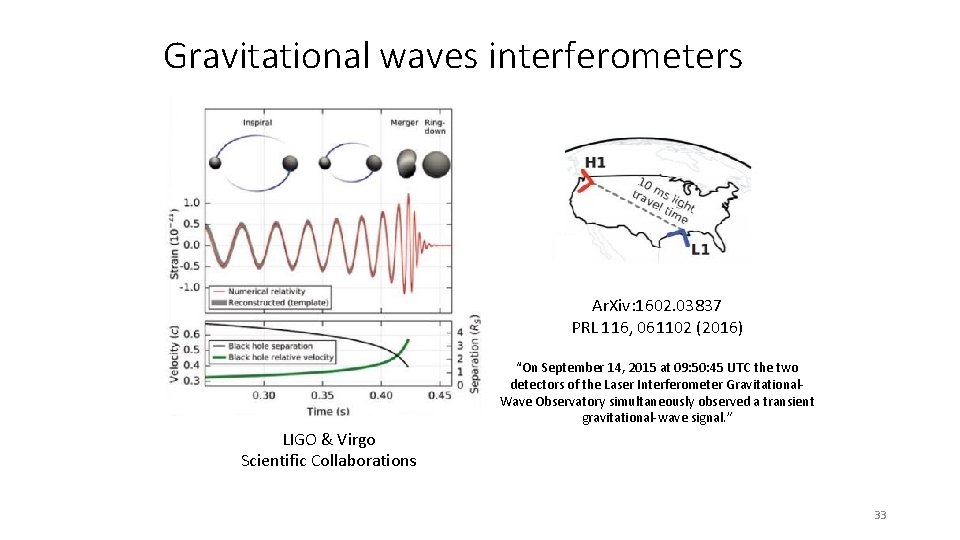
Gravitational waves interferometers Ar. Xiv: 1602. 03837 PRL 116, 061102 (2016) “On September 14, 2015 at 09: 50: 45 UTC the two detectors of the Laser Interferometer Gravitational. Wave Observatory simultaneously observed a transient gravitational-wave signal. ” LIGO & Virgo Scientific Collaborations 33
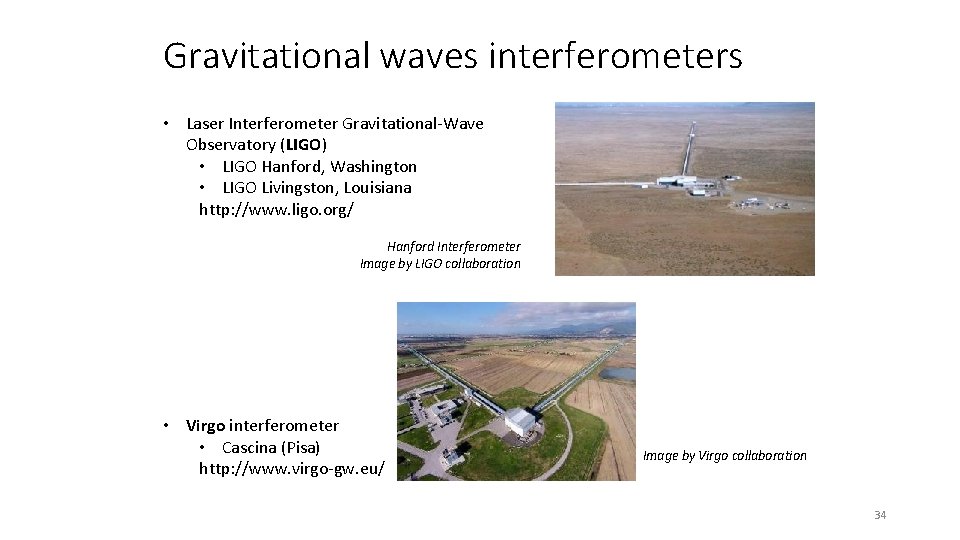
Gravitational waves interferometers • Laser Interferometer Gravitational-Wave Observatory (LIGO) • LIGO Hanford, Washington • LIGO Livingston, Louisiana http: //www. ligo. org/ Hanford Interferometer Image by LIGO collaboration • Virgo interferometer • Cascina (Pisa) http: //www. virgo-gw. eu/ Image by Virgo collaboration 34
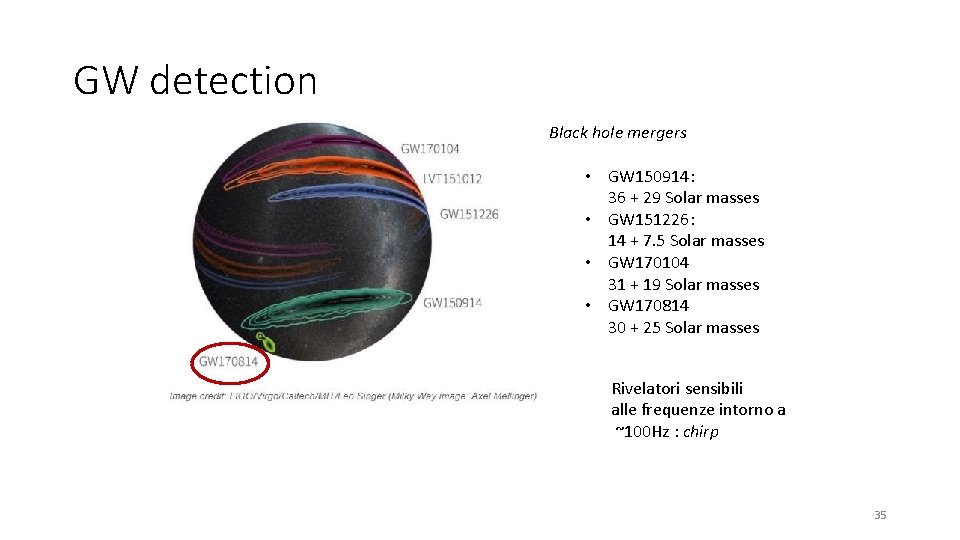
GW detection Black hole mergers • GW 150914: 36 + 29 Solar masses • GW 151226: 14 + 7. 5 Solar masses • GW 170104 31 + 19 Solar masses • GW 170814 30 + 25 Solar masses Rivelatori sensibili alle frequenze intorno a ~100 Hz : chirp 35
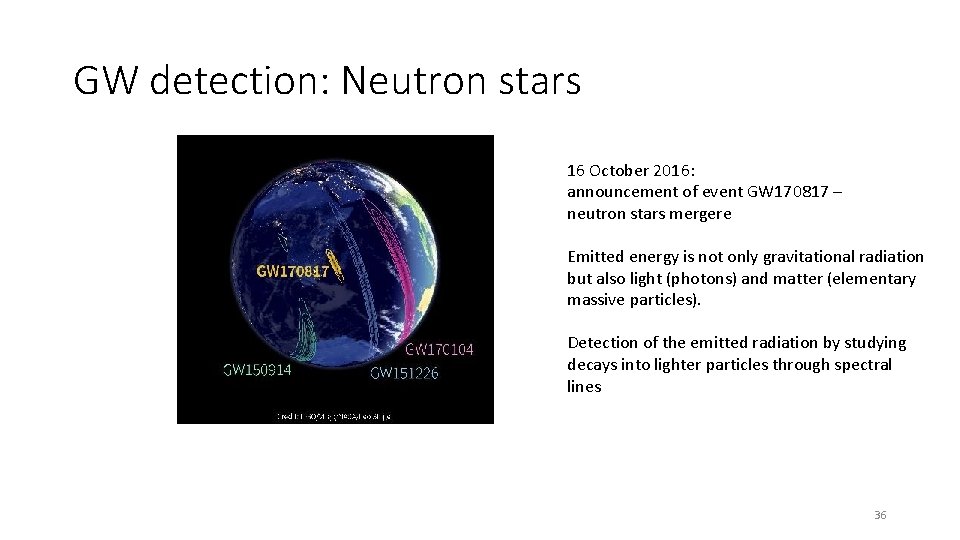
GW detection: Neutron stars 16 October 2016: announcement of event GW 170817 – neutron stars mergere Emitted energy is not only gravitational radiation but also light (photons) and matter (elementary massive particles). Detection of the emitted radiation by studying decays into lighter particles through spectral lines 36
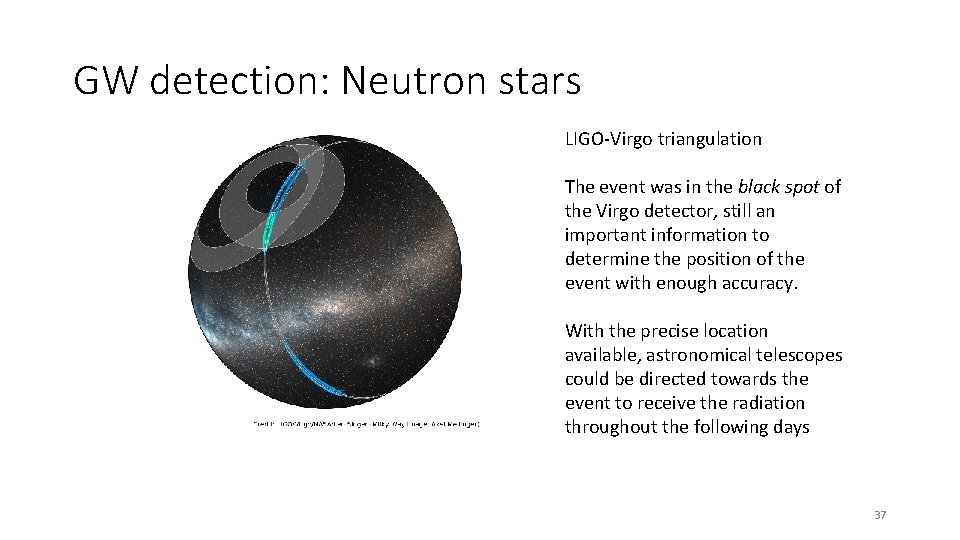
GW detection: Neutron stars LIGO-Virgo triangulation The event was in the black spot of the Virgo detector, still an important information to determine the position of the event with enough accuracy. With the precise location available, astronomical telescopes could be directed towards the event to receive the radiation throughout the following days 37
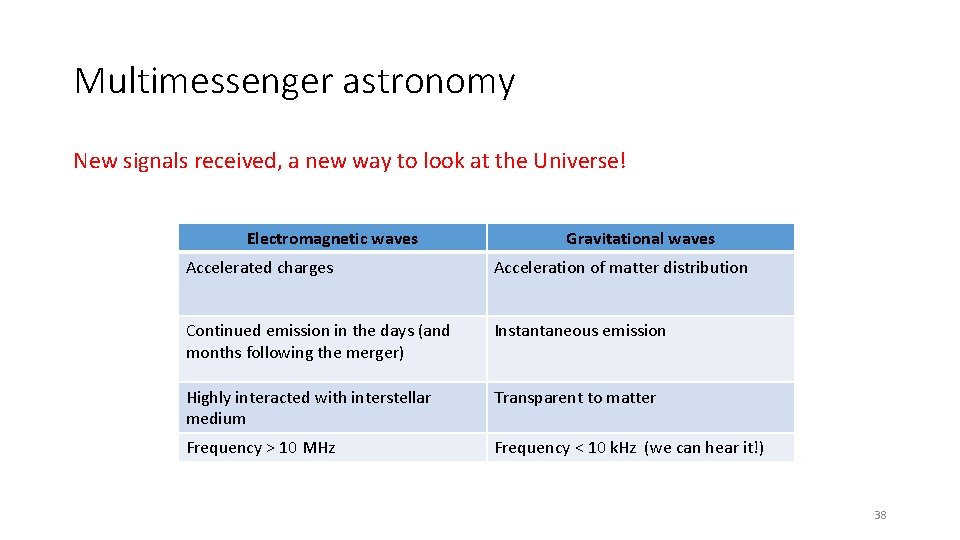
Multimessenger astronomy New signals received, a new way to look at the Universe! Electromagnetic waves Gravitational waves Accelerated charges Acceleration of matter distribution Continued emission in the days (and months following the merger) Instantaneous emission Highly interacted with interstellar medium Transparent to matter Frequency > 10 MHz Frequency < 10 k. Hz (we can hear it!) 38
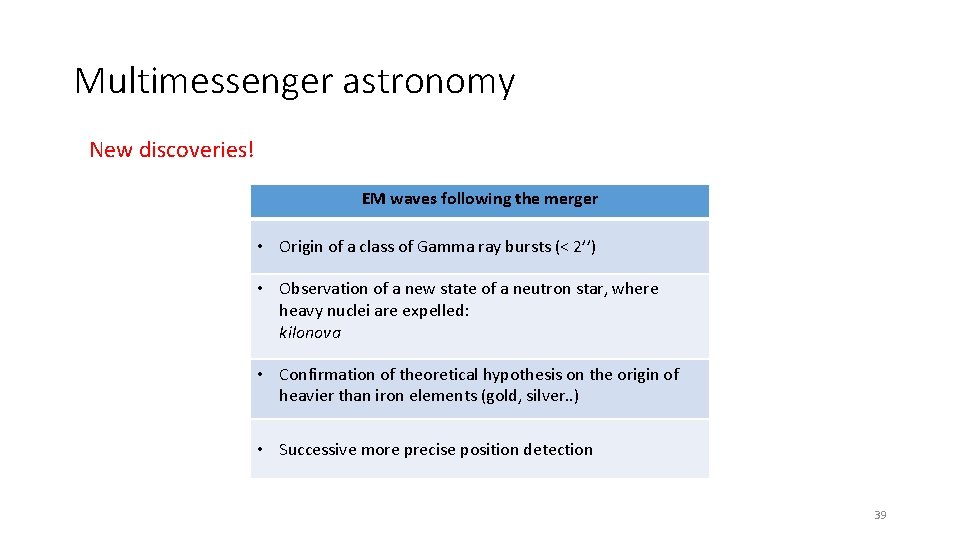
Multimessenger astronomy New discoveries! EM waves following the merger • Origin of a class of Gamma ray bursts (< 2’’) • Observation of a new state of a neutron star, where heavy nuclei are expelled: kilonova • Confirmation of theoretical hypothesis on the origin of heavier than iron elements (gold, silver. . ) • Successive more precise position detection 39
. . . is this all? where are the puzzles coming from?
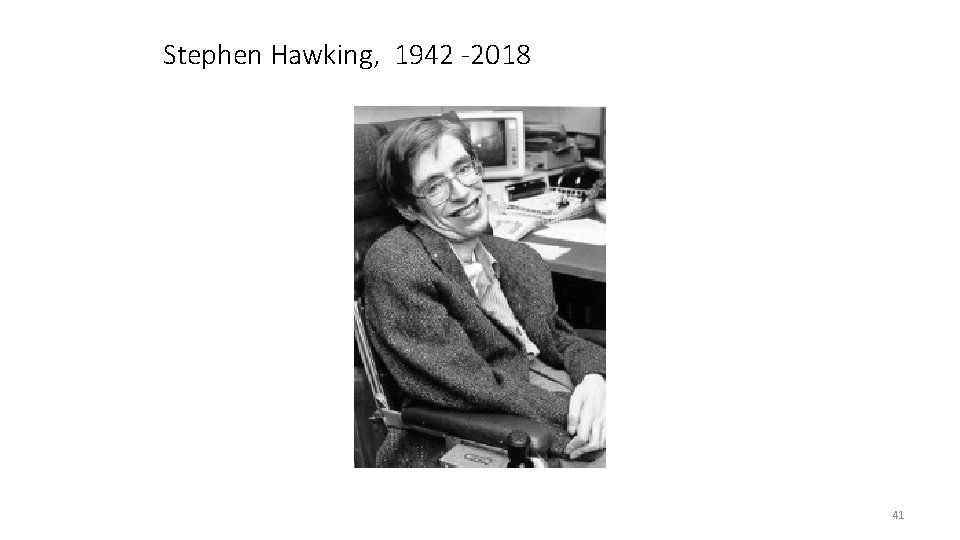
Stephen Hawking, 1942 -2018 41
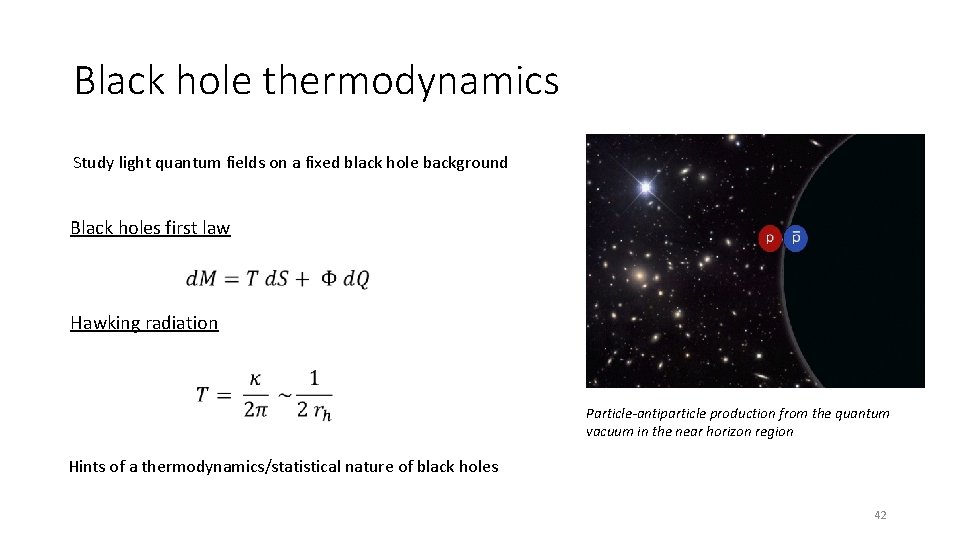
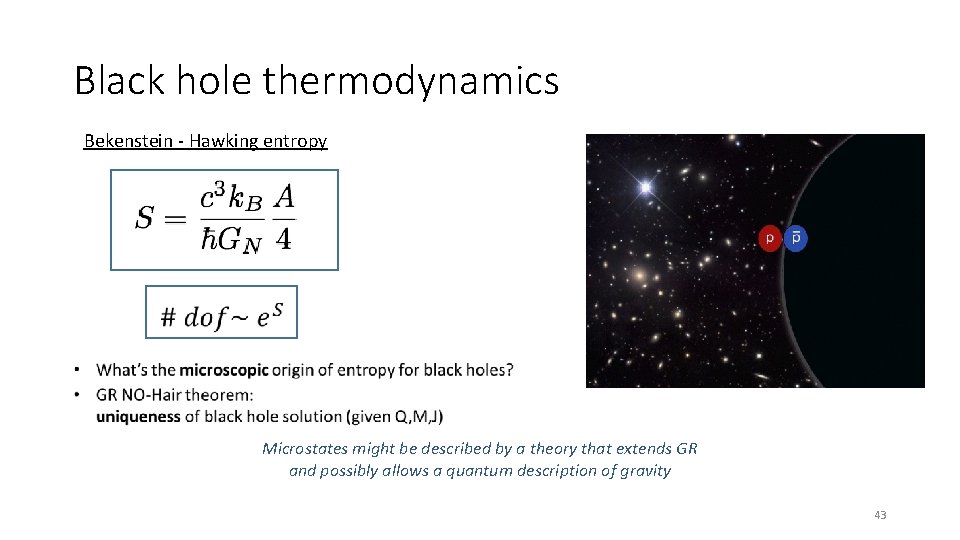
Black hole thermodynamics Study light quantum fields on a fixed black hole background Black holes first law Hawking radiation Particle-antiparticle production from the quantum vacuum in the near horizon region Hints of a thermodynamics/statistical nature of black holes 42
Black hole thermodynamics Bekenstein - Hawking entropy Microstates might be described by a theory that extends GR and possibly allows a quantum description of gravity 43
Conclusions • The interplay between observations, unexplained phenomena, and mathematical consistency of the physical laws is what keeps theorists busy (. . . excited). • The visible Universe offers a rich window to unexplained phenomena • Recent detection of gravitational waves has opened a new era of investigations that may give precious hints on the unification of interactions and the quantum nature of gravity • The future generation of physicists will bring important contributions. . . also thanks to you!!!! 44
Thank you!