
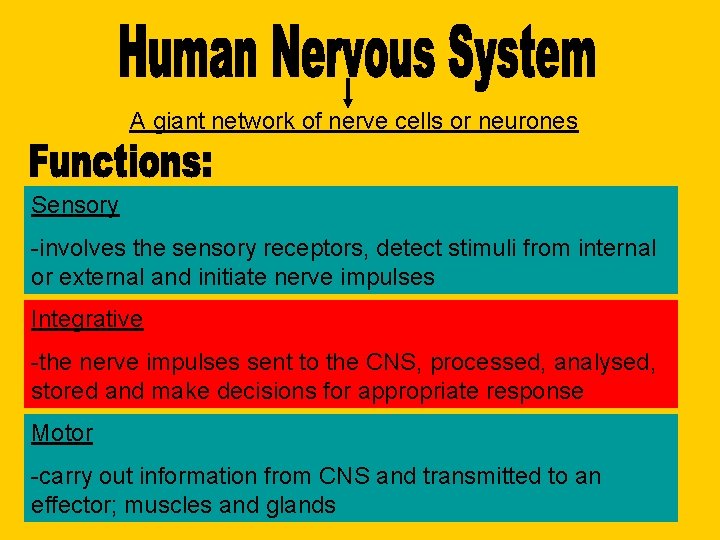
A giant network of nerve cells or neurones
- Slides: 99
A giant network of nerve cells or neurones Sensory -involves the sensory receptors, detect stimuli from internal or external and initiate nerve impulses Integrative -the nerve impulses sent to the CNS, processed, analysed, stored and make decisions for appropriate response Motor -carry out information from CNS and transmitted to an effector; muscles and glands
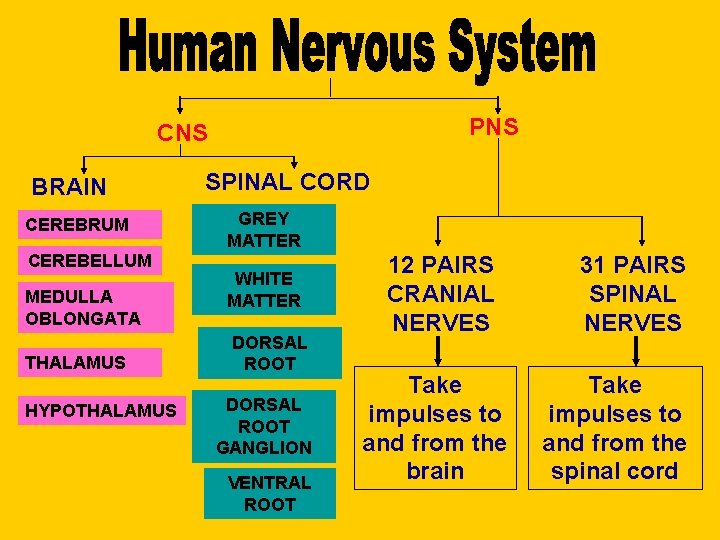
PNS CNS BRAIN CEREBRUM CEREBELLUM MEDULLA OBLONGATA THALAMUS HYPOTHALAMUS SPINAL CORD GREY MATTER WHITE MATTER DORSAL ROOT GANGLION VENTRAL ROOT 12 PAIRS CRANIAL NERVES Take impulses to and from the brain 31 PAIRS SPINAL NERVES Take impulses to and from the spinal cord
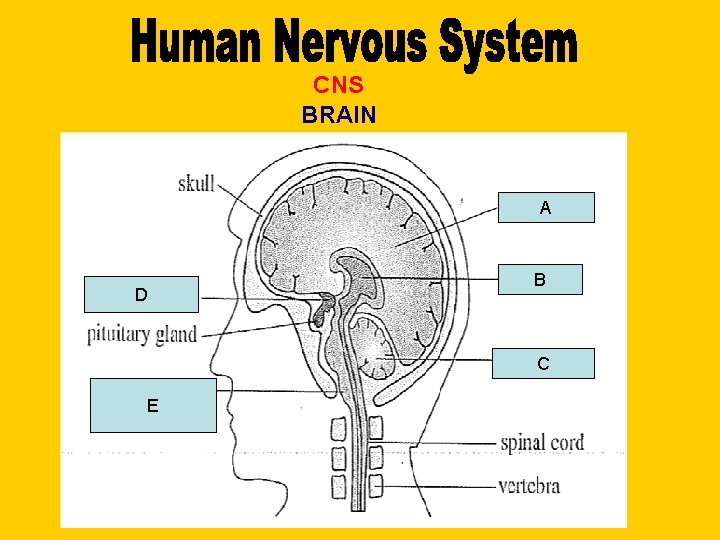
CNS BRAIN A D B C E
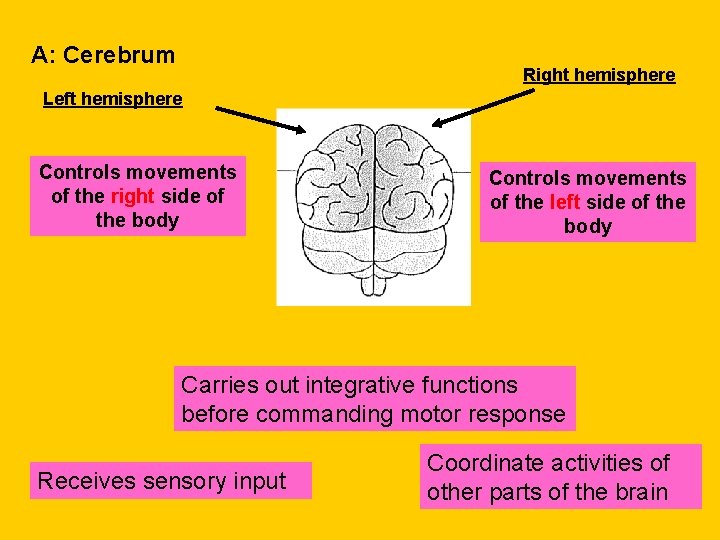
A: Cerebrum Right hemisphere Left hemisphere Controls movements of the right side of the body Controls movements of the left side of the body Carries out integrative functions before commanding motor response Receives sensory input Coordinate activities of other parts of the brain
Cerebral Cortex Outer region, highly folded Direct voluntary movement of muscles Creating sensory perception (see, hear, smell, taste, touch) Higher mental abilities ( learning, memory, reasoning, language skills, imagination, artistic talent and personality traits)
B: Thalamus Sorting information which goes in and comes out of the cerebral cortex Integrates the information that is carried out by sensory receptors to the cerebrum by enhancing some signals and blocking others
C: Cerebellum Coordinate movements Receive information from sensory receptors regarding the position of the body and from the cerebrum
D: Hypothalamus Maintain homeostasis Regulate sleep, hunger, body temperature, water balance and blood pressure Controls the pituitary gland which secretes hormones that influence other glands and body functions
E: Medulla Oblongata Regulating hearbeat, breathing and vasoconstriction Reflex centres for vomiting, coughing, sneezing, hicupping and swallowing
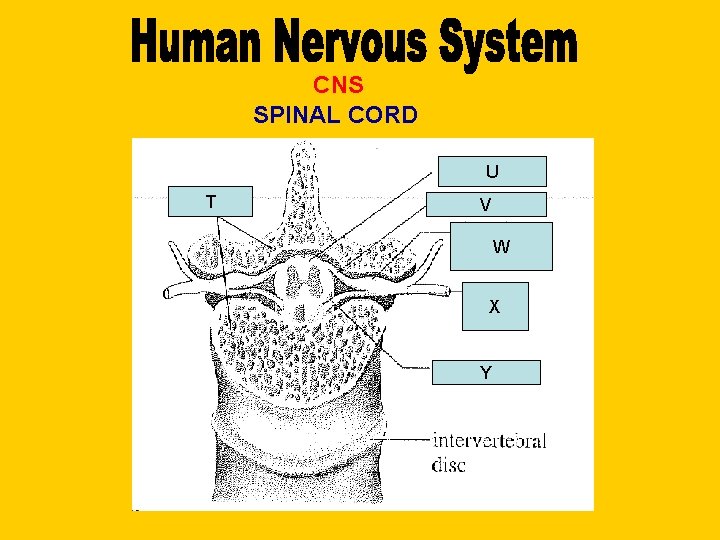
CNS SPINAL CORD U T V W X Y
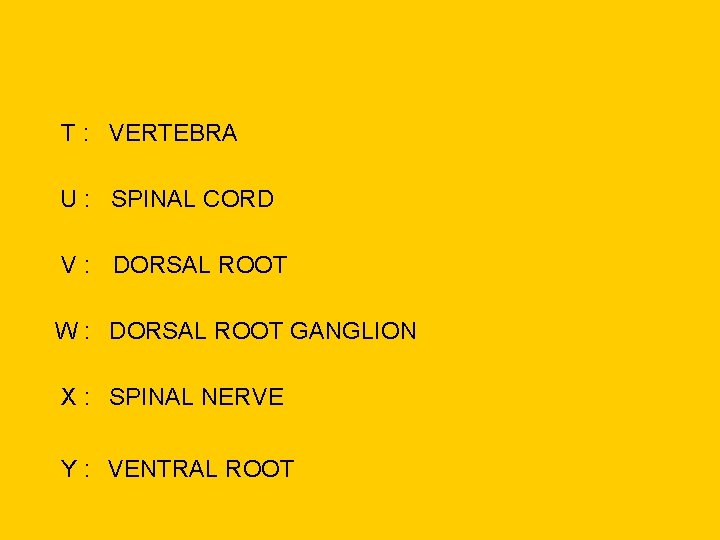
T : VERTEBRA U : SPINAL CORD V : DORSAL ROOT W : DORSAL ROOT GANGLION X : SPINAL NERVE Y : VENTRAL ROOT
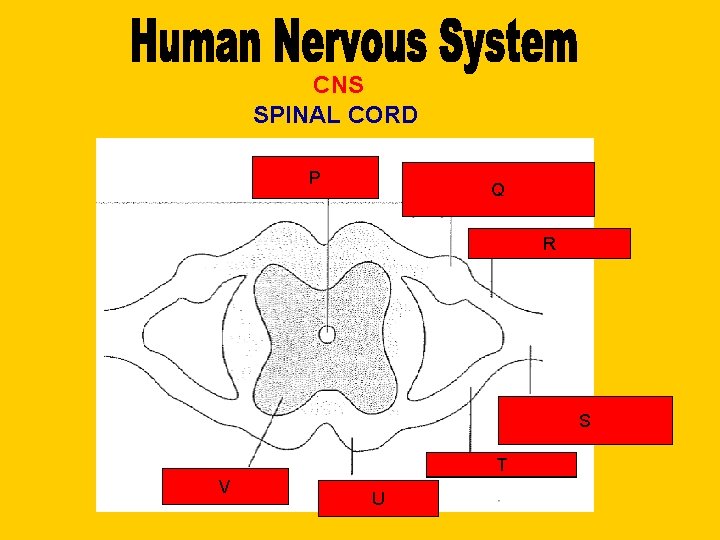
CNS SPINAL CORD Central Canal Central P Canal Dorsal Root Q Ganglion Dorsal R Root Spinal. SNerve T Root Ventral Grey V matter White. Umatter
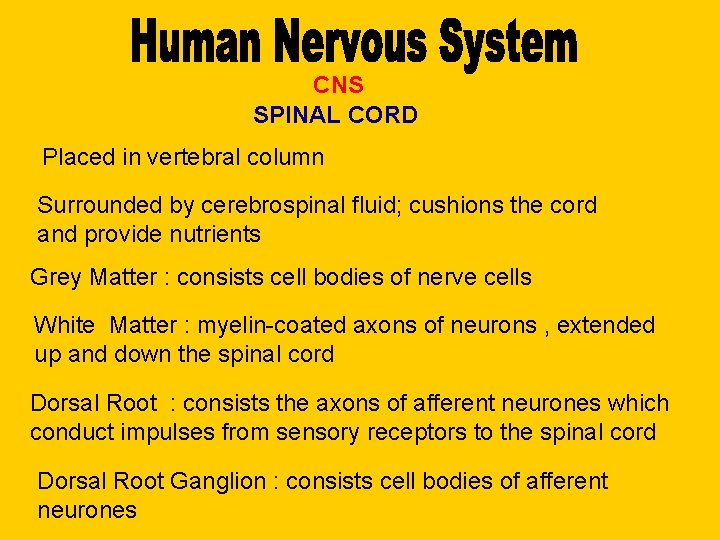
CNS SPINAL CORD Placed in vertebral column Surrounded by cerebrospinal fluid; cushions the cord and provide nutrients Grey Matter : consists cell bodies of nerve cells White Matter : myelin-coated axons of neurons , extended up and down the spinal cord Dorsal Root : consists the axons of afferent neurones which conduct impulses from sensory receptors to the spinal cord Dorsal Root Ganglion : consists cell bodies of afferent neurones
CNS SPINAL CORD Ventral Root : consists of axons of efferent neurones, conduct impulses away from spinal cord to effectors
CNS SPINAL CORD Process certain types of sensory information Send out impulses via response Reflex actions
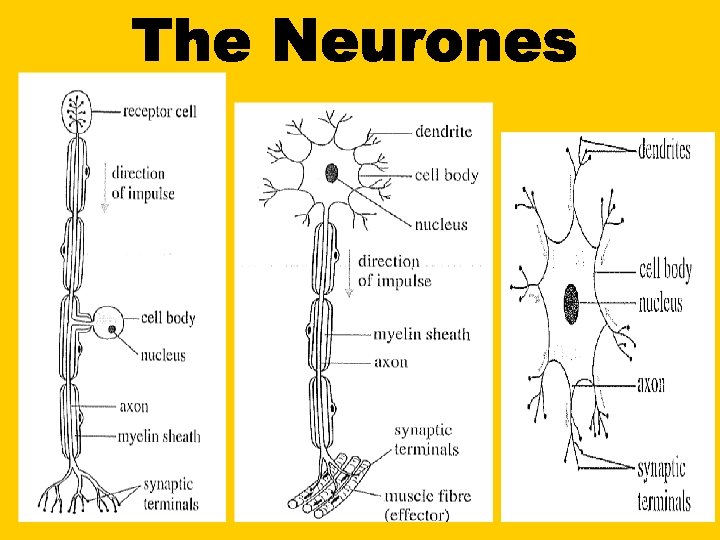
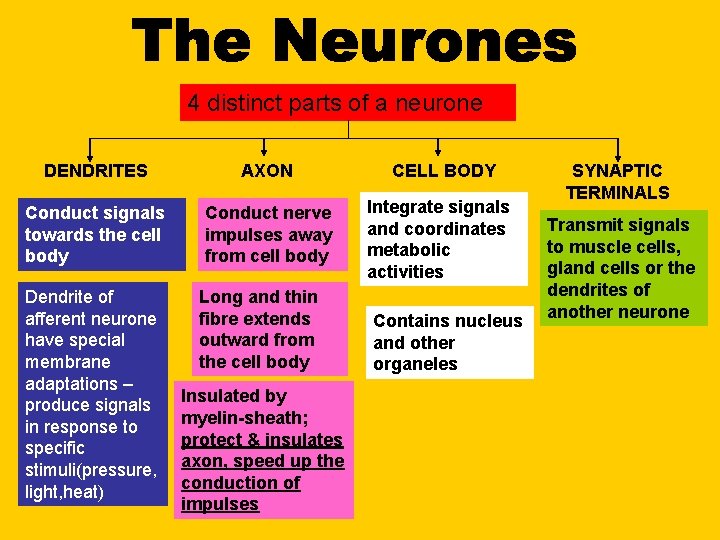
4 distinct parts of a neurone DENDRITES AXON CELL BODY Conduct signals towards the cell body Conduct nerve impulses away from cell body Integrate signals and coordinates metabolic activities Dendrite of afferent neurone have special membrane adaptations – produce signals in response to specific stimuli(pressure, light, heat) Long and thin fibre extends outward from the cell body Insulated by myelin-sheath; protect & insulates axon, speed up the conduction of impulses Contains nucleus and other organeles SYNAPTIC TERMINALS Transmit signals to muscle cells, gland cells or the dendrites of another neurone
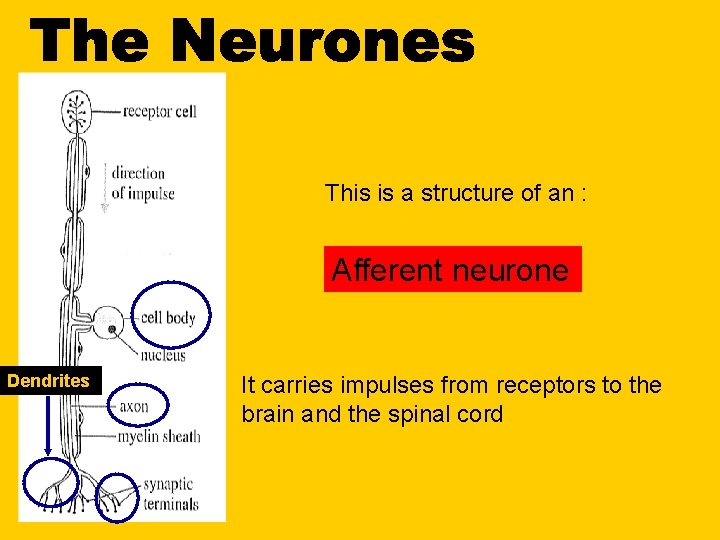
This is a structure of an : Afferent neurone Dendrites It carries impulses from receptors to the brain and the spinal cord
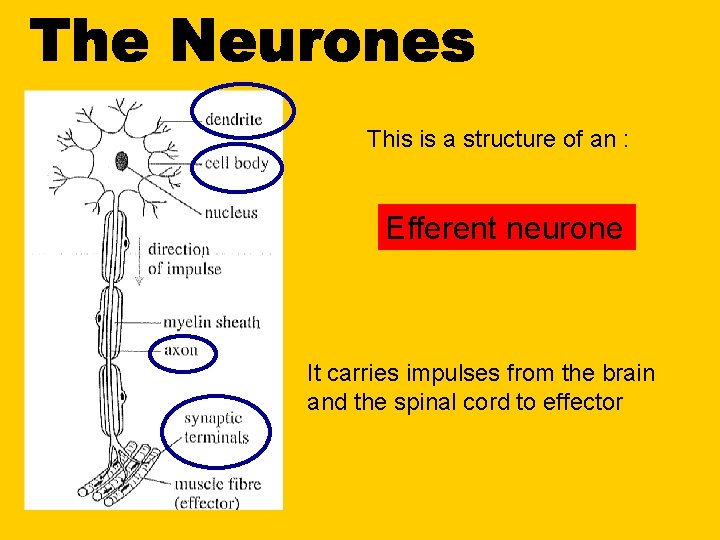
This is a structure of an : Efferent neurone It carries impulses from the brain and the spinal cord to effector
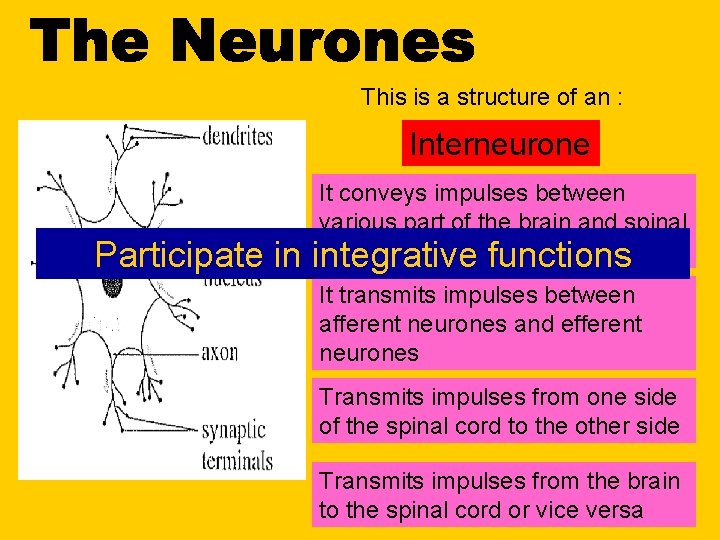
This is a structure of an : Interneurone Participate in It conveys impulses between various part of the brain and spinal cord integrative functions It transmits impulses between afferent neurones and efferent neurones Transmits impulses from one side of the spinal cord to the other side Transmits impulses from the brain to the spinal cord or vice versa
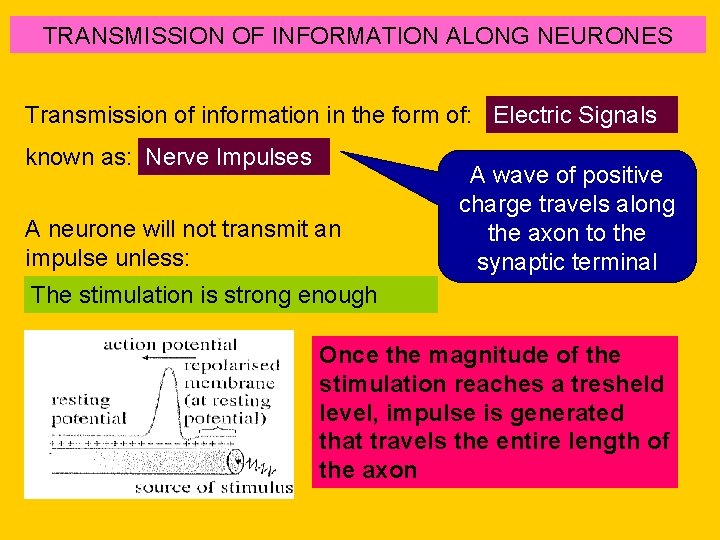
TRANSMISSION OF INFORMATION ALONG NEURONES Transmission of information in the form of: Electric Signals known as: Nerve Impulses A neurone will not transmit an impulse unless: A wave of positive charge travels along the axon to the synaptic terminal The stimulation is strong enough Once the magnitude of the stimulation reaches a tresheld level, impulse is generated that travels the entire length of the axon
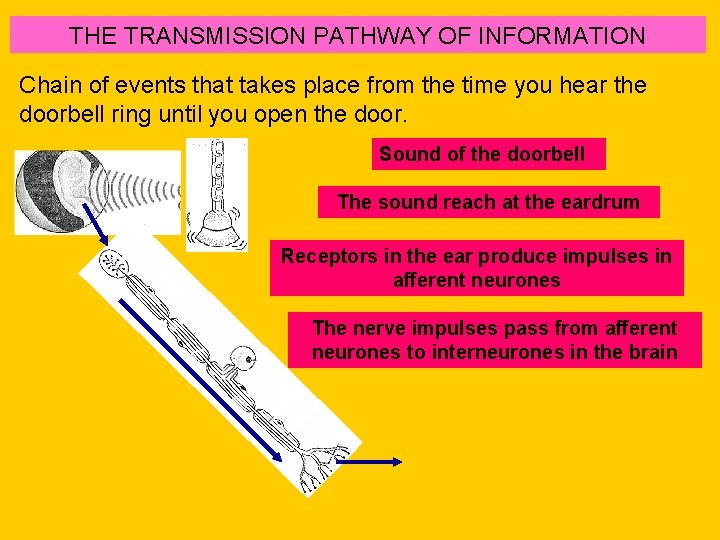
THE TRANSMISSION PATHWAY OF INFORMATION Chain of events that takes place from the time you hear the doorbell ring until you open the door. Sound of the doorbell The sound reach at the eardrum Receptors in the ear produce impulses in afferent neurones The nerve impulses pass from afferent neurones to interneurones in the brain
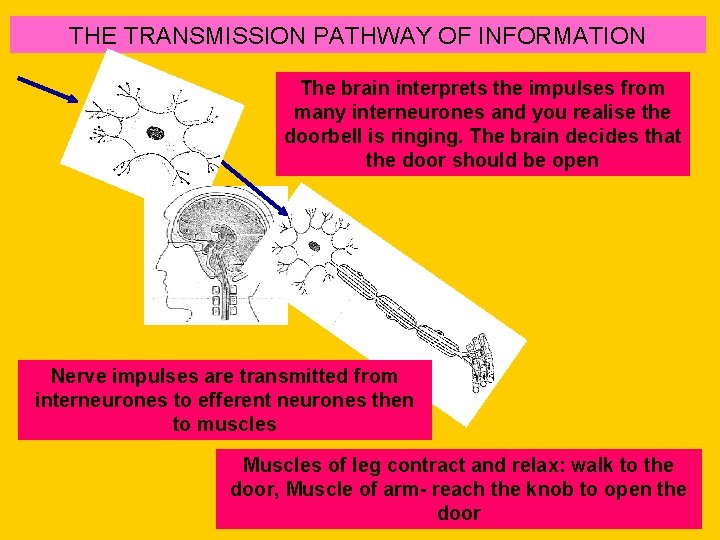
THE TRANSMISSION PATHWAY OF INFORMATION The brain interprets the impulses from many interneurones and you realise the doorbell is ringing. The brain decides that the door should be open Nerve impulses are transmitted from interneurones to efferent neurones then to muscles Muscles of leg contract and relax: walk to the door, Muscle of arm- reach the knob to open the door
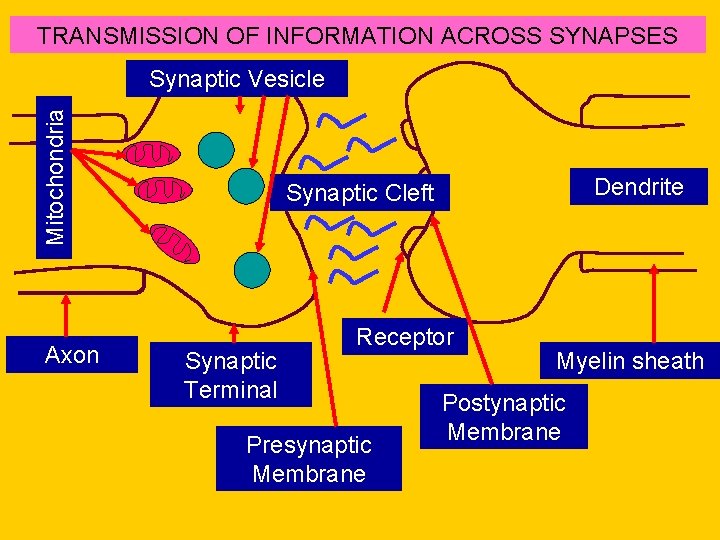
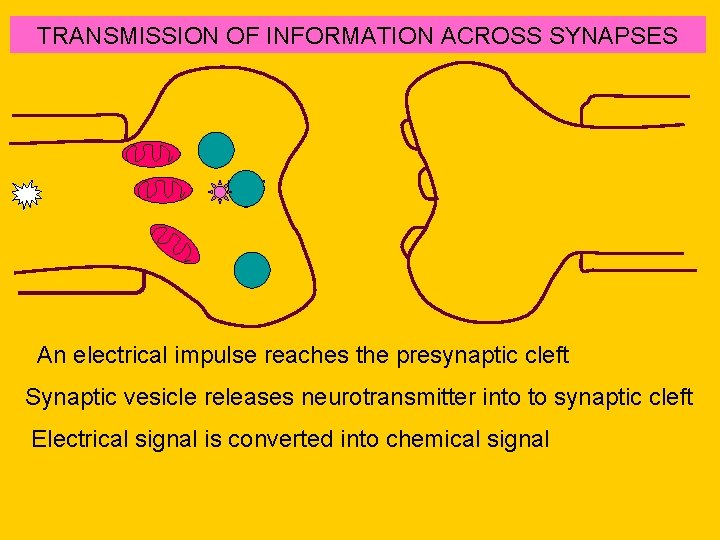
TRANSMISSION OF INFORMATION ACROSS SYNAPSES Mitochondria Synaptic Vesicle Axon Dendrite Synaptic Cleft Synaptic Terminal Receptor Presynaptic Membrane Myelin sheath Postynaptic Membrane
TRANSMISSION OF INFORMATION ACROSS SYNAPSES An electrical impulse reaches the presynaptic cleft Synaptic vesicle releases neurotransmitter into to synaptic cleft Electrical signal is converted into chemical signal
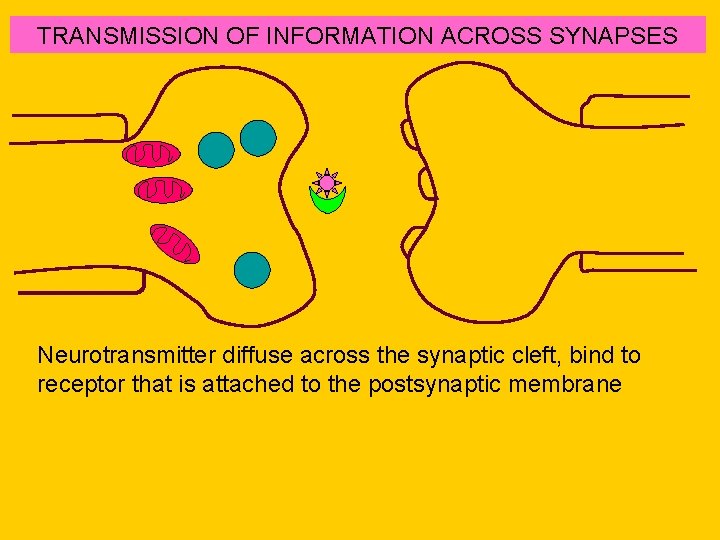
TRANSMISSION OF INFORMATION ACROSS SYNAPSES Neurotransmitter diffuse across the synaptic cleft, bind to receptor that is attached to the postsynaptic membrane
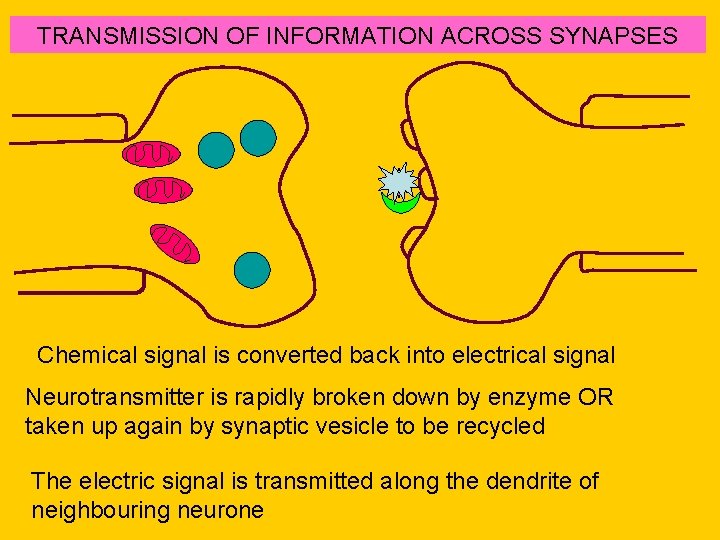
TRANSMISSION OF INFORMATION ACROSS SYNAPSES Chemical signal is converted back into electrical signal Neurotransmitter is rapidly broken down by enzyme OR taken up again by synaptic vesicle to be recycled The electric signal is transmitted along the dendrite of neighbouring neurone
THE IMPORTANCE OF SYNAPSES Controlling and integrating nerve impulses that are transmitted by stimulated receptors Allow nerve impulses to be transmitted only in one direction
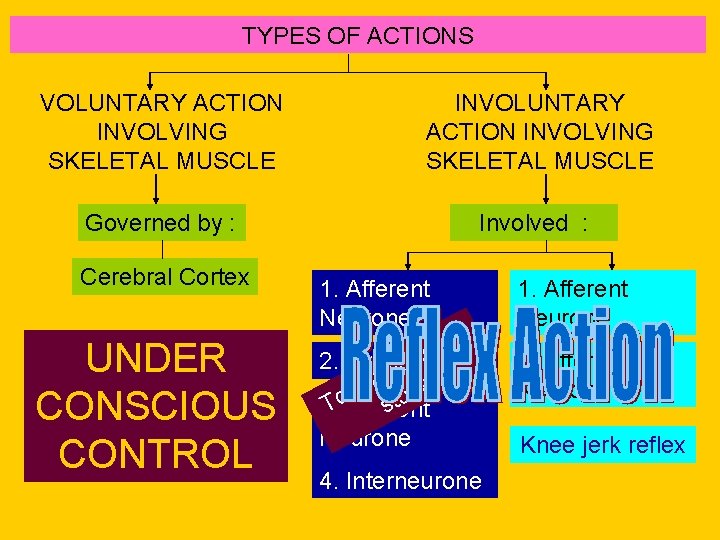
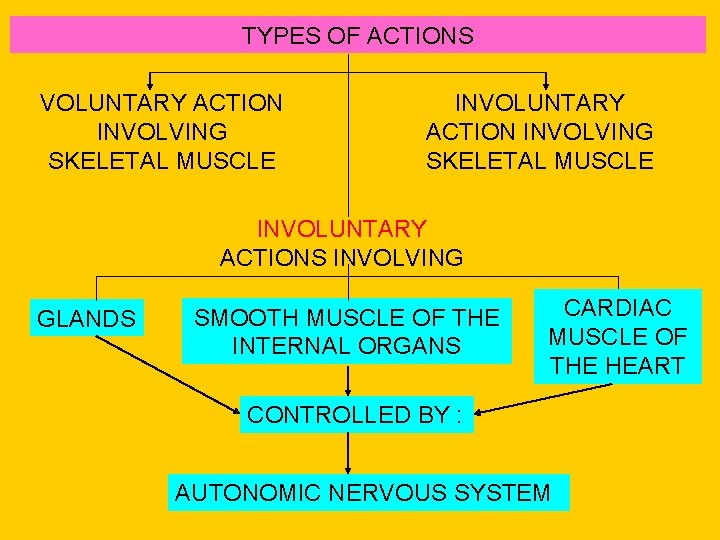
TYPES OF ACTIONS VOLUNTARY ACTION INVOLVING SKELETAL MUSCLE INVOLUNTARY ACTION INVOLVING SKELETAL MUSCLE Governed by : Involved : Cerebral Cortex Walking Talking UNDER CONSCIOUS Scratching CONTROL Digging ur NOSE 1. Afferent Neurone ot h a 2. Spinal Cord g n i h uc tove o T Efferent s 3. Neurone 4. Interneurone 1. Afferent Neurone 2. Efferent Neurone Knee jerk reflex
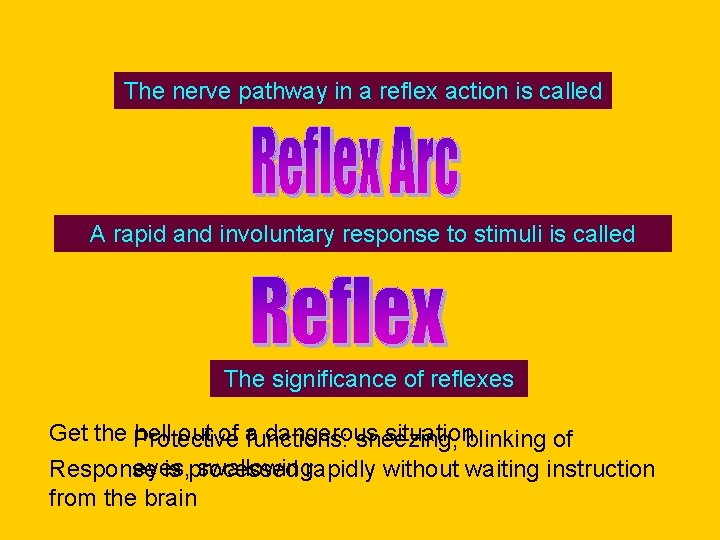
The nerve pathway in a reflex action is called A rapid and involuntary response to stimuli is called The significance of reflexes Get the Protective hell out of afunctions: dangerous situationblinking of sneezing, eyes, swallowingrapidly without waiting instruction Response is processed from the brain
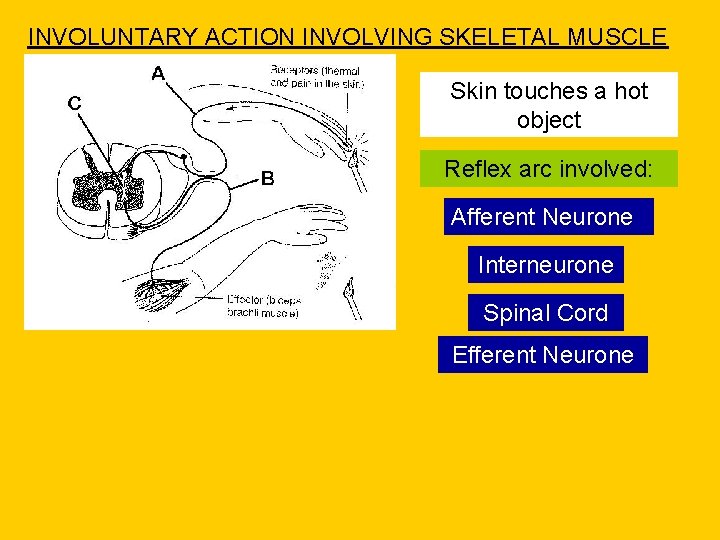
INVOLUNTARY ACTION INVOLVING SKELETAL MUSCLE Skin touches a hot object Reflex arc involved: Afferent Neurone Interneurone Spinal Cord Efferent Neurone
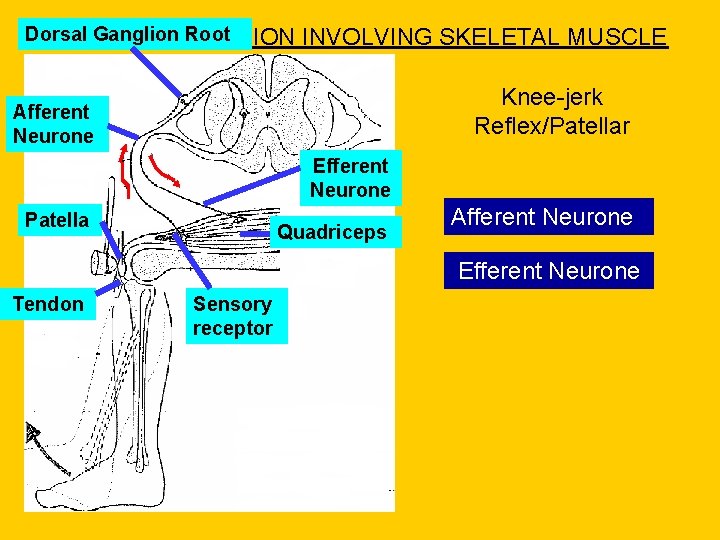
Dorsal Ganglion Root INVOLUNTARY ACTION INVOLVING SKELETAL MUSCLE Knee-jerk Reflex/Patellar Afferent Neurone Efferent Neurone Patella Quadriceps Afferent Neurone Efferent Neurone Tendon Sensory receptor
TYPESINVOLVING OF ACTIONS INVOLUNTARY ACTION SMOOTH MUSCLE VOLUNTARY ACTION INVOLVING SKELETAL MUSCLE INVOLUNTARY ACTIONS INVOLVING GLANDS SMOOTH MUSCLE OF THE INTERNAL ORGANS CARDIAC MUSCLE OF THE HEART CONTROLLED BY : AUTONOMIC NERVOUS SYSTEM
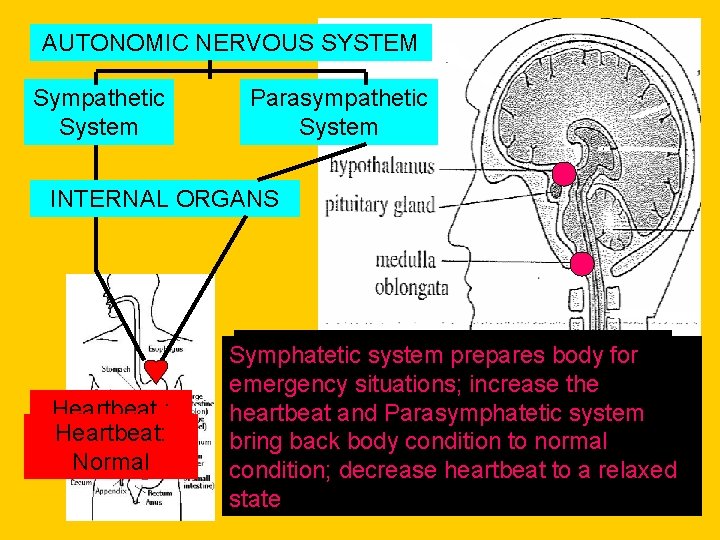
AUTONOMIC NERVOUS SYSTEM Sympathetic System Parasympathetic System INTERNAL ORGANS Heartbeat : Heartbeat: Fast Normal The autonomic nervous system Symphatetic system prepares body for connects hypothalamus and medula The autonomic nervousincrease system consists of emergency situations; the oblongataand toand internal organs ; heart, symphatetic parasymphatetic systems heartbeat Parasymphatetic system smallback intestine, pancreas, toovary, testes bring body condition normal etc. condition; decrease heartbeat to a relaxed state
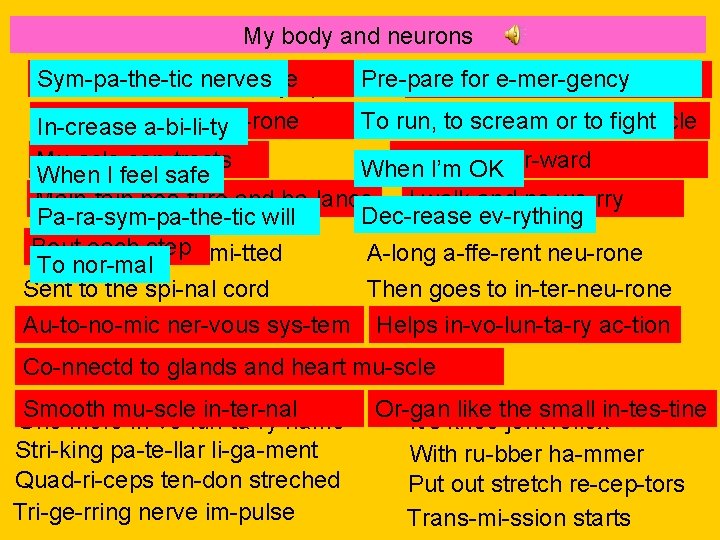
My body and neurons From Sym-pa-the-tic a-ffe-rent neu-rone Pre-pare formy e-mer-gency To Not e-ffe-rent spi-nal cord This was ne-vernerves the way I planned in-ten-tion IFrom was so e-ffe-rent brave, touched neu-ronethe pan. To run, To the Don’t to scream quad-ri-ceps knoworit to was fight mu-scle hot In-crease a-bi-li-ty In-vo-lun-ta-ry act Ion it’sfor-ward ref-lex ac-tion Mu-scle con-tracts Leg. I’m kicks When OK When I feel safe Pro-du-ce im-pulse Sen-so-ry Main-tain re-cep-tors pos-ture and ba-lance I walk and no wo-rry Dec-rease ev-rything Pa-ra-sym-pa-the-tic will Bout each step Im-pulse is A-long a-ffe-rent neu-rone To nor-maltrasn-mi-tted Sent to the spi-nal cord Then goes to in-ter-neu-rone To e-ffec-tor Au-to-no-mic To e-ffe-rent ner-vous sys-tem I pull Helps myin-vo-lun-ta-ry hand say ac-tion ouch! Neu-rones to and spi-nal cord Four of them Co-nnectd glands and heart mu-scle Smooth in-ter-nal One moremu-scle in-vo-lun-ta-ry name Stri-king pa-te-llar li-ga-ment Quad-ri-ceps ten-don streched Tri-ge-rring nerve im-pulse Or-gan like the It’s knee jerksmall reflexin-tes-tine With ru-bber ha-mmer Put out stretch re-cep-tors Trans-mi-ssion starts
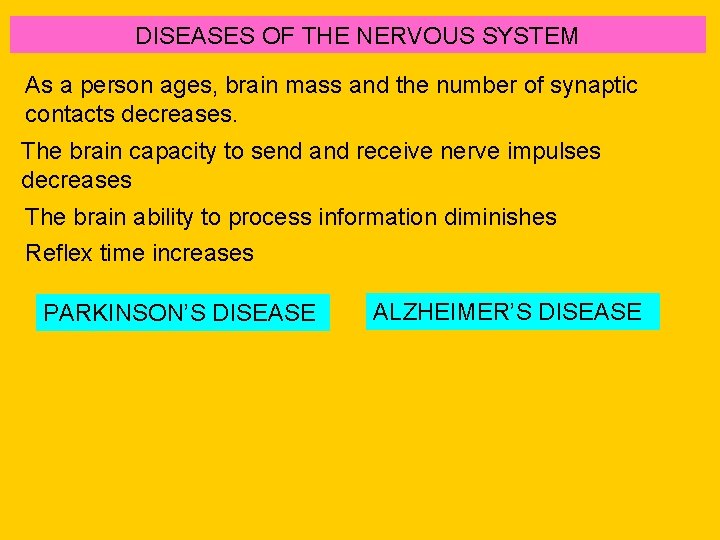
DISEASES OF THE NERVOUS SYSTEM As a person ages, brain mass and the number of synaptic contacts decreases. The brain capacity to send and receive nerve impulses decreases The brain ability to process information diminishes Reflex time increases PARKINSON’S DISEASE ALZHEIMER’S DISEASE
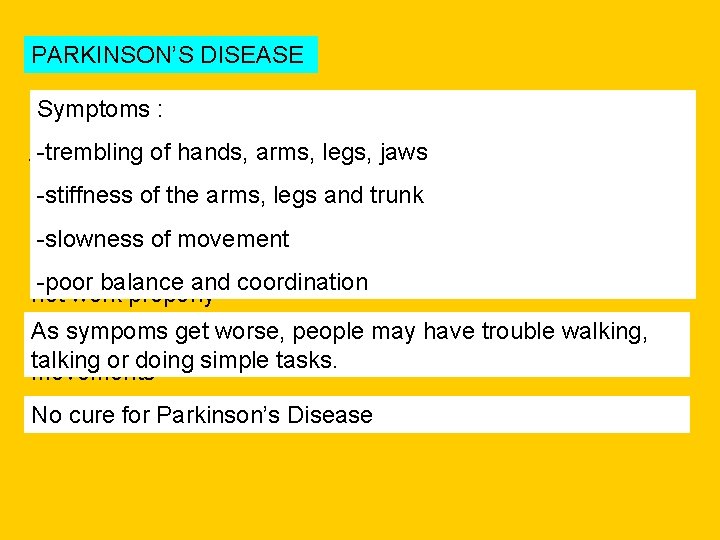
PARKINSON’S DISEASE Symptoms Also called : : Paralysis agitans / Shaking Palsy of hands, arms, legs, jaws A-trembling progressive disorder of the CNS Affects nerve cells or neurons, a part of the brain that -stiffness of the arms, legs andintrunk controls movement -slowness of movement Neurones that make a chemical called dopamine die or do -poor balance and coordination not work properly As sympoms get worse, people may have walking, Dopamine normally sends signals that helptrouble coordinate talking or doing simple tasks. movements Begins No curearound for Parkinson’s age 60 Disease
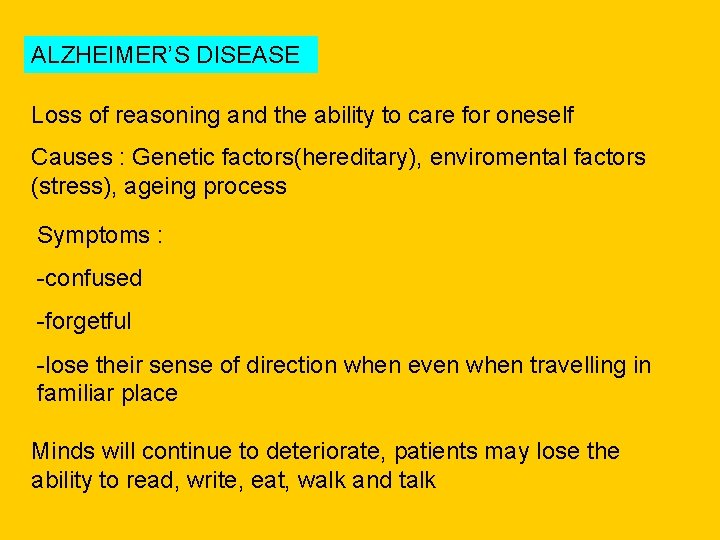
ALZHEIMER’S DISEASE Loss of reasoning and the ability to care for oneself Causes : Genetic factors(hereditary), enviromental factors (stress), ageing process Symptoms : -confused -forgetful -lose their sense of direction when even when travelling in familiar place Minds will continue to deteriorate, patients may lose the ability to read, write, eat, walk and talk
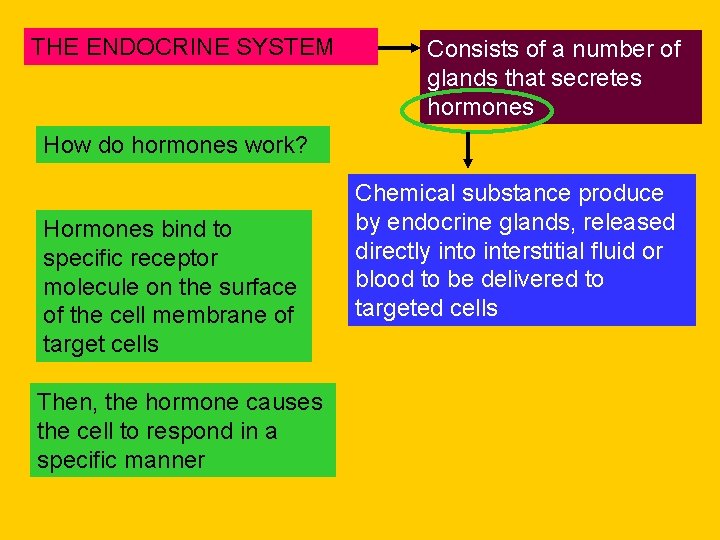
THE ENDOCRINE SYSTEM Consists of a number of glands that secretes hormones How do hormones work? Hormones bind to specific receptor molecule on the surface of the cell membrane of target cells Then, the hormone causes the cell to respond in a specific manner Chemical substance produce by endocrine glands, released directly into interstitial fluid or blood to be delivered to targeted cells
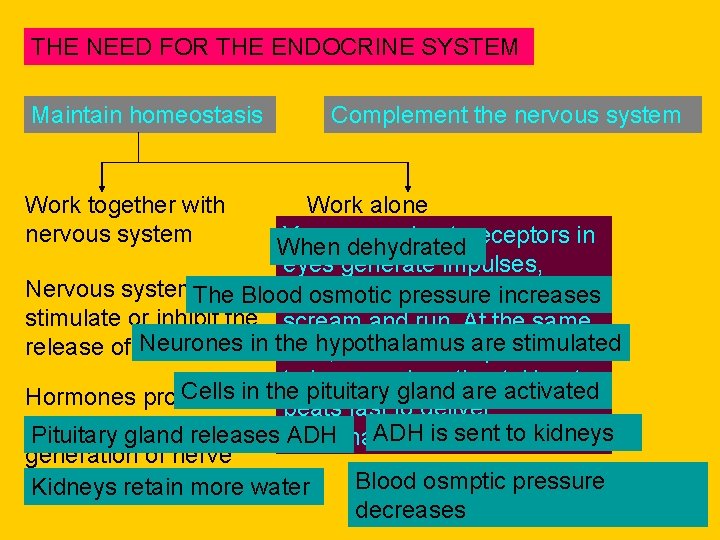
THE NEED FOR THE ENDOCRINE SYSTEM Maintain homeostasis Work together with nervous system Complement the nervous system Work alone You see a ghost, receptors in When dehydrated eyes generate impulses, Nervous system. The Blood impulses to the increases brain, -Menstrual osmoticsent pressure Cycle stimulate or inhibit the scream and run. At the same -Development ofare secondary Neurones in the hypothalamus stimulated release of hormones time, adrenaline is produced sexual characteristic to increase heartbeat. Heart Cells in the pituitary gland are activated Hormones promote beats fast to deliver and inhibitgland the releases oxygenated is sent to kidneys Pituitary ADHblood to muscle. generation of nerve Blood osmptic pressure impulses Kidneys retain more water decreases
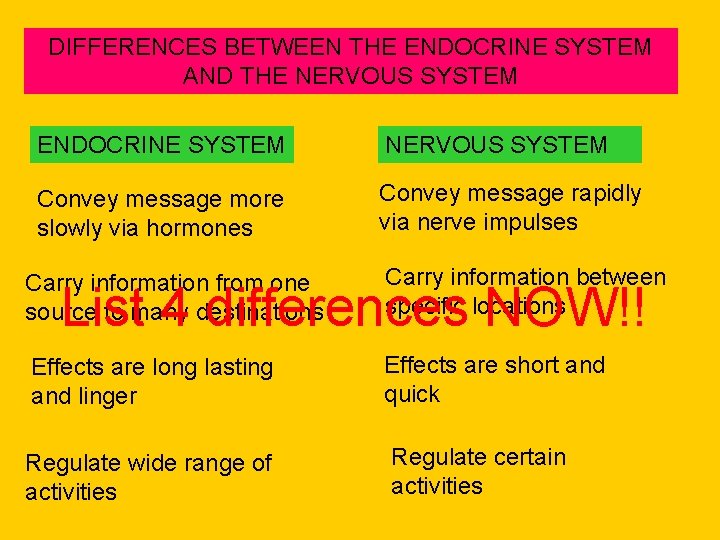
DIFFERENCES BETWEEN THE ENDOCRINE SYSTEM AND THE NERVOUS SYSTEM ENDOCRINE SYSTEM NERVOUS SYSTEM Convey message more slowly via hormones Convey message rapidly via nerve impulses Carry information from one source to many destinations Carry information between specific locations Effects are long lasting and linger Effects are short and quick Regulate wide range of activities Regulate certain activities List 4 differences NOW!!
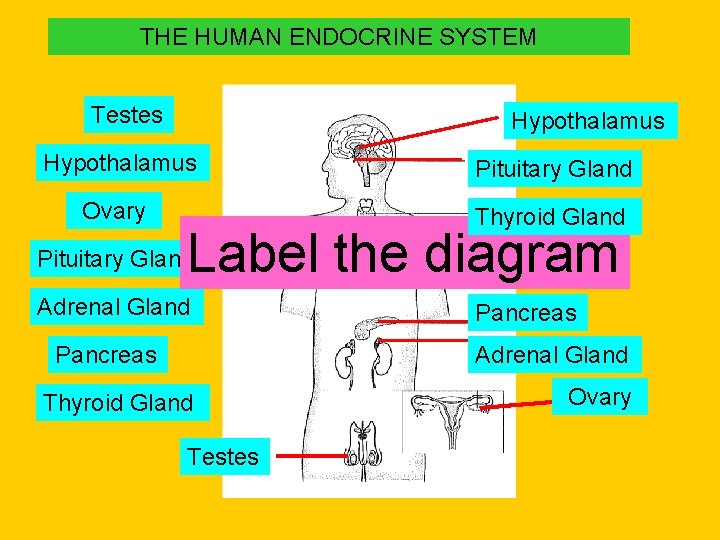
THE HUMAN ENDOCRINE SYSTEM Testes THypothalamus Pituitary Gland Ovary Thyroid Gland Label the diagram Pituitary Gland Adrenal Gland Pancreas Adrenal Gland Thyroid Gland Testes V UOvary
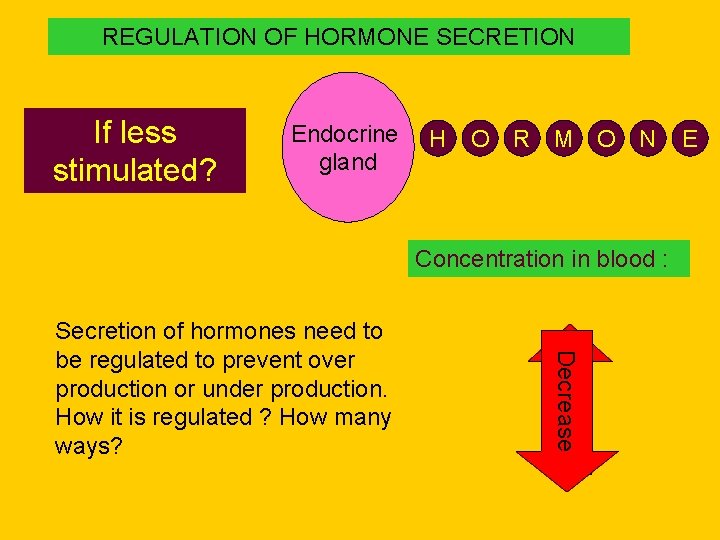
REGULATION OF HORMONE SECRETION If less stimulated? Stimulated Endocrine gland H O R M O N Concentration in blood : Increase Decrease Secretion of hormones need to be regulated to prevent over production or under production. How it is regulated ? How many ways? E
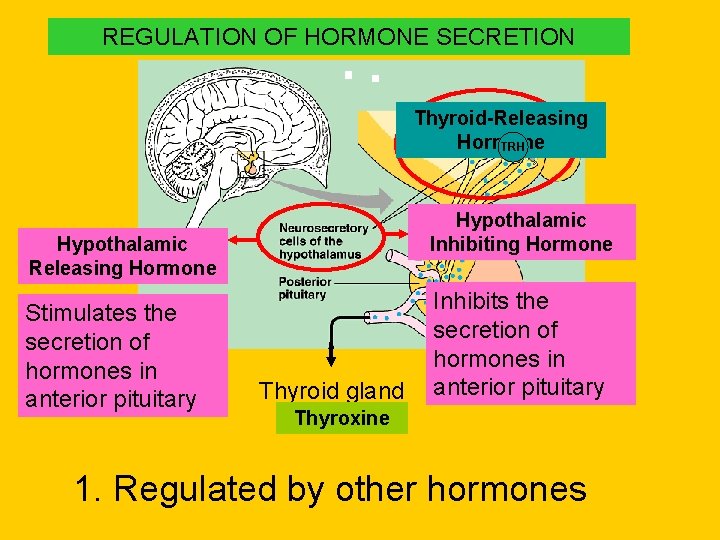
REGULATION OF HORMONE SECRETION Thyroid-Releasing Hormone TRH Hypothalamic Inhibiting Hormone Hypothalamic Releasing Hormone Stimulates the secretion of hormones in anterior pituitary Thyroid gland TSH the Inhibits secretion of hormones in anterior pituitary Thyroxine 1. Regulated by other hormones
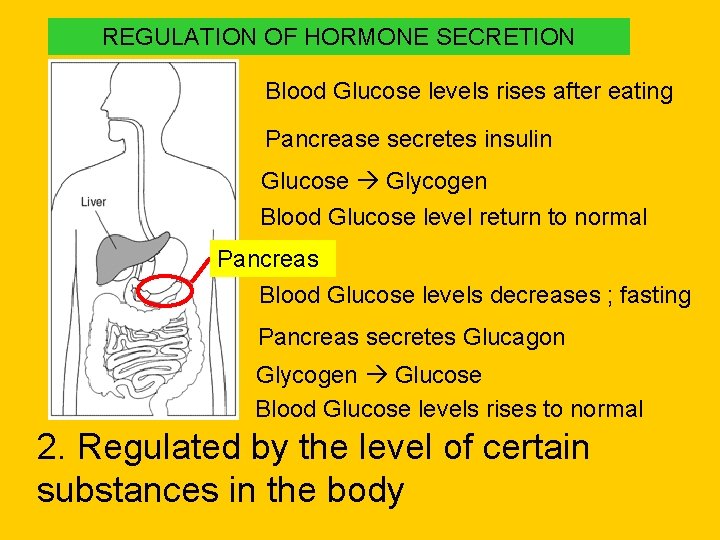
REGULATION OF HORMONE SECRETION Blood Glucose levels rises after eating Pancrease secretes insulin Glucose Glycogen Blood Glucose level return to normal Pancreas Blood Glucose levels decreases ; fasting Pancreas secretes Glucagon Glycogen Glucose Blood Glucose levels rises to normal 2. Regulated by the level of certain substances in the body
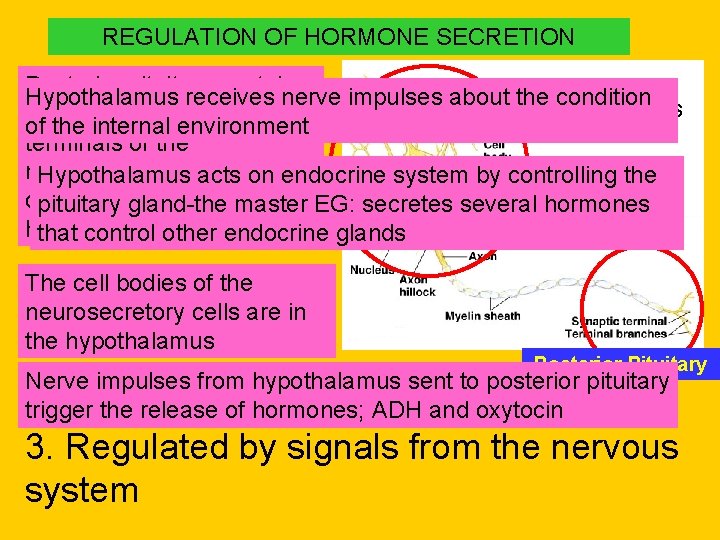
REGULATION OF HORMONE SECRETION Posterior pituitary contains Hypothalamus receives nerve impulses about the condition Hypothalamus axons and synaptic of the internal environment terminals of the neurosecretary Hypothalamus cells acts that on endocrine system by controlling the originate the pituitary in gland-the master EG: secretes several hormones hypothalamus that control other endocrine glands The cell bodies of the neurosecretory cells are in the hypothalamus Posterior Pituitary Nerve impulses from hypothalamus sent to posterior pituitary trigger the release of hormones; ADH and oxytocin 3. Regulated by signals from the nervous system
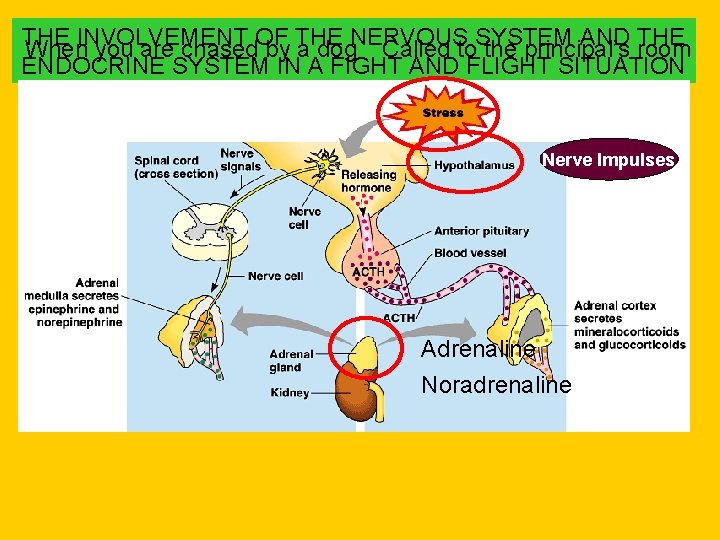
THE AND room THE When. INVOLVEMENT you are chased. OF by THE a dog. NERVOUS Called to. SYSTEM the principal’s ENDOCRINE SYSTEM IN A FIGHT AND FLIGHT SITUATION Nerve Impulses Adrenaline Noradrenaline
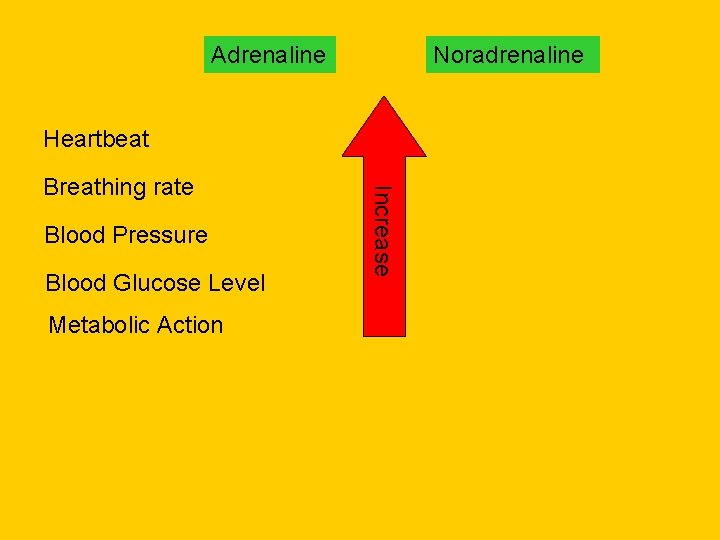
Adrenaline Noradrenaline Heartbeat Blood Pressure Blood Glucose Level Metabolic Action Increase Breathing rate
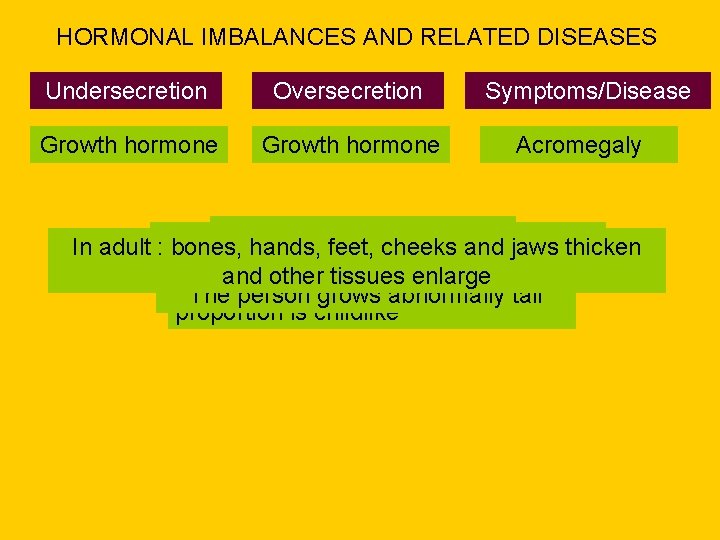
HORMONAL IMBALANCES AND RELATED DISEASES Undersecretion Oversecretion Growth hormone Symptoms/Disease Acromegaly Gigantism Dwarfism Slows bone growth increase incheeks the length bones In adult : Abnormal bones, hands, feet, andof jaws thicken and other tissues enlarge The organs fail to grow and the tall body The person grows abnormally proportion is childlike
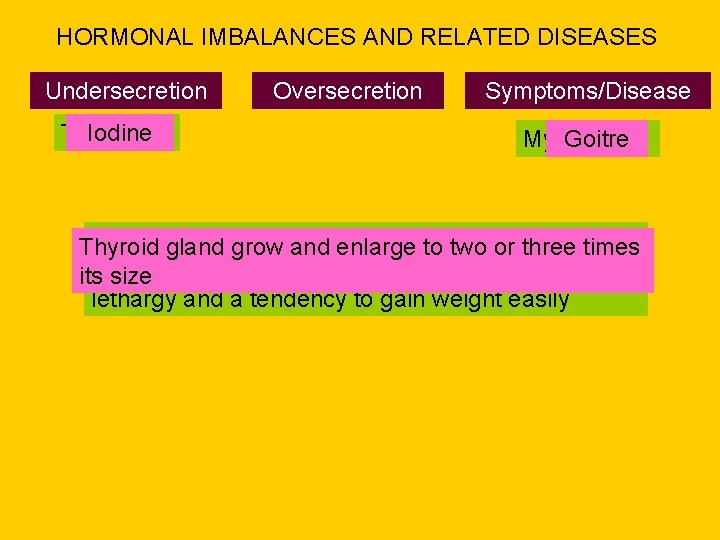
HORMONAL IMBALANCES AND RELATED DISEASES Undersecretion Thyroxine Iodine Oversecretion Symptoms/Disease Myxedema Cretinism Goitre During In adulthood childhood causing severe hearttorate, mental retardation bodytimes Thyroid gland growcausing andslow enlarge two low or three high sensitivity to cold, general itstemperature, size lethargy and a tendency to gain weight easily
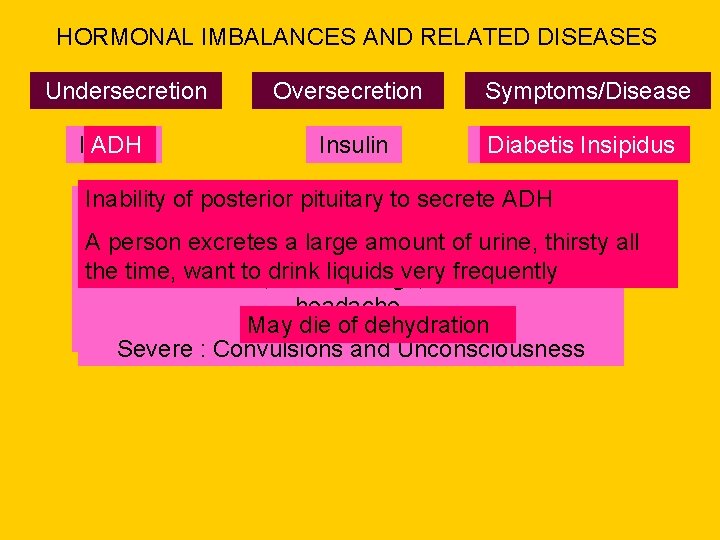
HORMONAL IMBALANCES AND RELATED DISEASES Undersecretion Insulin ADH Oversecretion Symptoms/Disease Insulin Diabetis Hypoglycaemia Insipidus mellitus Inability High of posterior ADH Low level ofpituitary glucoseto in secrete the blood. ASymptoms: person excretes a large amount of urine, thirsty Increased frequency fatigue, of insomnia, urination, mental excessive confusion, thirst, all the time, want to drink liquids very frequently numbness nervousness, or burning mood sensation swings, infaintness the feet, and ankles and legs , blurred orheadache. poor vision, fatigue and poor May die of dehydration wound healing Severe : Convulsions and Unconsciousness
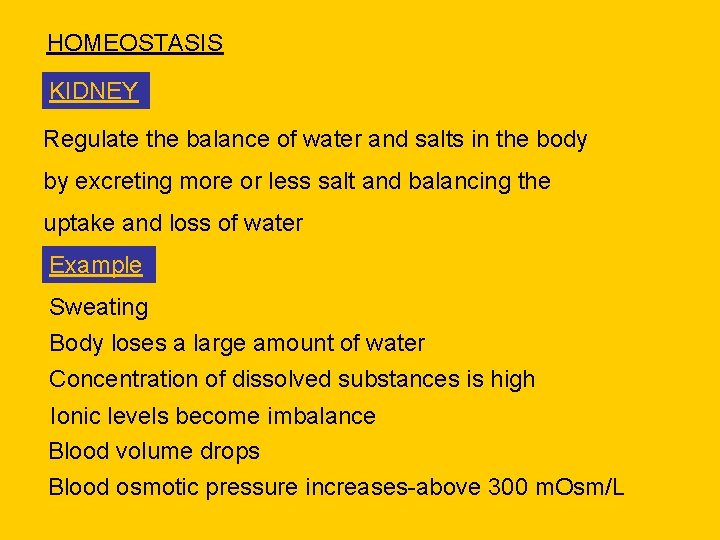
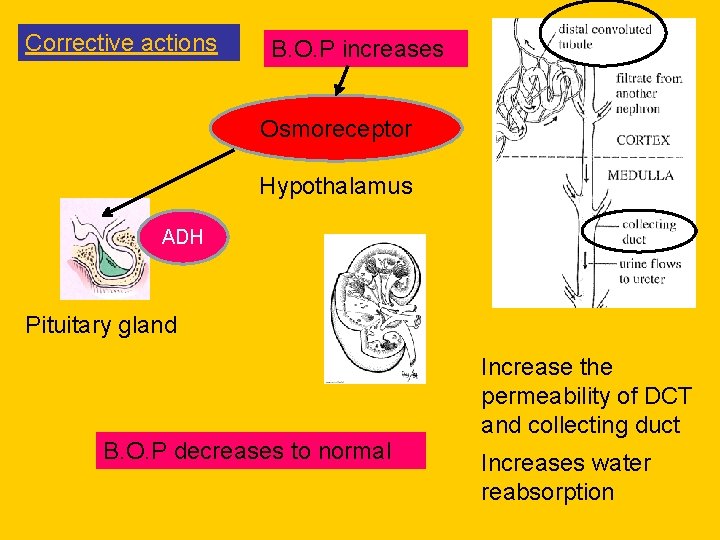
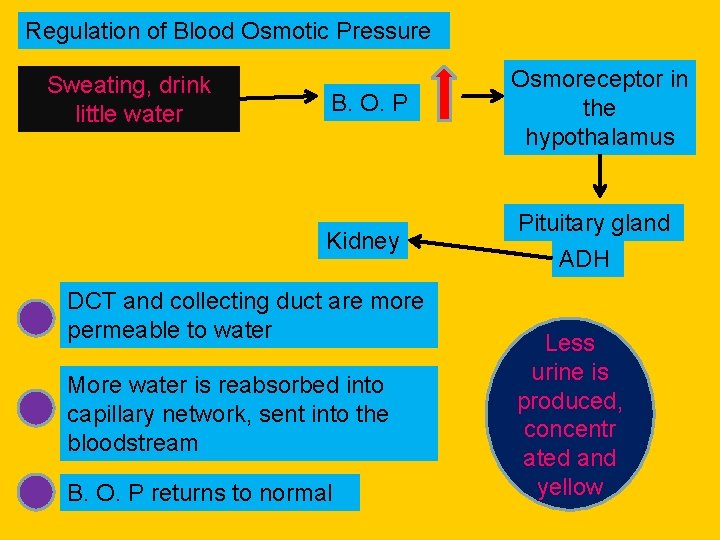
HOMEOSTASIS KIDNEY Regulate the balance of water and salts in the body by excreting more or less salt and balancing the uptake and loss of water Example Sweating Body loses a large amount of water Concentration of dissolved substances is high Ionic levels become imbalance Blood volume drops Blood osmotic pressure increases-above 300 m. Osm/L
Corrective actions B. O. P increases Osmoreceptor Hypothalamus ADH Pituitary gland B. O. P decreases to normal Increase the permeability of DCT and collecting duct Increases water reabsorption
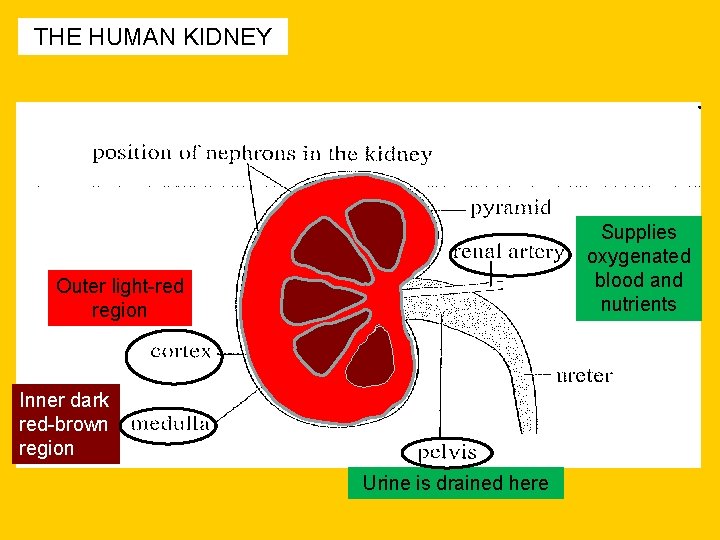
THE HUMAN KIDNEY Supplies oxygenated blood and nutrients Outer light-red region Inner dark red-brown region Urine is drained here
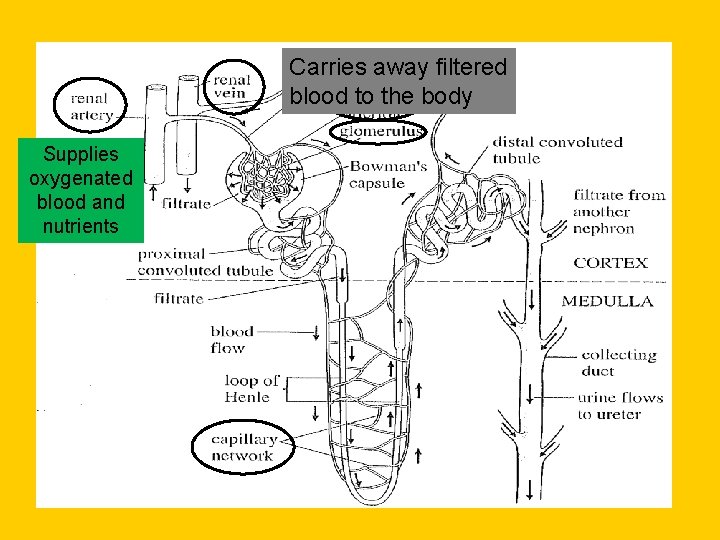
Carries away filtered blood to the body Supplies oxygenated blood and nutrients
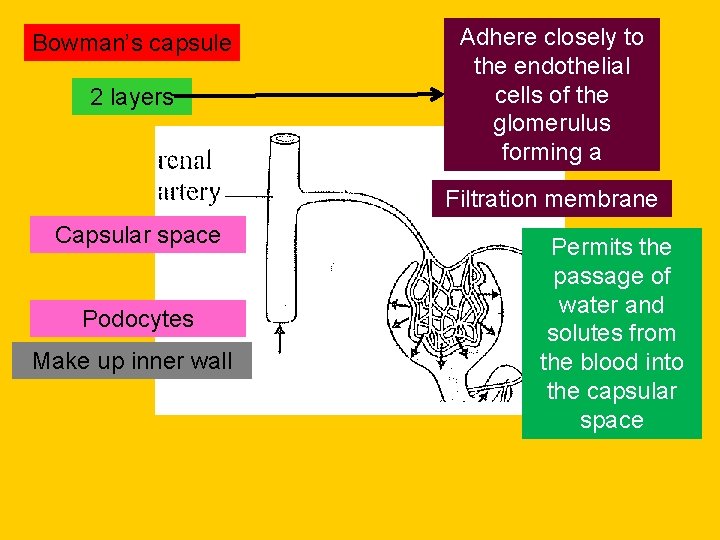
Bowman’s capsule 2 layers Adhere closely to the endothelial cells of the glomerulus forming a Filtration membrane Capsular space Podocytes Make up inner wall Permits the passage of water and solutes from the blood into the capsular space
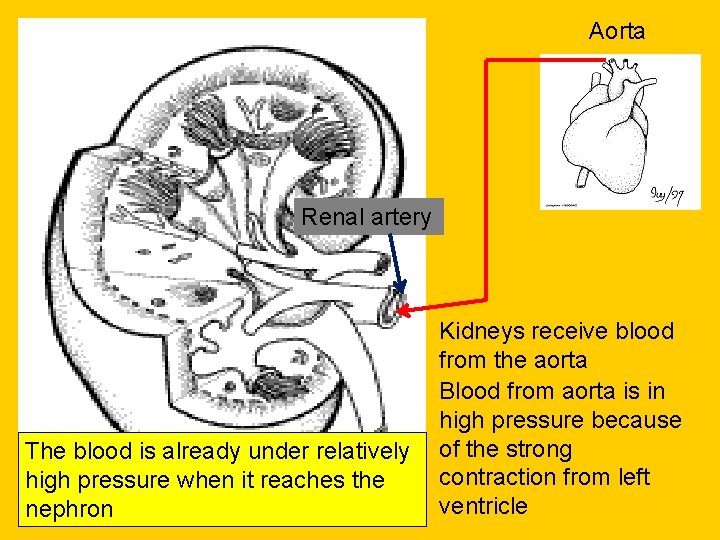
Aorta Renal artery The blood is already under relatively high pressure when it reaches the nephron Kidneys receive blood from the aorta Blood from aorta is in high pressure because of the strong contraction from left ventricle
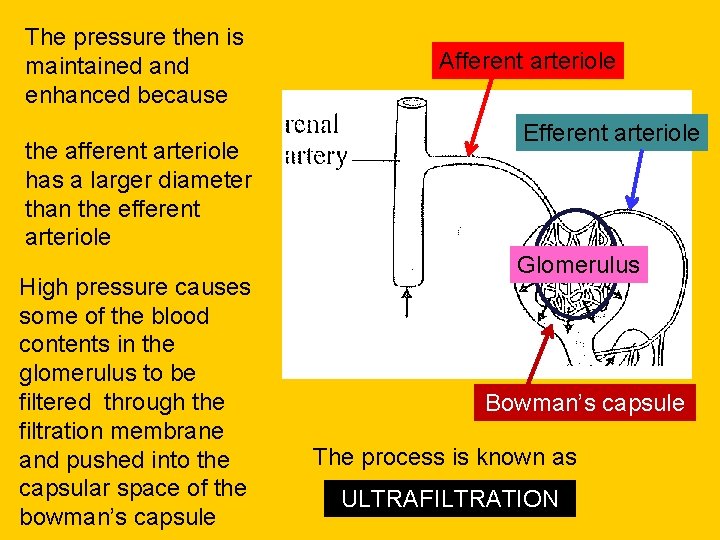
The pressure then is maintained and enhanced because the afferent arteriole has a larger diameter than the efferent arteriole High pressure causes some of the blood contents in the glomerulus to be filtered through the filtration membrane and pushed into the capsular space of the bowman’s capsule Afferent arteriole Efferent arteriole Glomerulus Bowman’s capsule The process is known as ULTRAFILTRATION
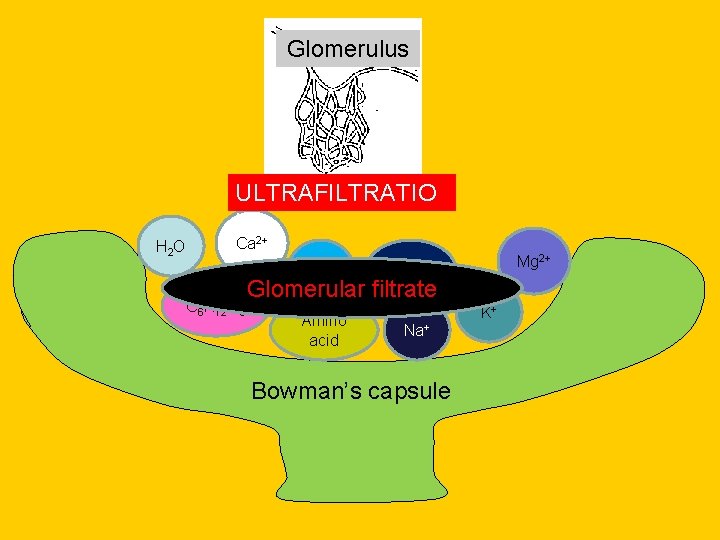
Glomerulus ULTRAFILTRATIO N H 2 O Ca 2+ Cl- C 6 H 12 O 6 Mg 2+ HCO 3 - Glomerular filtrate Amino acid K+ Na+ Bowman’s capsule
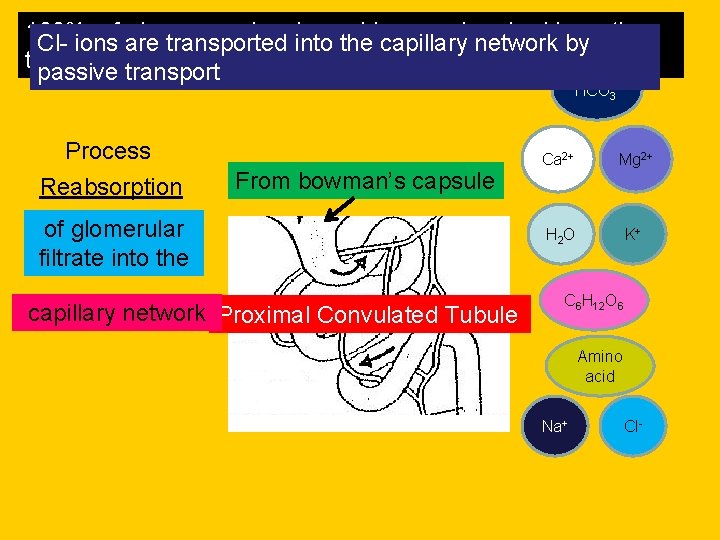
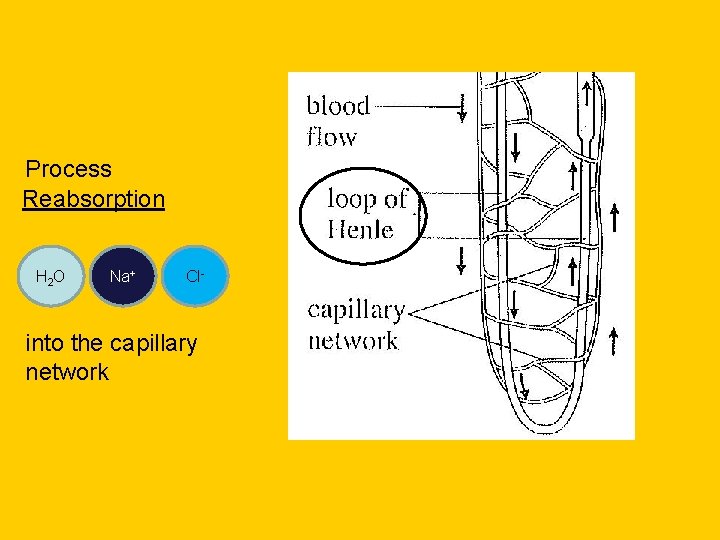
100% of Na glucose and acid are reabsorbed by active +, transported 2+, +amino 2+, HCO - ions Cl 65% ions of are Mg K , Ca into the capillary are network pumped by 65% of water is reabsorbed 3 transport passive actively transport into the capillary network HCO 3 - Process Reabsorption From bowman’s capsule of glomerular filtrate into the capillary network Proximal Convulated Tubule Ca 2+ Mg 2+ H 2 O K+ C 6 H 12 O 6 Amino acid Na+ Cl-
Process Reabsorption H 2 O Na+ Cl- into the capillary network
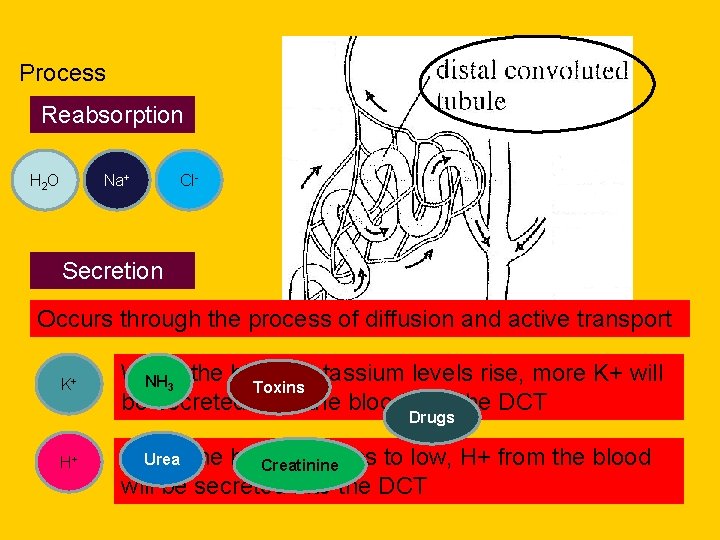
Process Reabsorption H 2 O Na+ Cl- Secretion Occurs through the process of diffusion and active transport K+ When potassium levels rise, more K+ will NH 3 the blood Toxins be secreted from the blood into the DCT Drugs H+ When p. H dips to low, H+ from the blood Urea the blood Creatinine will be secreted into the DCT
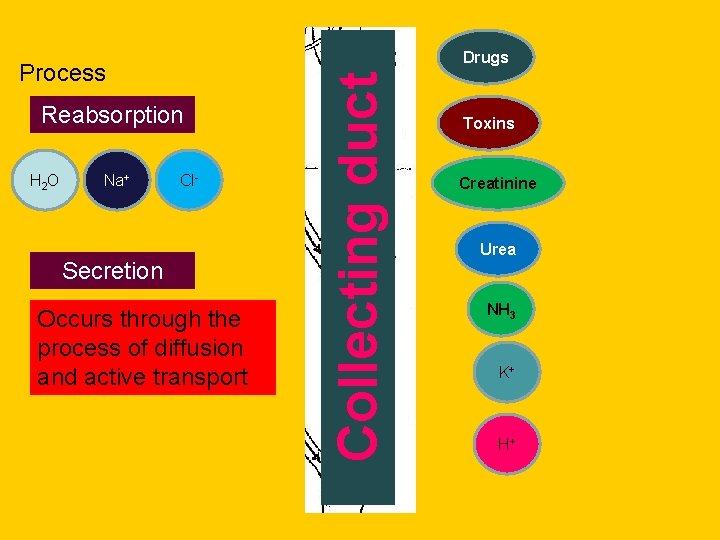
Process Reabsorption H 2 O Na+ Cl- Secretion Occurs through the process of diffusion and active transport Collecting duct Drugs Toxins Creatinine Urea NH 3 K+ H+
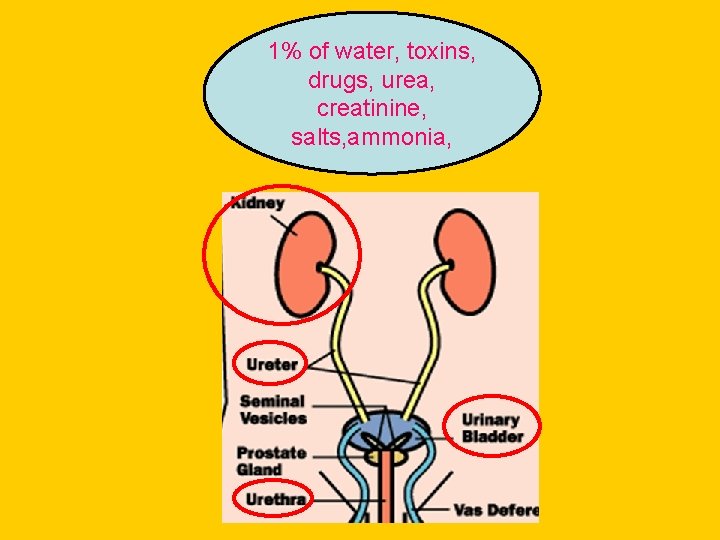
1% of water, toxins, drugs, urea, creatinine, salts, ammonia,
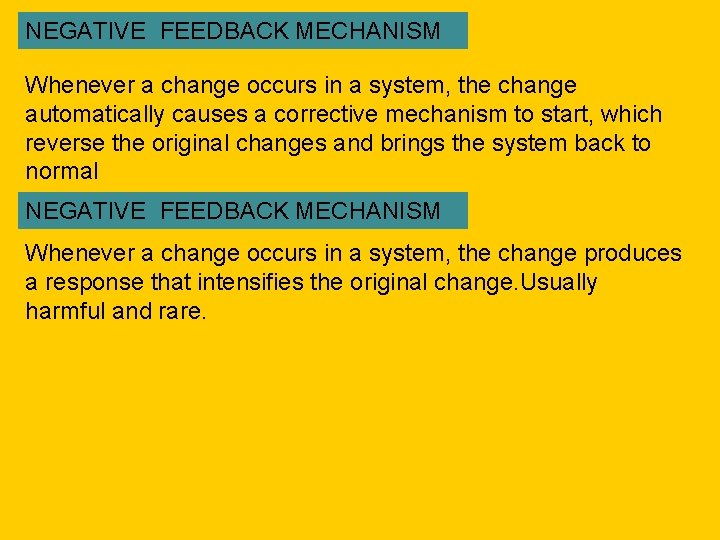
NEGATIVE FEEDBACK MECHANISM Whenever a change occurs in a system, the change automatically causes a corrective mechanism to start, which reverse the original changes and brings the system back to normal NEGATIVE FEEDBACK MECHANISM Whenever a change occurs in a system, the change produces a response that intensifies the original change. Usually harmful and rare.
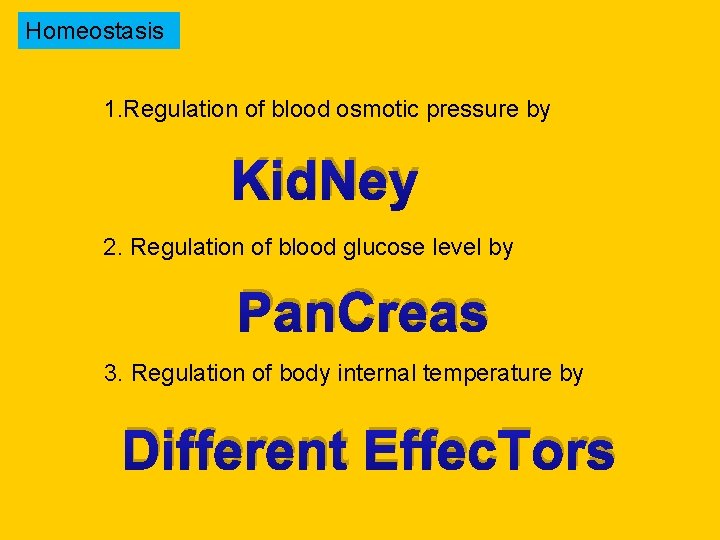
Homeostasis 1. Regulation of blood osmotic pressure by Kid. Ney 2. Regulation of blood glucose level by Pan. Creas 3. Regulation of body internal temperature by Different Effec. Tors
Regulation of Blood Osmotic Pressure Sweating, drink little water B. O. P Osmoreceptor in the hypothalamus Kidney Pituitary gland ADH DCT and collecting duct are more permeable to water More water is reabsorbed into capillary network, sent into the bloodstream B. O. P returns to normal Less urine is produced, concentr ated and yellow
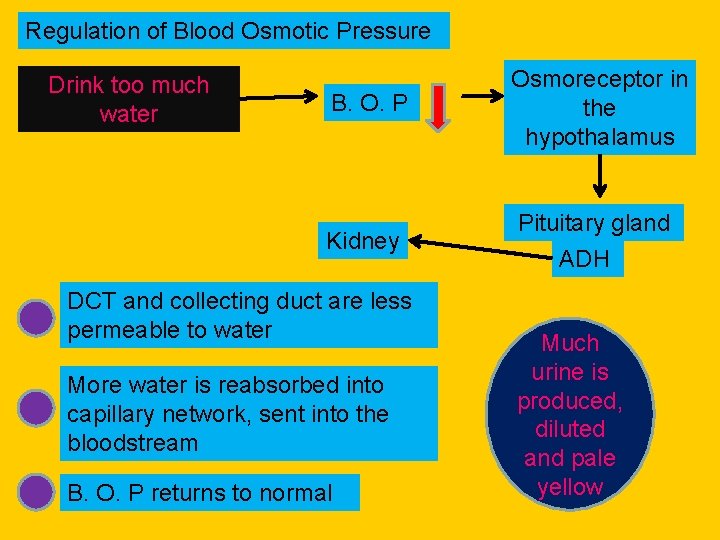
Regulation of Blood Osmotic Pressure Drink too much water B. O. P Osmoreceptor in the hypothalamus Kidney Pituitary gland ADH DCT and collecting duct are less permeable to water More water is reabsorbed into capillary network, sent into the bloodstream B. O. P returns to normal Much urine is produced, diluted and pale yellow
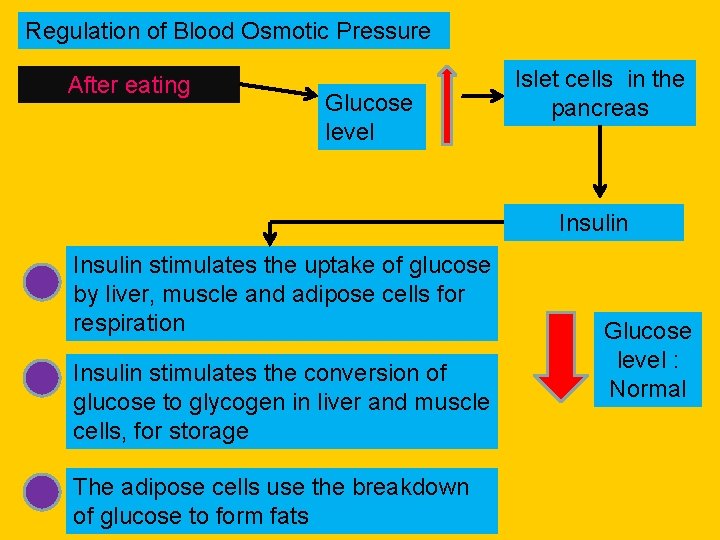
Regulation of Blood Osmotic Glucose Pressure level After eating Glucose level Islet cells in the pancreas Insulin stimulates the uptake of glucose by liver, muscle and adipose cells for respiration Insulin stimulates the conversion of glucose to glycogen in liver and muscle cells, for storage The adipose cells use the breakdown of glucose to form fats Glucose level : Normal
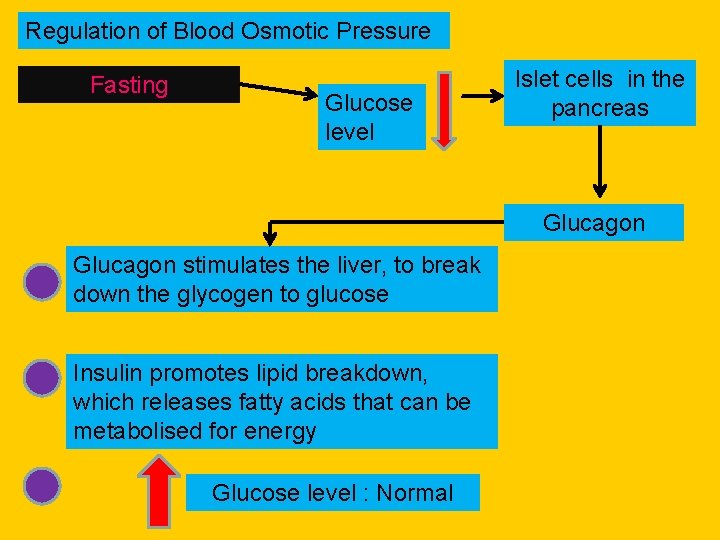
Regulation of Blood Osmotic Pressure Fasting Glucose level Islet cells in the pancreas Glucagon stimulates the liver, to break down the glycogen to glucose Insulin promotes lipid breakdown, which releases fatty acids that can be metabolised for energy Glucose level : Normal
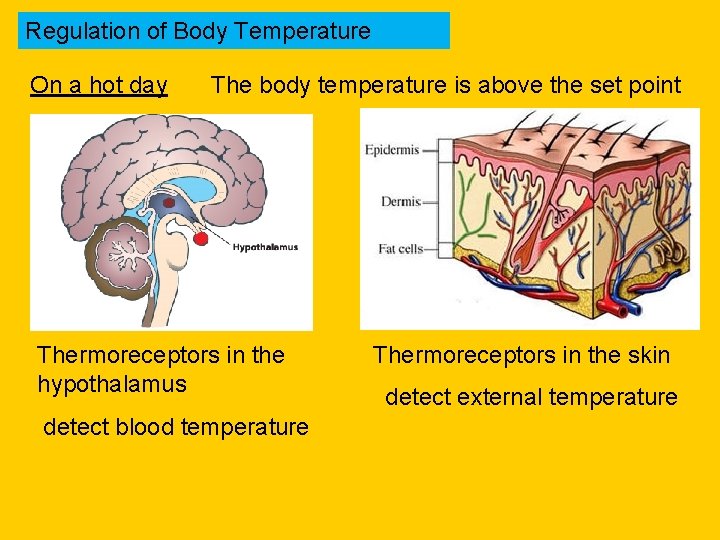
Regulation of Body Temperature On a hot day The body temperature is above the set point Thermoreceptors in the hypothalamus detect blood temperature Thermoreceptors in the skin detect external temperature
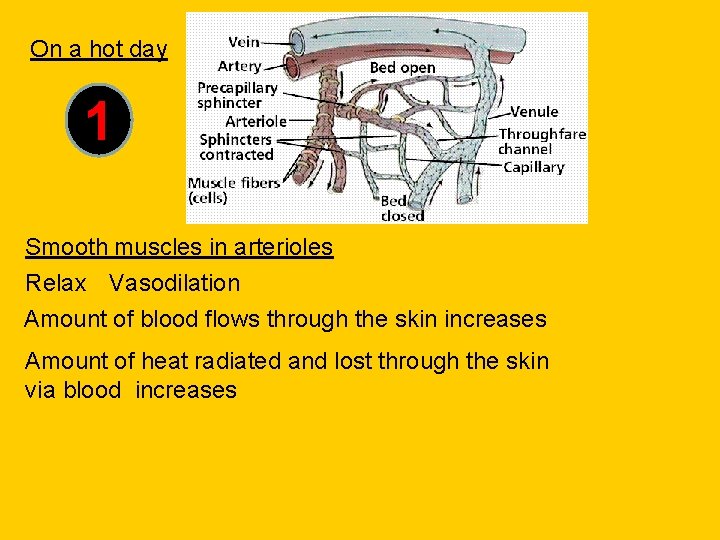
On a hot day 1 Smooth muscles in arterioles Relax Vasodilation Amount of blood flows through the skin increases Amount of heat radiated and lost through the skin via blood increases
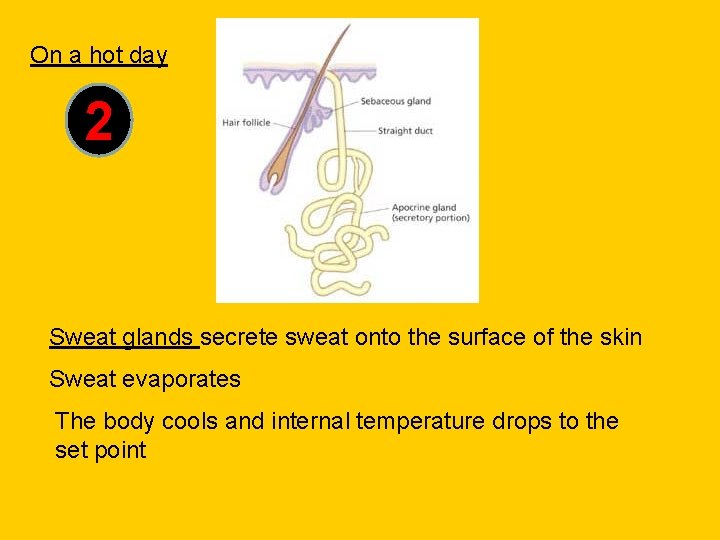
On a hot day 2 Sweat glands secrete sweat onto the surface of the skin Sweat evaporates The body cools and internal temperature drops to the set point
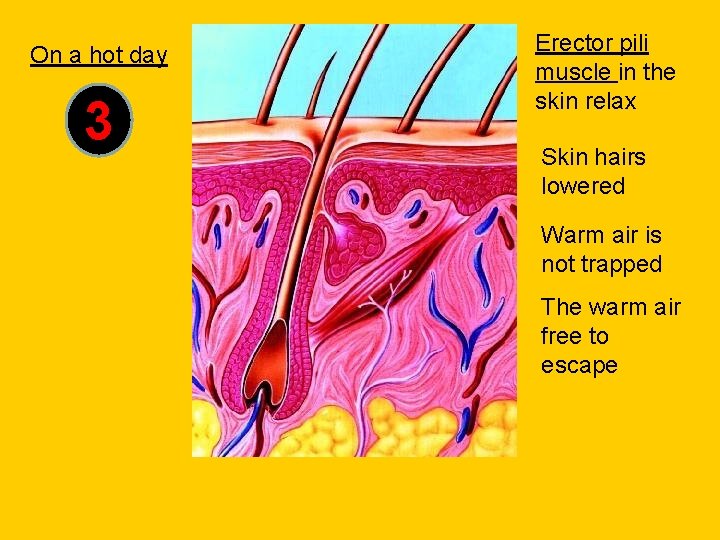
On a hot day 3 Erector pili muscle in the skin relax Skin hairs lowered Warm air is not trapped The warm air free to escape
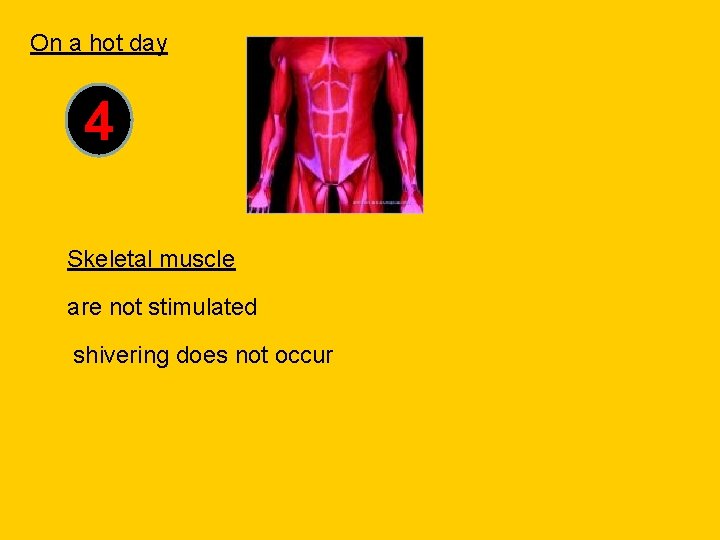
On a hot day 4 Skeletal muscle are not stimulated shivering does not occur
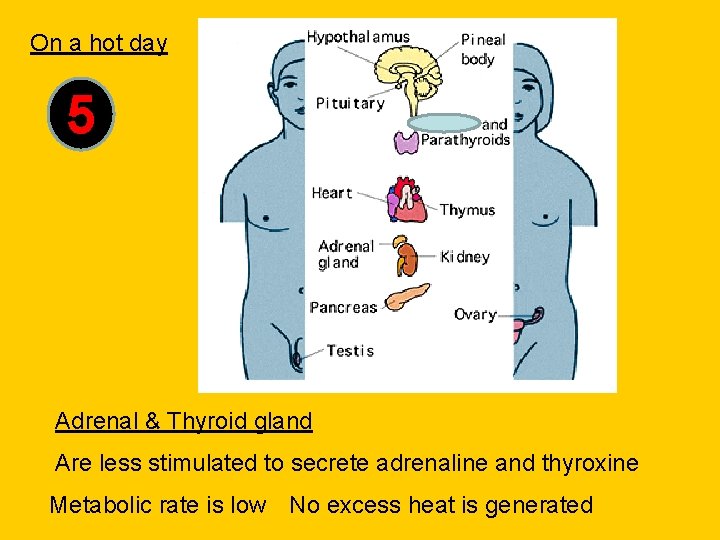
On a hot day 5 Adrenal & Thyroid gland Are less stimulated to secrete adrenaline and thyroxine Metabolic rate is low No excess heat is generated
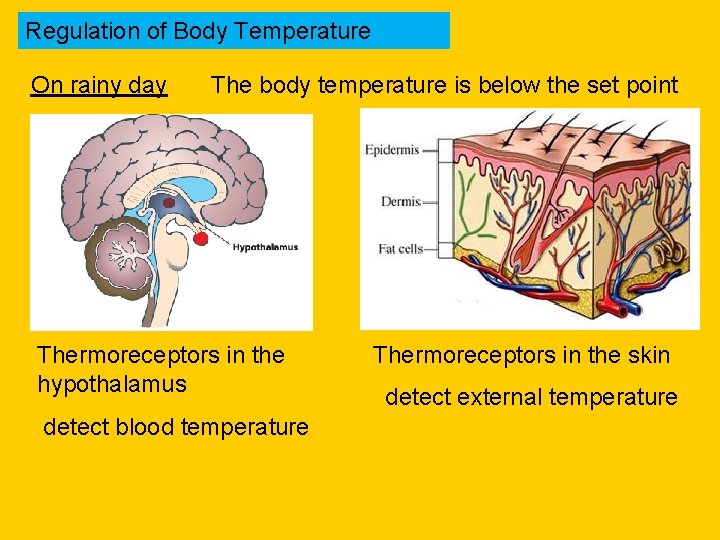
Regulation of Body Temperature On rainy day The body temperature is below the set point Thermoreceptors in the hypothalamus detect blood temperature Thermoreceptors in the skin detect external temperature
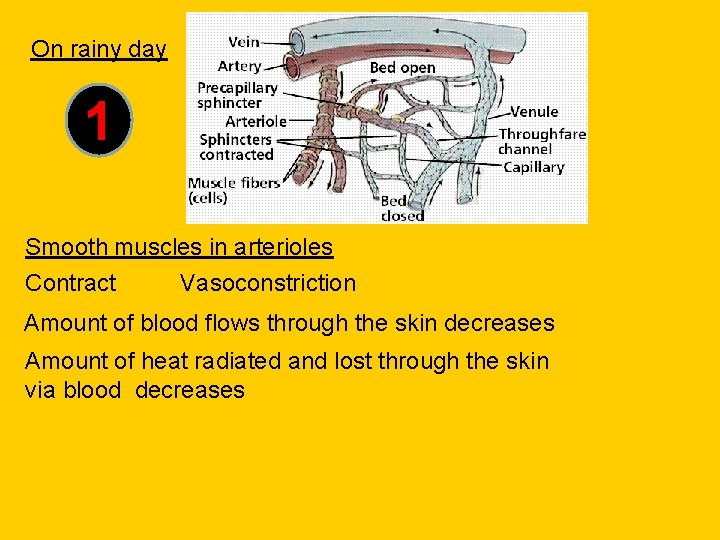
On rainy day 1 Smooth muscles in arterioles Vasoconstriction Contract Amount of blood flows through the skin decreases Amount of heat radiated and lost through the skin via blood decreases
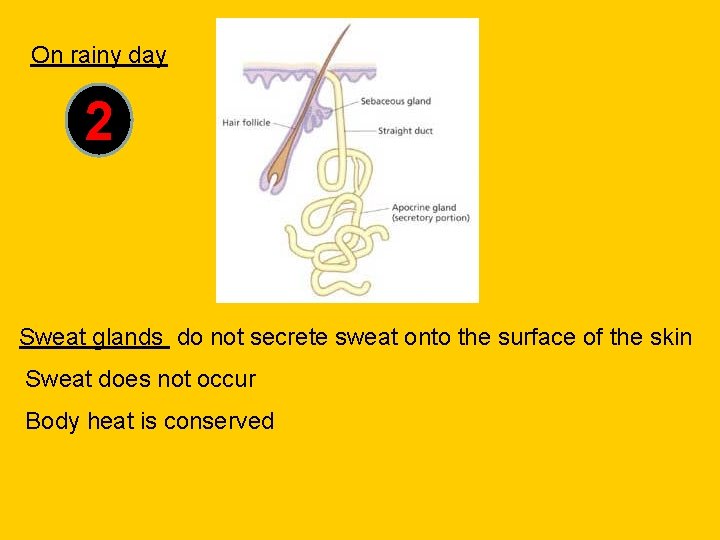
On rainy day 2 Sweat glands do not secrete sweat onto the surface of the skin Sweat does not occur Body heat is conserved
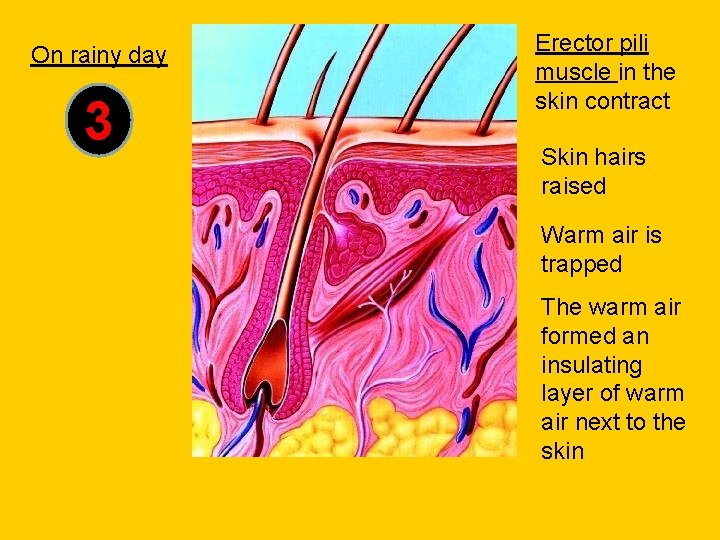
On rainy day 3 Erector pili muscle in the skin contract Skin hairs raised Warm air is trapped The warm air formed an insulating layer of warm air next to the skin
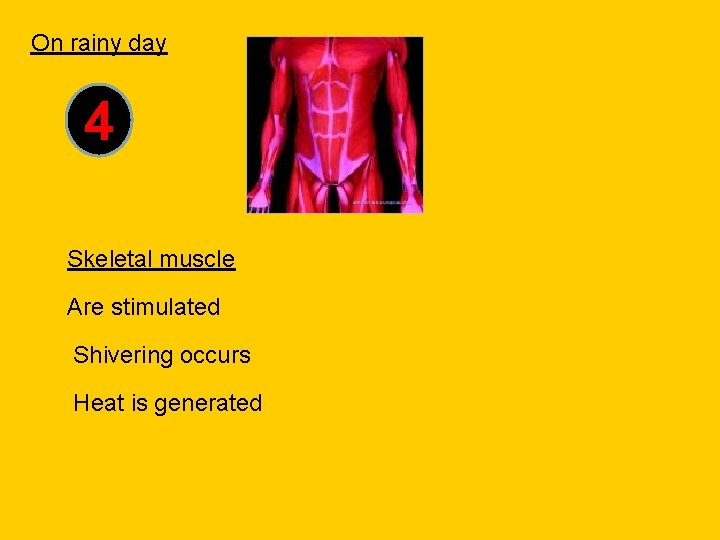
On rainy day 4 Skeletal muscle Are stimulated Shivering occurs Heat is generated
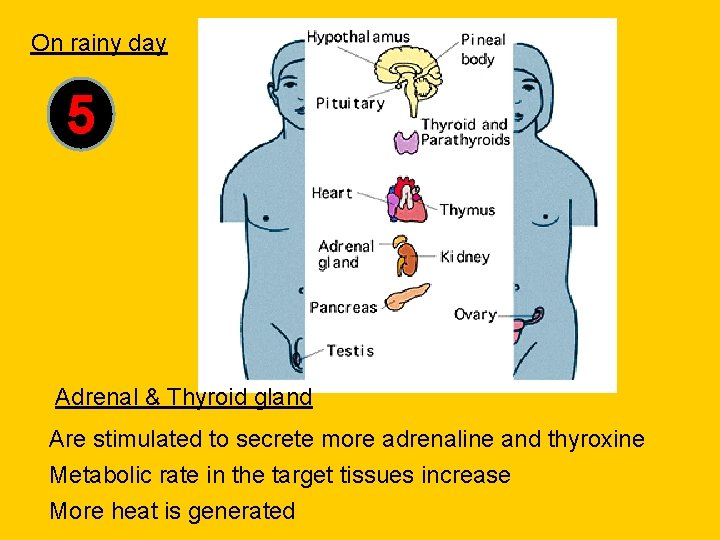
On rainy day 5 Adrenal & Thyroid gland Are stimulated to secrete more adrenaline and thyroxine Metabolic rate in the target tissues increase More heat is generated
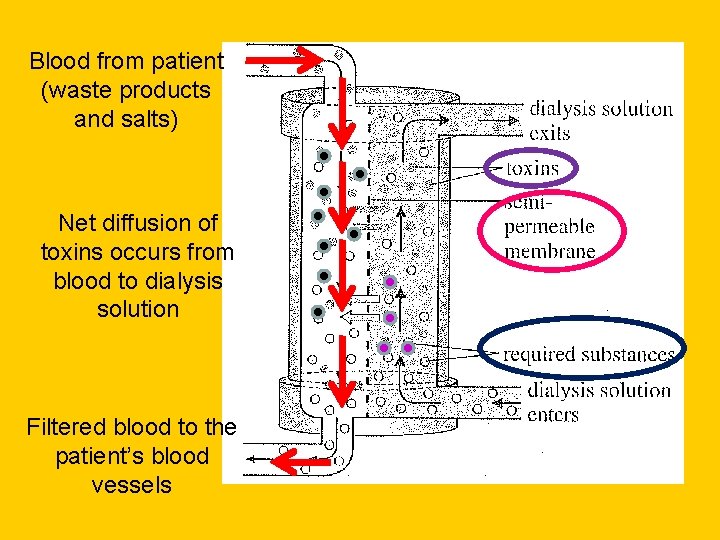
Haemodialysis and kidney therapy When both kidneys stop functioning Blood osmotic pressure and blood volume Cannot be maintained Results in build up of waste products in the body Haemodialysis Process of filtering blood using artificial means that replace failed kidneys
How? ? Blood from the patient’s artery is passed through a machine which contains a dialyser(artificial kidney) The dialyser has 2 spaces separated by a semipermeable membrane Blood passes from one side of the membrane and dialysis solution passes on the other The concentration gradient exists between the blood and the dialysis solution Blood contains high concentration of waste molecules and excess salts Waste products and excess salt diffuse from the blood into dialysis soltution
Blood from patient (waste products and salts) Net diffusion of toxins occurs from blood to dialysis solution Filtered blood to the patient’s blood vessels
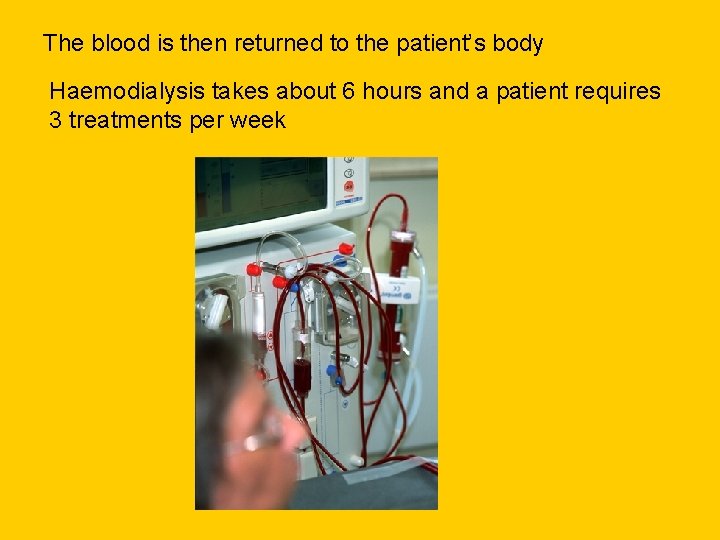
The blood is then returned to the patient’s body Haemodialysis takes about 6 hours and a patient requires 3 treatments per week
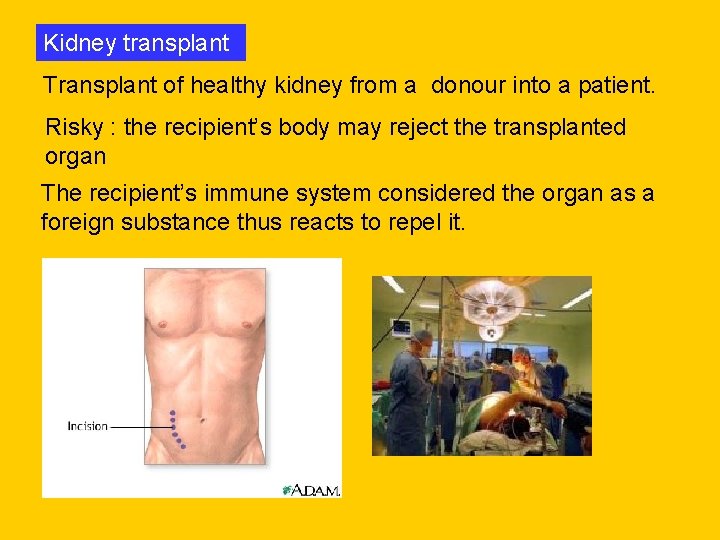
Kidney transplant Transplant of healthy kidney from a donour into a patient. Risky : the recipient’s body may reject the transplanted organ The recipient’s immune system considered the organ as a foreign substance thus reacts to repel it.
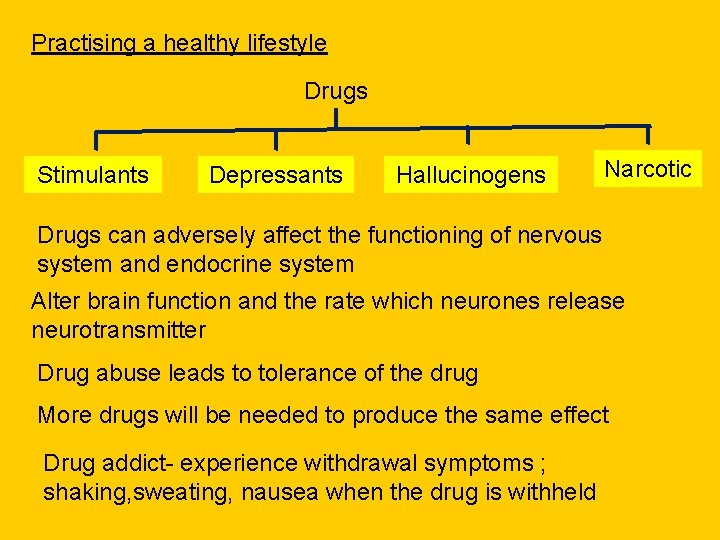
Practising a healthy lifestyle Drugs Stimulants Depressants Hallucinogens Narcotic Drugs can adversely affect the functioning of nervous system and endocrine system Alter brain function and the rate which neurones release neurotransmitter Drug abuse leads to tolerance of the drug More drugs will be needed to produce the same effect Drug addict- experience withdrawal symptoms ; shaking, sweating, nausea when the drug is withheld
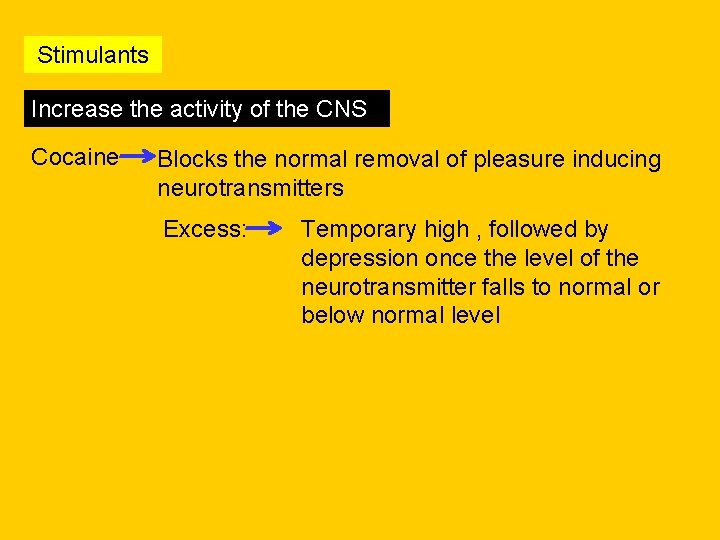
Stimulants Increase the activity of the CNS Cocaine Blocks the normal removal of pleasure inducing neurotransmitters Excess: Temporary high , followed by depression once the level of the neurotransmitter falls to normal or below normal level
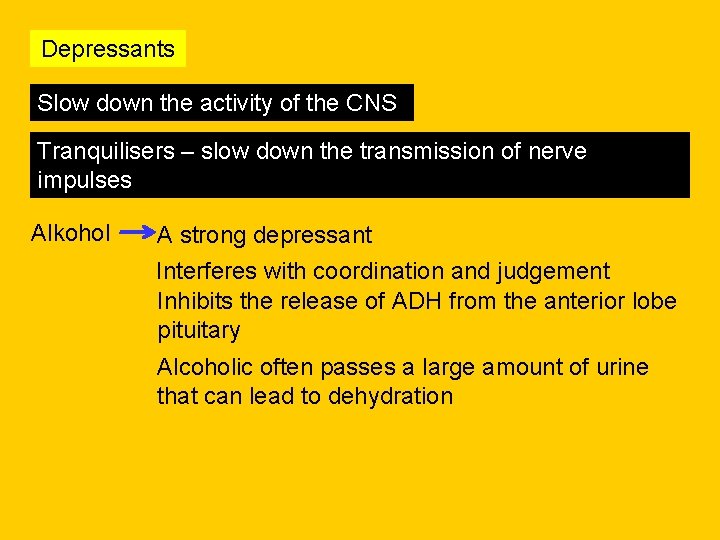
Depressants Slow down the activity of the CNS Tranquilisers – slow down the transmission of nerve impulses Alkohol A strong depressant Interferes with coordination and judgement Inhibits the release of ADH from the anterior lobe pituitary Alcoholic often passes a large amount of urine that can lead to dehydration
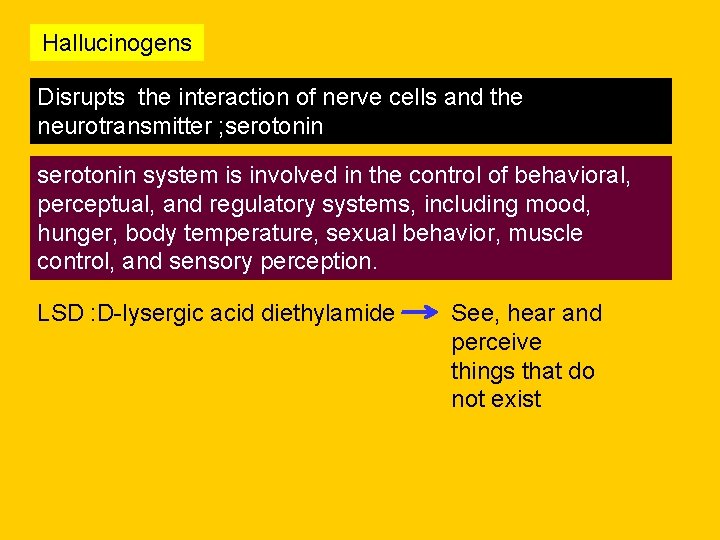
Hallucinogens Disrupts the interaction of nerve cells and the neurotransmitter ; serotonin system is involved in the control of behavioral, perceptual, and regulatory systems, including mood, hunger, body temperature, sexual behavior, muscle control, and sensory perception. LSD : D-lysergic acid diethylamide See, hear and perceive things that do not exist
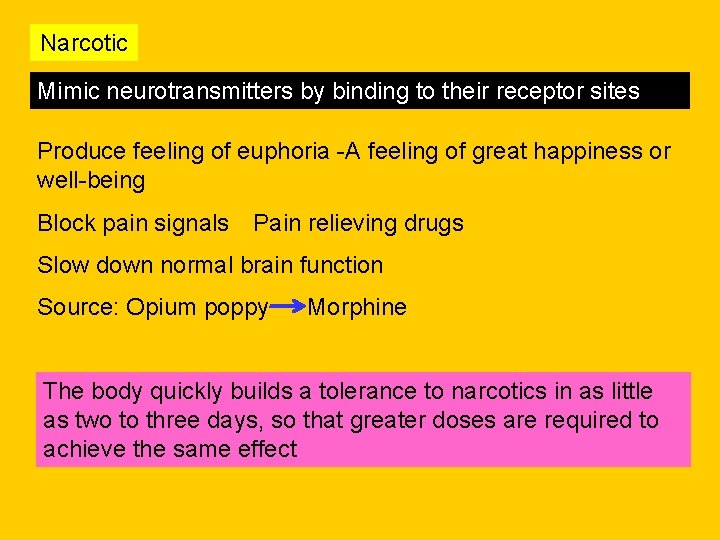
Narcotic Mimic neurotransmitters by binding to their receptor sites Produce feeling of euphoria -A feeling of great happiness or well-being Block pain signals Pain relieving drugs Slow down normal brain function Source: Opium poppy Morphine The body quickly builds a tolerance to narcotics in as little as two to three days, so that greater doses are required to achieve the same effect
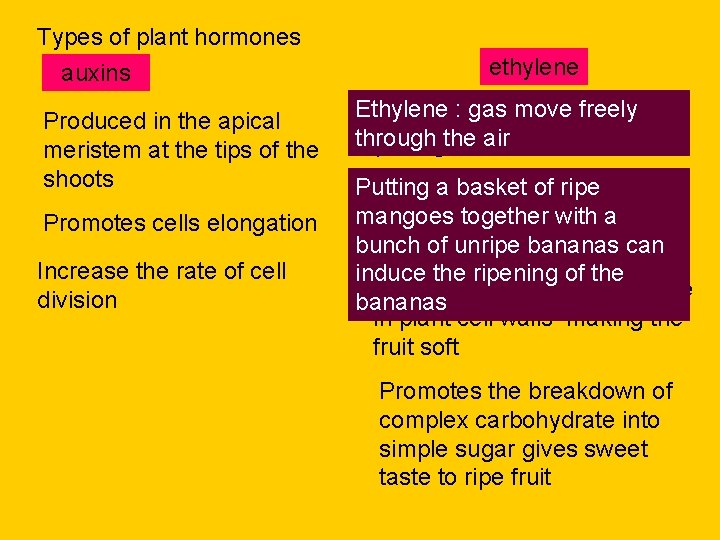
Types of plant hormones auxins Produced in the apical meristem at the tips of the shoots Promotes cells elongation Increase the rate of cell division ethylene Ethylene : gasduring movethe freely Synthesised through air ripeningthe of fruits Putting Speeds a up basket the ripening of ripe of mangoes fruits by stimulating together with thea bunch production of unripe of cellulase bananas can induce the ripening of the Cellulase hydrolyses cellulose bananas in plant cell walls making the fruit soft Promotes the breakdown of complex carbohydrate into simple sugar gives sweet taste to ripe fruit
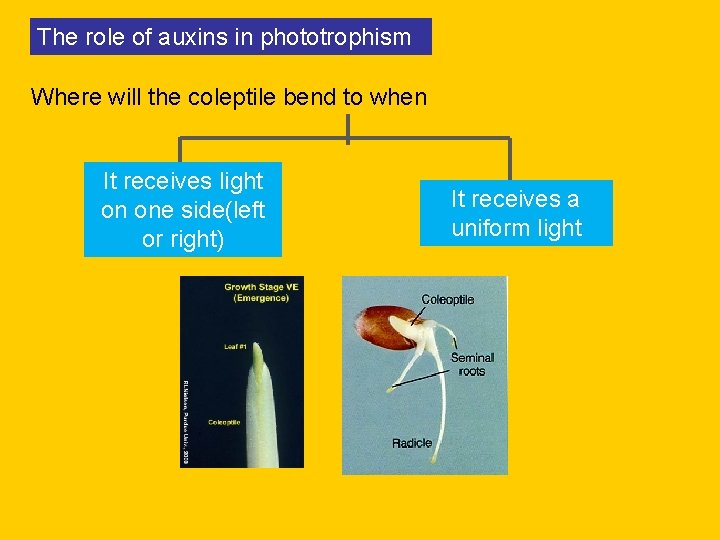
The role of auxins in phototrophism Where will the coleptile bend to when It receives light on one side(left or right) It receives a uniform light
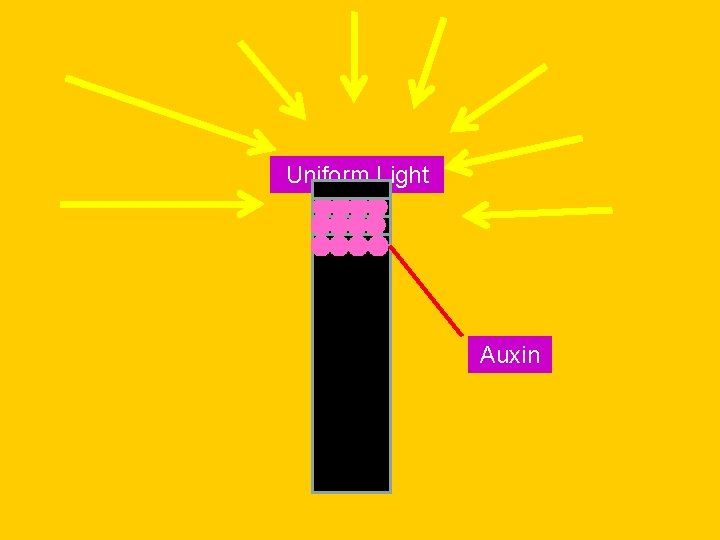
Uniform Light Auxin
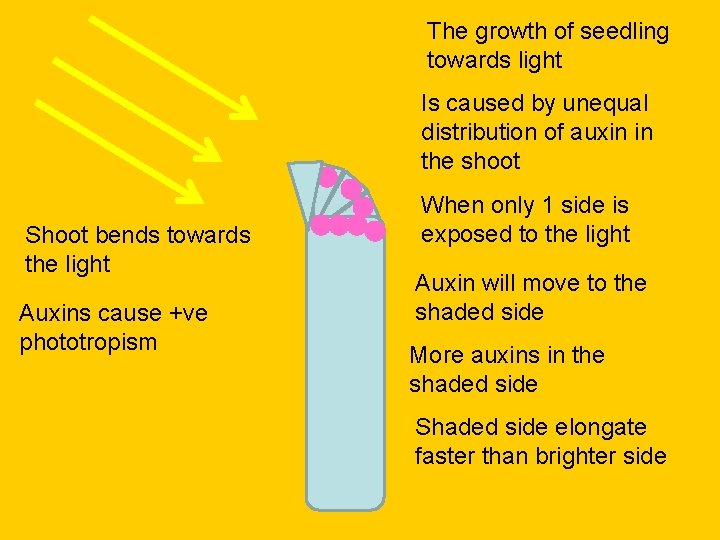
The growth of seedling towards light Is caused by unequal distribution of auxin in the shoot Shoot bends towards the light Auxins cause +ve phototropism When only 1 side is exposed to the light Auxin will move to the shaded side More auxins in the shaded side Shaded side elongate faster than brighter side
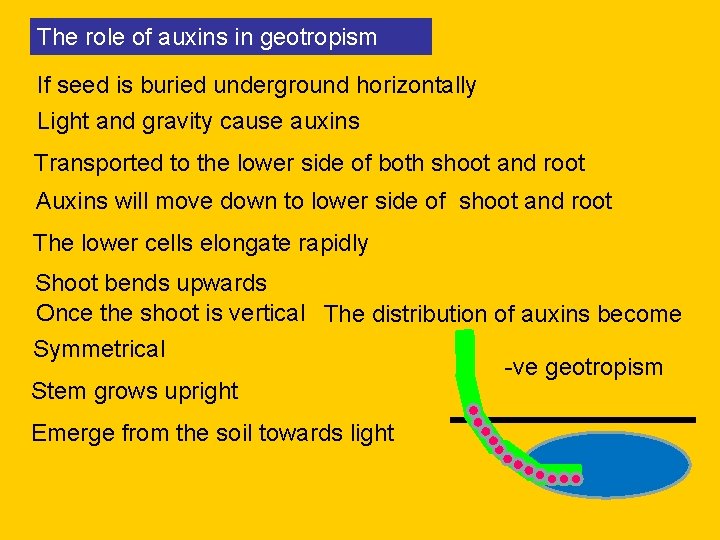
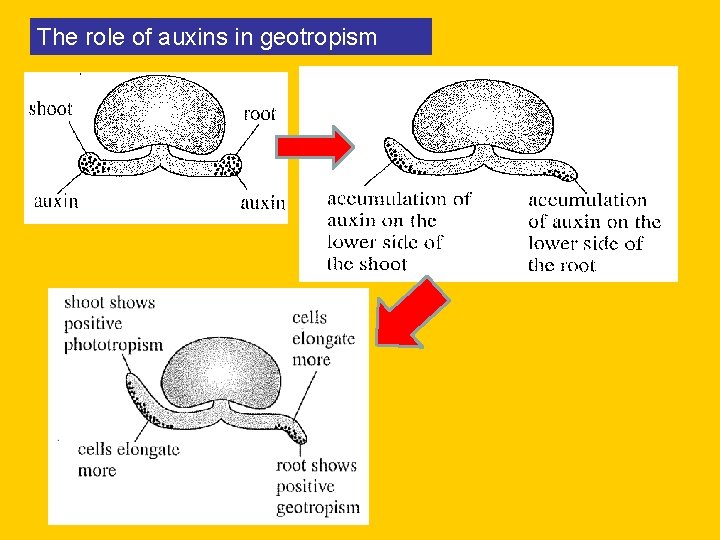
The role of auxins in geotropism If seed is buried underground horizontally Light and gravity cause auxins Transported to the lower side of both shoot and root Auxins will move down to lower side of shoot and root The lower cells elongate rapidly Shoot bends upwards Once the shoot is vertical The distribution of auxins become Symmetrical -ve geotropism Stem grows upright Emerge from the soil towards light
The role of auxins in geotropism If seed is buried underground horizontally Light and gravity cause auxins Transported to the lower side of both shoot and root Auxins will move down to lower side of root Auxins inhibit cells elongation in the root Cell elongation in the lower side is inhibited Upper side of the root Is not affected Root bends downwards Once the root tip is pointing directly downwards The auxin distribution becomes equal on all sides The root continues to grow straight downwards
The role of auxins in geotropism