
A Geometric Proof Of Napoleons Theorem Chrissy Folsom
- Slides: 15
A Geometric Proof Of Napoleon’s Theorem Chrissy Folsom June 8, 2000 Math 495 b
Napoleon the Mathematician? • Theorem named after Napoleon Bonaparte • Questionable as to whether he really deserves credit. • Some sources say he excelled in math • Earliest definite appearance of theorem: 1825 by Dr. W. Rutherford in “The Ladies Diary”
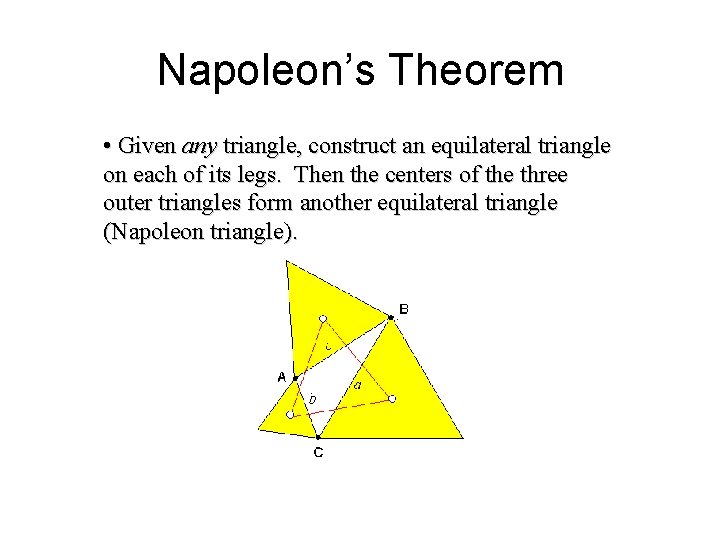
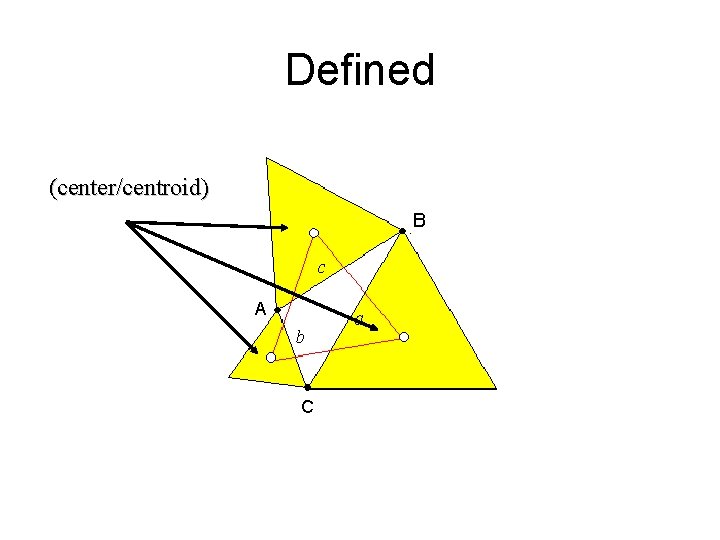
Napoleon’s Theorem • Given any triangle, construct an equilateral triangle on each of its legs. Then the centers of the three outer triangles form another equilateral triangle (Napoleon triangle).
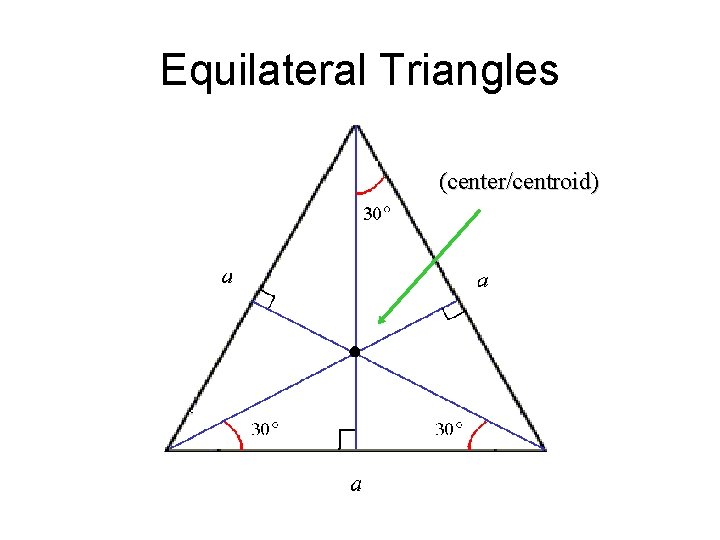
Equilateral Triangles (center/centroid)
Defined (center/centroid)
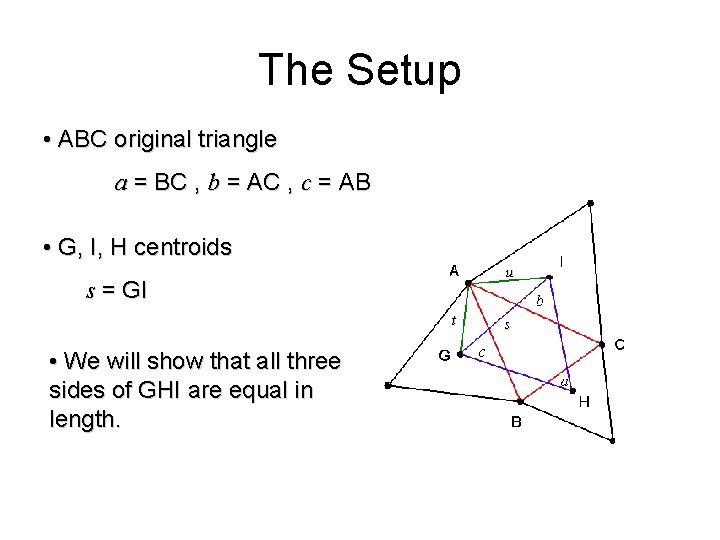
The Setup • ABC original triangle a = BC , b = AC , c = AB • G, I, H centroids u s = GI t • We will show that all three sides of GHI are equal in length. s
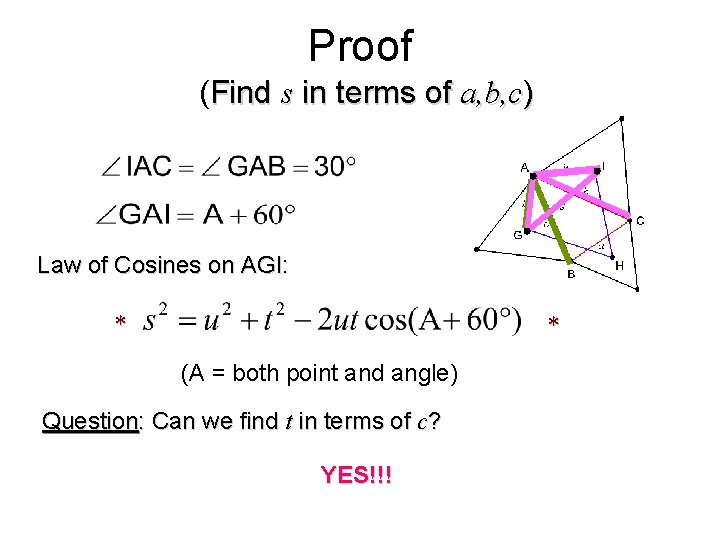
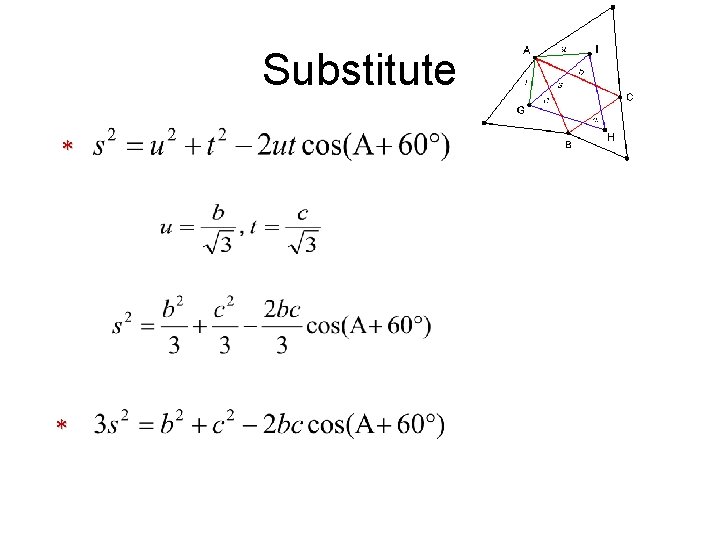
Proof (Find s in terms of a, b, c) Law of Cosines on AGI: * * (A = both point and angle) Question: Can we find t in terms of c? YES!!!
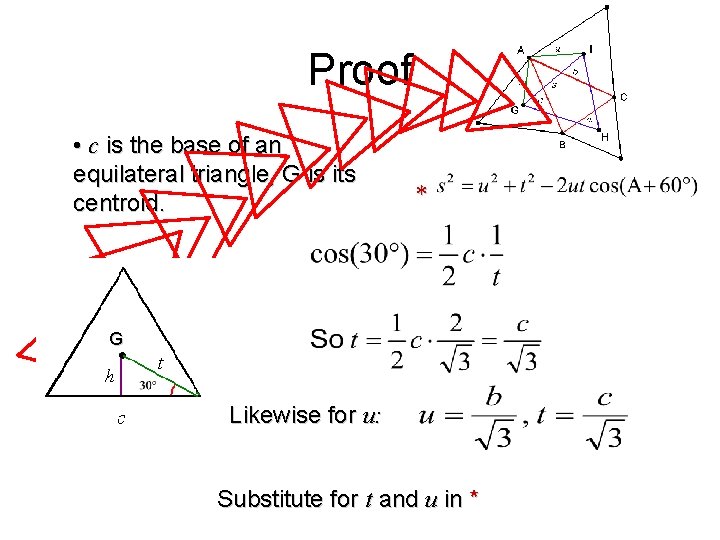
Proof • c is the base of an equilateral triangle, G is its centroid. * G Likewise for u: Substitute for t and u in *
Substitute * *
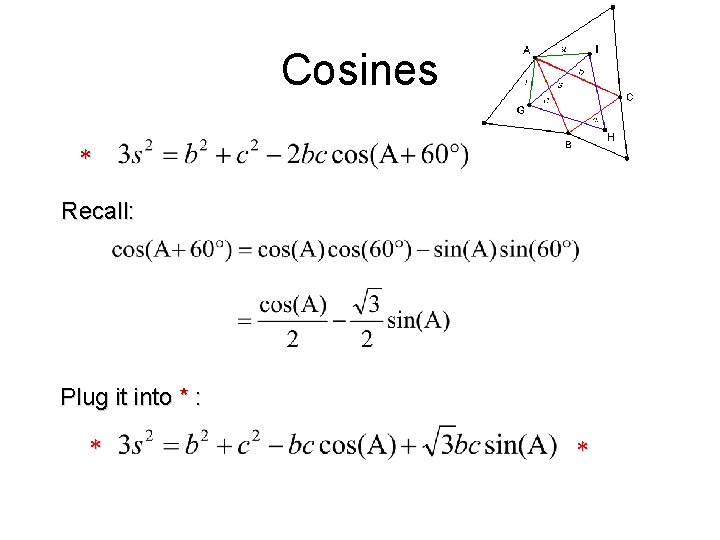
Cosines * Recall: Plug it into * : * *
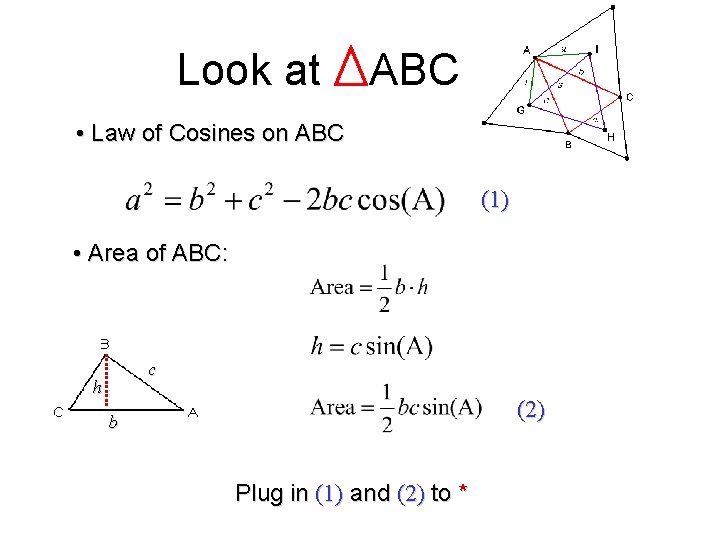
Look at ABC • Law of Cosines on ABC (1) • Area of ABC: c h (2) b Plug in (1) and (2) to *
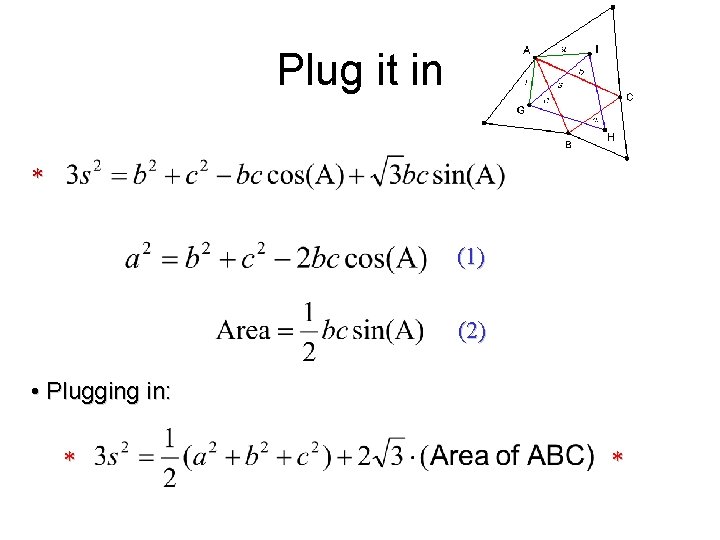
Plug it in * (1) (2) • Plugging in: * *
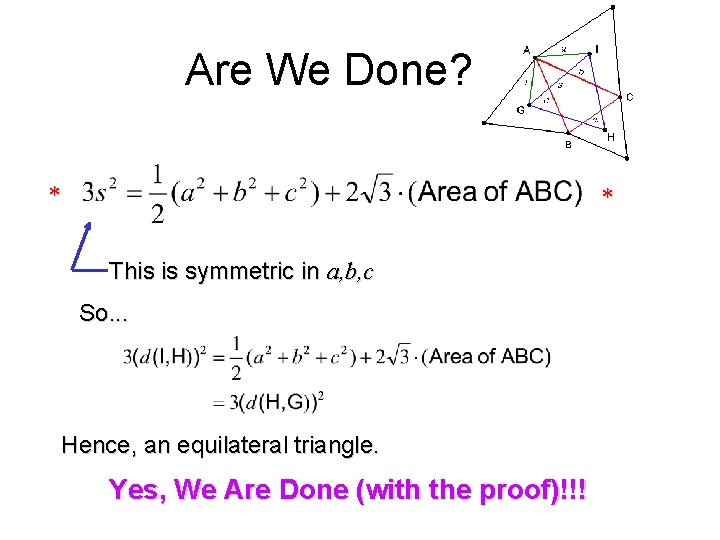
Are We Done? * * This is symmetric in a, b, c So. . . Hence, an equilateral triangle. Yes, We Are Done (with the proof)!!!
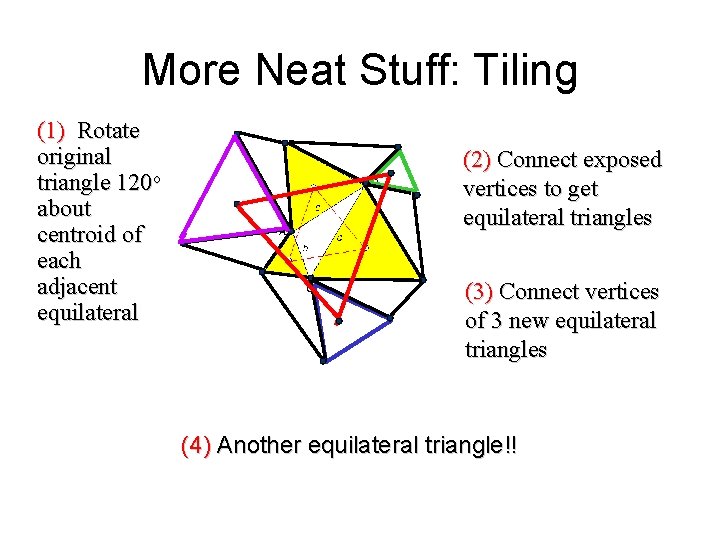
More Neat Stuff: Tiling (1) Rotate original triangle 120 o about centroid of each adjacent equilateral (2) Connect exposed vertices to get equilateral triangles (3) Connect vertices of 3 new equilateral triangles (4) Another equilateral triangle!!
Conclusions Some Generalizations: • If similar triangles of any shape are added onto the original triangle, then any triple of corresponding points on triangles forms a triangle of same shape. • Begin with arbitrary n-gon. Attach a regular ngon to each side. Connect similar points and get another regular n-gon. (Napoleon when n=3).