
A Geologic Field Trip Up or Down Mount
- Slides: 14
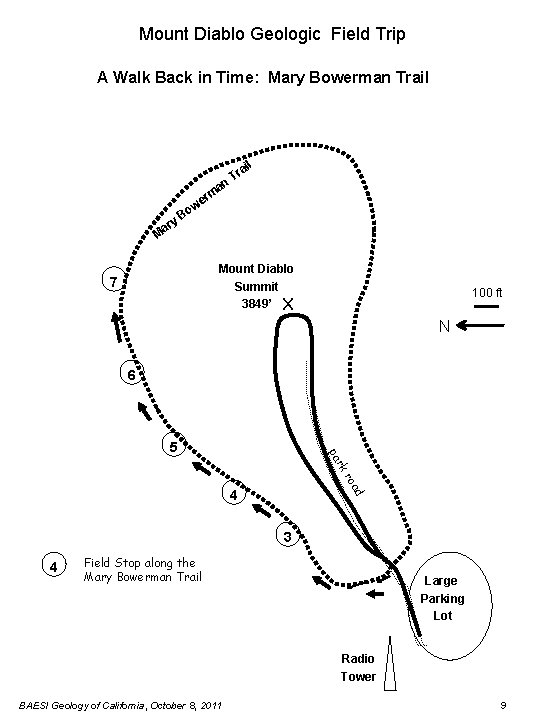
A Geologic Field Trip Up (or Down) Mount Diablo Take your students on a “virtual field trip” with photographs and maps o Today’s field trip will focus on relating geologic maps to real geology. We will drive directly to the top of the mountain to begin with a nearly aerial view of the geologic patterns around Mt. Diablo o We will examine several important rock types that occur throughout the central coast of California, and will discuss how these rock types represent different episodes of California’s complex geologic development. o This field trip will be entirely within Mt. Diablo State Park, which does not allow collecting samples of any rocks or plants within the park. We will bring along samples of the same types of rocks collected from outside the park for those who want to have samples for their classrooms. o To begin this field trip, we will drive into the park via the south gate, pay the entrance fee, and drive directly to the summit, about 11. 5 miles total from the turn off from the main road. Due to numerous tight curves and many bicyclers, this drive will take about 45 minutes. o As we approach the summit, you will notice a large radio transmission tower. Immediately after this tower is a large paved parking lot where we will begin our field trip. If you accidentally miss this turn and end up at the summit, just continue down the road about 100 meters back to the large parking lot. o After the field stops and discussions along the Mary Bowerman Trail, we will drive down the mountain about 10 minutes to a roadside outcrop of Franciscan Chert. The first car will lead the rest to a safe parking area off of the main road for this outcrop. o After the chert outcrop, we will drive about 5 minutes to the Rock City area where we will examine large outcrops of Domingene Sandstone. There are numerous parking spaces in this area. This will be the final official stop of this field trip. Participants can leave and drive back down to the main highway on their own. Please drive safely and carefully! BAESI Geology of California, October 8, 2011 1
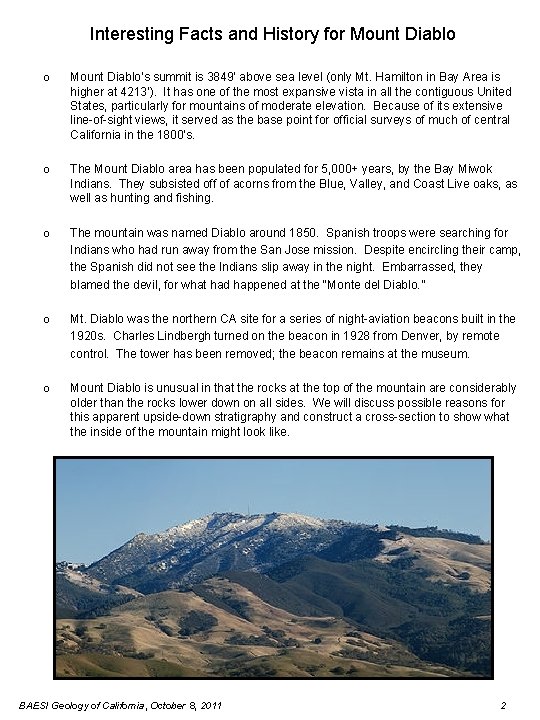
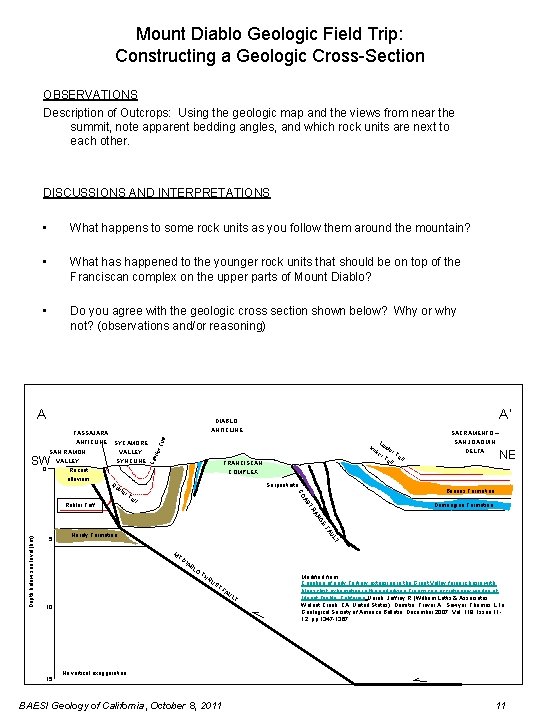
Interesting Facts and History for Mount Diablo o Mount Diablo’s summit is 3849’ above sea level (only Mt. Hamilton in Bay Area is higher at 4213’). It has one of the most expansive vista in all the contiguous United States, particularly for mountains of moderate elevation. Because of its extensive line-of-sight views, it served as the base point for official surveys of much of central California in the 1800’s. o The Mount Diablo area has been populated for 5, 000+ years, by the Bay Miwok Indians. They subsisted off of acorns from the Blue, Valley, and Coast Live oaks, as well as hunting and fishing. o The mountain was named Diablo around 1850. Spanish troops were searching for Indians who had run away from the San Jose mission. Despite encircling their camp, the Spanish did not see the Indians slip away in the night. Embarrassed, they blamed the devil, for what had happened at the “Monte del Diablo. ” o Mt. Diablo was the northern CA site for a series of night-aviation beacons built in the 1920 s. Charles Lindbergh turned on the beacon in 1928 from Denver, by remote control. The tower has been removed; the beacon remains at the museum. o Mount Diablo is unusual in that the rocks at the top of the mountain are considerably older than the rocks lower down on all sides. We will discuss possible reasons for this apparent upside-down stratigraphy and construct a cross-section to show what the inside of the mountain might look like. BAESI Geology of California, October 8, 2011 2
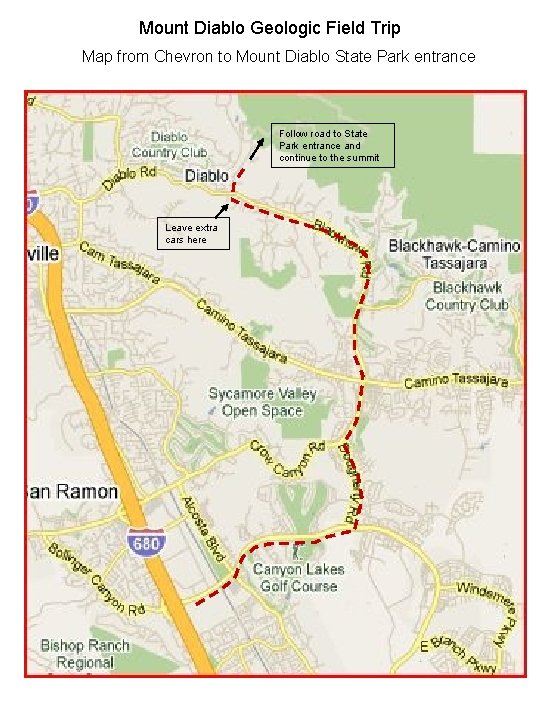
Mount Diablo Geologic Field Trip Map from Chevron to Mount Diablo State Park entrance Follow road to State Park entrance and continue to the summit Leave extra cars here
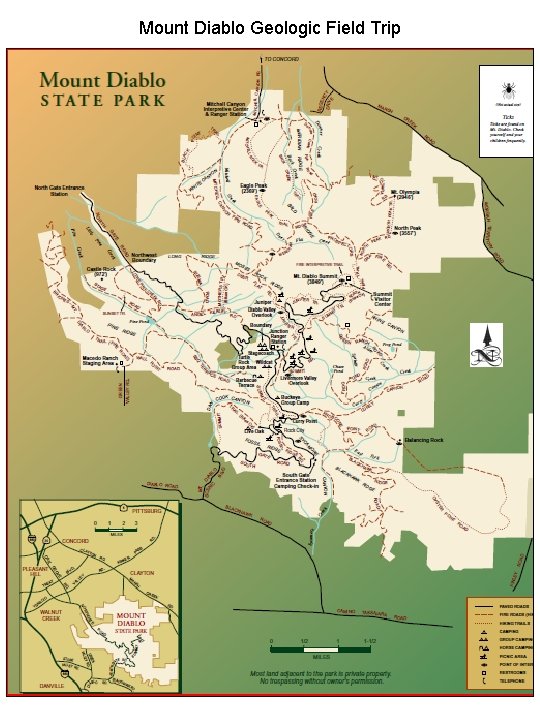
Mount Diablo Geologic Field Trip
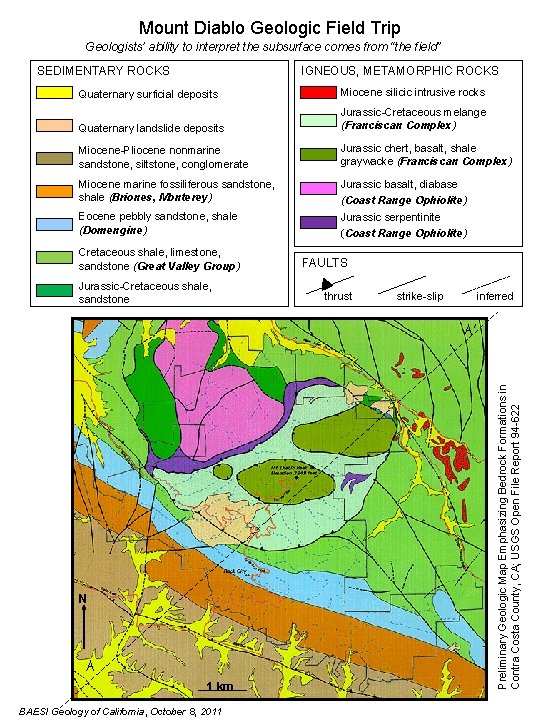
Mount Diablo Geologic Field Trip Geologists’ ability to interpret the subsurface comes from “the field” SEDIMENTARY ROCKS IGNEOUS, METAMORPHIC ROCKS Quaternary surficial deposits Miocene silicic intrusive rocks Quaternary landslide deposits Jurassic-Cretaceous melange (Franciscan Complex) Miocene-Pliocene nonmarine sandstone, siltstone, conglomerate Jurassic chert, basalt, shale graywacke (Franciscan Complex) Miocene marine fossiliferous sandstone, shale (Briones, Monterey) Jurassic basalt, diabase (Coast Range Ophiolite) Eocene pebbly sandstone, shale (Domengine) Jurassic serpentinite (Coast Range Ophiolite) Cretaceous shale, limestone, sandstone (Great Valley Group) Jurassic-Cretaceous shale, sandstone FAULTS thrust strike-slip inferred N A 1 km BAESI Geology of California, October 8, 2011 Preliminary Geologic Map Emphasizing Bedrock Formations in Contra Costa County, CA; USGS Open File Report 94 -622 A’
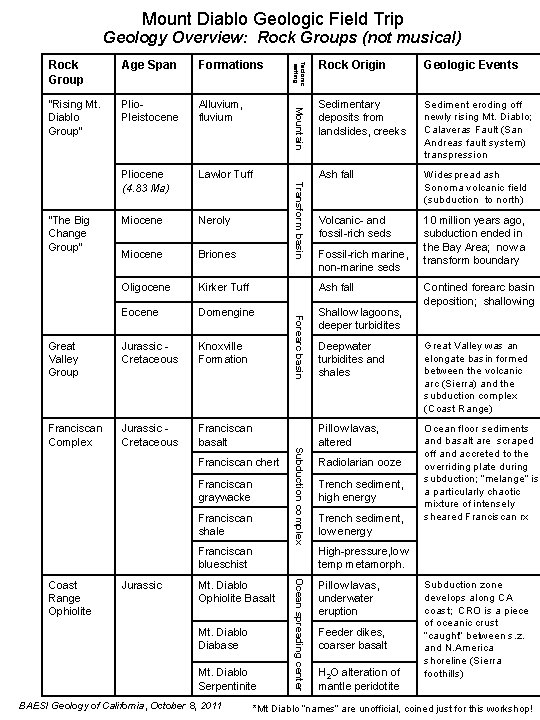
Mount Diablo Geologic Field Trip Geology Overview: Rock Groups (not musical) Age Span Formations “Rising Mt. Diablo Group” Plio. Pleistocene Alluvium, fluvium Pliocene (4. 83 Ma) Lawlor Tuff Miocene Neroly Miocene Briones Oligocene Kirker Tuff Ash fall Eocene Domengine Shallow lagoons, deeper turbidites Great Valley Group Jurassic Cretaceous Knoxville Formation Franciscan Complex Jurassic Cretaceous Franciscan basalt Mountain Transform basin “The Big Change Group” Franciscan shale Franciscan blueschist Mt. Diablo Ophiolite Basalt Mt. Diablo Diabase Mt. Diablo Serpentinite BAESI Geology of California, October 8, 2011 Ocean spreading center Jurassic Subduction complex Franciscan graywacke Forearc basin Franciscan chert Coast Range Ophiolite Tectonic setting Rock Group Rock Origin Geologic Events Sedimentary deposits from landslides, creeks Sediment eroding off newly rising Mt. Diablo; Calaveras Fault (San Andreas fault system) transpression Ash fall Widespread ash Sonoma volcanic field (subduction to north) Volcanic- and fossil-rich seds 10 million years ago, subduction ended in the Bay Area; now a transform boundary Fossil-rich marine, non-marine seds Contined forearc basin deposition; shallowing Deepwater turbidites and shales Great Valley was an elongate basin formed between the volcanic arc (Sierra) and the subduction complex (Coast Range) Pillow lavas, altered Ocean floor sediments and basalt are scraped off and accreted to the overriding plate during subduction; “melange” is a particularly chaotic mixture of intensely sheared Franciscan rx Radiolarian ooze Trench sediment, high energy Trench sediment, low energy High-pressure, low temp metamorph. Pillow lavas, underwater eruption Feeder dikes, coarser basalt H 2 O alteration of mantle peridotite Subduction zone develops along CA coast; CRO is a piece of oceanic crust “caught” between s. z. and N. America shoreline (Sierra foothills) *Mt Diablo “names” are unofficial, coined just for this workshop!
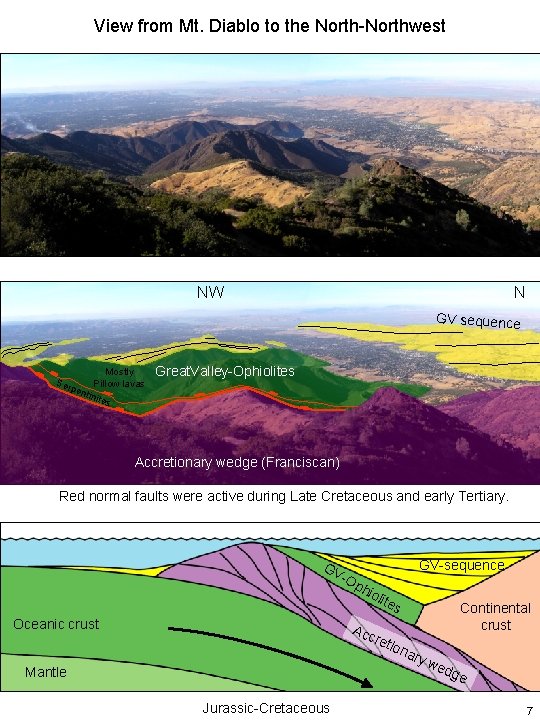
View from Mt. Diablo to the North-Northwest NW N GV sequence Mostly Pillow lavas pen tinit es Ser Great. Valley-Ophiolites Accretionary wedge (Franciscan) Red normal faults were active during Late Cretaceous and early Tertiary. GV GV-sequence -O ph io lite s Oceanic crust Acc Continental crust reti o Mantle Jurassic-Cretaceous nar y we dge 7
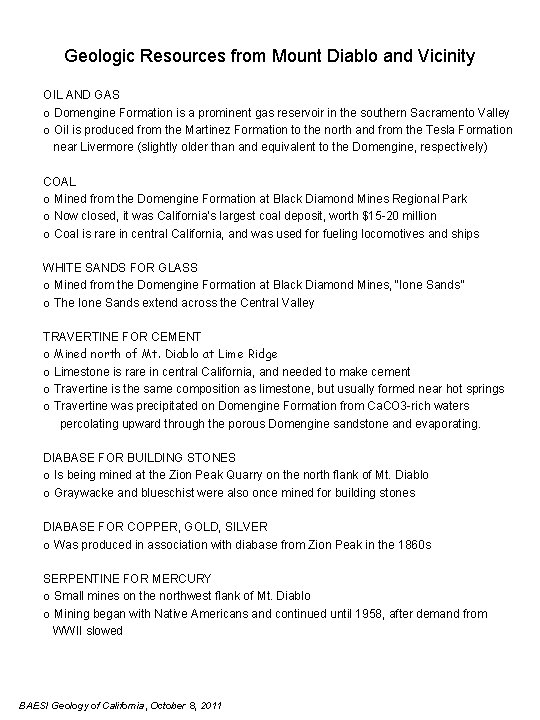
Geologic Resources from Mount Diablo and Vicinity OIL AND GAS o Domengine Formation is a prominent gas reservoir in the southern Sacramento Valley o Oil is produced from the Martinez Formation to the north and from the Tesla Formation near Livermore (slightly older than and equivalent to the Domengine, respectively) COAL o Mined from the Domengine Formation at Black Diamond Mines Regional Park o Now closed, it was California’s largest coal deposit, worth $15 -20 million o Coal is rare in central California, and was used for fueling locomotives and ships WHITE SANDS FOR GLASS o Mined from the Domengine Formation at Black Diamond Mines, “Ione Sands” o The Ione Sands extend across the Central Valley TRAVERTINE FOR CEMENT o Mined north of Mt. Diablo at Lime Ridge o Limestone is rare in central California, and needed to make cement o Travertine is the same composition as limestone, but usually formed near hot springs o Travertine was precipitated on Domengine Formation from Ca. CO 3 -rich waters percolating upward through the porous Domengine sandstone and evaporating. DIABASE FOR BUILDING STONES o Is being mined at the Zion Peak Quarry on the north flank of Mt. Diablo o Graywacke and blueschist were also once mined for building stones DIABASE FOR COPPER, GOLD, SILVER o Was produced in association with diabase from Zion Peak in the 1860 s SERPENTINE FOR MERCURY o Small mines on the northwest flank of Mt. Diablo o Mining began with Native Americans and continued until 1958, after demand from WWII slowed BAESI Geology of California, October 8, 2011
Mount Diablo Geologic Field Trip A Walk Back in Time: Mary Bowerman Trail l ai an M y ar Bo Tr rm we Mount Diablo Summit 3849’ X 7 100 ft N 6 rk pa 5 ad ro 4 3 4 Field Stop along the Mary Bowerman Trail Large Parking Lot Radio Tower BAESI Geology of California, October 8, 2011 9
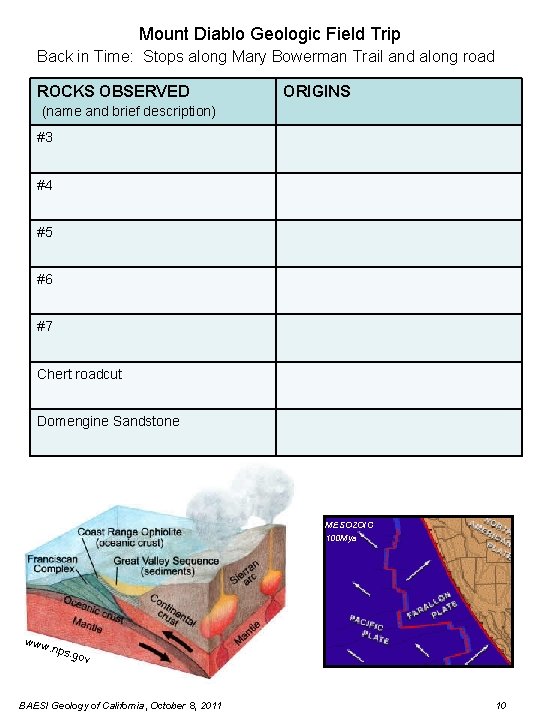
Mount Diablo Geologic Field Trip Back in Time: Stops along Mary Bowerman Trail and along road ROCKS OBSERVED ORIGINS (name and brief description) #3 #4 #5 #6 #7 Chert roadcut Domengine Sandstone MESOZOIC 100 Mya www. nps. gov BAESI Geology of California, October 8, 2011 10
Mount Diablo Geologic Field Trip: Constructing a Geologic Cross-Section OBSERVATIONS Description of Outcrops: Using the geologic map and the views from near the summit, note apparent bedding angles, and which rock units are next to each other. DISCUSSIONS AND INTERPRETATIONS • What happens to some rock units as you follow them around the mountain? • What has happened to the younger rock units that should be on top of the Franciscan complex on the upper parts of Mount Diablo? • Do you agree with the geologic cross section shown below? Why or why not? (observations and/or reasoning) A 0 Tu ff lor SW Ki Law TASSAJARA ANTICLINE SYCAMORE VALLEY SAN RAMON SYNCLINE VALLEY Recent alluvium A’ DIABLO ANTICLINE FRANCISCAN COMPLEX Ro Serpentinite wl rke or r T Tuf f uff SACRAMENTO – SAN JOAQUIN DELTA NE Briones Formation Domengine Formation T Roblar Tuff AS r. T CO bla La FA Neroly Formation T UL Depth below sea level (km) E NG RA 5 MT DI A BL O TH RU ST FA UL T 10 15 Modified from: Coupling of early Tertiary extension in the Great Valley forearc basin with blueschist exhumation in the underlying Franciscan accretionary wedge at Mount Diablo, California Unruh, Jeffrey R. (William Lettis & Associates, Walnut Creek, CA, United States); Dumitru, Trevor A. ; Sawyer, Thomas L. In: Geological Society of America Bulletin, December 2007, Vol. 119, Issue 1112, pp. 1347 -1367 No vertical exaggeration BAESI Geology of California, October 8, 2011 11
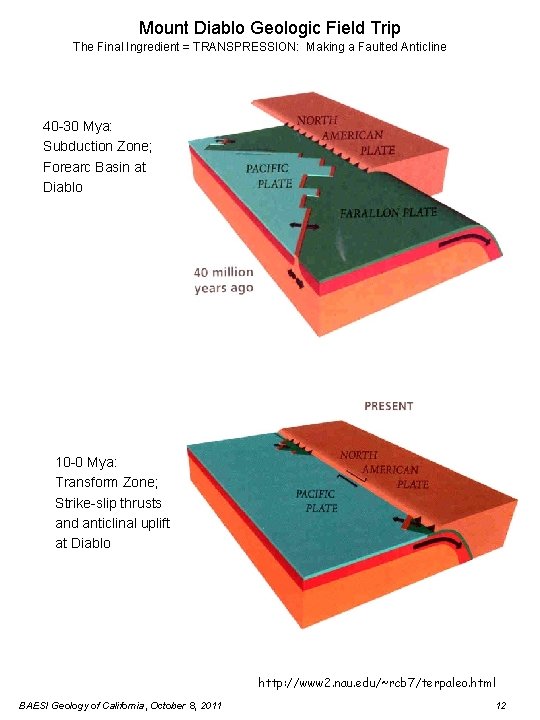
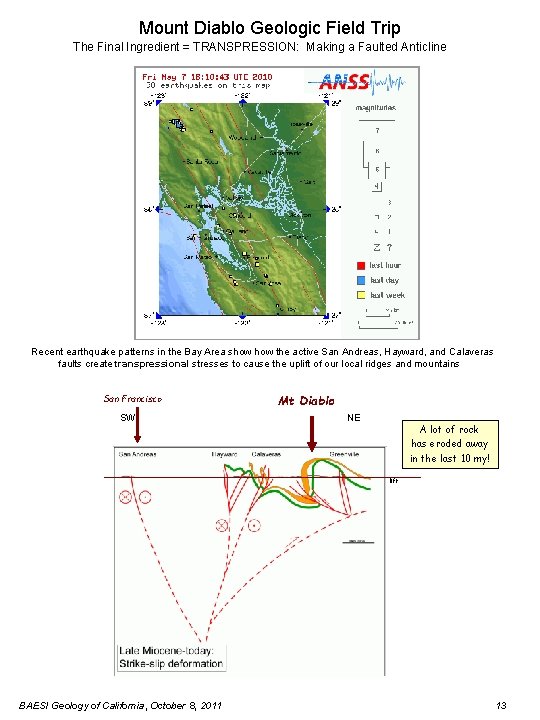
Mount Diablo Geologic Field Trip The Final Ingredient = TRANSPRESSION: Making a Faulted Anticline 40 -30 Mya: Subduction Zone; Forearc Basin at Diablo 10 -0 Mya: Transform Zone; Strike-slip thrusts and anticlinal uplift at Diablo http: //www 2. nau. edu/~rcb 7/terpaleo. html BAESI Geology of California, October 8, 2011 12
Mount Diablo Geologic Field Trip The Final Ingredient = TRANSPRESSION: Making a Faulted Anticline Recent earthquake patterns in the Bay Area show the active San Andreas, Hayward, and Calaveras faults create transpressional stresses to cause the uplift of our local ridges and mountains San Francisco SW Mt Diablo NE A lot of rock has eroded away in the last 10 my! 0 ft BAESI Geology of California, October 8, 2011 13
Links o USGS Geology http: //geology. usgs. gov/ o USGS Earthquakes http: //earthquake. usgs. gov/earthquakes/recenteqsus/Maps/US 2/ o Geological Society of America (K-12 Education) http: //www. geosociety. org/educate/ o American Geophysical Union (K-12 Education) http: //www. agu. org/education/students_teachers. shtml o San Joaquin Geological Society http: //www. sjgs. com/ o American Association of Petroleum Geologists (K-12 Education) http: //www. aapg. org/k 12 resources/index. cfm o American Geological Institute (K-12 Education) http: //www. agiweb. org/geoeducation. html o National Association of Geoscience Teachers http: //nagt. org/index. html o American Petroleum Institute http: //www. api. org/ o Oil price chronology, Energy Information Administration (www. eia. doe. gov) o Deep Earth Academy, Integrated Ocean Drilling Program http: //www. oceanleadership. org/education/deep-earth-academy/ o Joides scientific ocean drilling ship tour http: //joidesresolution. org/node/139 o Chevron http: //www. chevron. com/ BAESI Exploring for Oil and Gas May 8, 2010 14