
A GeneticNeuroFuzzy inferential model for diagnosis of tuberculosis
A Genetic-Neuro-Fuzzy inferential model for diagnosis of tuberculosis
Domain Introduction: • Image processing is a method to perform some operations on an image, in order to get an enhanced image or to extract some useful information from it. • It is a type of signal processing in which input is an image and output may be image or characteristics/features associated with that image. • Nowadays, image processing is among rapidly growing technologies. It forms core research area within engineering and computer science disciplines too. • Image processing basically includes the following three steps: • Importing the image via image acquisition tools; • Analyzing and manipulating the image; • Output in which result can be altered image or report that is based on image analysis.
Purpose of Image processing: The purpose of image processing is divided into 5 groups. They are: 1. Visualization - Observe the objects that are not visible. 2. Image sharpening and restoration - To create a better image. 3. Image retrieval - Seek for the image of interest. 4. Measurement of pattern – Measures various objects in an image. 5. Image Recognition – Distinguish the objects in an image.
Abstract: • In this process, we proposes a technique for intelligent diagnosis of TB using Neuro-Fuzzy Inferential method to provide a decision support platform by using the classification method. • Hence that can assist medical practitioners in administering accurate, timely, and cost effective diagnosis of Tuberculosis. • Performance evaluation observed, using a particle swarm optimization technique to optimize the feature data and then to classification by nuro-fuzzy that shows sensitivity and accuracy results of more than 95% , which are within the acceptable range of predefined by domain experts.
Objective: • The main objective of this process is to improve the efficiency of the decision support system by using the efficient classification method. • To improve the stability of the feature vector by using the shape of the segmented region.

Problem Identification: • In this process, we address the problem to rectify the decision support system and to improve the support system by using the classification. • Hence by improving the decision support system, we produce the accurate classification system and to improve reliability of the process.
Introduction: • TB is a bacterial disease which in humans is usually caused by an organism called Mycobacterium tuberculosis (M. tuberculosis). TB is an abbreviation of the word Tuberculosis and is how people usually refer to the disease. • Bovine TB is a disease caused by similar bacteria called Mycobacterium bovis (M. bovis). Bovine TB mainly affects cattle but can also affect humans. Most of the information on this website refers to TB in humans caused by M. tuberculosis. • Just a few years ago it was believed that TB was an old disease, and that it was no longer a problem in humans.
Existing System: • Tuberculosis remains a serious social and public health problem, affecting millions of people annually. The bacilli-Calmette-Guerin (BCG) vaccine, used prophylactically, does not impede the progression of the disease, which usually manifests as decreased cellular immunity. • Early diagnosis, together with poly chemotherapy, can control the dissemination of the tuberculosis infection. The current diagnostic methods present certain problems. • Such problems include the low sensitivity of sputum smear microscopy, the fact that performing microbiological cultures is quite time-consuming, and the low specificity of the skin test with the purified protein derivative of Mycobacterium tuberculosis.
Disadvantages: • The classification of the features were compared based on the different classifiers. The feature extraction process were not compared. • The estimation of optimal features were not employed in the existing methods. • The textural features were more often used in the existing methods. In medical images the statistical parameters and the intensity based features were also needed to get the best features from the images.
Proposed System: • The problem of health monitoring has been taken as it is one of the challenging problems in rural areas where people many times do not get proper treatment and are not financially sound to visit doctors in city. • Tuberculosis is an infectious disease and many lives are lost due to lack of proper treatment which in turn can be saved if proper prognosis is done in time. • In this proposed system, a detailed implementation has been done to design a system for diagnosing tuberculosis using adaptive neuro fuzzy inference system.
Advantages: • The most important advantage of neural networks is their adaptively. • Neural networks can automatically adjust their weights to optimize their behavior as pattern recognizers, decision makers, system controllers, predictors. • Fuzzy systems are more favorable in that their behavior can be explained based on fuzzy rules and thus their performance can be adjusted by tuning the rules.
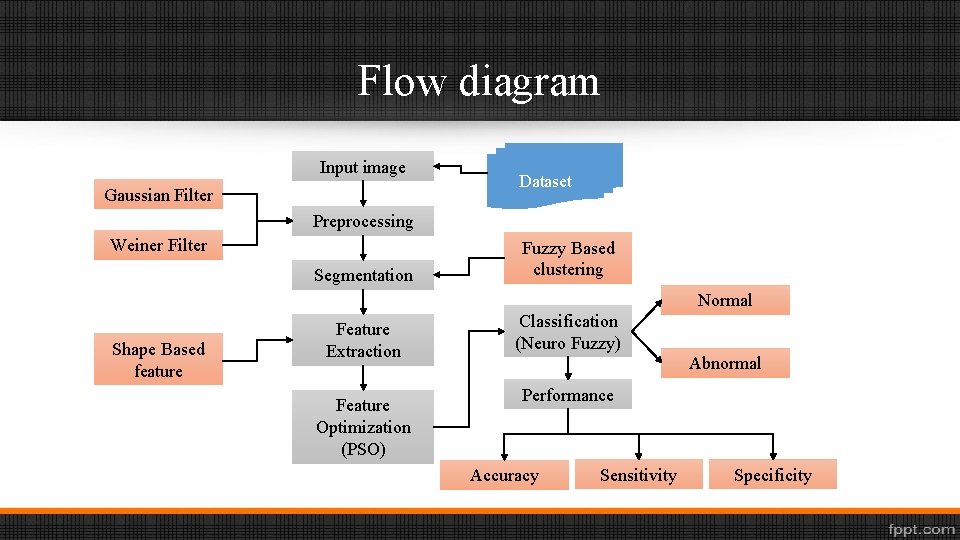
Flow diagram Input image Gaussian Filter Dataset Preprocessing Weiner Filter Segmentation Fuzzy Based clustering Normal Shape Based feature Feature Extraction Feature Optimization (PSO) Classification (Neuro Fuzzy) Abnormal Performance Accuracy Sensitivity Specificity
Modules: • Input image • Preprocessing • Segmentation • Feature Extraction • Feature Optimization (PSO) • Classification • Performance
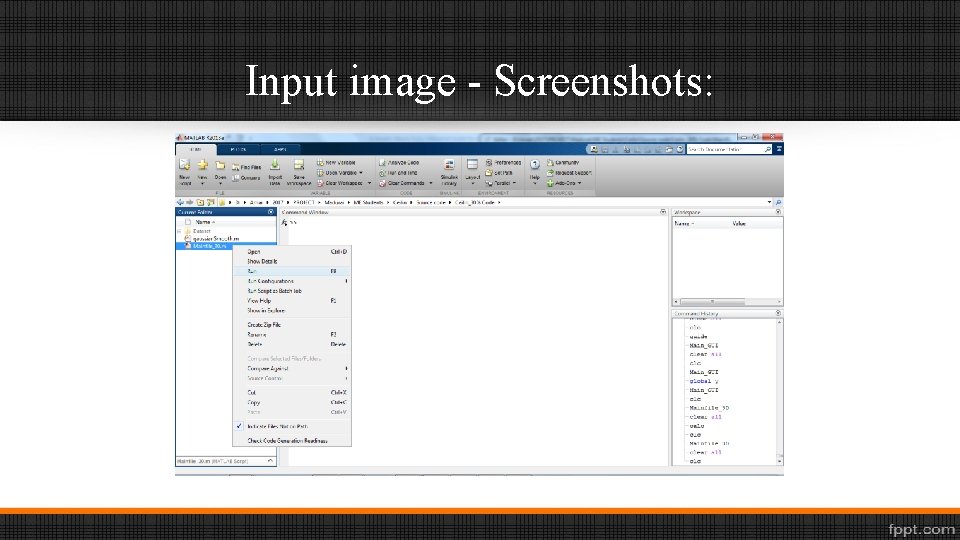
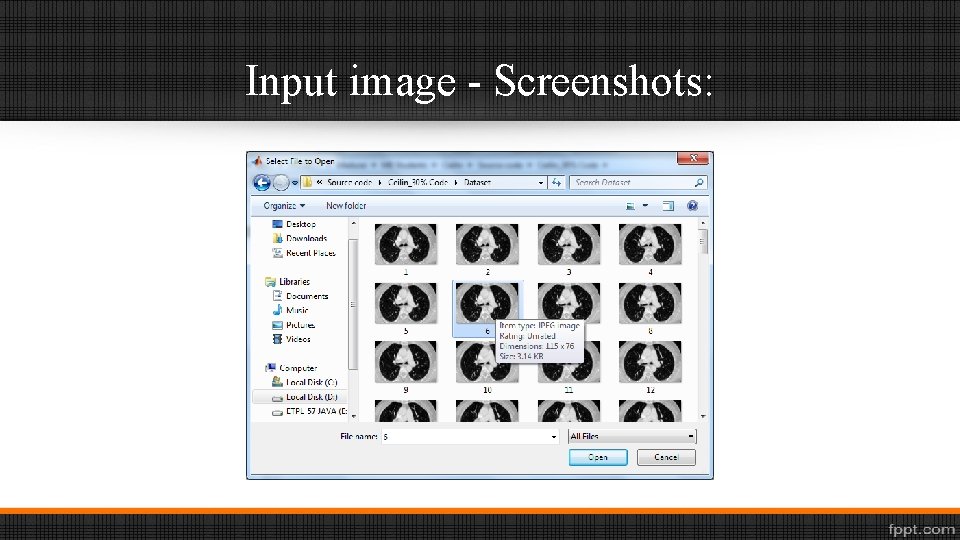
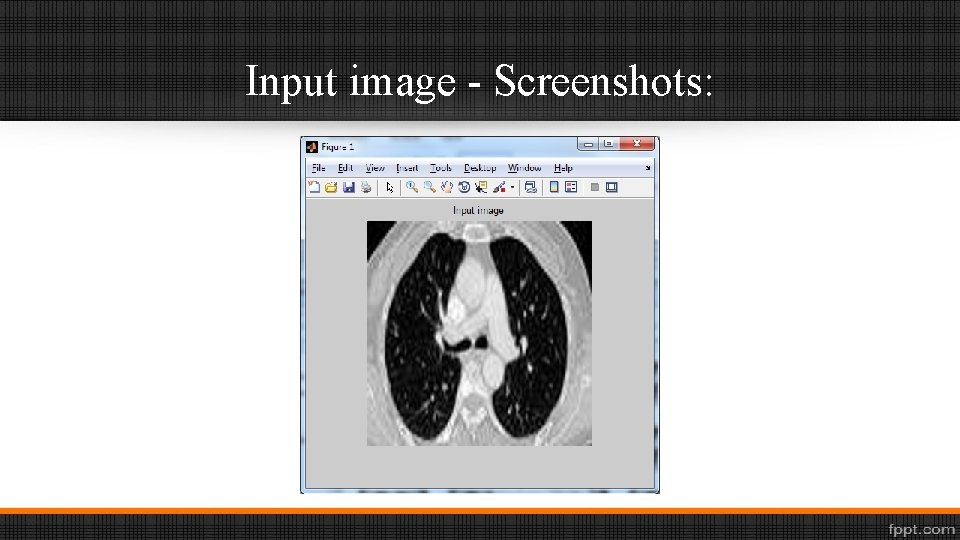
Input image: • Input Image: • An image is a rectangular array of values (pixels). Each pixel represents the measurement of some property of a scene measured over a finite area. • The property could be many things, but we usually measure either the average brightness (one value) or the bright nesses of the image filtered through red, green and blue filters (three values). • The values are normally represented by an eight bit integer, giving a range of 256 levels of brightness. • We talk about the resolution of an image: this is defined by the number of pixels and number of brightness values.
Input image - Screenshots:
Input image - Screenshots:
Input image - Screenshots:
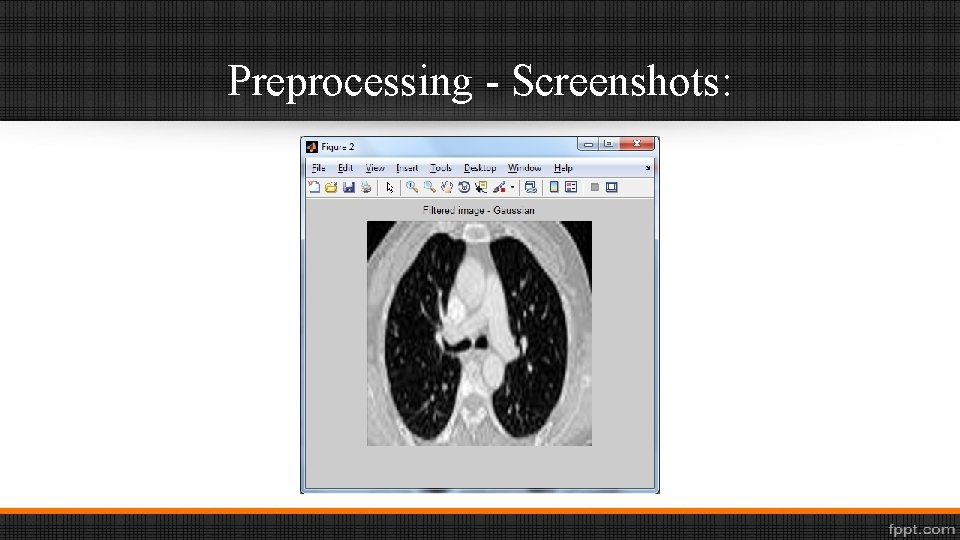
Preprocessing: • Gaussian Filter: • The Gaussian smoothing operator is a 2 -D convolution operator that is used to `blur' images and remove detail and noise. • In this sense it is similar to the mean filter, but it uses a different kernel that represents the shape of a Gaussian (`bell-shaped') hump. • The idea of Gaussian smoothing is to use this 2 -D distribution as a `point-spread' function, and this is achieved by convolution.
Preprocessing: • Gaussian Filter: • Since the image is stored as a collection of discrete pixels we need to produce a discrete approximation to the Gaussian function before we can perform the convolution. • In theory, the Gaussian distribution is non-zero everywhere, which would require an infinitely large convolution kernel, but in practice it is effectively zero more than about three standard deviations from the mean, and so we can truncate the kernel at this point. • It is not obvious how to pick the values of the mask to approximate a Gaussian.
Preprocessing - Screenshots:
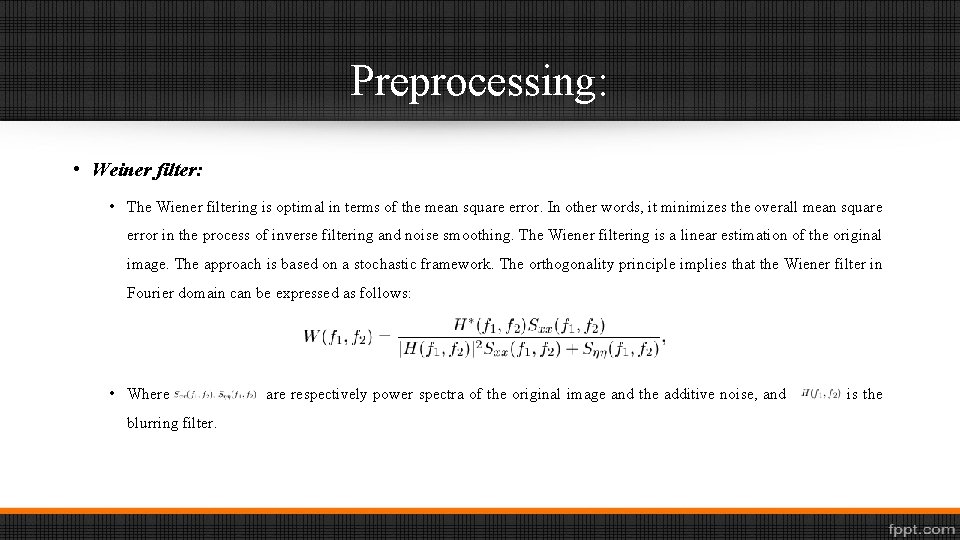
Preprocessing: • Weiner filter: • The Wiener filtering is optimal in terms of the mean square error. In other words, it minimizes the overall mean square error in the process of inverse filtering and noise smoothing. The Wiener filtering is a linear estimation of the original image. The approach is based on a stochastic framework. The orthogonality principle implies that the Wiener filter in Fourier domain can be expressed as follows: • Where blurring filter. are respectively power spectra of the original image and the additive noise, and is the
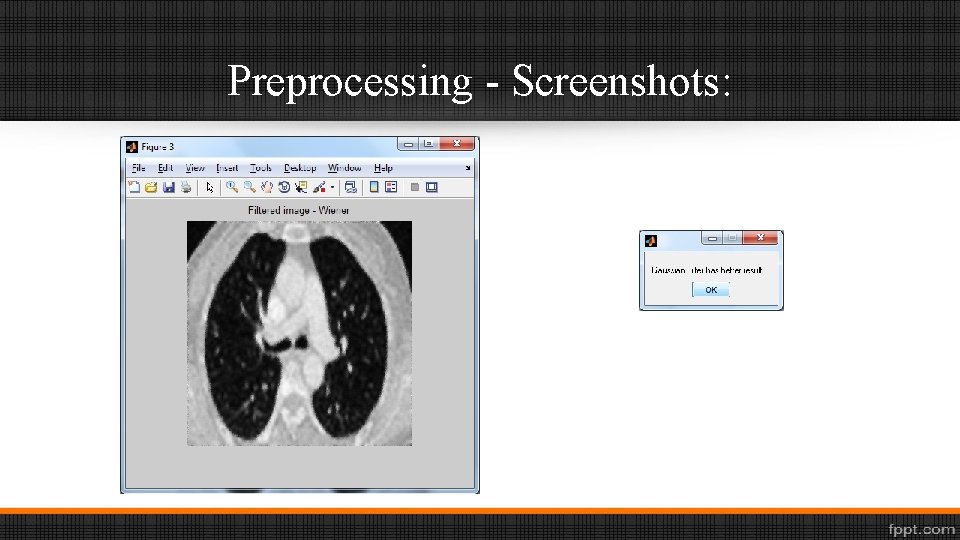
Preprocessing - Screenshots:
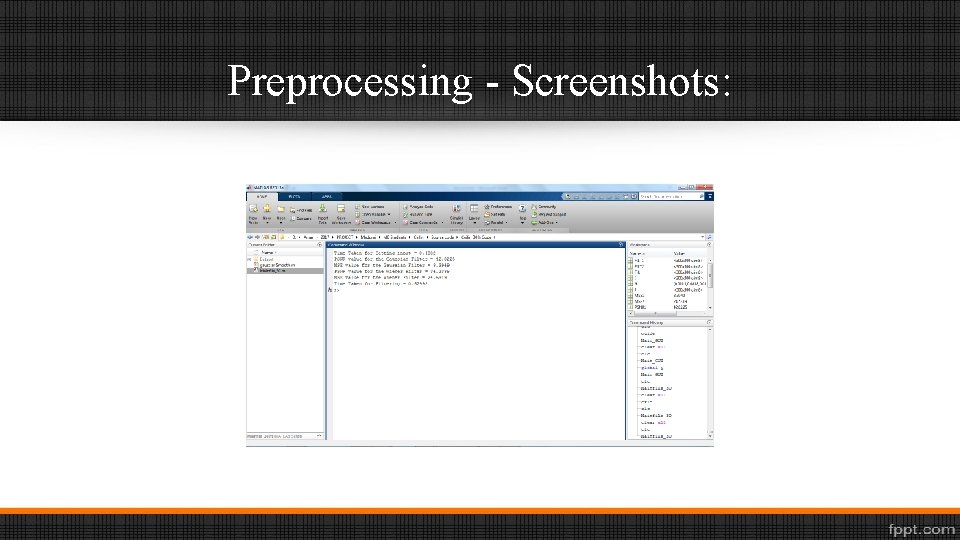
Preprocessing - Screenshots:
Segmentation: • Fuzzy clustering (also referred to as soft clustering) is a form of clustering in which each data point can belong to more than one cluster. • Clustering or cluster analysis involves assigning data points to clusters such that items in the same cluster are as similar as possible, while items belonging to different clusters are as dissimilar as possible. Clusters are identified via similarity measures. • These similarity measures include distance, connectivity, and intensity. Different similarity measures may be chosen based on the data or the application.
Segmentation: • The fuzzy c-means algorithm: ü Choose a number of clusters. ü Assign randomly to each point coefficients for being in the clusters. ü Repeat until the algorithm has converged that is, the coefficients' change between two iterations is no more than the given sensitivity threshold. ü Compute the centroid for each cluster (shown below). ü For each point, compute its coefficients of being in the clusters.
Feature Extraction: • Shape: • The most of the image recognition systems are based on the shape, color, texture and object layout. The shape of an object refers to its physical structure. Shape can be represented by the boundary, region, moment, etc. These representations can be used for matching shapes, recognizing objects, or for making measurements of shapes. • Area: the number of pixels in the interior. • Diameter: the Euclidean distance between the two farthest points on the perimeter of a region. • Perimeter: the number of pixels in the boundary. • Euler Number: the number of objects minus the number of holes in the objects. • Centroid: the center of mass of the object.
Feature Optimization: • Feature selection is the main step in classification systems, a procedure that selects a subset from original features. Feature selection is one of major challenges in text categorization. • The high dimensionality of feature space increases the complexity of text categorization process, because it plays a key role in this process. • This process was presents a novel feature selection method based on particle swarm optimization to improve the performance of text categorization.
Feature Classification: • Image classification is most emerging area in today’s world. Variety of images classified using different methods. • In this approach, the image classification based on two different approaches Artificial neural network and Neuro fuzzy system and it is seen that Neuro fuzzy system is better classification technique than ANN. • A Neuro fuzzy approach was used to take advantage of neural network’s ability to learn, and membership degrees and functions of fuzzy logic.
Literature Survey
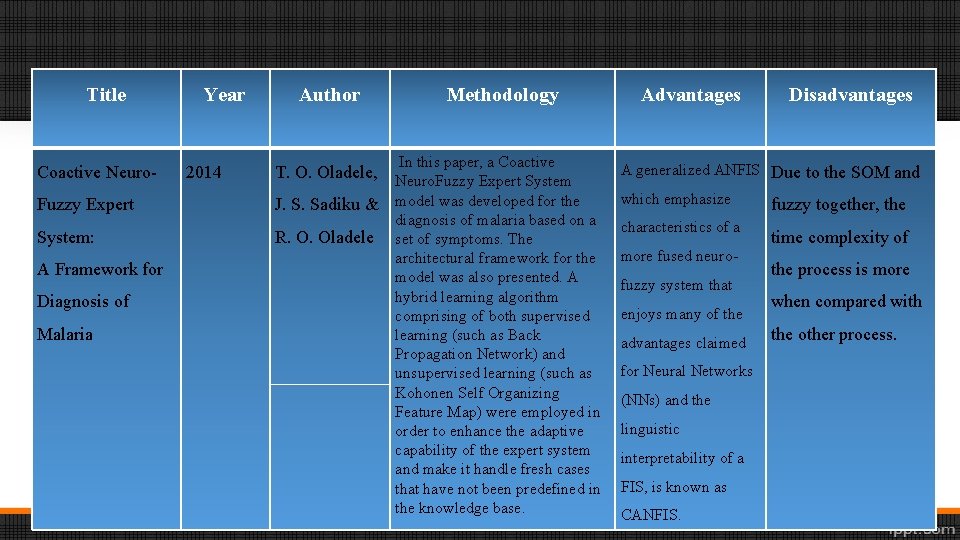
Title Coactive Neuro- Year Methodology In this paper, a Coactive Fuzzy Expert T. O. Oladele, Neuro. Fuzzy Expert System J. S. Sadiku & model was developed for the System: R. O. Oladele A Framework for Diagnosis of Malaria 2014 Author diagnosis of malaria based on a set of symptoms. The architectural framework for the model was also presented. A hybrid learning algorithm comprising of both supervised learning (such as Back Propagation Network) and unsupervised learning (such as Kohonen Self Organizing Feature Map) were employed in order to enhance the adaptive capability of the expert system and make it handle fresh cases that have not been predefined in the knowledge base. Advantages Disadvantages A generalized ANFIS Due to the SOM and which emphasize characteristics of a more fused neurofuzzy system that enjoys many of the advantages claimed for Neural Networks (NNs) and the linguistic interpretability of a FIS, is known as CANFIS. fuzzy together, the time complexity of the process is more when compared with the other process.
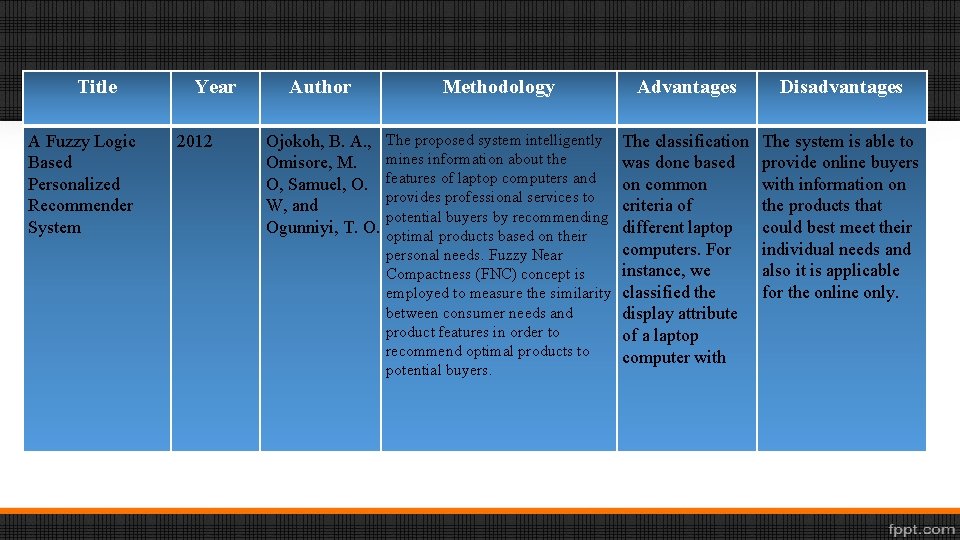
Title A Fuzzy Logic Based Personalized Recommender System Year 2012 Author Methodology Advantages Disadvantages Ojokoh, B. A. , Omisore, M. O, Samuel, O. W, and Ogunniyi, T. O. The proposed system intelligently mines information about the features of laptop computers and provides professional services to potential buyers by recommending optimal products based on their personal needs. Fuzzy Near Compactness (FNC) concept is employed to measure the similarity between consumer needs and product features in order to recommend optimal products to potential buyers. The classification was done based on common criteria of different laptop computers. For instance, we classified the display attribute of a laptop computer with The system is able to provide online buyers with information on the products that could best meet their individual needs and also it is applicable for the online only.
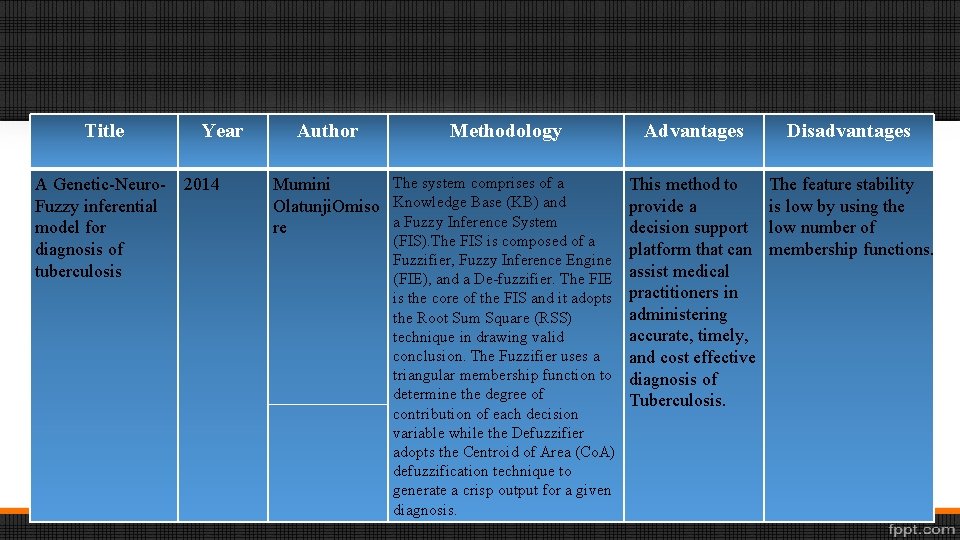
Title A Genetic-Neuro. Fuzzy inferential model for diagnosis of tuberculosis Year 2014 Author Methodology The system comprises of a Mumini Olatunji. Omiso Knowledge Base (KB) and a Fuzzy Inference System re (FIS). The FIS is composed of a Fuzzifier, Fuzzy Inference Engine (FIE), and a De-fuzzifier. The FIE is the core of the FIS and it adopts the Root Sum Square (RSS) technique in drawing valid conclusion. The Fuzzifier uses a triangular membership function to determine the degree of contribution of each decision variable while the Defuzzifier adopts the Centroid of Area (Co. A) defuzzification technique to generate a crisp output for a given diagnosis. Advantages Disadvantages This method to provide a decision support platform that can assist medical practitioners in administering accurate, timely, and cost effective diagnosis of Tuberculosis. The feature stability is low by using the low number of membership functions.
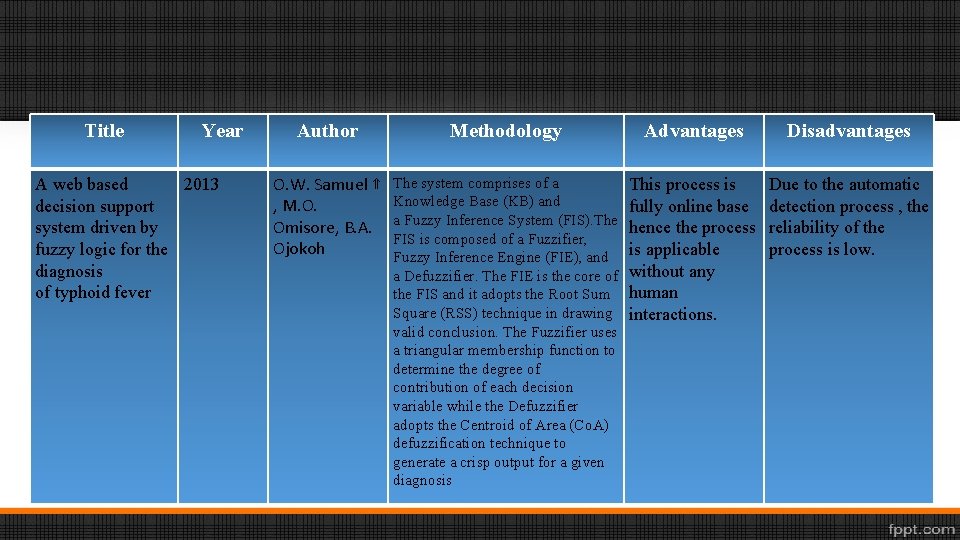
Title Year A web based 2013 decision support system driven by fuzzy logic for the diagnosis of typhoid fever Author Methodology Advantages Disadvantages O. W. Samuel ⇑ , M. O. Omisore, B. A. Ojokoh The system comprises of a Knowledge Base (KB) and a Fuzzy Inference System (FIS). The FIS is composed of a Fuzzifier, Fuzzy Inference Engine (FIE), and a Defuzzifier. The FIE is the core of the FIS and it adopts the Root Sum Square (RSS) technique in drawing valid conclusion. The Fuzzifier uses a triangular membership function to determine the degree of contribution of each decision variable while the Defuzzifier adopts the Centroid of Area (Co. A) defuzzification technique to generate a crisp output for a given diagnosis This process is fully online base hence the process is applicable without any human interactions. Due to the automatic detection process , the reliability of the process is low.
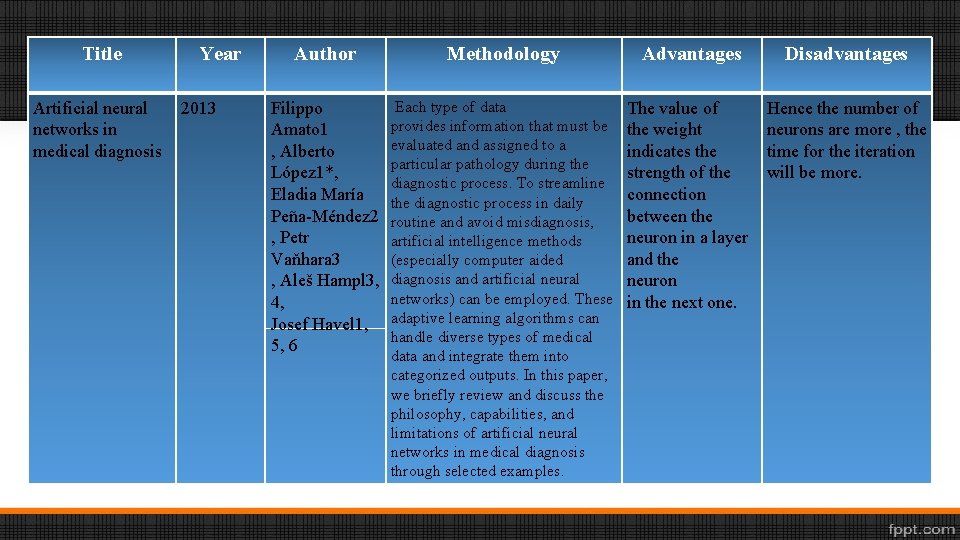
Title Artificial neural networks in medical diagnosis Year 2013 Author Methodology Advantages Disadvantages Filippo Amato 1 , Alberto López 1*, Eladia María Peña-Méndez 2 , Petr Vaňhara 3 , Aleš Hampl 3, 4, Josef Havel 1, 5, 6 Each type of data provides information that must be evaluated and assigned to a particular pathology during the diagnostic process. To streamline the diagnostic process in daily routine and avoid misdiagnosis, artificial intelligence methods (especially computer aided diagnosis and artificial neural networks) can be employed. These adaptive learning algorithms can handle diverse types of medical data and integrate them into categorized outputs. In this paper, we briefly review and discuss the philosophy, capabilities, and limitations of artificial neural networks in medical diagnosis through selected examples. The value of the weight indicates the strength of the connection between the neuron in a layer and the neuron in the next one. Hence the number of neurons are more , the time for the iteration will be more.
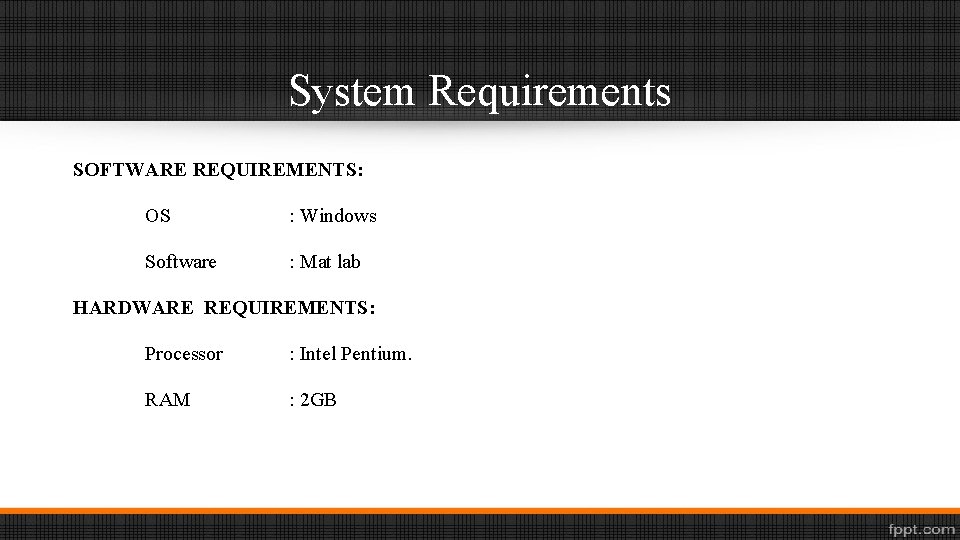
System Requirements SOFTWARE REQUIREMENTS: OS : Windows Software : Mat lab HARDWARE REQUIREMENTS: Processor : Intel Pentium. RAM : 2 GB
![References: • [1] C. A. Robert, J. E. Buikstra, The Bio-Archaeology of Tuberculosis: A](http://slidetodoc.com/presentation_image_h2/5d0b2754c6be84ea8fb60b3548030fc6/image-36.jpg "References: • [1] C. A. Robert, J. E. Buikstra, The Bio-Archaeology of Tuberculosis: A")
References: • [1] C. A. Robert, J. E. Buikstra, The Bio-Archaeology of Tuberculosis: A Global Perspective on a Re-Emerging Disease, University Press of Florida, Gainesville, Fl, 2009. • [2] David M. Morens, Gregory K. Folkers, Anthony S. Fauci, The challenge of emerging and reemerging infectious diseases, Nature 430 (2004) 242– 249. • [3] World Health Organization, WHO Country Cooperation Strategy: Federal Republic, 2002. • [4] World Health Organization, Global Tuberculosis Control, WHO Report 2008, Geneva, 2008. • [5] P. Sudre, G. T. Dam, A. Kochi, Tuberculosis: a global overview of the situation today, Bull. World Health Organ. 70 (1992) 149– 159.
![References: • [6] American Thoracic Society, Diagnostic standards and classification of tuberculosis in adults](http://slidetodoc.com/presentation_image_h2/5d0b2754c6be84ea8fb60b3548030fc6/image-37.jpg "References: • [6] American Thoracic Society, Diagnostic standards and classification of tuberculosis in adults")
References: • [6] American Thoracic Society, Diagnostic standards and classification of tuberculosis in adults and children, Am. J. Respir. Crit. Care. Med. 161 (2000) 1376– 1395. • [7] Syed Tasleem, Gulraiz Ali, Farzana Mahdi Sikandar. Hasan, Molecular diagnosis of tuberculosis: a new primer design, Iran. J. Clin. Infect. Dis. 4 (2) (2009) 105– 108. • [8] Young S. Kim, Donald E. Shelton, Gregg Barak, Studying juror expectations for scientific evidence: a new model for looking at the CSI myth, J. Am. Judges Assoc. 47 (1– 2) (2011) 8– 18. • [9] S. A. Oke, A literature review on artificial intelligence, Int. J. Inf. Manage. Sci. 19 (4) (2008) 535– 570.
![References: • [10] V. P. Masnikosa, The fundamental problem of an artificial intelligence realisation,](http://slidetodoc.com/presentation_image_h2/5d0b2754c6be84ea8fb60b3548030fc6/image-38.jpg "References: • [10] V. P. Masnikosa, The fundamental problem of an artificial intelligence realisation,")
References: • [10] V. P. Masnikosa, The fundamental problem of an artificial intelligence realisation, Cybernetes 27 (1) (1998) • [11] W. E. Halal, Artificial intelligence is almost here, On the Horizon, The Strategic Planning Resource for Education Professionals, vol. 11(2), 2003. • [12] Y. Peng, X. Zhang, Integrative data mining in systems biology: from text to network mining, Artif. Intell. Med. 41 (2) (2007) 83– 86. • [13] X. Zhou, B. Liu, Z. Wu, Y. Feng, Integrative mining of traditional chinese medicine literature and medline for functional gene networks, Artif. Intell. Med. 41 (2) (2007) 87– 104.

- Slides: 39